Origin, date, extent, characteristics, decline, survival and significance, art and architecture.
The Indus Valley Civilization is one of the most heavily examined units in the entire History Optional syllabus. UPSC has set 23 questions on it between 1986 and 2026, and it has appeared in eight of the last ten papers. If you are deciding where to spend your Ancient India revision time, this is not an optional topic.
Every question the Commission has asked on this topic is listed below, newest first, with a written model answer linked against each one.
| Questions asked (1986–2026) | 23 |
| Appeared in | 8 of the last 10 papers |
| Paper | Paper I, Section A (Ancient India) |
| Usual mark value | 10, 15 or 20 marks |
| Model answers available | 22 of 23 |
PYQs: Indus Valley Civilization (1985-2026)

| Year | Question | Answer |
|---|---|---|
| 2026 | "Harappan architecture reflects an integrated vision of environmental adaptation, technological rationality and urban aesthetics, going beyond functionality." Examine the statement. | |
| 2025 | "The Harappans were not an artistic people." Comment. | View answer |
| 2024 | Harappan art contributes to our understanding of their aesthetic sensibilities in addition to spiritual and ritualistic life. Comment. | View answer |
| 2023 | The Indus-Saraswati cultural zone exhibited both homogeneity and diversity. Discuss. | View answer |
| 2022 | The urban character of the Harappan Civilization was a result of neither of any outside influence nor a sudden act but a gradual evolution of regional socio-economic factors. Comment. | View answer |
| 2021 | Do you agree that ecological factors influenced the flow and ebb of the Harappan Civilization? Comment. | View answer |
| 2019 | Did the mastery over agriculture act as a leverage for the rise of Harappan towns and cities? Discuss. | View answer |
| 2018 | "Archaeological evidence does not give direct access to the possible social and political dimensions of the decline of the Harappan civilization. What it does indicate very clearly is that the Harappan culture underwent a gradual process of deurbanization" ? Comment. | View answer |
| 2016 | Explain why the majority of the known Harappan settlements are located in the semi-arid areas with saline groundwater. | View answer |
| 2015 | The decline of Harappan civilization was caused by ecological degradation rather than external invasion. Discuss. | View answer |
| 2014 | Do you think the Harappan civilization had a diversity of subsistence base? | View answer |
| 2013 | Discuss the water management and its conservation planning in the Harappan (Indus-Saraswati) cities. | View answer |
| 2012 | Evaluate the significance of seals and sealings in the reconstruction of socioeconomic and religious life of the Harappan people. | View answer |
| 2008 | Discuss the distribution and significance of farming cultures outside the Indus system. | View answer |
| 2002 | Analyse the elements of urban civilization in the Harappan Culture. What factors were responsible for its decline? | View answer |
| 1999 | Discuss salient features of the Indus Valley Civilization. Mention important places from where relics of civilization have been recovered so far. Examine causes of its decline. | View answer |
| 1997 | “The continuity of the Indus Civilization into later ages was not confined to the religious and spiritual fields alone.” Analyse the statement. | View answer |
| 1996 | Write brief essay on: The Religion of the Indus Civilization. | View answer |
| 1994 | Discuss the pattern of trade during the Indus Valley civilization. How far did it affect the nature of contemporary settlements in the Indian sub-continent? | View answer |
| 1993 | Write brief essay: The burial customs in the Indus Civilization. | View answer |
| 1991 | Write brief essay on External trade of the Harappans. | View answer |
| 1988 | “The Indus Civilization had an abrupt end.” Discuss the statement and explain how the Indus Civilization could influence Indian culture in its later history. | View answer |
| 1986 | 'On circumstantial evidence Indra stands convicted.' Explain, and discuss briefly different views about a sudden end of the Indus Valley civilization. How would you explain the presence of those elements in Indian culture and civilization which are found to have existed in the Indus Valley period? | View answer |
What UPSC keeps asking about the Indus Valley Civilization
Forty years of questions on one topic look random until you sort them. Sorted, they collapse into six threads — and the Commission has rotated through these six for four decades rather than inventing new ones.
1. Decline — ecology against invasion (1988, 2002, 2015, 2021)
- The single most repeated thread on this topic, asked roughly once every seven years.
- The examiner is testing whether you can retire the Aryan-invasion explanation without overclaiming for the ecological one.
- A full-mark answer names the Ghaggar-Hakra shift, the Rann tectonics argument and the de-urbanisation-not-disappearance framing.
2. Art, aesthetics and religion (1986, 1996, 2024, 2025, 2026)
- The most recently active thread — three of the last four papers have come from here.
- 2025 quoted the claim that the Harappans were not an artistic people; 2026 moved to architecture as an integrated vision.
- This is the thread to prepare first if you are writing the next paper.
3. Urbanism and town planning (2002, 2013, 2019, 2022)
- Reliably framed as a question about process — gradual regional evolution against sudden or borrowed urbanism.
- 2013 narrowed it to water management, which is the kind of specific turn you must be ready for.
4. Subsistence, agriculture and location (2008, 2014, 2016, 2019)
- Why settlements sit in semi-arid saline zones; whether the subsistence base was diverse; whether agriculture drove urbanisation.
- Answers here need actual site names and crop evidence, not general statements about the monsoon.
5. Trade and external contact (1991, 1994, 1997)
- Quieter since the 1990s, which by the rotation logic makes it overdue.
- Mesopotamian correspondences, Lothal, and the question of what trade did to social structure.
6. Reading society and polity from archaeology (1993, 2012, 2018)
- The hardest thread, and the one that separates scripts: what can archaeological evidence actually establish about social and political life?
- Seals and sealings, burial customs, and the limits of inference. Expect this framing to grow.
The model answers to this unit, in one place
Knowing the questions is half the work. The other half is seeing what a full-mark answer to each one looks like — not a hint or a bullet outline, but a complete answer at the mark and the word limit, with the historians named inside the argument.
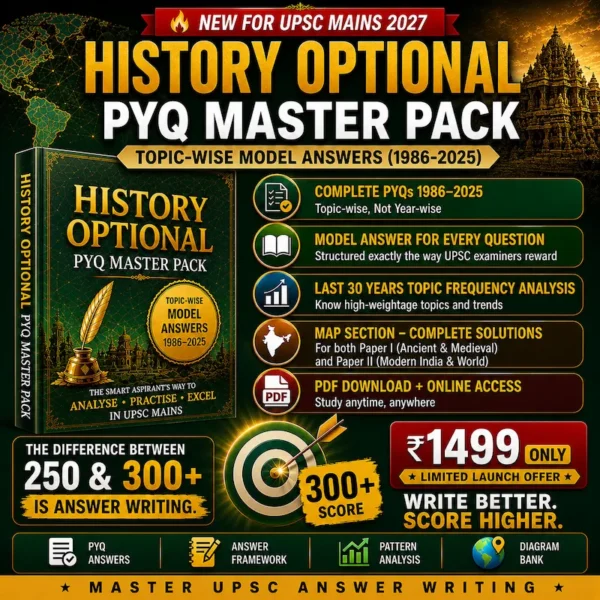
The History Optional PYQ Master Pack carries the same for every question the Commission has set since 1985, across the whole syllabus.
- PYQs 1985–2025, arranged topic-wise — revise a theme and see every way it has been asked
- Model answers with historiography — the debate cited where it belongs, not bolted on
- Map sections solved — the full 50-mark section, every year
- PDF plus online access — any device, permanently, no subscription
₹1,499 (regular ₹2,500). One-time payment, instant access.
How to use this topic list
Reading a question list feels like preparation and is not. Three sittings turn it into marks.
Sitting 1 — sort before you read (30 minutes)
- Copy the questions above into the threads identified in the previous section.
- Note which thread has gone longest without being asked — that is your priority, not the one you find most interesting.
Sitting 2 — write three answers cold (45 minutes)
- Pick the most recent question from three different threads.
- Seven minutes for a 10-marker, fifteen for a 20-marker. Stop when the time is up, even mid-sentence.
- Mark every place you wanted a historian’s name and could not produce one.
Sitting 3 — compare, then rewrite (45 minutes)
- Put your script beside the model answer for the same question.
- Compare structure first: opening claim, evidence, counter-view, judgement.
- Rewrite your weakest answer using that structure and no new content. Most candidates gain four to six marks from structure alone.
Two ways to prepare this optional
Two routes, depending on what is actually missing.
| PYQ Master Pack | Mains Master Kit 2027 | |
| Best when | Your notes are done; answer-writing is the gap | You are still building the subject |
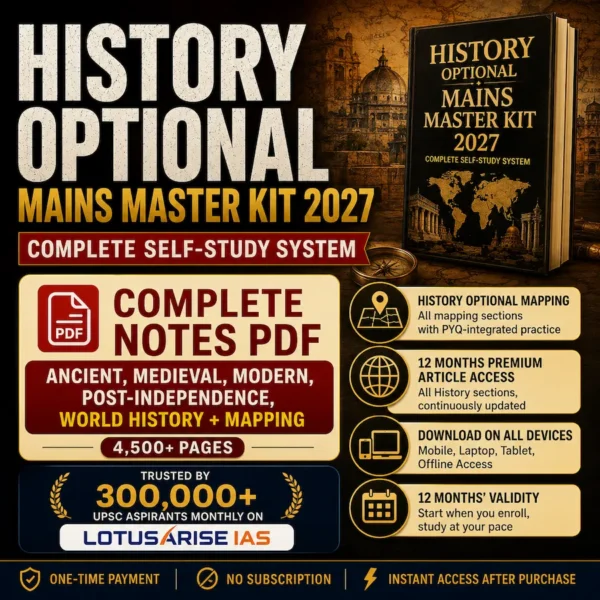
| What you get | Model answers to every question since 1985, topic-wise, map sections included | 4,500+ pages of notes, full mapping coverage, 12 months of article access |
| Price | ₹1,499 (reg. ₹2,500) | ₹1,770 (reg. ₹5,000) |
Frequently asked questions
Related topics
The same thread logic applies to every unit. These are the neighbouring topics an Indus Valley question most often borrows from:
- Pre-history and Proto-history
- Megalithic Cultures
- Aryans and Vedic Period
- Period of Mahajanapadas
- Sources
- All topics — History Optional PYQs, topic-wise
Prefer to work year by year?
The complete papers, with both papers in full, unit-wise analysis and the official PDFs:
- History Optional Question Paper 2026
- History Optional Question Paper 2025
- History Optional Question Paper 2024
- History Optional Question Paper 2023
- History Optional Question Paper 2022
- History Optional Question Paper 2021
- History Optional Question Paper 2020
- UPSC History Optional Map Solutions (2013–2025)