Formation of States (Mahajanapada): Republics and monarchies; Rise of urban centres; Trade routes; Economic growth; Introduction of coinage;
Spread of Jainism and Buddhism; Rise of Magadha and Nandas.
Iranian and Macedonian Invasions and their impact.
The Mahajanapada period covers the sixth century BCE transformation — second urbanisation, the rise of Magadha, and the Shramanic religions. UPSC has set 27 questions on it between 1987 and 2026, and it has appeared in eight of the last ten papers. Almost every one of them connects religion to economy rather than treating either alone.
Every question the Commission has asked on this topic is listed below, newest first, with a written model answer linked against each one.
| Questions asked (1987–2026) | 27 |
| Appeared in | 8 of the last 10 papers |
| Paper | Paper I, Section A (Ancient India) |
| Usual mark value | 10, 15 or 20 marks |
| Model answers available | 26 of 27 |
PYQs: Period of Mahajanapadas (1985-2026)

| Year | Question | Answer |
|---|---|---|
| 2026 | "The Iranian and Macedonian invasions reshaped ancient India through administrative influence, political transformation and cultural interaction." Review. | |
| 2025 | "The ideological challenge posed by Jainism and Buddhism was deeply rooted in the socio-economic transformations brought about by the expansion of agrarian settlements in eastern India." Explain. | View answer |
| 2025 | "The origin of the territorial republics has been traced to the reaction against the pattern of life that evolved in the later Vedic period." Analyse. | View answer |
| 2024 | Symbiotic relationships between Buddhist establishments, traders, artisan guilds, and royal support led to a close proximity of religion, economy, and polity in the Mauryan and post-Mauryan periods. Examine the statement. | View answer |
| 2022 | Though some of the ideas of Buddhism may have had their origin in Vedic-Upanishadic traditions but it was an altogether new religion with its own specific principles and institutions. Discuss. | View answer |
| 2021 | “The political and economic needs of rulers, combined with economic and status needs of the merchant class, together provided the receptive cultural milieu in which Buddhism flourished." Comment. | View answer |
| 2020 | Discuss the factors that played an important role in the process of urbanisation after the Later-Vedic period. | View answer |
| 2020 | A number of scholars considered Alexander as 'The Great’, although long term impacts of Alexander's invasion on India need to be re-evaluated. Comment. | View answer |
| 2018 | Give an account of gana-sanghas (non-monarchical state systems) ? Why did they decline? | View answer |
| 2018 | The concept of Shramanic religions, with particular reference to Buddhism, hadtheir roots in Upanisadic ideas. Discuss. | View answer |
| 2017 | Buddhism and Jainism were social movements under the umbrella of religion. Comment. | View answer |
| 2016 | Examine the relationship among the economic growth, 'urbanization and state formation from c. 7th century BCE to 3rd century BCE. | View answer |
| 2015 | How far is it correct to say that changes in the post-Vedic economy gave birth to new religious movement in India? | View answer |
| 2014 | Buddha’s teachings to a large extent could be helpful in understanding and resolving the problems of today’s society. Analyse critically. | View answer |
| 2013 | Explain as to how the early Buddhist Stupa art, while using folk motifs and narratives and common cultural symbols, succeeded in transforming these themes for expounding the Buddhist ideals. | View answer |
| 2011 | Assess the importance of Jain tenets and their relevance to humanity. | View answer |
| 2011 | Evaluate the introduction of iron technology in the development of human history of ancient India. | View answer |
| 2007 | Write what you know of the rise and spread of Buddhism before the first century A.D. | View answer |
| 2004 | Explain the social aspects of Buddhism and account for its decline in India. | View answer |
| 2003 | "The Sixth century B.C. was a period of religious and economic unrest in India." Comment. | View answer |
| 2001 | Analyse the causes of the success of the Magadhan imperialism upto the reign of Ashoka the Great. | View answer |
| 1996 | Write brief essay on Social and economic conditions of North India during the PreMauryan period (600-325 B.C.) | View answer |
| 1995 | Write brief essay on Essence of Early Jainism. | View answer |
| 1992 | Give an account of the republics in the preMaurya period. Discuss the factors which contributed to their decline. | View answer |
| 1990 | Trace the rise of Magadhan imperialism up to the times of the Nandas with particular reference to its policy towards the non-monarchical state. Discuss the factors that contributed to its success. | View answer |
| 1988 | Write short essays of not more than 200 words on: The intellectual revolution in the Sixth Century B.C. | View answer |
| 1987 | Discuss the social & economic factors for the rise of Buddhism. How far was it influenced by Upnisadic thought? | View answer |
What UPSC keeps asking about the Mahajanapadas
The striking feature of this unit is how rarely the Commission asks a purely religious or purely economic question. The five threads below are really five ways of asking one question: what connected the material change of the sixth century BCE to the ideas it produced.
1. Material roots of the Shramanic religions (1987, 2003, 2015, 2018, 2022, 2025)
- The single most repeated framing in the unit — asked six times, and in 2025 again.
- 2015 and 2025 both asked whether post-Vedic economic change gave birth to the new religious movements; 2018 and 2022 asked about the Upanishadic inheritance instead.
- The complete answer holds both: material conditions created the audience, Upanishadic thought supplied part of the vocabulary.
2. Buddhism and Jainism as social movements (1995, 2004, 2007, 2011, 2014, 2017)
- 2017 put it most directly: social movements under the umbrella of religion.
- 2004 asked about the social aspects and the decline in India, which is a different and harder question — be ready for both.
- 1995 and 2011 narrowed it to Jain tenets specifically, a reminder not to prepare Jainism as an afterthought to Buddhism.
3. Urbanisation, trade and state formation (2016, 2020, 2021, 2024)
- The most recently active thread. 2016 asked for the relationship between economic growth, urbanisation and state formation from c. 700 BCE.
- 2021 and 2024 both centred on the symbiosis of rulers, merchants, guilds and Buddhist establishments — patronage as mutual interest, not piety.
- Iron technology (2011) belongs here as the material driver.
4. Gana-sanghas and the republican question (1992, 2018, 2025)
- Why the non-monarchical states arose and why they declined.
- 2025 traced their origin to a reaction against a prevailing pattern; 2018 asked for an account and the causes of decline.
- Prepare the standard explanations for the decline — Magadhan expansion, the logic of scale, internal oligarchy — and be able to weigh them.
5. Magadhan imperialism and the invasions (1990, 2001, 2020, 2026)
- The rise of Magadha to Ashoka (2001), and the Nandas (1990).
- 2020 asked whether Alexander deserves “the Great” given the limited long-term impact; 2026 broadened it to the Iranian and Macedonian invasions together.
- The invasions thread is newly active and worth preparing deliberately.
6. Buddhist art and its social base (2013)
- Asked once, on early stupa art using folk motifs and narrative — a reminder that art questions can arrive inside this unit rather than in the cultural history one.
The model answers to this unit, in one place
Knowing the questions is half the work. The other half is seeing what a full-mark answer to each one looks like — not a hint or a bullet outline, but a complete answer at the mark and the word limit, with the historians named inside the argument.
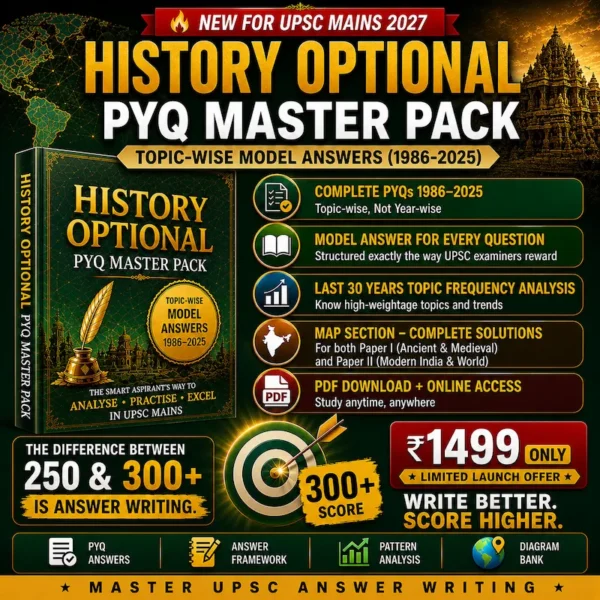
The History Optional PYQ Master Pack carries the same for every question the Commission has set since 1985, across the whole syllabus.
- PYQs 1985–2025, arranged topic-wise — revise a theme and see every way it has been asked
- Model answers with historiography — the debate cited where it belongs, not bolted on
- Map sections solved — the full 50-mark section, every year
- PDF plus online access — any device, permanently, no subscription
₹1,499 (regular ₹2,500). One-time payment, instant access.
How to use this topic list
Reading a question list feels like preparation and is not. Three sittings turn it into marks.
Sitting 1 — sort before you read (30 minutes)
- Copy the questions above into the threads identified in the previous section.
- Note which thread has gone longest without being asked — that is your priority, not the one you find most interesting.
Sitting 2 — write three answers cold (45 minutes)
- Pick the most recent question from three different threads.
- Seven minutes for a 10-marker, fifteen for a 20-marker. Stop when the time is up, even mid-sentence.
- Mark every place you wanted a historian’s name and could not produce one.
Sitting 3 — compare, then rewrite (45 minutes)
- Put your script beside the model answer for the same question.
- Compare structure first: opening claim, evidence, counter-view, judgement.
- Rewrite your weakest answer using that structure and no new content. Most candidates gain four to six marks from structure alone.
Two ways to prepare this optional
Two routes, depending on what is actually missing.
| PYQ Master Pack | Mains Master Kit 2027 | |
| Best when | Your notes are done; answer-writing is the gap | You are still building the subject |
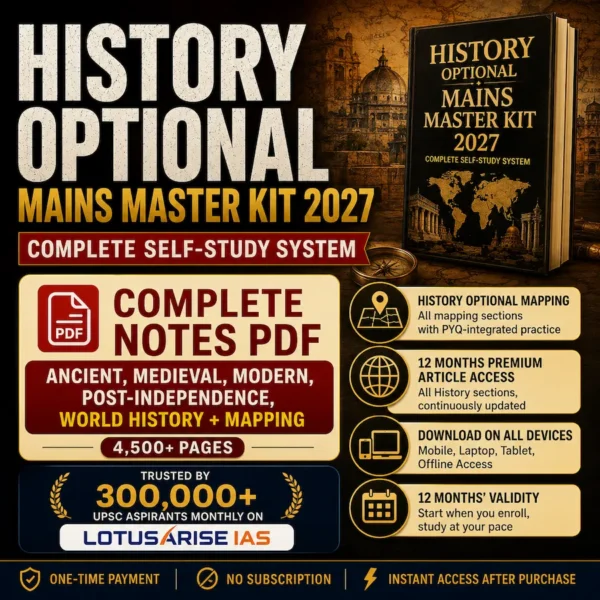
| What you get | Model answers to every question since 1985, topic-wise, map sections included | 4,500+ pages of notes, full mapping coverage, 12 months of article access |
| Price | ₹1,499 (reg. ₹2,500) | ₹1,770 (reg. ₹5,000) |
Frequently asked questions
Related topics
This unit sits between two others and is frequently examined across the boundary:
- Aryans and Vedic Period
- Mauryan Empire
- Post-Mauryan Period
- Themes in Early Indian Cultural History
- All topics — History Optional PYQs, topic-wise
Prefer to work year by year?
The complete papers, with both papers in full, unit-wise analysis and the official PDFs:
- History Optional Question Paper 2026
- History Optional Question Paper 2025
- History Optional Question Paper 2024
- History Optional Question Paper 2023
- History Optional Question Paper 2022
- History Optional Question Paper 2021
- History Optional Question Paper 2020
- UPSC History Optional Map Solutions (2013–2025)