

Establishment of the Delhi Sultanate: The Ghurlan Invasions — factors behind Ghurlan success;
Economic, social and cultural consequences;
Foundation of Delhi Sultanate and early Turkish Sultans;
Consolidation: The rule of Iltutmlsh and Balban
The Thirteenth Century — the founding of the Delhi Sultanate — has become one of the most regularly examined units in Paper I. UPSC has set 18 questions on it between 1985 and 2026, and eight of them fall in the last ten papers. It is a unit whose importance has grown sharply, not a legacy one.
Every question the Commission has asked on this topic is listed below, newest first, with a written model answer linked against each one.
| Questions asked (1985–2026) | 18 |
| Appeared in | 8 of the last 10 papers |
| Paper | Paper I, Section B (Medieval India) |
| Usual mark value | 10, 15 or 20 marks |
| Model answers available | 10 of 18 |
PYQs: The Thirteenth Century [1985-2026]

| Year | Question | Answer |
|---|---|---|
| 2026 | How far can the Qutub Complex at Mehrauli be considered as an ideal specimen for the study on the development of architecture under the Delhi Sultanate? Analyze. | |
| 2023 | Why did Balban prefer ‘consolidation over ‘expansion’ of the Delhi Sultanate? | |
| 2022 | Much of the political instability after the death of Iltutmish was the doing of the Chahalgan. Elucidate. | |
| 2021 | Do you consider Sultan Iltutmish to be the real founder of the Delhi Sultanate? Discuss, (in about 150 words) | |
| 2021 | Discuss the importance of Iqta system. How did it help in centralization of administration of the Delhi Sultanate? | |
| 2020 | Assess the causes of the defeat of Northern Indian States against the Turkish invasion. | |
| 2019 | Internal strife and conflict beset with personal ambitions was enough of an invitation for the Ghurids to invade India. Discuss. | |
| 2018 | The battles of Tarain and Chanawar laid the foundations of Turkish rule in India". Elaborate. | |
| 2017 | Critically examine the 'blood and iron’ policy of Balban. (150 words) | View answer |
| 2015 | What measures did Balban adopt to combat the Mongol menace? | View answer |
| 2013 | Analyze the steps taken by Razia Sultan to strengthen her position as an independent ruler despite the various obstacles. | View answer |
| 2011 | Assess the contribution of Iltutmish for the expansion and consolidation of the Delhi Sultanate. | View answer |
| 2008 | Write short essay on The ‘Corps of Forty' and its relations with the Sultan. | View answer |
| 2004 | Write brief essay on The 'Corps of Forty' and its relations with the Sultans. | View answer |
| 2001 | The inferior cavalry of the Rajputs was not the only cause of their defeat at the hands of Turko-Afghans and Mughals.” Comment. | View answer |
| 1996 | Give an estimate of Ghiasuddin Balban. | View answer |
| 1995 | Comment in about 200 words: Balban’s theory of kingship. | View answer |
| 1985 | What were the problems Balban faced? How far did he succeed in solving them? Was he a trend-setter in his theory of kingship? | View answer |
What UPSC keeps asking about the Thirteenth Century
Eighteen questions fall into four threads, and the unit is unusually concentrated: three rulers — Iltutmish, Razia and Balban — account for most of it.
1. Why the Rajput states fell (2001, 2018, 2019, 2020)
- Asked three years running from 2018 to 2020.
- The examiner wants more than “inferior cavalry” — 2001 said so outright. Weigh military organisation, the iqta-fed Turkish army, Rajput political fragmentation (2019) and the social limits on mobilisation.
- Tarain and Chandawar (2018) are the battles to know in detail.
2. Balban — kingship, consolidation and the Mongols (1985, 1995, 1996, 2015, 2017, 2023)
- Six questions on one ruler. His theory of kingship (1995), the blood-and-iron policy (2017), the Mongol defence (2015), and why he preferred consolidation to expansion (2023).
- Know the Persian elements of his kingship — sijda, paibos, the theory of divine right — and the destruction of the Forty.
3. Iltutmish, Razia and the nobility (2004, 2008, 2011, 2013, 2021, 2022)
- Was Iltutmish the real founder of the Sultanate (2021, and 2011 on his consolidation)?
- The Turkan-i-Chahalgani — the Forty — asked twice in short-answer form (2004, 2008); 2022 blamed them for the instability after Iltutmish.
- Razia’s attempt to rule independently (2013) belongs here as a case study in the Crown-nobility struggle.
4. Institutions and architecture (2021, 2026)
- The iqta system and centralisation (2021) — the single most important institution of the Sultanate, and a likely repeat.
- 2026 asked whether the Qutb complex is an ideal specimen of Indo-Islamic architecture. Expect more architecture questions here: the true arch, spolia from earlier temples, and the Alai Darwaza as the bridge to the next century.
The model answers to this unit, in one place
You need model answers to these questions — not hints or bullet outlines, but full answers at the mark and the word limit, with the historians named inside the argument.
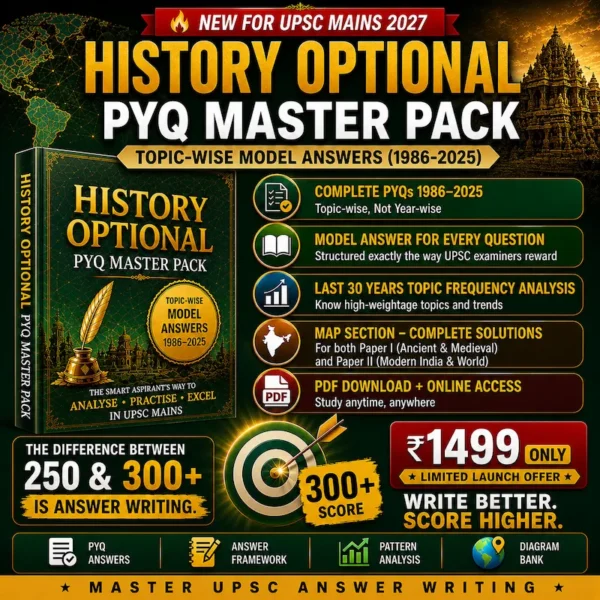
The History Optional PYQ Master Pack carries the same for every question the Commission has set since 1985, across the whole syllabus.
- PYQs 1985–2025, arranged topic-wise — revise a theme and see every way it has been asked
- Model answers with historiography — the debate cited where it belongs, not bolted on
- Map sections solved — the full 50-mark section, every year
- PDF plus online access — any device, permanently, no subscription
₹1,499 (regular ₹2,500). One-time payment, instant access.
How to use this topic list
Reading a question list feels like preparation and is not. Three sittings turn it into marks.
Sitting 1 — sort before you read (30 minutes)
- Copy the questions above into the threads identified in the previous section.
- Note which thread has gone longest without being asked — that is your priority, not the one you find most interesting.
Sitting 2 — write three answers cold (45 minutes)
- Pick the most recent question from three different threads.
- Seven minutes for a 10-marker, fifteen for a 20-marker. Stop when the time is up, even mid-sentence.
- Mark every place you wanted a historian’s name and could not produce one.
Sitting 3 — compare, then rewrite (45 minutes)
- Put your script beside the model answer for the same question.
- Compare structure first: opening claim, evidence, counter-view, judgement.
- Rewrite your weakest answer using that structure and no new content. Most candidates gain four to six marks from structure alone.
Two ways to prepare this optional
Two routes, depending on what is actually missing.
| PYQ Master Pack | Mains Master Kit 2027 | |
| Best when | Your notes are done; answer-writing is the gap | You are still building the subject |
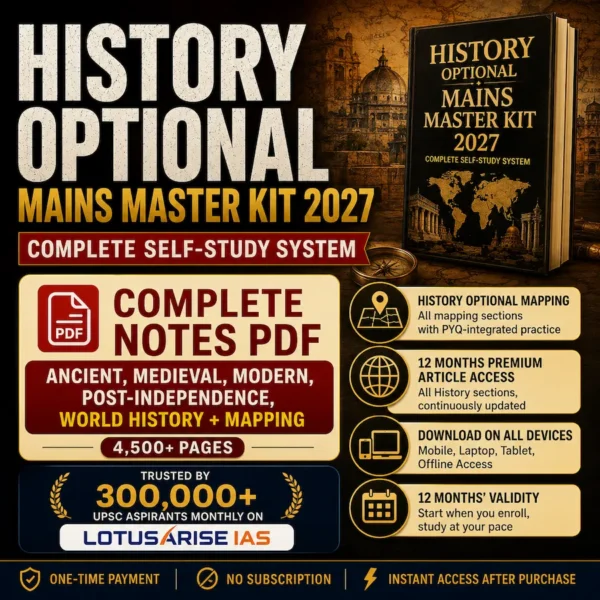
| What you get | Model answers to every question since 1985, topic-wise, map sections included | 4,500+ pages of notes, full mapping coverage, 12 months of article access |
| Price | ₹1,499 (reg. ₹2,500) | ₹1,770 (reg. ₹5,000) |
Frequently asked questions
Related topics
The Sultanate is examined continuously across these units:
- The Fourteenth Century
- Early Medieval India, 750–1200
- Cultural Traditions in India, 750–1200
- Akbar
- All topics — History Optional PYQs, topic-wise
Prefer to work year by year?
The complete papers, with both papers in full, unit-wise analysis and the official PDFs:
- History Optional Question Paper 2026
- History Optional Question Paper 2025
- History Optional Question Paper 2024
- History Optional Question Paper 2023
- History Optional Question Paper 2022
- History Optional Question Paper 2021
- History Optional Question Paper 2020
- UPSC History Optional Map Solutions (2013–2025)


a very good source for sectional PYQ”S