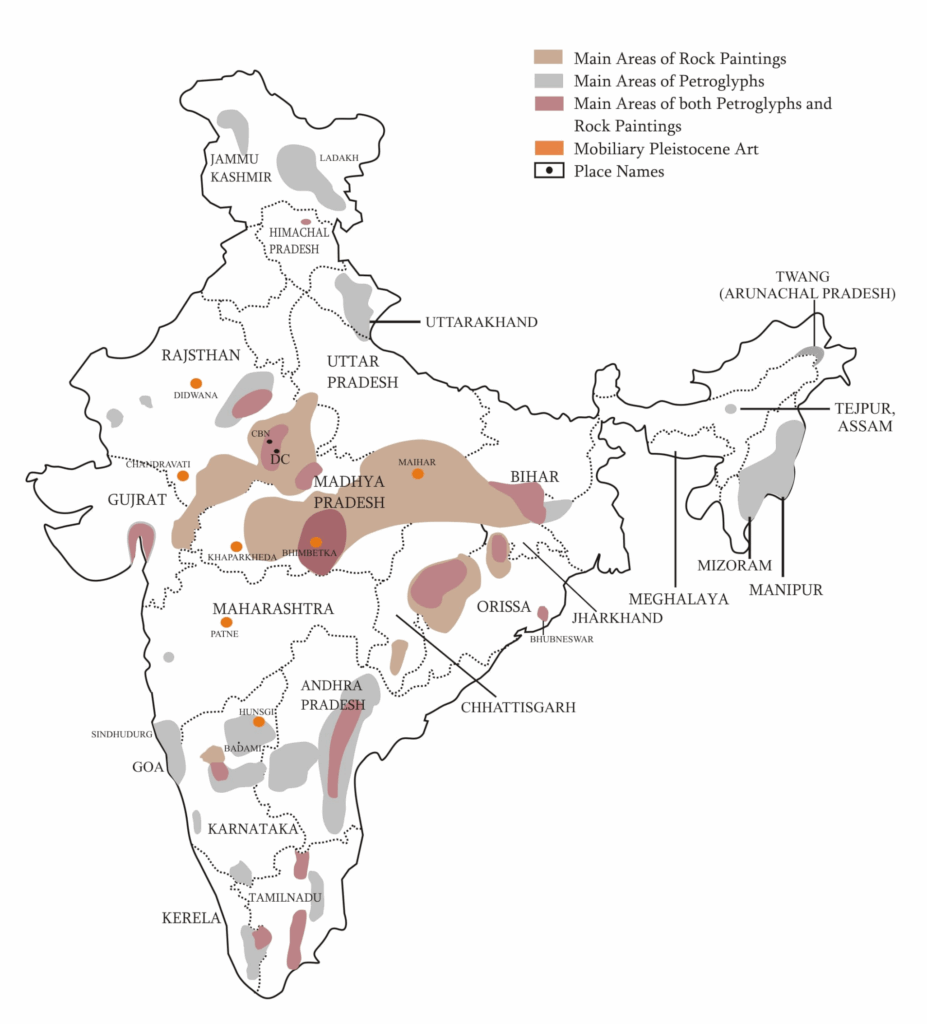
- A petroglyph is usually a prehistoric carving in a rock. Petroglyphs are drawn by removing part of a rock surface by incising, picking, carving or abrading.
- The term rock art includes pictographs (paintings on rocks) and petroglyphs which are carved into the flat, open rock surface gives them a scale and look that is unique.
Petroglyph Sites


Petroglyphs of Ratnagiri
- Ratnagiri district has more than 1,500 petroglyphs, also called katal shilpa, spread across 70 sites.
- Ratnagiri Maharashtra Petroglyphs, An eight ft long petroglyph in Devache Gothane village in Rajapur district, Maharashtra.
- Barsu, Ratnagiri District, Maharashtra.
- Devihasol, Ratnagiri District, Maharashtra.
- Features of these Petroglyphs
- The working theory around these petroglyphs is that they date back to about 10,000 BCE, placing them in the Mesolithic Period, which comes between the Old Stone Age or Paleolithic period, characterised by chipped stone tools, and the New Stone Age or Neolithic period, associated with smaller, more polished tools.
- The variety of the rock carvings are stunning as animals, birds, human figures and geometrical designs are all depicted.
- The images appear to have been created by hunter-gatherer communities as they depict hunted animals and detailing of animal forms.
- Prominent petroglyph and rock art sites in India that could be contemporary to this period are the
- Bhimbetka rock shelters in Madhya Pradesh,
- rock carvings in Mirzapur in Uttar Pradesh,
- petroglyphs from the Tindivanam and Villupuram districts in Tamil Nadu and
- Unakoti in Tripura.
- The carvings on laterite stone make the petroglyphs in Ratnagiri region unique, as the carvings discovered in other sites around India are on granite and sandstone.
Bhimbetka rock shelters, Raisen District, Madhya Pradesh
- Located in Raisen district, near Bhopal.
- UNESCO World Heritage Site.
- Over 700 rock shelters, with paintings dating from Mesolithic to Medieval period.
- Depicts hunting scenes, animals, dancing figures, and community life.
- Continuous human habitation for over 100,000 years.
Daraki-Chattan (Madhya Pradesh)
- Located in Indore district near Bhanpura.
- Contains some of the earliest known petroglyphs, possibly dating to Acheulian period.
- Over 500 cupules (cup-shaped depressions) found on vertical rock faces.
Adamgarh Hills (Madhya Pradesh)
- Located near Narmadapuram (Hoshangabad).
- Contains rock art from the Upper Paleolithic to historic times.
- Scenes include wildlife, dances, and battles.
Chhattisgarh Rock Art Sites
- Found in Raigarh, Bastar, and Dhamtari districts.
- Depict tribal life, animals, and mythical symbols.
- Use of white, red, and ochre colors.
Kabra Pahad (Chhattisgarh)
- Located in Raigarh district.
- Famous for engraved Brahmi inscriptions and ancient drawings.
Kupgal petroglyphs on Dolerite Dyke, and Piklihal, Bellary, Karnataka
- Sites in Bellary district.
- Associated with Neolithic and Megalithic cultures.
- Engravings of cattle, humans, and ritual scenes.
- Often found on dolmens and megalithic structures.
Kudopi, Sindhudurg District, Maharashtra
- Location:
- Located in Kudopi village, Sindhudurg district, Maharashtra.
- Chronology:
- Petroglyphs likely belong to the Mesolithic to early Historic period (exact dating under study).
- Key Features:
- Rock engravings (petroglyphs) found on laterite rock surfaces.
- Engravings depict:
- Geometric designs
- Animal figures
- Human-like forms
- Archaeological Importance:
- Indicates a cultural connection with other petroglyph-rich sites of the Konkan coast like Ratnagiri.
- Suggests prehistoric human activity in coastal Maharashtra.
Hiwale, Sindhudurg District, Maharashtra
- Location:
- Situated in Hiwale village, Sindhudurg district, Maharashtra.
- Chronology:
- The petroglyphs are tentatively dated to the Mesolithic or Chalcolithic period, but exact dating is pending scientific confirmation.
- Key Features:
- Carvings etched into laterite rock surfaces.
- Petroglyph motifs include:
- Animal figures (like deer and bulls)
- Human forms (possibly in dynamic poses)
- Geometric patterns (circles, spirals)
- Archaeological Significance:
- Reflects early human symbolic and artistic expression along the Konkan belt.
- Forms part of a wider network of petroglyph sites across Sindhudurg and Ratnagiri districts.
- Indicates hunter-gatherer or pastoral community presence.
Edakkal Caves, Wayanad District, Kerala
- Located in Wayanad district.
- Contains petroglyphs dating to 6000 BCE.
- Carvings include human figures, animals, symbols, and scripts.
- Shows signs of Neolithic habitation.
Kollur, Triukoilur 35 km from Villupuram in Tamil Nadu.
- A large dolmen with four petroglyphs that portray men with trident and a wheel with spokes has been found. The discovery was made by K.T. Gandhirajan.
- This is the second instance when a dolmen with petrographs has been found in Tamil Nadu, India.
- In October 2018, petroglyphs were discovered in the Ratnagiri and Rajapur areas in the Konkan region of western Maharashtra.
- Those rock carvings which might date back to 10,000 BC, depict animals like hippopotamuses and rhinoceroses which aren’t found in that region of India.
- Some carving depicts, what appears to be Pisces constellation. Perumukkal, Tindivanam District, Tamil Nadu, India.
Unakoti near Kailashahar in North Tripura District, Tripura
- Location:
- Situated near Kailashahar in North Tripura district, Tripura.
- Chronology:
- Dates back to approximately 7th to 9th century CE (post-Gupta period).
- Some scholars suggest association with early medieval Shaiva cults.
- Key Features:
- Known for its massive rock-cut sculptures and carvings on a hill slope.
- The name Unakoti means “one less than a crore” (i.e., 99,99,999) — associated with local legend of Shiva and celestial beings.
- Main highlights:
- Colossal image of Shiva called Unakotiswara Kal Bhairava (around 30 feet high).
- Other figures include Ganesha, Durga, Nandi, and mythical animals.
- Both bas-relief carvings and free-standing sculptures found on vertical rock faces and scattered stones.
- Religious Significance:
- A major centre for Shaivite worship.
- Pilgrimage site during Ashokashtami festival.
- Cultural Importance:
- Combines tribal art, Hindu mythology, and regional sculptural styles.
- Represents a rare example of open-air rock art in Northeast India.
Usgalimal rock engravings, Kushavati river banks, in Goa
- Location:
- Situated on the banks of the Kushavati River near Usgalimal village, in South Goa district, Goa.
- Chronology:
- Dated to the Mesolithic period (around 6,000–8,000 BCE).
- Considered among the oldest known petroglyph sites in India.
- Key Features:
- Around 100+ petroglyphs etched into laterite rock surfaces.
- Motifs include:
- Human figures in stylised postures.
- Animals such as bulls, deer, and peacocks.
- Labyrinthine patterns, geometric shapes, and abstract symbols.
- Carvings made by pecking and hammering into rock surfaces using stone tools.
- Cultural Significance:
- Offers insights into the life, beliefs, and symbolism of early Mesolithic hunter-gatherers.
- May have had ritualistic or communicative purposes.
- Archaeological Importance:
- Discovered in the 1990s by the Archaeology Department of Goa.
- Declared a protected monument under the Archaeological Survey of India (ASI).
Ladakhi rock art in Ladakh, NW Indian Himalaya.
- Location:
- Found across the Ladakh region in the northwestern Indian Himalaya, particularly along ancient trade routes and river valleys such as the Indus, Zanskar, and Suru rivers.
- Chronology:
- Ranges from the Bronze Age (c. 2000 BCE) to early historic periods.
- Some motifs possibly even earlier (Neolithic), continuing into the Buddhist period (up to ~10th century CE).
- Key Features:
- Engraved on dark patinated boulders and rock faces.
- Motifs include:
- Animal figures (ibex, yaks, sheep, goats, snow leopards).
- Hunting scenes, chariots, and warriors.
- Human figures, footprints, and ritual scenes.
- Later carvings include Buddhist motifs, such as stupas, Bodhisattvas, and mantras in Tibetan script.
- Cultural Significance:
- Reflects trans-Himalayan interactions, pastoralist traditions, and the spread of Buddhism.
- Often located near ancient trade routes, indicating importance for travellers, herders, and pilgrims.
- Archaeological Importance:
- Provides valuable insights into the evolution of Himalayan cultural landscapes.
- Subject of ongoing research and preservation due to exposure to the elements and tourism.
Kethaiyurumpu, Tamil Nadu
- Location:
- Located 28 km northwest of Dindigul, Tamil Nadu.
- Close to Idaiyakottai and around 6 km southwest of Oddanchatram.
- The petroglyphs are found on the Kothaiyurumbu hill, near the ruins of an old Murugan temple.
- Features of the Site:
- Petroglyphs are mostly abstract symbols engraved on two large rocks.
- The engravings appear near temporary rock shelters, suggesting short-term habitation or ritual usage.
- The hilltop location and association with a Murugan temple may hint at a ritual or sacred context.
- Cultural Significance:
- The abstract nature of symbols reflects early symbolic or religious expressions.
- The site’s proximity to a hill shrine suggests continuity of sacred geography from prehistory to the historic period.