Tamil Devotional Cult, Growth of Bhakti, and the Bhakti Movement

The Bhakti movement stands out as one of the most significant socio-religious developments in Indian history, transforming devotional surrender to a personally conceived Supreme God into a mass movement that cut across caste, region, and language. While it became the dominant feature of Hinduism in the fourteenth and fifteenth centuries, its philosophical roots reach back into ancient Indian religious traditions — the Vedas, Upanishads, the epics, the Puranas, and pre-Buddhist texts. It was, however, in South India between the seventh and tenth centuries that bhakti first evolved from a purely religious doctrine into a genuine popular movement, built on religious equality and broad social participation, through the Tamil devotional cult of the Nayanars and Alvars. From there, the ideas of bhakti travelled — over centuries and through diverse political, economic, and religious circumstances — into North, East, and West India, producing a rich mosaic of regional movements from Kabir’s monotheism to Chaitanya’s Gaudiya Vaishnavism and the Varkari tradition of Maharashtra. This article traces the growth of the Bhakti movement from its Vedantic and Tamil origins to its pan-Indian efflorescence during the Sultanate and Mughal periods, along with the key historiographical debates surrounding its causes and character.
Concept and Origin of Bhakti
- Bhakti, as a religious concept, means devotional surrender to a personally conceived Supreme God for attaining salvation; the relationship between the individual soul and the Supreme Being forms the core ideology of bhakti.
- Though the Bhakti movement became Hinduism’s dominant feature in the 14th and 15th centuries, its origins can be traced to ancient Indian religious traditions.
- The doctrine has been traced to both the Brahmanical and Buddhist traditions of ancient India and to scriptures such as the Gita.
- The word “Bhakti” in Pali literature dates back to the 8th century B.C.
- References to bhakti are found in the Vedas, Upanishads, the epics, and the Puranas.
- The Bhagavad Gita, certain pre-Buddhist texts, and the Chhandogya Upanishad contain references underlining the emergence of devotion to a single personal God.
Vedanta and the Three Paths (Margas) to Salvation
- Vedanta philosophy enumerates the concept of the Creator and creation — God (Brahman/Paramatman) and the soul (atma).
- Its other two basic principles are the doctrine of rebirth (transmigration of the soul) and the theory of karma (deeds); the soul’s ultimate objective is reunion with God.
- When the soul escapes rebirth through karma and merges with the universal soul (God), salvation is achieved — variously termed mukti, moksha, or nirvana.
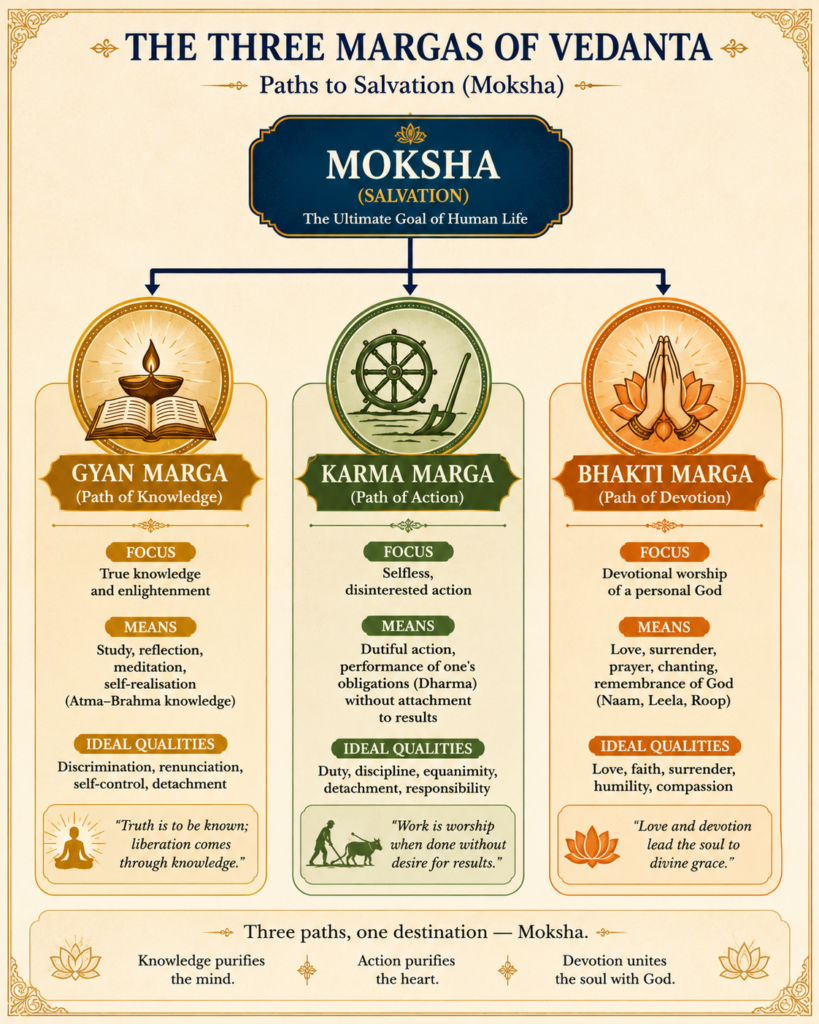
- Vedanta lays down three means (margas) for attaining salvation:
- Gyan marga — stresses acquisition of true knowledge or enlightenment.
- Karma marga — stresses selfless, disinterested action.
- Bhakti marga — stresses devotional worship of God.
- From the time of the Bhagavad Gita to the 13th century, the concept of bhakti evolved through a process of compromise between the traditional classical philosophy of the Upanishads and the urge for a personal God.
- Monotheism and pantheism were combined with the warmth of bhakti in the Bhagavad Gita.
- Until the 13th century, bhakti largely remained within the fold of Vedic intellectualism — evident from the fact that caste division is recognised in the Bhagavad Gita.
Bhakti Movement in South India
The Tamil Devotional Cult
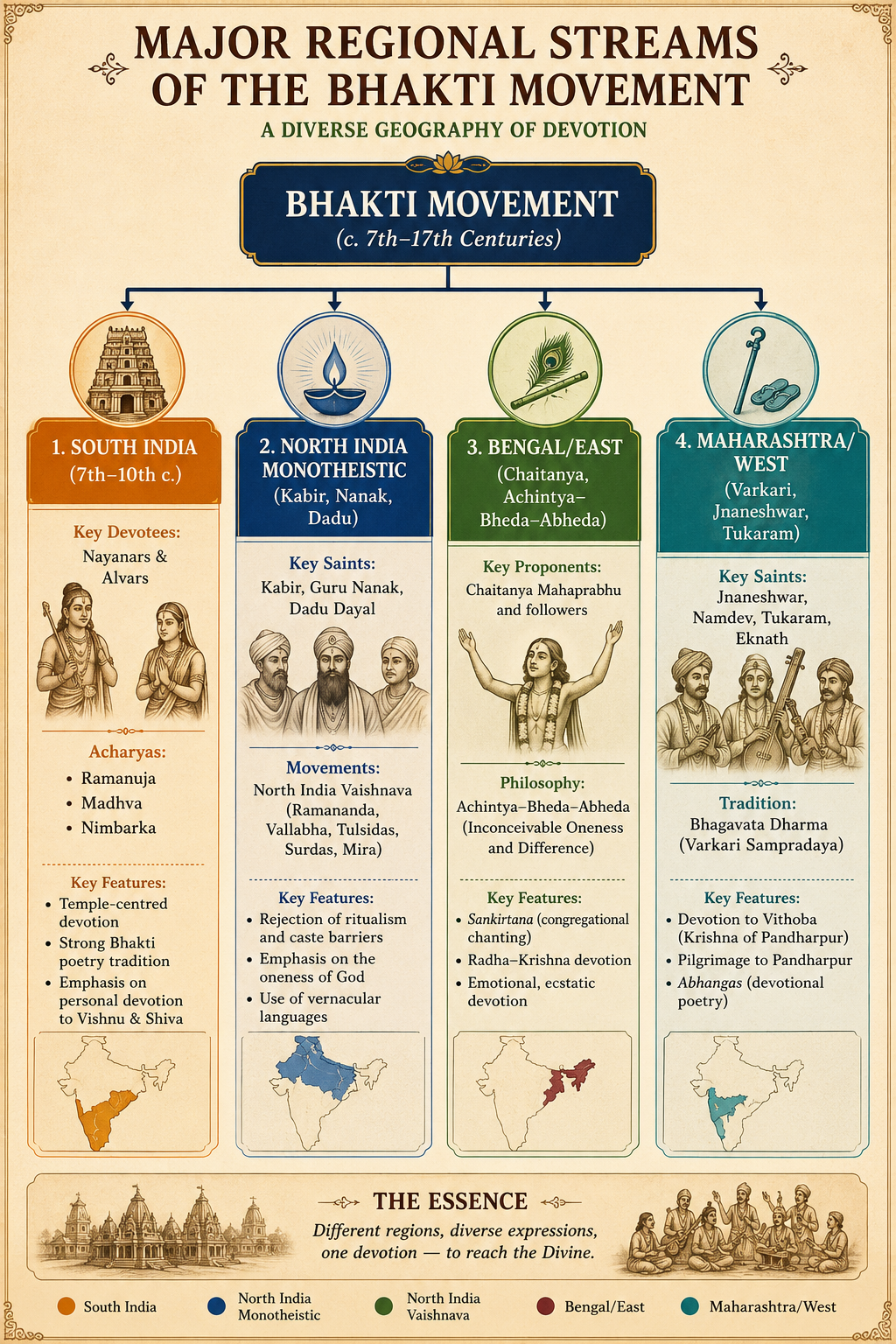
- The bhakti cult in the Tamil region began as a reaction against the growing influence of Buddhism and Jainism. It spread across South India for nearly three centuries, popularised by Saiva saints called Nayanars and Vaishnava saints called Alvars.
- These saints preached personal devotion to God as the means of salvation, spreading the doctrine of bhakti among all sections of society — irrespective of caste and sex — between the 7th and 10th centuries.
- Some of these saints came from “lower” castes, and some were women.
- They carried their message of love and personal devotion throughout South India using local languages rather than Sanskrit.
Characteristics of the Tamil Bhakti Cult
- For the first time, bhakti acquired a popular base. This popular character stemmed from the fact that:
- Saint-poets preached bhakti in an intensely emotional manner, promoting religious egalitarianism.
- They dispensed with rituals, travelling repeatedly across the region while singing, dancing, and advocating devotion.
- The Alvar and Nayanar saints used Tamil, not Sanskrit, for preaching and composing devotional songs.
- These poet-saints resisted the authority of the orthodox Brahmans by making bhakti accessible to all, regardless of caste or sex, and largely succeeded in championing the cause of religious equality — Brahmans had to accept the right of the “low-caste” to preach, to practise bhakti, and even to access the Vedas.
- The South Indian bhakti saints were particularly critical of the Buddhists and Jains, who enjoyed a privileged status at the courts of South Indian kings at the time, and won over many adherents from both religions, which had by then become rigid and formal.
Limitations of the Movement
- It never consciously opposed Brahmanism or the varna and caste systems at the social level.
- Since the ideological and social foundations of the caste system were never questioned by the South Indian saint-poets, the movement, in the long run, strengthened caste rather than weakening it.
- Despite its overriding emphasis on bhakti as the superior mode of worship, there was no elimination of Brahmanical rituals — idol worship, recitation of Vedic mantras, and pilgrimages to sacred places continued.
- The Buddhists and Jains, not the Brahmans, were its main targets; consequently, Brahman-dominated temples played an important role in the growth of the South Indian bhakti movement.
- After reaching its climax in the 10th century, the movement was gradually assimilated into conventional Brahmanical religion.
Other Tamil Devotional Cults
- Shaiva Siddhanta:
- Accepted the authority of the Vedas.
- Considered three things as eternal — God, Universe, and Soul.
- The Tirumurai (a Tamil compendium of devotional songs), the Shaiva Agamas, and the Siddhanta Shastras together form the scriptural canon of Tamil Shaiva Siddhanta.
- Siddhas:
- Followed an unorthodox sadhana, seeking salvation through yogic practices and tapasya.
Shankaracharya and the Gyan Marga
- Shankaracharya is considered the founding father of the bhakti movement and the proponent of the doctrine of Advaita (non-dualism/monism).
- He preached the Upanishadic doctrine of salvation through knowledge (gyan marga).
- Though he emphasised gyan marga as the means to salvation, this path was impractical for the average person.
- As a result, succeeding preachers of Vedanta philosophy substituted it with the more accessible bhakti marga.
Vaishnava Acharyas: Defending Bhakti at the Philosophical Level
- When the popularity of the bhakti movement in South India began declining, the doctrine of bhakti was philosophically defended by a series of brilliant Vaishnava Brahman scholars (acharyas).
Ramanuja (11th Century)
- Ramanuja (1017–1137), one of the earliest exponents of the bhakti movement, hailed from modern Andhra Pradesh and was a great Vaishnava teacher.
- He proposed Vishishtadvaita (qualified monism) — though a monist, he did not accept that God could be exempt from form and qualities.
- The individual soul, created by God out of His own essence, returns to its maker and lives with Him forever, yet remains always distinct — one with God, and yet separate.
- He emphasised that salvation could be achieved through bhakti marga alone.
- He redefined Vedanta by stressing devotional worship to a personal God, constituting the supreme reality, arguing that just as people need God, God too needs people.
- He held yoga to be the best mystical training, viewed the devotee-God relationship as that of a fragment to the totality, and identified prapti (attainment) as a second means of salvation.
- He established a careful balance between orthodox Brahmanism and popular bhakti, which was open to all.
- While he did not support “lower” castes having access to the Vedas, he advocated bhakti as a mode of worship accessible to all, including Sudras and outcastes.
- While propagating bhakti, he did not observe caste distinctions and even attempted to eradicate untouchability.
Madhvacharya (13th Century)
- Madhvacharya was born on the west coast of Karnataka and was the chief proponent of the Dvaita (dualism) school of Vedanta, calling his philosophy Tattvavada (“arguments from a realist viewpoint”).
- Madhva’s Dvaita school holds that Vishnu — also Hari, Krishna, Vasudeva, and Narayana — can only be known through proper samanvaya (connection) and pramana of Vedic scriptural teachings.
- Like Ramanuja, he did not dispute the orthodox Brahmanical restriction on Vedic study by Sudras, but believed bhakti offered them an alternate avenue of worship.
Bhakti Movement in North India
- Despite many points of contact between South and North India, the spread of bhakti ideas from south to north took considerable time. Many popular socio-religious movements arose in North, East, and West India during the Sultanate period.
South Indian and North Indian Bhakti: Similarities
- All bhakti movements shared two common features — bhakti and religious equality.
- Almost all the Sultanate-period bhakti movements have been linked to one or another South Indian Vaishnava acharya, suggesting continuity or resurgence of the older bhakti tradition through philosophical and ideological links — either via direct contact or diffusion. For example:
- Leaders of North India’s non-conformist monotheistic movements are believed to have been disciples of Ramananda, who is in turn believed to have been connected to Ramanuja’s philosophical order.
- Chaitanya, the most significant figure of the Vaishnava movement in Bengal, belonged to Madhva’s philosophical school, and is also believed connected to Nimbarka’s school because of its emphasis on Krishna bhakti.
- In both South and North India, though the movement was egalitarian in the religious sphere, it never denounced the caste system or the authority and privileges of the Brahmans (with the exception of the popular monotheistic movements).
- Consequently, like South Indian bhakti, most later Vaishnava movements were ultimately assimilated into Brahmanical religion, though the latter itself underwent significant changes in the process.
- Both contributed to the growth of modern vernacular languages.
- The Bhagavata Purana links most Vaishnava bhakti movements of the medieval period.
- It is a Vaishnavite work composed around the 9th century, emphasising bhakti to Vishnu in his various incarnations.
- It accepts the orthodox Brahmanical theory of the varna system but does not accept the superiority of Brahmans on the basis of status or birth alone — for it, bhakti is the main criterion.
South Indian and North Indian Bhakti: Differences
- Each movement had its own regional identity and socio-historical context.
- Non-conformist movements based on popular monotheistic bhakti differed essentially from the various Vaishnava bhakti movements.
- Kabir’s notion of bhakti was distinct from that of Vaishnava saints like Chaitanya or Mirabai; monotheists did not believe in incarnations and rejected Brahmanical and scriptural authority altogether.
- The influence of the Bhagavata Purana tradition was not direct on the monotheistic movement, as most such saints were illiterate and lacked direct access to the Bhagavata and other scriptures.
- Even within Vaishnavism, Maharashtrian bhakti differed from Bengal Vaishnavism or the North Indian bhakti of Ramananda, Vallabha, Surdas, and Tulsidas.
- As the Vaishnava bhakti movement later crystallised into sects, frequent disputes arose between them, occasionally turning violent.
- A few emerged as organised religious communities, such as the Sikhs, while others evolved into various sects or panths.
Popular Monotheistic Movement vs. Vaishnava Bhakti Movement
- Both movements arose in Northern India around the same time — the centuries following the establishment of the Delhi Sultanate and the advent of Islam — and shared certain common causes, such as the influence of Islam on Hinduism.
- However, their causes, sources, and influencing factors were quite diverse.
- Monotheistic movements arose and peaked during the Sultanate period itself, while Vaishnava movements began in the Sultanate period but reached their climax during the Mughal period.
Factors Leading to the Rise of the Bhakti Movement
These movements influenced large numbers of people during the 14th–17th centuries in North India, arising from political, socio-economic, and religious factors.
Political Factors
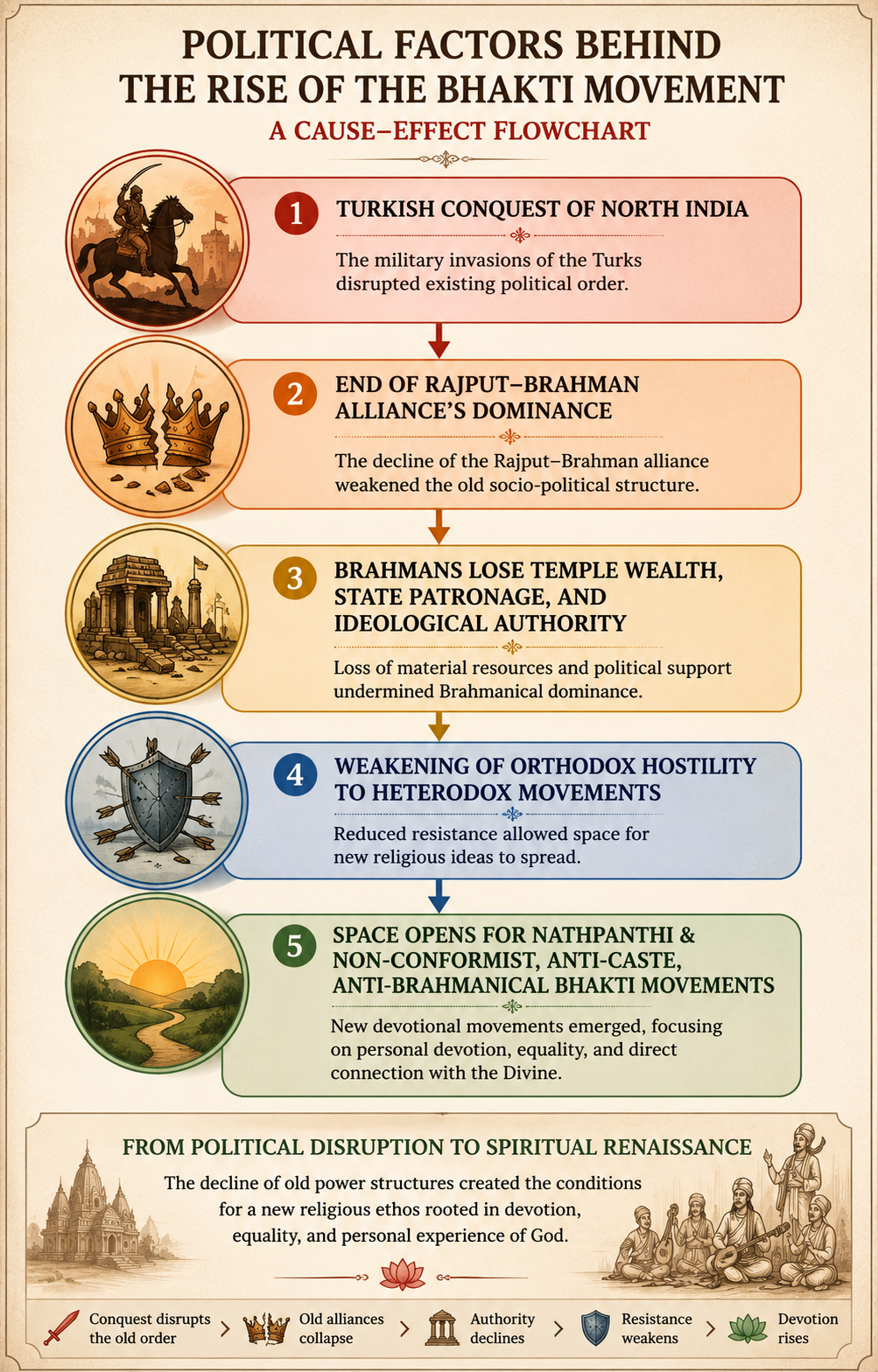
- The loss of power and influence of the Brahmans, combined with a new political situation, ultimately created favourable conditions for the movement’s growth.
- The Turkish conquests brought an end to the supremacy of the Rajput-Brahman alliance.
- Before the Turkish conquest, the socio-religious milieu was dominated by this alliance, which was hostile to any heterodox movement; the Nathpanthis were perhaps the first to benefit from its decline, reaching their peak at the beginning of the Sultanate.
- The advent of Islam dealt a setback to Brahmanical power and prestige, paving the way for non-conformist, anti-caste, and anti-Brahmanical movements.
- Ideologically, Brahmans had made people believe that temple images and idols were not mere symbols but gods themselves, possessing divine power that only Brahmans could influence.
- Materially, the Turks deprived Brahmans of their temple wealth and state patronage.
Socio-Economic Factors
- It has been argued that medieval India’s bhakti movements represented the sentiments of common people against feudal oppression, with elements of revolutionary opposition to feudalism visible in the poetry of saints from Kabir and Nanak to Chaitanya and Tulsidas.
- Consequently, these movements are sometimes viewed as the Indian counterpart of the European Protestant Reformation.
- However, the bhakti movements cannot be regarded as an Indian variant of the Protestant Reformation, because:
- There is nothing in the bhakti saints’ poetry to suggest they represented the class interests of the peasantry against the surplus-extracting feudal state.
- Vaishnava bhakti saints broke from the orthodox Brahmanical order only to the extent of their belief in bhakti and religious equality, while continuing to subscribe to many basic principles of orthodox Brahmanism.
- Radical monotheistic saints, though rejecting orthodox Brahmanical religion altogether, did not call for the overthrow of the state or the ruling class.
- The European Reformation, by contrast, was a far greater social upheaval, linked to the decline of feudalism and the rise of capitalism.
- This does not mean the bhakti saints were indifferent to people’s living conditions — they consistently identified with the sufferings of the common people.
Economic and Social Changes
- The popularity of the monotheistic movement can be attributed to significant socio-economic changes brought about by the Turkish conquest of Northern India.
- Expansion of the urban artisan class:
- Unlike the Rajputs, the Turkish ruling class lived in towns, and the extraction of large agricultural surplus gave this class considerable wealth.
- This created demand for manufactured goods, luxuries, and other necessities, introducing new techniques and crafts, which in turn expanded the class of urban artisans in the 13th and 14th centuries.
- This growing class was attracted to the monotheistic movement because it was dissatisfied with its low position in the Brahmanical hierarchy — for example, the Khatris in Punjab.
- The popularity of the monotheistic movement thus resulted, in large part, from the support of this class.
- In Punjab, Jat peasants (a non-urban class) also supported the movement, ultimately contributing to the development of Sikhism as a mass religion.
Role of the Delhi Sultanate in the Rise of the Bhakti Movement
Historians offer several explanations for the rise of the Bhakti movement:
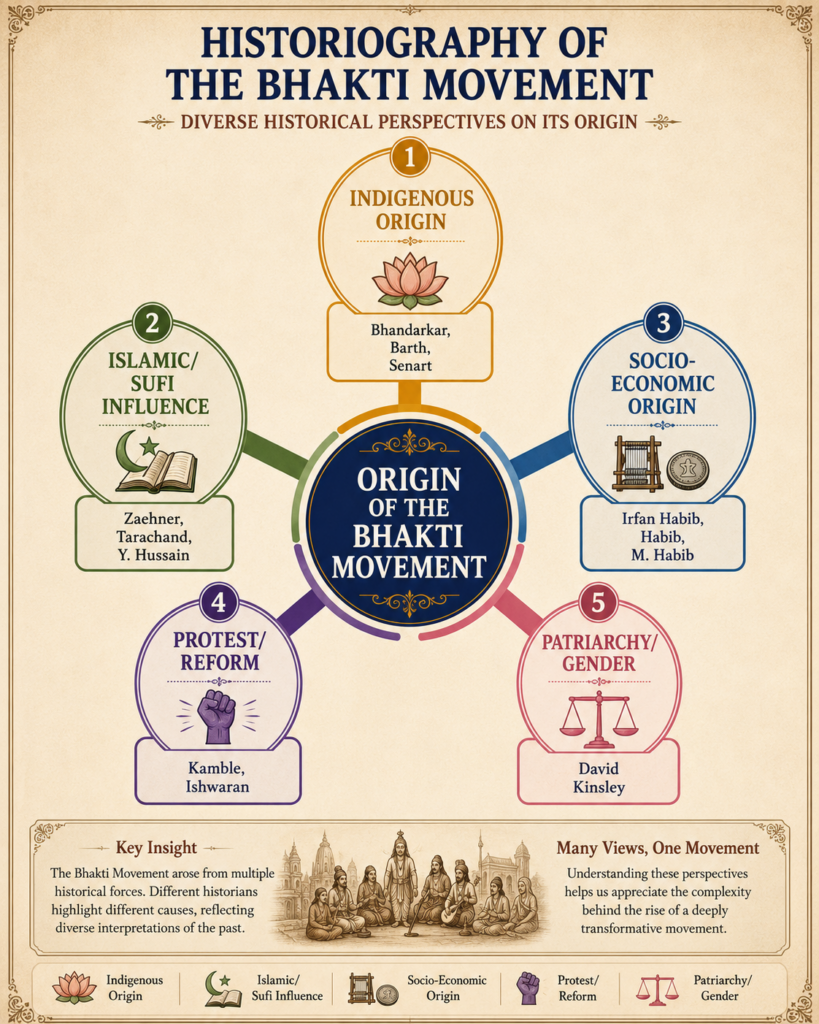
- R.G. Bhandarkar viewed the Bhakti movement as a product of the Vaishnavite tradition, particularly the Krishna bhakti (Bhagavata Purana bhakti) tradition.
- It is also considered an extension of the Shaivite and Vaishnavite religious movements of the Alvars and Nayanars in South India.
- The movement is also seen as an expression of anti-feudal sentiment — a popular response to the feudal oppression of the early medieval period, rooted in the Brahmin-Rajput coalition.
- David Kinsley considers the movement’s rise a product of discontent within patriarchal society, giving birth to protest and a search for a divine consort — visible in the devotion of Mirabai, Lalded, and Mahadevi Akka.
The Islamic Challenge View
Several historians consider the establishment of the Delhi Sultanate, and with it the arrival of Islam, the main factor behind the movement’s rise:
- Yusuf Hussain held that from ancient times to the 12th/13th century AD, bhakti was an individual sentiment; from the 13th century onward — following the Sultanate’s establishment — it became a doctrine of a cult under Islamic influence.
- R.C. Zaehner argued that the Bhakti movement was largely inspired by the Islamic ideas of monotheism and equality that arrived mainly after the Sultanate’s establishment.
- Tarachand argued that the Bhakti movement was inspired by Sufi ideas of equality, service, and universal brotherhood, which came mainly after the Sultanate’s establishment.
- Muhammad Habib and Irfan Habib situated the movement’s rise in an economic context — the foundation of the Sultanate led to political centralisation, growth of trade, craft, and coinage, and the emergence of new economic groups (artisans and traders).
- These groups were dissatisfied within the Brahmanical caste structure and hence broke caste rules, forming the social base of this monotheistic, non-conformist movement.
- Some view the movement as a form of defence against Islam — since Islam posed a challenge with the establishment of the Delhi Sultanate, the Bhakti movement emerged as a response.
- The Sultanate’s establishment was also a setback to the Rajput-Brahman coalition, which had been hostile to heterodox and non-conformist ideas, creating favourable conditions for the movement’s rise.
Hence, while several factors worked together, the establishment of the Delhi Sultanate, and with it Islam, was one of the main factors behind the rise of the Bhakti movement.
Historiography of the Bhakti Movement
- R.G. Bhandarkar and R.C. Zaehner were among the first historians to work on the Bhakti movement.
- Bhandarkar portrayed the movement as indigenous in character, offering literary and epigraphic evidence such as the antiquity of Krishna worship.
- Zaehner held that the movement was inspired by Islam, pointing to bhakti’s egalitarian message and equating personal worship with Islamic monotheism.
- Tarachand held that the ideas of equity and universal brotherhood taught by bhakti saints were equivalent to Sufi thought.
- Yusuf Hussain argued that the Bhakti movement, up to the 13th century, was an individual sentiment, transforming into a doctrine and cult under Islamic influence thereafter — viewing it as a reformation of Hinduism that brought simplicity of faith.
- Many historians view the movement as dissent, protest, and reform, voicing resentment against a social order discriminating against lower castes.
- J.R. Kamble argued that the movement’s main aim was to establish an egalitarian society, chiefly in the religious sphere; the message of equality was not extended to secular life, yet the movement enabled a composite Indian culture — a kind of national renaissance — across linguistic and religious communities.
- Ishwaran regarded Lingayatism, resting on universal values of freedom, equality, and rationality, as a model showing the movement’s contribution to modernisation.
- Irfan Habib argued that the Turks created an economic organisation superior to the earlier one, leading to growth in urbanisation, commerce, and craft production.
- This expanded the artisan class and led lower-class populations to adopt new professions, giving them dignity within the caste hierarchy.
- This, in turn, led to the breaking of caste rules and the anti-caste religious movements of saints like Kabir and Nanak, within a new social environment shaped by the egalitarian ideology of Islam.
- Trading groups such as the Khatris in Punjab, who directly benefited from urban growth and craft production, were drawn into the movement due to dissatisfaction with their low social status in Brahmanical society; in Punjab, the movement also spread to Jat peasants, whose support for Guru Nanak’s movement led to the development of Sikhism.
- Many historians have criticised the movement as status quoist, arguing it achieved little beyond voicing discontent.
- Max Weber argued that lower-caste Hindus adhered to caste duties with even greater intensity, hoping for a better position in the next life — thus, the Bhakti movement, in his view, strengthened the position of Brahmans. His claim that bhakti was a foreign idea reaching India through Christianity is generally not accepted.
- David Kinsley noted that while bhakti opened doors to women who voiced discontent with patriarchy, male bhaktas largely left women out despite their calls for change.
- Scholars such as Barth and Senart held that bhakti, as understood in India, belongs fundamentally to Indian thought, though it also absorbed external influences, especially after the arrival of Islam.
- One modern viewpoint attributes the rise of the movement to alleged persecution of Hindus under Muslim rule, framing bhakti as protecting Hinduism by removing caste discrimination and idolatry while preserving its basic tenets.
Main Popular Movements and Their Characteristics
Monotheistic Movements of North India
- Kabir (1440–1518) was undoubtedly the most powerful figure among the monotheistic movements that began in the 15th century.
- He was strictly monotheistic, advocated the abolition of Varnashrama, and doubted the authority of the Vedas and other sacred texts.
- References to him also appear in Sufi literature:
- The Mirat-ul-Asrar (a 17th-century biography of Sufis) called him a Firdausiya Sufi.
- The Dabistan-i-Mazahib — a mid-17th-century Persian work comparing South Asian religions and sects — places Kabir against the background of the Vaishnavite vairagis and testifies to his continuing popularity among the people of North India.
- Abul Fazl called Kabir a muwahhid (monotheist).
- The Bijak is the best-known compilation of Kabir’s compositions and became the holy scripture of the Kabirpanthi sect, which was founded only after his death — he himself never intended to found a religion or sect.
- He believed salvation was possible not through knowledge or action, but through devotion (bhakti), and favoured neither Hindus nor Muslims, admiring instead all that was good in both.
- Raidas (Ravidas) belonged to the generation following Kabir’s.
- Dhanna, a 15th-century Jat peasant from Rajasthan, along with Sen (a barber) and Pipa, were other notable monotheistic saints.
Guru Nanak (1469–1539)
- Though he preached in much the same manner as Kabir and other contemporaries, subsequent developments led to the emergence of Sikhism; the basic similarity in teaching and ideology makes him an integral part of the monotheistic movement.
- His philosophy comprised three basic elements: a leading charismatic personality (Guru), ideology (Shabad), and organisation (Sangat).
- Nanak critically evaluated prevailing religious beliefs, attempting to establish a true religion leading to salvation, and repudiated:
- Idol worship, pilgrimage, and the theory of incarnation.
- Formalism and ritualism.
- The caste system and its inequalities, holding that caste and honour should be judged by an individual’s deeds.
- He believed in the unity of God and the necessity of a true Guru for revelation, advising people to follow:
- Sach (truth), halal (lawful earning), khair (wishing well of others), niyat (right intention), and service of the Lord.
- He believed in the universal brotherhood of man and equality of men and women, championed women’s emancipation, and condemned sati pratha; he did not propound celibacy or vegetarianism.
- His verses centred on two basic concepts — Sach (truth) and Nam (Name); the divine self-expression rested on Sabad (the Word), Guru (the divine precept), and Hukam (the divine order).
- He emphasised kirtan and satsang, and introduced the community lunch (langar).
- Tarachand regarded Sufi influence on Nanak’s religious thought as of fundamental importance, drawing parallels between Nanak’s verses and those of Baba Farid in their sincere devotion and surrender before one God — though Nanak did not hesitate to criticise Sufis for leading luxurious lives.
- Nanak made a significant attempt to unify Hindus and Muslims, succeeding in synthesising the essential concepts of Hinduism and Islam within his teachings.
- His hymns were incorporated, along with verses of Kabir and Namdev, into the Adi Granth by the fifth Sikh Guru, Arjun, in 1604.
- After Guru Gobind Singh, the divine spirit did not pass to another Guru but remained in the Granth (Guru Granth Sahib) and the community of followers.
- The Gurus mostly belonged to the Khatri mercantile caste, while their followers were largely rural Jats.
- Guru Gobind Singh inaugurated the Khalsa (brotherhood) among the Sikhs; Khatris, Aroras, and Jats formed important groups within the Sikh community, alongside the Ramgarhia Sikhs (artisan castes) and converts from scheduled castes. Caste consciousness persisted within the Sikh panth, though it was not as prominent.
Common Characteristics of the Monotheistic Movements
- Most monotheists belonged to “low” castes and were conscious of a unity of ideas among themselves — their verses mention each other and their predecessors with harmonious ideological affinity (e.g., Kabir called Raidas a “saint among saints,” while Raidas respectfully mentioned Kabir in his hymns).
- The movement represented a synthesis of three traditions — the Vaishnava concept of bhakti, the Nathpanthi movement, and Sufism — though these were not accepted in their original form but were creatively adapted and given new meaning.
- They uncompromisingly believed in one God.
- Monotheists adopted the notion of bhakti from the Vaishnava tradition (both held that personally experienced bhakti was the sole path to communion with God) but gave it a nirguna orientation.
- Kabir called God by the name Ram, earning him the title Ram-bhakta — but for him, Ram was not the incarnate son of King Dashratha, but a formless, non-incarnate God.
- They emphasised the repetition of the divine name, a spiritual guru, community singing of devotional songs (kirtan), and companionship of saints (satsang).
- They followed a path independent of both dominant religions of the time, denying allegiance to either, criticising the superstitions of both, launching a vigorous ideological assault on caste and idolatry, and rejecting the authority of Brahmans and their scriptures.
- They composed their poems in popular languages, using familiar symbols and images.
- Monotheistic saints were not ascetics — they married, lived and preached among the people, and held professional ascetics in disdain; they were referred to as sant or bhagat.
- They travelled widely — for instance, Namdev, a 14th-century saint from Maharashtra, travelled as far as Punjab.
- Their popularity broke territorial barriers, as seen in the high position accorded to Kabir within the Sikh and Dadu panthi traditions of Rajasthan.
- Followers of each major figure organised into exclusive sectarian orders called panths — e.g., Kabir panth, Raidasi panth, Nanak panth (which later became the religion of Sikhism).
Vaishnava Bhakti Movement in North India
- Nimbarka, a younger contemporary of Ramanuja and a Telugu Brahman, established his ashram near Mathura and spent most of his time in Vrindavan.
- He preached total devotion to God, personified by Krishna and Radha, and founded the Kumara Sampradaya, propounding the Dvaitadvaita school of thought.
- His most famous work is the Vedanta-Parijata-Saurabha, a commentary on the Brahma Sutras.
- Ramananda (late 14th–early 15th century) and Vallabha (late 15th–early 16th century) lived mostly in North India during the Sultanate period.
Ramananda
- A Vaishnava devotional poet-saint of the Ganges region and a disciple of Ramanuja, Ramananda lived in South India in his early years but later settled in Banaras, becoming a link between South Indian bhakti and North Indian Vaishnava bhakti.
- He deviated from the ideology and practice of earlier South Indian acharyas in three ways:
- He regarded Ram, not Vishnu, as the object of bhakti, coming to be regarded as the founder of the Ram cult in North India within the Vaishnava bhakti tradition, and founded the Ramanandi Sampradaya.
- He preached in the language of the common people, not Sanskrit.
- He made bhakti accessible to all irrespective of caste, greatly relaxing caste rules in religious and social matters — though a Brahman, he took food with his “low”-caste Vaishnava followers, which is why Kabir and other monotheists are linked to him as disciples. Traditional scholarship holds that his disciples included later poet-saints such as Kabir, Ravidas, and Bhagat Pipa, though some scholars have questioned this lineage.
- By travelling widely across India, he gathered ideas and made careful observations, renouncing rigid Hindu ritual; his disciples took the name Advadhuta (“the detached”).
- However, in his Anand Bhashya, he did not recognise a Sudra’s right to read the Vedas — social equality, in this sense, was not fully his concern, though Raidas and Kabir remained among his disciples.
- His teachings produced two distinct schools among Hindus — Saguna (Tulsidas) and Nirguna (Kabir). His verse is also mentioned in the Sikh scripture, the Adi Granth.
Vallabhacharya
- A Telugu Brahman, Vallabhacharya founded the philosophy of Shuddha Advaita and the Krishna-centred Pushtimarga (“way of grace”) of Vaishnavism in the Braj region, also known as the Vallabha Sampradaya.
- He advocated Krishna bhakti. The famous poet Surdas (1483–1563) and seven other Krishna-bhakti poets of the Ashtachhap are believed to have been his disciples; the sect later gained popularity in Gujarat.
- These movements gained a more popular base only during the Mughal period.
Other Vaishnava Bhakti Poets of North India
- Tulsidas (1532–1623): devoted to Rama; gave literary form to religious bhakti while preserving the authority of the Vedas.
- Surdas (1483–1563): devoted to Krishna.
- Mirabai (1503–1573): devoted to Krishna; her devotion made her a distinguished poet and a symbol of love and attachment to Krishna.
- In her poetry, Padavali, she describes herself as a virgin whose fervent devotion to Krishna made her indifferent to worldly life; she advocated image-worship and observance of special fasts.
Vaishnava Bhakti Movement in Bengal
- The Bengal movement was influenced by two distinct traditions:
- The Vaishnava bhakti tradition of the Bhagavata Purana, glorifying Krishna Lila — first exemplified by Jayadeva in the 12th century, whose Gita Govinda, composed in Sanskrit during the time of the Palas, lent an erotic-mysticism to the love of Radha and Krishna; his songs in the Maithili dialect were later absorbed into the Bengali Vaishnava tradition.
- Non-Vaishnava cults — the Sahajiya Buddhist and Nathpanthi traditions — which preached an easy, natural religion focused on esoteric and emotional elements.
- Followers of Sahaja philosophy believed in a simple way to feel the innate reality (sahaja) present in every animate and inanimate object, holding that every object has both an external and an eternal internal form; feeling this internal eternity within oneself constitutes feeling the sahaja.
- Notable Bengal bhakti figures include Chandidas, Vidyapati, and Chaitanya.
- Chandidas (14th century, the first Bengali bhakti poet) was influenced by the Gita Govinda and Sahajiya doctrines; Vidyapati (14th–15th centuries) wrote in Maithili. Both were influenced by non-Vaishnava cults, though the Bhagavata tradition remained the major source of influence, and both highlighted the Krishna-Radha relationship.
- Social and religious conditions in pre-Chaitanya Bengal and Orissa:
- The social structure was based on Varnashrama, with Sudras and lower castes suffering various disabilities; the Sakta-tantric creed predominated among religious systems.
- Bengal bhakti was shaped by two streams — Vaishnava and non-Vaishnava (Buddhism and Hinduism); the decline of Buddhism produced a decadent form that influenced Vaishnavism and, through it, the Bengali Bhakti movement, with emphasis on eroticism, the female form, and sensuousness.
- Oppression of lower castes by Brahmins was rampant, and moral decadence was the order of the day — it was amid this social and religious conservatism that the Chaitanya movement dawned, bringing far-reaching change.
Chaitanya (1486–1533)
- The greatest saint of the Bhakti movement in Eastern India, Chaitanya, was born in Nadia, Bengal, in 1485, and founded the Gaudiya Vaishnav (Neo-Vaishnavite) movement, adopting the Krishna cult.
- He was not directly influenced by Sahajiya doctrine, though elements of it may have entered his movement through Chandidas and Vidyapati.
- A brilliant student who mastered Sanskrit learning, he became an ascetic at age twenty-five, travelled across most of the country, and stayed for years at Mathura and Vrindavan, attracting lakhs of devotees.
- He was the most prominent Vaishnava saint of Bengal, greatly popularising Vaishnavism there, and was so revered that he was regarded as an avatara (incarnation) of Krishna even in his lifetime.
- His advent marked the shift of Bengal Vaishnava bhakti’s focus from devotional literary compositions to a full-fledged reform movement with a broad social base.
- He disregarded all distinctions of caste, creed, and sex to give a popular base to Krishna bhakti; his followers spanned all castes and communities, and one of his favourite disciples, Haridas, was a Muslim.
- Though a Brahmin himself, he had no respect for claims of Brahmin superiority, openly violated caste rules, and mixed freely with lower occupational castes — Vrindavan Das, author of the Chaitanya Bhagavat, records this. He discarded the symbols of Brahminism, and the movement drew adherents from across the social spectrum, from untouchables to scholars.
- However, Chaitanya did not entirely abandon traditional Brahmanical values — he did not question the authority of the Brahmans and scriptures, and at times upheld the caste prejudices of his Brahman disciples against “lower”-caste ones.
- The six Sanskrit-knowing Brahman Goswamins he sent to Vrindavan established a religious order that recognised caste restrictions in its devotional practices and rituals, gradually distancing itself from Chaitanya’s original teachings.
- Nevertheless, Chaitanya’s movement had a great impact on Bengali society — his disregard for caste distinctions in devotional singing promoted a sense of equality in Bengali life.
- In Bengal and Puri (Orissa), his movement remained popular among common people (not only scholarly Brahmans), who wrote in Bengali, propagated his bhakti, and regarded Chaitanya as the living Krishna, or as Radha and Krishna in one body.
Chaitanya’s Theology: Achintya-Bheda-Abheda
- Chaitanyadeva propounded Achintya-Bheda-Abheda — a school of Vedanta representing the philosophy of inconceivable oneness and difference.
- It holds that the soul or energy of God is both distinct and non-distinct from God (identified as Krishna/Govinda) — a relationship that, though unthinkable, may be experienced through loving devotion (bhakti).
- It can best be understood as an integration of Madhvacharya’s strict dualist (Dvaita) view and Ramanujacharya’s qualified monism (Vishishtadvaita), while rejecting Adi Shankara’s absolute monism (Advaita).
- Krishna is considered not a mere incarnation of Vishnu but the highest aspect of the divine in its true essence, united with the highest Shakti, manifest in Radha.
- Krishna embodies contrary qualities — infinite yet incarnating as finite mortals, subject to love; all-pervading yet residing in the highest heaven; immanent and transcendent; inconceivable both in being and power; the creator, preserver, and destroyer of the world.
- The devotee’s aim is to gradually ascend the ladder of bhakti until reaching the supreme state of madhurya (sweetness), in which he emotionally identifies with Radha and achieves blissful union with Krishna.
- This mystical theology insists strongly on virtue and ethical training as necessary prerequisites for the full realisation of bhakti.
- Chaitanya popularised sankirtana — group devotional singing accompanied by ecstatic dancing — held in homes, temples, or erupting spontaneously in the streets.
- The Gaudiya Vaishnav (Neo-Vaishnav) movement, derived from Chaitanya’s life and teachings, had a tremendous impact on the social, religious, and cultural life of Assam, Bengal, and Orissa.
Bhakti Movement in Maharashtra (Maratha Vaishnavism / Bhagavata Dharma)
- The Bhakti movement in Maharashtra ran parallel to that in the North. By the close of the 13th century, a number of poet-saints steadily enriched and energised the movement, striving to bring religion to the lowest strata of society.
- These movements, similar to other Vaishnava bhakti movements, were majorly influenced by the Bhagavata Purana, but also by the Saiva Nathpanthi tradition — popular among the “lower” classes of Maharashtrian society in the 11th and 12th centuries, who composed their verses in Marathi.
- The centre of the movement was Pandharpur, home to the famous Vithoba temple.
- The movement’s leaders were Jnaneshvar, Namadeva, Ekanath, and Tukaram of the Varkari group, along with Sant Ramdas, another important Maharashtrian bhakti saint.
Jnaneshwar (1275–1296)
- A Brahmin, considered the pioneer bhakti saint of Maharashtra.
- He wrote the Bhavartha Dipika (also called Jnanesvari), a Marathi commentary on the Bhagavad Gita — one of the earliest works of Marathi literature and the foundation of bhakti ideology in Maharashtra; his hymns are known as Abhangs.
- He taught that bhakti alone was the way to attain God, with no place for caste distinctions within it.
- The movement’s main centre, Pandharpur, flourished after he rendered the Bhagavad Gita into melodious Marathi tunes, laying the basis of the Bhagavata Dharma in Maharashtra and giving fillip to the Varkari sect, which instituted regular popular pilgrimage to the shrine of Vithoba (a form of Vishnu) at Pandharpur.
- The Krishna bhakti movement of Pandharpur, though intimately linked to a temple and deity, was not idolatrous in nature — Vithoba’s importance lay in its symbolism rather than in being a simple deity.
- Vithoba was the god of the Varkari sect, whose followers were householders performing pilgrimage twice a year, with membership cutting across caste boundaries.
- The movement in Maharashtra saw mass participation from diverse social groups — Sudras, Atisudras, Kumbhars (potters), Malis, Mahars (outcastes), and Alute-Balutedars. Saints from lower strata included Harijan Saint Choka, Gora Kumbhar, Narahari Sonara, and Banka Mahara.
Later Maharashtrian Saints
- In the post-Jnaneshwar period, Namdev (a tailor by caste), Eknath, Tukaram, and Ramdas were important Marathi saints.
- Eknath, a Brahman, furthered Jnaneshwar’s tradition, teaching in vernacular Marathi and shifting Marathi literature’s emphasis from spiritual texts to narrative compositions.
- Namdev (1270–1350), of the tailor caste, is considered the link between the Maharashtrian bhakti movement and the North Indian monotheistic movement — he travelled to North India, including Punjab, and his songs are included in the Adi Granth. In Maharashtra, he is part of the Varkari (Vaishnava devotional) tradition, but in the North Indian tradition, he is remembered as a nirguna saint.
- Tukaram and Ramdas (Shivaji’s teacher) also raised anti-caste and anti-ritual slogans.
- Tukaram’s teachings, in the form of Abhangas (verses/dohas), constitute the Gatha — an important source for studying Maratha Vaishnavism.
- The Varkari saints developed new methods of religious instruction — Kirtan and Nirupana — contributing to the flowering of Marathi literature.
- These saints used popular dialect, transforming Marathi into a literary language; the Varkari school’s literature reflects the movement’s plebeian character, addressing the problems of Kunbis (farmers), Vanis (traders), and artisans.
- G. Ranade notes that this movement led to the development of vernacular literature and the upliftment of lower castes.
Bhakti Movement in Other Parts of Western India
- Narsinh Mehta was a 15th-century poet-saint of Gujarat and an exponent of Vaishnavism, revered in Gujarati literature as Adi Kavi. His bhajan Vaishnav Jan To was Mahatma Gandhi’s favourite and has become synonymous with him.
- Dadu Dayal (c. 1544–1603), also inspired by Kabir’s doctrine, was a great exponent of the Nirguna school, a native of Gujarat of uncertain parentage and social status.
- He opposed all distinctions of caste and creed, preaching a message of universal religion based on love and devotion to God, believing devotion should transcend sectarian affiliation, and that devotees should become non-sectarian (nipakh).
- In his Bani (a collection of hymns and poems), he regarded Allah, Ram, and Govind as his spiritual teachers; his thought and preaching show Sufi influence.
- In the 18th century, the Dadu Panth was transformed into the Nagas, professional fighters.
Bhakti Movements in Other Regions
- Kashmir: Saiva bhakti flourished in the 14th century, with Lal Ded (a woman saint) as its most prominent figure.
- Gujarat: the Vallabha sect of Vallabhacharya and Narsinh Mehta (1414–1481) flourished here; the Vallabha sect became particularly popular among merchants and landowners.
- Karnataka: the Virasaivas (12th–13th centuries), a Saiva bhakti cult, preached a strongly radical and heterodox concept of bhakti, incorporating social criticism into their religious outlook.
- Assam:Sankaradeva (1449–1568) preached absolute devotion to Vishnu or his incarnation, Krishna, facing persecution from orthodox Brahman priests.
- Influenced by monotheistic ideas, his concept of bhakti became known as eka-sarana-dharma (“religion of seeking refuge in one”); he denounced the caste system and used common language.
- His significant innovations included the incorporation of dance-drama-music forms into bhakti preaching, and the founding of the satra institution, which later grew into full-fledged monasteries. His sect is called the Mahapurashiya Dharma.
Influence of Other Traditions on the Bhakti Movement During the Sultanate Period
- Sultanate-period movements were not directly linked to older South Indian bhakti, but were influenced by pre-Sultanate traditions and movements — the Bhagavata Purana bhakti tradition and heterodox movements such as the Nathpanthis.
Monotheistic Saints and Ramananda
- Ramananda is often considered the source of the monotheists, since he strongly opposed caste restrictions, opened the path of bhakti to all, and preached in popular dialect.
- However, this may not be entirely accurate:
- Ramananda’s ideas and concept of bhakti were, on the whole, essentially part of the Vaishnava bhakti tradition.
- Kabir and other monotheists went several steps further than even the most liberal Vaishnava bhaktas like Ramananda, denouncing Brahmanical religion in its entirety.
- None of the monotheists claimed to be Ramananda’s disciples actually mention him, or any human guru, in their utterances.
Influence of the Nathpanthi Movement
- The Nathpanthi movement can be said to have influenced the monotheists because:
- A large number of Nathpanthi preachers (siddhas) belonged to “lower” castes — e.g., Doma, Chamara, etc.
- Anyone could be initiated into the Nathpanthi yogi sect, regardless of caste, and both movements shared non-conformist attitudes.
- However, this influence was limited to shared heterodox attitudes, not practices:
- Kabir rejected the Nathpanthis’ asceticism, esoteric practices, and physical methods such as breath control.
- Monotheists adopted Nathpanthi ideas only selectively — for instance, the Nathpanthis did not employ the harsh, abrasive style that Kabir later adopted.
Influence of Islamic Ideas and the Role of Sufism
- Many scholars argue that all variants of the bhakti movement, and the doctrine of bhakti itself, arose as a result of Islamic influence, both before and after the 12th century, citing similarities between Islam and bhakti cults.
- However, this is not entirely accurate, because:
- Bhakti and bhakti movements had indigenous origins, developing within the religious traditions of ancient India.
- The older South Indian bhakti movement came into being even before the advent of Islam in South India.
- It is more appropriate to understand medieval India’s bhakti movements within their immediate historical context, rather than searching for distant sources of inspiration in any particular religion.
- Nevertheless, Islam did influence bhakti cults, particularly the monotheistic movements.
- The relationship between the monotheistic bhakti movement and Islam appears to have been one of mutual influence, with Sufism providing the common meeting ground.
- Non-conformist saints absorbed several Islamic ideas — an uncompromising faith in one God, rejection of incarnation, the concept of nirguna bhakti, attacks on idolatry, and rejection of the caste system.
- Sufi concepts of pir and mystic union with the “beloved” (God) closely paralleled the non-conformist saints’ concepts of guru and devotional surrender.
- A few non-conformist saints directly interacted with Sufis — Guru Nanak’s encounters with Sufis are described in the Janam-Sakhis.
- Though Sufism and the monotheistic movement were historically independent, remarkable similarity existed in many of their basic ideas, including their common rejection of both Hindu and Muslim orthodoxies; interaction between them, however indirect, must have given mutual impetus.
- At the same time, monotheists did not uncritically borrow from Islam, rejecting many elements of orthodox Islamic practice.
- Vaishnava bhakti movements, by contrast, show little Islamic influence — they neither denounced idolatry, the caste system, nor the theory of incarnation, and continued to believe in Saguna bhakti.
The Theory of Islamic Challenge to Hinduism
- According to this viewpoint, the rise of medieval bhakti movements is attributed to alleged persecution of Hindus under Muslim rule and to the challenge Islam is supposed to have posed through its doctrines of “unity of God,” equality, and brotherhood.
- This theory holds that the bhakti movements served as a two-pronged defensive mechanism to save Hinduism — (i) purging it of evils like the caste system and idolatry, and (ii) defending its basic tenets by popularising them. However, this notion lacks strong evidence:
- Such a theory appears to be a projection of modern communal prejudices onto the past, because:
- By the time Islam reached India, its doctrine of “brotherhood” had already lost much appeal, and social, economic, and racial inequalities had crept into Muslim society — the Turkish ruling class considered itself superior, viewing Indian converts as low-born and unfit for high rank.
- The Hindu population continued to observe its religious practices and festivals freely, and the overwhelming majority of Hindus lived even near Delhi, the Sultanate’s capital, itself.
- Monotheistic saints denounced aspects of both orthodox Brahmanism and orthodox Islam.
- Assuming that all monotheistic and Vaishnava bhakti saints were reacting on Hindus’ behalf to an Islamic threat is unconvincing, as there was hardly any unity of purpose between monotheistic and Vaishnava saints.
- The poetry and teachings of the bhakti saints rarely mention such an Islamic threat and were largely indifferent to such influence — indeed, many Hindus and Muslims were disciples of bhakti saints like Chaitanya, Kabir, Nanak, and Dadu.
Impact of the Sufi and Bhakti Movements on Vernacular Languages
- Bhakti and Sufi saints challenged the sanctity of ancient Indian scriptures and Sanskrit, which had become unintelligible to the masses, preaching instead through vernaculars and local dialects, thereby greatly contributing to the development of languages such as Tamil, Telugu, Hindi, Punjabi, Bengali, Oriya, Assamese, Maithili, Marathi, Gujarati, and Rajasthani.
South India: Tamil, Telugu, and Kannada
- Tamil: The Bhakti movement originated in South India, where the Alvar (Vaishnavite) and Nayanar (Shaivite) saints composed several Tamil texts to spread their ideas. The Alvars’ devotional songs are compiled as the Divya Prabandham (Nayanar songs as the Devaram).
- Telugu: Tamil bhakti profoundly impacted Telugu’s development. The earliest major surviving work is the Telugu Mahabharata, produced by three successive poets — Nannaya, Tikkana, and Erra Pragada. Vaishnavism influenced the next stage of Telugu literature during the reign of Vijayanagara king Krishna Deva Raya.
- Kannada: Kannada was similarly shaped by both Shaivism and Vaishnavism. Basava, a 12th-century Kannada poet, led the Shaivite Lingayat bhakti movement. The Vaishnava movement, involving well-known haridasas (devotee saints) of the 14th–16th centuries, produced a rich body of literature called Haridasa Sahitya; Purandara Dasa (1484–1564), who visited Vijayanagara during King Achyuta Raya’s reign, composed songs in Kannada and Sanskrit.
Eastern India: Bengali, Oriya, Assamese, and Maithili
- Bengali: Chaitanya and poet Chandidasa used Bengali to spread Vaishnavism, giving rise to a new genre of Vaishnava biographies — Brindabandas’s Chaitanya Bhagavata and Krishnadas Kaviraj’s Chaitanya-Charitamrita.
- Oriya: The Bhakti movement of Chaitanya and Vaishnava poets left a lasting influence on Oriya literature; Sarladeva wrote a Mahabharata in Oriya in the 14th century.
- Assamese: Sankaradeva popularised the use of Assamese in the Brahmaputra valley in the 15th century, writing short plays and poetry to spread his ideas; he was followed by Madhavadas, who wrote the Bhakti-Ratnavali.
- Maithili: The development of Maithili was closely associated with Vaishnava bhakti culture; Vidyapati remains its most prominent poet, writing on Radha-Krishna and Shiva.
Western India: Rajasthani and Gujarati
- Rajasthani: Mirabai composed her songs in Rajasthani, influenced by bhakti saints who composed in Hindi.
- Gujarati: Narsinh Mehta composed his devotional lyrics in Gujarati, his bhajan Vaishnav Jan To being Mahatma Gandhi’s favourite; this era is considered the golden age of Gujarati literature.
Punjabi
- Baba Farid, a mystic Sufi poet, pioneered a new school of Punjabi poetry, followed by Guru Nanak’s contributions in the 15th century and further enrichment by later Sikh Gurus.
- Guru Arjun Dev compiled the Adi Granth in 1604, incorporating the works of saints like Kabir, Farid, Namdev, Surdas, Mirabai, and Ravidas; war ballads (vars) depict the Sikh-Mughal struggle, and Arjun Dev also composed the Sukhmani Sahib. Guru Gobind Singh’s writings are compiled in the Dasam Granth.
Marathi
- A major contribution came from the saint-poets of the Natha cult, founded by Gorakhanatha, along with Jnanadeva (Jnanesvari and Amritanubhava), Eknatha, Tukaram (Abhangas), and Ramdas.
- Eknath compiled his commentary on the Bhagavad Gita in 1563 and also wrote the Bhavartha Ramayana; Mukteshwar completed the translation of the Mahabharata; Tukaram’s devotional lyrics remain widely popular.
Hindi
- Amir Khusro, a 13th-century Sufi poet, wrote in Hindavi (an earlier form of Hindi), Punjabi, and Persian.
- The Adi Kala period, the richest phase of early Hindi literature, saw major contributions from bhakti and Sufi poets — Kabir, Guru Nanak, Dadu, Sundaradasa, Tulsidasa (Ramcharitamanas), Surdas (Sur-Sagar), and Mirabai.
- Dadu Dayal (16th century) composed devotional songs in Brajbhasha; Malik Muhammad Jaisi (Padmavati), Nur Muhammad (Indravati), and Abdur Rahim Khan-i-Khanan (Rahim Dohavali) contributed greatly to Hindi’s development. Ras Khan wrote the poem Prem Batika on Krishna’s life in Vrindavan.
Urdu
- Sufi saints greatly aided the development of Urdu literature, with strong Sufi elements evident throughout — the ghazal, in particular, suited the Sufi mode of thought, blending the mystical and erotic much as the padas of the Krishna cult did.
- Amir Khusro composed many Urdu verses; Miranji Sham al-Ushshaq established Urdu as a recognised medium of Sufi narrative verse, and Sufi saints freely transplanted Persian and Arabic religious vocabulary into Urdu.
Impact of the Sufi and Bhakti Movements on the Life and Thought of the Common People
- The Bhakti movement, though originating in the South, assumed the form of a widespread mass movement, embracing practically the whole country — perhaps the most widespread and popular movement in India since the decline of Buddhism, achieving a considerable extent of its objectives.
- According to Prof. A.L. Srivastava, the Bhakti movement had two main objectives:
- To reform Hindu religion, enabling it to withstand the onslaught of Islamic propaganda and proselytism.
- To bring about reconciliation between Hinduism and Islam and foster friendly relations between the two communities.
- The movement succeeded considerably in the first objective, simplifying worship and liberalising traditional caste rules — high and low among Hindus set aside many prejudices, embracing the reformers’ message that all people were equal before God and that birth was no bar to salvation.
- However, it failed in achieving the second objective — Hindu-Muslim unity. Neither the Turko-Afghan rulers nor the Muslim public accepted the Rama-Sita or Radha-Krishna cults, refusing to believe that Rama and Rahim, Ishwar and Allah, were names of the same God.
- Nonetheless, bhakti reformers and Sufi saints created, directly and indirectly, an atmosphere of brotherhood between Hindus and Muslims.
- This enabled Mughal emperors to follow a policy of religious toleration, preparing the way for Akbar’s rule, which attempted to transform the Mughal state’s predominantly Muslim character into a more national one.
- An enduring process of give and take between Hindus and Muslims began, encouraged by various rulers and writers — leading, for instance, to Mirza Jan Janan’s 18th-century declaration that both Rama and Krishna were prophets.
- The Bhakti movement also inspired Shivaji to establish swarajya, and the foundation of Sikhism was one of its results.
Contribution to Literature and Society
- The doctrine of bhakti helped uplift contemporary society in many ways:
- Literature: Indo-Aryan dialects such as Bhojpuri, Magadhi, and Maithili of Bihar, Avadhi of Avadh, Braj Bhasha of Mathura, and Rajasthani, Punjabi, Kashmiri, Sindhi, and Gujarati assumed new forms and meaning through bhakti poetry.
- Notable progress in Tamil and Marathi literature during medieval times came through the writings of famous Bhakti-order saints; the hymns, ballads, legends, and dramas centred on Chaitanya’s interpretation of Krishna made valuable contributions to Bengali literature.
- The Bhakti doctrine and its practice by saints of this order shaped socio-religious concepts, preparing the ground for improved social conditions in medieval times.
- Though essentially indigenous, the Bhakti cult received a great impetus from the presence of Muslims in the country, preparing a meeting ground for the devout of both creeds.
- It preached human equality, openly condemned ritualism and casteism, and was radically different from older religious traditions and authorities — cherishing the dream of a just and equal society in which people of all creeds could develop their full moral and spiritual stature.
Contribution of the Acharyas to the Ideological Basis of Bhakti
- The Bhakti movement was initiated by the Alvars and Nayanars; in South India, the Acharyas succeeded them, providing the movement’s ideological basis.
- These theologian-philosophers expanded and consolidated the philosophical base of their respective communities. Prominent names include Shankaracharya, Ramanujacharya, Madhvacharya, and Nimbarkacharya.
- Their major contributions were as follows:
- They collected the hymns of early saints, created an institutional framework for the bhakti movement, and harmonised regional ideas with Pan-Indian Sanskritic texts such as the Upanishads.
- The Acharyas evolved a textual tradition comprising commentaries, hagiographies, and temple texts such as the Agamas, through which the ideology of religious communities was articulated.
- A community tradition emerged in these texts, providing a sense of history and cultural continuity, reflecting an antiquated past, and lending legitimacy to the community — for example, Adi Shankaracharya wrote commentaries on the Brahma Sutras, the principal Upanishads, and the Bhagavad Gita.
- This commentatorial literature, while interpreting pre-existing texts, itself became the subject of further commentary and interpretation, continually adding to religious exegesis.
- Similarly, hagiographies and temple texts provided continuity through the biographical narratives of saints and myths of various deities, often linking the normative and popular traditions, and thereby becoming a focus of collective community consciousness.
- The Acharyas consolidated their communities by creating an institutional framework — strengthening their base in temples by securing privileges such as the right to perform rituals.
- Another institutional innovation was the emergence of the mathas; Adi Shankaracharya established four mathas at the four corners of the Indian peninsula.
- They travelled widely, encouraging pilgrimage and establishing local, regional, and pan-Indian networks, thereby reinforcing the collective consciousness of their communities.
Conclusion
The Bhakti movement, spanning nearly a millennium from its Vedantic and Tamil Nayanar-Alvar origins to the pan-Indian efflorescence of the Sultanate and Mughal periods, illustrates both the continuity and diversity of India’s devotional traditions. While the South Indian bhakti cult first gave the doctrine a popular, egalitarian character, subsequent philosophical elaboration by the Acharyas — Shankara, Ramanuja, Madhva, and Nimbarka — provided it with enduring intellectual foundations. In North India, the interplay of political disruption, socio-economic change, and cross-cultural contact with Islam and Sufism gave rise to both the radical monotheistic movements of Kabir and Nanak and the devotionally rich Vaishnava traditions of Chaitanya, the Varkaris, and the poets of Braj. Though the movement never fundamentally dismantled the caste system or achieved lasting Hindu-Muslim unity, its contribution to vernacular literature, religious egalitarianism, and India’s composite cultural identity remains foundational to understanding medieval Indian history — making it an indispensable theme for the UPSC History Optional syllabus.