Political Changes in Eastern Europe, 1989–2001

The years between 1989 and 2001 transformed the political map of Eastern Europe more radically than any period since the end of the Second World War. The fall of the Iron Curtain in 1989 set off a chain of events — the peaceful reunification of Germany, the dissolution of the Soviet Union and its satellite institutions, the emergence of over a dozen new sovereign states, and the violent breakup of Yugoslavia — that reshaped the continent’s political landscape and remains a core topic in UPSC History Optional’s World History paper. This article traces these transformations country by country, from the peaceful “Velvet Divorce” of Czechoslovakia to the bloody wars that accompanied Yugoslavia’s disintegration.
- With the fall of the Iron Curtain in 1989, the political landscape of the Eastern Bloc — and indeed the world — changed. In the process of German reunification, the Federal Republic of Germany peacefully absorbed the German Democratic Republic in 1990.
- In 1991, COMECON, the Warsaw Pact, and the Soviet Union were all dissolved. Many European nations that had been part of the Soviet Union regained their independence — Belarus, Moldova, Ukraine, and the Baltic States of Latvia, Lithuania, and Estonia.
- Czechoslovakia peacefully separated into the Czech Republic and Slovakia in 1993.
- Several countries of the region subsequently joined the European Union, namely Bulgaria, the Czech Republic, Hungary, Poland, Romania, and Slovakia.

1. Breakup of Czechoslovakia
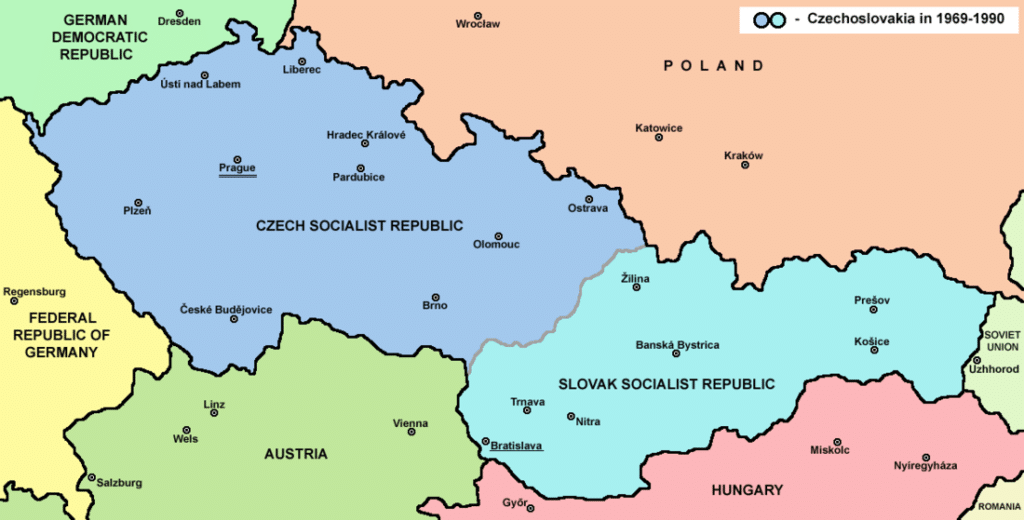
- Czechoslovakia peacefully separated into the Czech Republic and Slovakia in 1993 — a self-determined split of the federal state into two entities that had originally arisen as the Czech Socialist Republic and the Slovak Socialist Republic in 1969, within the framework of Czechoslovak federalisation.
- The split is sometimes known as the Velvet Divorce, a reference to the bloodless Velvet Revolution of 1989, which had ended the rule of the Communist Party of Czechoslovakia and brought about the formation of a democratic government.
Reasons for Separation
Mutual historical grievances:
- The Slovaks never fully embraced Czechoslovakism, the concept advocated by Czech leaders after 1918. While many appreciated the economic and educational assistance the Czech lands offered, they were critical of the patronising attitudes of many Czech leaders and their unwillingness to grant Slovakia greater autonomy.
- The Czechs, for their part, never forgot what they saw as a betrayal by Slovakia in 1939, when Slovakia formed its own state under Nazi protection — and later criticised the Slovaks for showing insufficient gratitude for avoiding the list of defeated nations after WWII, since Slovakia had been re-included within Czechoslovakia.
- During the communist era, many Czechs believed the Czech lands were subsidising Slovakia’s economic development through large transfers, and many did not favourably view the creation of the Czechoslovak federation in 1968.
- Common wisdom held that the Slovaks were punished far less after the 1968 Soviet invasion of Czechoslovakia, and even benefited from it — the subsequent era of “normalisation” was closely associated with Gustav Husák, a Slovak, and a political asymmetry emerged in the form of the Slovak Communist Party, which had no counterpart in the Czech Republic.
The asymmetrical nature of a two-state federation:
- A federation of two states of unequal size was, in itself, a difficult concept. The Federal Assembly, created by the constitutional amendment of 1968, was structured in a way bound to produce serious problems once the country regained democracy.
- These deficiencies were suppressed under centralised communist rule between 1968 and 1989, but once the federal institutions began operating in a politically free environment, problems emerged: first, a serious lack of clarity over the division of powers between republican and federal institutions; and second, the upper house of the Federal Assembly — the House of Nations — could in effect block meaningful reforms.
- The Federal Assembly’s growing inability to pass necessary federal laws became perhaps the most visible symbol of a mounting decision-making paralysis, as power gradually shifted from the federal government to the republican governments.
Incompatible political spectrums after the 1992 elections:
- Soon after the fall of communism — certainly after the June 1990 elections — it became clear the two republics were developing different political spectrums, with Slovakia’s shifting further left with a nationalist agenda.
- In the Czech Republic, the Communist Party did not reform itself and the Social Democratic Party was newly recreated from below, whereas Slovakia’s democratic left was represented by the reformed Communist Party.
- In the 1992 elections, self-described centre-right parties prevailed in the Czech Republic, while leftist and nationalist parties won in Slovakia, making it virtually impossible to form a functioning federal government.
Czech and Slovak nationalism:
- Slovak nationalism was an active expression of nation-building in a country that lacked the kind of historical experience of independent statehood the Czechs possessed.
- A parallel Czech nationalism also existed: Czechs identified more strongly with the idea of Czechoslovakia, in part because they held a privileged position within the two-state federation, where the other nation was half the size of the Czech one. Many Czech politicians were intellectually invested in an idea of Czechoslovakia in which the Czechs were, by definition, the more senior nation.
- Some Czech politicians also believed Slovakia was an economic burden — a version of Czech nationalism rooted in the belief that the Czechs were superior, more advanced, and more urbanised.
A lack of democratic experience in both countries:
- The growing Czech–Slovak rift might have been resolved by granting Slovakia greater autonomy, or by transforming the federation into a confederation — the Belgian or Canadian models of two nations coexisting within one state could have served as templates — but Czech–Slovak relations deteriorated at a time when many other pressing tasks demanded attention.
- Since Czech and Slovak politicians were only just learning the basics of democracy, there was a natural tendency on both sides to accelerate the process rather than fully explore democratic solutions.
Religious reason:
- Subtler differences also played a role, such as religion: most Czechs are irreligious, whereas most Slovaks are Roman Catholic.
The Process of Dissolution
- In the end, the dissolution of Czechoslovakia was a success in terms of the mechanisms and procedures used — a peaceful, negotiated process that produced none of the upheavals and bloody conflicts witnessed in the former Yugoslavia or parts of the Soviet Union.
- The main point of contention was whether Czechoslovakia should hold a referendum; the decision not to hold one proved fortunate. A single federal-level referendum would not have worked in a country of two unequal nations, while holding two separate referendums risked an unresolved outcome if one republic voted for the split and the other against it.
- It stands as something of a historical achievement that the Federal Assembly ultimately approved the federation’s dissolution, and that both sides agreed on a civilised division of federal assets and, eventually, the split of the monetary union.
After the Breakup
Impact on regional cooperation:
- The split initially had a negative impact on regional cooperation. The Visegrad grouping was downgraded, particularly as the Czechs began to propound an ideology of Czech exceptionalism and superiority toward other Visegrad countries.
- The Visegrad Group (Visegrad Four) is an alliance of four Central European states — the Czech Republic, Hungary, Poland, and Slovakia — for furthering European integration and advancing mutual military, economic, and energy cooperation.
- Slovakia’s slide into a semi-authoritarian regime further damaged regional cooperation, eventually forcing the other three Visegrad countries to leave Slovakia behind in their efforts to join NATO and other organisations.
Impact on international stature:
- A certain asymmetry also emerged in international stature: while the Slovaks became a more visible new international player (despite their reputation suffering under the semi-authoritarian regime), the Czech Republic was viewed as a truncated Czechoslovakia, and its international stature diminished.
- In relations with Germany and Austria — where demands were periodically raised by some organisations and politicians to re-evaluate the post-WWII expulsion of Sudeten Germans from Czechoslovakia — the Czech Republic found itself in a much weaker position than Czechoslovakia had been.
- The Czech Republic’s international stature began to improve visibly only after its admission to NATO in 1999.
Ethnicity:
- Another significant effect of the split was that the Czech Republic became almost ethnically homogeneous, while Slovakia became the most multicultural and multiethnic country in Central Europe, with ethnic Hungarians accounting for about 10 percent of its population, alongside other groups such as the Roma.
- Under the nationalist, semi-authoritarian government, Slovakia faced problems with its minorities, but the need for various ethnic groups to coexist ultimately contributed to improvements in the country’s political culture.
- The role of the EU was tremendously important and positive throughout — without EU integration, the story of the split could well have turned out to be a failure rather than a success for both nations.
2. Bulgaria
- The Bulgarian dictator Todor Zhivkov held the post of Secretary General of the Central Committee of the Bulgarian Communist Party continuously from 1954.
- Reforms toward social, political, and economic liberalisation across the Eastern Bloc began with Gorbachev’s reform programme in the Soviet Union, which was felt in Bulgaria in the late 1980s; the loosening of controls had, in fact, begun with the end of the Stalinist era and continued slowly toward the gradual breaking of the Iron Curtain — together with Gorbachev’s policies, this generated growing freedom and expectations of democracy among the Bulgarian people.
- In November 1989, demonstrations on ecological issues staged in Sofia soon broadened into a general campaign for political reform; that the Communists generally did not break up the demonstrations signalled the possibility of change to come.
- In February 1990, the Communist Party, forced by street protests, gave up its claim on power, and in June 1990 the first free elections since 1931 were held, won by the Bulgarian Socialist Party (the Communist Party’s new name). In July 1991, a new Constitution was adopted, providing for a representative, elected President along with a Prime Minister and Cabinet.
- The new system initially failed to improve living standards or generate economic growth, with average quality of life and economic performance remaining lower than under Communism.
- A 1997 reform package restored economic growth, though living standards continued to suffer; conditions improved greatly after 2001, by which point Bulgaria had achieved a high Human Development status.
- Bulgaria became a NATO member in 2004 and participated in the War in Afghanistan; after several years of further reform, it joined the European Union in 2007, despite continued concerns about government corruption.
3. Hungary
- By 1989, communist systems across the region were collapsing, but Hungary — despite facing economic and political crises of its own — went through an oddly calm process of democratisation.
- In 1989, reformers within the Communist Party agreed to “round table” talks with notable opposition leaders, laying the groundwork for multi-party democracy and a free market economy. In the first free elections of 1990, the centre-right Hungarian Democratic Forum (MDF), led by József Antall, won an overwhelming parliamentary majority with a clear mandate.
- The MDF advocated a gradual transition toward open markets, but the economic changes of the early 1990s brought declining living standards for most Hungarians.
- In 1991, most state subsidies were removed, triggering a severe recession that was worsened by the fiscal austerity needed to reduce inflation and stimulate investment.
- The Hungarian Socialist Party (MSZP), made up largely of former communists, won the 1994 elections and formed a coalition with the Free Democrats; four years later, the tide turned again with the centre-right Fidesz, under Viktor Orbán’s leadership, winning its first mandate. Throughout this period, all four main political parties advocated economic liberalisation and closer ties with the West.
- Hungary joined NATO in 1999, followed almost immediately by its involvement in the Yugoslav Wars. The European Union had begun membership negotiations with Hungary in 1998, and in a 2003 national referendum, 85 percent voted in favour of accession, which followed on 1 May 2004.
4. Poland
- The government’s inability to arrest Poland’s economic decline led to waves of strikes across the country in April, May, and August 1988. In an attempt to regain control, the government extended de facto recognition to the Solidarity union, and the Interior Minister began talks with its leader, Lech Wałęsa, on 31 August. A series of “round-table” talks began in February 1989.
- On 4 April 1989, the historic Round Table Agreement was signed, legalising Solidarity and setting up partly free parliamentary elections for 4 June 1989.
- Solidarity’s victory surpassed all predictions: its candidates captured every seat they were permitted to contest in the Sejm, while in the Senate they won 99 of the 100 available seats (the remaining seat going to an independent candidate); many prominent Communist candidates failed even to secure the minimum votes required for the seats reserved for them.
- The last Communist Prime Minister of Poland, General Czesław Kiszczak, agreed to resign to allow a non-Communist administration to form. Since Solidarity was the only other political grouping capable of forming a government, it was virtually assured that a Solidarity member would become prime minister.
- On 19 August 1989, Tadeusz Mazowiecki, an anti-Communist editor and Solidarity supporter, was nominated Prime Minister of Poland — and the Soviet Union voiced no protest, despite calls from hard-line Romanian dictator Nicolae Ceaușescu for the Warsaw Pact to intervene militarily “to save socialism,” as it had in Prague in 1968. Five days later, on 24 August 1989, Poland’s Parliament ended more than 40 years of one-party rule by making Mazowiecki the country’s first non-Communist Prime Minister since the early postwar years.
- On 29 December 1989, the Sejm amended the constitution to rename the country from the People’s Republic of Poland to the Republic of Poland; the communist Polish United Workers’ Party dissolved itself on 29 January 1990 and transformed into the Social Democracy of the Republic of Poland.
- In October 1990, the constitution was amended to curtail President Jaruzelski’s term, and in December, Lech Wałęsa became the first popularly elected President of Poland.
- A shock therapy programme initiated in the early 1990s transformed Poland’s socialist-style planned economy into a market economy. Like other post-communist countries, Poland suffered temporary slumps in social and economic standards, but it became the first post-communist country to reach its pre-1989 GDP levels, achieving this by 1995.
- The country also saw numerous improvements in human rights, including freedom of speech, internet freedom, civil liberties, and political rights.
- In 1991, Poland became a member of the Visegrad Group, and it joined NATO in 1999 alongside the Czech Republic and Hungary.
- Poles voted to join the European Union in a referendum in June 2003, becoming a full member on 1 May 2004; Poland joined the Schengen Area in 2007, dismantling its borders with other EU member states and enabling full freedom of movement within most of the EU.
5. Romania
- After the revolution, the National Salvation Front (NSF), led by Ion Iliescu, undertook only partial multi-party democratic and free-market measures.
- In April 1990, a sit-in protest contesting the election results and accusing the NSF — including Iliescu — of being made up of former Communists and members of the Securitate, rapidly grew into what became known as the Golaniad. The peaceful demonstrations degenerated into violence after Iliescu summoned coal miners to intervene, an episode remembered as the June 1990 Mineriad, the suppression of anti-NSF sit-in protests in Bucharest.
- The Front’s subsequent disintegration produced several political parties, including the Social Democratic Party and the Democratic Party; the former governed Romania from 1990 to 1996 through several coalitions and governments, with Iliescu as head of state, and there have been several democratic changes of government since.
- After the Cold War, Romania developed closer ties with Western Europe and the United States, eventually joining NATO in 2004 and hosting the 2008 NATO summit in Bucharest; the country joined the EU in 2007.
- During the 2000s, Romania enjoyed one of the highest economic growth rates in Europe and was at times referred to as “the Tiger of Eastern Europe.”
6. Slovenia
- In December 1991, a new constitution was adopted, followed in 1992 by laws on denationalisation and privatisation.
- Members of the European Union recognised Slovenia as an independent state on 15 January 1992, and the United Nations accepted it as a member on 22 May 1992.
- Slovenia joined the European Union on 1 May 2004, and also joined NATO in 2004.
7. Baltic Nations
(a) Estonia
- In 1989, during the “Singing Revolution,” more than two million people formed a human chain stretching through Lithuania, Latvia, and Estonia — the Baltic Way — in a landmark demonstration for independence; all three nations shared similar experiences of occupation and similar aspirations for regaining sovereignty. The Estonian Sovereignty Declaration had already been issued on 16 November 1988.
- On 20 August 1991, Estonia declared formal independence during the Soviet military coup attempt in Moscow, reconstituting its pre-1940 statehood; the Soviet Union recognised Estonian independence on 6 September 1991.
- Estonia joined NATO on 29 March 2004. The 2004 enlargement of the European Union was the largest single expansion of the EU in terms of territory and population, though not in terms of GDP — Estonia was among a group of ten countries admitted to the EU on 1 May 2004.
(b) Latvia
- In the summer of 1987, the first large demonstrations were held in Riga at the Freedom Monument, a symbol of independence; by the summer of 1988, a national movement had coalesced into the Popular Front of Latvia, opposed by the Interfront.
- The Latvian SSR, along with the other Baltic Republics, was granted greater autonomy, and in 1988 the old pre-war Flag of Latvia flew again, replacing the Soviet Latvian flag as the official flag in 1990.
- In 1989, the Supreme Soviet of the USSR adopted a resolution on the Occupation of the Baltic states, declaring the occupation “not in accordance with law” and not the “will of the Soviet people.” Pro-independence Popular Front of Latvia candidates won a two-thirds majority in the Supreme Council in the March 1990 democratic elections, and on 4 May 1990, the Supreme Soviet of the Latvian SSR adopted the Declaration on the Restoration of Independence of the Republic of Latvia, renaming the Latvian SSR the Republic of Latvia.
- In January 1991, Soviet political and military forces unsuccessfully tried to overthrow the Republic of Latvia’s authorities; during the transitional period, Moscow retained many central Soviet state authorities in Latvia.
- The Popular Front of Latvia advocated universal citizenship for all permanent residents, but this was not adopted, and the majority of ethnic non-Latvians did not receive Latvian citizenship — today, 290,660 non-citizens remain in Latvia, representing 14.1 percent of the population, holding no citizenship of any country.
- The Republic of Latvia declared the end of the transitional period and restored full independence on 21 August 1991, in the aftermath of the failed Soviet coup attempt.
- Russia completed its troop withdrawal in 1994 and shut down the Skrunda-1 radar station in 1998; Latvia’s major goals of the 1990s — joining NATO and the European Union — were both achieved in 2004.
(c) Lithuania
- The advent of perestroika and glasnost in the late 1980s allowed the establishment of Sąjudis, an anti-Communist independence movement. After a landslide victory in elections to the Supreme Soviet, Sąjudis members proclaimed Lithuania’s independence on 11 March 1990, making it the first Soviet republic to do so; the Soviet Union attempted to suppress the secession through an economic blockade.
- On 4 February 1991, Iceland became the first country to recognise Lithuanian independence. After the Soviet August Coup, independent Lithuania received wide official recognition and joined the United Nations on 17 September 1991; the last Soviet troops left Lithuania on 31 August 1993 — even earlier than they departed East Germany.
- Seeking closer ties with the West, Lithuania applied for NATO membership in 1994. After transitioning from a planned to a free-market economy, Lithuania became a full member of both NATO and the European Union in 2004, and joined the Schengen Agreement on 21 December 2007.
8. Ukraine
- On 16 July 1990, Ukraine’s new parliament adopted the Declaration of State Sovereignty of Ukraine, establishing the principles of self-determination, democracy, and independence, and asserting the priority of Ukrainian law over Soviet law — a month after a similar declaration had been adopted by the parliament of the Russian SFSR, beginning a period of confrontation with the central Soviet authorities.
- In August 1991, a conservative faction among the Soviet Union’s Communist leaders attempted a coup to remove Mikhail Gorbachev and restore the party’s power; after it failed, the Ukrainian parliament adopted the Act of Independence on 24 August 1991.
- A referendum and Ukraine’s first presidential elections took place on 1 December 1991, with more than 90 percent of the electorate supporting the Act of Independence and electing parliament chairman Leonid Kravchuk as the country’s first President.
- At a meeting in Brest, Belarus, on 8 December, followed by the Alma-Ata meeting on 21 December, the leaders of Belarus, Russia, and Ukraine formally dissolved the Soviet Union and formed the Commonwealth of Independent States (CIS).
- Though initially viewed as having more favourable economic conditions than other Soviet regions, Ukraine went on to experience a deeper economic slowdown than some other former Soviet republics — losing 60 percent of its GDP between 1991 and 1999 and suffering five-digit inflation rates, prompting protests and strikes over the economic conditions as well as crime and corruption.
- The Ukrainian economy stabilised by the end of the 1990s; a new currency, the hryvnia, was introduced in 1996, and after 2000 the country enjoyed steady real economic growth.
- A new Constitution of Ukraine was adopted in 1996 under second President Leonid Kuchma, turning Ukraine into a semi-presidential republic with a stable political system, although Kuchma himself was criticised by opponents for corruption, electoral fraud, discouraging free speech, and concentrating excessive power in his office.
- Ukraine also pursued full nuclear disarmament, giving up the third-largest nuclear weapons stockpile in the world and dismantling or removing all strategic bombers on its territory.
9. Belarus
- Belarus declared itself sovereign on 27 July 1990, and with the support of the Communist Party, the country’s name was changed to the Republic of Belarus on 25 August 1991.
- Stanislav Shushkevich, chairman of the Supreme Soviet of Belarus, met Boris Yeltsin of Russia and Leonid Kravchuk of Ukraine on 8 December 1991 at Belavezhskaya Pushcha to formally declare the Soviet Union’s dissolution and the formation of the Commonwealth of Independent States.
- A national constitution was adopted in March 1994, under which the functions of prime minister were assigned to the President of Belarus.
- Two-round elections for the presidency, held on 24 June and 10 July 1994, catapulted Alexander Lukashenko to national prominence; he was re-elected in 2001, 2006, and again in 2010, and has been criticised for his authoritarian style of government.
10. Russia
- In June 1991, Boris Yeltsin became the first directly elected President in Russian history when he won the presidency of the Russian Soviet Federative Socialist Republic, which became the independent Russian Federation in December of that year.
- During and after the Soviet Union’s disintegration, wide-ranging reforms — including privatisation and market and trade liberalisation — were undertaken, including radical “shock therapy” measures (the sudden release of price and currency controls, withdrawal of state subsidies, immediate trade liberalisation, and large-scale privatisation of previously public-owned assets) as recommended by the United States and the International Monetary Fund.
- This produced a major economic crisis, marked by a 50 percent decline in both GDP and industrial output between 1990 and 1995.
- Privatisation largely shifted control of enterprises from state agencies to individuals with inside government connections, and many of the newly rich moved billions in cash and assets abroad in an enormous capital flight. The economic depression led to the collapse of social services — the birth rate plummeted while the death rate skyrocketed, and millions were plunged into poverty, from a 1.5 percent poverty rate in the late Soviet era to 39–49 percent by mid-1993.
- The 1990s saw extreme corruption and lawlessness, alongside a rise in criminal gangs and violent crime, as well as armed conflicts in the North Caucasus, including both local ethnic skirmishes and separatist Islamist insurrections.
- After Chechen separatists declared independence in the early 1990s, an intermittent guerrilla war — the First Chechen War, a conflict between the Russian Federation and the Chechen Republic of Ichkeria — was fought between rebel groups and the Russian military.
The First Chechen War
- Predominantly Muslim Chechens had for centuries gloried in defying the Russians. Dzhokhar Dudayev, Chechnya’s nationalist president, took his republic out of the Russian Federation and declared Chechnya’s independence in 1991, submerging Russia in a Vietnam-like quagmire.
- Russian forces attacked the Chechen capital, Grozny, during the first weeks of January 1995, suffering humiliating losses with demoralised and ill-equipped troops, and had still not secured the city by year’s end; the Russians finally gained control of Grozny in February 1995 after heavy fighting.
- In August 1996, Yeltsin agreed to a ceasefire with Chechen leaders, and a peace treaty was formally signed in May 1997. The conflict resumed in 1999 as the Second Chechen War, rendering the 1997 peace accord meaningless; this time, the rebellion was brutally crushed by Vladimir Putin.
- Terrorist attacks against civilians carried out by separatists — most notably the Moscow theatre hostage crisis and the Beslan school siege — caused hundreds of deaths and drew worldwide attention.
- Russia took up responsibility for settling the USSR’s external debts, even though its population made up just half of the USSR’s total population at the time of dissolution.
- High budget deficits caused the 1998 Russian financial crisis (the “Ruble crisis”), which hit Russia on 17 August 1998 and resulted in the Russian government and Central Bank devaluing the ruble and defaulting on its debt, leading to a further GDP decline.
- On 31 December 1999, President Yeltsin unexpectedly resigned, handing the post to recently appointed Prime Minister Vladimir Putin, who then won the 2000 presidential election and suppressed the Chechen insurgency.
- High oil prices, combined with an initially weak currency followed by increasing domestic demand, consumption, and investment, helped the Russian economy grow for nine straight years, improving living standards and increasing Russia’s influence on the world stage.
Breakup of Yugoslavia
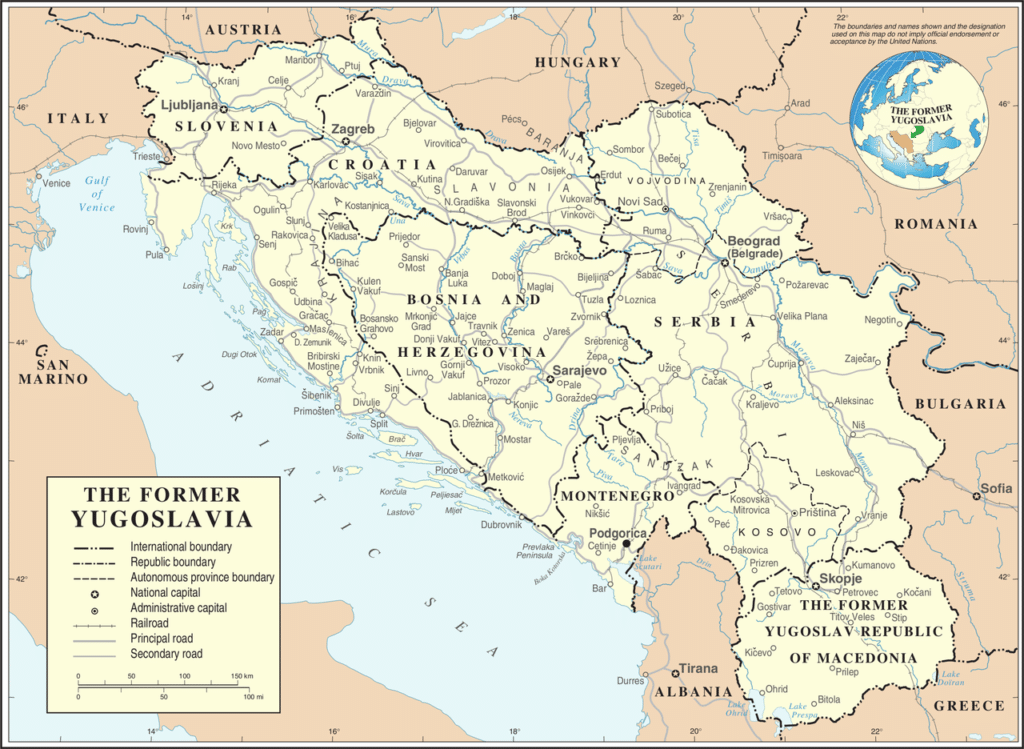

Background
- Yugoslavia — the land of the South (i.e., “Yugo”) Slavs — was created at the end of World War I, when Croat, Slovenian, and Bosnian territories that had been part of the Austro-Hungarian Empire united with the Serbian Kingdom.
- After World War II, Josip Broz Tito, who had liberated the country from the Nazis, organised it into a federal union. While ostensibly a communist state, Yugoslavia broke away from the Soviet sphere of influence in 1948, became a founding member of the Non-Aligned Movement in 1961, and adopted a more decentralised, less repressive form of government compared with other East European communist states during the Cold War.
- Yugoslavia was a federal union of six republics — Serbia, Croatia, Slovenia, Macedonia, Bosnia & Herzegovina, and Montenegro — and two autonomous provinces, Kosovo and Vojvodina.
Factors Responsible for the Breakup
- Internal factors included cultural and religious divisions between the ethnic groups, memories of WWII-era atrocities committed by all sides, centrifugal nationalist forces, and the death of Tito in 1980, since he had been able to sustain the union despite its several internal contradictions.
- The 1974 constitution provided for the devolution of real power away from the federal government to the republics and autonomous provinces, establishing a collective presidency of eight provincial representatives and a federal government with little control over economic, cultural, and political policy.
- External factors also eroded Yugoslavia’s political stability: the collapse of communism in Eastern Europe in 1989, the unification of Germany a year later, and the imminent collapse of the Soviet Union.
- As Eastern European states moved away from communist government toward free elections and market economies, Western attention shifted away from Yugoslavia, undermining the extensive economic and financial support needed to preserve a Yugoslav economy already close to collapse; the absence of a Soviet threat to Yugoslavia’s integrity also removed a powerful incentive for internal unity and cooperation.
- Role of Slobodan Milošević: Milošević, Serbia’s president from 1989, exploited the vacuum created by a weakening central state, deploying Serbian ultra-nationalism to fan conflict in the other republics and gain legitimacy at home — stripping the autonomous provinces of Kosovo and Vojvodina of their constitutionally guaranteed autonomy within Serbia.
- Democratisation in Eastern Europe: the ongoing effects of democratisation elsewhere in Eastern Europe were felt throughout Yugoslavia; elections in Slovenia and Croatia in 1990 gave non-communist parties control of the state legislatures and governments.
The Breakup (1990–1997)
- The breakup of Yugoslavia refers to a series of events between 1990 and 1997, driven by strong nationalistic feelings and political problems, compounded by rivalries and fighting between ethnic groups. The death of Tito and the fall of communism left the country in chaos, with different ethnic groups fighting over land and power.
- Slovenia was the first to declare independence, in 1991; the Yugoslav Army (JNA) briefly intervened but then withdrew, effectively confirming Slovenia’s separation.
- Croatia followed later in 1991. Its Serb minority declared its own independence and expressed a desire to join Serbia, sparking violence between armed militias; the JNA intervened ostensibly to separate the combatants, but it quickly became apparent that it favoured the Croatian Serbs, before a ceasefire was arranged by the UN.
- Macedonia declared independence following a September 1991 referendum, and a US peacekeeping and monitoring force was dispatched to its border with Serbia to monitor violence.
- Bosnia-Herzegovina declared independence in 1992. Its population comprised Muslim Bosniaks (44%), Orthodox Serbs (32.5%), and Catholic Croats (17%), and a complex conflict emerged — the Bosnian War — between Bosnian Serbs (backed by Serbia) and an alliance of Bosnian Muslims and Bosnian Croats.
- The war saw the ethnic cleansing of Muslims in Serb-controlled areas, culminating in the Srebrenica massacre of more than 8,000 Bosnian Muslims by Serbian troops, carried out in the presence of a Dutch UN peacekeeping force.
- In February 1994, in NATO’s first-ever use of force, NATO fighters shot down four Serb aircraft violating the no-fly zone; in May 1995, NATO conducted air strikes on the Serb stronghold. Around 100,000 people were killed during the war, and over 2.2 million were displaced.
- The US-sponsored Dayton Accords, signed in 1995, ended the war in Bosnia and outlined a framework for peace in Bosnia and Herzegovina.
- In 1992, Serbia (with Vojvodina and Kosovo) and Montenegro formed a new Federal Republic of Yugoslavia as the successor state to old Yugoslavia; in 2003, this became a looser state union of Serbia (subsuming Vojvodina) and Montenegro, before Montenegro and Serbia separated entirely in 2006.
- Kosovo separated last: in 1998–1999, violence erupted in the province as its majority Albanian population called for independence from Serbia. A NATO bombing campaign and economic sanctions forced the Milošević regime to accept a NATO-led international peacekeeping force, and the province was placed under UN administrative mandate; in 2008, Kosovo unilaterally declared its independence from Serbia.
- In the end, the Socialist Federal Republic of Yugoslavia broke down into seven new states after a bloody civil war: Slovenia, Croatia, Macedonia, Bosnia-Herzegovina, Kosovo, Serbia, and Montenegro.

Conclusion
The political transformation of Eastern Europe between 1989 and 2001 unfolded along two very different paths: the largely peaceful, negotiated dissolution of federations and the Soviet Union itself — from Czechoslovakia’s “Velvet Divorce” to the orderly emergence of Ukraine, Belarus, and the Baltic states — and the violent unravelling of Yugoslavia, where nationalist mobilisation and the absence of external restraint produced a decade of ethnic conflict. For UPSC History Optional aspirants, the contrast between these two trajectories offers rich material for comparative analysis of how federal states handle the pressures of democratisation, nationalism, and the end of one-party rule, and how the same historical moment — the collapse of Soviet communism — could produce such starkly different outcomes across the region.