

Sufi Movements: Introduction

- The medieval period witnessed the rise and development of a large number of Muslim religious movements, mystic organisations, religious cults, and devotional attitudes — the most influential of these being Sufism, the mystical tradition within Islam.
- Sufism aims at establishing direct communion between God and man through the personal experience of mystery that lies within Islam itself.
- Every religion gives rise to mystical tendencies at a particular stage of its evolution — in this sense, Sufism represents a natural development within Islam, rooted in the spirit of Quranic piety, and emerged as a kind of schism against the institutionalised or dogmatic creed.
- The Sufis, while accepting the Shariat, did not confine their religious practice to formal adherence alone — instead, they stressed the cultivation of religious experience aimed at the direct perception of God.
- Where the scholars of Kalam were mainly concerned with defending divine transcendence (the idea that God stands above His creation, not one with it), Sufism instead sought the inner realisation of divine unity by arousing intuitive and spiritual faculties. Rejecting purely rational argument, the Sufis advocated contemplation and meditation, finding justification in the esoteric aspects of Islam — centred on the purification of the heart through ethical regeneration.
- This orientation is captured in the Islamic doctrine that Allah should be worshipped with the certainty that the worshipper is watching Allah, or that He is watching the worshipper.
Meaning of Sufi
- The term Sufi most likely derives from the Arabic word suf, meaning “wool” — a reference to the coarse woollen garments worn by eastern ascetics, a practice the Sufis themselves adopted as a mark of poverty.
- An alternative root traces the word to safa, meaning “purity.”
Origin of Sufism
- Some of the earliest Sufis — such as the woman mystic of Basra, Rabia, and Mansur-al-Hallaj — placed great emphasis on love as the essential bond between God and the individual soul.
- The earliest Sufis traced their ideas to specific verses of the Quran and the Hadis (Traditions of the Prophet); over time, however, Sufism absorbed influences from a range of other sources, including Christianity, Zoroastrianism, Buddhism, and the Indian philosophical systems of Vedanta and Yoga.
- Mysticism was viewed with open disfavour by Muslim fundamentalists, and Sufis were consequently persecuted — some were even executed on charges of heresy and blasphemy.
- The Sufis offered mystic interpretations of scripture, whereas orthodox Muslims insisted on literal interpretation.
- Orthodox Muslims emphasised external conduct, while the Sufis sought inner purity; the orthodox stressed blind obedience to religious ritual, while the Sufis regarded love alone as the true means of reaching God.
- The Sufis used singing and dancing — practices forbidden by the orthodox — as a means of inducing a state of ecstasy, believed to bring the Sufi closer to the ultimate goal of union with God.
Features of Sufism
- A number of Sufi orders (silsilah) developed both in and outside India, each with its own specific character, but sharing several common features:
- A stress on traversing the Sufi path (tariqa) as the method for establishing direct communion with divine reality (haqiqat).
- The novice was required to pass through a succession of “stations” or “stages,” and through changing psychological conditions known as “states” (maqamat), in order to experience God.
- This path could only be traversed under the strict supervision of a spiritual guide — a shaikh, pir, or murshid — who had himself successfully completed the journey and thereby established direct communion with God.
- The disciple (murid) progressed through these stages and states by practising spiritual exercises, such as self-mortification (subjugating desire through self-discipline) and the recollection of God’s name for concentration.
- The Sufis practised sama (musical recital), intended to induce a mystical state of ecstasy — a practice the Ulema regarded with hostility.
- The sama was justified on the grounds that a Sufi is a lover of God, and therefore stands in a fundamentally different relation to God than those who are merely ‘abd’ (slaves); since music inflames the “fire of love” and helps produce the supreme state of ecstasy, it was considered permissible.
- Sufis organised themselves into various orders (silsilah) — such as the Suhrawardi, Qadiri, and Chishti — each centred on a hospice (khanqah), where the pir imparted spiritual training to disciples.
- The popularity of a khanqah, and its capacity to attract disciples, depended directly on the reputation of its pir; khanqahs themselves were sustained through endowment and charity.
Tasawwuf
- Sufism follows Tasawwuf — a term with hundreds of scholarly definitions, but which can be understood simply as the “inwardness” of Islam.
- The core elements of Tasawwuf philosophy include:
- Marifat / Ittisal / Wasl — mystical union with God.
- Zikr — the constant remembrance of God.
- Sama — a special, climactic form of zikr, involving dancing and music.
- Tark-i-Duniya — the rejection of worldly things, and a focus of thought exclusively on otherworldly matters.
- Fana-o-Baqa — the dissolution of self, which creates the necessary ground for union with God.
- Wahdat-ul-Wujud / Tauhid-i-Wujudi — the doctrine of unity between God and all beings.
- A broader focus on values such as repentance, perseverance, pity, charity, service, equality, and pacifism.
Advent of the Sufis to India
- Sufis migrated to distant lands, living among non-Muslims and carrying out their work of proselytisation through peaceful means.
- The advent of Sufism in India dates back to the Arab conquest of Sindh; following the establishment of Muslim rule in northern India, Sufis from across the Muslim world began to migrate and settle throughout the subcontinent.
- Notably, early Sufi saints arrived in India even before the establishment of the Delhi Sultanate.
- The basic features of Sufism in India initially mirrored those of the wider Islamic world, but its subsequent development came to be shaped far more by the Indian environment than by non-Indian variants of the tradition.
- Once Sufi orders took root across different parts of India, each followed its own distinct phases of growth, stagnation, and revival — determined largely by local, indigenous circumstances, even as the influence of developments in Sufism outside India continued to persist.
- Al Hujwiri (AD 1088) was the earliest Sufi known to have settled in India, and was the author of the Kashf-ul Mahjub, a celebrated Persian treatise on Sufism.
- Following the establishment of the Delhi Sultanate, various Sufi orders were introduced into India, which became a new home for Sufis fleeing (along with many other refugees) from across the Islamic world.
- By the middle of the 14th century, most of the subcontinent had come under the influence of Sufi activity — among the various orders, the Chishti order emerged as by far the most popular.
The Silsilahs
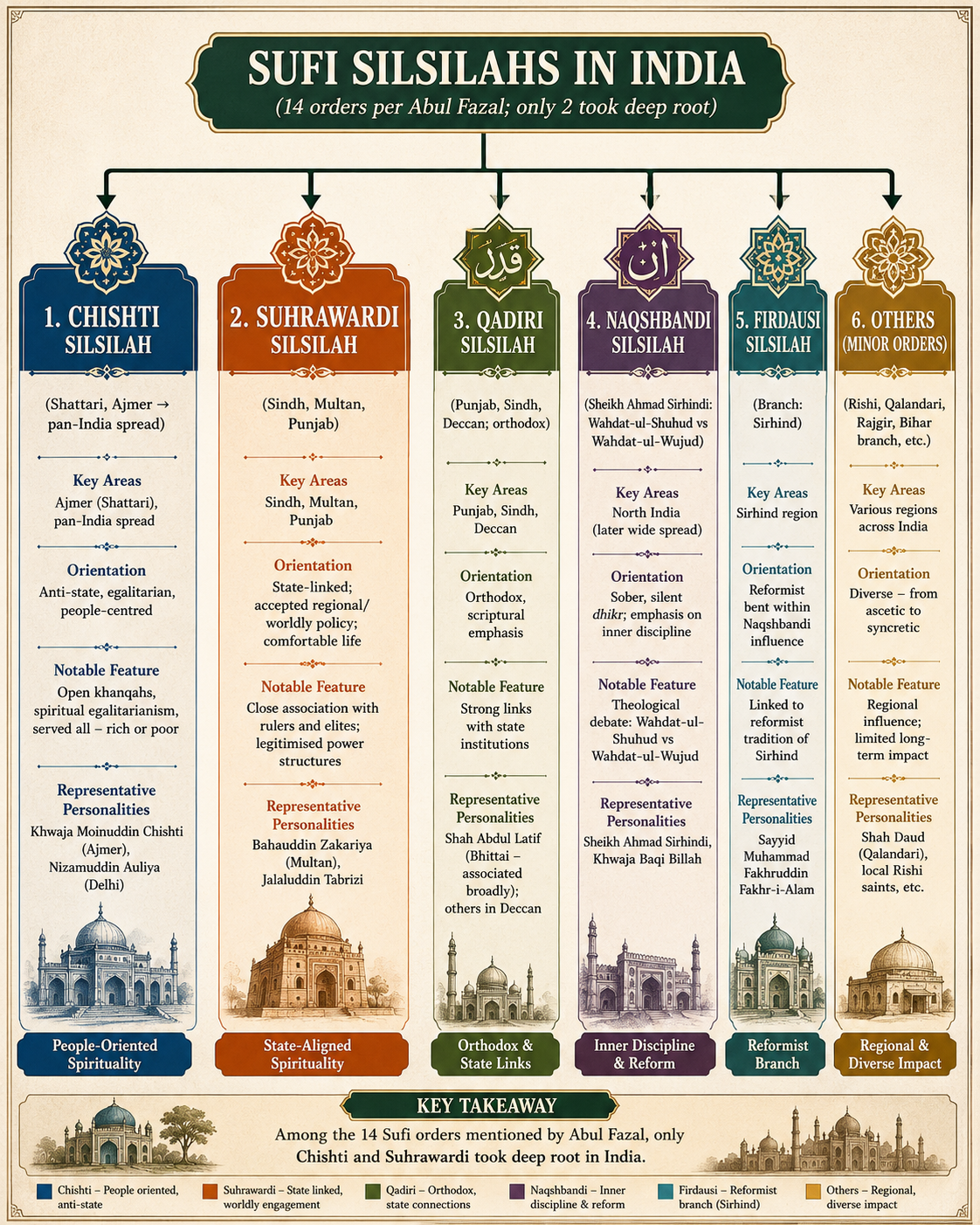
- Sufis in India came to be organised into a number of distinct silsilahs (orders). Abul Fazal documents a list of fourteen such orders that came to India — though of these, only two, the Chishti and Suhrawardi silsilahs, took genuinely deep root in Indian soil.
- The Chishti silsilah centred initially on Ajmer, gradually spreading to Rajasthan, Punjab, Uttar Pradesh, Bihar, Bengal, Orissa, and the Deccan.
- The Suhrawardi silsilah remained largely confined to Sindh, Multan, and Punjab.
The Chishti Silsilah
- The Chishti order itself was founded in Herat by Khwaja Abdul Chishti (d. 966).
- On the advice of his spiritual guide, Khwaja Muinuddin Chishti reached India in 1190 and settled at Ajmer, where he is said to have died in 1234 (some accounts give 1236).
- Muinuddin Chishti’s own sayings reveal a life’s mission centred on inculcating piety, humility, and devotion to God — he held that those who truly know God avoid mixing with others and remain silent on matters of divine knowledge.
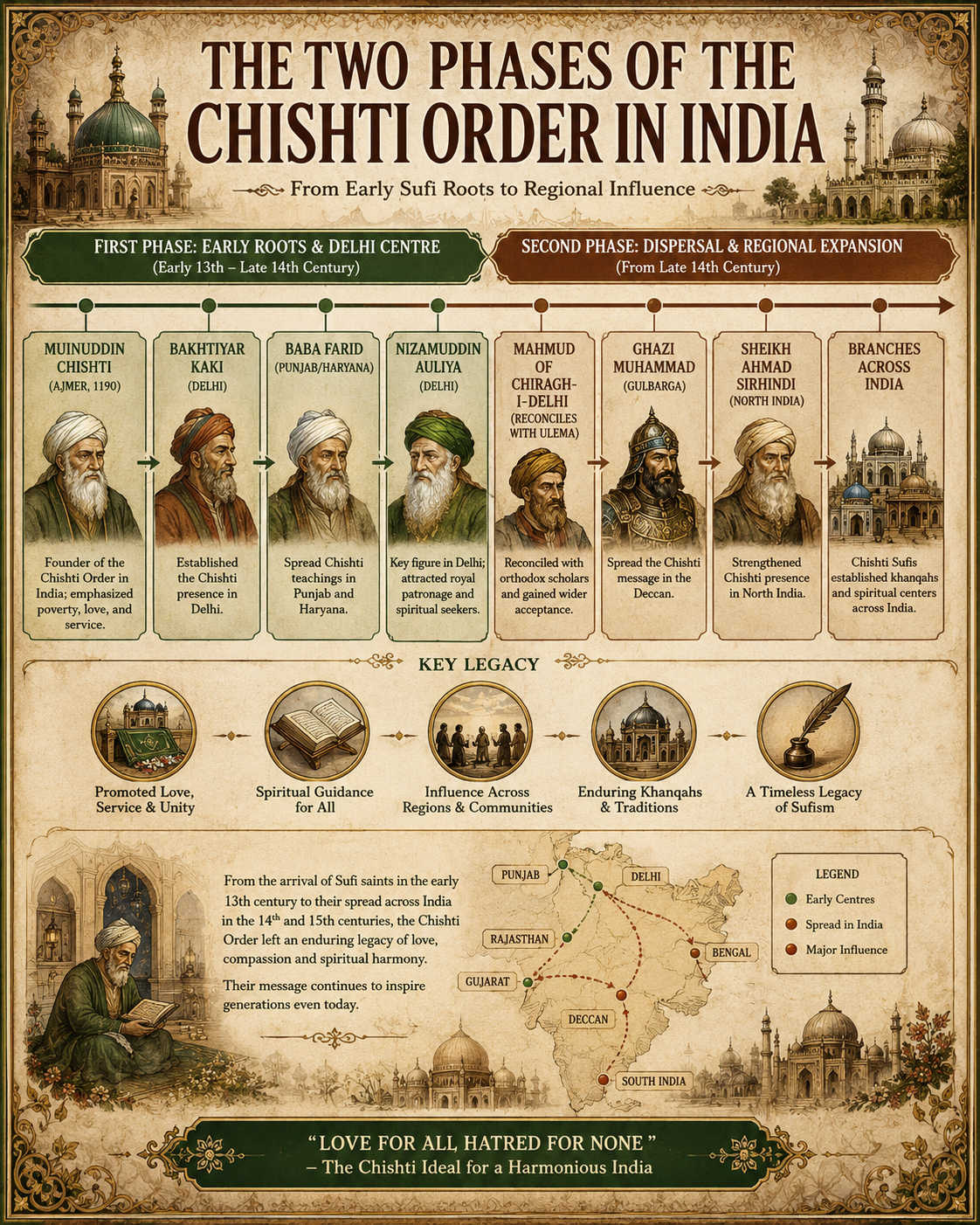
- After his death, the silsilah made notable progress under his able disciples. The growth of this order in India can be traced across two broad phases.
First Phase (Early 13th to Later 14th Century)
- Khwaja Muinuddin Chishti (d. 1236), a native of Persia and disciple of Khwaja Usman Haruni, introduced the order in India — arriving in 1190 during the Ghori conquest and settling in Ajmer around 1206.
- His simple, pious, and dedicated life left a deep impact on all who encountered him; he was respected by both Muslims and non-Muslims alike, was not actively involved in religious conversion, and maintained a broadly tolerant attitude toward non-Muslims. His tomb at Ajmer later became a celebrated centre of pilgrimage.
- His two eminent disciples, Shaikh Qutbuddin Bakhtiyar Kaki (d. 1235) and Shaikh Hamiduddin (d. 1276, after a long simple life in Nagaur, Rajasthan), popularised the Chishti order in Delhi and Rajasthan respectively.
- Both lived genuinely simple lives; Hamiduddin was a strict vegetarian who mixed freely with Hindus, while Bakhtiyar Kaki, settled in Delhi during the reign of Iltutmish, notably refused royal patronage — the famous Qutub Minar was named in his honour.
- The Chishti mystics believed deeply in the spiritual value of music — Bakhtiyar Kaki is said to have died in a state of ecstasy under the spell of music.
- Shaikh Fariduddin Ganj-i-Shakar, known as Baba Farid, was a disciple (khalifa) of Bakhtiyar Kaki, and popularised the Chishti order across Haryana and Punjab.
- He led the life of a householder, and some of his sayings were later included in the Adi Granth of the Sikhs some three centuries afterward.
- Baba Farid deliberately kept himself distant from political personalities, avoiding contact with the rich and powerful — advising his disciple Syed Maula: “Do not make friends with kings and nobles. Consider their visits to your home as fatal for your spirit. Every darwesh who makes friends with kings and nobles will end badly.” He conveyed much the same message to his chief disciple, Shaikh Nizamuddin Auliya, emphasising dissociation from kings.
- Baba Farid died in 1265, at the age of 93.
- Shaikh Nizamuddin Auliya (1236–1325) was the most prominent successor of Baba Farid, and made Delhi the most famous centre of the Chishti order.
- Though he lived through the reigns of seven Delhi sultans, he never once visited any of their courts. His liberal outlook, along with his evident delight in music, drew sharp denunciation from the orthodox Ulema.
- He gave a distinctly Islamic character to the socio-cultural life of the capital, stressing love as the central means of realising God — inspiring men to overcome their attachment to worldly affairs, and preaching that the love of God remains incomplete without the love of humanity; he held that social justice and benevolence were themselves integral parts of Islam.
- Unlike many other Chishti saints, Nizamuddin Auliya practised celibacy, and adopted yogic breathing exercises so thoroughly that local yogis regarded him as a siddha (perfect being). The langar at his khanqah was open to both Muslims and non-Muslims alike.
- Amir Khusrau (1253–1325) was a devoted disciple of Nizamuddin Auliya; his teachings and conversations were recorded by Amir Hasan Sijzi in the Fawaid-ul Fuad. Even after his death in 1325, the Shaikh continued to command tremendous respect.
- The message of love preached by Nizamuddin Auliya was subsequently carried across the country by his disciples:
- Shaikh Sirajuddin Usmani carried the message to Bengal, and was succeeded there by Shaikh Alaudin Ala-ul Haq, who continued the work in eastern India.
- Shaikh Burhanuddin, another disciple, settled at Daultabad, from where his own disciple Shaikh Zainuddin continued to preach.
- In Gujarat, Shaikh Syed Hussain, Shaikh Husamuddin, and Shah Brakatullah spread the message of equality and humanitarianism.
- Shaikh Nasiruddin Mahmud (d. 1356), the successor of Nizamuddin Auliya, came to be known as Chiragh-i-Delhi (“Lamp of Delhi”).
- He, along with some of his disciples, deliberately discontinued certain early Chishti practices that clashed with Islamic orthodoxy, in an effort to reconcile the order with the Ulema.
Decline of the Chishti Order in Delhi (Later Tughluq and Sayyid Periods)
- Some scholars attribute the decline of Delhi as a centre of the Chishti order to the attitudes and policies of Sultan Muhammad Tughluq — but this explanation appears inadequate, since Feroz Shah Tughluq, Muhammad Tughluq’s successor, in fact showered the Chishtis with gifts.
- More convincing reasons for the decline include:
- Shaikh Nasiruddin died without appointing a spiritual successor.
- His chief disciple, Gesu Daraz, fled Delhi for the relative safety of the Deccan at the time of Timur’s invasion (AD 1398).
- As the Delhi Sultanate itself began to decline and fragment, Sufis dispersed to the more stable provincial kingdoms, establishing new khanqahs there — a dispersal that brought real changes to their attitudes and practices.
Second Phase: Dispersal into the Provincial Kingdoms
- The second phase of Chishti history during the Sultanate period thus began with its decline in Delhi following Shaikh Nasiruddin’s death, and the order’s subsequent dispersal into various regional kingdoms.
- Shaikh Burhanuddin Gharib introduced the Chishti order into the Deccan during the reign of Muhammad Tughluq.
- The Chishti Sufis who migrated to Gulbarga (capital of the Bahmani kingdom) developed close relations with the court, accepting state patronage — Bahmani kings, in effect, purchased the political loyalty of these Sufis through land grants.
- Muhammad Banda Nawaz, Gesudaraz (c. 1321–1422) was the most prominent Sufi of this Deccan phase — an orthodox figure who declared the supremacy of Islamic law (Shariat) over all Sufi stages, and discontinued many early Chishti practices that had displeased the Ulema. His dargah at Gulbarga later developed into a major centre of pilgrimage in the Deccan.
- The Chishti tradition in Gulbarga itself eventually declined, for two main reasons: the transformation of Gesudaraz’s own descendants into a landed elite indifferent to genuine Chishti teachings, and the shift of the Bahmani capital from Gulbarga to Bidar in 1422 — the Bidar court’s pro-foreigner, anti-Deccani bias encouraged the immigration of foreign Sufis while withholding patronage from the Chishtis, who were seen as “too Indian.”
- Shaikh Salim Chishti (1478–1572) saw the Chishti order rise again to prominence under Akbar, owing directly to the emperor’s personal devotion to the saint of Fatehpur.
- Salim Chishti lived as an ordinary householder in his cave-dwelling at Sikri, and served as Akbar’s spiritual guide — Akbar named his own first son, Salim (the future Emperor Jahangir), in the saint’s honour. Bairam Khan, another prominent figure of the era, held Aziz Chishti in similarly high esteem.
- The Chishti tradition of Shahpur Hillock (from the late 15th through the 16th and 17th centuries) followed a rather distinct trajectory — maintaining deliberate distance from both the court and the Ulema, and drawing its inspiration instead from local influences. Closer in spirit to the early Delhi Chishtis, it developed independently of both the Delhi and Gulbarga traditions.
- In North India (later 15th and early 16th century), three distinct Chishti branches emerged:
- The Nagauriya branch (after Shaikh Hamiduddin Nagauri).
- The Sabiriya branch (after Shaikh Alauddin Kaliyari) — Shaikh Abdul Quddus Gangohi (d. 1537), a mystic of this order, was a noted exponent of the doctrine of Wahdat-ul Wujud (“Unity of Being”).
- The Nizamiya branch (after Shaikh Nizamuddin Auliya), founded by Makhdum Alauddin Ali Sabri, who isolated himself from worldly affairs and lived as a recluse.
Causes of Chishti Popularity
- Of all the Sufi orders, the Chishti silsilah emerged as by far the most popular — its rituals, attitudes, and practices made it a genuinely Indian silsilah in character.
- Many early Chishti practices closely resembled those of already-existing non-conformist religious orders in India, including asceticism, bowing before the master, shaving the head of new entrants, and the organisation of spiritual musical recitals.
- Most Chishti saints belonged to a broadly liberal school of thought, and their popularity in India stemmed directly from their genuine understanding of Indian conditions and the religious attitudes and aspirations of the Indian people.
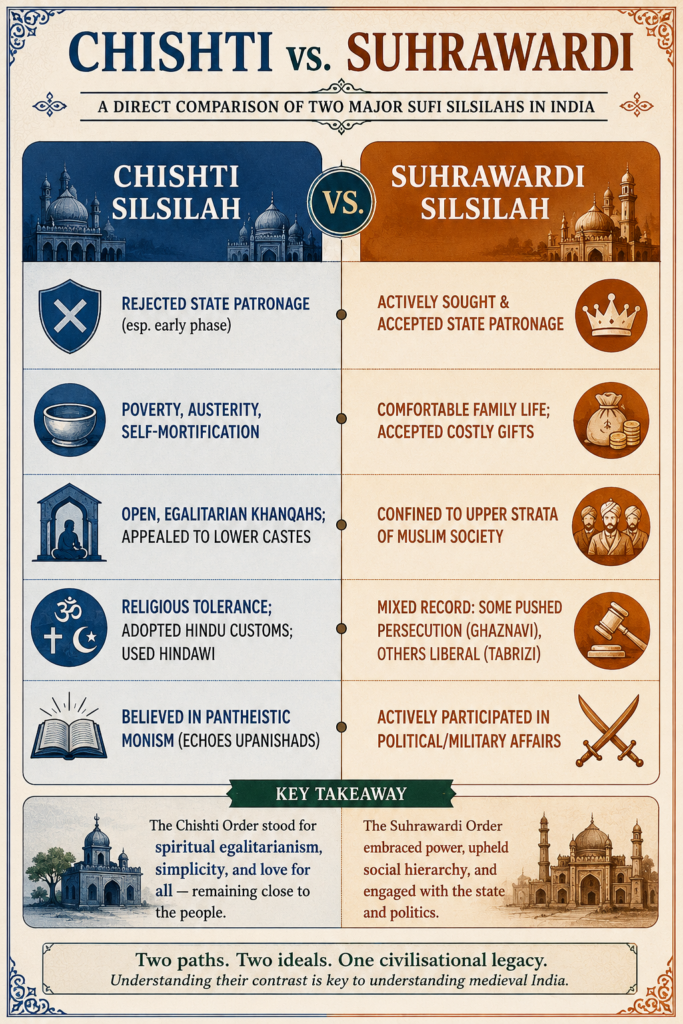
- The Chishtis adopted an attitude of religious tolerance toward India’s non-Muslim population, using Hindawi, popular imagery, and popular idiom to convey their teachings — and readily adopted many Hindu customs and ceremonies, placing heavy emphasis on service to mankind.
- The Chishti mystics were believers in pantheistic monism, a doctrine with its earliest exposition in the Upanishads — as a result, many Hindus felt a genuine closeness to the Chishti silsilah.
- The egalitarian atmosphere of Chishti khanqahs drew people from the lower sections of Indian society — the caste distinctions of the Brahmanical social order held no meaning within the khanqah, and the Chishtis showed real sympathy toward society’s deprived sections, rejecting the two-fold racial division imposed by the Turkish ruling class between “noble-born” and “low-born” people.
- Additional factors behind Chishti popularity include: the excellent leadership of the early Chishti masters; their outright rejection of orthodoxy; their unwillingness to accept state patronage, combined with a simple presentation of Islamic precepts alongside Sufi teaching; the hostile attitude of the Ulema, which paradoxically enhanced their popular appeal; and the proliferation of miracle stories about early Chishtis, which greatly boosted the popularity of Chishti dargahs and the posthumous reputation of the saints themselves — later writers and legend-makers accorded them considerable, sometimes excessive, respect.
The Suhrawardi Silsilah
- Shaikh Shahabuddin Suhrawardi (d. 1234) initiated this silsilah in Baghdad; his disciples Shaikh Bahauddin Zakariya and Shaikh Jalaluddin Tabrizi were specifically designated to spread the order in India.
- Shaikh Bahauddin Zakariya (1182–1262), the order’s founder in India, carried out his missionary work at Multan.
- He sided with Iltutmish in his conquest of Multan against Qubacha, and secured state patronage from the Delhi Sultanate as a direct consequence — receiving from Iltutmish the title Shaikh-ul Islam (“Leader of Islam”) along with substantial endowments.
- Unlike the Chishti saints of his time, Zakariya pursued a distinctly worldly policy, building up a large personal fortune and maintaining close links with the ruling class; the Suhrawardi saints who followed him remained similarly engaged with the establishment, actively participating in political affairs.
- Shaikh Jalaluddin Tabrizi, after an unsuccessful initial stay in Delhi, moved to Bengal, where he played a significant role in the process of Islamisation. Punjab, Sindh, and Bengal together formed the three main centres of Suhrawardi activity, where conversions of Hindus to Islam were actively supported by the ruling class.
- Shaikh Ruknuddin, greatly venerated by the Delhi sultans, held that a true Sufi should possess three essential attributes: property (to satisfy the qalandar’s physical needs), knowledge (to engage scholarly questions with the Ulema), and hal (mystical enlightenment, to impress fellow Sufis).
- After his death (1334–35), the Suhrawardi order continued to expand in provinces beyond Multan — spreading to Uch, Gujarat, Punjab, Kashmir, and even Delhi.
- Under Firoz Shah Tughluq, the order was revitalised by Syed Jalaluddin Bukhari, a staunch and puritan Muslim who openly objected to the growing Hindu influence on Muslim social and religious practices. Other prominent saints of this order, such as Qutab-Alam and Shah-Alam, wielded considerable influence over the political figures of their time.
- In sharp contrast to the Chishtis, the Suhrawardis rejected a life of poverty and excessive austerity or self-mortification — they lived comfortable family lives, felt no scruples about accepting costly gifts and patronage from the Muslim aristocracy, did not shun the ruling elite, and readily accepted government posts.
- The Suhrawardi silsilah remained confined largely to the upper strata of Muslim society, and some of its saints adopted rigid and uncompromising positions on religious and social matters — the contemporary historian Ziauddin Barani records that the Suhrawardi saint Syed Nuruddin Mubarak Ghaznavi actively advised Iltutmish to pursue a policy of discrimination and persecution against Hindus.
- Even so, some Suhrawardi saints proved genuinely liberal and broadminded, earning deep respect among Hindus — the devotion of Bengal’s Hindus toward Shaikh Jalaluddin Tabrizi, for instance, is reflected in the Sekha Subhodaya, a Sanskrit treatise compiling all the popular legends about the saint current among Hindus.
Other Silsilahs
- Several other Sufi orders were also introduced into India, though — unlike the Chishti and Suhrawardi silsilahs — none achieved comparable impact; most remained confined to specific regions.
- Firdausi: a 14th-century branch of the Suhrawardi order, established at Rajgir in Bihar, whose most prominent figure was Shaikh Sharfuddin Yahya Maneri (d. 1380), himself an ardent believer in Wahdat-ul Wujud.
- Separately, Shaikh Badruddin of Samarqand is credited with establishing a branch of the Firdausi silsilah at Delhi.
- Qadiri: founded in Baghdad by Shaikh Abdul Qadir Gilani (d. 1166), and introduced into India by Sayyid Muhammad Gilani (d. 1517), taking root in Punjab, Sindh, and the Deccan.
- The order maintained an orthodox orientation and close relations with the ruling classes, seeking to reform the religious life of Indian Muslims against “un-Islamic” influences — though Shaikh Musa joined Akbar’s service, his brother Shaikh Abdul Qadir deliberately avoided association with the government.
- Dara Shikoh followed Mian Mir (1550–1635), Lahore’s celebrated Qadiri saint — Prince Dara Shukoh visited Mian Mir at Lahore alongside Shah Jahan and was deeply impressed by his saintly character. After the Shaikh’s death, Dara became the disciple of his successor, Mulla Shah Badakhshi, and stood beside him when this mystic laid the foundation stone of the Golden Temple.
- Qalandari: wandering dervishes (ascetic Muslim monks) who deliberately violated normal social conventions, and were consequently criticised under Islamic law.
- They possessed no organised spiritual masters or institutional structure; many were eventually absorbed into the Chishti order, and many maintained close contact with the Nathpanthis, adopting practices such as ear-piercing.
- Shattari: an orthodox order, introduced into India in the 15th century by Shaikh Abdullah Shattari (d. 1485), maintaining close relations with the state and establishing itself in Bengal, Jaunpur, and the Deccan.
- Naqshbandi: founded by Khwaja Bahauddin Naqshbandi (1317–1389), and introduced into India by Khwaja Baqi Billah (1563–1603), whose disciples included Sheikh Ahmad Sirhindi and Sheikh Abdul Haq of Delhi.
- Sheikh Ahmad Sirhindi broke decisively from earlier mystic traditions, propounding his own theory of the unity of the phenomenal world, and spoke out forcefully against Sufi “innovations” — for instance, he openly opposed Emperor Akbar’s liberal views on Hindu–Muslim marriage.
- From its inception, the Naqshbandi order emphasised strict observance of the Shariat, denouncing all biddat (innovations) believed to have compromised the purity of Islam — the order can, in this sense, be understood as a direct reaction to the challenge posed by the doctrine of Wahdat-ul Wujud, a doctrine furiously attacked by Sirhindi himself, chief disciple of Khwaja Baqi Billah.
- Sirhindi argued that God, as creator of the world, could not be identified with His own creation. Rejecting Wahdat-ul Wujud, he propounded instead the doctrine of Wahdat-ul Shuhud (“apparentism”) as a corrective to prevailing mystical tendencies — holding that the relationship between man and God was properly that of slave and master, or worshipper and worshipped, rather than the lover-and-beloved relationship generally favoured by other Sufis.
- He stressed each individual’s unique relation of faith and responsibility to God as Creator, holding that only through the Shariat could one truly realise the mystery of divine existence — an effort to harmonise mysticism with orthodox Islamic teaching that earned him the title Mujaddid (“the renovator”) of Islam.
- Aurangzeb was himself a disciple of Khwaja Mohammad Masum, son of the Mujaddid.
- Shah Waliullah (1702–1762), a noted Naqshbandi scholar and saint, sought to reconcile the two competing doctrines of Wahdat-ul Wujud and Wahdat-ul Shuhud.
- Khwaja Mir Dard, the celebrated Urdu poet and a contemporary of Shah Waliullah, condemned believers in Wahdat-ul Wujud as lacking true knowledge of Reality, holding instead that only through complete “slavery” to God could closeness to Him be attained.
- Rishi: an indigenous order that flourished in Kashmir during the 15th and 16th centuries, established by Shaikh Nuruddin Wali (d. 1430).
- It drew its popularity directly from the Shaivite bhakti tradition of Kashmir, and remained deeply rooted in the region’s socio-cultural milieu.
- By the fourteenth century, the overall influence of the Sufis had begun to decline, owing to growing doctrinal differences between the various orders and the reassertion of Islamic orthodoxy.
Social Role of Sufis
- Sufis played an important role not just in society, but frequently in polity as well. Despite their speculative, mystical orientation, Muslim mystics never fully lost touch with the realities of everyday life — they were unwilling to abandon the socio-moral dimensions of existence purely for the sake of spiritual exaltation, which is precisely why they consistently demanded justice and benevolence.
Sufis and the State
- The early Chishtis were notably reluctant to accept state patronage, since this would have compromised their independence of mind and action.
- Setting aside the early Chishtis and the Chishtis of Shahpur Hillock in the Bijapur kingdom, Sufis of most other silsilahs — including the later Chishtis — did become genuinely involved in the affairs of state, accepting state endowments.
- There are documented instances of Chishti Sufis openly disagreeing with the policies of individual sultans — as during the reign of Muhammad Tughluq.
- Sufis of other silsilahs, by contrast, served effectively as an integral part of the state machinery.
- The early Chishtis helped the state in a different way — by creating a broader social milieu in which people of different classes and religious communities could coexist harmoniously.
- Even so, the Sufis never questioned the existing political system or class structure, though they did on occasion advise state officials to show leniency in the collection of land revenue from peasants.
Sufis and the Ulema
- From a very early stage, the Ulema were hostile toward the Sufis and their practices (particularly sama), and objected specifically to the Chishti quest for religious synthesis.
- Chishti figures such as Shaikh Nasiruddin (Chiragh-i-Delhi) and Gesudaraz deliberately gave the Chishti order a more orthodox orientation in order to mitigate this hostility.
- As the Chishti order became progressively drawn into court politics and began accepting state endowments, it gradually adopted doctrinal attitudes increasingly similar to those of the Ulema itself.
Sufis and Conversions
- Sufis are generally regarded as important propagators of Islam in India — even relatively tolerant figures such as Shaikh Muinuddin Chishti and Shaikh Nizamuddin Auliya are claimed to have been personally involved in converting non-Muslims to Islam.
- Mir Sayyid Ali Hamadani and his followers entered Kashmir in the 14th century with genuine proselytising zeal, though they achieved only limited success in their mission.
- There is, however, little historical evidence that the earliest Sufis in the Deccan were “warriors” who fought for the expansion of Islam — even though later legends went on to portray the first Sufis who entered the Deccan (late 13th century) as militant champions of Islam, waging jihad against non-Muslims.
- A large number of non-Muslims, particularly from lower castes, were genuinely drawn to the Sufis, and their dargahs came, over time, to be increasingly Islamised.
Material Life in Sufi Khanqahs
- There are a few documented instances of prosperous, state-endowed khanqahs forging close links with the state, and of certain Sufis eventually transforming into a landed elite.
- The majority of early Chishtis, however, lived in khanqahs organised around genuinely egalitarian principles, marked by a distinct lack of hierarchy and structure — both residents and visiting pilgrims experienced a real sense of equality within khanqah life.
- Even so, while the Chishtis followed egalitarian principles within the khanqah, they generally accepted the broader logic of the existing class structure at the wider social and political level, seeing no realistic alternative to it.
- Khanqahs depended not on state patronage but on futuh (unsolicited charity) to meet their necessary expenses, and remained genuinely open to all sections of society and every community.
- Khanqahs also made significant contributions to economic life in various ways:
- Some undertook the cultivation of waste lands.
- Others were involved in the construction of buildings (both religious and of public utility) and the planting of gardens.
- Khanqahs played a meaningful role in the broader process of urbanisation.
- The annual urs (a festival commemorating the death of a spiritual master) provided a real stimulus to local trade, commerce, and handicraft production.
Interaction between the Sufi and Bhakti Movements, and Cultural Synthesis
Influence of Sufism on the Bhakti Movement
- Many scholars have argued that all variants of the bhakti movement — and indeed the very doctrine of bhakti itself — arose as a result of Islamic influence, both before and after the 12th century.
- This claim rests on genuine similarities between Islam and various bhakti cults, but is not entirely accurate: bhakti and the bhakti movements had clear indigenous origins, with bhakti as a religious concept already well developed within the religious traditions of ancient India. Notably, the older South Indian bhakti movement emerged even before the advent of Islam in South India.
- It is, accordingly, more appropriate to understand the various bhakti movements of medieval India within their immediate historical context, rather than searching for far-fetched external sources of inspiration in any single religion.
- That said, Islam did genuinely influence certain bhakti cults, particularly the monotheistic movements.
- The relationship between the monotheistic bhakti movement and Islam appears to have been one of mutual influence, with Sufism providing the common meeting ground.
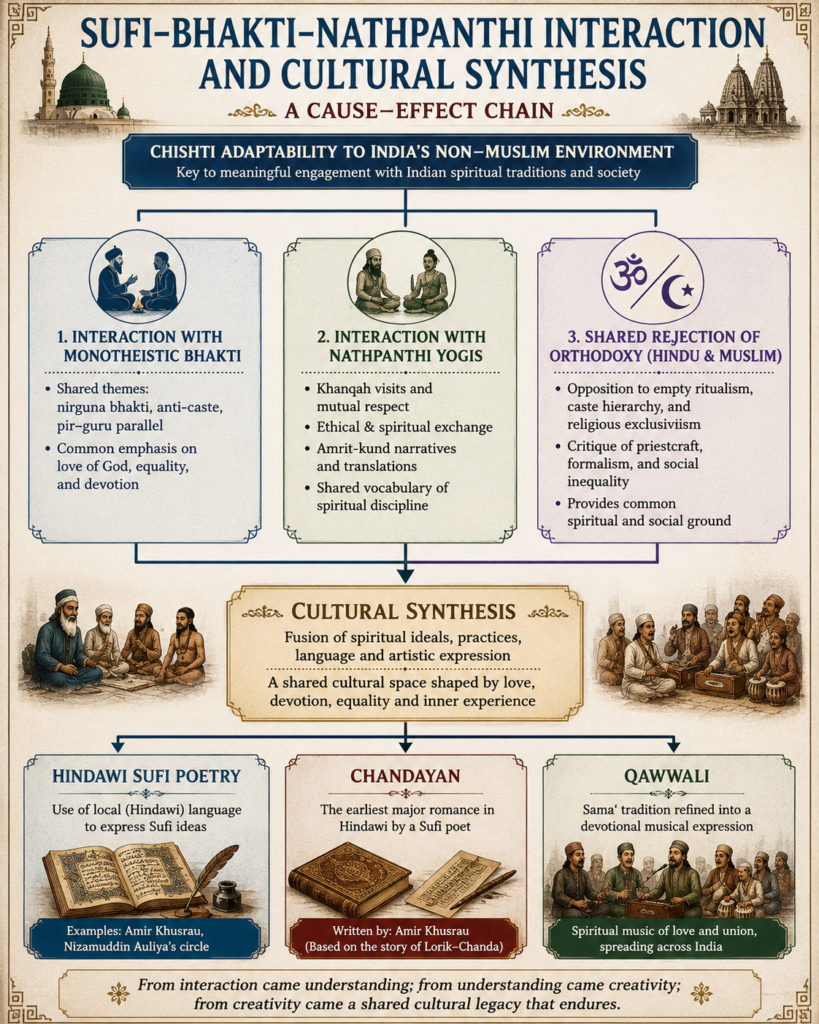
- Non-conformist saints drew on several core Islamic ideas — including an uncompromising faith in one God, a rejection of incarnation, the conception of nirguna bhakti and a related attack on idolatry, and a broader rejection of the caste system.
- Sufi conceptions of the pir, and of mystic union with the “beloved” (God), closely paralleled the non-conformist saints’ own concepts of the guru and of devotional surrender to God.
- A number of non-conformist saints had direct interaction with Sufis — Guru Nanak’s encounters with Sufis, for instance, are recorded in the Janam-sakhis.
- Though Sufism and the monotheistic movement developed historically independently of one another, they shared a remarkable similarity in many of their basic ideas — including a common rejection of both Hindu and Muslim orthodoxies. Even indirect interaction between them likely gave real impetus to both movements.
- Vaishnava bhakti movements, by contrast, show little such influence — since they neither denounced idolatry, the caste system, nor the theory of incarnation, and instead continued to believe firmly in saguna bhakti.
- The relationship between the monotheistic bhakti movement and Islam appears to have been one of mutual influence, with Sufism providing the common meeting ground.
Influence of the Bhakti Movement on Sufism
- The Rishi order of Sufis in Kashmir, founded by Shaikh Nuruddin Wali, drew profound inspiration from the non-conformist ideas of Lal Ded, the celebrated 14th-century woman bhakti-preacher of the Kashmir Shaivism school.
- The interaction between Chishti Sufis and Nathpanthi yogis was similarly significant. During the 13th and 14th centuries, the Nathpanthi movement achieved considerable popularity in northern India, particularly among the lower sections of society, and this interaction took several concrete forms:
- Nathpanthi yogis regularly visited the khanqahs of leading Chishti shaikhs, engaging them in discussion on the nature of mysticism.
- Early Chishtis, in turn, approved of several ethical values held by the Nathpanthi yogis, along with their collective way of life.
- Even before the formal advent of Sufism in India, the translation of the yoga treatise Amrit-kund from Sanskrit into Persian led Sufis to adopt a range of meditative practices.
- Much like the Chishtis, the Nathpanthis kept their doors open to all sections of society, irrespective of caste distinctions.
Cultural Synthesis
- The Chishtis’ adaptability to India’s non-Muslim environment released genuine syncretic forces, contributing to broader cultural synthesis.
- The shared outlook of the Sufis, Nathpanthis, and monotheistic movements provided a real basis for mutual understanding between Muslims and non-Muslims.
- Many early Chishtis spoke Hindawi and composed verse in it; numerous khanqahs directly inspired the composition of mystical poetry in various regional languages.
- The Chandayan (written in Hindi) by Mulla Daud (second half of the 14th century) combined mysticism with Hindu mythology and philosophy, and was later translated into Persian by the Chishti Sufi Shaikh Abdul Quddus Gangohi (1456–1537).
- Sufi folk literature more broadly blended the simplest precepts of Islam and Sufi terminology with existing popular imagery and idiom, contributing directly to the growth of a genuinely eclectic religious life.
- The qawwali tradition, begun by Amir Khusrau, emerged as a syncretic musical form directly rooted in the Chishti practice of sama.
- This sustained interaction had a genuinely positive effect on the social and cultural life of the period, producing a broader cultural synthesis across the fields of art, music, and literature.
Role of the Sufi Movement in Promoting Communal Harmony
- Like the bhakti movement, Sufism played a substantial role in shaping the character of medieval Indian society.
- The Sufis stressed the essential unity between different religions, adopted a tolerant attitude toward other faiths, and actively worked toward reconciliation between Hindus and Muslims.
- The Islamic ideals of brotherhood and equality among believers held particular appeal for India’s lower castes, contributing directly to large-scale conversions.
- The Sufis consistently emphasised the unity of God and the superiority of the path of devotion over mere ritual, ceremony, pilgrimage, or fasting.
- The liberal and tolerant attitude adopted by Akbar and his successors made Sufi literature and thought genuinely popular among Hindu intellectuals.
- The Sufi doctrine of Universal Brotherhood (sulh-i-kul) was itself adopted by Akbar in his broader attempt to build a national state in India.
- The Sufi movements, taken together, promoted a real feeling of religious toleration between Hindus and Muslims, becoming instrumental in maintaining the social equilibrium of medieval society.
- The healthy religious atmosphere created by these movements enabled Akbar to adopt a considerably broader religious outlook, ultimately culminating in the foundation of the syncretic religion, Din-i-Ilahi.
- It is important to recognise that both the bhakti reformers and the Sufi saints, directly and indirectly, helped create a genuine atmosphere of brotherhood and fellow-feeling between Hindus and Muslims — enabling the Mughal emperors to pursue a broader policy of religious toleration.
- The bhakti movement, in this sense, helped pave the way for Akbar’s own efforts to transform the predominantly Muslim character of the Mughal state into something closer to a national state; it also went on to inspire Shivaji’s establishment of swarajya, and the foundation of Sikhism stands as one of its most enduring legacies.
Impact of the Sufi Movement
- Despite the decline of Sufi influence in the fourteenth century — driven by doctrinal differences between orders and the reassertion of Islamic orthodoxy — the Sufis continued to play an important role in spreading Muslim culture among the masses across different parts of the country.
- Like the bhakti movement, Sufism contributed significantly to shaping the character of medieval Indian society: stressing religious unity, promoting tolerance, and working toward genuine Hindu–Muslim reconciliation.
- The Sufis also promoted educational advancement, with their khanqahs (monasteries) functioning as genuine centres of knowledge and wisdom.
- Chishti Sufis in particular held strong appeal for lower-caste Hindus, whose conversion the Islamic ideals of equality and brotherhood actively encouraged.
- As elsewhere in this movement, the Sufis consistently emphasised the unity of God and the superiority of the path of devotion over ritual, ceremony, pilgrimage, and fasting — a recurring theme central to their popular appeal.
- Notably, high-caste Hindus initially remained largely aloof from the Sufi saints — it was only during the reign of Akbar that Persian-educated Hindus began to take genuine interest in Chishti Sufi philosophy, a shift made possible by the liberal, tolerant religious climate Akbar himself cultivated (including his adoption of sulh-i-kul, or Universal Brotherhood).
Mystical or Sufi Literature
Doctrinal Texts
- Sufi doctrine in India rests on several well-known foundational works, most notably the Kashf-ul-Mahjub of Hujwiri, which provides biographical detail and outlines Sufi thought from the days of the Prophet onward.
- Shaikh Shihabuddin Suhrawardi’s Awarif-ul Maarif is the second major work of this kind; both texts accepted the superiority of the Shariat, arguing that Sufis must obey Islamic law, and treating Shariat, Marifat (gnosis), and Haqiqat (reality) as fundamentally interdependent.
Other Persian Literary Genres
- A further category of Persian literary work includes: treatises on mysticism written by the Sufis themselves; collections of letters written by Sufis; malfuzat (recorded discourses of Sufi saints); biographies of Sufis; and collections of Sufi poetry.
- Prince Dara Shukoh was among the most prolific contributors to this literature:
- His Sakinat-ul Auliya offers a biographical account of the Sufi Mian Mir and his disciples.
- His Majma-ul Bahrain (“Mingling of Two Oceans”), the product of nine years of research comparing Brahmavidya and the Quran, stands as a testimony to the deep similarities between Sufism and Hinduism.
- His Mukalama Baba Lal wa Dara Shukoh compiles a dialogue between the prince and Baba Lal, exploring questions on Kashi, Hindu mythology, various gods and goddesses, Braj, the correct recitation of Om, the panchabhuta, and the relationship between the individual soul (atma) and the divine soul (paramatma). Dara also understood jyotish vidya (astrology), and is said to have written a Sanskrit treatise on the subject.
- His Sirr-i-Akbar — inspired by the “hidden treasures” of the Upanishads, which he translated into Persian — draws a remarkable parallel between the concept of tauhid (unity of God) present in both the Quran and the Upanishads.
- His Iksir-ul-Azam is a diwan comprising his own ghazals and rubaiyat on the doctrines of Sufism and Qadirism.
- The other works listed above — Safinat-ul-Auliya (1640), Sakinat-ul-Auliya (1643), Risala-e-Haq Numa (1647, a revelation concerning yoga), and Tariqat-ul-Haqiqat and Hasanat-ul Arifeen (1653) — together reflect the strong influence of Wahdat-ul Wujud on the prince’s own mystical thought.
- Sufi poets also made a considerable contribution to the development of Punjabi literature: Sultan Bahu expressed himself through intense poetry, Shah Husain (1553–1593) composed passionate lyrics set to music, and Bulhe Shah — the best known of the three — produced work that has passed into folklore, forming a rich part of Punjab’s literary tradition.
Malfuzat Texts as a Source of Medieval History
- The malfuzat texts record the teachings of Sufi saints. During the 13th century, the previously oral teachings of these saints acquired a formal canonical textual form, and these works gradually came to be recognised as the authoritative, normative genre both for members of the Sufi order and for their lay followers.
Malfuzat as Historical Source
- The malfuzat texts, as records of Sufi discourse, formed an extremely popular literary genre in 13th-century north India, making them of considerable historical importance.
- One of the most admired malfuzat texts is the Fawaid Al-Fuad (“Morals of the Heart”), written by Amir Hasan Sijzi Dehlavi, a poet and disciple of Nizamuddin Auliya — a beautifully composed account of Nizamuddin’s teachings.
- The Fawaid Al-Fuad is valued more for its historical significance — as a corrective to the almost exclusively dynastic focus of court historians — than for its purely religious content.
- Indeed, much of the social history of the period, largely absent from the dynastic chronicles, can be reconstructed precisely from such malfuzat texts — offering a genuine glimpse into medieval society’s popular customs, manners, and everyday problems, drawn directly from recorded conversation.
- The malfuzat tradition was later carried forward by Hamid Qalandar, who compiled the teachings and speeches of Nasiruddin Mahmud (Chiragh-i-Delhi), Nizamuddin Auliya’s successor in Delhi.
- Hamid provides a detailed account of how the resulting compilation, Khair al-Majalis (“The Best of Assemblies”), began in 1354, and was subsequently forwarded to the master himself for final approval.
- Another notable text is the malfuzat on Burhan al-Din Gharib, known as the Nafaid al-Anfas.
- One of the most admired malfuzat texts is the Fawaid Al-Fuad (“Morals of the Heart”), written by Amir Hasan Sijzi Dehlavi, a poet and disciple of Nizamuddin Auliya — a beautifully composed account of Nizamuddin’s teachings.
Limitations of Malfuzat as a Historical Source
- The authors of malfuzat texts did not, in practice, take verbatim notes while the master spoke — instead, they typically wrote down and transcribed the master’s sayings from memory, introducing a real possibility of error and exaggeration.
- On occasion, the resulting text was subsequently revised or improved upon by the Sufi saint himself.
- Malfuzat texts, moreover, provide relatively little information on rulers or the broader political history of their time — since the protagonists of these texts were, by design, the great Sufi saints, they show little concern for either the reigning Sultan or his court.
Conclusion
- The Sufi movements in medieval India represent far more than a purely religious phenomenon — from the contrasting institutional paths of the Chishti and Suhrawardi silsilahs, to sustained interaction with the indigenous bhakti and Nathpanthi traditions, Sufism decisively shaped the social, cultural, and political fabric of medieval Indian society.
- Through their emphasis on love, devotion, and religious tolerance, the Sufis — alongside the bhakti reformers — helped build a genuine atmosphere of communal harmony, one that would go on to shape everything from Akbar’s Din-i-Ilahi to the emergence of Sikhism itself.
- The malfuzat literature the Sufis left behind, meanwhile, offers historians an invaluable — if imperfect — window into the social life of medieval India that the dynastic chronicles of court historians simply do not provide.




