The Chinese Revolution

China had a long history of national unity and, since the mid-seventeenth century, had been ruled by the Manchu (Ch’ing/Qing) dynasty. However, during the 1840s, the country entered a troubled period of foreign interference, civil war, and disintegration that lasted until the communist victory of 1949. The Chinese Revolution is a cornerstone World History theme for UPSC aspirants, offering rich comparative ground with the Russian Revolution — both in the trajectory of a backward, peasant-majority society producing a Marxist revolution, and in the divergent paths Chinese and Soviet communism eventually took.
- China’s last emperor was overthrown in 1911, and a republic was proclaimed. The period 1916 to 1928, known as the Warlord Era, was one of great chaos, as numerous generals seized control of different provinces.
- The Kuomintang (KMT), or Nationalists, sought to govern China and rein in the warring generals. Its leaders were Dr Sun Yat-sen, and, after his death in 1925, General Chiang Kai-shek.
- The Chinese Communist Party (CCP) was founded in 1921 and initially cooperated with the KMT in the joint struggle against the warlords.
- As the KMT gradually extended its control over more of China, it felt strong enough to dispense with communist support and moved to destroy the CCP.
- The communists, under Mao Zedong, reacted vigorously, and after escaping encircling KMT forces, embarked on the 6,000-mile Long March (1934–35) to establish a new power base in northern China.
- Civil war dragged on, complicated by Japanese interference that culminated in a full-scale invasion in 1937. When World War II ended in Japanese defeat and withdrawal from China, the KMT and CCP resumed their struggle for control of the country.
- Chiang Kai-shek received support from the USA, but in 1949 it was Mao and the communists who finally triumphed. Chiang and his supporters fled to Taiwan (Formosa), while Mao Zedong established control over mainland China and remained its leader until his death in 1976.
Revolution and the Warlord Era
(a) Background to the Revolution of 1911
- In the early nineteenth century, China kept itself largely separate from the rest of the world, with life proceeding quietly and without great change.
- By the mid-nineteenth century, however, China faced a series of compounding crises.
- A prolonged period of relative peace had driven rapid population growth, making it difficult to produce enough food for subsistence and forcing many peasants into robbery and banditry as a means of survival.
- This chaos encouraged foreign powers, especially European ones, to force their way into China for trading advantage. The British were first on the scene, defeating China in the Opium Wars (1839–42).
The Opium Wars
- The Opium Wars were two armed conflicts in mid-nineteenth-century China between Western powers and the Qing dynasty (which ruled China from 1644 to 1912).
- The First Opium War (1839–42) was fought between China and Britain.
- The Second Opium War (1856–60), also called the Arrow War, was fought by Britain and France against China.
- In both cases, the foreign powers were victorious, securing commercial privileges and legal and territorial concessions in China. These conflicts marked the beginning of the era of “unequal treaties” that progressively weakened and ultimately helped topple the Qing dynasty in favour of republican China in the early twentieth century.
First Opium War (1839–42):
- The war arose from China’s attempts to suppress the opium trade. Foreign traders — primarily British — had illegally exported opium from India to China since the eighteenth century, with the trade growing dramatically from around 1820 (helping India’s trade balance, which otherwise favoured China). The resulting widespread addiction caused serious social and economic disruption in China.
- In March 1839, the Chinese government confiscated and destroyed over 1,400 tons of opium warehoused at Canton (Guangzhou) by British merchants. Tensions escalated further when drunken British sailors killed a Chinese villager, and the British government refused to hand the accused over to Chinese courts.
- Hostilities broke out when British warships destroyed a Chinese blockade of the Pearl River estuary and occupied Hong Kong in May 1841. Subsequent British campaigns succeeded against the militarily inferior Qing forces, and the British capture of Nanjing in late August 1842 ended the fighting.
- Peace negotiations resulted in the Treaty of Nanjing (signed 29 August 1842), under which China:
- paid Britain a large indemnity,
- ceded Hong Kong Island to the British, and
- increased the number of treaty ports open to British trade and residence from one (Canton) to five, including Shanghai.
- The British Supplementary Treaty of the Bogue (Humen), signed 8 October 1843, granted British citizens extraterritoriality (the right to be tried by British courts) and most-favoured-nation status. Other Western powers quickly demanded and received similar privileges.
- After this first defeat to the West, the Qing court struggled to contain further foreign intrusion.
- Reform efforts were constrained by a deeply conservative court culture, in which the ethnic Manchu rulers were reluctant to grant greater authority to the Han Chinese majority.
- Yet in subsequent conflicts, the traditional Manchu armies proved incompetent, forcing the court to rely increasingly on local Han armies.
The Second Opium War / Arrow War (1856–60):
- In the mid-1850s, while the Qing government was preoccupied with suppressing the Taiping Rebellion, the British sought a pretext to extend their trading rights and renew hostilities.
- In October 1856, Chinese officials boarded the British-registered ship Arrow at Canton, arrested Chinese crew members, and allegedly lowered the British flag — prompting a British warship to bombard Canton, while Chinese mobs burned foreign factories in the city in December.
- France joined the British expedition, citing the murder of a French missionary in China’s interior as its pretext.
- After delayed mobilisation, allied forces began operations in late 1857, quickly capturing Canton and installing a compliant governor. By April 1858, allied troops had reached Tianjin, forcing China into negotiations.
- The Treaties of Tianjin (signed June 1858) provided for:
- foreign envoys to reside in Beijing,
- the opening of several new ports to Western trade and residence,
- the right of foreign travel in China’s interior, and
- freedom of movement for Christian missionaries.
- Further negotiations in Shanghai later that year legalised the importation of opium.
- Following this second defeat, the Qing attempted to modernise by adopting select Western technologies through the Self-Strengthening Movement, beginning in 1861.
The Taiping Rebellion (1850–64):
- The Taiping Rebellion spread across southern China, combining elements of a Christian religious movement and a political reform movement aimed at establishing a “Heavenly Kingdom of Great Peace” (Taiping Tianguo).
- The rebellion was eventually defeated not by ineffective Manchu government troops, but by newly formed regional armies — a failure that dealt a serious blow to Ch’ing authority and left the dynasty dependent on regional forces it did not directly control.
- This dependency began the process by which provinces progressively asserted independence from the central government in Beijing, a trend that culminated in the Warlord Era (1916–28).
The First Sino-Japanese War:
- This conflict marked Japan’s emergence as a major world power and exposed the weakness of the Chinese empire. It grew out of rivalry between the two countries for supremacy over Korea, China’s most important client state, whose strategic location and coal and iron resources drew growing Japanese interest.
- In 1875, Japan forced Korea to open itself to foreign (especially Japanese) trade and declare independence from China in its foreign relations, becoming identified with modernising forces in Korea while China continued to back conservative royalist officials.
- In 1884, pro-Japanese Korean reformers attempted a coup, but Chinese troops rescued the king, killing several Japanese legation guards; war was averted by the Li-Ito Convention, under which both nations agreed to withdraw troops from Korea.
- By 1894, however, buoyed by successful modernisation, Japan was less inclined to compromise.
- The assassination in Shanghai of pro-Japanese Korean leader Kim Ok-kyun, whose body was returned to Korea and publicly displayed as a warning to rebels, outraged the Japanese public.
- Tensions rose further when the Tonghak Rebellion broke out in Korea and China sent troops at the Korean king’s request — a move Japan considered a violation of the Li-Ito Convention, prompting it to dispatch 8,000 troops in response, while China moved to reinforce its own forces.
- War was formally declared on 1 August 1894. Despite foreign expectations of an easy Chinese victory given its larger forces, Japan’s superior modernisation gave it better-equipped, better-prepared troops, who scored rapid, overwhelming victories on land and sea.
- By March 1895, Japan had invaded Shandong province and Manchuria and fortified positions commanding the sea approaches to Beijing, forcing China to sue for peace.
- Under the Treaty of Shimonoseki, which ended the conflict, China:
- recognised Korea’s independence,
- ceded Taiwan and the Liaodong Peninsula in Manchuria,
- agreed to pay a large indemnity, and
- granted Japan trading privileges on Chinese territory.
- This treaty was later modified after Russian fears of Japanese expansion led Russia, France, and Germany to jointly force Japan to return the Liaodong Peninsula to China.
- China’s defeat encouraged Western powers to press further demands on the Chinese government, and within China itself the war triggered a reform movement seeking to renovate the state, alongside the beginnings of revolutionary activity against Qing rule.
The Hundred Days’ Reform (1898):
- This was an imperial attempt to renovate China’s state and social system, occurring after China’s defeat in the Sino-Japanese War and the ensuing scramble for concessions by Western imperialist powers.
- Following the war, reform clubs modelled on Western ideas sprang up across China, though the imperial government initially ignored their calls for rejecting the peace treaty and pursuing wide-ranging reform.
- Within official circles, a group of conservative reformers led by Zhang Zhidong called for Western-style industrialisation without abandoning China’s cultural heritage — a position that, combined with alarm over China’s slow dismemberment by Western powers, pushed the government to seriously consider reform.
- Reformer Kang Youwei came to the Emperor’s attention, meeting a group of senior officials in January 1898. On 11 June 1898, the Emperor issued his first reform decree, beginning what became known as the Hundred Days’ Reform.
- In all, the Emperor issued over 40 edicts that, if enacted, would have transformed nearly every aspect of Chinese society — abolishing the old civil service examination system based on the Chinese Classics, establishing a new system of national schools and colleges, promoting Western industry, medicine, science, commerce, and patents, and reforming government administration, law, and the military while attacking corruption.
- This assault on corruption, the army, and traditional education threatened the privileged classes of Chinese society.
- Conservative forces rallied behind the Empress Dowager Cixi, who — with army backing — carried out a coup, imprisoned the Emperor, and reversed most of the reforms. Kang escaped to Japan, but six other young reformers were executed.
- Some moderate measures, such as modern schools, survived, but the examination system was reinstated and most reform edicts — largely unenacted anyway — were repealed.
The Boxer Rebellion:
- The Boxer Rebellion was a peasant uprising in 1900 that sought to drive all foreigners from China. “Boxers” was the foreigners’ name for the Chinese secret society Yihequan (“Righteous and Harmonious Fists”), who practised boxing rituals believed to render them invulnerable, originally aiming to destroy both the dynasty and the privileged foreign presence in China.
- Growing economic hardship, natural calamities, and unchecked foreign aggression fuelled Boxer strength in North China during the late nineteenth century.
- In 1898, conservative anti-foreign forces gained control of the government and persuaded the Boxers to redirect their opposition toward foreigners rather than the Qing dynasty, with the Shandong governor enrolling Boxer bands as local militia.
- Many Qing officials, along with Cixi herself, came to believe Boxer rituals genuinely conferred immunity to bullets and continued to encourage the movement despite Western protests.
- Christian missionary activity helped provoke the Boxers, as converts flouted traditional customs and missionaries pressured local officials to favour Christians in disputes.
- By late 1899, the Boxers openly attacked Chinese Christians and Western missionaries; by May 1900, Boxer bands roamed the countryside around Beijing, burning churches and foreign residences.
- The Empress Dowager ordered all foreigners killed; the German minister was murdered, and other foreign diplomats, families, staff, and hundreds of Chinese Christians were besieged in the legation quarters and Beijing’s Roman Catholic cathedral.
- An international force of roughly 19,000 troops — drawn chiefly from Japan and Russia, with contingents from Britain, the USA, France, Austria-Hungary, and Italy — captured Beijing on 14 August 1900, relieving the besieged foreigners and Christians.
- As foreign troops looted the capital, the Empress Dowager and her court fled. A protocol signed in September 1901 ended hostilities and imposed reparations on China.
- Further Chinese losses to Japan followed the Russo-Japanese War (1904–05), leaving China in a dire state. Thousands of young Chinese who travelled and studied abroad in the early twentieth century returned with radical, revolutionary ideas of overthrowing the Manchu dynasty and westernising China — some, like Dr Sun Yat-sen, envisioning a democratic state modelled on the USA.
(b) The Revolution of 1911 — Xinhai Revolution / Double Ten Revolution
- The Chinese Revolution of 1911–12 overthrew the Qing (Manchu) dynasty — China’s last imperial dynasty — and established the Republic of China (ROC). It is named the Xinhai Revolution after the corresponding year in the Chinese calendar.
- Attempts by the government to respond to radical new ideas through reforms, promises of democracy, and elected provincial assemblies only encouraged provinces to distance themselves further from an increasingly unpopular central government.
- The dynasty had been declining throughout the nineteenth century and lost its last capable leader with the death of Empress Dowager Cixi in 1908. By 1911, the child-emperor Puyi sat on the throne under an incompetent regency, while repeated failures against foreign powers had shaken the entire machinery of government.
- The revolution arose primarily from the Qing state’s ineffectiveness in modernising China and confronting foreign aggression, sharpened by ethnic resentment against the ruling Manchu minority. It comprised numerous revolts and uprisings, with most provinces swiftly declaring independence from Beijing.
- A provisional republican government was established at Nanjing, with Sun Yat-sen, leader of the United League and recently returned from abroad, elected provisional president.
- The government, acting on behalf of the child-emperor, turned in desperation to retired general Yuan Shikai, former commander of the Chinese Northern Army and still influential among the generals, appointing him premier.
- Yuan, however, had ambitions of his own: he struck a deal with the revolutionaries, agreeing to become the republic’s first president in exchange for Puyi’s abdication and the formal end of the Manchu dynasty.
- A provisional constitution was promulgated by the Nanjing parliament in March 1912, and the government transferred to Beijing that April, marking the beginning of China’s early republican era (1912–16). With army backing, Yuan ruled as a military dictator from 1912 to 1915.
- The republic, established with such startling ease, was nonetheless destined to witness the progressive collapse of national unity and orderly government in the years that followed.
The Twenty-One Demands (1915):
- Japan sought to exploit China’s upheaval and the outbreak of World War I. Days after the war began, Japan demanded Germany hand over all its Shantung peninsula rights to Japan, followed in January 1915 by the Twenty-One Demands, grouped into five sets:
- Chinese approval of Japan’s Shantung concessions, including railway and mining rights;
- expansion of Japan’s sphere of influence in southern Manchuria and eastern Inner Mongolia, including settlement rights, extraterritoriality, and priority for Japanese investment;
- control of the Hanyeping mining and metallurgical complex in central China;
- a bar on China granting further coastal or island concessions to any foreign power; and
- the acceptance of Japanese political, economic, and military “advisers,” and joint Japanese-Chinese organisation of police in some major cities.
- The demands, once public, triggered a wave of anti-Japanese sentiment and a boycott of Japanese goods. Yuan delayed acceptance until Japan agreed to drop the fifth group, and an agreement covering the rest was signed on 25 May 1915 — largely restating concessions Japan already held. It was the fifth group that most clearly revealed Japan’s intent to reduce China to a virtual colony or protectorate.
- Separately, Japan secretly promised to support Yuan’s ambition to become emperor in exchange for his acceptance of the demands, calculating that a new emperor beholden to Japanese backing would offer an effective alternative means of controlling China.
- In December 1915, it was announced that Yuan would restore the monarchy, becoming emperor on 1 January 1916 — a fatal miscalculation, as most Chinese viewed the end of the republic as a backward step, and Yuan’s support collapsed rapidly. The army turned against him, forcing his abdication; he died in October 1916.
(c) The Warlord Era (1916–28)
- Yuan’s abdication and death removed the last figure capable of holding China together. The country disintegrated into hundreds of territories of varying size, each controlled by a warlord and his private army — with ordinary Chinese peasants bearing the brunt of the resulting hardship.
- Two important positive developments nonetheless emerged from this period.
The May Fourth Movement:
- The May Fourth Movement began on 4 May 1919 with a massive student demonstration in Beijing, protesting both the warlords and traditional Chinese culture. It was also strongly anti-Japanese, particularly after the 1919 Versailles Settlement formally recognised Japan’s right to take over Germany’s former concession in Shantung province.
- Although Japan eventually returned control of Shantung to China in February 1922, the Allied decision to favour Japan at Versailles deeply outraged the Chinese, and this humiliation galvanised nationwide support for the movement.
- Thousands of university students went on strike over the government’s weak protest at Versailles, and a boycott of Japanese goods followed — welcomed by Chinese industrialists who benefited from it, who in turn supported the (often jailed) student protestors, while factory and railway workers struck in sympathy.
- This remarkable show of mass patriotism forced the government to concede: students were released, ministers who had signed the 1915 Twenty-One Demands agreement were dismissed, and the Chinese delegation at Versailles refused to sign the peace treaty.
The problem of warlords and modernising Chinese culture:
- The movement’s other goals — taming the warlords and modernising Chinese culture — took longer to realise. As the Kuomintang (Nationalist Party) gradually grew stronger, it succeeded in bringing the warlords under control by 1928.
- Chinese culture was partly rooted in the teachings of the fifth-century BCE philosopher Confucius, developed during a period of anarchy to address how society could best be organised for peace.
- He stressed loyalty in all relationships and strict upbringing of children — “Let the ruler be a ruler, the subject a subject, the father a father, and a son a son” — believing that if people acted according to their place in society, moral integrity and social harmony would follow.
- Chinese emperors had long embraced Confucianism because it justified their autocratic, conservative rule.
- After the 1911 revolution and the 1919 May Fourth Movement, some writers began producing challenging, modernising works calling for change in politics, science, and individual rights in place of traditional Confucianism. Their practical effect, however, remained limited:
- the warlords remained wholly unmoved by this new thinking, and
- Chiang’s Nationalists, after establishing their Nanjing government in the late 1920s, suppressed intellectual and political freedom, actively promoting Confucianism for its conservatism and as a means of distinguishing themselves from Mao and the communists.
The Kuomintang, Dr Sun Yat-sen, and Chiang Kai-shek
(a) The Kuomintang (KMT)
- The main hope for a united China lay with the Kuomintang, or National People’s Party, formed in 1912 by Sun Yat-sen, who between 1905 and 1912 had developed a preceding political movement called the Revolutionary Alliance.
- Sun, trained as a doctor in Hawaii and Hong Kong, lived abroad until the 1911 revolution, dismayed by China’s disintegration and determined to build a modern, united, democratic state. Returning to China after the revolution, he established a government at Canton in southern China in 1917, though his influence outside that region remained limited.
- The KMT was not a communist party, though it was prepared to cooperate with the communists, and developed its own party organisation along communist lines while building up its own army.
- Sun summarised his aims as the Three Principles of the People:
- Nationalism — ridding China of foreign influence and building it into a strong, united, internationally respected power;
- Democracy — rule by the people themselves, after being educated for democratic self-government, rather than by warlords; and
- Land reform (or “the people’s livelihood”) — vaguely defined, involving a long-term policy of economic development and land redistribution to peasants, favouring rent restraint but opposing outright confiscation of landlords’ property.
- The Three Principles were later claimed as the ideological basis of both the KMT under Chiang Kai-shek and the CCP under Mao Zedong — the two parties broadly agreeing on nationalism but diverging sharply on democracy and people’s welfare, which the KMT interpreted in Western social-democratic terms and the CCP in Marxist-communist terms.
- Sun earned enormous respect as an intellectual statesman and revolutionary leader, but at his death in 1925, little progress had been made toward achieving the Three Principles, largely because he was not himself a general and had to rely on alliances with sympathetic warlords, struggling to exercise authority beyond the south. Remarkably, Sun remains unique among twentieth-century Chinese politicians in being widely revered by both Communist China and Nationalist Taiwan.
(b) Chiang Kai-shek
- General Chiang Kai-shek became KMT leader after Sun’s death. Trained militarily in Japan before World War I, and a strong nationalist, he joined the KMT at a time when the new Soviet Russian government was providing help and guidance in the hope that Nationalist China would prove friendly toward Russia.
- In 1923, Chiang spent time in Moscow studying the organisation of the Communist Party and the Red Army; the following year he became head of the Whampoa Military Academy near Canton, set up with Russian funding, arms, and advisers to train KMT officers.
- Despite his Russian contacts, Chiang was not a communist — in fact, more right-wing than Sun, with growing anti-communist sympathies aligned with businessmen and landowners. Soon after becoming party leader, he removed left-wingers from leading Party positions, though for a time he maintained the KMT-CCP alliance.
Actions against the warlords:
- In 1926, Chiang launched the Northern Expedition to destroy the warlords of central and northern China. Starting from Canton, the KMT and communists together had captured Hankow, Shanghai, and Nanking by 1927, with the capital Beijing falling in 1928.
- Much of Chiang’s success rested on massive local peasant support, drawn by communist promises of land; the capture of Shanghai was aided by an uprising of industrial workers organised by Zhou Enlai, then a KMT member and also a communist.
Actions against the communists:
- During 1927, Chiang concluded the communists had grown too powerful — in areas of communist strength, landlords were being attacked and land seized — and decided it was time to eliminate this embarrassing ally.
- All communists were expelled from the KMT, and a brutal “purification movement” was launched, massacring thousands of communist, trade union, and peasant leaders.
- With the communists checked and the warlords brought under control, Chiang stood as China’s undisputed military and political leader.
- Yet the KMT government proved a great disappointment to most Chinese: Chiang could claim to have achieved Sun’s first principle, nationalism, but relying as he did on wealthy landowners, no real moves were made toward democracy or land reform, beyond limited progress in schools and roads.
The Chinese Communist Party
(Founding of the Chinese Communist Party is discussed in the section “How far did the Chinese Communist Party owe their victory to the USSR?” below.)
CCP-KMT Cooperation and the Northern Expedition (1926–28)
- Initially, the CCP consisted mostly of intellectuals with very little military strength, which explains its willingness to work with the KMT.
- Lenin, and later Stalin, ordered the CCP to join the KMT, and many leading communists — including Mao and Zhou Enlai — did so, with the goal of simultaneously strengthening and infiltrating the KMT.
- CCP-KMT cooperation peaked during the Nationalist Revolution of 1925–27, crowned by Chiang’s Northern Expedition of 1926 against the warlords of central China.
- The Northern Expedition aimed to unify China by ending the rule of the Beiyang government (in place in Beijing from 1912 to 1928) and the local warlords. Chiang won a series of impressive victories, unifying roughly half the country, ending the Warlord Era, reunifying China by 1928, and establishing the Nanjing government.
- Midway through the Expedition, Chiang reversed the tables on his communist allies by massacring the Communist Party in the 1927 Shanghai massacre.
End of Cooperation Between the KMT and CCP
- Chiang’s triumph signalled the end of KMT-CCP cooperation. The generally accepted view holds that the split was precipitated by CCP radicalism, which targeted not only foreign privileges and symbols but also wealthy Chinese.
- Alarmed Shanghai industrialists offered to bankroll Chiang if he freed himself from dependence on Moscow — a proposal that suited him. In March 1925 (per the source), he arrested political commissars in his army and placed Soviet advisers under house arrest.
- In April 1927, as Northern Expedition forces approached Shanghai, communist-led labour unions rose to seize the city from within; when Chiang entered Shanghai, he ordered the massacre of the communists — the Shanghai massacre.
- Also in April 1927, KMT leaders meeting at Nanjing proclaimed a National Government and outlawed the CCP. The CCP attempted several uprisings that year, all of which failed.
- There was, in fact, no realistic way the CCP could have seized control from the KMT in the 1920s or 1930s, since the KMT at that time embodied the dominant national drive toward unification and symbolised China’s broader national goals.
- Chiang’s chances of fully consolidating power, however, were ultimately cut short by the Japanese attack on China in 1937, which drove him to Chungking in the southwest, where he waged only limited military resistance against Japan for the rest of the war.
The Period Between 1928 and 1935
- The KMT under Chiang continued its struggle to unify China up to the Yangtze River and beyond, but Japan overran Manchuria in 1931, establishing it as the puppet state of Manchukuo under the exiled last emperor, Puyi. By 1936, the KMT exerted at least loose control over two-thirds of China’s population.
- For most peasants, little had actually changed beyond the national flag — warlords loosely allied with Chiang still ruled large parts of the country, and no land reform materialised. Many intellectuals grew alienated from Chiang over this period, as he failed to introduce democratic reforms and instead appeared to favour his own dictatorship, viewing fascism as a desirable model of government.
- Meanwhile, the communist movement was being rebuilt by Mao in southern Jiangxi province, while the official Party leadership loyal to Moscow went into hiding in Shanghai until 1930.
The Emergence of Mao and His Policies
- Mao Zedong, present at the CCP’s founding meeting, was born in Hunan province in 1893, the son of a prosperous peasant farmer. After working the land, he trained as a teacher, then moved to Beijing to work as a library assistant at the university — a centre of Marxist study — before returning to Hunan to build a reputation as a skilled trade union and peasant association organiser.
- In an essay on physical education published in the progressive journal New Youth (April 1917), Mao attacked “passive” Confucian thinking, calling for physical strength, and for embracing violence and anger; he soon also advocated equal rights for women and attacked arranged marriage, expressing firm determination to fight for his beliefs.
- After the communist breach with the KMT, Mao reoriented Party strategy toward winning mass peasant support rather than attempting to capture industrial towns, where several earlier communist insurrections had failed against KMT strength.
- In 1931, Mao was elected chairman of the Party’s Central Executive Committee, from which point he steadily consolidated his position as Chinese communism’s real leader.
- Mao developed the strategy of operating from a stable base area while harassing government troops through guerrilla tactics — tactics rooted in traditional Chinese military strategy, which Mao knew well from his reading, and which would prove central to his eventual victory over Chiang.
- Equally important was the communists’ implementation of land reform in their southern Jiangxi stronghold — broadly, redistributing land equally while giving landlords and richer peasants smaller shares, though in practice some landlords and rich peasants retained more land in exchange for supporting the communists. Overall, this policy secured solid peasant support, since land reform was the issue that mattered most to them.
The Chinese Soviet Republic (Jiangxi Soviet), 1931–34
- Mao’s policies were embodied in the Chinese Soviet Republic, also known as the Jiangxi Soviet, proclaimed in 1931 and lasting until 1934.
- The first All-China Congress of Soviets convened there on 7 November 1931, developments that occurred independently of Moscow.
- Mao served as both state chairman and prime minister of the CSR, leading its state and government; his tenure at the head of this “small state within a state” gave him invaluable experience in mobile warfare and peasant organisation, later crucial to communist reunification of China in the late 1940s.
- Mao and his supporters spent most of this period simply surviving, as Chiang’s National Revolutionary Army launched five “extermination campaigns” against them between 1930 and 1934. The communists retreated to the mountains between Hunan and Kiangsi (Jiangxi) provinces, concentrating on building up the Red Army.
- Early in 1934, however, Mao’s base area was surrounded by KMT forces poised for the final destruction of Chinese communism, and Mao concluded that survival demanded breaking through Chiang’s lines to establish a new power base elsewhere.
- The breakthrough was achieved in October 1934, when almost 100,000 communists set out on the remarkable Long March — an event of enormous significance in the history of Chinese communism.
The Long March (1934–35)
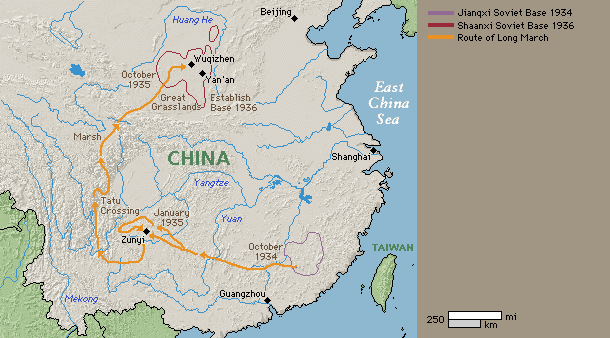
- The Long March (October 1934–October 1935) was a military retreat by the Red Army of the CCP to evade pursuing KMT forces, beginning from Jiangxi province in October 1934.
- The Army of the Chinese Soviet Republic, under an inexperienced military commission, faced near-annihilation at Chiang’s hands in its Jiangxi stronghold. Under Mao Zedong and Zhou Enlai, the communists escaped in a circling retreat westward and northward.
- They covered roughly 6,000 miles in 368 days, described by American journalist Edgar Snow as crossing 18 mountain ranges (5 snow-capped) and 24 rivers, passing through 12 provinces, occupying 62 cities, and breaking through the encircling armies of 10 different provincial warlords, besides defeating, eluding, or outmanoeuvring various government forces sent against them.
- Of the original 100,000 marchers, only about 20,000 survivors found refuge at Yenan in Shensi (Shaanxi) province — China’s last surviving communist base — where the Shensi communists, not entirely willingly, accepted Mao’s leadership as a new base and soviet were organised.
- The Long March marked the beginning of Mao’s ascent to power, as his leadership during the retreat won him the support of Party members.
- Some writers, however, have argued that the march’s heroism was vastly exaggerated, even suggesting Chiang deliberately permitted Mao’s October 1934 “breakout” because he preferred the communists confined to the north, where he could contain them while extending KMT control over the southwest.
- This interpretation was welcomed by Mao’s critics, but most historians take a more balanced view: while acknowledging some exaggeration in accounts designed to present Mao and the communists favourably, they reject the more sceptical Jung Chang/Halliday interpretation as “more fantasy than fact.”
- The Long March’s arrival in Shaanxi secured the survival of Mao’s brand of communism in a stable base, from which it could gather its forces and, through guerrilla war against Japan, lay the groundwork for its later conquest of China. Over the following decade, the communists steadily gained support while Chiang and the KMT steadily lost popularity.
The Second Sino-Japanese War and the Yenan Period, 1937–1945
- In September 1936, Japan presented secret demands to Chiang’s government, disguised as proposals for a common war against the communists but whose acceptance would have meant effective Japanese domination of China.
- In December 1936, Chiang travelled north to coordinate a campaign against the Yenan communists with Marshal Zhang Xueliang, who — angered by Japan’s assassination of his warlord father and by Chiang’s preference for fighting communists over the Japanese — was already in touch with the communists.
- When Chiang moved against him, Zhang invited the KMT leader to a meeting and kidnapped him. At a subsequent meeting with communist leaders and Zhang, Chiang was persuaded to abandon his anti-communist campaign and agree to a common fight against Japan, flying back to his capital with Zhang to proclaim this united war effort.
- On 7 July 1937, an accidental firefight between Chinese and Japanese troops near Beijing gave Tokyo its long-desired pretext for attacking China. Japanese armies seized Beijing and Tientsin, then occupied most of eastern China.
- The Japanese invasion had a dual effect: it swept away old, ineffective authorities in north-east China (whom the KMT had never fully controlled anyway), while also bogging Japan down in territory it could not itself control — creating an ideal opening for guerrilla warfare, or what the communists called the “People’s War of Resistance.”
- The KMT and CCP joined in a United Front against Japan; after the USA entered the war following Pearl Harbor, the two Chinese sides maintained their formal alliance but nonetheless clashed on several occasions.
- The communist guerrillas established links throughout northern China, harassing the Japanese while also striving — not always successfully — to protect villagers, whereas the KMT, after an initial hard fight, scaled back its resistance to a minimum once the government settled in distant Chungking.
- The CCP’s other major wartime achievement was using the resistance effort to permanently penetrate the villages.
- Communists generally treated peasants well, paying for what they needed and implementing popular socio-economic policies — most importantly, rent and interest controls and an end to abusive tax collection — alongside basic literacy education, following precedents set in Jiangxi.
- These policies gave the CCP a mass base no Chinese government, including the KMT, had ever possessed. By war’s end, the CCP controlled 19 base areas with a population of about 100 million and an army of roughly half a million, with the Party itself numbering around 1 million members — setting up a test of strength with the KMT, though at the time the CCP itself doubted it could win, given the KMT’s superiority in troops and weapons.
The Civil War and Communist Victory, 1949
(a) China and the Second World War
- When World War II began, Chiang Kai-shek faced a dilemma: China had already been in a state of undeclared war with Japan since 1937, yet Chiang held great admiration for Japan’s ally Germany and its military tradition. Only after the German defeat at Stalingrad (1942–43) did he commit China formally to the Allied side.
- Relations between China and the USSR remained strained by Chiang’s earlier anti-communist campaigns, to the point that Stalin refused to attend any meeting where Chiang was present.
- As encouragement, in January 1943 the USA, Britain, and other states renounced their territorial rights and concessions in China (though Britain retained Hong Kong) and promised the return of Manchuria and Formosa after the war — though ironically, most of this territory was under Japanese occupation at the time. These agreements nonetheless mattered symbolically, treating China as an equal among the great powers and promising it a permanent seat on the UN Security Council.
- Japan responded to these developments by launching an offensive with troops moved from Manchuria, striking south from the Yangtse Valley to the Indochina frontier and cutting off the south-east coast from the interior; disorganised Nationalist forces could offer little effective resistance.
- Fortunately for China, time was running out for Japan elsewhere: the atomic bombings of Hiroshima and Nagasaki in August 1945 brought Japan’s surrender within days. China’s own contribution to Japan’s defeat had been to keep hundreds of thousands of Japanese troops tied down in what was, for Tokyo, only a secondary theatre.
(b) Victory for the Communists Was Still Not Inevitable
- With Japan’s defeat in 1945, the KMT and CCP became locked in a final struggle for power, and many observers — especially in the USA — expected Chiang to prevail.
- The Americans helped the KMT take over areas previously held by Japan, except Manchuria, captured by the Russians shortly before the war ended, where the Soviets obstructed the KMT and allowed CCP guerrillas to move in.
- By 1948, the ever-growing communist armies were strong enough to abandon guerrilla tactics and challenge Chiang’s forces directly, and KMT armies began to disintegrate.
- Chiang continued fighting in his old style — garrisoning fortified positions rather than adopting Maoist guerrilla methods — but these were soon surrounded by Mao’s troops.
- Even the KMT’s traditional mainstay, merchants and civil servants, grew alienated from Chiang amid the runaway inflation that followed the war with Japan, looking instead to Mao, who carefully avoided proclaiming radical measures such as the abolition of private property.
- Chiang also made tactical blunders — like Hitler, he could not bear to order retreats, so his scattered armies were repeatedly surrounded and, as at Beijing and Shanghai, often surrendered without resistance, thoroughly disillusioned.
- In January 1949, the communists took Beijing; later that year, Chiang and his remaining forces fled to Taiwan (Formosa), leaving Mao in command of mainland China.
- In October 1949, standing at Tiananmen (the Gate of Heavenly Peace) in Beijing, Mao proclaimed the new People’s Republic of China, becoming both Chairman of the CCP and president of the republic.
- In December 1949, Chiang proclaimed Taipei the Republic of China’s temporary capital, continuing to assert his government as China’s sole legitimate authority, while the PRC continued to call for the unification of all China.
- The outbreak of the Korean War in June 1950 led the USA to station its fleet in the Taiwan Strait, preventing either side from attacking the other.
Shock to the USA:
- The communist victory in China came as a great shock to American opinion. Wartime propaganda had portrayed Chiang as China’s heroic leader, and — with the imposition of Soviet domination over Eastern Europe, the Greek Civil War, and the Berlin Blockade (1948–49) marking the onset of the Cold War — it was natural for American opinion to interpret communism’s establishment in China as Moscow-directed, seeking to explain Chiang’s defeat through some form of communist “plot.”
Reasons for the Success of the Chinese Revolution of 1949
- Even before the stirring of communist ideas, the Nationalists had grown corrupt and disregarded ordinary people’s needs.
- Chiang concentrated on rapid industrialisation benefiting the middle and upper classes, enraging the mass of the Chinese working population, while starved peasants were made to pay heavy taxes to service foreign debts, offering the working class no relief.
- The suffering of ordinary people, alongside the successful establishment of Soviet Communism, drew pro-communist intellectuals who viewed the capitalist Kuomintang as greedy and self-serving while common people starved.
- The communists used the Long March as propaganda, winning considerable Chinese sympathy, while KMT persecution of communist intellectuals only cemented their hostility.
- Prominent revolutionaries emerging from across China eventually formed the Communist Party, marking the beginning of the Chinese Civil War — a war temporarily paused by Japan’s invasion during the Second Sino-Japanese War, when the two sides formed an unwilling peace pact under threat from a common foe.
- Chiang, however, never genuinely intended to share power with the communists, a fact the CCP well understood; the Civil War resumed quickly once World War II ended.
- The communists’ strong anti-Japanese stance and several victories over Japanese forces helped mobilise broader civilian support.
- Ultimately, the Communist Party won largely on the strength of its land reforms, which gave desperately needed land to starving peasants, casting the communists as the true guardians of the people against a corrupt Nationalist elite — drawing civilian volunteers who forged the communists into an overpowering force that eventually defeated the Nationalists.
- The KMT’s own ranks, containing many soldiers from peasant families, also saw large-scale defections to the communist side.
Impact of the Chinese Revolution on China
- Excess land holdings were expropriated on the grounds that the wealth and power of the landed gentry rested on the appropriation of others’ labour, with land given to the landless to cultivate. Since this alone would not fully solve the underlying problem, the government proceeded to establish producers’ co-operatives.
- Authorities introduced food rationing, ensuring basic necessities reached the population, and brought disease, banditry, and crime under greater control.
- A strict ban was imposed on the sale of daughters and wives and on child brothels.
Role of Women
- Traditionally, women were regarded as inferior to men — girls owed obedience to fathers, wives to husbands, and elderly women to their sons; the new Marriage Law abolished this hierarchy of supremacy, along with concubinage and child marriage.
- Marriage was redefined as a freely concluded contract between man and woman, with both partners granted the right to demand divorce, and women given equal rights in family property.
- Child marriage, though it had previously helped ensure husbands’ dominance over wives, and the killing or abandonment of baby girls, along with the sale of girls as servants, concubines, or prostitutes, were all banned by the communists.
- In the communes, women were treated as equal to men and required to work alongside them; their children were placed in crèches to free them for labour, though this arrangement damaged their traditional maternal role.
Health
- Patriotic Health Movements sent cadres into villages to explain the connection between dirt and disease and how to avoid ailments such as dysentery and malaria.
- “Barefoot doctors” — around a million people given six months of basic medical training — were dispatched to villages to provide free basic medical care.
- On opium addiction, poppy fields were burned and addicts killed or forced into reform, with their families held responsible for their future conduct.
Education
- A national primary education system was established; the literacy rate, just 20% in 1949, reached 70% by 1976. Education was officially free for both boys and girls.
- To ease communication and learning, the government introduced pinyin, a phonetic system for writing Mandarin, greatly simplifying its acquisition.
Destruction of Traditional Religion and Culture
- Around 1.5 million Propagandists — loyal Party members — were charged with spreading the latest Party messaging; ordinary people were required to attend one or two meetings a week to hear lectures, with those needing “re-education” attending more.
- Many of Beijing’s ancient houses and structures were demolished and replaced by Soviet Realist concrete buildings.
Religion:
- Mao regarded religion as being as harmful as Nazism and requiring eradication. Churches were destroyed, priests and monks mocked and beaten, and ancestor worship condemned as superstition.
- In Tibet, the government, fearing the combination of Buddhism and nationalism, embarked on a campaign of religious persecution.
- In Xinjiang, similarly wary of Islam combined with nationalism, the government conquered the region militarily and settled large numbers of Chinese immigrants there to counterbalance the local population.
Culture:
- Mao believed the Communist revolution should brutally overthrow every aspect of the past, placing his wife in charge as “the cultural purifier of the nation.”
- The government banned traditional songs, dances, festivals, and wandering poets, replacing them with children chanting communist slogans; all traditional and Western culture was banned, and musicians, authors, and other cultural figures had to conform or face persecution and “re-education.”
The Weakness of the Kuomintang and the Strength of the Communists
The interplay of KMT weakness and communist strength ultimately decided the outcome of the Chinese Revolution.
KMT’s Weaknesses
- The KMT administration was inefficient and corrupt, with much of its American aid disappearing into officials’ pockets.
- Bearing the main brunt of the Japanese invasion, the strain of prolonged resistance weakened and impoverished the KMT army.
- Poorly paid KMT troops were permitted to loot the countryside, alienating the population; attempts to terrorise local populations into submission only alienated more areas still.
- The KMT’s policy of financing its wars by printing extra money produced galloping inflation, causing widespread hardship for the masses and ruining much of the middle class.
- Exposed to communist propaganda, KMT troops grew increasingly disillusioned with Chiang and began deserting to the communists.
- Distrustful of the masses, the KMT relied instead on landlords and the propertied classes, losing touch with ordinary people and failing to win their sympathy.
- Industrial conditions saw little improvement: laws against abuses such as child labour in textile mills went largely unenforced amid widespread bribery of inspectors, with Chiang himself unwilling to offend his industrial backers.
- Peasant poverty likewise saw no improvement.
- A series of droughts and bad harvests in the early 1930s caused widespread famine in rural areas, even as profiteering merchants hoarded plentiful rice and wheat in the cities.
- High taxes and forced labour compounded these hardships.
- By contrast, the communist land policy in areas under their control proved far more attractive — initially seizing and redistributing rich landlords’ estates in the south, and later, after the wartime truce with the KMT, adopting the more moderate policy of restricting rents and ensuring even the poorest labourers received a small plot of land, which won support from smaller landowners as well as peasants.
- Chiang’s tactical blunders — his Hitler-like refusal to order retreats — led his scattered armies to be repeatedly surrounded and, as at Beijing and Shanghai, often surrender without resistance, thoroughly disillusioned.
- The KMT’s failure to mount effective resistance against Japan proved the crucial factor in the communist success: Chiang appeared to prioritise destroying the communists over resisting Japan, disillusioning nationalists and the masses alike.
- Chiang’s “New Life Movement” proved controversial: introduced in 1934, it advocated a return to traditional Confucian values, styled by Chiang as a unique secular, rational, modern version of Confucianism. The movement was ultimately unsuccessful, with many May Fourth-inspired progressive thinkers protesting it as another backward step toward China’s oppressive imperial past.
Communist Strengths
- The CCP’s alliance with the KMT in a national front against Japan brought major advantages.
- KMT extermination campaigns against the communists ceased for the time being, leaving the CCP secure in its Shensi base.
- When full-scale war broke out with Japan in 1937, KMT forces were quickly defeated and most of eastern China fell under Japanese occupation as Chiang retreated westward.
- This allowed the undefeated communists in Shensi to present themselves as patriotic nationalists leading an effective guerrilla campaign against Japan in the north, winning them massive support among peasants and middle classes appalled by Japanese brutality.
- Where the CCP controlled just 5 base areas with 12 million people in 1937, this had grown to 19 base areas with 100 million people by 1945.
- The communists continued winning popular support through a restrained land policy tailored to local needs — sometimes confiscating and redistributing a landlord’s full estate, sometimes simply restricting rents — backed by well-disciplined armies and honest, fair administration.
- The apparent strength of the KMT proved deceptive: once the growing communist armies felt strong enough, in 1948, to abandon guerrilla tactics and challenge Chiang’s forces directly, KMT armies quickly began to disintegrate under direct pressure.
- CCP leaders Mao Zedong and Zhou Enlai proved shrewd and fully dedicated in exploiting KMT weaknesses, while communist generals Lin Biao, Chu Teh, and Chen Yi had prepared their armies carefully and proved tactically superior to their KMT counterparts.
How Japan Became the Creator of Communist China
- Japanese occupation of Chinese territory and its blatant imperialism led directly to the strengthening of the CCP under Mao and the weakening of the KMT under Chiang, ultimately paving the way for the CCP’s 1949 victory and Mao’s proclamation of the People’s Republic of China.
- Japan occupied Manchuria in 1931 and was clearly preparing to extend control over neighbouring provinces of northern China. Chiang, believing it more important to destroy the communists than resist Japan, moved into south Shensi to attack Mao in 1936 — but was persuaded, following the Xi’an kidnapping episode, to abandon his anti-communist campaign in favour of a common fight against Japan. This new alliance brought the communists significant advantages:
- KMT extermination campaigns against the communists ceased for the time being, securing the CCP’s Shensi base.
- The Japanese invasion swept away old authorities in north-east China that the KMT had never effectively controlled, while also bogging Japan down in territory it could not fully control either — an ideal opening for guerrilla warfare, or the “People’s War of Resistance,” which helped the CCP extend its influence in these areas.
- The KMT’s ineffective resistance to Japan proved the crucial factor behind communist success: when full-scale war broke out in 1937, KMT forces were quickly defeated, and most of eastern China fell to Japanese occupation as Chiang retreated westward.
- This let the undefeated communists in Shensi present themselves as patriotic nationalists waging effective guerrilla war against Japan in the north, winning massive peasant and middle-class support appalled by Japanese arrogance and brutality — the CCP’s base areas growing from 5 (covering 12 million people) in 1937 to 19 (covering 100 million people) by 1945.
- Japan thus indirectly aided the CCP’s success and the establishment of Communist China, though other factors were equally responsible — the inefficiency and corruption of the KMT government, the miserable conditions of factory workers and peasants, Chiang’s controversial New Life Movement, and Mao’s own leadership, among others.
US Policy Toward Resolving the KMT–Communist Conflict, 1945–49
- While the communists fought the Japanese largely on their own, Chiang waited for an American victory over Japan, using most American aid to build up strength for his planned war against the communists for control of China.
- Chiang’s passive stance toward Japan drew sharp criticism from the American military adviser in Chungking, General Joseph W. Stilwell, whose relations with Chiang soon deteriorated into mutual hostility.
- Nonetheless, President Franklin D. Roosevelt judged it politically unwise to abandon Chiang in favour of the more militarily active communist forces.
- Roosevelt sent General Patrick Hurley to try to reconcile Chiang and Mao, and also sanctioned the US Observer Mission to Yenan, which was established there in July 1944 and remained until 1946 — its members left favourably impressed by Mao’s movement and its potency against Japan.
- Recognising that the KMT had ceased to be an effective unifying force and that the communists were serious contenders for power, American policy in the post-war scenario looked toward forming a political coalition between the two — a policy pursued by Ambassador Patrick Hurley between 1944 and 1945.
- Japan’s surrender, forced by the atomic bombings of Hiroshima and Nagasaki, posed a dilemma for the American government: which Chinese forces should take over Manchuria and north China, and how could civil war be averted?
- With Japanese power removed, the Nationalist Government and Communist Party abandoned any pretence of a united front. The communists now enjoyed advantages they had previously lacked — no longer confined to a small northwestern region, they controlled the countryside across the north and central regions with ever-growing membership, even as the KMT declined as a vital force amid corruption, inflation, and deteriorating morale.
- President Harry S. Truman sent General George C. Marshall as special ambassador to China in December 1945, tasked with mediating an agreement between the communists and the KMT, on the premise that American assistance would not extend indefinitely and that a united, democratic China was essential to world stability.
- The communists initially proved willing to negotiate; the KMT, while offering political promises for the future, insisted on military integration under its own control first.
- Though Marshall himself maintained notable impartiality, the USA continued furnishing aid to the Nationalists and helping the KMT take over all areas previously held by Japan, except Manchuria (captured by the Russians shortly before the war ended) — a contradiction the communists seized upon to denounce American interference in Chinese affairs.
- The Civil War duly resumed, with the USSR allowing CCP guerrillas to move into Manchuria. As before, the KMT’s apparent strength proved deceptive: by 1948, the ever-growing communist armies abandoned their guerrilla campaign to directly challenge Chiang’s forces, which began to disintegrate under direct pressure.
- The communists took Beijing in January 1949; later that year, Chiang and his remaining forces fled to Taiwan, leaving Mao in control of mainland China, and in October 1949, standing at Tiananmen in Beijing, Mao proclaimed the new People’s Republic of China.
Setback to the USA:
- The communist success dealt a serious setback to American prestige, since the KMT was defeated despite substantial US economic and military aid, and the emergence of Communist China shifted the balance of power between the Western powers and the communist bloc. In the words of the historian Schuman, it represented the first Soviet victory of the post-war period, and the first American defeat.
How Far Did the Chinese Communist Party Owe Its Victory to the USSR?
Early Help
- As with Russian Marxists, the central problem facing Chinese Marxists was that the vast majority of the population consisted not of workers but of peasants.
- Li Dazhao circumvented this obstacle by arguing that foreign exploitation had rendered the entire Chinese people an exploited proletariat, and that China could not be liberated without liberating the peasants — urging young Marxists to go into the countryside, a movement they began in 1920.
- Chinese communists benefited from the fact that Sun Yat-sen received no support from the Western powers, invested as they were in their own privileges within China, and so turned instead to Moscow — congratulating Lenin on the Bolshevik revolution’s success as early as January 1918.
- Lenin was convinced the Russian Revolution could not survive without successful revolutions elsewhere becoming Soviet Russia’s socialist allies. Yet he knew from Russia’s own backward, 1917 experience that revolutionary leadership in economically underdeveloped countries came not from workers or peasants but from bourgeois, middle-class intellectuals.
- Lenin therefore developed the policy of supporting “bourgeois nationalism” in Western-ruled colonial regions as the primary instrument of anti-imperialist revolution, expected in turn to precipitate the fall of “imperialism” — the highest stage of capitalism, in his view. This explains Lenin’s particular interest in the nationalist KMT movement.
- Thus, from the early 1920s, the Soviet Union supported Sun Yat-sen’s KMT with military, political, and organisational help.
- Marxist study groups existed earlier, but only in spring 1920 did Comintern agent Grigorii Voytinskii arrive in China with information and political writings (many subsequently translated into Chinese), successfully transforming these study groups first into communist groups and then into the Communist Party of China.
- The CCP thus began taking shape between spring and winter 1920 with Voytinskii’s active help, building on Marxist study groups earlier organised in Beijing and Shanghai. The Party was secretly constituted in Shanghai in July 1921, formalising the organisation founded the previous year, with its programme closely following the Bolshevik model.
- Voytinskii’s organisational efforts were aided by the Soviet government’s announced willingness to relinquish old Russian privileges in China, including a promise (never actually implemented) to return the Chinese Eastern Railway to China. In May 1924, the Soviet government formally gave up old Russian concessions in Tianjin and Hankow and paid the outstanding indemnity owed for Chinese losses during the Boxer Rebellion intervention — moves that cost Moscow little while significantly increasing Chinese goodwill.
CCP-KMT Cooperation and the Northern Expedition (1926–28) — The Stalin-Trotsky Dimension
- Lenin, and later Stalin, ordered the CCP to join the KMT, with many leading communists, including Mao and Zhou Enlai, doing so with the goal of strengthening and simultaneously infiltrating the movement.
- Although Soviet advisers gave KMT ideology an anti-imperialist slant, the bulk of the movement remained distinctly non-communist; ironically, the CCP’s major contribution to the KMT was organising worker support in the coastal cities.
- The Northern Expedition became a flashpoint in the foreign-policy dispute between Joseph Stalin and Leon Trotsky.
- Stalin pursued an opportunist policy that set aside communist ideology, instructing the CCP to defer to KMT orders rather than press lower-class grievances, believing the KMT’s middle and upper classes would defeat Western imperialists in China and complete the revolution — and funding the KMT accordingly during the Expedition.
- Trotsky openly criticised Stalin’s China policy as a failure, wanting the Communist Party to pursue an orthodox proletarian revolution and opposing reliance on the KMT — criticism that, combined with his opposition to Stalin over industrialisation policy (1926–27), contributed to his exile from Russia in 1929.
- Even after the Shanghai massacre of communists by the KMT, Stalin refused to admit his China policy’s failure, ordering continued CCP cooperation with the KMT. While Trotsky opposed this cooperation, neither he nor Stalin ever endorsed Mao’s own strategy of building Chinese communism on the support of the peasant masses.
- Although the Stalin-Comintern China policy exposed the CCP to brutal repression, it seemed at the time to serve the primary Soviet goal of aiding a strong national movement to loosen imperialist powers’ grip on China — a largely theoretical benefit, however.
- Britain, holding the greatest imperialist investments in China, made its peace with the KMT, while Germany gained a foothold by helping Chiang fight the communists in Kiangsi.
- The Chinese communists, in other words, did not owe their eventual victory to the Soviets — Stalin continued recognising Chiang’s government as China’s legitimate government right up until Chiang’s flight to Taiwan.
- Stalin’s cautious policy likely reflected several considerations:
- his priority of consolidating the growing Soviet hold on Eastern Europe, avoiding confrontation with the United States until confident of holding his gains — a caution reinforced by his loss of the 1948–49 Berlin confrontation, and by American nuclear monopoly until the Soviets’ own successful test in 1949 (with a usable stockpile and delivery system still years away);
- his likely distrust of Mao, who had built his own brand of communism and independent power base without Soviet direction — foreshadowing tensions akin to Stalin’s 1948 split with Tito in Yugoslavia, though the Sino-Soviet split itself came only years later; and
- his probable reluctance to see a strong, united China on Russia’s Asian border, given the territory China had earlier lost to Imperial Russia, a loss Chinese communists themselves kept firmly in mind.
Early Advantages of Chinese Communism over Soviet Communism
- The Chinese had the benefit of the earlier Soviet experience to learn from, an advantage the Soviets themselves had not enjoyed.
- The Soviet Union provided Chinese communists substantial economic and technical aid, at least in the initial stages.
- Unlike the USSR, China did not face severe economic blockade or diplomatic isolation and could count on a powerful ally in the USSR.
- Unlike Lenin, who died soon after the revolution, Mao continued to guide China over a long period, providing sustained leadership and continuity.
- China was thoroughly familiar with rural problems and possessed a firm peasant base — an advantage the USSR itself had lacked at a comparable stage.
Differences Between Chinese Communism and Soviet Communism
Early ideological differences:
- China’s early Communist Party adhered closely to Russian political philosophy, but Mao Zedong disagreed with the concept of a workers’ revolution suited to China, reasoning that since most Chinese were peasants, Chinese communism should instead be reoriented around a peasant revolution.
- Despite this, the two movements shared broadly similar values until the 1950s, when a major ideological rift emerged: the Soviet Union came to advocate coexistence with capitalism, while China remained committed to a more confrontational stance, labelling the United States an imperialist enemy and declaring its intent to support revolutionary struggles against imperialism worldwide.
Cultural:
- The Soviets celebrated the cultural achievements of the Russian past, whereas Mao’s tendency was to displace and dismantle historical Chinese culture, even outlawing traditional medicine for a time.
Political:
- Mao’s programme envisaged cooperation and coalition with progressive bourgeois parties, meaning the Chinese communist regime never truly professed to be a “dictatorship of the proletariat” in the strict sense. The Chinese communists did not seek to fully liquidate the bourgeoisie or private capitalists — they imposed increasing restrictions on private business but continued to tolerate private capital, making Chinese Communism a modification of orthodox Marxism.
Economic and other differences:
- In the Soviet system, land was organised through collectivisation, with Stalin replacing private peasant farming with “collective farms” and “state farms” operating under strict Party supervision for the collective good. In China, by contrast, farmers worked toward a government-set production goal but were permitted to use any surplus as they wished — giving them a personal incentive to exceed the target.
- Russia underwent forced urbanisation as Stalin compelled people into the cities, whereas Mao’s support base was rural, and people were deliberately kept out of the cities.
- The CPSU sought to export world revolution and spread communism globally, whereas the CCP showed comparatively little interest in other countries’ affairs, spending far less on the military and maintaining no large, expensive overseas armies.
- The CPSU was essential to the Soviet Union’s very identity — without it, people would simply have been Russians, Ukrainians, and Tajiks rather than “Soviets.” China, by contrast, possesses a national identity independent of the Party, meaning a non-communist or even anti-communist China remains conceivable — and, correspondingly, the CCP has been able to redefine itself radically (as with the creation of the liberal, free-speech Hong Kong Special Administrative Region) without losing power, something the Soviet Union could never have replicated.
- The PRC Constitution prohibits secession, whereas the Soviet Constitution formally granted republics the right to secede — a difference reflected in party structure: the CCP is a highly centralised party, whereas the CPSU was theoretically a federation of nominally independent republic-level parties.
Adaptation:
- One consequence of these differences is that Chinese Communism endured while Soviet Communism did not. After Mao’s death, China restructured its government and shifted its economic policy toward a market economy open to foreign trade, rather than a centrally managed one.
- During the 1980s, by contrast, the Soviet government remained unwilling to enact reforms it viewed as capitalistic, and the resulting economic decline contributed directly to the Soviet Union’s eventual collapse — even as China moved toward what became known as “market socialism,” distinguished from the USSR precisely by its reliance on free-market mechanisms.
Impact of the Chinese Revolution on International Relations
- The revolution dealt a serious setback to the prestige of the United States: despite substantial American economic and military assistance to the Nationalist government following Japan’s defeat, the communists still succeeded in defeating Chiang Kai-shek.
- The Chinese Revolution thus represented the first Soviet victory and the first American defeat of the post-World War II period, shifting the balance of power between the Western powers and the communist bloc.
- After World War II, the Soviet Union had been the world’s only leading communist power. Although communist governments were also established across Eastern Europe, North Korea, and Outer Mongolia, the overall balance of power still favoured the Western powers.
- After Communist China’s emergence, the communist bloc acquired a dominant position in terms of population, even though it remained militarily unable to outweigh the Western powers.
- China’s emergence produced a revolutionary impact across Asia — greatly influencing nationalist forces in Asia and Africa, while also serving as an experimental model for the industrial development of other backward countries. It further became symbolic of the perceived superiority of the communist system over capitalism, naturally alarming the Americans.
- The Revolution of 1949 marked the advent of communism in Asia, communism having until then existed only in Western countries; the Chinese Revolution thus inaugurated communism’s spread across Asia.
- The revolution also left a deep impact on Africa: the new Communist Government of China quickly declared open support for nationalist movements worldwide, lending impetus to the anti-imperialist struggles already being waged by African nations.
- The emergence of Red China left a deep impact on Soviet policy as well.
- While Soviet leaders initially viewed Communist China’s emergence as an addition to the communist bloc’s collective military strength, they soon discovered China posing itself as a rival for leadership of the communist world — giving rise to a struggle for supremacy and ideological conflict between the Soviet Union and China, and posing a serious threat to Soviet leadership of the communist movement.
- The Chinese Revolution thus left a profound mark on world politics — giving rise to new problems, adding new dimensions to the East-West conflict, and transforming South-East Asia into a focal point of global politics.
Editor’s Note
Structural decisions:
- The original article’s section order and topic breakdown have been preserved in full, including its own internal cross-referencing (e.g., the note that “Founding of Chinese Communist Party” is explained later, retained here as a pointer to the later “Early Help” sub-section under “How far did the CCP owe their victory to the USSR?”).
- The heading hierarchy has been standardised into H2 (major part) → H3 (section) → H4/bold-lead sub-points, mirroring the original’s own (a)/(b)/(c) and bolded sub-header breakdown.
- Long numbered demand-lists (e.g., the Twenty-One Demands) and multi-part definitions (e.g., the Treaty of Nanjing provisions) have been kept as distinct sub-bullets rather than merged into prose, since these are commonly reproduced as standalone points in Mains answers.
Content duplication in the source, retained as-is:
- The original document contains two separate treatments of “CCP-KMT Cooperation and the Northern Expedition (1926–28)” — one under “The Chinese Communist Party” (factual sequence) and one under “How far did the CCP owe their victory to the USSR?” (the Stalin-Trotsky policy dispute). Per the completeness rule, both have been retained in full at their original locations rather than merged, since the second occurrence adds distinct content (the Stalin-Trotsky foreign-policy debate) not present in the first.
- Similarly, the section “How Japan became the creator of Communist China” substantially repeats points already made under “Communist strength” (KMT extermination campaigns ceasing, the 5-to-19 base-area growth figures, etc.). Both are retained verbatim at their original locations, exactly as they appeared in your source, since this repetition exists in the original notes and the instruction is to reorganise/clarify rather than delete overlapping content.
- The KMT actions against communists (Shanghai massacre) and the “Reasons for the successful Chinese Revolution of 1949” section also overlap partially with the later “KMT’s weakness / Communist strength” section; all instances have been kept at their original places in the sequence.
Corrections applied (grammar/clarity only, no factual changes):
- Spelling standardisations: “Farmosa”/”Formosa” standardised to “Formosa”; “Comminist” → “Communist”; “Sanghai” → “Shanghai”; “banditory” → “banditry”; “he” → “be” in two evident typos (“would he an excellent,” “turned out to he a fatal mistake”); “Ukaranians” → “Ukrainians”; “burnt” → “brunt.”
- Minor tense and phrasing tightened throughout without altering meaning (e.g., “was trying to govern” retained where it reflects the original’s descriptive framing).
Ambiguities flagged (not silently altered):
- The source dates Chiang’s arrest of political commissars and house arrest of Soviet advisers to “March 1925” in one passage, but this appears immediately after discussion of the 1927 Shanghai events, and most standard accounts place this specific episode in March 1926 (the “Canton Coup” / Zhongshan Incident). Since the original text explicitly states 1925, that date has been retained as written, but instructors may wish to verify this date independently, as it appears internally inconsistent with the surrounding chronology.
- The original refers to the KMT’s founding year as 1912 in one place (“formed in 1912 by Sun Yat-sen”) while also describing Sun’s preceding “Revolutionary Alliance” as active from 1905–1912 — both statements have been retained exactly as given, since the source does not treat them as contradictory (the Alliance predates and evolves into the KMT).
- Two slightly different figures appear for the CCP’s wartime base areas by 1945 in different sections — all describe 19 base areas and ~100 million people consistently, so no discrepancy was found here on cross-check, but this is noted for the record given the topic’s repetition across sections.
SEO treatment:
- No specific target keywords were supplied for this piece. Organic UPSC-relevant terms have been woven into headers and body text based on subject matter, including: Chinese Revolution 1911, Xinhai Revolution, Kuomintang (KMT), Chinese Communist Party (CCP), Sun Yat-sen, Chiang Kai-shek, Mao Zedong, Long March, Northern Expedition, Second Sino-Japanese War, Chinese Civil War, Sino-Soviet relations, and UPSC History Optional World History. No keyword stuffing has been applied.
Completeness check: A full section-by-section cross-check was carried out against the source PDF and pasted text (which are identical in content) to confirm no content, date, name, treaty provision, or interpretive debate has been dropped from the original, including the deliberately retained duplicate passages noted above.