The Foundation of the Indian National Congress

By the early 1880s, many Indians had already been contemplating the creation of an all-India organisation of nationalist political workers. The credit for actually organising the first meeting of what became the Indian National Congress, however, belongs to A.O. Hume — a retired officer of the English Civil Service who had chosen to remain in India after his retirement.
A.O. Hume and the Preparatory Work Behind the Congress
- It was Hume who travelled across the subcontinent, meeting prominent political leaders in Bombay, Madras, and Calcutta, and persuading them to gather at a national conference — one initially planned to be held at Poona.
- He enjoyed a close personal relationship with Lord Ripon, then Viceroy of India, and consolidated a wide network of contacts over the course of his efforts.
- In Bombay, he met and discussed with leaders influential in the presidency the programme of political action to be adopted by educated Indians.
- Hume held that the emergence of an educated Indian class had to be accepted as a political reality, and that timely steps were needed to provide a proper channel for the expression of this class’s grievances — and, he believed, for the satisfaction of its ambitions as well. Lord Ripon shared this view.
- On 1 March 1883, Hume addressed students at Calcutta University, urging them to form an association for the mental, moral, social, and political regeneration of the people of India.
The “Safety Valve” Theory
- One of Hume’s stated aims in facilitating the establishment of the National Congress was to offer a “safety valve” for the rising tide of popular dissatisfaction with British rule. In his own words:
“A safety valve for the escape of great and growing forces generated by our own action was urgently needed, and no more efficacious safety valve than our Congress Movement could possibly be devised.”
- This “safety valve” theory, however, captures only a small part of the truth — if not being outright mistaken. More than anything else, the National Congress represented the genuine urge of politically conscious Indians to build a national organisation working for their own political and economic advancement, a movement already gathering strength in the country through the operation of much larger, independent historical forces.
The Role of A.O. Hume: Why Was an Englishman Needed?
- A natural question arises here: if the founders of the Congress were themselves capable and patriotic men of high character, why did they need Hume to act as its chief organiser?
- The Indian leaders who cooperated with Hume in launching the Congress were, indeed, patriotic men of high character — but they willingly accepted his help precisely because they did not wish to provoke official hostility toward their efforts at such an early stage of political activity.
- Given the sheer size of the Indian subcontinent, there were still very few politically active individuals in the early 1880s, and the tradition of open opposition to the rulers was not yet firmly entrenched.
The First Session of the Indian National Congress
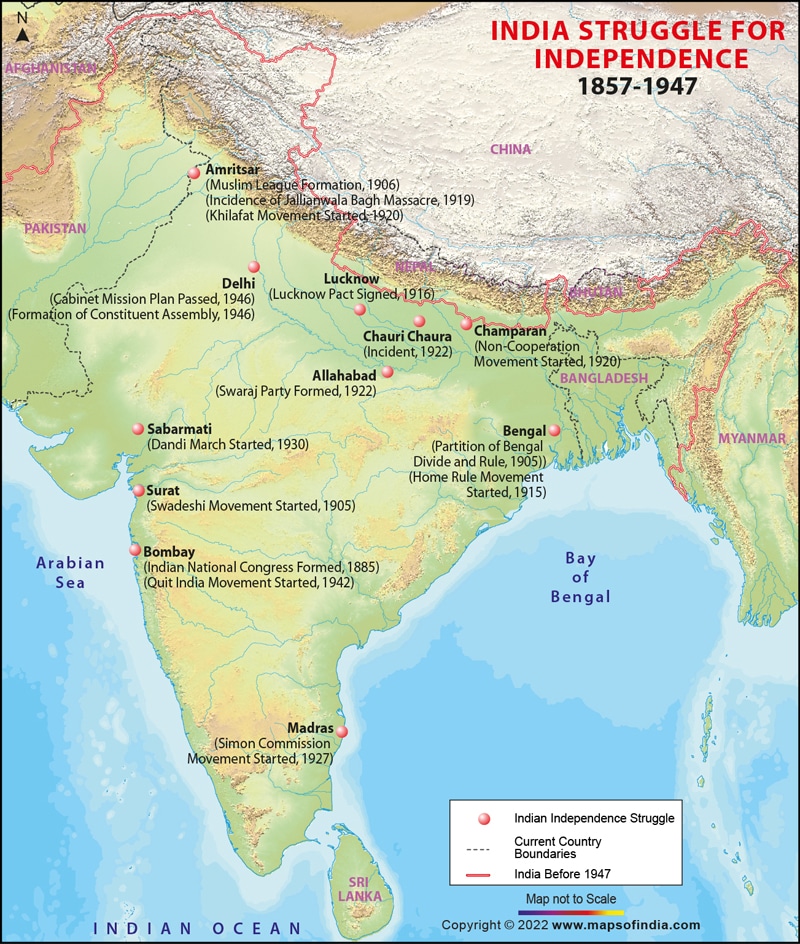
- Hume’s efforts bore fruit: the first session of the Indian National Congress was organised at Bombay, in the hall of Gokuldas Tejpal Sanskrit College, on 28 December (a Monday), 1885.
- The session was presided over by Womesh Chunder Bonnerjee of Bengal and attended by 72 delegates.
- Bonnerjee was one of the earliest Indian barristers and among the foremost legal luminaries of his day; his election as president established a healthy precedent — that the Congress president should, as far as possible, be chosen from a province other than the one hosting that year’s session.
Foundation of the Congress as the Culmination of Earlier Political Work
- By 1885, Indian political development had reached a stage where certain basic tasks and objectives needed to be clearly laid down and actively pursued.
- These objectives were closely correlated with one another and could only be achieved through the coming together of political workers within a single, all-India organisation.
- The men who met in Bombay in December 1885 were inspired by precisely these objectives, and hoped to set in motion the process of achieving them.
- The ultimate success, failure, and future character of the Congress would be determined not by who had founded it, but by the extent to which these objectives were actually realised in its early years.
- With the foundation of the National Congress in 1885, the struggle for India’s freedom from foreign rule was launched — modestly, but in an organised form for the first time. From this point on, the national movement would continue to grow, and the country would know no rest until freedom was finally won.