Agrarian Economy in Early Medieval India

- The early medieval period in Indian history marks a sustained growth of cultivation and a fundamental reorganisation of land relations through land grants — the central theme underlying the agrarian economy in early medieval India.
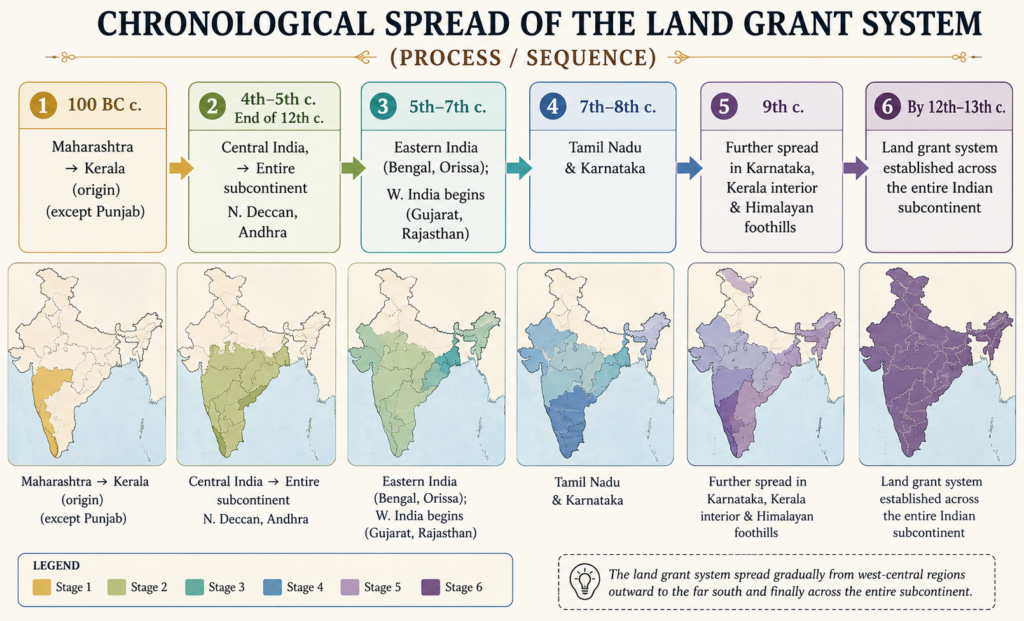
- These grants began around the beginning of the Christian era and, by the end of the twelfth century, had come to cover practically the entire subcontinent — in the words of the sources, “what began as a mere trickle, became a mighty current.”
- This expansion was driven by the regular use of advanced agricultural techniques (plough cultivation and irrigation technology), the institutional management of agricultural processes, and evolving control over the means and relations of production.
- Alongside this expansion, new forms of rural tension emerged, even as commercial activity in both agricultural and non-agricultural commodities increased.
- This article traces the agrarian economy of early medieval India through its patterns of expansion, the ideology behind land grants, the organisation of agrarian settlements, the resulting rural tensions, the agriculture–exchange network relationship, and finally the two competing historiographical frameworks used to characterise this economy — the feudal economy thesis and the peasant state and society thesis.
Agrarian Expansion through Land Grants
- The land grant system developed in 100 BC in Maharashtra, and by 1000 AD had come to cover almost the entire subcontinent, acquiring a universal, all-India character.
- Around 100 BC onward, grants were made chiefly to Vedic priests; by 500 AD, the practice extended to religious establishments and temple priests; and from 700 AD onward, grants began to be made for secular purposes as well.
- Agrarian expansion began with the establishment of brahmadeya and agrahara settlements through land grants to Brahmanas from the fourth century onward, and this practice acquired a uniform, universal form in the centuries that followed.
- The period between the eighth and twelfth centuries witnessed both the intensification of this expansion and the culmination of an agrarian organisation based on land grants to religious and secular beneficiaries — Brahmanas, temples, and officers of the king’s government.
- However, this development showed significant regional variation, shaped by both geographical and ecological factors.
Geographical Patterns
- Cultivation was extended to hitherto virgin lands, often through the clearing of forest areas.
- Some scholars hold that land grants began in outlying, backward, and tribal tracts before gradually extending to the Ganga valley — the hub of Brahmanical culture.
- In these backward and aboriginal tracts, Brahmanas spread new methods of cultivation by applying their specialised knowledge of the seasons (astronomy), the plough, and irrigation, while also protecting cattle wealth.
- This pattern, however, does not hold for all regions — land grants were equally made in areas of already-settled agriculture and in other ecological zones, often specifically to integrate them into the new economic order.
Chronological Pattern
- The land grant system spread across the subcontinent in a fairly discernible chronological sequence:
- 4th–5th centuries — central India, northern Deccan, and Andhra.
- 5th–7th centuries — eastern India (Bengal and Orissa), with beginnings in western India (Gujarat and Rajasthan).
- 7th–8th centuries — Tamil Nadu and Karnataka.
- 9th century — Kerala.
- End of the 12th century — almost the entire subcontinent, with the possible exception of Punjab.
The Ideology behind Land Grants
- Epigraphic records — our principal source for this period — are marked by a striking contradiction: they are simultaneously eloquent about the cruelty, violence, and territorial ambition of kings, and yet equally lavish in describing the magnanimity these same kings showed towards Brahmana donees.
- Several explanatory strands have been proposed for this apparent contradiction:
- The grants may have been a means of satisfying royal vanity — the pompous genealogies and grandiloquent titles heaped on donor kings and their predecessors were, in this reading, examples of political sycophancy.
- There was likely an element of selfishness too: the ostensible purpose of such munificent gifts was to earn punya (religious merit) — not only for the donor but for his predecessors as well.
- It has also been argued that land grants provided financial support to “selfless” Brahmanas engaged in teaching and learning, who supposedly led plain, simple lives.
- This view, however, is an oversimplification, since Brahmana vocations were themselves diversifying during this period — Brahmanas were undergoing a clear transformation from priests to landlords, emerging as a property-owning and property-seeking class.
- A particularly significant dimension of the epigraphic evidence is the close correspondence between dharmashastric prescriptions and the terminology of gift-making found in inscriptions — the very concept of dana (gift-making) was itself undergoing perceptible change.
- The dharmashastras placed great emphasis on prayashchitta (expiation/repentance) for worldly sins — and few kings, guilty of loot, arson, and killing in the course of war, could claim to be free of sin.
- Brahmana lawmakers cultivated a deep sense of fear in kings through a graded system of sins and punishments, including the concept of mahapatakas (great sins).
- This sense of royal guilt, combined with the doctrine of prayashchitta, was effectively exploited by Brahmanas, who strongly recommended lavish gifts of cows, bulls, land, and gold to spare kings (and their ancestors) a miserable rebirth as insects or lower animals — and among all such gifts, land held pre-eminent status.
- Vyasa, frequently quoted in inscriptions, is said to have declared that the giver of land dwells in heaven for 16,000 years.
- Several Puranas similarly promise land-donors the good fortune of dwelling in the charming company of apsaras (celestial nymphs).
- In the hands of Brahmana lawgivers, these sacred texts ceased to be mere abstract or prescriptive works and effectively acquired the character of policy statements — reinforced by imprecations against the destruction or resumption of such gifts, which helped ensure their perpetuity.
- Alongside religious merit, the quest for legitimacy was a major consideration for political authorities, who sought legitimacy in return for their gifts — underlining the essential mutuality of interest between donor and donee.
- The prashastikaras (eulogy-composers), dharmashastrakaras (lawmakers), and purohitas (court Brahmanas) all functioned as collaborators in sustaining this new landed order.
Agrarian Organisation
- The agrarian organisation and economy of the period were highly complex, and can best be understood through intensive study of regional land-grant patterns and the character and role of brahmadeya, non-brahmadeya, and temple settlements.
- A fuller picture also requires understanding the growth and nature of land rights, the interdependence among various groups connected with land, and the underlying production and distribution processes.
Character and Role of Agrarian Settlements
Brahmadeya
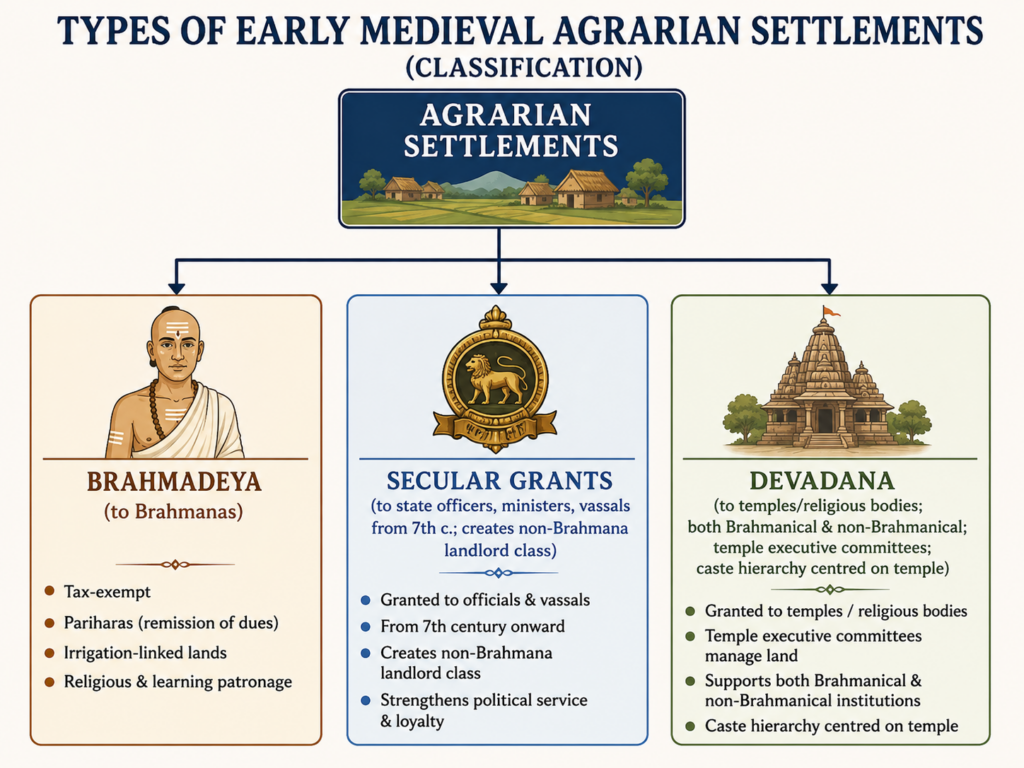
- A brahmadeya represents a grant of land — either individual plots or entire villages — made over to Brahmanas, transforming them into landowners or land-controllers.
- Such grants were intended either to bring virgin land under cultivation or to integrate existing agricultural/peasant settlements into the new economic order dominated by a Brahmana proprietor.
- Brahmana donees played a major role in integrating diverse socio-economic groups into this new order, through service tenure and caste groupings under the varna system — for instance, the growing peasantisation of Shudras was rationalised within the existing Brahmanical social framework.
- Brahmadeyas facilitated agrarian expansion in several ways:
- They were exempted from various taxes or dues, either entirely or at least during the initial years of settlement (e.g., for up to 12 years).
- They were endowed with ever-growing privileges (pariharas); ruling families gained both an expanded resource base and valuable ideological support for their political authority by creating brahmadeyas.
- Land was granted as brahmadeya either to a single Brahmana or to several Brahmana families together, and was invariably located near major irrigation works such as tanks or lakes — new irrigation sources were often constructed specifically when a brahmadeya was created, especially in rain-dependent, arid, and semi-arid regions.
- When situated within intensive river-valley agriculture, brahmadeyas served to integrate surrounding settlements engaged in subsistence-level production; sometimes, two or more settlements were clubbed together to form a single brahmadeya or agrahara, with the boundaries of the donated land or village carefully demarcated.
- Brahmanas effectively became managers of agricultural and artisanal production:
- The different categories of land within a village — wet, dry, and garden land — were precisely specified, sometimes down to specific crops and trees.
- Land donations implied far more than the transfer of land rights alone: along with revenues and economic resources, human resources — peasants, artisans, and others — were often transferred to the donees as well.
- There is also growing evidence of encroachment on villagers’ rights over community resources such as lakes and ponds, even as the Brahmanas themselves organised into formal assemblies.
Secular Grants
- From the seventh century onward, state officers too began to be remunerated through land grants, creating an entirely new class of non-Brahmana landlords.
- While evidence for such grants exists from as early as c. AD 200 (the age of Manu), the practice gained real momentum only in the post-Gupta period.
- Literary works from central India, Rajasthan, Gujarat, Bihar, and Bengal between the tenth and twelfth centuries frequently mention grants made to ministers, kinsmen, and those rendering military service — the rajas, rajaputras, ranakas, and mahasamantas named in Pala land charters, for instance, were mostly vassals connected with land.
- The incidence of such grants varied significantly by region: while only a handful of the half-dozen or so Paramar official ranks are known to have received land, very large territories were granted to vassals and high officers under the Chalukyas of Gujarat; similarly, Orissa appears to have had more service grants than Assam, Bengal, and Bihar combined.
- The right of various officials to enjoy specific, exclusive levies — irrespective of how long these levies lasted — created a fresh layer of intermediaries with vested interests in the lands of tenants.
Devadanas
- Large-scale gifts were also made to religious establishments, both Brahmanical and non-Brahmanical, functioning as nuclei of agricultural settlement and helping to integrate peasant and tribal populations through a process of acculturation.
- These centres integrated diverse socio-economic groups through service tenures or remuneration via temple lands — such lands were leased to tenants who paid a higher share of produce to the temple, and were managed either by the sabha of the brahmadeya or the mahajanas of the agrahara settlement.
- In non-Brahmana settlements, temples similarly became the central institution, with temple lands administered by temple executive committees composed of land-owning non-Brahmanas — such as the Velalas of Tamil Nadu or the Okkalu and Kampulu of Karnataka and Andhra.
- The resulting caste organisation centred on the temple assigned different groups a specific caste and ritual status; it was through this very process that people engaged in “impure” or “low” occupations were assigned untouchable status, excluded from the temple, and settled at the fringes of the settlement.
- Taken together, these developments produced several strata of intermediaries between the king and the actual producer — the Brahmana, the temple, and the upper strata of non-Brahmanas as landlords, employers, and holders of superior land rights became the central feature of early medieval agrarian organisation.
- The new landed elite also included local peasant clan chiefs and heads of kinship groups or families, who held kani rights — rights of possession and supervision over land.
Nature of Rights Granted to Assignees
- Rights conferred on grantees typically included both fiscal and administrative powers.
- Land tax, theoretically payable to the king or the state, effectively came to be assigned to the donees instead.
- References to pariharas (exemptions) in copper-plate and stone inscriptions show that dues theoretically owed to the king were not fully waived — rather, the right to collect them was transferred to the grantee, a practice apparently sanctioned by the dharmashastras, which upheld royal ownership of land while simultaneously justifying such grants and the intermediary rights they created.
- While some evidence points to a communal basis of land rights in earlier settlements, the growing development of private ownership is indicated by several trends:
- Grantees frequently enjoyed rights of alienation over the land.
- They also enjoyed other hereditary benefits within the settlements.
- Land gifts were often made after purchase from private individuals, suggesting that hereditary ownership developed out of both religious and secular grants alike.
Rural Tension
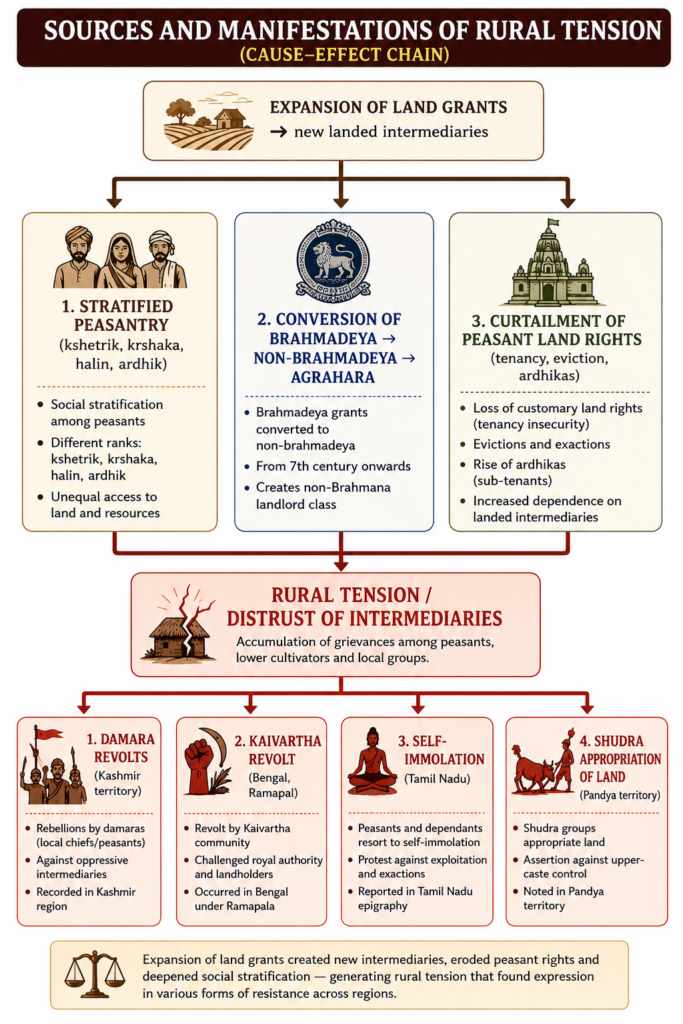
- The expansion of the land-grant system generated distinct sources of rural tension:
- The peasantry itself became increasingly heterogeneous and stratified — unlike the age-old, pre-Gupta gahapatis, this period introduced a graded set of cultivator categories such as kshetrik, krshaka, halin, and ardhik, though these terms unfortunately give little direct indication of actual landownership.
- The steady conversion of brahmadeyas into non-brahmadeyas, and of the latter into agraharas, was itself a recurring source of friction in rural society.
- This underlying distrust of the new landed intermediaries found expression in several documented episodes:
- The damara revolts in Kashmir.
- The rebellion of the Kaivarthas during the reign of Ramapal in Bengal.
- Acts of self-immolation in response to land encroachments in Tamil Nadu.
- The appropriation of donated land by Shudras in Pandya territory.
- Other indications of underlying tension included conflict between Brahmanas and temples, and within the ranks of secular landholders themselves; the fact that donors often sought out land where cultivation was undisputed also hints at simmering unrest, as does the possible link between agraharas and the appearance of hero-stones (memorials commemorating a hero’s honourable death in battle) in their vicinity.
- The growing prominence of the concept of Brahmahatya (the killing of a Brahmana) in this period raises an important historiographical question: does its rise cast doubt on the validity of the “Brahmana–peasant alliance” and the “peasant state and society” models discussed later?
Agriculture and the Exchange Network
- It has sometimes been argued that in the early medieval economy — predominantly agrarian and organised around self-sufficient villages — production was largely subsistence-oriented and not responsive to market forces, leaving little scope for economic growth.
- Craftsmen and artisans were typically attached to villages, estates, or religious establishments, leaving little independent role for traders and middlemen, who mainly procured and supplied items like iron tools, oil, spices, and cloth to rural communities — in short, the market system functioned only in a very limited way.
- This picture holds reasonably well for the period c. 300–800 AD. However, the subsequent five centuries witnessed a rapid rise in the number of agrarian settlements alongside the growth of local markets, initially serving purely local exchange.
- Over time, the need for regular exchange — both within regions and between them — led to more organised commerce, which in turn spurred the emergence of merchant organisations, itinerant trade, and partial monetisation from the ninth century onward.
- Although the relative weight of these features varied by region, the growing centrality of agriculture within this evolving exchange economy is clearly discernible.
- Agricultural produce increasingly came to be exchanged for goods carried by itinerant long-distance traders, a development that also reshaped patterns of landownership toward the close of the early medieval period.
- Merchants and economically influential craftsmen, such as weavers, began investing in land — purchasing or acquiring it, and in turn making land gifts of their own.
- In south Karnataka, for example, a weavers’ community called the Jagati-kottali and a community of oil-pressers called the Telligas were active participants in agriculture; the Jagati-kottali are repeatedly recorded as excavating tanks and laying out gardens.
- Merchants and economically influential craftsmen, such as weavers, began investing in land — purchasing or acquiring it, and in turn making land gifts of their own.
Characterising the Early Medieval Agrarian Economy
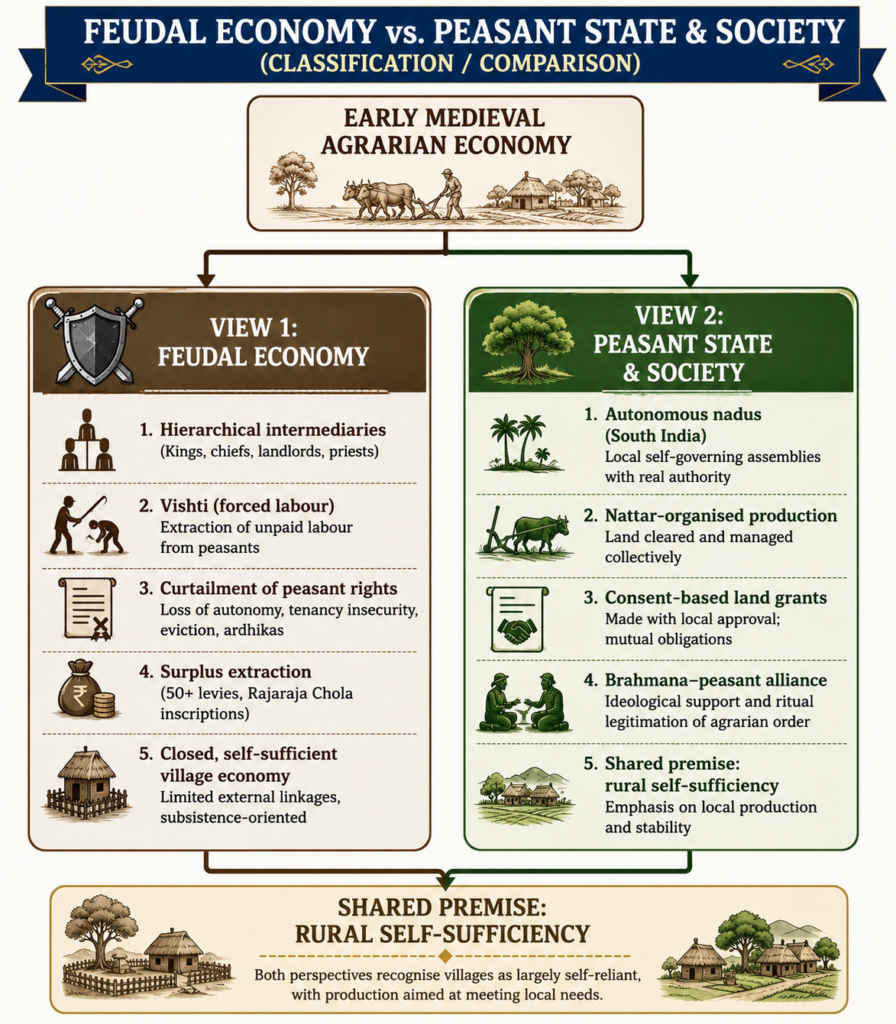
- Historians differ sharply on how to characterise the overall structure of the early medieval agrarian economy: one influential view treats it as a manifestation of feudal economy, while a competing view describes it instead as a “peasant state and society.”
View 1 — Early Medieval Agrarian Economy as Feudal Economy
(These features overlap closely with the broader theory of “Indian Feudalism.”)
- Emergence of hierarchical landed intermediaries: Vassals, state officers, and other secular assignees held military obligations and feudal titles; their sub-infeudation of land to get it cultivated produced a graded hierarchy of landed aristocrats, tenants, sharecroppers, and cultivators — reflecting the gross inequality in land and produce distribution that characterised Indian feudalism.
- Prevalence of forced labour (vishti): The right to extract forced labour, originally a royal prerogative, was transferred to Brahmana and other grantees, petty officials, and village authorities.
- The Chola inscriptions alone contain over a hundred references to forced labour, which extended even to peasants and artisans — producing a form of serfdom in which agricultural labourers were reduced to semi-serf status.
- Curtailment of peasants’ land rights: As rulers and intermediaries claimed ever-greater rights over land, peasants’ own rights correspondingly declined — many were reduced to tenants facing eviction, or survived merely as ardhikas (sharecroppers), compounded by rising taxation, coercion, and indebtedness.
- Extraction of surplus through multiple mechanisms: New property relations gave rise to new instruments of economic subordination — the scale of this extraction is evident in the more than fifty levies recorded in the inscriptions of Rajaraja Chola.
- Closed village economy: Since human resources were transferred along with land to beneficiaries, peasants, craftsmen, and artisans within such villages became mutually dependent and effectively attached to the village — their attachment to both land and service grants ensured firm control by the beneficiaries.
- In sum, a subject and immobile peasantry, operating within relatively self-sufficient villages reinforced by varna restrictions, was the defining feature of the agrarian economy across the five centuries under review.
View 2 — Early Medieval Agrarian Economy as “Peasant State and Society”
- Advanced chiefly in opposition to the theory of Indian feudalism, this view rests primarily on evidence from South Indian sources.
- According to this theory, autonomous peasant regions called nadus evolved across South India by the early medieval period, organised on the basis of clan and kinship ties.
- Agricultural production within the nadus was organised and controlled by the nattar — the people of the nadu — who governed themselves through assemblies (also called nadu); members of this assembly were the velalas, or non-Brahmana peasants.
- The autonomy of the nattar is evident from the fact that when kings or lesser chiefs made land grants, the orders were issued with their consent and were first addressed to them — the nattar demarcated the gifted land and supervised the execution of the grant, since they themselves were the organisers of production.
- In this framework, Brahmanas and dominant peasants became allies in the process of agricultural production.
- Notably, proponents of this hypothesis also share the notion of rural self-sufficiency — a concept that is itself a core component of the feudalism thesis, underscoring how both models draw on overlapping empirical ground even while reaching different conclusions.
Conclusion
- The agrarian economy of early medieval India was shaped by the steady expansion of the land grant system — from its regional and chronological patterns of spread, through the complex religious and political ideology that sustained it, to the elaborate organisation of brahmadeya, secular, and devadana settlements it produced.
- This transformation was not free of strain: rural tensions, ranging from stratified peasant categories to open revolts, reveal the underlying costs of this new agrarian order, even as a gradually reviving exchange network began to reshape rural society from around the ninth century onward.
- Ultimately, historians remain divided between the feudal economy and peasant state and society frameworks for characterising this period — a reminder that, given the regional complexity of early medieval India, a fuller understanding will require continued region-specific studies of its agrarian patterns.