

Portuguese Colonial Enterprise in India

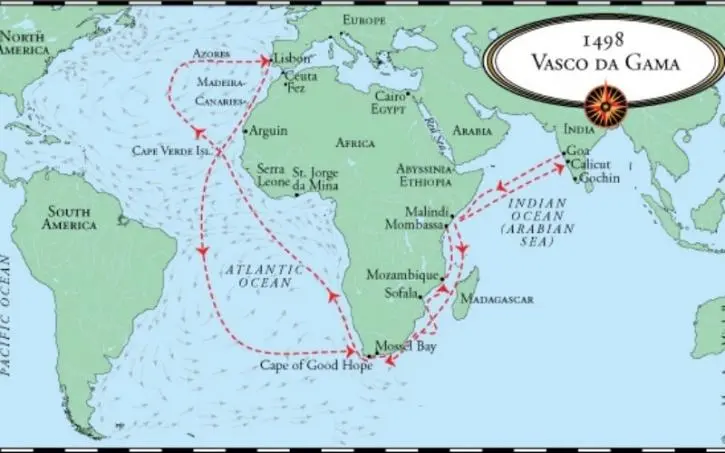
The landing of Vasco da Gama at Calicut on the Malabar coast in 1498, with three ships guided by a Gujarati pilot, Abdul Majid, is generally regarded as marking the beginning of a new era in the relationship between Asia and Europe.
Previous Attempts at Finding a Sea Route
- A search for a sea route to India had already been attempted in post-Roman times by Genoa. In 1291, the Genoese navigator Ugolino di Vivaldo set out with two galleys to reach India by the ocean route, but was never heard from again.
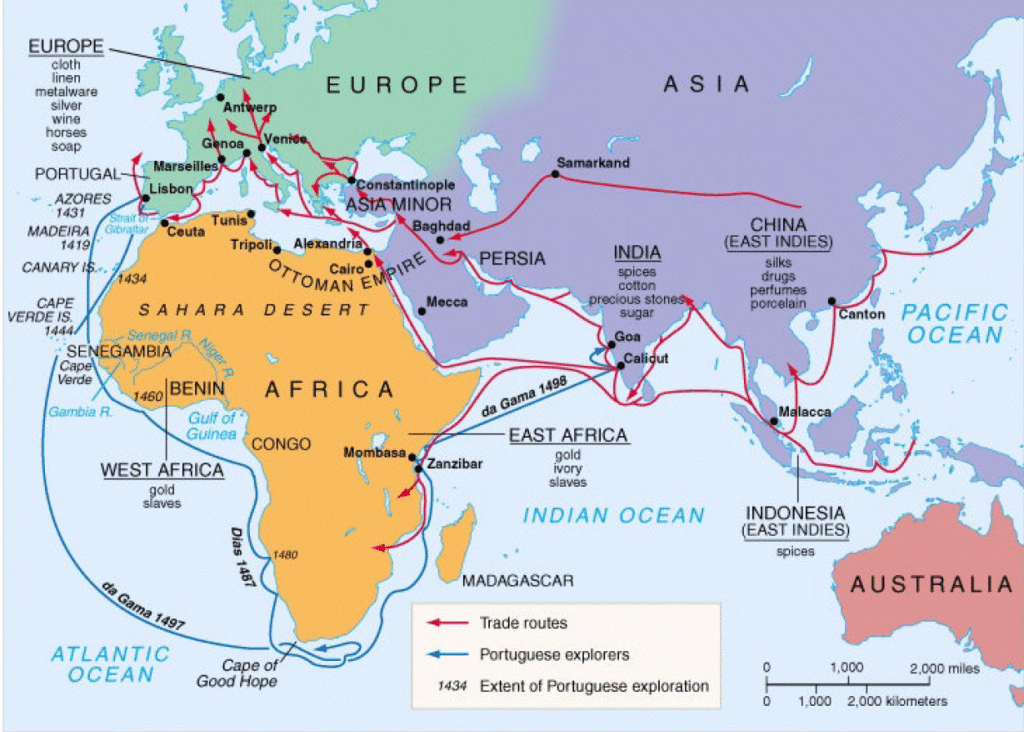
- The lead in this search subsequently passed to Portugal. From 1418, Dom Henrique, ruler of Portugal — better known as Henry the Navigator — despatched two to three ships each year to explore the west coast of Africa.
- The occupation of the African coast up to the mouth of the Congo river between 1443 and 1482 gave Portugal access to trade in ivory, slaves, and gold dust, further whetting its ambitions.
- The rounding of the southern tip of Africa in 1487 by Bartolomeu Dias opened the sea route to India, though it would be another ten years before this route was taken up by Vasco da Gama.
The Asian Oceanic Trade Network Before the Coming of the Portuguese
- There was no fundamental difference in the internal structure of trade and commerce between Asia and Europe before the rise of industrial capitalism in the West. Both European and Asian merchants sought exclusive market intelligence, and Asia’s larger traders were notably flexible, prepared to deal in any commodity expected to yield good profit — reflecting far less specialisation than in modern times.
Big Merchants and Trading Associations
- Asia’s biggest merchants, most active in long-distance emporium trade, were equally active in domestic and foreign commerce, and often doubled as bankers, money-lenders, and insurance agents. Some owned their own ships, though the carrying of goods — overland and overseas — was also a distinct, specialised occupation.
- A definite pattern of trade had developed between regions, shaped by wind movements, ocean currents, and distances:
- Voyages originating in the Red Sea or Persian Gulf rarely went beyond Gujarat or the Malabar ports.
- Goods bound for South-East Asian ports were shipped from Gujarat, Malabar, or the Coromandel coast.
- Chinese traders had earlier visited Malabar, but following a ban on foreign trade imposed by the Ming rulers in the 15th century, they no longer ventured beyond South-East Asia.
- Commanding a ship over such vast distances demanded considerable nautical skill and experience — skills that Asian sailors (Arabs, Indians, Malays, and Chinese) possessed in abundance. Ship captains (nakhudas) were held in high esteem and commanded good wages, while ships also carried numerous small traders, best described as peddlers.
- Like their European counterparts, Asian merchants relied on family connections as well as associations built around shared interests or regional ties — such as the Karimi merchant association based at Aden, whose activities extended as far as China; the trade associations of Burmese merchants; and Maniraman, a long-active association of south Indian merchants engaged in both domestic and foreign trade.
- Notably wealthy merchants of the period included Vastupal and Tejpal in Gujarat, the Chetti merchants of Tamil Nadu and Bengal, and the Maraccars of Malabar.
- Asian trade at the time was, in fact, considerably larger in scale than European trade, and some of the world’s richest merchants were to be found in Asia — even though European scholars long and indiscriminately labelled Asian traders as mere “peddlers.” What truly mattered was the size and range of Asia’s trading communities, the diversity of their activities, their entrepreneurial skill, and the financial and shipping resources at their command. Unlike many European traders, Asian merchants also did not rely on state political or military backing.
Beyond Luxury Goods: The True Scale of Oriental Trade
- A second misconception was the notion that oriental trade consisted solely of luxury goods — largely true of trade with Europe, which imported mainly silk and jade from China, spices from India and the Spice Islands, and certain cloths from the Middle East.
- Within the Indian Ocean region itself, however, trade encompassed everyday necessities — salt, sugar, grains, and clothing — alongside luxury items such as spices, horses, silk, Chinese porcelain, incense, ivory, glass, jewellery, precious stones, and slaves.
- Trade in basic necessities was essential because regions such as the South-East Asian islands had very limited rice production and clothing manufacture, while the Middle East depended on imported salt, sugar, and food-grains.
- Pre-modern merchant ships also could not operate without low-value bulk cargo to serve as ballast, so heavy goods such as dates, sugar, building material, and timber were regularly shipped to India or China.
- Climate and geography dictated the movement and direction of trade: ships from the Middle East reached Indian ports ahead of the monsoon, where goods were transhipped onward to South-East Asia or China in different vessels — with Malacca serving as another key transhipment point. While Chinese traders did not sail beyond Java-Sumatra, Arabs and Indians traded as far as China itself — reflecting both the impressive range and the sheer bulk of goods moved across the pre-modern Indian Ocean.
Capability of Asian Shipping
- A third misconception held that Asian ships were incapable of long-distance open-sea voyages, owing to frail construction and a lack of nautical technique. In fact, it was Indians who pioneered open-sea voyages from Gujarat to Aden, and across the Indian Ocean to South-East Asia and East Africa — so much so that when Vasco da Gama sailed for Calicut from Malindi in East Africa, he found four Indian ships already there. It has similarly been shown that even relatively frail boats could sail the open seas from the Malay Peninsula to Mauritius, guided by ocean currents.
- Sewn versus nailed ships: Indian shipbuilding tradition favoured sewing hulls rather than nailing them; according to Arab geographers, nailed ship construction began in the Persian Gulf region in the 10th century. Sewn ships, however, continued in use because of their greater flexibility and ease of repair — an advantage in the shallow waters and swift currents of the Gulf. The Portuguese chronicler Gaspar Correa, writing in the early 16th century, noted that Indian waters saw both sewn and nailed ships in operation, observing that sewn ships “remain as secure as if they were nailed.”
- Size and technology: By the time the Portuguese arrived, boats plying the region ranged from 350 to 400 tonnes — a substantial tonnage for the era — and carried several masts, though the multi-storeyed Chinese junks remained the most advanced vessels of the time. Since Arabia and Persia lacked shipbuilding timber, most such ships were built in Gujarat or Malabar, reflecting a long history of mutual influence between Indian and Arab shipbuilding traditions whose vessels were by no means inferior to European ones.
- Nautical techniques: The Chinese possessed a mariner’s compass from as early as the 10th century, though it was not widely used. Arab and Indian sailors instead fixed their position at sea using the stars, aided by a compass card or kamal, while the mariner’s compass proved most valuable for navigating uncharted waters.
Traders and State Policy
- The seas were plied by a diverse community of traders — Arabs, Iranians, Jews, Armenians, Genoese, Gujaratis, Tamil Chettis, and Javanese.
- Rulers generally protected the life and property of these traders, observing well-defined commercial laws and keeping customs duties within reasonable limits; where such conventions were occasionally violated, the offending state stood to lose, since traders in this highly competitive environment would simply relocate to another port.
- Crucially, while rulers taxed trade, they did not attempt to dominate the seas or protect and expand their trade through armed intervention on land or sea — though they remained mindful of commercial advantage even while conducting land-based military campaigns. In Asia, the only armaments typically carried aboard ships were soldiers and rockets, intended as a safeguard against sea pirates active off Oman, Malabar, South-East Asia, and China. A notable exception to this pattern were the Chola naval expeditions against Java-Sumatra in the 14th century; broadly, however, the tradition of trading under armed naval escort did not develop in Asia.
- Owing to these factors, the 14th and 15th centuries were an unusually prosperous period in Indian Ocean history. Although by the second half of the 15th century Chinese traders had withdrawn on imperial orders, and the Karimi merchants of Yemen as well as Jewish traders had scaled back operations — perhaps in the face of growing Arab competition — this did not create any “commercial vacuum.” Nor did the Arabs hold an outright monopoly over trade in the western Indian Ocean, though they were undoubtedly its richest and most powerful group of long-distance traders. These conditions explain why the Portuguese, who initially came to Asia merely to capture the trade in Asian goods bound for Europe, ultimately chose to remain and seize the trans-Asian trade itself through the use of force.
Objectives Behind the Portuguese Search for a Sea Route
- Although Asia and Europe had maintained commercial relations since antiquity — the Greek historian Herodotus even recorded that the Phoenicians had rounded Africa as early as the 6th century BC — the opening of a direct sea link between the two continents was not merely the fulfilment of an old dream, but also promised a substantial increase in trade.
- In 1453, Constantinople fell to the Ottoman Turks. Merchandise from India reached European markets through Arab Muslim intermediaries, with the Red Sea trade route functioning as a state monopoly that generated enormous revenues for Islamic rulers; the overland routes to India were similarly under Arab control. This spurred Europeans to seek a direct sea route to India — one that would break the virtual Arab-Turkish monopoly over the trade in eastern goods, especially spices.
- For the Portuguese specifically, opening a sea route to India promised a significant blow against the Arabs and Turks — Christianity’s traditional adversaries, and an increasingly serious military and naval threat to Europe. The Portuguese also hoped that exploring Africa might allow them to link up with the legendary kingdom of Prester John, enabling a two-pronged assault on Muslim power. Commercial and religious objectives thus reinforced one another.
- Papal support: The Pope’s growing interest in the search was reflected in a 1453 Bull granting Portugal “in perpetuity” whichever lands it “discovered” beyond the Cape in Africa up to India, on condition that it convert the “heathens” of those lands to Christianity.
- The Renaissance also spurred this search, as the intellectual ferment gripping 15th-century Europe challenged established modes of thought and fostered a new spirit of daring and exploration — reflected in the growing presence of Genoese traders in the Indian Ocean from the 13th century onward, and travellers such as the Venetians Nicolò Conti and Barbosa, and the Russian Nikitin, among many others who reached India during this period.
- Europe’s economic development was progressing rapidly, with expanding cultivation, improved ploughs, scientific practices such as crop rotation, and rising meat consumption — which in turn increased demand for spices, both for cooking and for preservation.
- Since much European cattle had to be slaughtered in winter for lack of fodder, the resulting salted meat created strong demand for oriental spices to make it more palatable.
- Europe simultaneously made great strides in shipbuilding and navigation, fuelling an eagerness across the continent for adventurous voyages to the unknown corners of the East.
- Genoese motivations: The principal European rivals of the Venetians, the Genoese had also distributed oriental goods across Europe but had gradually been sidelined by Venice. Both Venice and Genoa, despite having earlier prospered from the oriental trade, were too small to confront the mighty Ottoman Turks or undertake major exploration independently. The fall of Constantinople in 1453 was a particularly severe blow to Genoa, as it gradually lost access to the Black Sea ports — its principal outlet for oriental goods. This setback, combined with its old rivalry with Venice, led Genoa to support Portugal and Spain with ships, funds, and nautical expertise in the search for a sea route to India — Christopher Columbus, who “discovered” America in 1492 while attempting to find such a route, was himself Genoese.
- Portugal, meanwhile, had positioned itself as the leader of Christendom’s resistance to Islam even as it embraced the spirit of exploration. Finding an ocean route to India had become something of an obsession for Prince Henry “the Navigator”, who was equally keen to bypass Muslim domination of the eastern Mediterranean and all routes connecting India to Europe.
- Arabs and Turks were not obstructing trade: It is worth noting that the European search for a direct sea route was not driven by any Arab or Turkish obstruction of the eastern trade, or by excessive taxation. With the rise of Islam, Arabs had in fact become the world’s principal long-distance traders, and their merchants, sailors, and geographers linked the trade between the Mediterranean and Asia — and within Asia, between West Asia, India, East Africa, South-East Asia, and China — more closely than ever before. Nor were the Turks averse to commerce.
- Trade from the Orient flowed from the Persian Gulf via Hormuz and Basra to the Levant, and from the Red Sea via Jeddah to Cairo and Alexandria in Egypt, besides overland routes leading to Black Sea ports. The customs duties levied on this trade were a rich source of profit for Arab and Turkish rulers, who had every reason to protect and encourage it.
- Despite a papal ban on trading with “heathens” (i.e., Muslims), Genoese and Venetian merchants remained active in the oriental trade — indeed, Venetian merchants held a virtual monopoly over the purchase of oriental goods in Egypt and the Levant for distribution across Europe. Though Venice and the Ottomans fought long and bitter naval battles, neither side pushed the conflict far enough to harm their shared commercial interests, earning them the description of “complementary enemies.”
Arrival of Vasco da Gama
- The arrival of Vasco da Gama’s three ships, guided by the Gujarati pilot Abdul Majid, at Calicut in May 1498, profoundly affected the course of Indian history. The Hindu ruler of Calicut, the Zamorin (Samuthiri), harboured no suspicion of European intentions and, since his kingdom’s prosperity rested on Calicut’s role as a trading entrepôt, extended a friendly reception to da Gama — permitting him to trade in spices and set up a factory (warehouse) on the coast.
- Over the objections of local Arab merchants, Gama secured a letter of trading concession from the Zamorin, though the Portuguese proved unable to pay the customs duties and the price of goods in gold as required. When the Portuguese sought to enforce a monopoly over the spice trade to Europe and claimed the right to search Arab traders’ ships, a violent clash ensued in which Portuguese residents at their factory were massacred; in retaliation, Portuguese ships bombarded Calicut before withdrawing.
- Da Gama remained in India for three months. On his return to Portugal, he carried a rich cargo that was sold in the European market at enormous profit — the spices he brought back were computed at sixty times the cost of the entire expedition. The value of direct access to the pepper trade was underscored by the fact that Europeans buying through Muslim middlemen elsewhere paid roughly ten times as much for the same quantity of pepper. Unsurprisingly, this success drew other European merchants to seek direct trade with India.
- In 1502, Vasco da Gama returned with a fleet of twenty-five vessels, demanding that the Zamorin expel all Muslim merchants settled in Calicut and bar any future trade with Muslims. The Zamorin refused, arguing that the port was open to all and that excluding any trader — Muslim or otherwise — was impossible. Gama’s response was a brutal assault on Calicut, followed by the establishment of forts at Cochin, Quilon, and elsewhere to dominate the Malabar trade — marking a complete and irrevocable rupture with the Zamorin. Vasco da Gama also set up a trading factory at Cannanore.
- At the heart of this conflict lay two fundamentally different philosophies of the relationship between trade and the state:
- The Asian convention favoured open trade, with governments supporting commerce but not employing military or naval force to promote or protect it.
- The Mediterranean tradition the Portuguese brought with them combined trade with warfare on land and sea — an approach that deeply unsettled Asian traders and the small trading states of the region, such as Calicut and Cochin, which — much like certain European city-states — depended heavily on trade but adhered to the convention of open commerce without armed force.
- For centuries, the Indian Ocean trading system had accommodated numerous participants — Indians, Arabs, East Africans, Chinese, Javanese, and others — operating within tacit rules of conduct, with none seeking overwhelming dominance despite all pursuing profit. The Portuguese changed this equation, seeking to monopolise the immensely profitable eastern trade by excluding competitors — the Arabs above all. Calicut, Cannanore, and Cochin gradually became key Portuguese trading centres, with the Portuguese eventually securing permission — under the pretext of protecting their factories — to fortify these settlements.
Portuguese Governors in India
Francisco de Almeida
- In 1505, the King of Portugal appointed a governor for India on a three-year term, on condition that four forts be established on the south-western Indian coast — at Anjediva Island, Cannanore, Cochin, and Quilon — and equipped him with sufficient force to protect Portuguese interests.
- Almeida’s vision was to make Portugal the master of the Indian Ocean, embodied in his “Blue Water Policy” (the cartaz system). He famously declared: “As long as you may be powerful at sea you will hold India as yours; and if you do not possess this power, little will avail you a fortress on shore.”
- Alarmed by growing Portuguese power, the Sultan of Egypt assembled a fleet and sent it toward India, joined by a contingent of ships from the ruler of Gujarat, along with the support of the Zamorin of Calicut and the rulers of Bijapur and Ahmadnagar. Though this combined fleet initially prevailed — killing Almeida’s own son in the process — it was ultimately routed by the Portuguese in 1509. This naval victory made the Portuguese navy supreme in the Indian Ocean for the time being, enabling them to extend operations toward the Persian Gulf and the Red Sea.
Alfonso de Albuquerque
- Albuquerque, who succeeded Almeida as governor, was the true founder of Portuguese power in the East — a task he completed before his death. He pursued a policy of dominating the entire oriental commerce by establishing forts at strategic points across Asia and Africa, backed by a strong navy.
- Defending this approach, he wrote: “A dominion founded on a navy alone cannot last.” Lacking forts, he argued, rulers would “neither trade nor be on friendly terms with you.” The Portuguese under Albuquerque further tightened their grip by introducing a permit system for other ships and asserting control over major regional shipbuilding centres — aided by the fact that the Gulf and Red Sea regions lacked timber for shipbuilding.
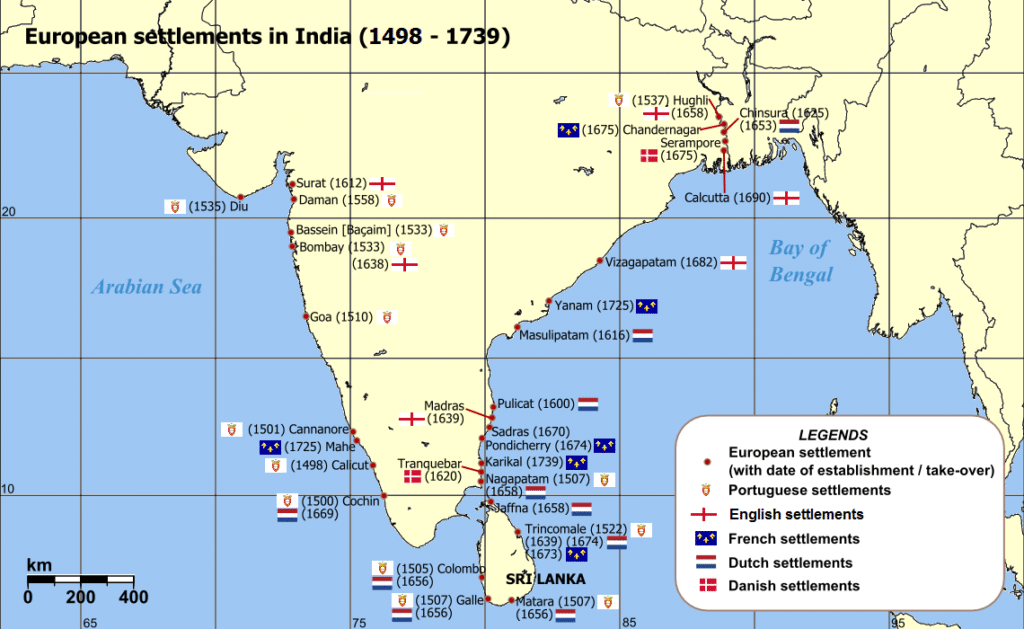
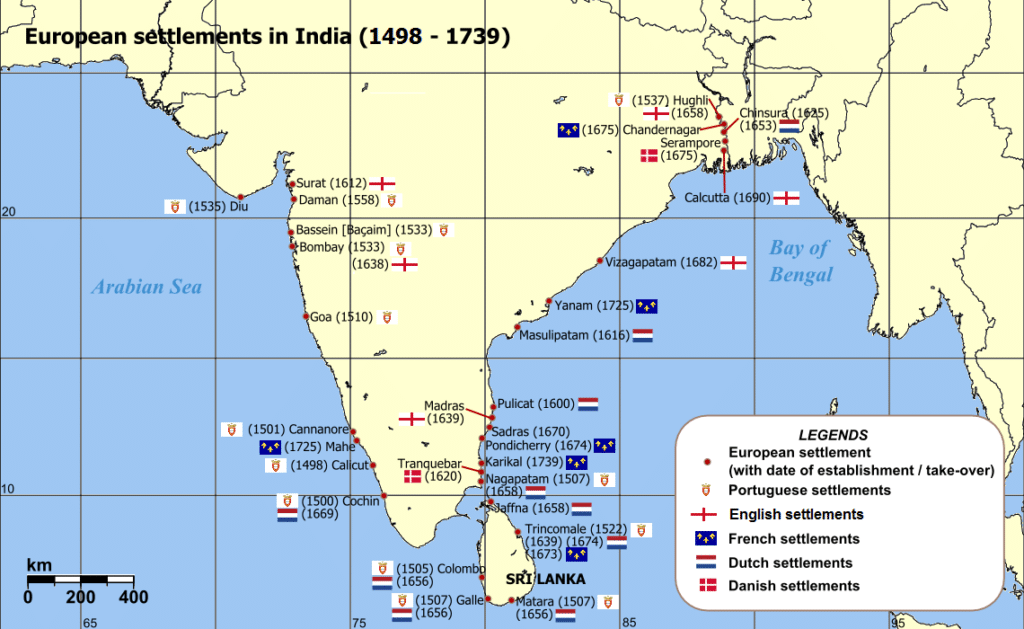
- Albuquerque initiated this policy by acquiring Goa from the Sultan of Bijapur with relative ease in 1510 — making it “the first bit of Indian territory to be under the Europeans since the time of Alexander the Great.” Goa’s excellent natural harbour and strategic location — allowing the Portuguese to command the Malabar trade, monitor the Deccan rulers, and maintain proximity to the Gujarat seaports — made it the ideal centre for Portuguese commercial and political activity in the East.
- The Portuguese further extended their possessions on the mainland opposite Goa, blockading and sacking the Bijapuri ports of Danda-Rajouri and Dabhol until the Adil Shah came to terms by ceding Goa outright.
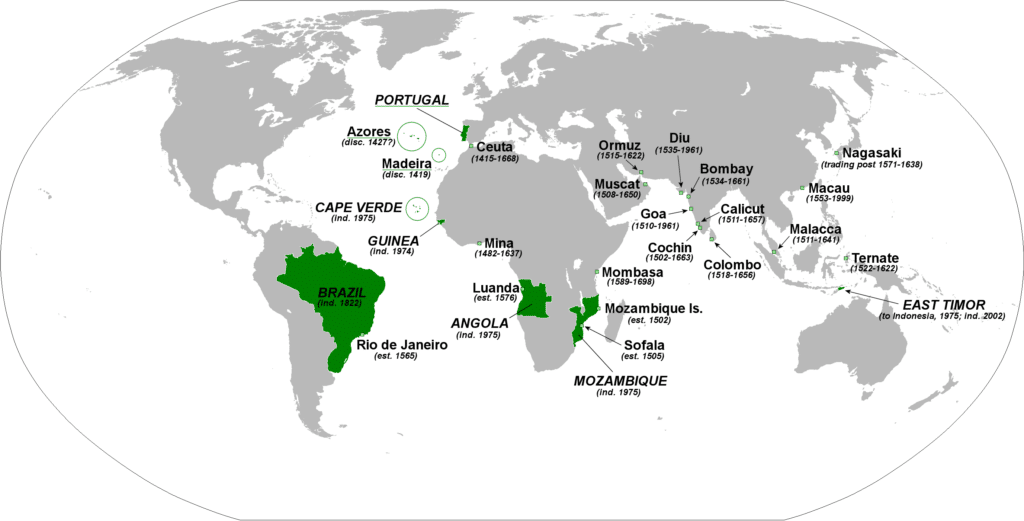
- From their base at Goa, the Portuguese consolidated their position by establishing forts at Colombo in Sri Lanka, at Achin in Sumatra, and at the strategically vital port of Malacca, which controlled passage between the Malay Peninsula and Sumatra. They also established a station at the island of Socotra, at the mouth of the Red Sea, and laid siege to Aden — though Vasco da Gama’s failure to capture Aden remained his sole setback in the region. The Portuguese did, however, compel the ruler of Ormuz, which controlled entry to the Persian Gulf, to permit them to establish a fort there.
- During this period, a major Portuguese concern was gaining control of the forts of Diu and Cambay, key centres of Gujarati trade with the Red Sea. Two attempts to capture Diu in 1520–21 were repelled by its governor, Ahmad Ayaz. An interesting feature of Ayaz’s rule was his abolition of sati; separately, to secure a permanent Portuguese population in India, Albuquerque encouraged his men to take Indian wives.
Nino da Cunha
- Nino da Cunha served as governor of Portuguese possessions in India from 1528 to 1538, and shifted the headquarters of Portuguese government in India from Cochin to Goa.
- Before a Gujarat-Turkish alliance could be consolidated, a greater threat to Gujarat emerged from the Mughals, as Humayun attacked the region. Bahadur Shah of Gujarat, embroiled in conflict with Humayun, secured Portuguese assistance by ceding them the island of Bassein and its dependencies in 1534, along with a promise of a base at Diu.
- Relations soured, however, once Humayun withdrew from Gujarat in 1536. Following the Mughal retreat, Bahadur Shah once again appealed to the Ottoman Sultan for support and sought to limit Portuguese encroachments at Diu. During subsequent negotiations, Bahadur Shah was invited aboard a Portuguese ship and killed in 1537; later attempts to recapture Diu failed.
- Through these events, the Portuguese acquired several key territories from the Sultans of Gujarat:
- Daman (occupied 1531, formally ceded 1539);
- Salsette, Bombay, and Baçaim (occupied 1534); and
- Diu (ceded 1535).
- Da Cunha also sought to expand Portuguese influence in Bengal, settling many Portuguese nationals there with Hooghly as their headquarters.
The Ottoman Challenge
- The Ottoman Turks, under Sulaiman, were then at the height of their power, poised to attack Europe while also completing their conquests in Asia — having defeated the ruler of Iran in 1514 and subsequently conquered Syria, Egypt, and Arabia, thereby assuming a growing role in Indian Ocean affairs.
- The Sultan of Gujarat sent an embassy to the Ottoman ruler, congratulating him on his victories and seeking support; the Ottomans, in turn, expressed a desire to combat the “infidel” Portuguese, who had disturbed the shores of Arabia. From this point on, embassies and correspondence flowed continuously between the two states.
- After expelling the Portuguese from the Red Sea in 1529, a strong Ottoman fleet under Sulaiman Rais was despatched to aid Bahadur Shah of Gujarat, who received it warmly and appointed two Turkish officials — given Indian names — as governors of Surat and Diu respectively. Of these, Rumi Khan would later earn fame as a master gunner.
- In 1531, after intriguing with local officials, the Portuguese attacked Daman and Diu, but were repulsed by Rumi Khan; they subsequently built a fort further down the coast at Chaul.
- The Turks staged their largest naval demonstration against the Portuguese in Indian waters in 1536, with many sailors drawn from Venetian galleys at Alexandria. Commanded by the 82-year-old Sulaiman Pasha, governor of Cairo, the fleet appeared before Diu in 1538 and laid siege to it. However, the Turkish admiral’s arrogant conduct led the Sultan of Gujarat to withdraw his support, and after a two-month siege, the fleet retreated upon news of an approaching Portuguese relief armada.
- The Turkish threat persisted for another two decades, during which the Portuguese further strengthened their position by securing Daman from its ruler. A final Ottoman expedition under Ali Rais in 1554 also failed, prompting a shift in Turkish policy. In 1566, the Portuguese and Ottomans reached an agreement to share the oriental trade — including spices — and avoid conflict in Arab waters, after which Ottoman attention shifted back to Europe, foreclosing any future alliance between the rising Mughal power and the Turks against the Portuguese.
Favourable Conditions for Portuguese Dominance
- In India, apart from Gujarat — ruled by the powerful Mahmud Begarha (1458–1511) — the north was fragmented among numerous small powers, while in the Deccan, the Bahmani Kingdom was itself breaking up into smaller states. None of these powers possessed a navy of any consequence, nor gave serious thought to developing naval strength.
- In the Far East, the Chinese emperor’s decree had limited the navigational reach of Chinese ships, while Arab merchants and shipowners — despite their dominance of Indian Ocean trade until then — lacked the organisation and unity of the Portuguese, who also possessed the advantage of shipborne cannons.
- Why, then, did Indian powers permit the domination of the Indian Ocean by a small and economically modest state like Portugal for over a century?
- Technologically, Indo-Arab dhows and the Chinese junk could match Portuguese galleons and caravels in strength, cargo capacity relative to tonnage, and the ability to sail against the wind using lateen (triangular) sails — Asian sailors were fully equipped with the nautical skills needed for open-sea travel.
- Where the Portuguese held a genuine edge was in the manoeuvrability of their ships — Indo-Arab vessels being comparatively slow and cumbersome owing to their heavier sails — and in the strength of their hulls, which could better withstand the recoil of cannon fire.
- Above all, it was the sheer determination of Portuguese sailors that decided the issue. Indian sailors, more accustomed to fighting pirates, had little appetite for naval combat without the backing of their own rulers.
- Thus, it was not military and naval technology alone, but a combination of factors, that enabled Portuguese naval dominance over the Indian seas for more than a century. Indian powers largely reconciled themselves to this dominance because it did not threaten their political control on the mainland, nor did it significantly harm their income from overseas trade — making the prospect of a naval conflict with the Portuguese appear difficult, uncertain of success, and of limited financial reward.
Religious Policy of the Portuguese
- The Portuguese arrived in India with a strong missionary zeal to promote Christianity, coupled with a marked hostility toward Muslims. While initially fairly tolerant toward Hindus, this changed over time following the introduction of the Inquisition at Goa, after which Hindus too came under persecution.
- Despite this generally intolerant stance, the Jesuits made a favourable impression at the court of Akbar, owing largely to the emperor’s genuine interest in theological questions.
- In September 1579, Akbar sent a letter to the Church authorities at Goa requesting two learned priests. Eager to seize the opportunity to convert the emperor — and with him, his court and people — Goa readily agreed, and the Jesuit fathers Rodolfo Aquaviva and Antonio Monserrate reached Fatehpur Sikri in 1580, returning in 1583 without fulfilling Portuguese hopes of Akbar’s conversion. Jesuit priests nonetheless remained in contact with the Mughal court even under Jahangir.
Portuguese Lose Favour with the Mughals
- In 1608, Captain William Hawkins, aboard the ship Hector, reached Surat bearing a letter from King James I of England requesting trading permission from Jahangir’s court. Although Portuguese authorities tried to block his access, Hawkins reached the Mughal court and, in 1609, received a warm reception from Jahangir — conversing with the emperor directly in Turkish, without an interpreter. Pleased, Jahangir appointed him a Mansabdar of 400.
- This grant of trading facilities to the English deeply offended the Portuguese, though a truce was eventually negotiated with the Mughal emperor. The Portuguese nonetheless continued to block English ships from entering Surat, and a frustrated Hawkins left the Mughal court in 1611, unable to overcome Portuguese intrigue or the Mughals’ shifting policies.
- In November 1612, however, the English ship Dragon, under Captain Best, successfully fought off a Portuguese fleet in the naval Battle of Swally — a success that greatly impressed Jahangir, who had no navy of his own.
- Portuguese acts of piracy further strained relations with the Mughal government. In 1613, they offended Jahangir by seizing Mughal ships, imprisoning Muslims, and plundering cargo, prompting an enraged Jahangir to order Muqarrab Khan, then in charge of Surat, to secure compensation. It was ultimately during the reign of Shah Jahan, however, that the Portuguese permanently lost their remaining advantages at the Mughal court.
Capture of Hooghly
- In 1579, the Portuguese had settled on a riverbank near Satgaon in Bengal to carry on trade, gradually strengthening their position through the construction of large buildings — leading trade to shift from Satgaon to the new port of Hooghly.
- There, they monopolised salt manufacture, built their own customs house, and rigorously enforced duties on tobacco, an important trade commodity since its introduction in the early 17th century. Beyond legitimate trade, the Portuguese also engaged in a brutal slave trade, purchasing or seizing Hindu and Muslim children and raising them as Christians — including, notoriously, two slave girls belonging to Mumtaz Mahal.
- On 24 June 1632, the siege of Hooghly began, ending in its capture three months later. Shah Jahan had ordered the Bengal governor, Qasim Khan, to act against the Portuguese; the ensuing siege forced the Portuguese to flee. The Mughals suffered the loss of 1,000 men but took 400 prisoners to Agra, who were given the choice of converting to Islam or becoming slaves. Persecution of Christians continued for some time thereafter before gradually subsiding.
Impact of the Portuguese on Indian Trade
- The Portuguese brought an end to the era of unarmed open-sea trade in Indian waters, dealing a heavy blow to the virtual Muslim monopoly over the western Indian Ocean trade and the flow of eastern goods to Europe.
- From their very arrival at Calicut, the Portuguese demanded the exclusion of other merchants — Indian and foreign alike — in favour of a complete trading monopoly for themselves, backing this demand with armed ships that threatened rival merchants and confiscated their vessels and cargo — marking the beginning of armed trade in the region.
The Cartaz System
- In 1502, the Portuguese demanded exclusive trading rights at Calicut, a demand the Zamorin refused to concede. In response, Vasco da Gama declared war on all ships plying the Arabian Sea and Indian Ocean, introducing the cartaz — a sea-pass or trading licence, first issued in 1502 — under which ships bearing a certificate signed by Portuguese authorities (the royal factor) would not be attacked.
- The Portuguese declared trade in spices, drugs and dyes (including indigo), copper, silver, gold, arms and ammunition, and war horses a royal monopoly, barring traders of any nationality — including Portuguese private traders and officials — from dealing in these commodities. Ships carrying other goods were required to obtain a cartaz from Portuguese officials.
- The system aimed to enforce Portuguese trade monopoly across the Indian Ocean and ensure that merchants paid taxes at Portuguese trading posts. All Indian merchants, rulers, and others engaged in maritime trade were required to obtain a cartaz, which explicitly excluded monopoly items from being loaded, and which sought to control the routes and destinations of ships — with the Portuguese attempting to force all vessels bound east or to Africa to pass via Goa and pay customs there.
- To enforce these rules, the Portuguese searched ships suspected of trading without a cartaz or in monopolised goods; any vessel suspected of carrying contraband, or refusing search, could be treated as a prize of war — sunk or captured, with its crew and passengers enslaved.
- Rulers such as Akbar, along with the Nizam Shah of Ahmadnagar, the Adil Shah of Bijapur, the kings of Cochin, the Zamorins of Calicut, and the rulers of Cannanore, all purchased passes from the Portuguese to despatch their ships to various destinations.
The Question of Monopoly
- When the Portuguese first arrived, merchants from across the world — Mecca, Tenasserim, Pegu, Ceylon, Turkey, Egypt, Persia, Ethiopia, Tunis, and various parts of India, as reported by Vasco da Gama himself in 1498 — freely traded at ports such as Calicut, alongside merchants from China and the Red Sea region. There is no record, before the Portuguese, of any group demanding exclusive trading rights, or of any commodities being set apart for particular traders.
- With the Portuguese arrival, this changed considerably: local rulers were pressured to exclude other merchants from their ports, and certain commodities were declared off-limits to non-Portuguese traders. In effect, the Portuguese demanded an outright trade monopoly, formally written into their treaties with Indian rulers, and enforced through strategically placed fortresses, patrolling vessels, and the insistence on passes for other ships.
Persistence of Indian Trade Despite Portuguese Pressure
- Despite Portuguese ambitions, Indian rulers and merchants continued to trade extensively. The king of Cannanore, for instance, obtained Portuguese passes to send vessels to Cambay and Hormuz, importing horses from these ports even though horse-trading was designated a Portuguese monopoly — sometimes at the risk of having his vessels confiscated. The kings of Tanur, Chale, and Calicut on the Malabar coast followed similar practices, as did the nobles of Gujarat — Malik Gopi, Malik Ayaz, Khwaja Sofar, and others — who continued trading with or without Portuguese passes.
- Limits of the monopoly: Local and foreign merchants settled in India carried on trade regardless of the cartaz system, and the Portuguese soon found that the losses incurred on land outweighed the gains made at sea — traders who lost goods at sea would pressure their own governments to retaliate against Portuguese trade in their territories. Policing such vast coastlines proved impossible, and sea piracy off Oman, Malabar, and South-East Asia was, if anything, encouraged by Portuguese policies.
- It was estimated that of the 60,000 quintals of pepper produced annually between Calicut and Cape Comorin, only 15,000 quintals actually reached Portuguese factories — the remaining three-quarters were diverted to other ports, which the Portuguese branded “illegal.” Since the Portuguese refused to raise the price fixed for pepper in 1503 even decades later, cultivators had little choice but to sell to other merchants willing to buy at better rates.
- Arab and Gujarati traders repeatedly found ways to bypass the Portuguese embargo and regulations, and even Portuguese private traders — resentful of the royal monopoly and cartaz system, and often underpaid — could be bribed by other traders. Several Portuguese officials also conducted their own unauthorised private trade.
- Structural limits of Portuguese control: The Portuguese never gained full control of the Indian Ocean, largely because they failed to capture Aden and thus could not control access to the Red Sea. Turkish conquests in Syria, Egypt, and Arabia, along with expanding Ottoman naval power in the eastern Mediterranean and Red Sea, made it difficult for the Portuguese to enforce an effective blockade of the Bab-el-Mandeb strait — Portuguese monopoly was, in fact, never truly effective in the Red Sea zone.
- At the eastern end of the Indian Ocean, Portuguese control over the Spice Islands also weakened. The Sultan of Acheh in northern Sumatra, Ali Mughayat Shah, drawing on traditional Javanese naval skills, defeated the Portuguese in several naval engagements, capturing large numbers of their guns to fortify Acheh, and further secured Ottoman-supplied bronze cannon that enabled the port to withstand sieges. This allowed Acheh to emerge as a major spice-exporting rival to Portuguese-controlled Malacca, with Arab and Gujarati traders based at Malacca using Acheh as an alternative export route via the Laccadives, bypassing Portuguese-controlled Malabar waters altogether.
- The key factors limiting Portuguese success were thus: the resilient structure of the Asian trading network; the strength and resourcefulness of Asian merchant communities — Arabs, Gujaratis, Tamils, and others — with long experience of the system; the naval and military power of the Ottoman Turks and the ruler of northern Sumatra; and the internal limitations of the Portuguese and their cartaz-based Estado da India. The Portuguese consequently had to liberalise the cartaz system considerably, extending it to Muslim traders as well — since Muslims dominated the highly profitable and strategically important horse trade, along with substantial trade in textiles, glass, aromatics, and coffee, sectors where the Portuguese lacked both the capital and the shipping to compete. In practice, the pursuit of profit soon overrode religious prejudice.
- Ultimately, Portuguese efforts to displace Muslim traders and establish a monopoly over West Asian trade achieved only limited success. By the mid-16th century, despite the large volumes of spices reaching Lisbon and being distributed through Antwerp, the Black Sea ports and the markets of the Levant and Egypt remained as well supplied with eastern goods — spices, dyes, and textiles — as before. The cartaz system gave the Portuguese only partial control over oceanic trade, a control that persisted until the arrival of the Dutch and English in the 17th century.
Limitations of Portugal’s Enterprise
- Portugal itself was a small country, and despite rapid commercial development, its financial resources remained limited. German and Italian merchant houses consequently became the principal agents distributing eastern goods brought to Lisbon across Europe.
- Since demand in Asia for European goods was limited, precious metals — especially silver — had to be exported to pay for pepper and other eastern goods. Unlike Spain, however, Portugal lacked American silver mines to draw upon, and depended heavily on Italian and German financiers. The Portuguese crown’s expectation that its control of Indian coastal trade would finance the export of pepper and other goods to Europe proved unfounded, and Portuguese trade to Europe remained confined to just twelve to thirteen ships sailing from Lisbon to India each year.
- This picture changed by the end of the 16th century, when the share of private Portuguese traders in overall trade to Europe rose sharply, eventually accounting for over 90 per cent of the total — largely additional cargo of textiles and precious stones, financed through extensive private involvement in Asian trade. For the Portuguese crown itself, however, the enterprise in the western Indian Ocean remained essentially a “redistributive enterprise” — its main income derived from taxing others’ trade rather than genuinely expanding it or opening new trade routes. A real expansion of trade between Europe and the East would have to await the arrival of the Dutch and English in the 17th century.
Success in the Far East
- The Portuguese achieved somewhat greater success expanding trade in the Far East. They took over the export of textiles from the Coromandel Coast to the Indonesian Archipelago, exchanging them for spices — though they never came close to monopolising the spice trade there, given the continued activity of Javanese and Malay traders.
- The Portuguese also carried spices to China, exchanging them for Chinese silk, which they then carried to Japan in exchange for silver — an especially profitable trade, since the Peking court’s ban on foreign trade (owing to fears of piracy) left this route open to Portuguese enterprise.
- Another avenue the Portuguese opened was trade to South America via the Philippines, driven by consistent demand for Indian cotton goods. Since Spanish rulers had barred Muslims and Protestants from trading with the Philippines, this created a favourable opening for the Portuguese, who also accommodated some Armenian and Gujarati traders in the exchange. From the Philippines, Spanish galleons carried Indian textiles onward to South America, where they were exchanged for silver.
- The profitability of this Far Eastern trade allowed Portugal to take a more relaxed approach to its Indian Ocean pepper trade. Thus, the second half of the 16th century emerged as an era of growing partnership between Portuguese and Asian merchants — with many Arab and Gujarati traders finding it more profitable to ship goods aboard Portuguese vessels, even as Portuguese private traders and officials used Asian ships to evade the crown’s own monopolies.
Did the Portuguese Bring Transparency to Eastern Trade?
- It has often been argued that the Portuguese introduced transparency into eastern trade by establishing a network of factories or warehouses across widely separated regions, thereby stabilising markets and prices. Modern research, however, does not support this claim.
- Wide price fluctuation was, in fact, a defining characteristic of pre-modern trade. Indian and Arab merchants already understood the distinction between spot and future markets — maintaining warehouses for spot trade to secure the best prices by buying during a glut and selling during scarcity (as with commodities like coffee), while for fine textiles and spices, prices and goods had to be fixed well in advance, a task Asian merchants managed effectively through their own trade associations and family networks.
- The Portuguese instead attempted to fix black pepper prices in advance by pressuring or incentivising local Malabar rulers to supply pepper at fixed rates, leaving it to the ruler to procure supplies through local traders or directly from cultivators. This policy proved deeply unpopular, as the Portuguese used political pressure to depress prices paid to cultivators while also trying to block competing buyers — meaning that any expansion in spice production brought little benefit to the actual producers.
Significance of the Portuguese
Political Contribution
- The Portuguese political impact on Asia was relatively small. Too few in number to capture and hold extensive mainland territory in India or elsewhere, they wisely confined their control to islands and easily defensible coastal forts supplied by sea — Goa, their seat of government, being the prime example. Beyond this, they could pressure or persuade small states such as Calicut, Cochin, and Cranganore to act as their agents or brokers in the spice trade.
- The Portuguese establishment at Goa was headed by a Governor-General, assisted by a council that included the Ecclesiastical Head. Owing to their limited numbers, the Portuguese encouraged mixed marriages, giving rise over time to a distinct Indo-Portuguese (Goanese) society — though this society and its government remained organised along rigid racial lines, with those of pure Portuguese descent at the top and those of mixed origin at the bottom, excluded from any share in political power. The Church, meanwhile, occasionally exercised the feared auto-da-fé (burning at the stake) to root out religious heresy. On the whole, Portuguese contributions to Asian politics or the expansion of world trade remained fairly negligible.
Opening of the Direct Sea Route
- The opening of a direct sea route to India paved the way for its closer integration with the emerging world economy, contributing to the further growth of a market economy in India and dealing a blow to India’s relative “introspectiveness.”
- Most historians regard the arrival of the Portuguese as marking not just the beginning of a distinctly European era, but also a new phase in the exercise of naval power in the region. The Cholas, among earlier Indian powers, had themselves been a significant naval force — but this marked the first time a foreign power had reached India by sea. Notably, the Portuguese were the first Europeans to arrive in India (in 1498) and the last to leave (in 1961).
- They established India’s trade links with Japan, the Philippines, and Latin America, and paved the way for the arrival of subsequent European powers — Spain, the Dutch, the English, and the French. The Portuguese also introduced their Cruzado coinage in Goa and its neighbouring regions, which came to be accepted in the territories of both the Vijayanagara and Bahmani kingdoms.
Technological Contribution
- The Portuguese were skilled practitioners of improved maritime technique. Under their supervision, shipbuilding using Western techniques began at Cochin; their heavily built, multi-decked ships allowed for the carriage of heavier armaments.
- In 16th-century Malabar, the Portuguese introduced military innovations including body armour, matchlock men, and ship-landed guns, and may have influenced the Mughal adoption of field artillery and the so-called “artillery of the stirrup” by example.
- Certain other technologies — such as printing and clocks — were introduced at Goa but failed to gain wider acceptance on the mainland. The Portuguese are also credited with building new roads and irrigation works.
Contribution to Agriculture
- Several crops from the Latin American world — maize, potato, pineapple, tobacco, and chilli — entered the Indian agrarian economy through the Portuguese, much as new fruit varieties had earlier arrived with the Turks. Of these, tobacco went on to become a major trade commodity.
- Other plants introduced by the Portuguese included papaya (first cultivated in Mexico), cashew (native to Brazil), and guava (native to Central and South America), while the quality of mango and citrus fruits was substantially improved, and superior plantation varieties of coconut were introduced alongside large-scale groves. The Indian peasant, evidently, was not averse to adopting new crops where profit was to be had.
Cultural Contribution
- The missionaries and the Church also served as teachers and patrons of the arts in India — supporting painters, carvers, and sculptors, and, much as in music, acting as interpreters not merely of Portuguese but of broader European artistic traditions to India.
Decline of the Portuguese
- By the 18th century, the Portuguese in India had lost most of their commercial influence, though some individuals continued trading privately, while others turned to piracy and robbery — with Hooghly, in particular, becoming a base for Portuguese piracy in the Bay of Bengal.
- The Portuguese decline resulted from several converging factors:
- The emergence of powerful new dynasties in Egypt, Persia, and north India, along with the rise of the turbulent Marathas as immediate neighbours, eroded the local advantages the Portuguese had once enjoyed. (The Marathas captured Salsette and Bassein from the Portuguese in 1739.)
- The Portuguese religious policy — particularly the activities of the Jesuits — stoked political fears; beyond their hostility toward Muslims, their aggressive conversion efforts also alienated the Hindu population.
- Their dishonest trading practices provoked strong resentment, and their notoriety as sea pirates, coupled with general arrogance and violence, earned them the animosity of both the rulers of small states and the imperial Mughals.
- The discovery of Brazil diverted Portuguese colonising energies toward the West.
- The union of the Spanish and Portuguese crowns in 1580–81 dragged the smaller kingdom into Spain’s wars with England and Holland, severely damaging its trade monopoly in India.
- The Portuguese monopoly of knowledge of the sea route to India could not remain secret indefinitely — the Dutch and English, developing their own navigational expertise, soon acquired this knowledge as well.
- As new European trading powers arrived in India, fierce rivalry ensued, and the Portuguese — possessing fewer resources and less commercial drive than their rivals — were gradually forced to give way to the more powerful and enterprising Dutch and English.
- Goa, which remained under Portuguese control, had already lost much of its importance as a port following the fall of the Vijayanagara Empire, after which it mattered increasingly little in whose hands it lay.




