Central Asian Politics and the Advance of Babur towards India

Throughout Indian history, developments in Central Asia have repeatedly shaped the course of events on the subcontinent. The 10th and 12th centuries saw Central Asian upheavals bring the Ghaznavids and later the Ghurids into India. In much the same way, the political churn in Central Asia during the 15th and early 16th centuries produced a fresh Turkish incursion into India — this time led by Zahiruddin Muhammad Babur. Understanding Central Asian politics and the advance of Babur towards India therefore requires tracing the rise of Timur, the Timurid legacy, the Uzbek-Safavid-Ottoman contest for Transoxiana, and Babur’s own long struggle before he finally turned towards Hindustan.
The Rise of Timur and the Timurid Legacy
- The rapid rise and decline of the Mongols, and their mutual squabbles, created the conditions for the emergence of a new Central Asian empire during the 14th century.
- Its founder, Timur, belonged to the Barlas clan of Turks, landowners in Transoxiana who had freely intermarried with the Mongols.
- Timur himself claimed descent from Chingiz Khan by marrying a daughter of the Mongol ruler Qazan Khan, a descendant of Chingiz.
- Chingiz Khan’s career had given rise to a new concept of imperium that captured the imagination of Central Asia, even though the immediate sentiment after the fall of the Mongol empire had been one of terror. Consequently, every princeling in the region sought to legitimize his rule by claiming descent from Chingiz Khan.
Timur’s Conquests
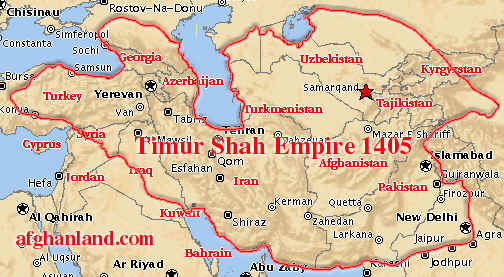
- Timur launched a career of conquest that lasted almost a quarter of a century, until his death in 1404-05.
- He overran Khurasan (eastern Iran), Iran, Georgia, Iraq, and the Ottoman empire in Syria and Anatolia (modern Turkey).
- He also campaigned against the Mongol ulus known as the Golden Horde, which controlled Southern Russia and parts of modern Sinkiang and Siberia, though he made no attempt to incorporate it into his empire.
- He sacked Delhi and laid a vague claim over the Punjab, and was planning an invasion of China at the time of his death.
- Timur has been called “one of the boldest and most destructive conquerors in human history.”
- Like Chingiz before him, he used terror as an instrument of war, ruthlessly sacking cities that resisted him, slaughtering and enslaving large numbers, and carrying off artisans, craftsmen, and scholars to his capital, Samarqand.
- He followed this policy in Khurasan and Iran, and again in India when he sacked Delhi.
The Yassa, the Sharia, and a Liberal Timurid Culture
- Timur left behind no lasting institutions, and his empire disintegrated rapidly after his death. Yet the state he built, and the cultural values it generated, went on to influence not only the Mughals in India but also the Uzbeks, the Safavids, and the Ottomans.
- Although the Mongols had embraced Islam like the Turks before them, they continued to follow many Mongol practices, including the yassa — the secret, unwritten code of law laid down by Chingiz Khan (the word literally means “order” or “decree”). This functioned as the de facto law of the Mongol empire even though it was never made public.
- Timur claimed to be a pious Muslim, but the contemporary observer Ibn Arab Shah held that the yassa and Mongol tradition, not the Quran and sharia, were fundamental to Timur’s character and policy, with Islamic law mattering to him only as an external form.
- Many of Timur’s successors posed as orthodox Muslims — patronising the religious classes, endowing religious institutions, and building shrines, mosques, and madrasas — yet none of them repudiated the yassa.
- This willingness to treat the yassa as a supplement to the sharia, and to issue royal edicts (yarligh) modifying the sharia as convenient, gave the Timurid state a broader and more liberal character than the states which had preceded it.
- The Timurids supported the new liberal philosophical current based on Ibn Arabi’s doctrine of wahdat-al-wajud (unity of God and the created world), popularised by a new generation of poets. Jami, one of the most celebrated of these poets, was patronised by Timur’s successor Shah Rukh at Herat.
- The Timurids presided over what has been called “the last great age of Persian literature”, and also encouraged the growth of Chaghtai Turkish as a literary language.
- Another successor, Sultan Husain Baiqara, established a new school of painting at Herat under the master painter Bihzad.
- Under Timur and his successors, therefore, a liberal Muslim state emerged that did not exclude people on the basis of faith — Christians and other non-Muslims served in Timur’s armies — and the state itself became a champion of a broad, liberal school of culture. No other Central Asian dynasty left behind a comparable legacy.
- The Timurids also inherited the Mongol tradition of absolute loyalty to the chief, or Qa-an (“great chief”).
- Chingiz Khan, and the Timurids after him, claimed a divine right to rule, so that no ordinary noble or military leader could aspire to displace them; nobles were content to be called the ruler’s servants (nokar).
- This tradition of loyalty gave greater stability and longevity to the great post-Mongol empires — the Mughal, Safavid, Uzbek, and Ottoman — compared to the states that had existed before the Mongols, and it later helped shape Mughal state and culture in India as well.
The Timurid-Uzbek and Uzbek-Iranian Conflict, and Babur
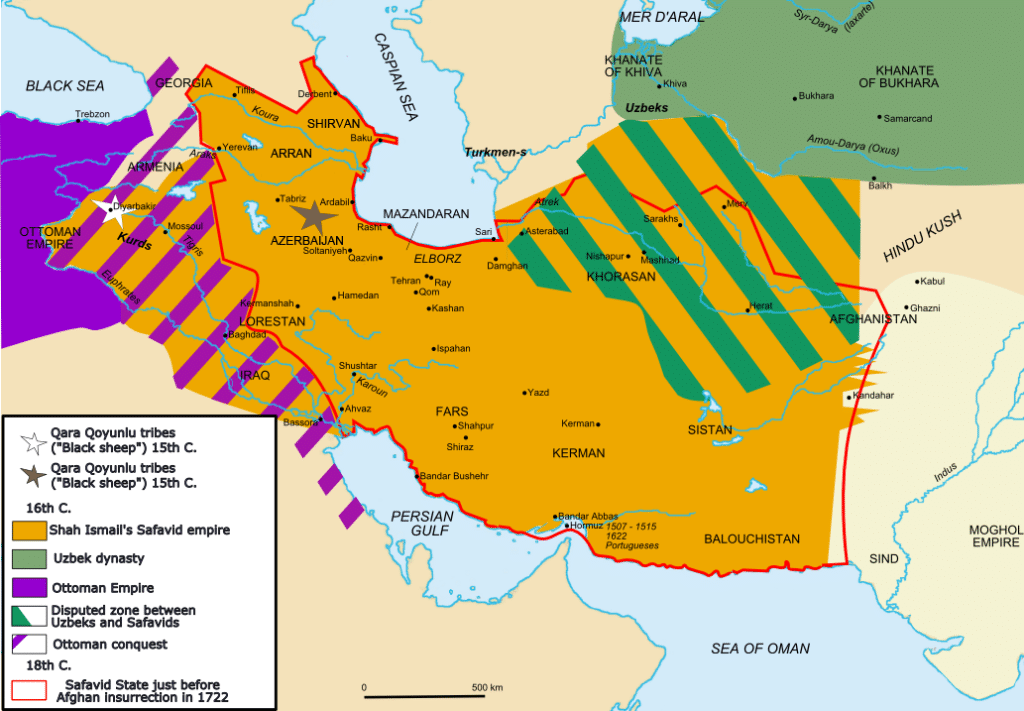
- Following the disintegration of the Timurid empire in the second half of the 15th century, three powerful empires arose across Central and West Asia:
- The Uzbek empire, dominant in Transoxiana.
- The Safavid empire, comprising Iran.
- The Ottoman empire, based on Anatolia (modern Turkey) and Syria, extending into Eastern Europe and dominating the Mediterranean. The Ottomans were the only Asian power with a large navy, and clashed with the Safavids over control of Baghdad, south-western Iran, and Azerbaijan.
- The Safavids, claiming descent from an old order of saints, established themselves around the beginning of the 16th century.
- They were fiercely Shia and persecuted Sunnis, including theologians, within Iran, and also attempted to propagate Shiism in Syria and Anatolia.
- The Ottomans, staunch Sunnis, retaliated by persecuting Shias in these regions, so that sectarian conflict sharpened an already bitter political rivalry between the two empires.
- The Uzbeks, the main rivals of the Timurids, were nomadic Turkish and Mongol tribes speaking Turkish and inhabiting what is modern Kazakhstan.
- They had set up an Uzbek khanate in the region by the mid-15th century, but this khanate was destroyed, and the Uzbek empire was effectively rebuilt by Muhammad Shaibani Khan.
- Shaibani Khan began as a free-booter and mercenary, served briefly under the Mongol Khan of Mughalistan, and then struck out on his own with Uzbek and Mongol soldiers of fortune.
The Struggle for Transoxiana and Samarqand
- Transoxiana was the great prize sought by all contenders, and was at the time fragmented among rival Timurid princelings, each on the lookout to seize the territory of a neighbour — whether brother, cousin, uncle, or nephew — and each willing to employ Uzbek or Mongol mercenaries or invite outside powers into their internal disputes.
- In such a fluid environment, only a bold and unscrupulous person could hope to succeed; among the unreliable begs (nobles/military leaders), the Mongol mercenaries were considered the worst. Years later Babur himself wrote of them: “If they win, they grab at booty; if they lose, they unhorse and pilfer their own side.”
- Besides the Uzbeks, the Mongol Khans of Mughalistan (modern Sinkiang), who held a toe-hold in Transoxiana, were also keen to expand there. Two such Khans, Muhammad Khan and Ahmad Khan, were Babur’s maternal uncles who helped him at times but never abandoned their own ambitions.
- The third party in this contest was the Timurid Sultan Husain Baiqara, ruler of Khurasan (eastern Iran), who was always ready to nibble at Transoxiana.
- The centre of this struggle was control over Samarqand, which carried immense prestige as the Timurid capital for nearly 140 years, besides being the hub of a rich and prosperous tract.
- Babur himself later wrote: “Few towns in the whole habitable world are so pleasant as Samarqand,” praising its magnificent buildings and gardens, its trade and manufactures, its meadows, fruits, and wine.
Babur’s Early Struggles: Farghana and the First Two Conquests of Samarqand
- It was against this backdrop that Babur was born and spent his early years. He ascended the small principality of Farghana in 1494, at the age of twelve, on the death of his father, Umar Shaikh.
- Farghana was immediately attacked from several quarters, chiefly by his paternal uncle Sultan Ahmad Mirza, aided by his maternal uncle Sultan Mahmud Khan. With luck, firmness, and the loyalty of his subjects, Babur withstood these attacks and forced his attackers to make peace.
- Over the following decade, Babur twice conquered Samarqand, only to lose it again after a short spell each time.
- First conquest (1497): Barely fifteen years old, Babur took Samarqand after a seven-month siege, aided by a split within the camp of its Timurid ruler, Baisanghar Mirza (whose own brother sided with Babur). Baisanghar’s appeals to Shaibani Khan for help failed, as Shaibani found Babur’s defences too strong and retreated.
- Although warmly welcomed by the citizens, Babur had to vacate the city soon after — it lacked both supplies and money, there was little to plunder, and his Mongol mercenaries deserted along with many of his own begs, who returned to the comforts of Farghana.
- Babur’s serious illness and a conspiracy against him worsened matters further, forcing him out of Samarqand altogether. Meanwhile, some of his begs installed his younger half-brother Jahangir Mirza at Farghana, while his maternal uncle Mahmud Khan seized parts of the kingdom — leaving Babur without either Samarqand or his own kingdom, and dependent on uncles who merely fobbed him off with promises.
- While Babur grappled with these setbacks, the Uzbek mother of the Timurid Sultan invited Shaibani Khan to occupy Samarqand in exchange for marrying her — an opportunity Shaibani seized at once, going on to become the virtual master of Mawara-un-Nahar and capturing Bukhara as well.
- Second conquest (1501): To prevent Shaibani Khan from consolidating further, Babur advanced on Samarqand with a small force and captured it with the help of the Samarqandis, who Babur says found the Uzbeks deeply unpopular. However, the goodwill of citizens alone could not sustain him — his appeals to other Timurids for support went unanswered, and the aid sent by his maternal uncles was too small to matter.
- Without resources of his own to attract adventurers to his cause, Babur stood little chance against the able and experienced Shaibani Khan, and he did not fully grasp the real weakness of his own position.
- Shaibani Khan counter-attacked from Bukhara, and Babur boldly came out to face him in the open, but was sharply defeated at Sar-i Pul (1502). It was here that Shaibani Khan employed the wheeling tactic or tulghuma, a well-known Uzbek device that Babur himself would later use against Ibrahim Lodi, twenty-five years on.
- Retreating into Samarqand with starvation setting in and his begs slipping away, Babur was forced into what he called “a sort of peace” with Shaibani Khan, one term of which was the marriage of his elder sister, Khanazad Begum, to Shaibani Khan. The peace, however, did not heal the breach, and Shaibani Khan continued to press the remaining Timurid states in the region.
- Babur was again without a kingdom, reduced, in his own words, to “great poverty and humiliation.”
- First conquest (1497): Barely fifteen years old, Babur took Samarqand after a seven-month siege, aided by a split within the camp of its Timurid ruler, Baisanghar Mirza (whose own brother sided with Babur). Baisanghar’s appeals to Shaibani Khan for help failed, as Shaibani found Babur’s defences too strong and retreated.
The Battle of Archian and Babur’s Conquest of Kabul
- The Mongol Khans finally recognised the danger posed by growing Uzbek power and marched a large army from Tashkend towards Farghana to confront Shaibani Khan, hoping — as Babur had earlier — that the Timurid princes would join them against the Uzbeks.
- Moving swiftly to prevent any such combination, Shaibani Khan met the Khans near Archian, and in one of the greatest battles ever fought between Mongols and Turks, routed them completely (1503), capturing both Khans.
- In a masterstroke, Shaibani Khan spared their lives and legitimised his position through matrimonial alliances with them, while simultaneously admitting Mongols into the Uzbek army.
- The victories at Sar-i-Pul and Archian together established firm Uzbek supremacy over Transoxiana against both the Timurids and the Mongols.
- Realising his position in the region was now untenable, Babur made a bold move: crossing the Hindukush mountains in winter, he attacked and conquered Kabul (1504) and Ghazni.
- The strategic importance of Kabul was well understood by Babur and his kinsmen and begs, who now rallied to him in large numbers. Kabul gave Babur a breathing space from Uzbek attacks, and as master of the country he could now look either west to Samarqand or east to Hindustan.
- In his Memoirs, Babur observed, “Kabul is the intermediate point between Hindustan and Khurasan.”
- In 1506, he travelled to Herat at the invitation of his uncle Sultan Husain Baiqara, who sought a joint expedition against the Uzbeks after they occupied Khawarazm. But the Sultan died before the expedition could materialise, and Babur, realising the Sultan’s sons were incompetent and unserious about fighting the Uzbeks, returned to Kabul. Shaibani Khan, recognising the same weakness, soon overran Herat, extinguishing the last Timurid kingdom in the region.
- Fearing an Uzbek attack on Kabul itself, Babur in 1506 had his followers begin addressing him as “Padshah” — partly to raise morale, and partly to signal that the Timurid dynasty still lived, thereby claiming the loyalty of Chaghtai and Mughal tribesmen, princes, and begs attached to the Timurid name.
- This was, however, less of an innovation than it is sometimes made out to be, since the title “Padshah” was in common use across Central Asia at the time; Babur’s own Memoirs record his followers addressing him thus even earlier, after his conquest of Samarqand.
The Third Samarqand Expedition and Safavid Intervention
- The Uzbeks suffered their first serious reverse when Shah Ismail Safavi, conscious that an Uzbek conquest of Khurasan would threaten Safavid Iran, marched against Shaibani Khan. In the battle near Merv (1508), the Uzbek forces were routed and Shaibani Khan himself was killed.
- This Uzbek debacle tempted Babur to try his luck at Samarqand once more.
- Arriving at the Amu-Darya (Oxus), he defeated the Uzbeks in a sharp encounter but judged himself still too weak to expel them from Transoxiana, and so sent an embassy to Shah Ismail — who had already shown goodwill by honourably escorting back Babur’s sister Khanazad Begum, who had fallen into Persian hands after the deaths of Shaibani Khan and her second husband.
- Although the Shah had earlier agreed with the Uzbeks to fix the Oxus as their mutual boundary, he had no hesitation in helping the Timurids expel the Uzbeks from Transoxiana, hoping thereby to remove any future Uzbek threat. As the price of his assistance, he demanded that Babur read the khutba and strike coins in the Shah’s name, and propagate Shia doctrines in his dominions — conditions applicable only to territories conquered with Persian help, since Babur was permitted to issue coins (sikka) in his own name in Afghanistan and in his hereditary domain of Farghana.
- Babur accepted these terms. With Persian military help, he conquered Bukhara and then Samarqand, where the begs and people welcomed him.
- After the fall of Bukhara, Babur sent the Persian army back to assert his independence, but the Persian ruler was determined to treat him as a subordinate, and Babur chafed at the intervention of the Persian agent in the day-to-day affairs of Samarqand.
- Both the Persians and the local population expected that Babur would repudiate the khutba and sikka at the first opportunity and declare independence. Wary of the Uzbek danger, Babur maintained friendship with the Shah for the time being, even wearing Persian Kizilbash dress to the annoyance of the local population, though he refused to permit the persecution of Sunni theologians.
- Muhammad Jan Ishaq, the Shah’s chamberlain and agent at Samarqand, secretly warned the Shah that Babur was contemplating rebellion, prompting the Shah to send a punitive Persian army.
- Before this army could arrive, however, the Uzbeks rallied, captured Bukhara, and defeated Babur near it in a sharp battle. Facing a sullen population, Babur abandoned Samarqand and fell back on Hisar on the Amu Darya, while the emboldened Uzbeks went on to defeat the advancing Persian punitive force as well.
- Babur, present with the Persian forces, appears to have stood aloof from this final clash. The Amu Darya once again became the boundary between Persia and the Uzbeks, and Babur had no option but to withdraw from Transoxiana and return to Kabul.
- This third and final Samarqand venture brought Babur little credit.
- He had grossly overestimated his own strength and his ability to hold Samarqand, let alone conquer the rest of Transoxiana, without sustained Persian military support — and in the process compromised his principles by accepting a treaty he could neither fully implement nor openly repudiate.
- The Persians, in turn, underestimated Uzbek strength and their capacity to recover, which led Shah Ismail to treat Babur merely as a cat’s paw to be discarded once the Uzbeks had been dislodged. It was these mutual miscalculations — rather than the real but subordinate factor of Shia-Sunni sectarian strife — that ultimately doomed Babur’s last Samarqand enterprise.
- The expedition had two lasting consequences: it finally forced Babur to turn his attention towards India, and it laid the foundation for Timurid-Safavid cooperation against the Uzbeks, setting aside sectarian differences.
Babur’s Advance Towards India
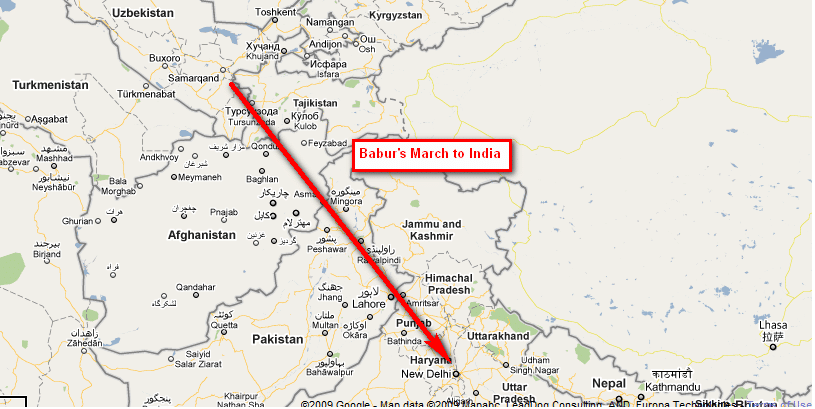
- The dream of conquering India had never been far from Babur’s mind. Even while wandering in Transoxiana without a kingdom, his imagination had been fired by tales of Timur’s exploits in India, and he had resolved to recover the Punjab territories ceded to Timur and long held by his descendants.
- Babur states that from the time he conquered Kabul (1504) to his victory at Panipat, “I had never ceased to think of the conquest of Hindustan.”
- Almost immediately after taking Kabul, in 1505, he made a move on Hindustan, reaching the district of Ningnahar (modern Jalalabad), and mounted another expedition the following year — though these were essentially forays to extract revenue from outlying Afghan tribes and assert control over them, rather than genuine preparations for the conquest of India.
- Until the failure of his third and last Samarqand expedition (1514), Babur remained more concerned with Central Asia than with India.
- His own explanation — that he was “hindered sometimes by the apprehensions of my begs, sometimes by the disagreements between my brothers and myself” — is only partial. His subsequent moves towards Punjab and India were equally driven by shifts in India’s political situation, the revival of Uzbek power, and Babur’s mounting financial difficulties.
- Kabul’s income, drawn mainly from the tamgha (cess on imports and exports), never sufficed for the needs of Babur’s begs and kinsmen, since most of the surrounding countryside was ruined; the only way to extract resources from the war-like tribes was through plundering expeditions, which Babur was compelled to undertake.
- The situation worsened as many Turkish and Mongol tribes (aimaq), displaced after Babur’s expulsion from Transoxiana, crossed over to seek service under him — service he could not afford to refuse, especially after Shah Ismail Safavi’s disastrous defeat at Ottoman hands in 1514 emboldened renewed Uzbek incursions into Khurasan.
- Fearing a fresh Uzbek threat to Kabul, Babur conquered Qandahar (1522) and established control over Badakhshan, but maintaining a large army for these campaigns strained his finances severely. As the historian Abul Fazl noted, Babur’s territories of Badakhshan, Qandahar, and Kabul did not yield income sufficient for his army’s requirements.
- Babur’s push into the Punjab built up gradually through a series of expeditions:
- In 1518, he besieged and conquered the fortress of Bajaur, then went on to capture Bhira on the river Jhelum, just beyond the Salt Ranges — territories that, together with the Indus, traditionally formed India’s defensive frontier.
- Babur claimed these lands as his own on the ground that they had once been part of Timur’s empire, and — “picturing as our own the countries once occupied by the Turks” — ordered that there be no plundering, though this leniency applied only where no resistance was offered. At Bajaur, where the Afghan tribesmen had resisted, he had instead ordered a general massacre, with women and children taken captive.
- The Bajaur expedition marks the real beginning of Babur’s effort to conquer the Punjab, and India itself, should the opportunity arise. As Babur himself put it: “From this time to 925H (1526), I was always actively concerned in the affairs of Hindustan. I went there in person at the head of an army, five times in the course of seven or eight years” — the fifth being the expedition against Ibrahim Lodi.
- Although Babur later presented conquest of India as his aim from the start, his ambitions clearly expanded gradually.
- Initially, he sought only the parts of Punjab to which he held a hereditary claim: after the Bhira expedition, he sent an envoy to Ibrahim Lodi asking him to cede the territories that had belonged to Timur — a proposal Ibrahim Lodi was never likely to accept.
- In fact, the governor of Lahore, Daulat Khan Lodi, whose jurisdiction covered Bajaur and Bhira, did not even let Babur’s envoy proceed to Delhi, detaining him at Lahore instead.
- As soon as Babur returned to Kabul, Daulat Khan Lodi expelled Hindu Beg and the other officers Babur had appointed over the claimed territories.
- In the following years, Babur mounted several incursions into the tribal areas of the North-West and the Punjab. In 1520, he recaptured Bhira and advanced up to Sialkot, but had to return to Kabul after an attack by the Arghun rulers of Qandahar, allies of Iran. He subsequently captured Qandahar and Badakhshan.
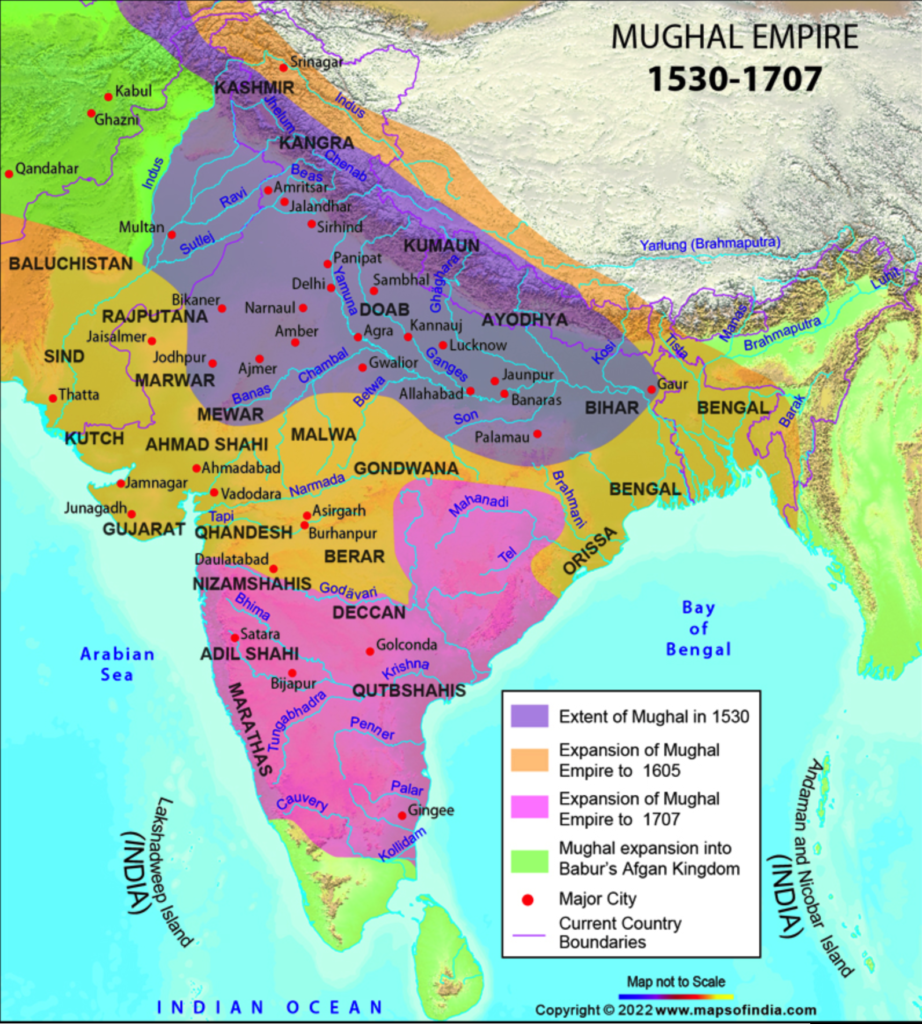
- By 1524, Babur had firmly consolidated his position in Afghanistan and was ready to contest the mastery of Punjab, even at the cost of a direct struggle with Ibrahim Lodi, the ruler of Delhi. The stakes had risen sharply, and the stage was now set for a contest not merely for the Punjab, but for the mastery of north India itself.
- In 1518, he besieged and conquered the fortress of Bajaur, then went on to capture Bhira on the river Jhelum, just beyond the Salt Ranges — territories that, together with the Indus, traditionally formed India’s defensive frontier.
In summary, Babur’s advance towards India was not a sudden or pre-planned invasion but the culmination of decades of Central Asian political turmoil. The Timurid inheritance, the relentless Uzbek-Timurid-Mongol contest for Samarqand and Transoxiana, and the shifting alliances with the Safavids all repeatedly frustrated Babur’s ambitions in Central Asia, pushing him instead towards Kabul and, eventually, towards Hindustan. By 1524, with Afghanistan secured and Punjab beckoning, the long chain of Central Asian politics had set the stage for Babur’s final confrontation with Ibrahim Lodi at Panipat.