

Bengal – Mir Jafar and Mir Kasim;
The Battle of Buxar;
Mysore;
The Marathas;
The three Anglo-Maratha Wars;
The Punjab.
British Expansion in India is one of the largest units in Paper II. UPSC has set 40 questions on it between 1985 and 2025, and it has appeared in eight of the last ten papers. It is also the most quotation-driven unit in the optional: roughly three-quarters of its questions hand you a contemporary or historian’s verdict and ask you to test it.
Every question the Commission has asked on this topic is listed below, newest first, with a written model answer linked against each one.
| Questions asked (1985–2025) | 40 |
| Appeared in | 8 of the last 10 papers |
| Paper | Paper II, Section A (Modern India) |
| Usual mark value | 10, 15 or 20 marks |
| Model answers available | 40 of 40 |
PYQs: British Expansion in India [1985-2026]

| Year | Question | Answer |
|---|---|---|
| 2025 | "The Sikh monarchy was Napoleonic in the suddenness of its rise, the brilliancy of its success and the completeness of its overthrow." | View answer |
| 2025 | "The seeds of domestic dissensions were thickly and deeply sown in the Maratha system under the Peshwas." | View answer |
| 2024 | Twenty years of peace secured by the treaty of Salbai proved very costly to the Marathas in strategic terms. – Elucidate. | View answer |
| 2023 | "Haidar Ali was born to build an empire, and Tipu Sultan to lose one”. Comment. | View answer |
| 2022 | 'The Battle of Plassey (1757) was a skirmish while the Battle of Buxar (1764) was a real war'. Critically examine. | View answer |
| 2022 | 'The Treaty of Amritsar (1809) was significant for its immediate as well as potential effects'. Critically examine. | View answer |
| 2021 | Critically examine the following statement in about 150 words: Tipu Sultan had little success in setting forth a course of change significantly different from the general experience of the 18th century crisis of Indian politics and society where public life tended over and over to become a system of plundering. | View answer |
| 2021 | The East India Company had thought that they had found an ideal puppet in Mir Kasim. Mir Kasim, however, belied the expectation of the company. Examine critically. | View answer |
| 2021 | While individually the Marathas were clever and brave,they lacked the corporate spirit so essential for national independence. Discuss with reasons. | View answer |
| 2020 | Critically examine (150 words): “Maharaja Ranjit Singh died in 1839. His death was the signal for an outburst of anarchy all over the Punjab." | View answer |
| 2019 | “Tipu Sultan was trying to build in Mysore a strong centralised and militarised state, with ambitious territorial designs.” Critically examine. | View answer |
| 2019 | Do you subscribe to the view that the Anglo-French tussle in Carnatic demonstrated the internal decay of the provincial chieftains of South India? | View answer |
| 2017 | “The Maratha polity disintegrated through internal stress." Critically comment in 150 words. | View answer |
| 2017 | Underline the major considerations of the British imperial power that led to the annexation of Punjab. | View answer |
| 2015 | ‘Annexation of Punjab was part of a broad north-west frontier policy set in motion after the exit of Maharaja Ranjit Singh.” Critically examine. | View answer |
| 2010 | "Punjab’s fate after Ranjit Singh was foredoomed as the impulse of neo – Victorian Imperialism was bound to overwhelm it.” Elucidate. | View answer |
| 2009 | Why was Mysore – considered a threat by the British to their possessions and mercantile interests in the south. Do you think that Tipu Sultan’s posturing became his undoing? | View answer |
| 2009 | How did the East Indian Company become the dejure power in India? | View answer |
| 2006 | Examine the circumstances which led to the Third Mysore War. Could Cornwallis have avoided it? | View answer |
| 2005 | ‘Upon the whole, then, I conclude that the treaty of Bassein was wise, just and a politic measure.' Comment. | View answer |
| 2005 | Examine the essential principles of the Subsidiary Alliance system. How far did it contribute in making the British Company the supreme sovereign authority in India? | View answer |
| 2004 | ‘The Treaty of Salbai (1782) was neither honourable to the English nor advantageous to their interests.’ Comment. | View answer |
| 2002 | “The verdict at Plassey was confirmed by the English victory at Buxar.” Comment. | View answer |
| 2002 | “The rise and expansion of British empire was an accident rather than the result of a deliberate policy and design." Critically examine this statement. | View answer |
| 2001 | ‘Dalhousie changed the map of India with speed and thoroughness no campaign could equal.’ Comment. | View answer |
| 2000 | Sir Charles Napier said, "We have no right to seize Sind, yet we shall do so, and a very advantageous, useful, human piece of rascality it will be”. Comment. | View answer |
| 1998 | The British “fought the First Maratha War in a period when their fortunes were at the lowest ebb”. Comment. | View answer |
| 1997 | The British conquered India “in a fit of absent mindedness." Comment. | View answer |
| 1996 | "The verdict of Plassey was confirmed by the English victory at Buxar.” Comment. | View answer |
| 1996 | The British policy towards Indian States in 1818-1858 was one of “isolation and noninterference tempered by annexation.” Comment. | View answer |
| 1995 | The British conquest of Sind was both a political and moral sequel to the first Afghan war. Comment. | View answer |
| 1995 | Explain the British policy of ‘Subordinate union' of Indian States with British India from 1858 to 1905. How did the Government of India implement this policy during this period? | View answer |
| 1995 | ‘This Anglo – Maratha War covering nearly nine years from the murder of Narayan Rao to the Treaty of Salbye emphatically discloses the vitality of the Maratha nation which had not been exhausted either by the disaster of Panipat or the death of their great Peshwa Madhavrao.’ Comment. | View answer |
| 1994 | How did the British establish their control over Maharashtra in the first two decades of the 19th century? Why did the Maratha challenge ultimately collapse? | View answer |
| 1993 | ‘The treaty of Bassein, by its direct and indirect operations, gave the Company the Empire of India.’ Comment. | View answer |
| 1990 | ‘We have no right to seize Sind, yet we shall do so, and a very advantageous, useful and human piece of rascality it will be.’ Comment in about 200 words. | View answer |
| 1989 | “… the hunt of the Pindaris became merged in the Third Maratha War.’ Comment in about 200 words. | View answer |
| 1987 | ‘The revolution of 1760 (Bengal) was really no revolution.’ Comment in about 200 words. | View answer |
| 1986 | ‘Upon the whole, then, I conclude that the treaty of Bassein was wise, just and a politic measure.’ Comment in about 200 words. | View answer |
| 1985 | "Thus ended the famous battle of Buxar, on which depended the fate of India and which was as gallantly disputed as was important in its results." Comment in about 200 words. | View answer |
What UPSC keeps asking about British Expansion
Forty questions fall into six threads, organised almost entirely by the power Britain was fighting. Mysore and the Sikhs are the currently active fronts; the Marathas are the most examined overall.
1. Bengal: Plassey, Buxar and the puppet nawabs (1985, 1987, 1996, 2002, 2021, 2022)
- “The verdict of Plassey was confirmed at Buxar” has been set twice (1996, 2002), and 2022 asked it in reverse: Plassey a skirmish, Buxar decisive.
- 2021 on Mir Jafar as the ideal puppet; 1987 on the “revolution” of 1760 that was no revolution.
2. The Marathas (1986, 1989, 1993, 1994, 1995, 1998, 2004, 2005, 2017, 2021, 2024, 2025)
- Twelve questions — the largest thread.
- Treaty questions dominate: Bassein (1986, 1993, 2005) and Salbai (2004, 2024). Know each treaty’s terms and who gained what.
- The recent framing is internal: disintegration through internal stress (2017), bravery without corporate spirit (2021), domestic dissension (2025). Answer with the Peshwa-Sardar split and the Holkar-Sindhia rivalry, not just British cunning.
3. Mysore: Haidar and Tipu (2006, 2009, 2019, 2021, 2023)
- Five questions, four since 2019.
- Tipu as moderniser building a centralised military state (2019), Tipu critically examined (2021), “Haidar born to build an empire, Tipu to lose one” (2023).
- Irfan Habib’s and Kate Brittlebank’s work on Tipu gives the revisionist view against the older colonial portrait.
4. Punjab and the Sikh state (2010, 2015, 2020, 2022, 2025)
- Ranjit Singh’s monarchy as “Napoleonic” (2025), the Treaty of Amritsar (2022), the collapse after 1839 (2010, 2020), annexation as frontier policy (2015).
- The active thread — four questions in the last decade.
5. Sind and the policy of annexation (1990, 1995, 2000, 2001, 2017)
- Napier’s “We have no right to seize Sind, yet we shall do so” has been set twice (1990, 2000).
- Dalhousie changing the map of India (2001) and the imperial considerations behind annexation (2017).
6. Instruments and theories of expansion (1995, 1996, 1997, 2002, 2005, 2009, 2019)
- Subsidiary alliance (2005), ring-fence and subordinate isolation (1995, 1996), how the Company became de jure power (2009).
- The accident-or-design debate: “a fit of absent-mindedness” (1997), an accident rather than a plan (2002). Seeley’s phrase against the evidence of deliberate policy is the standard frame.
Every question above, already answered
Knowing the questions is half the work. The other half is seeing what a full-mark answer to each one looks like — not a hint or a bullet outline, but a complete answer at the mark and the word limit, with the historians named inside the argument.
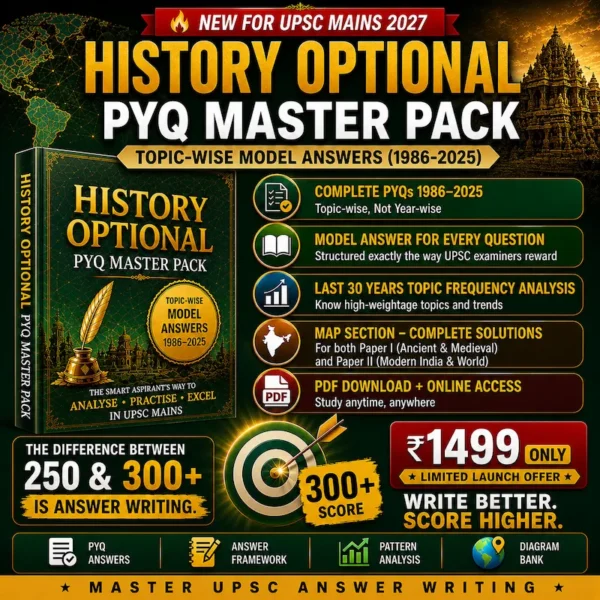
The History Optional PYQ Master Pack carries the same for every question the Commission has set since 1985, across the whole syllabus.
- PYQs 1985–2025, arranged topic-wise — revise a theme and see every way it has been asked
- Model answers with historiography — the debate cited where it belongs, not bolted on
- Map sections solved — the full 50-mark section, every year
- PDF plus online access — any device, permanently, no subscription
₹1,499 (regular ₹2,500). One-time payment, instant access.
How to use this topic list
Reading a question list feels like preparation and is not. Three sittings turn it into marks.
Sitting 1 — sort before you read (30 minutes)
- Copy the questions above into the threads identified in the previous section.
- Note which thread has gone longest without being asked — that is your priority, not the one you find most interesting.
Sitting 2 — write three answers cold (45 minutes)
- Pick the most recent question from three different threads.
- Seven minutes for a 10-marker, fifteen for a 20-marker. Stop when the time is up, even mid-sentence.
- Mark every place you wanted a historian’s name and could not produce one.
Sitting 3 — compare, then rewrite (45 minutes)
- Put your script beside the model answer for the same question.
- Compare structure first: opening claim, evidence, counter-view, judgement.
- Rewrite your weakest answer using that structure and no new content. Most candidates gain four to six marks from structure alone.
Two ways to prepare this optional
Two routes, depending on what is actually missing.
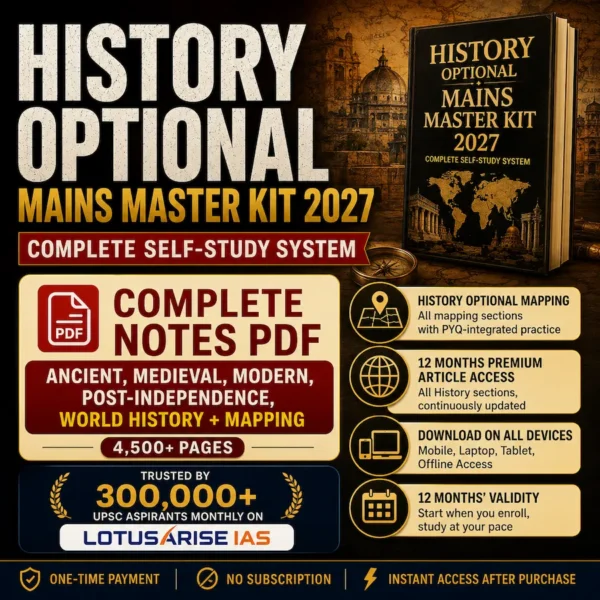
| PYQ Master Pack | Mains Master Kit 2027 | |
| Best when | Your notes are done; answer-writing is the gap | You are still building the subject |
| What you get | Model answers to every question since 1985, topic-wise, map sections included | 4,500+ pages of notes, full mapping coverage, 12 months of article access |
| Price | ₹1,499 (reg. ₹2,500) | ₹1,770 (reg. ₹5,000) |
Frequently asked questions
Related topics
Expansion questions connect directly to:
- European Penetration into India
- The Eighteenth Century
- Early Structure of the British Raj
- Economic Impact of British Colonial Rule
- All topics — History Optional PYQs, topic-wise
Prefer to work year by year?
The complete papers, with both papers in full, unit-wise analysis and the official PDFs:
- History Optional Question Paper 2026
- History Optional Question Paper 2025
- History Optional Question Paper 2024
- History Optional Question Paper 2023
- History Optional Question Paper 2022
- History Optional Question Paper 2021
- History Optional Question Paper 2020
- UPSC History Optional Map Solutions (2013–2025)


Nothing can be equivalent to this help which you are providing us by giving access to these pyq’s of optional.thanks
आप जैसे pyq प्रदान कर रहे वैसे ही pyq के model answer प्रदान करे । धन्यवाद