

- Hominid is any member of the biological family Hominidae, which includes all living and extinct great apes, encompassing humans, chimpanzees, gorillas, and orangutans.
- Fossils are the preserved remains or traces of plants and animals that lived in the past, typically more than 10,000 years ago.
- Hominid fossil sites are crucial for understanding early human evolution, migration, and prehistoric culture in the Indian subcontinent.
- The hominid fossil record is one of the best known and most complete of any mammal.
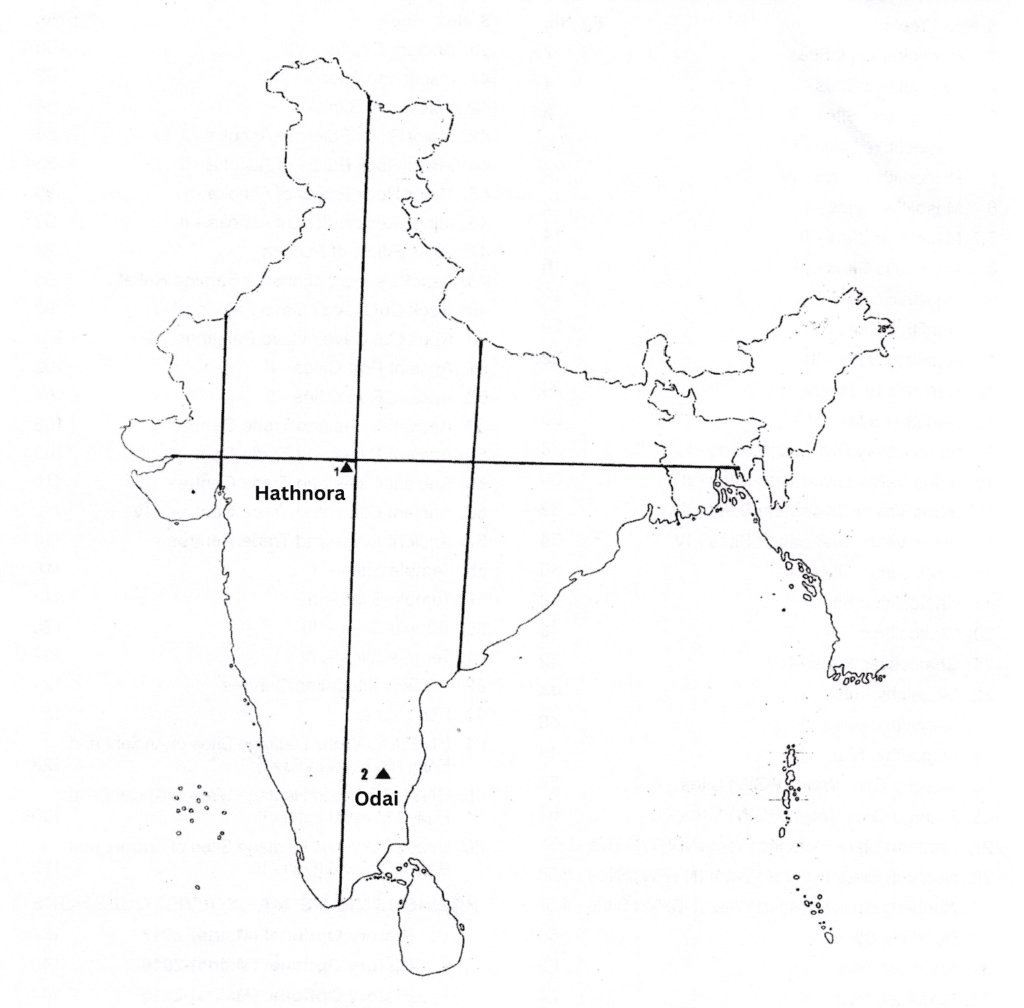
- The oldest fossil hominid in South Asia is an archaic Homo sapiens from Hathnora on the Narmada River, near the famous palaeolithic site at Hoshangabad.

Hominid Fossil Sites

Hathnora
- Location:
- Situated on the northern bank of the Narmada River, in Sehore district, Madhya Pradesh.
- Key Discoveries:
- A fossilized fragment of a skull cap along with vertebrate fossils and Acheulian tools was discovered by Arun Sonakia.
- The skull belonged to a woman around 30 years old, considered to represent an advanced variety of Homo erectus (also referred to as Narmada Man).
- A hominid clavicle (collar bone) was later found by A. R. Sankhyan, along with animal fossils and Paleolithic tools.
- Two sets of human fossils possibly belonged to the same individual.
- Chronology:
- Estimated to date from 0.5 to 0.2 million years ago (mya).
Odai
- Location:
- Situated in Villupuram district, Tamil Nadu.
- Key Discoveries:
- A fossilized human baby skull was discovered by P. Rajendran.
- It is the first human fossil ever discovered within ferricrete.
- The age of the baby skull is estimated to be around 1.66 lakh years (166,000 years).
- The excavation trench revealed:
- Microliths in the upper levels.
- Upper Palaeolithic tools in the lower levels.
- Chronology:
- Dated to the Middle or Upper Pleistocene period.
Pune
- Location:
- Situated in Pune district, Maharashtra.
- Discovery made on the bank of the Mula-Mutha river.
- Key Discoveries:
- Two human mandibles belonging to:
- An adult male Homo sapiens
- An adult female Homo sapiens
- Discovered by H. D. Sankalia and S. N. Rajaguru.
- Two human mandibles belonging to:
- Chronology:
- The exact age of the fossils is uncertain.
Bhimbetka
- Location:
- Situated in Raisen district, Madhya Pradesh.
- The discovery was made inside a cave at Bhimbetka.
- Key Discoveries:
- Fossil remains of an adult male.
- Discovered by V. S. Wakankar.
- Chronology:
- The age of the fossil is uncertain.
Jwalapuram
- Location:
- Situated in the Kurnool district, Andhra Pradesh.
- Lies in the Jurreru Valley near the town of Jwalapuram.
- Key Discoveries:
- Numerous stone tools ranging from Lower Palaeolithic to Mesolithic.
- Tools found both below and above the volcanic ash layer from the Toba super-eruption (c. 74,000 years ago).
- Indicates continuity of human occupation before and after the eruption.
- Archaeological Significance:
- Suggests that modern humans in India survived the Toba volcanic event.
- One of the most significant Middle Palaeolithic sites in South Asia.
- Associated with early Homo sapiens presence in the Indian subcontinent.





Nice initiative
Intresting