

Condition of Women in Early Medieval India (750–1200)

- The condition of women in early medieval India (750–1200) continued, in many respects, the patterns of the earlier period — the status of women remained subordinate to that of men, with married women required to be devoted to their husbands and to obey them without question.
- One contemporary writer illustrates the wife’s duty of personal service toward her husband — even describing her role in shampooing his feet and rendering other services “as befits a servant” — though he adds the important condition that the husband, in turn, was to follow the righteous path, remaining free of hatred and jealousy toward his wife.
- It was equally the husband’s duty to maintain his wife under all circumstances: a faithful wife was not to be abandoned even if she was disagreeable in appearance or harsh in speech.
- This article examines the condition of women in early medieval India across several dimensions — education, seclusion and trust, property rights, the institution of marriage, widowhood and sati, temple-dedication and the Ganika class, women rulers, and finally the far less documented lives of ordinary women — to build a rounded picture of where continuity and change coexisted in this period.
Women’s Education
- Women continued to be denied the right to study the Vedas, and the marriageable age for girls was progressively lowered, directly curtailing their opportunities for higher education.
- The near-total omission of any reference to women teachers in contemporary dictionaries reflects the generally poor state of higher education among women during this period.
- Despite this, some dramatic works of the period reveal that court ladies, and even a queen’s maids-in-waiting, were capable of composing excellent verse in Sanskrit and Prakrit.
- Various accounts also point to the skill of princesses in the fine arts, particularly painting and music, while daughters of high officials, along with courtesans and concubines, were similarly expected to be highly accomplished in the arts, including poetry.
Seclusion, Trust, and the Absence of Purdah
- Women, in general, were viewed with distrust by contemporary society — expected to be kept in seclusion, with their lives regulated by male relatives such as father, brother, husband, or son. Within the home itself, however, they continued to be genuinely honoured.
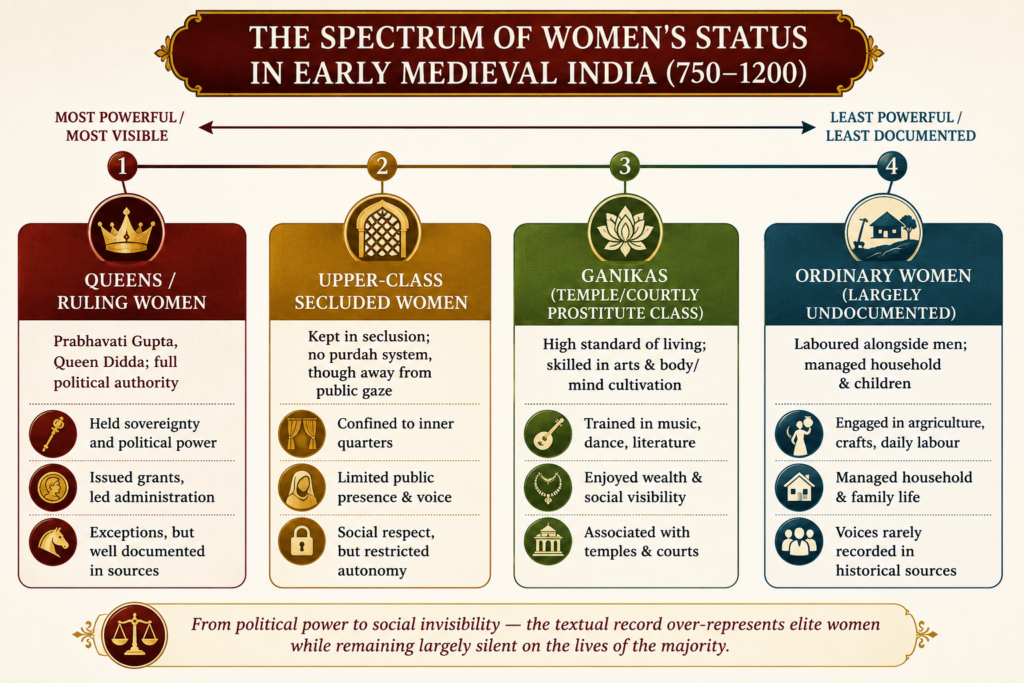
- Upper-class women in particular lived in seclusion, generally kept away from public gaze.
- Notably, there was no formal system of purdah or veiling during this period.
- Abu Zaid, a tenth-century Arab traveller, observed that most Indian princes, while holding court, allowed the women of their household to appear unveiled before all present — a group that, notably, included even foreigners.
Property Rights of Women
- If a husband abandoned even a wife guilty of offensive behaviour, she was nonetheless entitled to maintenance.
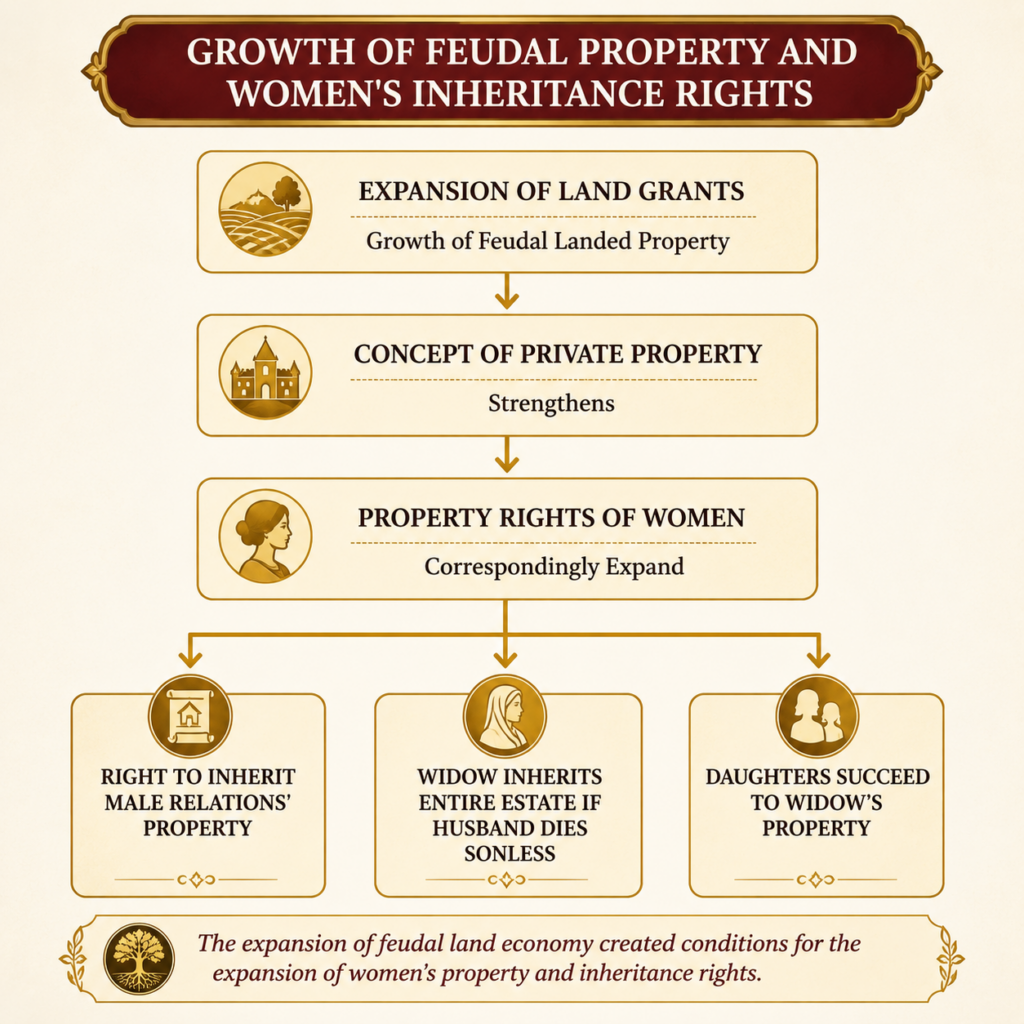
- As property rights in land expanded during this period, the property rights of women correspondingly grew.
- In order to preserve family property, women were granted the right to inherit the property of their male relations.
- With certain reservations, a widow was entitled to her deceased husband’s entire estate if he died sonless, and daughters, in turn, held the right to succeed to the property of such a widow.
- In effect, the growing structure of feudal society — with its expanding, land-based concept of private property — directly strengthened women’s property rights as a corollary of that same system.
The Institution of Marriage
- According to the smriti writers, girls were customarily given away in marriage by their parents between the ages of six and eight, or at some point between their eighth year and the attainment of puberty.
- The Gandharva form of marriage — in which a woman chose her own husband — was explicitly censured by Medhatithi, one of the oldest and most authoritative commentators on the Manusmriti.
- Medhatithi treated marriages of Brahmana men with Kshatriya and Vaishya women as altogether exceptional, while forbidding outright the marriage of a Brahmana with a Shudra girl.
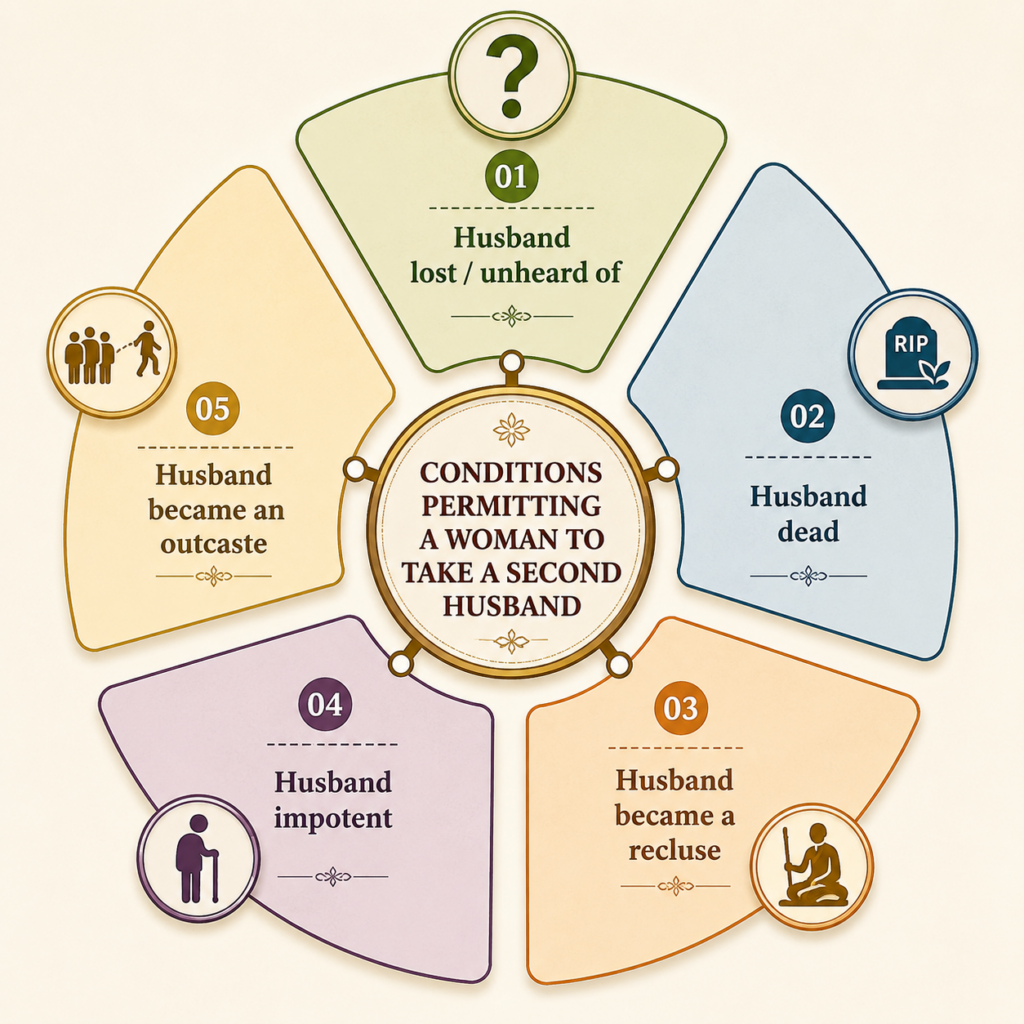
- A woman was permitted to take a second husband only under one of five recognised calamities:
- Her husband was lost or unheard of.
- Her husband was dead.
- Her husband had adopted the life of a recluse.
- Her husband was impotent.
- Her husband had become an outcaste.
- Considerable emphasis was placed on the purity of sexual life, with heavy punishments reserved for those guilty of adultery — in some cases, both the man and the woman involved were put to death, while lesser offences attracted correspondingly lighter punishment.
- A widow, for her part, was required to live a life of strict celibacy and self-restraint.
Widowhood and the Practice of Sati
- The practice of sati was regarded as obligatory by some contemporary writers, while being explicitly condemned by others — reflecting a genuine lack of social consensus on the practice.
- According to the Arab writer Sulaiman, the wives of kings would sometimes burn themselves on their husband’s funeral pyre, but the decision remained, in principle, a matter of their own personal choice.
- There is evidence that sati became more prevalent alongside a specific structural trend: as leading chiefs maintained increasingly large numbers of women, the resulting disputes over property appear to have created a growing incentive for the rite of sati to spread.
Temple Dedication and the Ganika Class
- The custom of dedicating maidens for service in temples was prevalent during this period, and the class of prostitutes known as Ganikas existed as a distinct social unit.
- A Ganika was expected to possess high qualifications of both body and mind, and to maintain a correspondingly high standard of living.
Women Rulers
- In Orissa and Kashmir, a number of women ruled as queens in their own right.
- Prabhavati Gupta of the Vakataka dynasty ruled for at least thirteen years as regent, in her capacity as mother of the yuvaraja.
- Queen Didda ruled Kashmir for fifty years, successfully withstanding all political intrigues mounted against her.
Ordinary Women
- Very little information survives on the lives of ordinary women during this period. They must have worked hard alongside their men, in addition to managing the household and tending to children.
Conclusion
- The condition of women in early medieval India (750–1200) reveals a society of genuine contradictions: formal subordination within marriage and the household coexisted with real, if unevenly distributed, gains in property rights; strict seclusion for upper-class women coexisted with the absence of any formal purdah system; and a patriarchal social order that denied women access to Vedic learning nonetheless produced accomplished poets, artists, and — in states like Kashmir and Orissa — powerful reigning queens.
- As with much of early medieval Indian society, formal reflects only part of the picture — the lived experience of ordinary women, largely absent from the textual record, likely diverged considerably from the norms prescribed by smriti writers and commentators, a reminder that the sources available for this period skew heavily toward elite and royal women.




