

Indian Science and Technology in Early Medieval India: Introduction

- It is genuinely difficult to periodise the history of Indian science and technology in early medieval India to a single, sharply-defined period — the developments of this era are best understood as a continuation of trends from the earlier period, rather than as a wholly distinct phase.
- Readers are encouraged to first review the developments of ancient India (e.g., the work of Aryabhata and Varahamihira) as essential background to this period.
- This article surveys Indian science and technology in early medieval India across two broad domains — first, developments (and, notably, the relative decline) in science — spanning mathematics, astronomy, medicine, and chemistry/metallurgy — and second, the more modest but real technological improvements, particularly in agriculture and irrigation.
Science in Early Medieval India
- The overall growth of science in the country slowed considerably during this period, to the point that India was no longer regarded as a leading centre of scientific inquiry.
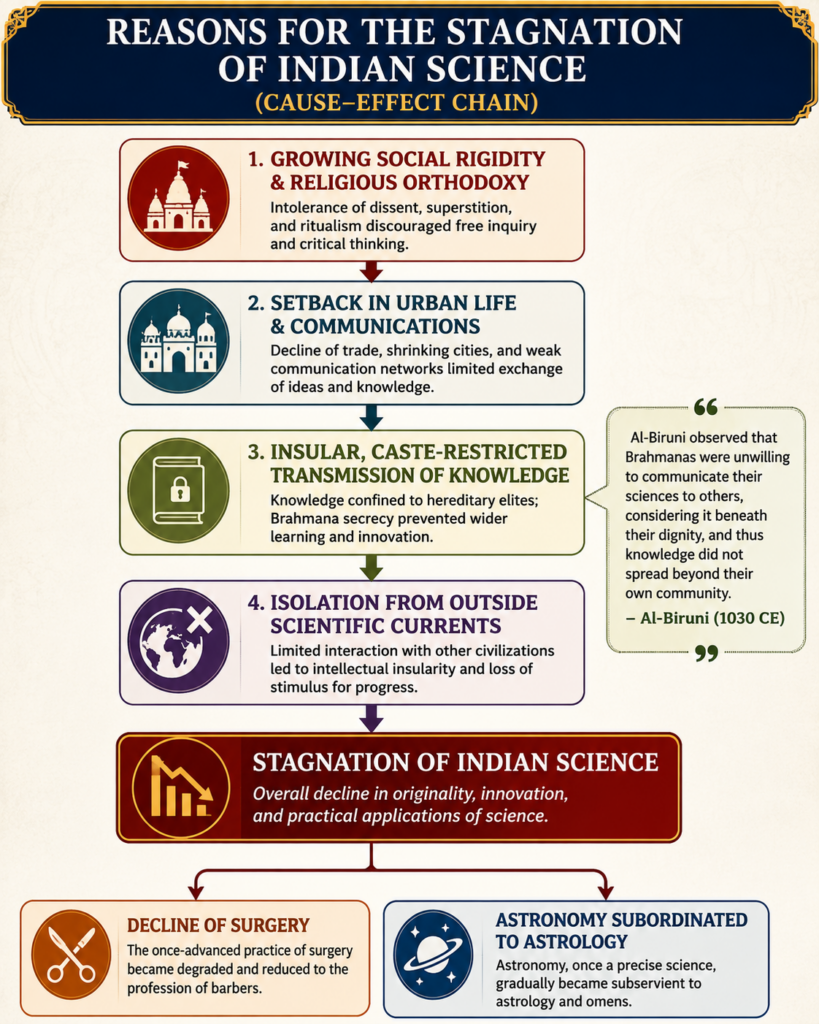
- Surgery, for instance, went into marked decline once the dissection of dead bodies came to be regarded as fit only for people of “low” castes — as a direct result, surgery increasingly became the profession of barbers.
- Astronomy was similarly and gradually pushed into the background by astrology.
- Even amid this general slowdown, however, real advances continued in mathematics — the Lilavati of Bhaskara II, written during this period, went on to remain a standard mathematical text for centuries thereafter.
Development of Mathematics
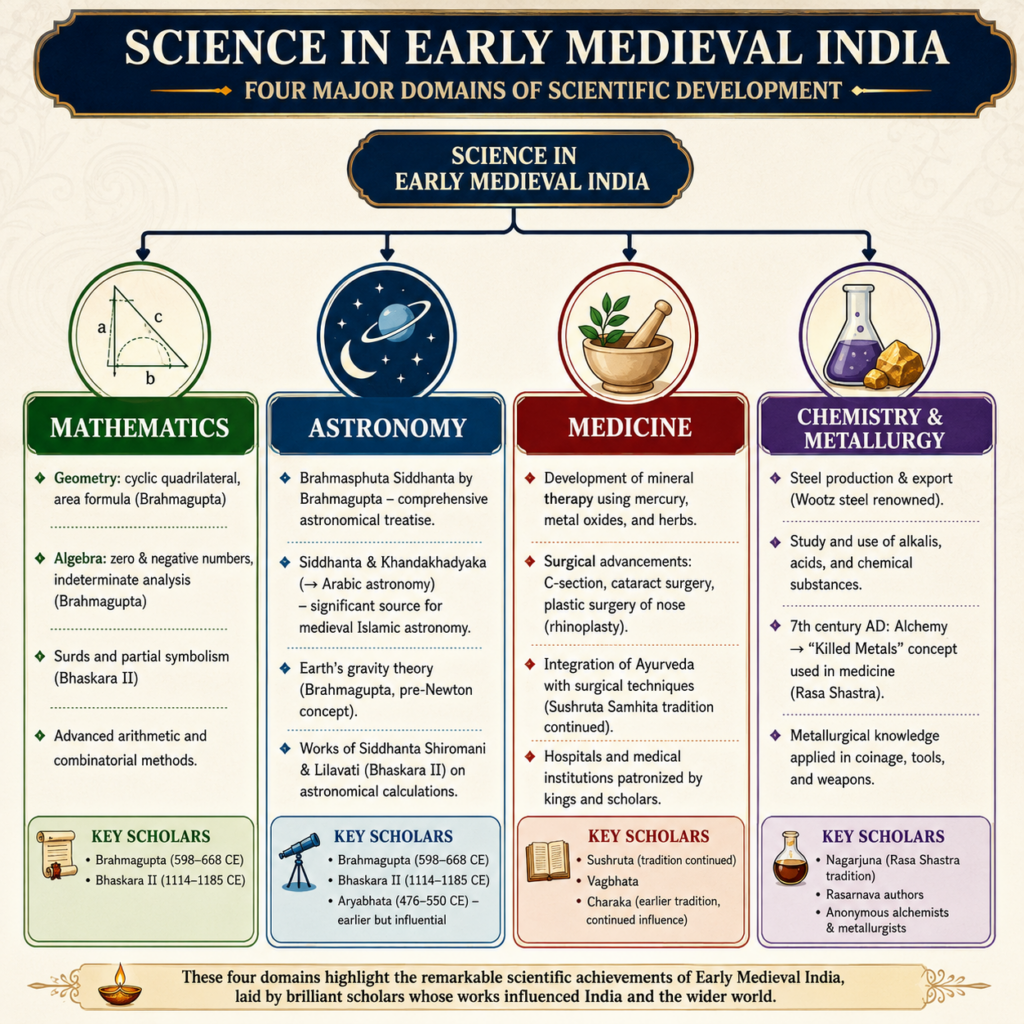
- Geometry: Brahmagupta (d. 668 CE) provided a formula for calculating the area of any cyclic quadrilateral.
- Algebra:
- Brahmagupta developed the rules for operating with negative quantities and with zero, and was the first to apply algebra systematically to astronomical problems. In indeterminate analysis, he succeeded in finding complete whole-number (integral) solutions to equations of the form ax ± by = c.
- The next major contribution came from Bhaskara, who in 1200 CE developed the concept of surds; his other important algebraic contribution was the development of “partial symbolism.”
Development in Astronomy
- Brahmagupta authored the Brahmasphuta Siddhanta and the Khandakhadyaka, both of which were translated into Arabic and went on to significantly influence Arabic astronomy.
- Remarkably, Brahmagupta anticipated Newton by declaring that all things fall to earth by a “law of nature,” since it is the very nature of the earth to attract and retain objects — a genuinely revolutionary theory for its time, even though it was never fully elaborated or explained.
- Bhaskara II likewise contributed significantly to astronomy through his celebrated work Siddhanta Shiromani, which includes a separate mathematical chapter — the Lilavati — so extensive in scope that it is often treated as a standalone work in its own right.
Medicine
- The broader period between 800 BC and 1000 CE is regarded as the golden age of Indian medicine, and this early medieval segment saw continued, genuine advances — particularly in the therapeutic use of minerals, most notably mercury.
- From the eighth century AD onward, the oxides, chlorides, and sulphates of tin, iron, copper, silver, gold, and mercury came into medicinal use, some functioning as stimulants and rejuvenators.
- Dietary treatment was similarly refined: a salt-free diet was prescribed for nephritis, while fat and fleshy foods were recommended for tuberculosis.
- Diagnosis relied heavily on the physical senses — for instance, physicians applied the ear to the chest to distinguish the nature and extent of lung disease.
- While demons were still believed to cause mental illness specifically, and magic and prayer had not been entirely eliminated from medical practice more broadly, surgical practice had genuinely advanced, encompassing procedures such as:
- Extracting the foetus from the womb, including caesarean section.
- Treating fistula and repairing rectal prolapse.
- Removing bladder stones.
- Tapping the abdomen for dropsy, and couching for cataracts.
- Plastic surgery of the nose — often needed to repair damage inflicted as a punishment for adultery.
- Numerous texts were also written on plant sciences and on the treatment of animals (horses, elephants, etc.); however, India never developed effective methods for breeding fine-quality horses, leaving the country dependent on horse imports from Central Asia, including Arabia and Iran — a dependence that created serious difficulties for Indian rulers once these regions came under Muslim conquest, disrupting the supply of good-quality horses.
Chemistry and Metallurgy
- By the beginning of the Christian era, India already had large-scale production of copper, iron, steel, brass, silver, and gold, along with their various alloys.
- Indian steel was highly valued throughout the ancient world and was exported in large quantities, while tin and mercury were imported and worked domestically; glass beads were manufactured at scale, and both mild and caustic alkalis, along with certain mineral acids, were known.
- A Chinese traveller records that Indian Brahmanas possessed a liquid — likely a mineral acid — capable of dissolving most substances.
- From the seventh century AD onward, alchemy began to appear in Indian literature, with a considerable number of practitioners searching for methods to manufacture precious metals and an elixir of life.
- While these practitioners never achieved their stated objectives, the sustained research process yielded genuine advances in the chemistry of metallic salts — producing what were termed “killed metals,” which came to be highly valued for their medicinal properties.
- Indian steel was highly valued throughout the ancient world and was exported in large quantities, while tin and mercury were imported and worked domestically; glass beads were manufactured at scale, and both mild and caustic alkalis, along with certain mineral acids, were known.
Reasons for the Stagnation of Indian Science
- Several interlinked factors account for the broader stagnation of Indian science during this period.
- The growth of science, as experience suggests, is closely tied to the growth of society as a whole — and as discussed elsewhere in this series, early medieval Indian society was becoming increasingly rigid and narrow in character, accompanied by a genuine setback in urban life and communications and growing religious orthodoxy.
- A second key factor was the growing tendency of Indians to isolate themselves from the main currents of scientific thought outside India.
- This insularity is vividly captured in the writings of Al-Biruni, the noted Central Asian scientist and scholar who lived in India for roughly ten years during the early eleventh century.
- Although himself a genuine admirer of Indian science and learning, Al-Biruni was sharply critical of the insular attitude of India’s learned class — the Brahmanas — observing: they are “haughty, foolish, vain, self-conceited, stolid,” by nature reluctant to share their knowledge, taking “the greatest possible care to withhold it from men of another caste among their own people,” let alone from foreigners, since they believed no other created beings possessed any knowledge of science whatsoever.
- (A fuller account of science and technology as described by Al-Biruni is available in a separate dedicated chapter on Al-Biruni’s India*.)*
- This insularity is vividly captured in the writings of Al-Biruni, the noted Central Asian scientist and scholar who lived in India for roughly ten years during the early eleventh century.
Technology in Early Medieval India
- Historians such as D.D. Kosambi and Burton Stein have argued that the level of technology in early medieval India remained a broadly constant factor across the period. Even so, some significant improvements are documented, particularly in the field of agriculture.
Improvements in Irrigation
- There was a notable increase in irrigation sources, including canals, lakes, and tanks (tataka, eri), as well as wells (kupa, kinaru).
- Prominent examples include the (now-ruined) great reservoir of King Bhoja, and the Grand Anicut built by the Cholas.
- Various water-lift devices, operated by either human or animal power, are also documented — oxen, for instance, were used to draw leathern buckets upward via a rope-and-pulley wheel.
- Water-lifting devices such as the araghatta (used in the wells of Rajasthan) and the ghatiyantra are both mentioned in inscriptions and literary works; the potgarland (mala) device also came into use, attested both by epigraphic evidence and by a reference in Bana’s Harshacharita.
- The Krishisukti of Kashyapa specifically recommends that the ghatiyantra be operated by oxen for best results.
- Water-lifting devices such as the araghatta (used in the wells of Rajasthan) and the ghatiyantra are both mentioned in inscriptions and literary works; the potgarland (mala) device also came into use, attested both by epigraphic evidence and by a reference in Bana’s Harshacharita.
Improvements in Agricultural Implements
- References survive to a draw-bar device, by which cattle could be made to move in circles to power threshing or other agricultural work — the Ramacharita specifically mentions bullock-powered threshing using such a device.
- A tenth-century inscription from Ajmer refers to a “big plough,” and the one-humped camel was added to the domestic animal stock specifically for its usefulness in ploughing — noted by Xuan Zhuang as being used in Sind, with Khajuraho sculpture providing further evidence of the animal’s continued diffusion across India.
- Separate implements were developed specifically for weeding out parasitic plants.
- Weather knowledge relevant to agriculture also advanced considerably during this period:
- Its practical application to farming operations is documented in texts such as the Gurusamhita and Krishinarashwara.
- Knowledge of fertilizers improved substantially, and the deliberate use of compost became well established.
Crops
- Contemporary agricultural writings mention more than a hundred types of cereals, including wheat, barley, and lentils.
- Cash crops documented in this period include arecanuts, betel leaves, cotton, and sugarcane.
- The early tenth-century writer Rajashekhara describes the exceptional quality of north Bengal sugarcane, which reportedly yielded juice even without the use of a pressing instrument.
- There is also clear evidence of increased spice production, corroborated by the account of Marco Polo.

Military Technology
- Beyond agriculture, there is also evidence of improvement in military technology during this period.
- The increased frequency of horsemen in Indian sculpture reflects a growing emphasis on cavalry warfare; a number of sculptures at Khajuraho specifically depict the use of the saddle.
- Hoysala sculptures similarly depict the use of the stirrup, typically made of leather or wood, and only rarely of iron.
Conclusion
- The story of Indian science and technology in early medieval India is one of genuine contrast: pure science — surgery, astronomy, and broader scientific inquiry — saw a marked relative decline, driven by growing social rigidity, religious orthodoxy, and a deepening scholarly isolation from outside currents of thought, even as mathematics and medicine continued to record real, if narrower, advances.
- Technology, by contrast, showed more concrete and measurable improvement — particularly in irrigation, agricultural implements, and crop diversity — even if historians like Kosambi and Stein rightly caution against overstating the pace of change across the period as a whole.
- Read together with the article on Al-Biruni’s India, this account offers a fuller picture of how contemporaries — both Indian and foreign — understood the state of Indian science at the turn of the eleventh century.




