

Society in Early Medieval India

- For almost a century, historical understanding of society in early medieval India was shaped by a fallacious colonialist and imperialist notion — the idea that Indian society remained essentially static across the millennia.
- In reality, Indian social organisation between the 8th and 13th centuries was extremely vibrant and responsive to the changes taking place across the realms of economy, polity, and ideas.
- This article traces that vibrancy — examining the sources available for reconstructing early medieval society, the Brahmanical drive toward rigidity and the voices of dissent that challenged it, the changing material base that reshaped the social order, the resulting new social ethos (including the emergence of Shudra cultivators, new literate classes, and a proliferation of castes), the links between land distribution and feudal rank, and the increasing social tensions that accompanied these transformations.
Sources for the Reconstruction of Society
- Both literary and epigraphic sources are available for reconstructing early medieval Indian society.
Inscriptional Sources
- Copious inscriptional data survives from this period — post-Gupta inscriptions run into the thousands and are available in a wide variety of languages and scripts.
- These records are particularly valuable for identifying regional and local particularities without losing sight of a broader, macro view of the subcontinental scene.
Literary Sources
- The Dharmashastras and other dharma-nibandhas document the ebb and flow of the social system, supplemented by kavyas (poetic works), drama, technical and scientific treatises, and works on architecture.
- Notable examples include Kalhana’s Rajatarangini, Shriharsha’s Naishadhiyacharita, Merutunga’s Prabandha Chintamani, Soddhala’s Udaya-Sundari Katha, Jinasena’s Adipurana, and the dohas of the Siddhas.
- Medhatithi’s and Vigyaneshwar’s commentaries on the Manusmriti and Yajnavalkya Smriti respectively, along with works such as the Manasollasa, Mayamata, and Aparajitapriccha, serve as valuable aids for reconstructing the social fabric of the period under survey.
The Brahmanical Perspective: Growing Rigidity
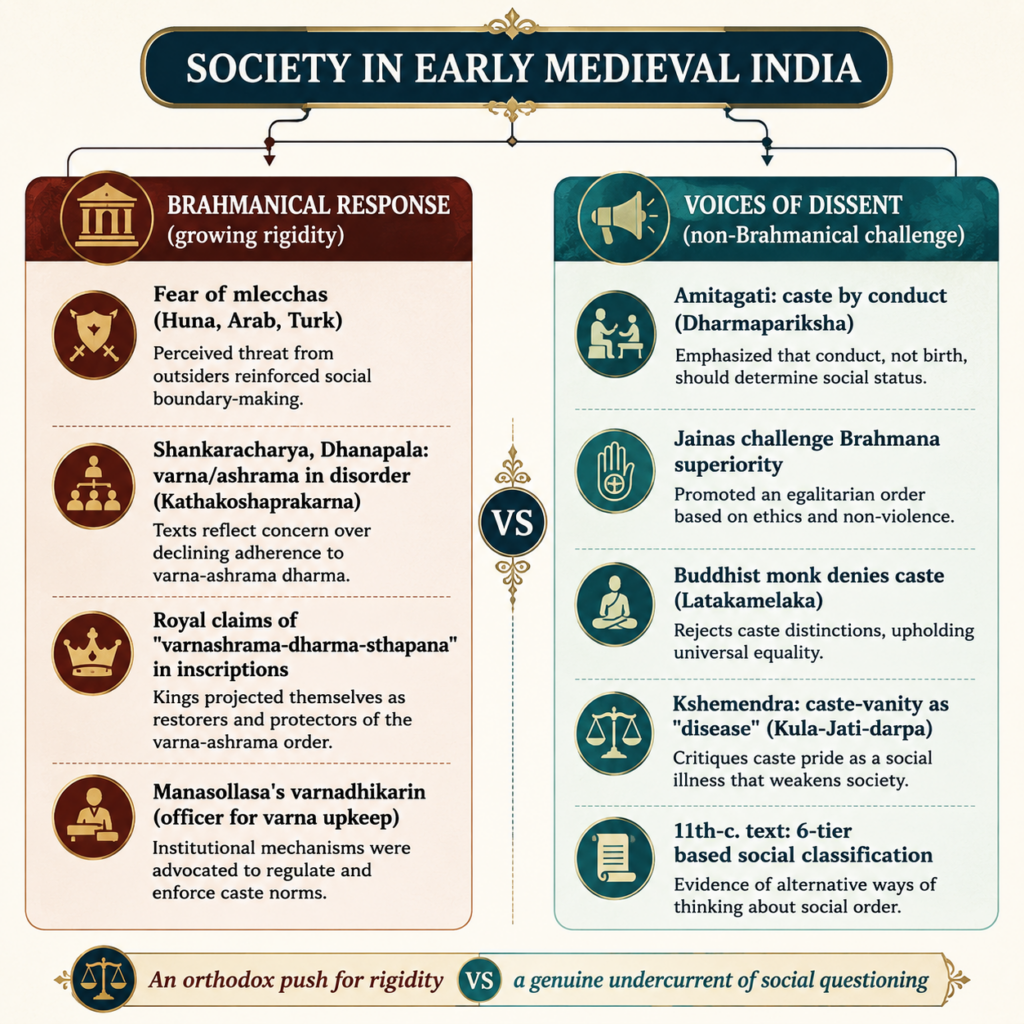
- A growing tendency emerged among Brahmanas to preserve the age-old social order, driven in large part by the arrival of mlecchas (non-Vedic foreigners such as the Hunas, Arabs, and Turks), which generated a genuine fear psychosis.
- Shankaracharya stated that the varna and ashrama dharmas were in a state of disturbance, while the eleventh-century writer Dhanapala similarly described the chaos afflicting the varna order.
- Various rulers between the sixth and thirteenth centuries made rather pompous claims about preserving the social order, a trend reflected directly in their inscriptions — the phrase varnashrama-dharma-sthapana (“establishment of the system of varna and ashrama”) became a frequently used expression in contemporary epigraphy, and the twelfth-century text Manasollasa even mentions a dedicated officer, the varnadhikarin, responsible for maintaining varna order.
- This drive to close social ranks, rigidify the social system, and denounce efforts at change was largely the concern of Brahmanical lawgivers and political advisers, who had developed vested interests in preserving the status quo — though this attitude was by no means universal.
Voices of Dissent
- The non-Brahmanical sections of society repeatedly questioned the fundamental basis of the caste system, with simmering discontent against the Brahmanical social order surfacing at regular intervals.
- In the Dharmapariksha (11th century), the Jaina author Amitagati argued that caste should be determined by personal conduct rather than birth; the Kathakoshaprakarana similarly saw the Jainas challenge the claimed superiority of Brahmanas.
- The Latakamelaka records a Buddhist monk who dismissed the importance of caste altogether, regarding it as baseless and a source of pollution.
- Kshemendra, the literary genius of Kashmir (himself a physician), described Kula-Jati-darpa (“vanity of caste and clan”) as a disease afflicting society.
- The Padmapurana captures a genuine ideological conflict of the age — between an orthodox view that consigned the Shudra to a life of penury, and a heterodox view urging him toward the pursuit of wealth.
- An eleventh-century text offers a striking alternative framework, classifying social rank not by birth but by occupation — dismissing priests of all religions as hypocrites, and dividing householders into six broad categories:
- The highest — chakravartins (universal sovereigns).
- The high — the feudal elite.
- The middle — traders, moneylenders, and owners of cattle such as cows, buffaloes, camels, and horses.
- Small businessmen and petty cultivators.
- The degraded — members of artisan and craftsmen’s guilds.
- The highly degraded — chandalas and others following “ignoble” occupations such as the killing of birds and animals.
- This scheme makes clear that social status was increasingly determined by economic factors — and even though such classifications remained shaped by Brahmanical bias and prejudice, and were far from a blueprint for a truly egalitarian society, they nonetheless represent a more rational basis for social reconstruction than pure birth-based hierarchy.
Changing Material Base and the New Social Order
- Conflicting trends show that social organisation during this period was in a state of flux, far from harmonious — driven primarily by the changing economic structure of society.
- The mechanics of this changing social system are difficult to grasp if the improving economic conditions of a sizeable section of the lower classes are ignored.
- The agrarian expansion, fuelled by the ever-growing phenomenon of land grants, transformed the entire social outlook. This was accompanied by several interconnected effects:
- A fillip to tendencies of localisation.
- A direct bearing on fluctuations in urban settlement.
- A close nexus with the monetary system.
- A role in increasing social and economic immobility, and the growing subjection of the peasantry and non-agricultural toiling classes.
- The resulting emergence of a hierarchy of ruling landed aristocracy.
- A new social ethos was thus taking shape — the new trends in the Indian economy were conducive to feudal formation, and in the political realm too, a great majority of power centres came to be marked by feudal tendencies based on graded land rights.
- The social landscape, in short, could not escape the domineering impact of this fast pace of economic change — and these resulting social changes decisively demolish the myth of an unchanging, static Indian social organisation, a myth propagated by colonialist and imperialist historians. More recent scholarship, especially over the last three decades, has rightly emphasised the dynamism and vibrancy of the Indian social fabric and its close interlinkage with changing economic patterns.
The New Social Ethos (8th–13th Century)
- Social organisation during this period was marked by six interlinked developments:
- Modifications in the varna system, notably the transformation of Shudras into cultivators, bringing them closer to the Vaishyas.
- A newly founded Brahmanical order in Bengal and South India, wherein intermediary varnas were largely absent.
- The rise of a new literate class (the Kayasthas) struggling for a place within the varna order.
- A phenomenal increase in the rise of new mixed castes.
- An unequal distribution of land and military power, which in turn produced feudal ranks that cut across varna distinctions.
- Growing evidence of social tensions.
Emergence of Shudras as Cultivators
- The expansion of the rural space and agricultural activity drove this change, making a significant dent in the Brahmanical social order and prompting a redefinition of varna norms.
- Post-Gupta law books began including agriculture within the samanaya-dharma (common occupation) of all four varnas.
- The smriti of Parashar went further, stating that Brahmanas too could engage in agricultural activity — preferably through Shudra labour — while enjoining them to treat oxen properly and to offer fixed quantities of grain to the king, gods, and fellow Brahmanas in order to avoid sin.
- This period also saw a bridging of the gap between Vaishyas and Shudras:
- Although this trend has roots in the early centuries of the Christian era, it is significant that in the post-Gupta centuries, Vaishyas practically lost their distinct identity as a peasant caste.
- Hsuan-Tsang describes Shudras explicitly as agriculturists, while Al-Biruni notes the absence of any real difference between Vaishyas and Shudras — by the eleventh century, both were treated alike ritually and legally, and both, he notes, were punished with amputation of the tongue for reciting Vedic texts.
- The Skanda Purana describes the pitiable condition of the Vaishyas, while an eighth-century text states that thousands of mixed castes emerged from marriages between Vaishya women and men of lower castes.
- Many Tantric and Siddha teachers were themselves Shudras, performing occupations such as fishing, leatherworking, washing, and blacksmithing; some Shudras, called bhojyanna, prepared food that could be accepted even by Brahmanas.
- There is also mention of anashrita Shudras (i.e., non-dependent Shudras) — prosperous individuals who occasionally became members of local administrative bodies and even rose into the ruling aristocracy, though such achievements remained rare, since a base of dependent peasants was equally necessary to the system.
- Although this trend has roots in the early centuries of the Christian era, it is significant that in the post-Gupta centuries, Vaishyas practically lost their distinct identity as a peasant caste.
- This approximation of Vaishyas and Shudras fulfilled a real structural need: strengthening the early medieval economic and political set-up — characterised by a largely self-sufficient local economy and a dominant class of rural aristocracy — required a steady supply of dependent peasants, ploughmen, and artisans.
- Even so, Brahmanical orthodoxy persisted: Parashar himself threatened Shudras who abandoned their duty of serving the dvijas with dire consequences in the afterlife, and certain orthodox Jaina sections held that Shudras were not eligible for religious initiation.
Absence of Intermediary Varnas in Bengal and South India
- The new Brahmanical order established in Bengal and South India provided mainly for Brahmanas and Shudras, resulting in a notable absence of intermediary varnas in these regions — a consequence of two factors:
- A general tendency toward removing distinctions between Vaishyas and Shudras.
- The strong influence of non-Brahmanical religions in these regions, alongside considerable intermixing and acculturation — tribal and non-Brahmanical populations in peripheral areas were admitted into the Brahmanical system as Shudras.
- The Brahmavaivarta Purana (attributed to 13th-century Bengal) refers to tribal groups such as the Agaris, Ambashthas, Bhillas, Chandalas, and Kaunchas, who were accommodated as Shudras within the Brahmanical order — a pattern equally true of the Abhiras in the Deccan.
- The Vallalacharita (concerning Vallala Sena, 12th-century king of Bengal) describes a deliberate reordering of the social order: the king elevated the position of the Kaivarthas, potters, blacksmiths, and garland-makers, while simultaneously degrading goldsmiths and trader-Brahmanas.
- A similar tendency toward eliminating intermediary varnas is visible in South India, particularly in the status of scribes: the Kayasthas, Karanas, Lekhakas, and Lipikaras were classed as Shudras, as were the Gavundas (present-day Gowdas of Karnataka) in the medieval Deccan.
Rise of a New Literate Class: The Kayasthas
- The expansion of land grants required land transactions, ownership records, and measurement statistics to be maintained — generating an entire class of specialist scribes, of whom the Kayasthas were only one of roughly a dozen categories of writers and record-keepers.
- While the first Kayastha is mentioned in Gupta-era inscriptions from Bengal, post-Gupta inscriptions are replete with references to a wide variety of record-keeping roles, including karanas, karanikas, pustapalas, lekhakas, diviras, aksharachanchus, dharmalekhins, and akshapatalikas.
- Though these scribes were originally recruited from different varnas, they gradually crystallised into a distinct caste with its own marriage restrictions — the use of the terms Kula and Vamsha with “Kayastha” from the eleventh century, and terms such as jati and gyati from the 12th–13th centuries, confirm the clear emergence of the Kayastha caste.
- Individual Kayasthas rose to prominence in learning and literature — for instance, Tathagatarakshita of Orissa, who belonged to a family of physicians by profession and Kayasthas by caste, became a reputed professor of Tantras at the Vikramashila University in Bihar during the twelfth century.
Phenomenal Increase in the Rise of New Mixed Castes
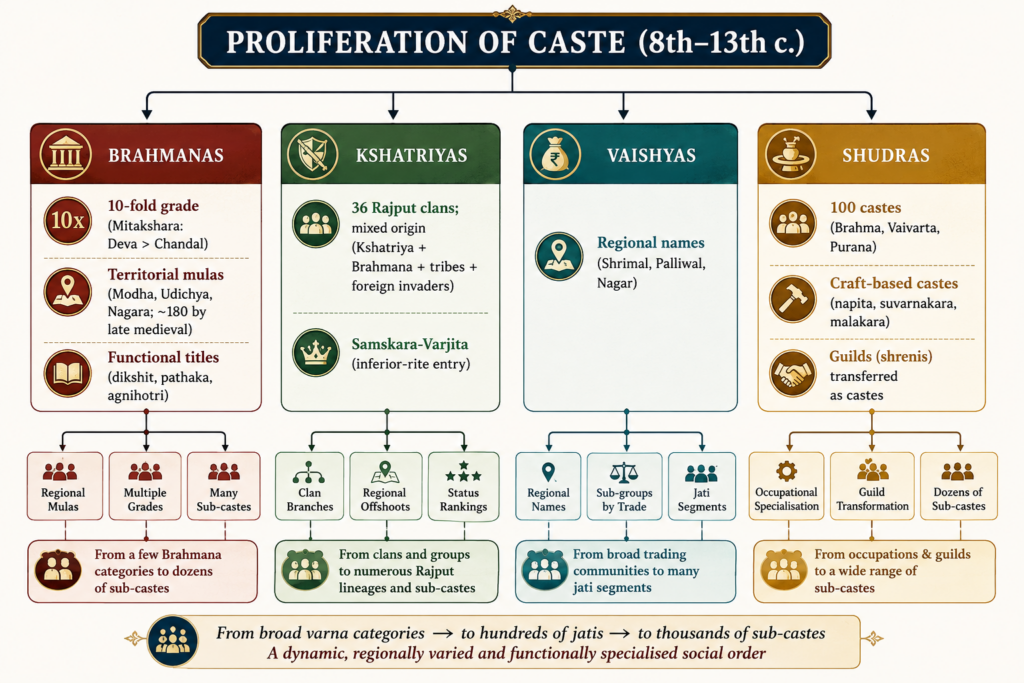
- This proliferation of caste stands as one of the most distinctive features of social change during this period.
- The Brahmavaivarta Purana’s dictum of deshabheda (regional/territorial difference) helps explain the resulting differences in caste; a tenth-century Bengal inscription mentions a village named Brihat-Chhattivanna, inhabited by no fewer than 36 varnas.
- No varna, it seems, remained homogeneous — each fragmented further due to territorial affiliation, gotra purity, and the pursuit of specific crafts, professions, and vocations.
Multiplication of Caste Amongst Brahmanas
- This proliferation appears most pronounced among Brahmanas, who were no longer confined to their traditional sixfold duties.
- Beyond high governmental positions such as ministers, purohitas, and judges, Brahmanas even began performing military functions — the senapati (general) of Prithviraj Chauhan, for instance, was a Brahmana named Skanda.
- Inscriptions from Pehoa and Siyadoni (9th–10th century) mention Brahmanas working as horse dealers and betel sellers, while the eleventh-century Kashmiri writer Kshemendra describes Brahmanas performing artisanal work, dancing, and selling wine, buttermilk, and salt.
- This functional diversity is reflected in a range of Brahmana titles — shrotriya, pandita, maharaja pandita, dikshit, yajnik, pathaka, upadhyaya, thakkura, and agnihotri. The Mitakshara, the famous commentary on the Smriti of Yagyavalkya, describes a ten-fold gradation of Brahmanas ranging from the Deva (a professor devoted to religion and shastras) down to the Chandal (who fails to perform sandhya thrice daily), with Shudra-Brahmanas — those living by arms or temple priesthood — occupying the middle ranks.
- Divisions within the Brahmana varna also arose from territorial affiliation: North India recognised Sarasvat, Kanyakubja, Maithili, Ganda, and Utkal Brahmanas, while in Gujarat and Rajasthan, Brahmanas were identified by their mula (original place of habitation) and divided into groups such as Modha, Udichya, and Nagara — by the late medieval period, Brahmanas had split into roughly 180 mulas.
- Feelings of regional superiority also emerged, with certain regions — Saurashtra, Sindh, and Dakshinapath — labelled papadeshas (“impious regions”), driving a phenomenal migration of Brahmanas away from them.
Multiplication of Caste Amongst Kshatriyas
- The ranks of Kshatriyas similarly swelled after the eighth century — numerous texts give varying lists of 36 Rajput clans in northern India alone, drawn from different strata of the population:
- Original Kshatriyas.
- Brahmanas.
- Various other tribes, including indigenous groups.
- Foreign invaders who settled in India and were assimilated into the Indian social system.
- Although the Kshatriya varna was traditionally associated with the function of rulership, ideologues were never opposed to recognising non-Kshatriya rulers as Kshatriyas.
- It is recorded that among captured populations, “respectable men” were enrolled among the Shekhavat and Wadhela Rajput tribes, while “lower kinds” were assigned instead to other castes such as the Kolis, Khantas, and Mers.
- Some of these new Kshatriyas were termed Samskara-Varjita (deprived of ritualistic rites) — likely reflecting their admission into the Brahmanical social order through inferior rites.
Multiplication of Caste Amongst Vaishyas and Shudras
- Vaishyas, too, came to be identified by regional affiliation — giving rise to groups such as the Shrimals, Palliwals, Nagars, and Disawats.
- Shudras displayed considerable internal heterogeneity, performing multifarious roles as agricultural labourers, petty peasants, artisans, craftsmen, servants, and attendants.
- The Brahma Vaivarta Purana lists as many as one hundred castes of Shudras, again sub-divided along regional and territorial lines; some Shudra castes emerged directly from specific industrial occupations, such as the Padukakrit and Charmakara (shoemakers and leatherworkers).
- The crystallisation of crafts into castes was a complementary phenomenon — groups such as the napita (barbers), modaka (confectioners), tambulika (betel-sellers), suvarnakara (goldsmiths), sutrakara, and malakara (garland-makers) emerged as distinct castes out of specific crafts, growing alongside the ruling aristocracy on whom they became dependent — a dependence reflected in their categorisation as ashrita.
- Their subjection and immobility is evident in the practice of transferring entire trading guilds (called shrenis or prakritis) to Brahmana donees: an inscription of AD 1000, belonging to the Yadava mahasamanta Bhillama II, describes a donated village as comprising eighteen guilds — guilds that, notably, also functioned simultaneously as castes.
Land Distribution, Feudal Ranks, and Varna Distinctions
- The nature of power dispersal, closely tied to the structure of land distribution, inevitably shaped the social order as well.
- A particularly significant consequence was the emergence of feudal ranks that cut across varna distinctions — membership of the ruling aristocracy was no longer the monopoly of Kshatriyas.
- The architectural text Mansara notes that anyone, irrespective of varna, could attain the two lowest military ranks in the feudal hierarchy — praharka and astragrahin — making clear that feudal ranks were, in principle, open to all varnas, and that varna distinctions were receiving a real shock from the new distribution of land and power.
- Titles such as thakur, raut, and nayaka were similarly not confined to Kshatriyas or Rajputs — these were also conferred on Kayasthas and other castes who received land grants or served in the army.
- Kulluka’s commentary on the Smriti of Manu notes the growing tendency of wealthy merchants to join the ranks of the ruling landed aristocracy.
- In Kashmir, the honorific rajanaka (literally, “nearly a king”) became closely associated with Brahmanas, eventually evolving into the family name Razdan.
- Feudal titles were also bestowed upon artisans — the Deopara inscription of Vijayasena records that Shulapani, the head of artisans of Varendra (Barind, in present-day Bangladesh), held the title ranaka.
- The symbols and insignia of social identity among feudal rank-holders were closely tied to landed possessions — badges of honour, the fly-whisk, umbrella, horses, elephants, palanquins, and the acquisition of the pancha-mahashabda (five great sounds) all depended on one’s precise place in the feudal hierarchy.
- Chakravartis and mahasamantas, for instance, were permitted to erect the chief gate (sinhadvar) — a privilege denied to lesser vassals.
- The provision of varying sizes of houses for different grades of vassals and officials was likewise a direct product of this unequal distribution of land.
Increasing Social Tensions
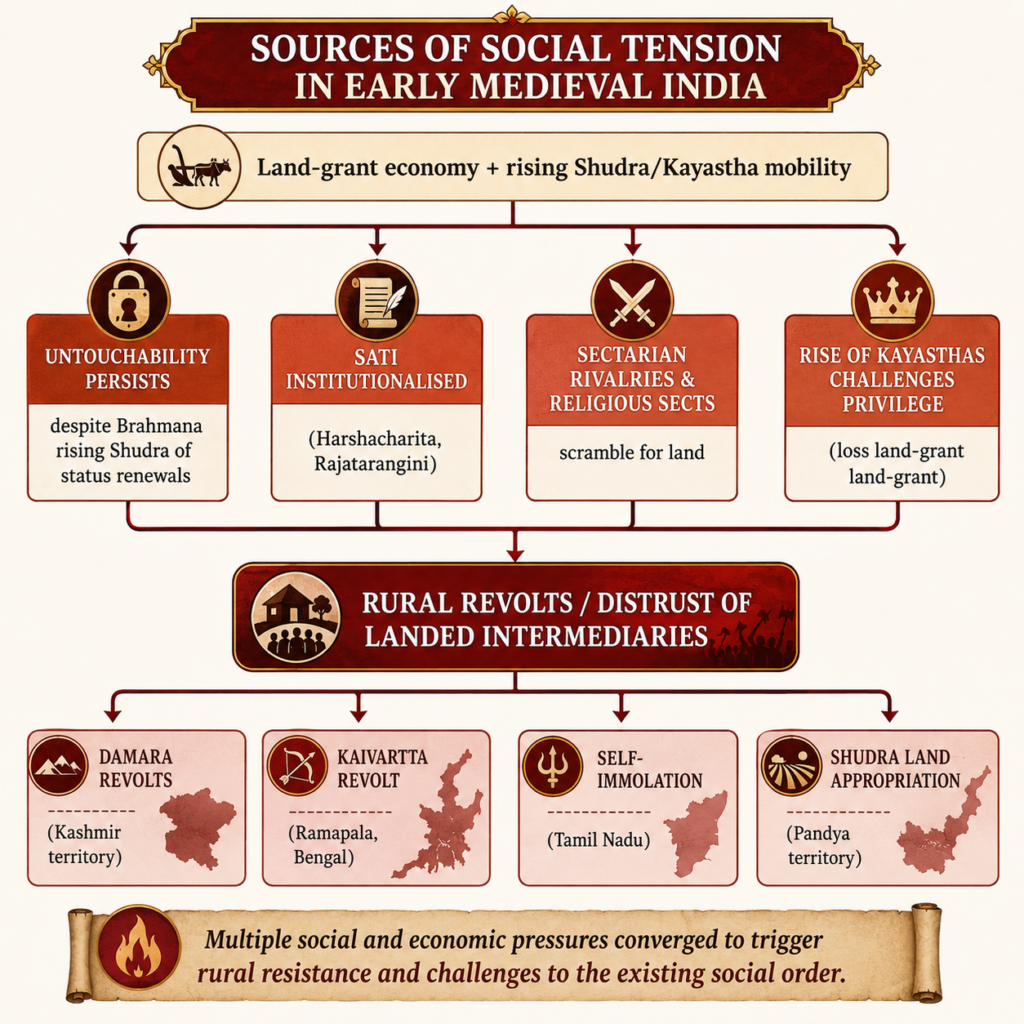
- Although the modifications described above cut across varna distinctions, the pace of social change after the eighth century was far from producing a harmonious or egalitarian social order.
- Social tension was an inevitable outcome in a society marked by considerable inequality: even as Shudras rose in status, untouchability remained deeply embedded in the social fabric.
- When Vastupala served as governor of Cambay, he constructed separate platforms specifically to prevent the mingling of different castes in curd-selling shops.
- Several factors drove the growth of untouchability:
- The pursuit of so-called impure occupations.
- Being guilty of prohibited acts.
- Adherence to heretical practices.
- Physical impurities.
- The Brihad Naradiya Purana documents the beginnings of the exclusion of Shudras from places of worship — chandalas and dombas were required to carry sticks, striking them to announce their approach so that others could avoid physical contact.
- This period also witnessed the real institutionalisation of sati, even as Brahmanical lawgivers simultaneously expressed concern for women’s proprietary rights, particularly over stridhan.
- The Harshacharita of Banabhatta records that King Harsha’s own mother performed sati even before her husband’s death; the Rajatarangini, the chronicle of Kashmir, likewise records instances of sati within royal families, while archaeological evidence survives in the form of numerous sati-satta plaques (commemorating couples in which the wife became sati) found across both North and South India.
- Sectarian rivalries were equally pervasive — a Brahmana who converted to Jainism, for instance, was considered an outcaste.
- The Latakamelaka (of Sankhadhara) depicts two Brahmanas trading insults and accusing each other of abrahmanya without apparent cause.
- Religious sects themselves multiplied and split repeatedly: Buddhism fragmented into 18 sects, the Jainas of Karnataka developed as many as seven sects, and Karnataka also saw open conflict between the Lingayats and Virashaivas.
- It is a notable historical irony that religions whose founding aim was to abolish caste distinctions were themselves gradually absorbed into the caste system, as religious sects tended over time to crystallise into castes of their own.
- The land-grant economy itself fuelled competition among religious sects eager to acquire as much land as possible — a dynamic that generated further social tension, as the majority of religious establishments steadily transformed into landed magnates.
- Some rulers of the post-eighth century — such as Avantivarman of the Mattamayara region (possibly a Chalukya prince near Gwalior) and a Cedi king of Dahala — reportedly dedicated their kingdoms to the religious heads of the Shaiva Siddhanta school, thereafter ruling merely as vassals.
- A “Protestant” movement within the Vidhi-Chaitya sect of the Jainas emerged specifically to denounce greedy and acquisitive Jaina ascetics who were themselves trying to grab land.
- The rise of the Kayasthas, the new literati class, itself emerged as a direct challenge to Brahmana status:
- Tathagatarakshita of Orissa, as noted earlier, became a celebrated professor at Vikramashila University despite his Kayastha caste.
- Kshemendra of Kashmir records that the rise of Kayasthas caused genuine economic loss to Brahmanas, since Kayastha officials often hesitated to renew land grants to them — in retaliation, Brahmanas frequently denounced Kayasthas as mere Shudras.
- In Kashmir, members of the temple-purohita corporation even organised prayopavesha (hunger strikes) as a means of pressing their grievances.
- Rural tensions further reveal the deep-seated distrust of the new landed intermediaries created by the land-grant system, manifesting in specific documented episodes:
- The damara revolts in Kashmir.
- The rebellion of the Kaivarttas in the region of Ramapala, Bengal.
- Acts of self-immolation in situations of land encroachment in Tamil Nadu.
- The appropriation of donated land by Shudras in Pandya territory.
Conclusion
- Society in early medieval India was anything but static — between the 8th and 13th centuries, it was reshaped continuously by the twin pressures of Brahmanical orthodoxy and genuine social dissent, by the steady expansion of land grants, and by the resulting emergence of Shudra cultivators, new literate classes, and hundreds of new mixed castes cutting across the traditional varna framework.
- Even as feudal ranks opened up across varna lines, the period was equally marked by deepening social tensions — from the hardening of untouchability and the institutionalisation of sati to open sectarian rivalry and outright rural revolt.
- Taken together, these developments decisively overturn the older colonial image of a changeless Indian society, revealing instead a social order in constant negotiation with the shifting economic and political currents of its time.




