

Trade and Commerce in Early Medieval India: Introduction

- The nature and extent of the use of money, the functioning of markets, the role of agricultural production, and the changing state of urban settlements were all closely interrelated developments during the early medieval period — and all of them, in turn, were linked to the system of land grants.
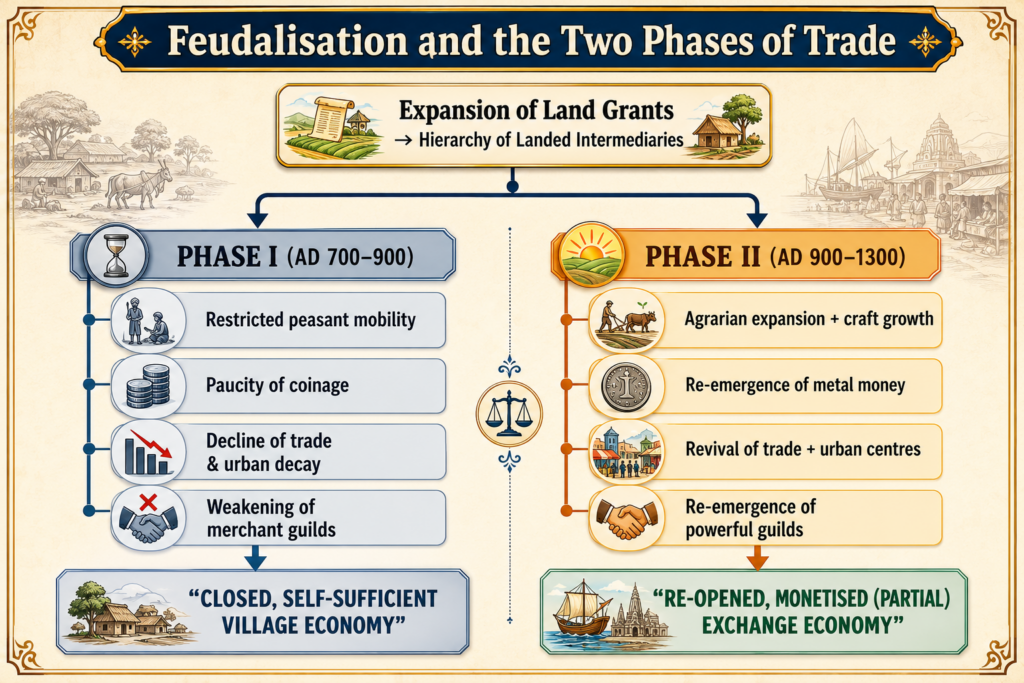
- The overall picture of trade and commerce in early medieval India across the six centuries under discussion (AD 700–1300) is one of feudalisation. Several indicators point to this process:
- The manner in which money transactions took place.
- The manipulation of landed interests, including those of state officials and ruling chiefs.
- The functioning of the ruling elite in the interests of big traders and merchants.
- The imposition of restrictions on artisans and craftsmen.
- The historical trajectory of trade in this period is best understood by dividing it into two broad phases:
- AD 700–900 — marked by the relative decline of trade, metallic currency, and urban centres, alongside a somewhat closed village economy.
- AD 900–1300 — trade regained momentum both within and outside the country, and the number of metal coins in circulation increased — though the monetary economy still did not penetrate as deeply as it had during the five centuries following the Mauryan period.
- This article examines trade and commerce in early medieval India through this two-phase framework — covering the media of exchange, the causes of decline and revival, crafts and industry, trade routes and maritime commerce, and the changing role of merchant communities and guilds.
Phase I — Relative Decline of Trade (c. AD 700–900)
- The period from AD 750–1000 witnessed the widespread practice of granting land not only to priests and temples but also to warrior chiefs and state officials, resulting in the emergence of a hierarchy of landlords — even graded state officials such as the maha-mandaleshvara, mandalika, samanta, mahasamanta, and thakkura developed vested interests in land.
- These intermediaries lived off the surplus extracted from peasants, who were consequently left with little to trade.
- This produced a rural economy in which local needs were met locally, reinforced by numerous restrictions on the mobility of actual producers — a trend further strengthened by the relative scarcity of metal coins as a medium of exchange.
Media of Exchange: The Coinage Debate
- The paucity of actual coins and the near-absence of coin-moulds in archaeological finds point to a genuine shrinkage of trade during this period.
- Though first suggested by D.D. Kosambi, it was R.S. Sharma’s 1965 work that brought sustained focus to the paucity of coinage in post-Gupta India, its link to trade and commerce, and the consequent emergence of a feudal social formation. This thesis has since been keenly debated, producing several distinct regional responses:
- A case study of Orissa substantiates a complete absence of coins between c. AD 600 and 1200, but argues for continued trade with Southeast Asia and emphasises the role of barter in this foreign trade.
- Kashmir, by contrast, shows the emergence of copper coinage from around the eighth century AD — though its extremely poor quality has been explained in terms of a decline of trade-based economy and a corresponding rise of agricultural pursuits in the valley.
- A third view questions the very idea of coin paucity and trade decline, drawing on evidence from mid-eastern India (Bihar, West Bengal, and present-day Bangladesh) during AD 750–1200.
- While it is conceded that the Palas and Senas did not strike coined money themselves, this view argues there was no genuine dearth of media of exchange — pointing to a long series of Harikela silver coinage (Harikela being an ancient Bengal kingdom), as well as cowries and, more importantly, churni (gold/silver dust used as currency), all functioning as media of exchange.
- Even in these regions, however, three qualifications apply: sources are silent on indigenous participation in maritime trade; even the limited trading activity that did exist was confined to the ruling elite; and the miserable condition of the common man is reflected in the very meaning of the word vangali (“resident of Bengal”), which came to denote someone “very poor and miserable.”
- Thus, while some regional exceptions exist, the all-India picture still broadly fits R.S. Sharma’s general hypothesis.
- A similar pattern held in Southeast Asia: a detailed study of Cambodia shows that during the two post-Gupta centuries (AD 600–800), the region failed to evolve any system of coinage, and barter — based largely on paddy and, marginally, cloth — sustained the essentials of the Khmer economy.
- Even where a few early medieval coin types did emerge — the Indo-Sassanian, Shri Vigraha, Shri Adivaraha, Bull-and-Horseman, and Gadhaiya types, mainly in Western and North-western India and parts of the Ganga valley — they made little real dent in the overall economy, given ongoing doubts about their period of emergence, their extremely poor quality, and their weak purchasing power.
- Set against the backdrop of a rising population and expanding area of settlement, the overall volume of money in circulation remained negligible — the case for a relative decline of metallic money during this first phase thus rests on convincing empirical evidence, with clear implications for India’s trading activity as a whole.
- Though first suggested by D.D. Kosambi, it was R.S. Sharma’s 1965 work that brought sustained focus to the paucity of coinage in post-Gupta India, its link to trade and commerce, and the consequent emergence of a feudal social formation. This thesis has since been keenly debated, producing several distinct regional responses:
Relative Decline of Trade
- Internally, the fragmentation of political authority and the dispersal of power to local chiefs and religious grantees appear to have had an adverse effect, at least in the initial centuries of the land-grant economy.
- The enthusiasm of traders and merchants declined for identifiable reasons: many intermediary landlords, particularly in less productive areas, resorted to loot, plunder, or excessive taxation on goods passing through their territories, compounded by frequent warfare among rival ruling chiefs.
- Two eighth-century Jain texts — the Samaraicchakaha of Haribhadra Suri and the Kuvalayamala of Uddyotana Suri — do refer to brisk trade and busy towns, but scholars rightly caution that these texts draw heavily on material from earlier centuries, and therefore may not accurately reflect the true economic condition of the eighth century itself.
Why Foreign Trade Declined
- India lost an important western market that had earlier brought in considerable gold during the early centuries of the Christian era, owing to two developments:
- The fall of the Roman Empire in the 4th century.
- The people of Byzantium (Eastern Rome) learning the art of silk-making by the mid-6th century, reducing dependence on Indian/Chinese silk.
- The expansion of the Arabs along India’s north-western frontier in the 7th and 8th centuries further disrupted trade:
- A story from the Kathasaritsagara recounts merchants travelling from Ujjain to Peshawar being captured and sold by an Arab raider.
- Arabs raided Broach and Thana in the 7th century and destroyed Valabhi — an important port on the Saurashtra coast — in the 8th century, dislocating and disrupting sea trade along India’s western coast.
- Though the Arabs would later become important contributors to the growth of Indian maritime trade after the tenth century, their initial raids had a clearly adverse effect on Indian commercial activity.
- Ongoing conflict between the Tibetans and Chinese during these centuries also disrupted the flow of goods along Central Asian trade routes.
- Some contemporary literature does refer to India’s contacts with Southeast Asia during this period, but it remains doubtful whether these could offset the losses suffered from the decline of western trade.
Urban Settlements in Decay
- This first phase was also marked by the decay and desertion of many towns — a significant symptom of commercial decline, since towns were primarily settlements of people engaged in crafts and commerce.
- As trade declined and demand for craft goods slumped, traders and craftsmen dispersed to rural areas in search of alternative livelihoods, causing towns to decay and townsfolk to be absorbed back into the village economy.
- Alongside the account of Hiuen Tsang, the Pauranic records — in their references to the Kali age — likewise indicate the depopulation of important cities, continuing a trend already noted by Varahamihira in the 5th century.
- The decay of major towns such as Vaishali, Pataliputra, and Varanasi is confirmed by archaeological excavations, which reveal a marked poverty of structure and antiquities.
- Across the subcontinent, the period between the 3rd and 8th centuries was broadly marked by the desertion or decay of urban centres — even settlements that survived up to the eighth century, such as Ropar (Punjab), Atranjikhera and Bhita (Uttar Pradesh), and Eran (Madhya Pradesh), were subsequently abandoned. Even the medieval greatness of Kanauj has yet to be conclusively confirmed by excavation.
- Despite this overall decline, commercial activity did not vanish entirely:
- Trade in costly and luxury goods — meant for kings, feudal chiefs, and heads of temples and monasteries — continued, with articles such as precious and semi-precious stones, ivory, and horses forming an important part of this long-distance trade.
- Evidence for transactions in everyday goods, however, remains meagre — the only significant items mentioned in inscriptions are salt and oil, neither of which could be produced by every village and thus had to be brought in from outside; had the economy been anything other than largely self-sufficient, references to trade in grains, sugar, textiles, and handicrafts would surely have been more numerous.
- In short, commercial activity during AD 750–1000 catered more to landed intermediaries and feudal lords than to the masses. A few pockets of trade — such as Pehoa (near Karnal, Haryana) and Ahar (near Bulandshahr, Uttar Pradesh) — did attract merchants from far and wide, but these could not make any significant dent in the closed economy of the country as a whole.
Phase II — Revival of Trade and Commerce (c. AD 900–1300)
- This phase marks a clear revival of trade and commerce, coinciding with agrarian expansion, the increased use of money, and the re-emergence of a market economy in which goods were increasingly produced for exchange rather than local consumption.
- These centuries also witnessed substantial growth of urban settlements across the subcontinent — though this development is difficult to quantify precisely and shows noticeable regional variation.
- Between the 9th and 13th centuries, greater production of both cereals and pulses, as well as commercial crops, created favourable conditions for widening the scope of both internal and external trade.
Crafts and Industry
- The growth in agricultural production was matched by increased craft production, which in turn stimulated both regional and inter-regional exchange.
- The textile industry, well established since ancient times, developed into a major economic activity — both coarse and fine cotton goods were now being produced at scale.
- Marco Polo (AD 1293) and Arab writers alike praised the excellent quality of cotton fabrics from Bengal and Gujarat, aided by the local availability of madder (Bengal) and indigo (Gujarat).
- The twelfth-century text Manasollasa identifies Paithan (Maharashtra), Nagapattinam, Kalinga, and Multan as important textile centres, while the silk weavers of Karnataka and Tamil Nadu formed a particularly important and influential section of society.
- The oil industry gained considerable importance during this period — from the tenth century onward, references to oilseed cultivation and ghanaka (oil mills) multiply.
- An inscription from Karnataka describes different types of oil mills, operated by both men and bullocks, and records the growing affluence of oilmen (tellikas), some of whom funded the construction of temples and other public works.
- References to sugarcane cultivation and cane crushers in this period likewise indicate large-scale production of jaggery and other forms of sugar.
- Metalwork and leatherwork reached a high level of craftsmanship, with literary sources referring to artisans working in copper, brass, iron, gold, and silver:
- Iron: the large iron beams at the Puri and Konarak temples in Orissa attest to the skill of twelfth-century Indian iron-smiths; iron was also used to manufacture high-quality swords, spearheads, and other weapons, with Magadha, Benaras, Kalinga, and Saurashtra renowned for sword-making.
- Embroidery: Gujarat was noted for its gold and silver embroidery.
- Brass: the twelfth-century Ginza records of Jewish merchants show that Indian brasswork was so highly regarded that customers in Aden sent broken vessels and utensils to India specifically to be refashioned; surviving Chola bronzes and metalwork from Nalanda, Nepal, and Kashmir further attest to the excellence of Indian metalworkers.
- Leather: Gujarat held an enviable position in leatherwork — Marco Polo notes that artisans there produced beautiful red-and-blue leather mats, skilfully embroidered with figures of birds and animals, which were in great demand across the Arab world.
Coins and Other Media of Exchange
- This phase saw a genuine re-emergence of metal money:
- Literary references — texts such as the Prabandhachintamani, Lilavati, Dravyapariksha, and Lekhapaddhati — mention a wide range of coins and their multiples, including bhagaka, rupaka, vimshatika, karshapana, dinar, dramma, nishka, gadhaiyamudra, gadyanaka, and tanka.
- Inscriptional evidence is similarly abundant: the Siyadoni inscription alone refers to multiple varieties of drammas in the mid-tenth century, while the Paramara, Chalukya, Chahmana, Pratihara, Pala, Candella, and Cola inscriptions corroborate most of these terms.
- As for actual coin specimens: gold-coin minting was revived by the Kalachuri king Gangeyadeva of Tripuri (AD 1019–1040) after a gap of more than four centuries, and was followed by rulers such as Govindachandra (Gahadavala, near Varanasi), the Chandella kings Kirttivarman and Madanavarman, King Harsha of Kashmir, and some Chola kings in Tamil Nadu. About nine mints are estimated to have functioned in different parts of Karnataka during the twelfth and thirteenth centuries, alongside an important mint at Shrimol (near Jodhpur, Rajasthan).
The Limited Penetration of Metal Money
- Despite this apparent revival, the actual role of metal money appears to have remained limited: regional studies suggest that money did not penetrate deeply into the economy, and the overall volume of coins in circulation remained modest relative to the many literary and epigraphic references to them.
- All coins of the period were highly debased and reduced in weight, giving them poor purchasing power regardless of metal type — and set against the era’s rising population and expanding settlement, the actual use of money remained highly restricted.
- A case study of early medieval Rajasthan shows that the revival of trade, the multiplication of exchange centres, and the prosperity of merchant families were achieved only through “partial monetisation.” A similar pattern of limited monetisation held on the Konkan coast under the Shilaharas, and even the South Indian currency system (AD 950–1300) suggests that transactions were not equally monetised across all levels of society — for instance, the Pandyas’ heavy expenditure on imported horses is difficult to reconcile with what is otherwise known as a very “poor” Pandyan currency.
- Barter consequently remained an important means of exchange, in local, inter-regional, and even international commerce — merchant caravans are recorded exchanging commodities directly with those of other regions, and imported horses are said to have sometimes been paid for not in cash but in Indian goods such as silk, spices, or ivory, all of which enjoyed constant global demand.
- Alongside barter, this period saw the parallel development of credit instruments, allowing debts and credits to be transferred without the physical handling of cash.
- Contemporary texts refer to a device called the hundika, or bill of exchange, through which one merchant could extend credit to another — helping merchants overcome the obstacle posed by a shortage of coined money.
- The Lekhapaddhati, a text illuminating twelfth–thirteenth century Gujarat, describes various means of raising loans — for both consumption and commercial ventures — through the mortgage of land, house, and cattle.
Aspects of Trade
- The rise in agricultural production, combined with the momentum of industrial and craft production, gave rise to a hierarchy of exchange centres, with inter-regional and intra-regional networks gradually cracking open the relatively closed village economy of the first phase.
Inland Trade
- Commodities: numerous inscriptions record merchants carrying foodgrains, oil, butter, salt, coconuts, arecanuts, betel leaves, madder, indigo, candied sugar, jaggery, thread, cotton fabrics, blankets, metals, and spices from place to place, paying taxes and tolls along the way; rice, wheat, barley, pulses, linseed fibre, cotton cloth, palm sugar, indigo, and coir for ropes also figured among traded items.
- Consumers: the principal customers for Indian goods were the wealthy inhabitants of China, Arabia, and Egypt, with some goods reaching Europe via the Mediterranean. Domestically, key consumers included the new landowning class, ruling chiefs, the rising mercantile class, and Brahmanical and non-Brahmanical religious establishments, whose growing need for food offerings (prasada) also drove demand.
- Trade Routes: a vast network of roads connected ports, markets, and towns, forming the physical backbone of trade and commerce.
- The overland connections between regions are illustrated by the itinerary of the Chinese pilgrim Hiuen Tsang, who travelled across the Hindu Kush in the seventh century, visiting towns and capitals from Kashmir in the north to Kanchi in the south, and from Assam in the east to Sindh in the west; the eleventh-century Kashmiri poet Bilhana similarly records travelling widely across India.
- Albiruni (AD 1030) documented fifteen major routes originating from cities such as Kannauj, Mathura, and Bayana:
- The route from Kannauj passed through Prayaga eastward to the port of Tamralipti (Tamluk, West Bengal), then along the eastern coast to Kanchi; a north-eastern branch led to Assam, Nepal, and Tibet, connecting onward to China, while Kannauj and Mathura also linked north-west to Balkh, joining Peshawar, Kabul, and ultimately the Grand Silk Route to Europe.
- This north-western route, the chief channel of commercial contact with Central Asia in pre-Gupta times, came under the control of Arab and Turkish traders in the early medieval period, who used it primarily to bring horses from Persia and Balkh.
- The route from Bayana in Rajasthan crossed the Marwar desert to reach the port of Karachi in Sindh, with a branch via Abu (western foothills of the Aravallis) connecting Gujarat’s ports and towns to Bayana, Mathura, and other northern centres.
- The route from Mathura and Prayaga, via Ujjain, proceeded to the western port of Broach — these interior routes played an important role in opening India’s hinterland to international sea trade, which gained fresh momentum after the tenth century.
- The route from Kannauj passed through Prayaga eastward to the port of Tamralipti (Tamluk, West Bengal), then along the eastern coast to Kanchi; a north-eastern branch led to Assam, Nepal, and Tibet, connecting onward to China, while Kannauj and Mathura also linked north-west to Balkh, joining Peshawar, Kabul, and ultimately the Grand Silk Route to Europe.
- Rivers in the northern plains, along with the eastern and western coastal sea routes in South India, likewise served as important channels of inter-regional contact.
- Means of Communication:bullock-carts were the chief means of overland conveyance on the plains, while human carriers transported goods where animals could not travel; contemporary literature also refers to various river boats and larger seagoing ships.
- A significant post-tenth-century development was the keen interest shown by rulers in keeping highways safe — punishing thieves and robbers, and providing both military and monetary support to villagers protecting traders and travellers.
- The Chalukyas of Gujarat maintained a dedicated department, the Jiala-patha-karana, to oversee highways, building new roads linking major ports and markets and excavating tanks and wells for travellers’ benefit.
- Since trade was a major source of state revenue, political authorities took a direct interest in the safety of merchants — Marco Polo’s description of Cambay as free from pirates reflects royal efforts to guard ports against piracy, a major threat along the sea route from South China to the Persian Gulf.
- A significant post-tenth-century development was the keen interest shown by rulers in keeping highways safe — punishing thieves and robbers, and providing both military and monetary support to villagers protecting traders and travellers.
Maritime Trade
- Large-scale trading activity during this phase was increasingly carried out by sea, with the period marked by a great expansion of maritime trade between the two poles of Asian commerce — the Persian Gulf and South China — with India, positioned midway, benefiting substantially; the hazards of long sea voyages encouraged coastal anchoring along Indian shores.
Chief Participants
- Asian maritime trade during these centuries was largely dominated by the Arabs, who, after destroying the port of Valabhi on the Saurashtra coast in the eighth century, established themselves as the chief maritime power in the Arabian Sea.
- China emerged as an important participant from the twelfth century, though this did not displace continued Arab dominance of Asian trade.
- Despite strong Arab competition, evidence suggests Indians too participated actively in maritime trade from the tenth century onward:
- Abu Zaid, a tenth-century Arab author, records Indian merchants visiting Siraf in the Persian Gulf.
- Ibn Battuta (14th century) describes a colony of Indian merchants at Aden in the Red Sea.
- A fourteenth-century Gujarati text refers to the merchant Jagadu of Kutch, who traded with Persia through Indian agents stationed at Hormuz.
- In South India, the Cholas took a keen interest in maritime trade — Tamil inscriptions found in Malaya and Sumatra attest to the commercial activity of the Tamil mercantile community there; the Cholas also sent multiple embassies to China to strengthen economic relations, and even launched a naval expedition against Srivijaya in the eleventh century to secure the sea route to China.
- Overall, however, direct references to the physical participation of Indian merchants remain limited — though this did not diminish global demand for Indian products, which reached distant markets largely through Arab and Chinese intermediaries.
Commodities Exchanged
- Imports from the East: Chinese texts show the Malabar coast receiving silk, porcelain-ware, camphor, cloves, wax, sandalwood, and cardamom from China and Southeast Asia — much of the silk, always in high domestic demand, was actually re-exported onward to the Arab world. Marco Polo notes that ships from the east brought gold, silver, and copper to Cambay, while tin arrived from Southeast Asia.
- Exports to the East: India exported aromatics and spices, especially pepper — Marco Polo records pepper consumption alone at 10,000 pounds daily in the city of Kirisay (Hangzhou). Cotton cloth was exported to China (noted by the Chinese port official Chau Ju-Kua), and Ibn Battuta (AD 1333) observed that fine cotton fabrics were rarer and pricier than silk in Chinese cities. India also exported ivory, rhinoceros horns, and various precious and semi-precious stones to China.
- Trade with the Arab West: Arabic inscriptions found at Cambay, Samaratha, and Junagadh confirm that merchants and shippers from the Persian Gulf visited western India during the twelfth and thirteenth centuries, while the Lekhapaddhati records ships arriving on the Gujarat coast from Hormuz.
- Exports to the West: Jewish merchants carried goods from India’s west coast to Egyptian markets — including spices, aromatics, dyes, medicinal herbs, bronze and brass vessels, textiles, pearls, beads, and coconuts. India also exported teakwood (vital for shipbuilding in the largely treeless Persian Gulf and South Arabia), surplus rice, and — per Marco Polo — the fine embroidered leather mats of Gujarat, which fetched high prices in the Arab world; iron and steel products, especially swords and spears, also found a wide western market.
- Imports from the West: the single most significant import was the horse, driven by ever-growing demand from the expanding class of feudal lords and chiefs — horses arrived by both land and sea.
- Ibn Battuta notes the large profits earned by horse-dealers using the north-western land routes, while the Arab author Wassaf (AD 1328) records that more than 10,000 horses were brought annually to the Coromandel coast, Cambay, and other Indian ports in the thirteenth century, sourced from Bahrain, Muscat, Aden, and Persia. India also imported dates, ivory, coral, and emeralds from the West.
Ports
- Western coast:
- Debal, at the mouth of the Indus, received vessels from Arabia, China, and other Indian ports.
- On the Gujarat coast: Somanatha (linked to China in the east and Zanzibar in the west), Broach (ancient Bhrigukachha, with a very long history), and Cambay (Khambayat/Stambhatirtha, first referenced in the ninth century); Sopara and Thana were other notable ports.
- On the Malabar coast, Quilon emerged as the most important port, praised by both Arab and Chinese sources.
- Eastern coast: between the tenth and thirteenth centuries, the Coromandel coast developed into a virtual clearing house for ships arriving from both east and west — Wassaf notably attributes much of the wealth of the Persian Gulf isles and even distant European lands to this coast, with Nagapattinam as the region’s most important port.
- On the Orissa coast, Puri and Kalingapattam were significant ports; in Bengal, Tamralipti’s fortunes were reviving, though some scholars believe it was gradually being superseded by the port of Saptagrama.
Safety and Security of Merchants
- Given the substantial returns from foreign trade, contemporary rulers took a keen interest in protecting merchants:
- The Chalukyas of Gujarat (10th–13th centuries) established a dedicated department of harbours (Velakulakarana) under royal control, and extended religious and economic freedoms to Muslim merchants in their territory.
- The Chola kings managed their ports through royal officials working alongside local merchant organisations, who looked after foreign merchants and collected port cesses.
- Arab writers unanimously praised the Rashtrakuta kings for their policy of peace and toleration toward Arab traders, and Ibn Battuta notes that when a foreign merchant died, his property was kept in safe custody rather than confiscated, pending transfer to his rightful heirs.
- An AD 1244 inscription found at Motupalli (Guntur district, Andhra Pradesh) records a royal guarantee of protection for storm-strayed ships, along with a promise to collect duty strictly as per the law of the land — a clear effort to win the confidence of foreign merchants.
Revival of Towns
- The second phase (c. AD 900–1300) marked a sharp departure from the preceding two centuries, distinguished by a genuine revival of urban centres across nearly the entire subcontinent — a development frequently described as the “third urbanisation” of India.
Trading Communities and Organisations
- Traders formed the crucial link between producers and consumers — collecting agricultural surplus and artisanal products from different regions and distributing them across wide areas.
- The social standing of merchants tracked the two broad phases of commercial activity: adversely affected during the first phase (AD 700–900) owing to limited exchange, and considerably strengthened during the second phase (AD 900–1300) as trade revived.
- Ancient Indian texts specify trade — alongside agriculture and cattle-rearing — as a lawful occupation for Vaishyas; in the seventh century, Hiuen Tsang distinctly identifies Vaishyas as traders and Shudras as cultivators.
- By this period, however, Vaishyas and Shudras were already converging occupationally, with Shudras undertaking trade in commodities such as wine, honey, salt, and malt — the traditional Brahmanical varna barriers were crumbling in the post-Gupta centuries, and trade came to be pursued by people of all varnas and castes.
Position of Merchants across the Two Phases
- First phase (c. AD 700–900): the decline of trade considerably eroded the merchants’ social role.
- As trade slumped and markets vanished, merchants were forced to seek patronage and shelter with temples and emerging landed magnates — a dependence that stripped them of independent commercial activity and tied their fortunes to their patrons’ needs.
- Inscriptions from Orissa and Central India confirm that traders, artisans, and merchants were among those actually transferred to donees along with land grants.
- There is no evidence of merchants holding any significant administrative role between the eighth and tenth centuries — a sharp contrast to their documented administrative presence, evident from seals and sealings, during the Gupta period in Uttar Pradesh and Bihar.
- A small number of merchants remained active, particularly along the coast, but their activity was largely confined to luxury goods for kings, chiefs, and temples; in South India too, trade held only modest importance, reflected in the relative absence of merchants as a distinct class in contemporary records. This first phase, in short, was marked by the thinning away of the prosperous, independent merchant class.
- As trade slumped and markets vanished, merchants were forced to seek patronage and shelter with temples and emerging landed magnates — a dependence that stripped them of independent commercial activity and tied their fortunes to their patrons’ needs.
- Second phase (c. AD 900–1300): the mercantile community returned decisively to prominence, with large numbers of merchants once again carrying luxury and essential goods across regions.
- Many merchants took an active part in administration, even rising to ministerial positions at royal courts, and gained further social standing through gifts to temples and priests.
- Literature and inscriptions of the period refer to numerous merchants known by their specialised trades, and moneylending emerged as a major mercantile activity.
- In western India, the Nikshepa-vanika emerged as a distinct group specialising in banking and moneylending; the Lekhapaddhati records an instance of a merchant’s son claiming his ancestral share specifically to start a moneylending business, while Medhatithi, the earliest commentator on the Manusmriti, speaks of a formal association or corporation of moneylenders.
- Contemporary literature, however, is often unflattering toward moneylenders, portraying them as greedy and untrustworthy, prone to misappropriating deposits.
- Many new regional merchant groups emerged, predominantly from western India — a region well served by an extensive network of land routes connecting coastal ports to the towns and markets of the north.
- Groups such as the Oswals (from Osia), Palivalas (from Patli), Shrimalis (from Shrimala), and Modhas (from Modhera) are among the best documented; most are today collectively known as Marwaris (“merchants of Marwar”).
- Beyond such functional and regional names, the terms shreshthi and sarthavaha were widely used: the shreshthi was a wealthy, town-based wholesale dealer who also functioned as a banker, lending goods or money to smaller merchants, while the sarthavaha was the caravan leader guiding merchants to distant markets — expected to be highly capable, knowledgeable in local routes, languages, and the rules of exchange in different regions.
- In South India, the expansion of agriculture and the availability of surplus from the 8th/9th century onward likewise stimulated commercial exchange.
- South Indian merchants, like their northern counterparts, specialised in specific commodities such as textiles, oil/ghee, betel leaves, and horses, with local exchange centred on the nagaram markets.
- The number of nagarams grew considerably during the Chola period (11th–12th centuries), and the term nagarattar (member of the nagaram assembly) became a generic term for all Tamil merchants.
Social Role of Traders
- As trade brought merchants growing economic prosperity, they increasingly sought social prestige by patronising temples, priests, and religious functions — numerous inscriptions record grants of cash or goods by merchants for exactly this purpose.
- Some merchants became highly influential, joining the ranks of state officials and ministers — a tenth-century inscription records a merchant of the Modha caste serving as chief of Sanjan (near Thane) in Maharashtra.
- In Gujarat, the merchant family of Vimala played a prominent role in political and cultural life; his descendants Vastupala and Tejapala held important ministerial posts and are renowned for building the famous marble Jain temples at Mount Abu.
- A thirteenth-century inscription from central Gujarat confirms that important merchants, traders, and artisans were regularly part of local administrative bodies.
Character and Conduct of Traders
- Foreign travellers such as Al-Idrisi (12th century) and Marco Polo (13th century) praised Indian traders for their truthfulness and honesty in business.
- Indian literature, however, offers a more mixed picture, with several examples of greedy and dishonest merchants — the Kashmiri author Kshemendra, for instance, describes a selfish merchant who welcomed news of famine, since it promised good profit on his hoarded foodgrains.
- An eleventh-century western Indian text divides merchants into two classes based on standing and conduct — high and low: large-scale sea or land traders enjoyed great reputation, while small merchants such as hawkers and retailers, accused of cheating with false weights and measures, were looked down upon; artisans, too, were sometimes included in this “dishonest” category.
- It is worth noting that such judgments partly reflect the contemporary feudal tendency to regard those working with their own hands and resources as socially inferior.
Organisation of Traders: Guilds
- Merchants derived their power and prestige not only from wealth but from the guilds or associations they formed to protect their collective interests.
- In the first phase, declining trade weakened this corporate activity, reducing many guilds to little more than regional or occupational subcastes; as trade revived in the second phase, however, merchant guilds re-emerged as a central feature of economic life.
Guilds: Definition and Functions
- Definition: guilds were voluntary associations of merchants dealing in a common commodity — grains, textiles, betel leaves, horses, perfumes, and so on — formed by both local (more permanent) and itinerant (journey-specific) merchants.
- Functions: guilds framed their own rules on membership and conduct, fixed the prices of their goods, and could collectively decide to withhold a commodity from sale on a given day, or refuse to trade in a region if local authorities proved hostile or uncooperative.
- Guild merchants also acted as custodians of religious interests, with inscriptions recording instances where members collectively agreed to an additional tax on sales specifically to fund temple maintenance or functions.
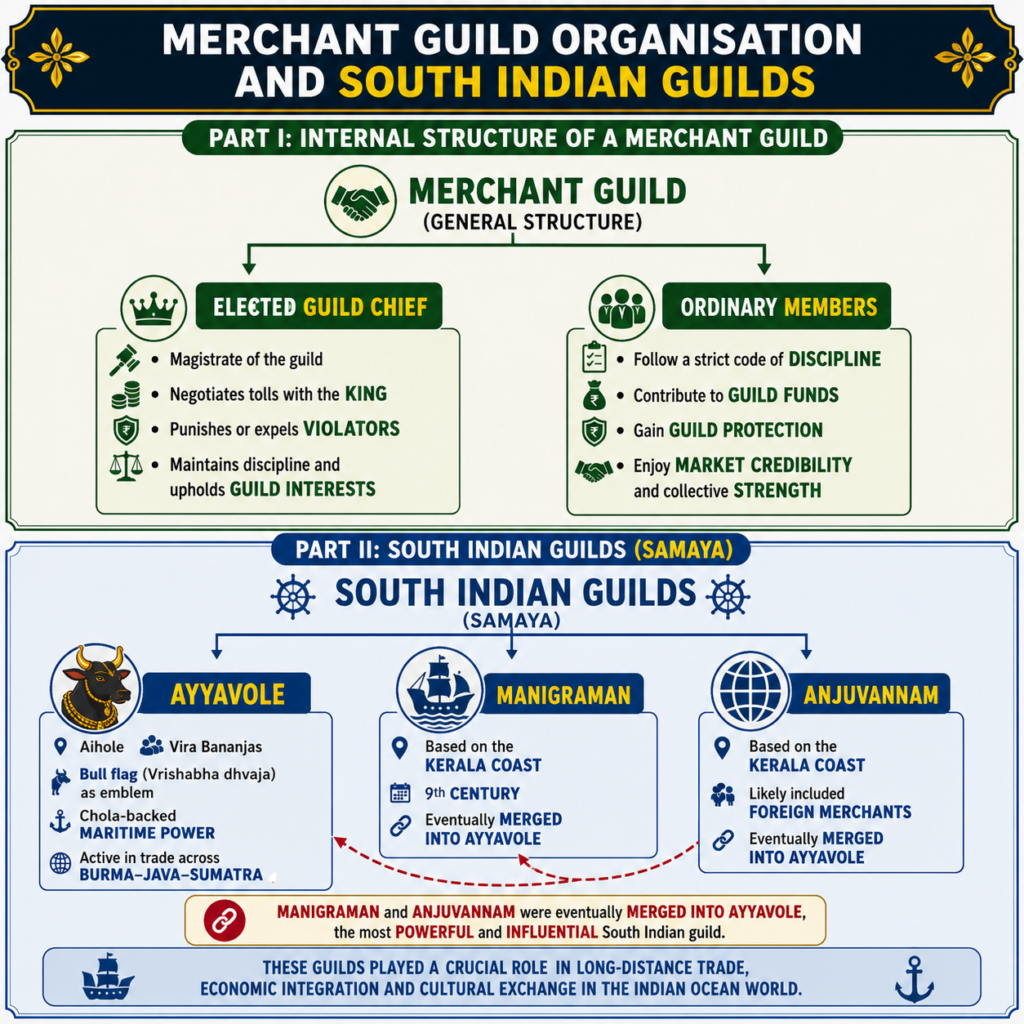
- Each guild operated under an elected chief, who functioned as a kind of magistrate over the guild’s economic affairs — empowered to punish, censure, or expel members who violated guild rules, and responsible for negotiating directly with the king over market tolls and taxes on behalf of fellow merchants.
- This growth in corporate authority allowed guild chiefs to consolidate power and status, with many serving as members’ representatives on local administrative councils.
- Individual members operated under a strict code of discipline, sacrificing some personal initiative in exchange for tangible benefits: full guild backing in economic activity (shielding them from harassment by local officials) and greater market credibility than an independent hawker or vendor.
- Thus, despite the sometimes rude and authoritative conduct of guild chiefs, merchants generally found guilds an important source of physical and economic protection.
- Contemporary digests and commentaries refer to the corporate body of merchants using several terms — naigama, shreni, samuha, sartha, and samgha:
- The naigama denoted an association of caravan merchants of different castes travelling together for trade with other countries.
- The shreni, per Medhatithi, referred to a group following the same profession — traders, moneylenders, or artisans — though some authors restricted the term to artisan groups alone.
- The Lekhapaddhati notes that western Indian kings set up a dedicated Shreni-karana department to oversee the activities of merchant and artisan guilds, while the Manasollasa records that many merchant guilds maintained their own private troops (shrenibala) for personal safety.
- Inscriptions also refer to the corporate activity of merchants directly — for instance, an inscription from western India mentions the vanika-mandala, likely a guild of local merchants.
Organisation of Trading Guilds in South India
- The expansion of agriculture and trade from the tenth century led to the emergence of numerous merchant guilds in South India as well, often referred to in inscriptions as samaya — organisations formed by mutual agreement or contract among members to follow a shared set of rules.
- The two most important South Indian merchant guilds were the Ayyavole and the Manigraman, operating chiefly across present-day Maharashtra, Karnataka, Tamil Nadu, and southern Andhra Pradesh. From the tenth century onward, the Chola kings made a concerted effort to promote trade — through trade missions, maritime expeditions, and the abolition of tolls — turning these guilds into important channels for exporting Indian culture abroad.
- The Ayyavole guild:
- Also known as the guild of the “500 Swami of Aihole” or nanadeshi, and as the Vira Bananjas (“valiant merchants”) — a name reflecting their self-styled role as protectors of the Vira Balanja Dharma, the code of the heroic or noble merchant, symbolised by a bull emblem on their flag.
- Originating from Aihole, the guild provided trade links between merchant communities in Tamil Nadu, Karnataka, and Andhra Pradesh, and eventually operated across Southern India and Southeast Asia, growing especially powerful under Chola patronage.
- As the Ayyavole-500 evolved into a large, overarching guild of South India, most existing local and indigenous trade guilds — including the Manigraman and various nanadesi guilds — became affiliated with it.
- Backed by Chola naval expeditions to Southeast Asia, the Ayyavole guild emerged as a genuine maritime power, continuing to flourish in the Srivijaya kingdom (Sumatra) — documented in an AD 1088 inscription found at Barus, West Sumatra — with South Indian merchants also active in Burma and the Thai peninsula.
- A detailed study of the Kannada Ayyavole shows that it functioned as a set of small, workable district-level federations. Originally an itinerant group, the “Five Hundred” grew into a broad community as trade expanded between the 9th and 15th centuries, eventually spreading from Bhalvani (Sangli district, Maharashtra) in the north to Kayalpattinam (Tamil Nadu) in the south — its membership eventually drawn from diverse regions, religions, and castes, giving rise to the term nanadeshi for the wider organisation.
- In the course of this expansion, Ayyavole members interacted closely with local nagaram markets, collecting agricultural produce from the hinterland and distributing goods brought from elsewhere; its commercial influence is attested by inscriptions found as far afield as Burma, Java, Sumatra, and Sri Lanka. Some of its wealthier, more powerful members even assumed the title samaya chakravarti (“emperor of the trading organisation”) — suggesting, as in the north, an emerging trend of individual merchants seeking greater control over guild affairs.
- The Manigraman guild: first appears along the Kerala coast in the ninth century AD, and as it drew closer to the Ayyavole, its inter-regional activity expanded to cover much of the peninsula; a ninth-century Tamil inscription found at Takua Pa on the west coast of Malaya confirms its early engagement in long-distance sea trade.
- Anjuvannam: another South Indian merchant body, likely representing an association of foreign merchants (rather than a grouping of “five communities,” as some scholars have suggested). Like the Manigraman, it began operations along the Kerala coast in the eighth or ninth century, gradually spreading to other coastal areas by the eleventh century, and interacted closely with both local merchants and the Ayyavole–Manigraman network.
- The prestige of these guilds is reflected in their deliberate construction of exalted genealogies — the Vira Bananjas of the Ayyavole, for example, claimed descent from the line of Vasudeva, with their qualities likened to those of epic heroes; the Kolhapur stone inscription even contains a formal prashasti (panegyric) dedicated to the Vira Bananja.
- In sum, the vast trading network of South India was governed by several merchant organisations working in close cooperation and harmony, whose chiefs — through their control over trade — forged close links with royal houses and enjoyed considerable social prestige.
Relationship between Merchants and Craftsmen
- The precise nature of the relationship between merchants and craftsmen is not directly recorded in contemporary sources, leaving it unclear whether artisans such as weavers and metalworkers operated independently or under merchant direction (in terms of capital, raw material, or both).
- Some evidence, however, suggests growing merchant control: as merchants increasingly dominated the mobilisation of raw material and finished goods, their influence over artisan activity correspondingly increased.
- Albiruni and the twelfth-century jurist Lakshmidhara both note that artisans lived in the midst of merchants, suggesting that merchants supplied capital and raw material, with artisans producing goods to merchant specifications.
- An eleventh-century inscription from Erode, Tamil Nadu, records merchants granting asylum to craftsmen, further indicating artisan dependence on merchant organisations.
- As trade expanded, merchants tended to monopolise the commercial network of sale and purchase, restricting artisans’ ability to market their own goods directly — though there are some documented exceptions, such as oilmen and weavers who sold their own produce and grew wealthy enough to endow temples and priests.
- In general, however, artisans and craftsmen in early medieval India remained economically dependent on the larger merchant class.
Conclusion
- The story of trade and commerce in early medieval India is fundamentally a story of two contrasting phases — a first phase (AD 700–900) of relative decline, driven by land-grant-based feudalisation, coin scarcity, and the disruption of both overland and maritime trade routes; and a second phase (AD 900–1300) of genuine revival, marked by expanding craft production, the partial re-monetisation of the economy, flourishing inland and maritime trade networks, and the resurgence of powerful merchant guilds such as the Ayyavole and Manigraman.
- Even at its height, however, this revival remained only partially monetised, with barter and credit instruments continuing to play a vital role — a reminder that the transformation of India’s early medieval economy, while substantial, remained closely bound up with the underlying agrarian and feudal structures examined elsewhere in this series.




