The Pitt’s India Act, 1784 – UPSC History Optional

The East India Company Act, 1784, better known as Pitt’s India Act, was an Act of the Parliament of Great Britain intended to address the shortcomings of the Regulating Act of 1773 by bringing the East India Company’s rule in India under firmer control of the British Government. It takes its name from William Pitt the Younger, who became the youngest Prime Minister of England in 1783, at the age of just 24 — an outstanding administrator known for efficiency and reform, who brought a new generation of capable administrators into government. For UPSC History Optional aspirants, Pitt’s India Act is a pivotal milestone: it introduced the system of dual control over India — shared between the Company and the British Crown — that endured, with modifications, until 1858.
Background
- The British Government had enacted the Regulating Act of 1773 to control the Company’s activities, setting up a system that supervised the Company’s work without formally taking power away from it. Within a few years, this Act had proven a failure, prompting the British Government to consider a more active role in Company affairs.
- In 1781, both a Select Committee and a Secret Committee were appointed to investigate the Company’s affairs.
- The Select Committee examined the relations between the Supreme Court and the Council in Bengal.
- The Secret Committee examined the causes of the Maratha War. The voluminous reports both committees produced were freely used as ammunition against the Company by party orators in Parliament.
- Parliamentary interference in Company affairs was called for once again, especially after the Directors admitted that the war had beggared the Company and applied to the State for a further loan of £1 million.
- Pitt’s India Act established the system of dual control of India, shared between the Government of Great Britain and the British East India Company — an arrangement that continued until 1858.

Provisions of Pitt’s India Act (1784)
The Company’s territorial possessions were left untouched; only its public affairs and its administration in India were brought under more direct government control. With this Act, the Company’s political functions were, for the first time, clearly differentiated from its commercial activities.
The Board of Control
- In political matters, the Company — which had until then functioned as a somewhat sovereign entity — was made directly subordinate to the British Government. To achieve this, a Board of Commissioners, known as the Board of Control, was created.
- Membership: The Board consisted of six members — the Chancellor of the Exchequer, the Secretary of State, and four Privy Councillors nominated by the King. The Secretary of State served as the President of the Board of Control.
- Powers: The Board was empowered to control all matters of civil or military government or revenue, and was authorised to “superintend, direct and control all acts, operations and concerns” relating to the civil or military government or revenues of the British territorial possessions in the East Indies.
- The Board was given full access to the Company’s records, along with the power to send Governors to India and full authority to recall or alter them.
Result of the Board of Control’s Creation
- Pitt’s India Act effectively established a joint government of the Company and the British Crown in India — the fate of the Indian people would now be decided jointly (though indirectly) by the Company and the British Government.
- The Company was represented by the Court of Directors, while the Crown was represented by the Board of Control.
- A Secret Committee of three Directors was set up to transmit the Board’s orders to India, functioning as the link between the Board of Control and the Court of Directors.
- The Court of Proprietors lost its right to rescind, suspend, or revoke any resolution of the Directors that had been approved by the Board of Control.
- The Board of Control itself had no independent executive power and no patronage — its power operated in a veiled manner. It had access to all the Company’s papers, and its approval was required for all dispatches that were not purely commercial; in an emergency, it could send its own draft to the Secret Committee of Directors to be signed and issued in the Committee’s name.
- The Court of Directors, meanwhile, retained their patronage and their right to dismiss their own servants.
Changes in India
- The government of India was placed under the Governor-General and a Council of three, giving the Governor-General considerably greater power than before — the Council having been reduced from its earlier, larger size. One of the three Councillors was to be the Commander-in-Chief of the King’s army in India. The Act similarly reorganised the Councils of Madras and Bombay on the pattern of Bengal’s.
- The Governor-General was given a casting vote in case the Council members present at a meeting were equally divided in opinion.
- He remained liable to be overridden by the Council, but since the Council now had only three members, his casting vote meant he could always make his will prevail as long as he had one supporter. The Act of 1784 went no further than this — the defect was only fully addressed by the Act of 1793, which empowered the Governor-General to disregard the Council’s majority altogether, provided he did so formally and accepted personal responsibility for the decision.
- Under the 1784 Act, the Presidencies of Madras and Bombay were subordinated to the Governor-General and Council of Bengal in all matters of diplomacy, revenue, and war — effectively making Calcutta the capital of the Company’s Indian possessions. The Governor-General’s power over the presidencies was thus enlarged and more clearly defined.
- The Governor-General-in-Council was, in turn, subordinated to the Court of Directors and the Board of Control, placing it under the indirect control of the British Government. This established a clear hierarchy of command and more direct parliamentary control over Indian administration.
- Only covenanted servants were henceforth to be appointed as members of the Governor-General’s Council, since the earlier experiment of appointing outsiders had proved calamitous.
Prohibition on Wars and Treaties of Guarantee
- Among the Act’s most striking provisions was the prohibition not merely of all aggressive wars in India, but of all treaties of guarantee with Indian princes — such as those with the Nawabs of Carnatic and Oudh — on the ground that “to pursue schemes of conquest and extension of dominion in India are Measures repugnant to the wish, the honour and the policy of this nation.”
- This declaration, however, was honoured more in the breach than in observance in the years that followed. For a short period after 1784, parliamentary prohibition on imperial expansion did hold, and the Board of Control and the Company largely focused on protecting British possessions and promoting trading interests through a careful balance of power among the Indian states — thereby reducing imperial military commitments.
- This cautious policy was abandoned once Lord Wellesley arrived as Governor-General in 1798, bringing with him a dream of conquest and a taste for personal glory.
Disclosure of Property
- All civil and military officers of the East India Company were required to submit to the Court of Directors a full inventory of their property, both in India and in Britain, within two months of taking up their posts.
- Severe punishment was prescribed for corrupt officials.
The constitutional framework established by Pitt’s India Act underwent no major changes until the end of Company rule in India in 1858.
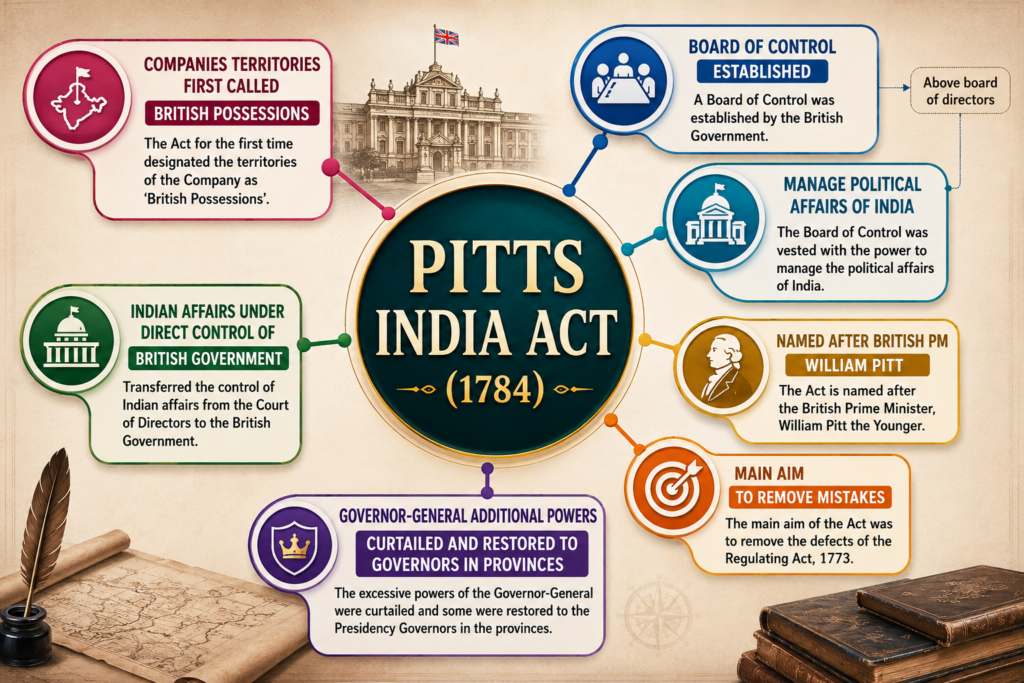
Assessment of Pitt’s India Act, 1784
Pitt’s India Act brought about important changes to the Company’s constitution:
- It created a department of state in England — the Board of Control — whose special function was to control the policy of the Court of Directors, thereby introducing the dual system of government by the Company and a parliamentary board, an arrangement that lasted until 1858.
- For instance, the head of the Board was, at first, one of the Secretaries of State without any special salary; after 1793, a dedicated President of the Board was appointed, an office ultimately responsible for the government of British India until it was succeeded, in 1858, by the Secretary of State for India.
- It placed the civil and military government of the Company in due subordination to the Government in England, and removed many of the faults of the Regulating Act of 1773.
- It ended an inappropriate division of authority in India by making the Governor-General supreme over the subordinate governments of Bombay and Madras.
- By reducing the Governor-General’s Council to three members, it removed one of the key shortcomings of the Regulating Act — the Governor-General could now more easily secure a majority for any decision, and in case of a tie, had the final say through his casting vote.
- Pitt’s India Act settled the main lines of the Company’s Home and Indian Government down to 1858, and was widely regarded as a highly skilful measure bearing all the marks of political compromise. Edmund Burke himself admitted it was “as able and skillful a performance for its own purposes as ever issued from the wit of man.”
- As Sir Courtney Ilbert observed, Pitt achieved two things simultaneously: he avoided the charge of conferring patronage on the Crown, while also avoiding the appearance of radically altering either the Company or the Government in England.
- Historian P. J. Marshall (1968) has argued that, until the passage of Pitt’s India Act in 1784, there was no conscious or consistent British policy for political conquest in India — authority at home remained divided between the Court of Directors and the tenuous regulatory power of the government, with no one seemingly interested in acquiring Indian territories until that point.
Defects of the Act
- The Act still suffered from significant defects. Foremost among these was that it gave the Governor-General two masters — the Court of Directors and the Board of Control — which paradoxically gave virtual autonomy to the man on the spot, since the Governor-General could play one master off against the other and act largely at his own discretion.
- On the other hand, a factious Council, combined with the Governor-General’s continuing inability to override its decisions outright, could often render him ineffective — particularly since his authority to deploy the army had also been curtailed.
- The Act was ultimately deemed a failure, because it soon became apparent that the boundaries between government control and the Company’s powers were nebulous and highly subjective. Responsibility was divided between the Board of Control, the Court of Directors, and the Governor-General-in-Council, but no clear boundaries could be fixed, since the matter remained inherently subjective rather than objective.
- The British Government also felt obliged to respond to humanitarian calls for better treatment of local peoples in British-occupied territories, and the Board of Control itself was accused of nepotism.
The Act of 1786
- In 1786, Pitt introduced another supplementary bill in Parliament relating to India, in order to persuade Lord Cornwallis to accept the Governor-Generalship of India.
- Cornwallis had insisted on holding the powers of both Governor-General and Commander-in-Chief simultaneously. The new Act conceded this demand, making the Governor-General also the Commander-in-Chief — as a result, Warren Hastings became the first person to hold both positions at once.
- This created an effective and authoritative instrument of control that continued, with only minor modifications, until 1858.
- The Governor-General was also given the power to override his Council in extraordinary cases, on his own responsibility.
Conclusion
Pitt’s India Act of 1784 was, in essence, a carefully balanced political compromise — one that brought the East India Company’s Indian administration under the supervisory umbrella of the British State through the Board of Control, without formally nationalising the Company or its territories. By separating the Company’s political functions from its commercial ones, strengthening the Governor-General’s authority over Bombay and Madras, and instituting the dual system of Company-and-Crown control that would govern India for the next seven decades, it corrected many of the structural flaws exposed by the Regulating Act of 1773. Yet its own ambiguities — particularly the ill-defined boundary between the Board of Control and the Court of Directors — meant that further refinement, through the Act of 1786 and later legislation, would still be necessary. For UPSC aspirants, Pitt’s India Act is best remembered as the point at which the British Parliament first asserted decisive, if still incomplete, control over the government of British India.