Emergence of Two Power Blocs: Thaw and Escalation (1953–62)

The period from 1953 to 1962 is one of the most eventful phases of the Cold War in the UPSC History Optional World History syllabus, marked first by a partial “thaw” in East-West relations following Stalin’s death, and then by a rapid escalation of superpower rivalry that brought the world to the brink of nuclear war during the Cuban Missile Crisis. This article covers the reasons for and limits of the thaw, and traces the major flashpoints of escalation — from the Warsaw Pact and the Hungarian Revolution to the Suez Crisis, the Sino-Soviet split, the Space Race, and the Berlin and Cuban crises.
Extent of the ‘Thaw’ in the Cold War After 1953
- There is no doubt that East-West relations did begin to improve in some ways during 1953, though areas of disagreement remained and the thaw was not a consistent development.
Reasons for the Thaw
The Death of Stalin
- The death of Stalin was probably the starting point of the thaw, since it brought to the forefront new Russian leaders — Malenkov, Bulganin, and Khrushchev — who wanted to improve relations with the USA.
- Their motives were possibly connected to the fact that by August 1953, the Russians, like the Americans, had developed a hydrogen bomb: the two sides were now so finely balanced that international tensions had to be relaxed if nuclear war was to be avoided.
- Nikita Khrushchev explained the new policy in a famous speech (February 1956) in which he criticized Stalin and declared that ‘peaceful coexistence’ with the West was not only possible but essential.
- This did not mean Khrushchev had abandoned the idea of a communist-dominated world; such a world would still come, but through the West recognizing the superiority of the Soviet economic system, rather than through defeat in war.
McCarthy Discredited
- Anti-communist feeling in the USA, stirred up by Senator Joseph McCarthy, began to moderate once McCarthy himself was discredited in 1954.
- It had gradually become clear that McCarthy was something of a fanatic, and when he began accusing leading generals of communist sympathies, he had gone too far.
- The Senate condemned him by a large majority, and he foolishly attacked the new Republican President Eisenhower for supporting the Senate’s action. Soon afterwards, Eisenhower announced that the American people wanted to be friendly with the Soviet people.
How Did the Thaw Show Itself?
The First Signs
- The signing of the peace agreement at Panmunjom ended the Korean War in July 1953, and the following year the war in Indo-China also ended.
Soviet Concessions in 1955
- The Russians made several important concessions in 1955:
- they agreed to give up their military bases in Finland;
- they lifted their veto on the admission of 16 new member states to the UN;
- the quarrel with Yugoslavia was healed when Khrushchev paid a visit to Tito; and
- the Cominform was abandoned, suggesting greater freedom for the satellite states.
The Austrian State Treaty (May 1955)
- The Austrian State Treaty was the most important development of the thaw.
- At the end of the war in 1945, Austria had been divided into four zones of occupation, with the capital, Vienna, situated within the Russian zone; unlike Germany, however, Austria was allowed her own government, since she was viewed not as a defeated enemy but as a state liberated from the Nazis.
- The Austrian government had only limited powers, and the problem resembled that in Germany: while the three Western occupying powers organized the recovery of their zones, the Russians insisted on extracting reparations — mainly in the form of food supplies — from theirs.
- Early in 1955, the Russians were persuaded, largely by the Austrian government, to be more co-operative; they were also wary of a possible merger between West Germany and western Austria.
- As a result of the agreement, all occupying troops were withdrawn and Austria became independent within her 1937 frontiers, remaining neutral in any dispute between East and West — meaning she could join neither NATO nor the European Economic Community.
The Thaw Was Only Partial
- Khrushchev’s policy was a curious mixture: while making conciliatory moves toward the West, he had no intention of relaxing Russia’s grip on the satellite states.
- The Hungarians discovered this to their cost in 1956, when a rising in Budapest against the communist government was ruthlessly crushed by Russian tanks; Khrushchev sometimes seemed prepared to see how far he could push the Americans before they stood up to him.
- The Warsaw Pact (1955) was signed between Russia and her satellite states shortly after West Germany was admitted to NATO; the Pact was a mutual defence agreement, which the West took as a gesture directed against West Germany’s NATO membership.
- The Russians continued to build up their nuclear armaments, while the situation in Berlin caused mounting tension that ultimately led to the erection of the Berlin Wall.
- The most provocative action of all came when Khrushchev installed Soviet missiles in Cuba, less than a hundred miles from the American coast, in 1962.
Escalation
(1) Khrushchev, Eisenhower, and John Foster Dulles
- In 1953, changes in political leadership on both sides shifted the dynamic of the Cold War.
- Dwight D. Eisenhower was inaugurated president that January; during the last 18 months of the Truman administration, the American defense budget had quadrupled, and Eisenhower moved to reduce military spending by a third while continuing to fight the Cold War effectively.
- In 1953, Stalin died, and Nikita Khrushchev became Soviet leader after pushing aside his rivals — a jolly man who argued that, to prevent the most destructive war in history, there needed to be “peaceful co-existence” between the superpowers.
- On 25 February 1956, Khrushchev shocked delegates to the 20th Congress of the Soviet Communist Party by cataloguing and denouncing Stalin’s crimes.
- As part of this campaign of de-Stalinization, he declared that the only way to reform and move away from Stalin’s policies was to openly acknowledge the errors of the past.
- Everyone hoped this would improve East-West relations. It did not — in fact, the period 1953–1962 proved to be the time of greatest danger in the entire Cold War, with America and Russia competing across the arms race, in sport, and in the space race.
- On 18 November 1956, while addressing Western ambassadors at a reception at the Polish embassy in Moscow, Khrushchev delivered his famous line — “Whether you like it or not, history is on our side. We will bury you” — shocking everyone present.
- Eisenhower’s secretary of state, John Foster Dulles, initiated a “New Look” for the containment strategy, calling for greater reliance on nuclear weapons against US enemies in wartime.
- This reflected Eisenhower’s concern for balancing America’s Cold War military commitments with the nation’s financial resources, emphasizing reliance on strategic nuclear weapons to deter both conventional and nuclear threats from the Soviet Union.
- Dulles also enunciated the doctrine of “massive retaliation,” threatening a severe US response to any Soviet aggression, and treated Mutual Assured Destruction (MAD) as itself a deterrent during any nuclear confrontation.
- Dulles defined his policy of brinkmanship thus: “The ability to get to the verge without getting into the war is the necessary art.”
- Dulles’s hard line alienated many leaders of non-aligned countries; on 9 June 1955, he argued in a speech that “neutrality has increasingly become obsolete and, except under very exceptional circumstances, it is an immoral and short-sighted conception.”
- Possessing nuclear superiority, for instance, allowed Eisenhower to face down Soviet threats to intervene in the Middle East during the 1956 Suez Crisis.
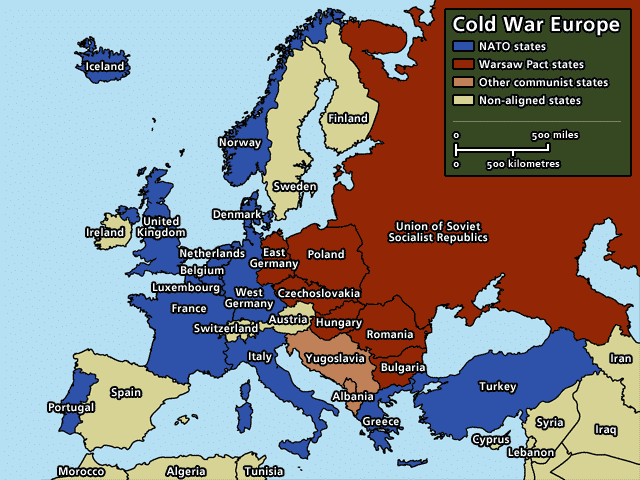
(2) The Warsaw Pact (1955)
- While Stalin’s death in 1953 slightly relaxed tensions, the situation in Europe remained an uneasy armed truce.
- The Soviets, who had already created a network of mutual assistance treaties across the Eastern Bloc by 1949, formalised this into a single alliance — the Warsaw Pact — in 1955.
- Formally titled the Treaty of Friendship, Co-operation, and Mutual Assistance, the Warsaw Pact was a collective defense treaty among eight communist states of Central and Eastern Europe, serving as the military complement to the Council for Mutual Economic Assistance (Comecon), the region’s economic organization for communist states.
- The Warsaw Pact was in part a Soviet military reaction to the integration of West Germany into NATO in 1955 under the Paris Pacts of 1954, but was primarily motivated by the Soviet desire to maintain control over military forces in Central and Eastern Europe — justified, per the Pact’s own preamble, as necessary to maintain peace in Europe in line with the Charter of the United Nations (1945).
- After the collapse of the USSR and the end of the Cold War, the alliance was transformed into the successor Collective Security Treaty Organization (CSTO).
(3) The Hungarian Revolution (1956)
- The Hungarian Revolution of 1956 was a spontaneous, nationwide revolt against the government of the Hungarian People’s Republic and its Soviet-imposed policies, lasting from 23 October to 10 November 1956.
- Though leaderless at first, it was the first major threat to Soviet control; despite its ultimate failure, the uprising proved highly influential and later played a role in the downfall of the Soviet Union itself.
Factors Responsible
- The Hungarians were deeply patriotic and resented Russian control, particularly:
- the secret police, known as the AVH, in Hungary;
- Russian control of the economy, which had impoverished Hungary;
- Russian control over what schools taught; and
- censorship and the general lack of freedom.
- The Hungarians were also religious, but the Communist Party had banned religion and imprisoned Cardinal Mindszenty; many Hungarians believed the United Nations, or the new US president Eisenhower, would come to their aid.
- The death of Stalin led many Hungarians to hope Hungary too would be ‘de-Stalinised’; in July 1956, the ‘Stalinist’ Secretary of the Hungarian Communist Party, Rakosi, fell from power.
The Course of the Revolution
- During October 1956, students, workers, and soldiers in Hungary attacked the AVH and Russian soldiers, and smashed a statue of Stalin.
- On 24 October 1956, Imre Nagy — a moderate and a westerniser — took over as prime minister, and asked Khrushchev to withdraw Russian troops; Khrushchev agreed, and on 28 October 1956, the Russian army pulled out of Budapest.
- For five days, there was freedom in Hungary: the new government introduced democracy, freedom of speech, and freedom of religion, and Cardinal Mindszenty was freed from prison.
- Then, on 3 November 1956, Nagy announced that Hungary would leave the Warsaw Pact.
- Khrushchev was not going to allow this, claiming he had received a letter from Hungarian Communist leaders asking for his help.
- At dawn on 4 November 1956, 1,000 Russian tanks rolled into Budapest, destroying the Hungarian army and capturing Hungarian Radio.
- Hungarian people — even children — fought the Russian troops with machine guns; some 4,000 Hungarians were killed. Imre Nagy and others were executed following secret trials, and Khrushchev installed the Russian loyalist Janos Kadar as prime minister.
Effects of the Hungarian Revolution
- Repression in Hungary: thousands of Hungarians were arrested and imprisoned, some were executed, and 200,000 Hungarian refugees fled to Austria.
- Russia stayed in control behind the Iron Curtain: no other country attempted to remove Russian troops until Czechoslovakia in 1968.
- Polarisation of the Cold War: people in the West were horrified — many communists left the Communist Party — and Western leaders became more determined to contain communism.
- The events in Hungary produced ideological fractures within Communist parties worldwide, particularly in Western Europe, causing a great decline in membership as many in both Western and communist countries felt disillusioned by the brutality of the Soviet response.
- The communist parties of the West never recovered from this blow to their membership, a fact recognized almost immediately by observers such as the Yugoslav politician Djilas, who remarked shortly after the revolution was crushed that “the wound which the Hungarian Revolution inflicted on communism can never be completely healed.”
(4) Competition in the Third World
- Nationalist movements in some countries and regions — notably Guatemala, Indonesia, and Indochina — were often allied with communist groups, or at least perceived in the West to be so allied.
- In this context, the United States and the Soviet Union increasingly competed for influence by proxy across the Third World as decolonization gained momentum through the 1950s and early 1960s, with both sides selling armaments to build influence.
- The United States, in particular, made use of the Central Intelligence Agency (CIA) to remove a string of unfriendly Third World governments and support allied ones in their place.
The 1953 Iranian Coup d’État
- In 1953, a covert operation orchestrated by the United Kingdom and the United States overthrew the democratically elected, non-aligned Iranian Prime Minister Mohammad Mosaddegh on 19 August 1953.
- Mosaddegh had sought to audit the books of the Anglo-Iranian Oil Company (AIOC), a British corporation, and to renegotiate the terms of its access to Iranian oil reserves; when the AIOC allegedly refused to cooperate, the Iranian parliament (Majlis) voted to nationalize the company’s assets and expel its representatives.
- Winston Churchill told the United States that Mosaddegh was increasingly turning towards communism.
- The pro-Western shah, Mohammad Reza Pahlavi, assumed control as an autocratic monarch, banning the communist Tudeh Party and suppressing political dissent through SAVAK, the shah’s domestic security and intelligence agency.
The 1954 Guatemalan Coup d’État (18–27 June 1954)
- In Guatemala, a CIA-backed military coup ousted the left-wing President Jacobo Arbenz Guzman in 1954.
- The post-Arbenz government — a military junta headed by Carlos Armas — repealed a progressive land reform law, returned nationalized property to the United Fruit Company, set up a National Committee of Defense Against Communism, and, at the request of the United States, decreed a Preventive Penal Law Against Communism.
The Indonesian Issue
- The non-aligned Indonesian government of Sukarno faced a major threat to its legitimacy beginning in 1956, when several regional commanders began demanding autonomy from Jakarta; after mediation failed, Sukarno moved to remove the dissident commanders.
- In February 1958, dissident military commanders in Central Sumatra and North Sulawesi declared the Revolutionary Government of the Republic of Indonesia (Permesta Movement), aimed at overthrowing the Sukarno regime, and were joined by civilian politicians from the Masyumi Party opposed to the growing influence of the Communist Party of Indonesia.
- Owing to their anti-communist rhetoric, the rebels received arms, funding, and other covert aid from the CIA — until Allen Lawrence Pope, an American pilot, was shot down after a bombing raid on government-held Ambon in April 1958.
- The central government responded with airborne and seaborne invasions of the rebel strongholds Padang and Manado; by the end of 1958, the rebels were militarily defeated, and the last guerilla bands surrendered by August 1961.
The Congo Crisis
- In the Republic of the Congo, newly independent from Belgium since June 1960, the CIA-cultivated President Joseph Kasa-Vubu ordered the dismissal of the democratically elected Prime Minister Patrice Lumumba in September; Lumumba, in turn, called for Kasa-Vubu’s dismissal.
- In the ensuing Congo Crisis, the CIA-backed Colonel Mobutu quickly mobilized his forces to seize power through a military coup d’état.
British Guiana
- In British Guiana, the leftist People’s Progressive Party (PPP) candidate Cheddi Jagan won the position of chief minister in a colonially administered election in 1953, but was quickly forced to resign after Britain suspended the still-dependent nation’s constitution.
- Embarrassed by the landslide victory of Jagan’s allegedly Marxist party, the British imprisoned the PPP’s leadership and engineered a divisive split within the organization in 1955.
- Jagan again won the colonial elections in 1957 and 1961; despite a British shift toward reconsidering its view of the left, the United States pressured Britain to withhold Guyana’s independence until an alternative to Jagan could be identified and brought into office.
Vietnam and the Non-Aligned Movement
- Worn down by the communist guerrilla war for Vietnamese independence and handed a watershed defeat by the communist Viet Minh in 1954, the French accepted a negotiated abandonment of their colonial stake in Vietnam.
- At the Geneva Conference, peace accords left Vietnam divided at the 17th parallel north, between a pro-Soviet administration in North Vietnam and a pro-Western administration in South Vietnam.
- Between 1954 and 1961, Eisenhower’s United States sent economic aid and military advisers to strengthen South Vietnam’s pro-Western regime against communist destabilization efforts.
- Many emerging nations of Asia, Africa, and Latin America rejected the pressure to choose sides in the East-West competition.
- In 1955, at the Bandung Conference in Indonesia, dozens of Third World governments resolved to stay out of the Cold War, a consensus that culminated in the creation of the Belgrade-headquartered Non-Aligned Movement in 1961.
- Meanwhile, Khrushchev broadened Moscow’s policy to establish ties with India and other key neutral states; independence movements across the Third World transformed the post-war order into a more pluralistic world of decolonized African and Middle Eastern nations, alongside rising nationalism in Asia and Latin America.
Suez Crisis (1956)
The Circumstances Leading to the Suez Crisis
- Colonel Nasser, the new ruler of Egypt, was aggressively committed to Arab unity and independence, including the liberation of Palestine from the Jews; almost everything he did irritated the British, Americans, or French.
- He organized guerrilla fighters known as fedayeen to carry out sabotage and assassinations inside Israel, and Egyptian ships blockaded the Gulf of Aqaba leading to the port of Eilat, territory the Israelis had taken from Egypt in 1949.
- In 1936, Britain had signed an agreement with Egypt allowing British troops to remain at Suez; this treaty was due to expire in 1956, and while Britain wanted it renewed, Nasser refused and insisted that all British troops withdraw immediately once the treaty ended.
- He sent help to the Algerian Arabs in their struggle against France, pushed other Arab states to oppose the British-sponsored Baghdad Pact, and forced King Hussein of Jordan to dismiss his British army chief of staff.
- He signed an arms deal with Czechoslovakia (September 1955) for Russian fighters, bombers, and tanks, with Russian military experts sent to train the Egyptian army.
- The Americans were outraged, since this meant the West no longer controlled arms supplies to Egypt: in American eyes, any country outside the Western alliance that bought arms from Eastern Europe was as bad as a communist state, and this was seen as a sinister Russian plot to ‘move into’ the Middle East.
- The Americans therefore cancelled a promised $46 million grant toward the building of the Aswan Dam (July 1956), intending to force Nasser to abandon his new links with the communists.
- Crisis point was reached when Nasser immediately retaliated by nationalizing the Suez Canal, intending to use its income to finance the dam himself; compensation was promised to shareholders, most of whom were British and French.
- Britain believed Nasser was on his way to forming a united Arabia under Egyptian control and communist influence, capable of cutting off Europe’s oil supplies at will.
- British Prime Minister Eden, recalling Britain’s appeasement of Hitler in the 1930s, looked to military action that might topple Nasser from power — even though Nasser had offered compensation to shareholders and promised continued use of the canal to the ships of all nations except Israel.
- Secret talks between the British, French, and Israelis produced a plan: Israel would invade Egypt across the Sinai Peninsula, while British and French troops would occupy the canal zone under the pretext of protecting it from damage in the fighting, restoring Anglo-French control of the canal and, it was hoped, toppling Nasser.
- The war began with the planned Israeli invasion of Egypt (29 October), a brilliant success that saw the Israelis capture the entire Sinai Peninsula within a week, while the British and French bombed Egyptian airfields and landed troops at Port Said.
Repercussions on Global Politics
- The intervention in Suez proved a disaster. US President Dwight Eisenhower was incensed, and the attacks caused an outcry across the world; the Americans, fearing they would push the Arabs into closer ties with the USSR, refused to support Britain.
- At the United Nations, Americans and Russians agreed for once, demanding an immediate ceasefire and preparing to send a UN force; under the combined pressure of world opinion and the threat of Soviet intervention, Britain, France, and Israel agreed to withdraw, while UN troops moved in to police the Egypt-Israel frontier.
- Britain’s standing with the US was severely weakened, and its influence ‘east of Suez’ diminished by the episode; British prestige was shattered, leaving her unable to pursue a foreign policy independent of the USA — a stark demonstration of the real balance of power in the post-war world.
- The episode also cost Britain an ally in Iraq, where premier Nuri-es-Said came under increasing attack from fellow Arabs for his pro-British attitude and was murdered in 1958.
- Far from being overthrown, Nasser’s prestige as leader of Arab nationalism against interfering Western powers was greatly increased.
- The Egyptians blocked the canal, and the Arabs reduced oil supplies to Western Europe — introducing petrol rationing there for the first time — while Russian aid replaced that from the USA.
- The Algerians, meanwhile, were encouraged in their own struggle for independence from France, which they achieved in 1962.
- The war was not without gains for Israel: although compelled to hand back all captured Egyptian territory, she had inflicted heavy losses on the Egyptians in men and equipment that would take years to make good, and the fedayeen raids ceased for a time, giving Israel a breathing space to consolidate. Following Britain’s humiliation, the Israelis increasingly looked to the USA as their chief supporter.
- The “non-white Dominions” saw Egypt’s seizure of the canal as an admirable act of anti-imperialism, likening Nasser’s Arab nationalism to Asian nationalism.
- Jawaharlal Nehru of India was with Nasser when the latter learned of the Anglo-American withdrawal of Aswan Dam aid; as a user of the canal himself, Nehru remained publicly neutral, warning only that any use of force or threats could be “disastrous.”
- Yet Nehru privately did not hold Nasser’s intellect in high regard: while he did not dispute Egypt’s right to nationalize the canal, he regretted Nasser’s method as ‘intemperate and even warmongering’.
(5) The Sino-Soviet Split
- The period after 1956 brought serious setbacks for the Soviet Union, most notably the breakdown of the Sino-Soviet alliance — the beginning of the Sino-Soviet split (1960–1989), a worsening of political and ideological relations between the People’s Republic of China (PRC) and the USSR.
- The doctrinal divergence stemmed from differing Chinese and Russian national interests, and from their contrasting interpretations of Marxism — Maoism versus Marxism-Leninism.
- Through the 1950s and 1960s, ideological debate between the Russian and Chinese communist parties centred on whether peaceful coexistence with the capitalist West was possible; Mao Zedong, to the Chinese public, proposed a belligerent attitude toward capitalist countries, initially rejecting peaceful coexistence as a form of “Marxist revisionism” emanating from the Soviet Union.
- Mao had defended Stalin when Khrushchev denounced him after his death in 1956, treating the new Soviet leader as a superficial upstart who had “lost his revolutionary edge.”
- Khrushchev, in turn, disturbed by Mao’s glib attitude toward nuclear war, referred to the Chinese leader as a “lunatic on a throne.”
- Mao considered himself the head of international communism as its most senior leader, a status Khrushchev did not recognize, given that he himself headed one of the world’s two superpowers.
- In 1958, Mao announced China would undertake a Great Leap Forward, a classically Marxist-Leninist approach to development that clashed with Khrushchev’s more reformist tendencies.
- Mao included the pursuit of nuclear weapons within this plan, disparaging Khrushchev’s nuclear detente with the United States and hoping the PRC would take the USSR’s place as the leading communist superpower; the Soviets, however, refused to help China develop nuclear weapons.
- Cracks in the alliance began appearing publicly in 1959, when the USSR offered moral support to the Tibetan people during their 1959 Uprising against Chinese rule.
- The split hit international headlines in 1960 at the Romanian Communist Party Congress, where Mao and Khrushchev openly traded insults before assembled delegates.
- Mao accused Khrushchev of capitulating to the Americans during the 1962 Cuban Missile Crisis; Khrushchev replied that Mao’s own policies would lead to nuclear war. The Soviets subsequently backed India in the Sino-Indian War of 1962, and relations between the two communist powers collapsed completely.
- Khrushchev later made several attempts to reconstitute the alliance, but Mao considered these useless and rejected them; the resulting animosity spilled out into an intra-communist propaganda war, with the Soviets increasingly focused on a bitter rivalry with Mao’s China for leadership of the global communist movement.
Ramifications of the Sino-Soviet Split
- As a result of the split, international politics shifted markedly during the latter half of the twentieth century.
- The two communist powers nearly went to war in 1968 over a border dispute in Xinjiang; the Soviet Union even considered a pre-emptive strike against the Lop Nur Basin, also in Xinjiang, where the Chinese were preparing to test their first nuclear weapons — it was, oddly enough, the US government that persuaded the Soviets not to destroy China’s nuclear test sites, for fear of sparking a wider war.
- When the Soviets invaded Afghanistan in 1979 to prop up their client government, the Chinese saw this as an aggressive move to encircle China with Soviet satellite states, and consequently allied with the US and Pakistan in supporting the mujahideen, the Afghan guerrilla fighters who successfully opposed the Soviet invasion.
- The Sino-Soviet split was one of the defining events of the Cold War, helping to shape its later framework and influencing the course of the Second Vietnam War in particular.
- The divide fractured the international communist movement and opened the way for warming relations between the United States and China under Richard Nixon in 1971.
- Relations between China and the Soviet Union remained tense until the visit of Soviet leader Mikhail Gorbachev to Beijing in 1989.
(6) The Space Race
- The Space Race was a twentieth-century (1955–1972) competition between the USSR and USA for supremacy in spaceflight capability, with the technological superiority it required seen as essential to national security and symbolic of ideological superiority.
- It spawned pioneering efforts to launch artificial satellites, unmanned probes of the Moon, Venus, and Mars, and human spaceflight in both low Earth orbit and to the Moon itself.
- The competition began on 2 August 1955, when the Soviet Union responded to a US announcement, made four days earlier, of its intent to launch artificial satellites, by declaring it too would launch a satellite in the near future.
- The Soviet Union beat the US to it, launching Sputnik 1 on 4 October 1957.
- The Space Race peaked with the US landing of the first humans on the Moon via Apollo 11 on 20 July 1969 — an event astronaut Frank Borman later described as “just a battle in the Cold War” — and concluded in a period of detente with the April 1972 agreement on the co-operative Apollo-Soyuz Test Project, resulting in the July 1975 rendezvous in Earth orbit of a US astronaut crew with a Soviet cosmonaut crew.
- The Space Race had its origins in the missile-based arms race that followed World War II, when both the Soviet Union and the United States captured advanced German rocket technology and personnel.
(7) The U2 Incident and the Paris Summit of 1960
- By the end of the 1950s, there was massive tension in the Cold War on several fronts:
- the arms race, where both sides accepted the need for some form of Nuclear Test Ban treaty;
- Berlin, where the Russians were furious that many East Germans were fleeing to the West through West Berlin; and
- Cuba, where the Americans were alarmed that Fidel Castro, a communist, had seized power in 1959.
- A summit meeting was arranged for Paris to try to resolve these tensions.
- On 1 May 1960 — thirteen days before the summit — an American U2 spy plane was shot down over Russia and its pilot, Gary Powers, was captured.
- The Americans initially claimed it was a weather plane, but were forced to admit it was a spy plane once the Russians revealed that much of the aircraft had survived and that Powers himself had been captured alive.
- When the summit convened on 14 May, Khrushchev’s first act was to demand that President Eisenhower apologise; when Eisenhower refused, Khrushchev stormed out of the conference, and the Cold War became substantially more dangerous as a result.
Effects of the U2 Incident
- The Paris meeting collapsed, and no Test Ban Treaty was signed.
- There was no discussion of the Berlin problem, which would ultimately lead to the Berlin Wall.
- The incident was seen as a defeat for the US, contributing to the election of John F. Kennedy as president on his promise to take a tougher line with the Russians.
(8) The Berlin Ultimatum and the Berlin Crisis of 1961
- West Berlin was a source of worry and embarrassment for the Soviet Union by 1961, for several reasons:
- nearly 2,000 refugees a day were fleeing to the West through West Berlin — hardly proof of the Soviet claim that the communist way of life was superior to capitalism — as East Germans annually emigrated through a loophole in the divided city’s system;
- many of those leaving were skilled and qualified workers, producing a massive “brain drain” of younger, educated professionals from East to West Germany; and
- the Soviets also believed West Berlin served as a centre for US espionage.
- The Berlin Crisis of 1961 was the last major Cold War incident concerning the status of Berlin and post-war Germany.
- At the Vienna Summit of June 1961, Khrushchev demanded that the US leave West Berlin within six months; Kennedy refused, and instead guaranteed West Berlin’s freedom.
- On 13 August, Khrushchev closed the border between East and West Berlin and began building the Berlin Wall, closing the loophole and culminating in the city’s de facto partition. What the Russians initially regarded as a propaganda success became, over time, a propaganda disaster — a symbol of all that was wrong with Soviet rule.
- In 1963, President Kennedy visited West Berlin and delivered his famous ‘I am a Berliner’ speech beside the Wall.
- Khrushchev himself had earlier told Mao Zedong: “Berlin is the testicles of the West. Every time I want to make the West scream, I squeeze on Berlin.”
(9) The Bay of Pigs Invasion and the Cuban Missile Crisis
- Cuba became embroiled in the Cold War in 1959, when Fidel Castro — who had just seized power from the corrupt, American-backed dictator Batista — outraged the USA by nationalizing American-owned estates and factories.
- In retaliation, the Americans halted all aid to Cuba and all imports of Cuban sugar, a serious blow given sugar’s centrality to the Cuban economy.
- Castro was forced to turn to the USSR for help, and in 1960 the USSR agreed to buy 1 million tonnes of Cuban sugar every year; Castro, who had not been a communist when he took power, now became one.
- As relations between Cuba and the USA worsened, those with the USSR improved: in January 1961, the USA broke off diplomatic relations with Cuba, while the Russians increased their economic aid.
The Bay of Pigs Invasion
- Convinced Cuba was now a communist state in all but name, the new US president, John F. Kennedy, approved a plan by Batista supporters to invade Cuba from American bases in Guatemala, with deep involvement from the CIA.
- The small invading force of about 1,400 men landed at the Bay of Pigs in April 1961, but the operation was so badly planned and executed that Castro’s forces, aided by just two jet planes, crushed it within three days.
- Later that year, Castro announced he was now a Marxist and that Cuba was a socialist country.
- Kennedy continued his campaign against Castro through various means — sinking Cuban merchant ships, sabotaging island installations, and running American troop invasion exercises — and Castro in turn appealed to the USSR for military help.
Khrushchev’s Missiles in Cuba
- Khrushchev decided to install nuclear missile launchers in Cuba, aimed at the USA, whose nearest point lay less than a hundred miles away.
- He intended missiles with a range of up to 2,000 miles, meaning major US cities such as New York, Washington, Chicago, and Boston would come under threat.
- This was a risky decision, and there was great consternation in the USA when, in October 1962, photographs from spy planes revealed a missile base under construction.
- Why did Khrushchev take such a risky decision?
- The Russians had lost the lead in ICBMs, and this was one way of trying to seize back the initiative from the USA — though it would be wrong to place all the blame for the crisis on the USSR alone.
- In 1959, the Americans had signed an agreement with Turkey allowing them to deploy Jupiter nuclear missiles from Turkish bases, well before any top-level contact between Castro and the Russians had taken place.
- As Khrushchev put it in his memoirs, “the Americans had surrounded our country with military bases, now they would learn what it feels like to have enemy missiles pointing at you.”
- It was also a gesture of solidarity with his ally Castro, who remained under constant US threat even after the failure of the Bay of Pigs invasion — in November 1961, Kennedy had authorised the secret CIA operation “Operation Mongoose,” aimed at helping Cuba “overthrow the Communist regime,” and Khrushchev hoped the missiles might deter such an operation.
- The move would also test the resolve of the young American president, and Khrushchev may have intended to use the missiles as bargaining leverage for the removal of American missiles from Europe, or a Western withdrawal from Berlin.
The Crisis and Its Resolution
- Kennedy’s military advisers urged him to launch air strikes against the missile bases, but he chose a more cautious course.
- He alerted American troops, imposed a naval blockade of Cuba to intercept the 25 Russian ships bringing missiles to the island, and demanded the dismantling of the missile sites and the removal of missiles already present.
- The world seemed on the verge of nuclear war; the UN Secretary-General, U Thant, appealed to both sides for restraint.
- Khrushchev made the first move, ordering the Russian ships to turn back, and eventually a compromise was reached: Khrushchev promised to remove the missiles and dismantle the sites, while Kennedy promised the USA would not invade Cuba again and undertook to disarm the Jupiter missiles in Turkey, though he would not allow this concession to be announced publicly.
- At the height of the crisis, a US U2 spy plane was shot down over Cuba, but Kennedy chose to ignore the incident rather than escalate further.
- Castro was furious with Khrushchev for ‘deserting’ him without consultation, and Cuban-Soviet relations remained extremely cool for several years afterward.
- Speaking years later, Khrushchev claimed he had won the Cuban Missile Crisis, having achieved both his aims: America never again bothered Cuba, which remains a communist country, and the US missile sites in Turkey were dismantled in November 1962.
- The Cuban Missile Crisis (October–November 1962), though it lasted only a few days, brought the world closer to nuclear war than at any other point in the Cold War, and further demonstrated the logic of mutually assured destruction — that neither superpower was prepared to risk total global destruction through mutual retaliation.
- Soon afterward, in 1963, a telephone hotline was established between Moscow and Washington to allow instant consultation in future crises.
- In July 1963, the Nuclear Test Ban Treaty was signed by the USSR, USA, and Britain, agreeing to conduct nuclear tests only underground to avoid further atmospheric pollution.
- In 1968, the Nuclear Non-Proliferation Treaty was signed, with the superpowers promising not to supply nuclear technology to other countries.
- Both sides could claim to have gained something from the crisis, but most importantly, both realized how easily a nuclear war could have started, and how terrible its results would have been — producing a marked relaxation of tension in its aftermath.
Historiography of the Crisis
- At first, Kennedy’s handling of the crisis was highly praised: most American commentators argued that by standing firm against the Russians and resisting pressure from his own Chiefs of Staff for a military response, he had defused the crisis and achieved a peaceful settlement.
- To place the blame for the crisis squarely on the USSR, the Americans emphasized that Khrushchev and Russian diplomats had repeatedly lied, denying any intention of building missile bases in Cuba.
- However, some later historians took a more critical view of Kennedy.
- A few accused him of missing an opportunity to resolve the Cuban problem permanently, arguing he should have called Khrushchev’s bluff, attacked Cuba, and overthrown Castro.
- Others criticized Kennedy for having caused the crisis in the first place, by placing nuclear missiles in Turkey and repeatedly trying to destabilise the Castro regime.
- It was also pointed out that, since Soviet long-range missiles could already reach the USA from Russian territory itself, the missiles in Cuba did not represent an entirely new threat.
- Meanwhile, Khrushchev’s own prestige suffered: China broke off relations with Russia, and in 1964, he was forced to resign as Soviet leader.
Explaining the Nature of the Cold War, 1948–1962
- The period 1948–1961 saw several major changes in the character of the Cold War:
- the death of Stalin and the rise of a new Soviet leadership;
- the growth of communism in the Far East;
- the assertion of Soviet rule across Eastern Europe;
- the increased use of espionage between the USA and USSR; and
- the physical separation of East and West in Berlin.
- Historians have viewed this period of the Cold War in a variety of ways. Some of the recurring observations include:
- Between 1949 and 1963, the Cold War developed through a series of major crises; when Stalin died in 1953, there was a slight improvement in East-West relations, though underlying problems persisted.
- Khrushchev’s blustering vigour — his love of travel, of argument, and his willingness to take risks — left its mark on these years.
- The Berlin Wall did not merely divide the city: over the following years, it became a symbol of division more broadly — of Germany, of Europe, and of the communist East from the democratic West. Communists presented the wall as a protective shell; the West presented it as a prison wall.
- The Americans believed it was both their duty and a matter of national security to resist the expansion of communism wherever it occurred, a conviction that, during the 1960s, repeatedly brought them to the brink of nuclear war.
- It became increasingly clear to the capitalist states that, despite talk of coexistence, Khrushchev remained determined to prove that communism could compete with — and ultimately beat — the West.
- In sum, the Cold War of this period was a mixture of a religious crusade in favour of one ideology or the other, and the most ruthless power politics.