Spread of Buddhism: Life of the Buddha, Doctrines, the Sangha, and Buddhist Councils

Buddhism, founded by Gautama Buddha in the sixth century BCE, emerged as one of the most influential religious and philosophical movements of ancient India, alongside its contemporary, Jainism. From its origins in the Gangetic plains, Buddhism grew from a small band of disciples into a pan-Asian tradition, shaped by successive Buddhist councils, a rich body of canonical scripture, and a distinctive social and ethical vision. Understanding the life of the Buddha, the core doctrines of his teaching, the organisation of the Sangha, and the historical factors behind Buddhism’s rise, spread, and eventual decline in India is essential for any UPSC History Optional aspirant studying the religious and cultural history of ancient India.
Gautama Buddha: Life and Times
Early Life and the Great Renunciation
- Among the notable contemporaries of Mahavira was Gautama Buddha, the founder of Buddhism. His personal name was Siddhartha, and he belonged to the Gautama gotra.
- He was born in 563 BCE at Lumbini (now in Nepal), in the Shakya Kshatriya clan of Kapilavastu; the site of his nativity is marked by the celebrated Rummindei Pillar of Ashoka Maurya.
- He was the son of Suddhodana, who appears to have been the elected ruler of Kapilavastu and headed the republican clan of the Shakyas; his mother, Maya, was a princess of the Koliya clan, and died in childbirth, after which the infant Siddhartha was raised by his aunt and stepmother, Prajapati Gautami.
- Having been born into a republic, the Buddha also inherited certain egalitarian sentiments.
- At the age of sixteen, the prince was married to a lady known to tradition variously as Bhadda Kachchana, Yasodhara, or Subhadraka.
- From early childhood, Gautama showed a meditative bent of mind. The sight of an old man, a sick man, a dead body, and an ascetic — the Four Great Signs — intensified his deep disquiet with the world and made him realise the hollowness of worldly pleasure.
- At the birth of his son Rahula, he left home at the age of twenty-nine in search of the truth — a departure known as the Great Renunciation (mahabhinishkramana).
The Search for Truth and Enlightenment
- For six years, Gautama lived as a wandering ascetic, seeking instruction under two religious teachers — Alara Kalama (at Vaishali) and Uddaka, or Ramaputta (at Rajagriha) — and visiting many places.
- From Alara Kalama he learned the technique of meditation and the teachings of the Upanishads, but these did not lead him to final liberation.
- He then practised rigid austerities and various forms of self-torture in search of the truth, only to find that they, too, were of no help in reaching his goal.
- Abandoning this path, he went to Uruvela (near Bodh Gaya, on the banks of the Niranjana river) and, after bathing in the river, sat under a pipal tree (the Bodhi tree).
- Here he attained supreme knowledge — Enlightenment — at the age of thirty-five, on the forty-ninth day of his continuous meditation; from this point on, he was called the Buddha (“the enlightened one”). He also came to be known as Tathagata (“he who had attained the truth”) and Sakya-Muni, “the sage of the Sakya clan.”
- From Uruvela he proceeded to the Deer Park at Sarnath, near Varanasi, at Isipatana, where he delivered his first sermon, known as the Dharmachakra Pravartana (“setting in motion the wheel of Dharma”).
- Asvajit, Upali, Mogallana, Sariputra, and Ananda were the first five disciples of the Buddha; they soon realised the truth themselves and became arhats. The Buddha laid the foundations of the Buddhist Sangha at this time.
The Buddha’s Ministry and Death (Mahaparinirvana)
- The Buddha preached most of his sermons at Sravasti, where Anathapindika, a rich merchant of the city, became his follower and made liberal donations to the Buddhist order.
- He soon began visiting various places to propagate his teachings, wandering, preaching, and meditating continuously for forty years, resting only during the rainy season each year; he visited Sarnath, Mathura, Rajgir, Gaya, and Pataliputra.
- Kings such as Bimbisara and Ajatashatru of Magadha, Prasenajit of Kosala, and Udayana of Kausambi accepted his doctrines and became his disciples.
- He also visited Kapilavastu and converted his foster mother and his son Rahula to his faith.
- During this long period, he encountered many staunch supporters of rival sects, including Brahmanas, but defeated them in debates; his missionary activity did not discriminate between rich and poor, high and low, man and woman.
- Gautama Buddha passed away at the age of eighty, in 483 BCE, at a place called Kusinagar (the capital of the Mallas), identified with the modern village of Kasia, in the Deoria district of eastern Uttar Pradesh — an event known as the Mahaparinirvana.
Sources of the Buddha’s Hagiography
- Some elements of the Buddha’s hagiography (sacred biography) are contained in the Sutta and Vinaya Pitakas, but more detailed and connected accounts appear in later texts such as the Lalitavistara, Mahavastu, Buddhacharita, and Nidanakatha — all belonging to the early centuries CE.
- It is difficult to extract a strictly historical life story from these hagiographies, since they have moulded the Buddha’s life into a narrative aimed at conveying a series of significant meanings to his followers, designed to have a powerful impact.
Doctrines of Buddhism
- The Buddha proved to be a practical reformer who took note of the realities of his day. He did not involve himself in the fruitless controversies over the soul (atman) and Brahma that raged strongly in his time, addressing himself instead to worldly problems.
- He taught that the world is full of sorrow, and that people suffer on account of desire; if desire is conquered, nirvana can be attained — that is, freedom from the cycle of birth and death.
- The basic teachings of the Buddha are contained in the Four Noble Truths and the Eightfold Path. Within Buddhism, samsara is defined as the continual, repetitive cycle of birth and death, and karma is the force that drives it.
The Four Noble Truths (Chatvari Arya Satyani)
- Dukkha: the world (samsara) is full of sorrow, or suffering (dukkha).
- Samudaya (origin, arising): the cause or origin of sorrow lies in desire (trishna).
- This cause is explained through Patichcha-Samuppada (“dependent origination”) — a causal chain of twelve co-dependent events or phenomena, all linked together, each conditioning and depending on the other. It begins with ignorance, which leads to other phenomena including desire, which ultimately leads to sorrow.
- Nirodha (cessation, ending): the ending of dukkha can be attained by renouncing, or letting go of, desire.
- Magga (path — the Noble Eightfold Path, or Ashtangika Marga/Madhyama Marga): the path leading to the renunciation of desire and the cessation of dukkha.
Patichcha-Samuppada: The Twelve Nidanas (Dependent Origination)
- Patichcha-samuppada, the law of dependent origination, served both as an explanation of all phenomena and as an explanation of dukkha. Its elements were presented as a wheel consisting of twelve nidanas, one leading to the next:
- ignorance (avijja),
- formations (sankhara),
- consciousness (vinnana),
- mind and body (nama-rupa),
- the six senses (salayatana),
- sense contact (phassa),
- feeling (vedana),
- craving (tanha/trishna),
- attachment (upadana),
- becoming (bhava),
- birth (jati), and
- old age and death (jaramarana).
- These twelve nidanas were later divided into three groups pertaining to the past, present, and future lives; patichcha-samuppada thus also became an explanation of how the origins of rebirth lay in ignorance.
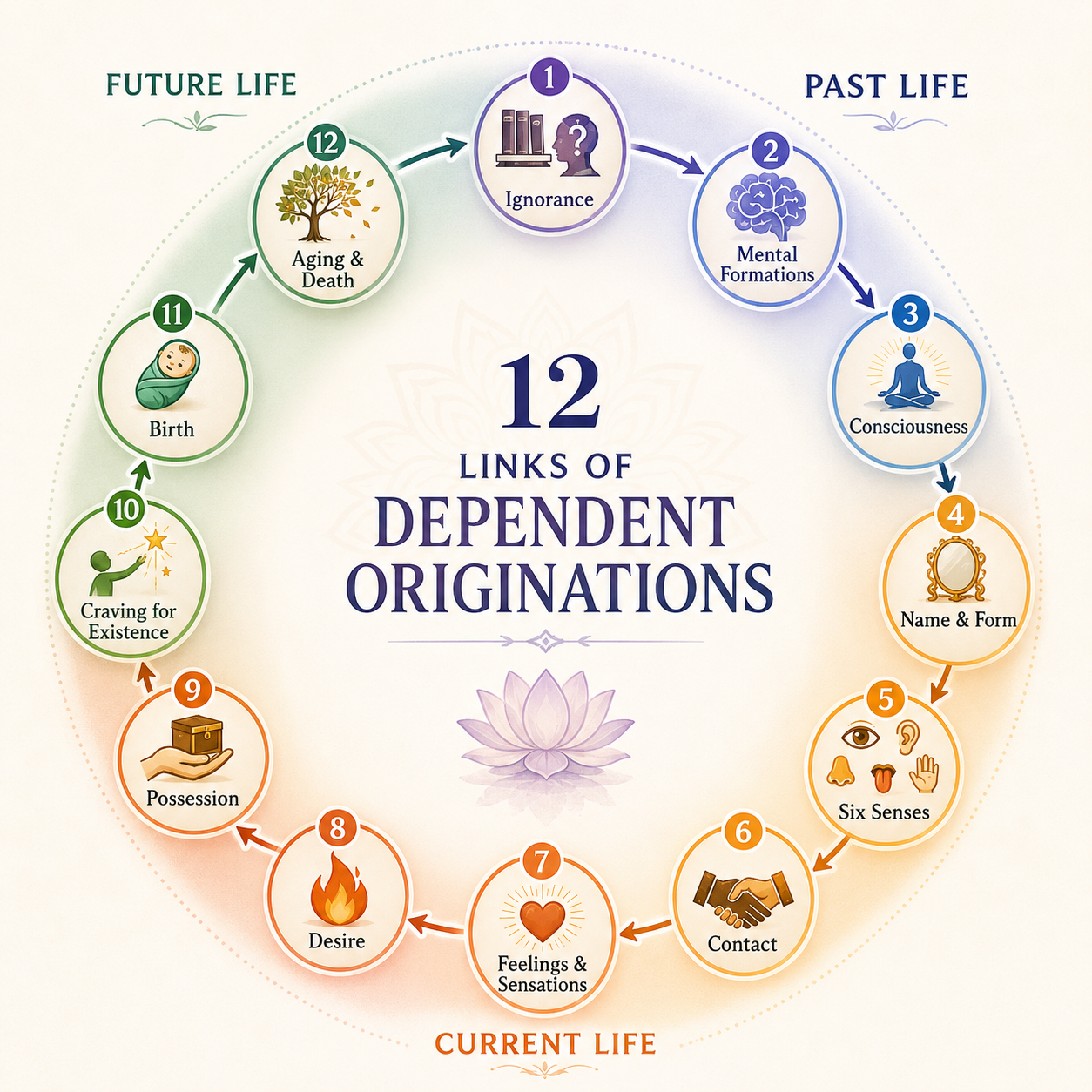
The twelve links of dependent origination (Patichcha-Samuppada) are traditionally depicted as a wheel, each link conditioning the one that follows.
The Eightfold Path (Ashtangika Marga) and the Middle Path
- The Eightfold Path consists of the following principles:
- Right view — viewing reality as it is, not merely as it appears; understanding that the world is filled with sorrow generated by desire, and that the ending of desire leads to the liberation of the soul.
- Right thought/aim/intention — seeking to avoid the enjoyment of the senses and luxury, aiming instead to love humanity and increase the happiness of others; an intention of renunciation, freedom, and harmlessness.
- Right speech — speaking in a truthful and non-hurtful way.
- Right action — acting in a non-harmful and unselfish way.
- Right livelihood — living by honest means; a non-harmful livelihood.
- Right effort/conduct — the proper control of one’s senses to prevent bad thoughts, achieved through correct mental exercise, which destroys desire and attachment; an ongoing effort at self-improvement.
- Right mindfulness — understanding the impermanence of the body, with meditation as the means for removing worldly evils.
- Right concentration/meditation — observing this principle leads to peace, since meditation unravels the real truth.
- According to the Buddha’s teaching, anyone who follows this path — considered the “middle path” (madhyama pratipad) — would attain salvation irrespective of social position.
- The Middle Path is the practice of non-extremism: a path of moderation away from the extremes of self-indulgence and self-mortification. An individual should pursue this middle course, avoiding both severe asceticism and a luxurious life.
Dukkha and the Nature of Suffering
- Dukkha and its extinction are central to the Buddha’s doctrine; he taught that everything is suffering (sabbam dukkham) — a teaching that can be seen as either extremely pessimistic or extremely realistic.
- Suffering refers not only to the actual pain and sorrow experienced by an individual but also to the potential to experience these things; states of happiness or pleasure are unstable and temporary, since they depend on the gratification of the senses through particular objects or experiences.
- The causes of suffering include human propensities such as desire, attachment, greed, pride, aversion, and ignorance; desire (trishna) is central to both the cause and the removal of suffering.
Impermanence (Anichcha)
- All of this is connected with another aspect of existence emphasised in the Buddha’s teaching — impermanence (anichcha), which has many facets.
- In relation to an individual’s life, there is no being or power in the universe that can prevent old age, sickness, and death.
- At a more basic level, what we think of as the “I” or “me” is actually an ever-changing compound of a succession of instants of experience and consciousness — the simile of the river helps explain this, since the river appears the same even though the drops of water constituting it change every instant.
- The idea of a permanent, unchanging “I” or “me” is thus the result of misperception and ignorance; the emphasis on impermanence involved the rejection of any unchanging, permanent, eternal substance or essence, such as the atman.
The Law of Karma
- Buddhism laid great emphasis on the law of karma. In the Buddhist universe, there are many worlds and many kinds of beings, and one can be born as any one of them; the connection between different lives is established by karma.
- In the Brahmanical tradition, karma refers to ritual action, whereas in the Buddha’s teaching, karma means the intentions that lead to actions of body, speech, or mind; rebirth is governed by the cumulative results of the karma of a particular life. The doctrine of karma is thus an essential part of the Buddha’s teachings.
Nibbana (Nirvana)
- The ultimate goal of the Buddha’s teaching was the attainment of nibbana — not a place, but an experience, attainable in this very life. Nirvana means the shedding of all desires and the ending of suffering, finally leading to freedom from rebirth; it can be attained through the elimination of desire, and the Buddha therefore preached that the annihilation of desire is the real problem.
- Prayers and sacrifices would not end desire; unlike the emphasis on rituals and ceremonies in the Vedic religion, the Buddha laid emphasis on the moral life of the individual. The Buddha is supposed to have experienced nibbana himself, as did some of his disciples.
- Nibbana literally means “blowing out,” “dying out,” or “extinction” — the extinction of desire, attachment, greed, hatred, ignorance, and the sense of “I-ness,” and the breaking of the cycle of birth, death, and rebirth; nibbana does not mean physical death. The term parinibbana (complete or final dying-out) is used for the death of an enlightened being such as the Buddha.
Transmigration Without a Permanent Soul
- The Buddha’s teaching accepts the idea of transmigration (samsara) but rejects the idea of the atman. What, then, is it that transmigrates?
- One interpretation is that Buddhism teaches the transmigration of character or personality; another possibility is that it suggests the transmission of a life-impulse, similar to the transmission of a flame from one candle to another.
- What the teaching suggests is that the elements of conscious existence do not disappear into thin air on death — they reappear in some other combination and form, at another time and place.
- The Milindapanha (first century CE) offers an analogy that explains this well: just as milk turns into curds, butter, and ghee, a being transmigrates, neither as the same being nor as a wholly different one.
- The Buddha may be called an agnostic, as he neither accepted nor rejected the existence of God. According to him, all things are composite and, as a corollary, all things are transient, since the composition of all aggregates is liable to change; he was more concerned with the individual and his actions.
- Buddhism did not believe in the existence of a permanent soul (atman), nor did it recognise the existence of God — a stance that can be seen as something of a revolution in the history of Indian religions. The Buddha accepted karma and transmigration but denied the permanence of the soul.
- Since early Buddhism was not entangled in the intricacies of philosophical discussion, it appealed readily to the common people.
The Five Aggregates (Skandhas)
- According to the Buddha, a person is composed of five groups (skandhas) of physical and mental factors:
- Rupa (form),
- Samjna (name/perception),
- Vedana (sensations),
- Vijnana (consciousness), and
- Samskara (disposition/formations).
Ahimsa in Buddhism
- Buddha emphasised the spirit of love, which could be expressed towards all living beings through ahimsa (non-killing); though this principle was well understood, it was not emphasised to the same degree as in Jainism.
- The Buddhist emphasis on ahimsa involved a critique of Brahmanical animal sacrifice: monks and nuns were not to kill animals, nor to drink water in which small creatures lived.
- However, this emphasis did not necessarily entail vegetarianism, and monks were not forbidden from eating meat, since the emphasis was on the factor of intention. Monks had to accept whatever was given to them on their begging rounds, so meat had to be accepted if offered, provided the animal had not been killed specifically to feed them.
- Certain kinds of flesh, however, were never to be accepted — that of humans, elephants, snakes, dogs, and horses.
- Buddhism does not accept the authority of the Vedas, and for this reason, Buddhist philosophy is classed as an atheistic philosophy.
- Buddhism also opposed the varna system and caste, and won particular support among the lower orders for attacking it; people were admitted into the Buddhist order without any consideration of caste.
The Ethical Code of Conduct
- The Buddha laid down an ethical code of conduct for both members of the monastic order and the laity. Monks and nuns were expected to strictly avoid:
- the destruction of life,
- taking what is not given (theft),
- sexual activity,
- lying,
- the use of intoxicants that cause heedlessness,
- eating after midday,
- attending entertainments,
- using perfumes and jewellery,
- using luxurious beds, and
- handling gold and silver (including money).
- The first five of these rules also applied to the laity, except that celibacy was replaced by chastity — a concept defined not merely in terms of sexual activity, but also of sexual desire and thought.
The Three Jewels (Triratna)
- Buddhism recognises three jewels:
- the Buddha, the fully enlightened one;
- the Dhamma, the teachings expounded by the Buddha; and
- the Sangha, the monastic order that practises the Dhamma.
- All three are inseparable, since the Dhamma could not have been taught without the Buddha, and could not have been followed without the Sangha.
Duties in Social Relationships
- The Buddha focused on harmonious social relations and defined duties within society:
- Duties to friends: be generous, treat as equal, stand by your friend, take care of them, and help in trouble.
- Employers’ duties towards servants: treat them decently, do not assign tasks beyond their strength, care for them in times of need, and provide adequate food and wages.
- Duties of servants to their master: work thoroughly, be content with a just wage, and maintain the master’s reputation.
- Husband’s duty towards his wife: pay her respect, comply with her requests as far as possible, and provide for her according to his capacity.
- Wife’s duty towards her husband: perform her duties honestly, be gentle and kind, work with skill and enthusiasm, and maintain the household properly.
The Buddhist Sangha
Membership and Organisation
- The Buddha had two kinds of disciples — monks (bhikshus or shramanas) and lay worshippers (upasakas); the former were organised into the Sangha, or congregation.
- Membership of the Sangha was open to all persons, male or female, above fifteen years of age, who were free from leprosy, consumption, and other infectious diseases; there were no caste restrictions, and women too were admitted to the Sangha.
- Persons in the service of the king or of an individual, those in debt, slaves, and those branded as robbers or criminals were refused admission.
- The only condition required of monks was that they faithfully observe the rules and regulations of the Sangha; once enrolled, they had to take the vow of continence, poverty, and faith, along with the non-acceptance of varna distinctions.
- Monasteries were constructed to house monks and nuns for study and meditation, and gradually developed into academic centres.
- Every Buddhist monk had to become a Sramana before being ordained as a full member of the Sangha; the higher ordination of a Bhikshu was called upasampada. Whenever a new person wished to join the Sangha, they had to shave their head, put on a yellow robe, and take the oath of fidelity to the triratna — the Buddha, the Dhamma, and the Sangha.
Governance of the Sangha
- The Sangha was governed on democratic lines and was empowered to enforce discipline among its members.
- The monks of a monastery held a fortnightly assembly, at which they elected their president (Sanghaparinayaka) and selected two speakers — one on the Dhamma and one on the Vinaya.
- In assembly meetings, there were systems of formal moving of resolutions (jnapati) and ballot voting by means of wooden sticks (salaka).
- No assembly was valid unless at least ten monks were present; novices and women were not entitled to vote or to constitute the quorum.
Social Implications of the Buddha’s Teachings
- The Buddha’s doctrine was certainly more socially inclusive than the Brahmanical tradition, but it did not aim at abolishing social differences altogether; Buddhist texts reveal biases of their own, reflected even in the supposedly a-social world of the Sangha.
- The key point is that the Buddha saw all social relationships as fetters and a source of suffering, and it was only by breaking away from these fetters that a person could attain liberation.
- The creation of the monastic order had the potential to cause great social upheaval by providing a haven for social dropouts; however, the Buddhist tradition reflects a desire to maintain the status quo, specifying a number of conditions for entry.
- Soldiers could not join without the permission of the king; slaves could not join until freed by their masters; and debtors could not join until they had paid off their debts.
Varna and Caste in the Sangha
- The Buddhist tradition considered varna a man-made ordering, unlike the divine sanction conferred upon it by the Brahmanical tradition.
- In the Samyutta Nikaya, when asked about his origins by the Brahmana Sundarika, the Buddha replied that one should not ask of one’s origin (jati), but of one’s behaviour, since just as fire can be born out of any wood, so can a saint be born in a kula of low status.
- To this may be added the statement that a person does not become a Brahmana by birth but by deed; birth in a high or low family is often explained as the result of actions in previous lives, but the potential for achieving nibbana exists in all.
- The fact that bhikkhus were expected to accept food from everyone, regardless of class or caste, suggests a deliberate disregard for prevailing social practice; the Buddha himself did not maintain any restrictions on accepting food, enjoying the hospitality of wealthy gahapatis and setthis while also dining with people lower in the social hierarchy — his last meal, in fact, is supposed to have been at the home of a blacksmith named Chunda.
- A close reading of the Pali texts, however, shows that they too had a notion of high and low status: the Vinaya Pitaka discusses high and low sippas (occupations) — money-changing, accounting, and writing, along with farming, cattle-rearing, and trade, were considered high occupations, while the professions of leather-maker, reed-worker, potter, tailor, painter, weaver, and barber were considered low.
- The Buddhist laity was not supposed to engage in trade in weapons, meat, intoxicants, or poisons.
- In the Anguttara Nikaya, the Buddha describes a dream in which four birds of different varnas (kinds, colours) came from the four directions and sat at his feet; similarly, he asserted that monks from the four varnas — Khattiya, Brahmana, Vessa, and Sudda — came within his fold. The same text declares that when a person joins the Sangha, he becomes without varna (vevanniyanti); varna and jati were supposed to be irrelevant for aspirants to the Sangha.
- The distinguished monk Upali, for instance, was originally a barber of the Sakyas.
- However, a closer look at the Sangha’s actual composition indicates a significant proportion of upper-class members: a large section of monks were Brahmanas, Kshatriyas, or belonged to families of high status (uchcha kulas), while members from other backgrounds — gahapatis, setthis, members of nicha kulas — were comparatively few. Brahmanas such as Sariputta, Mahamoggallana, and Mahakassapa figure prominently among the famous bhikkhus, while the prominent Kshatriya monks included the Buddha himself, along with Ananda and Aniruddha.
The Kshatriya-Brahmana Question
- The Pali canon reverses the Brahmanical order of rank, placing the Kshatriya higher than the Brahmana. This position emerges clearly in the Ambattha Sutta of the Digha Nikaya, which holds that the Kshatriya is superior to the Brahmana in worldly social status, but that the one who has attained nibbana is superior to all.
- While the Buddha is frequently portrayed as rejecting the Brahmanical claim to innate superiority, the term “Brahmana” is used in two senses in Buddhist texts — conventionally, as a social category, and ideally, to refer to a wise person who led an exemplary life; the Buddha himself is, in places, addressed as “Brahmana.”
- The Sonadanda Sutta asserts that Brahmanahood was not a matter of birth — a true Brahmana was not one who muttered Vedic verses, but one who possessed true knowledge.
- The large-scale participation of Brahmanas as monks and lay-followers of the Buddha — despite his criticism of Brahmanical ritual and claims to social pre-eminence — may be explained by the fact that such issues were already being debated within the Brahmana intelligentsia itself; further, not all Brahmanas were ritual specialists, and would not necessarily have been offended by the critique of sacrifice. At the same time, Brahmanas who joined the Sangha were evidently looked upon with disapproval by other Brahmanas.
Buddhism and Women
- Two important features of early Buddhism were the assertion that the highest goal — nibbana — was possible for women, and the creation of a bhikkhuni sangha (order of nuns).
- On the other hand, Buddhist texts also reflect stereotyped ideals of the submissive and obedient woman, whose life was supposed to revolve around her husband and sons, and contain many negative images of women as temptresses and creatures of passion — comparisons with poisonous black snakes and fire (the message being: stay away from them) are not surprising in a tradition that set such store by celibacy and therefore perceived women as a threat. Just as monks were warned against women, nuns were warned against men.
- Buddhist tradition suggests that the Buddha was not initially keen to establish a bhikkhuni sangha, but ultimately gave in to the persistent pressure of his disciple Ananda and his foster-mother Mahapajapati Gotami.
- The Vinaya Pitaka describes him as making the gloomy prediction that the doctrine would decline in 500 years, instead of 1,000, because women had been admitted into the Sangha.
- The Sangha was not open to pregnant women, mothers of unweaned children, rebellious women who associated with young men, or those who lacked their parents’ or husband’s permission to join. The rules for nuns were basically the same as those for monks, but with more rules subordinating the order of nuns to that of monks; while women could attain salvation, the capability of attaining Buddhahood directly — without first being born as a man — was not accepted.
- Buddhist texts such as the Samyutta Nikaya and Anguttara Nikaya contain several references to learned nuns.
The Therigatha
- The Therigatha (“Verses of Elder Nuns”) is a collection of 73 poems, supposed to have been composed by 72 nuns who had reached a high level of spiritual attainment; many are described as possessing tevijja (the three kinds of knowledge), an attribute of arhats, and some of the poems express the nuns’ experience of nibbana.
- The poems also tell of the experiences that preceded the nuns’ joining the Sangha, ranging from unhappy marriages to tragedies such as the death of a child.
Regulation of Monk-Nun Interaction
- Monks and nuns were bound to have had some degree of interaction: nuns were not supposed to live too far from monks, whether during regular times or the monsoon retreat, and had to consult monks for the date of the uposatha ceremony; if a nun broke certain rules, she had to answer before a mixed gathering of monks and nuns.
- However, such contact and interaction were carefully regulated and restricted — for instance, a monk was not supposed to be alone with a nun in a closed room, and was not allowed to preach to a woman in private without the presence of a third person, though a monk could accompany a nun along a road considered dangerous.
Judging Buddhism’s Progressiveness by Its Own Time
- A tradition’s progressiveness has to be judged by the standards of its own time: by the standards of the sixth/fifth century BCE, the Buddha opened up a significant space for women’s spiritual aspirations, and compared to the texts of other religious traditions, women are strikingly visible in Buddhist texts.
- In subsequent centuries, women — both bhikkhunis and upasikas — were very visible as donors at Buddhist stupa-monastery sites; nevertheless, after its inception, the bhikkhuni sangha seems to become a shadowy entity in the available sources.
Buddhist Councils
The First Council
- Following the death (Mahaparinirvana) of the Buddha, the First Buddhist Council was held in 486 BCE at the Sattapanni cave, near the Magadhan capital of Rajagriha, under the leadership of king Ajatashatru and the presidency of Mahakassapa.
- Its purpose was to compile the Dhamma (religious doctrines) and the Vinaya (monastic code); it resulted in the settlement of the Sutta Pitaka (the Buddha’s sermons on doctrine and ethics) by Ananda, and the Vinaya Pitaka (monastic rules) by Upali.
- Nearly 500 Buddhists attended this council, which went a long way in making Buddhism popular.
The Second Council
- The Second Council was held at Vaishali, one hundred years after the Buddha’s death, in 386 BCE, during the reign of Kalasoka of the Sisunaga dynasty; it was probably presided over by Sabakami.
- This council relaxed some of the stricter principles of Buddhism, such as those concerning the preservation of salt, taking lunch after midday, and receiving gold and silver.
- Over such points of monastic discipline, the Buddhist order broke into the orthodox Sthaviravadins (“Believers in the Teachings of the Elders”) and the unorthodox Mahasanghikas (“members of the Great Community”); the Sthaviras gave rise to several schools, one of which was the Theravada school.
The Third Council
- The Third Council was held at Pataliputra, in the reign of Ashoka (around 250 BCE), and was presided over by Moggaliputta Tissa. An attempt was made to discuss conflicting ideas and arrive at a consensus.
- It resulted in the expulsion of many heretics and the establishment of the Sthaviravada school as orthodox; it also introduced a new classification of the Buddhist canonical texts by adding a third Pitaka, the Abhidhamma Pitaka, containing philosophical interpretations of the doctrines of the two existing Pitakas — and, as a result, the Buddha’s sayings and discourses came to be known collectively as the Tripitaka.
- The teaching approved and accepted by this council became known as Sthaviravada, or Theravada (“Teaching of the Elders”).
- After the Third Council, king Ashoka sent missions to Sri Lanka, Kanara, Karnataka, Kashmir, the Himalaya region, Burma, and Afghanistan. His son, Mahinda, brought the Tripitaka to Sri Lanka, along with the commentaries recited at the Third Council — teachings that later became known as the “Pali canon.”
The Fourth Council
- The Fourth and last Buddhist Council was held at Kundalabana Vihar in Kashmir, under the leadership of Vasumitra, assisted by Ashvaghosha, during the reign of Kanishka in the first century CE; Vasumitra served as its president and Ashvaghosha as its vice-president.
- Its purpose was to settle differences among all eighteen sects of Buddhism and to compose commentaries; Kanishka ordered the gist of all discussions to be engraved on copper plates, to be preserved in the stone chambers of a stupa.
- Its results included:
- the division of all Buddhists into two major sects, with the Sarvastivadins (popular in Kashmir and Mathura) and the Mahasanghikas together forming the Mahayanists (“followers of the Greater Vehicle”), and the rest, including the Sthaviravadins, forming the Hinayanists (“followers of the Lesser Vehicle”);
- the emergence of a new branch under Ashvaghosha, known as Mahayana, whose followers came to practise the worship of the Buddha’s image — thus the Fourth Council split the Buddhists into the two groups Hinayana and Mahayana;
- the codification of Buddhist doctrines into an encyclopaedia of Buddhism called the Mahavibhasha; and
- the conduct of the council’s deliberations in Sanskrit instead of Pali.
Spread of Theravada Buddhism
- The Theravada tradition is based on the set of teachings decided by the Third Council to represent the teachings of the Buddha; Sri Lanka has played a central role in preserving Theravada scriptures and practices, and after the Third Council, the Tripitaka collection of sutras was carried there.
- Most of these texts were originally in Pali, though some were compiled in other languages; through the centuries, all teachings were eventually translated into Pali (around 35 BCE).
- Initially, most ordained members of the Sangha were known as parivrajakas (wanderers), who assembled during the rainy season when travel became difficult; gradually, buildings were donated and the Sangha became more static — just a century after the Buddha’s death, monasteries had become the main mechanism for preserving the teachings, and additional monastic rules were introduced.
- Buddhism was banned in Sri Lanka only during one short period in history, but was later restored with teachings from Thailand, which had in turn originated from Sri Lanka; the main countries where the Theravada tradition remains alive today are Sri Lanka, Thailand, Burma, Cambodia, and Laos.
- The teachings on the Four Noble Truths and meditation form the basis of Theravada practice. In India, non-Mahayana or Hinayana sects developed independently of the form of Buddhism existing in Sri Lanka; today, no Hinayana tradition survives anywhere, though Theravada could be described as the tradition most similar to Hinayana.
- The ultimate goal of Theravadin and other non-Mahayana practice is to attain the state of an Arhat, since Buddhahood is considered practically unachievable for nearly everyone within this aeon; although helping other sentient beings is accepted as an important Buddhist practice, the main motivation for following the spiritual path remains liberation for oneself — Nirvana.
Spread of Mahayana Buddhism
- Nagarjuna developed the Mahayana philosophy of Sunyata (emptiness), arguing that everything is “void” (not only the self), in a text called the Madhyamika-karika. About the fourth century CE, the masters Asanga and Vasubandhu wrote extensively on Mahayana thought, and the Mahayana teachings were mainly recorded in Sanskrit.
- Mahayana philosophy is based on the older tradition and fully accepts its teachings, but not all traditional interpretations — for instance, the traditional view that Buddhahood can be achieved only by a very few. Mahayana instead teaches that every sentient being (a being with a mind) can become a Buddha, the only obstacle to full enlightenment being the failure to improve one’s own actions and state of mind.
- This motivation is reflected in the taking of an additional set of vows, known as Bodhisattva vows, the main one being to free all sentient beings from suffering — vows taken not only for this life, but for all future lives, until this goal is achieved.
- The Mahayana tradition developed mainly in North India, and spread further north into China and Tibet.
- In China, Buddhist philosophy and practice were often mixed with Taoist and Confucian elements; via China, Mahayana Buddhism also spread to Korea, Vietnam, Cambodia, Laos, and Japan — and in China, the Ch’an tradition evolved, which was later introduced into Japan.
- Around the sixth century CE, the tantras, or tantric texts, emerged within the Mahayana tradition — giving rise to Vajrayana.
- Tantric practices are psychologically profound techniques aimed at quickly achieving Buddhahood — considered important not for oneself, but because a Buddha possesses the best qualities to help others; the underlying motivation is that the faster one achieves Buddhahood, the sooner one can be of maximum benefit to others.
- Depending on the class of tantra, extra vows might need to be taken alongside the Refuge and Bodhisattva vows, along with specific commitments such as particular retreats, the daily recitation of mantras, or a daily meditation practice.
- In the eighth century, the Mahayana and Tantrayana (or Vajrayana) traditions of North Indian Buddhism were introduced into Tibet; in fact, only in Tibet, Bhutan, and Mongolia was a virtually complete set of tantric teachings preserved.
- The Tibetan tradition can also be found in the Himalayan range of Ladakh (north-west India), Sikkim (north-east India), and Nepal, and in Mongolia (whose tradition is virtually identical to the Tibetan one); in China and countries such as Korea and Japan, remnants of Vajrayana can also be found.
Mahayana versus Hinayana: A Comparison
- Mahayana means “great vehicle,” while Hinayana means “lesser vehicle.” A great vehicle is like a large ship that can carry many people across the ocean, while a lesser vehicle is like a small boat that can carry only a few people across a river — the term “vehicle” describing the Buddha’s teachings, since their ultimate purpose is to carry people from the shore of this impure world to the other shore of enlightenment.
- Mahayana, which promises spiritual liberation to both monks and ordinary people, is called the “greater vehicle” because it can help a larger number of people attain enlightenment, and is based on the possibility of universal liberation from suffering for all beings.
- Hinayana, on the other hand, calls for strict discipline that cannot be practised by ordinary people, and so carries fewer people towards enlightenment.
- Mahayana followers regard the Buddha as a god, believing that he descended to earth to help people cross the sea of life and can therefore be worshipped as eternal and divine. Hinayana Buddhists, by contrast, regard the Buddha as human rather than divine, holding that he was simply a man who found the way to Nirvana — an ordinary person with human-like characteristics, since a god would already have known of old age, disease, and death without needing to witness them; Siddhartha Gautama, in this view, was an ordinary person who devoted his life to finding the truth and reaching enlightenment.
- Hinayana is found mostly in the south and west, covering Indochina and Ceylon (Sri Lanka), while Mahayana is found mostly in the north and east, covering China, Korea, Japan, and Tibet; the Mahayana sect spread from India to several other nations, including China, Korea, Japan, Taiwan, Nepal, Tibet, Bhutan, and Mongolia.
- The earliest Hinayana works were written in Pali (for example, kamma, dhamma), while early Mahayana texts are in Sanskrit (for example, karma, dharma).
- Mahayana worships the bodhisattvas and reads the Mahayana sutras, practices that Hinayanists do not perform. Hinayana follows the original teaching of the Buddha, emphasising individual salvation through self-discipline and meditation, while Mahayana believes in the heavenliness of the Buddha, idol worship, and mantras, with its principles resting on the existence of Buddhas and Bodhisattvas embodying Buddha-nature.
- Both Hinayana and Mahayana Buddhism began with the same goal — Nirvana — but took different paths to reach it.
Practice Question: Discuss the rise of Mahayana and its significance.
The Buddhist Scriptures
Canonical Pali Texts: The Tripitaka
- The sacred scriptures of the Buddhists are in Pali — the word “Pali” simply means “text” or “sacred text.” As a language, Pali is an archaic Prakrit, and in the days of the Buddha was the spoken language of Magadha and adjoining territories.
- The Buddhist scriptures in Pali are commonly referred to as the Tripitaka (“Threefold Basket”), consisting of the Vinaya Pitaka, the Sutta Pitaka, and the Abhidhamma Pitaka.
Vinaya Pitaka
- The Vinaya Pitaka contains pronouncements attributed to the Buddha, laying down numerous rules for the conduct of the Order.
- The Mahavagga (“Great Section”) supplements this, laying down rules for admission to the monastic order, regulations on dress, and the like.
- The Chullavagga (“Smaller Section”) contains the duties of monks and nuns, edifying Buddhist stories, and methods of settling disputes among monks.
Sutta Pitaka
- The largest and most important of the three baskets is the Sutta Pitaka, consisting chiefly of discourses, both small and long, delivered by the Buddha himself. It is divided into five groups, called Nikayas:
- Digha (Long) Nikaya — a collection of long sermons ascribed to the Buddha, including his last speeches and an account of his death and funeral ceremonies.
- Majjhima (Medium) Nikaya — a collection of medium-sized sermons.
- Samyutta (Connected) Nikaya — discusses Buddhist doctrines.
- Anguttara (Graduated) Nikaya — a collection of over 2,000 brief statements, arranged artificially into eleven sections, enumerating doctrines and principles.
- Khuddaka (Minor) Nikaya — miscellaneous works in prose and verse, added to the canon later than the other four Nikayas; it comprises fifteen books of miscellaneous material essential for an understanding of Buddhism. Its principal texts include:
- Khuddaka Patha — a book intended for youngsters joining the Sangha.
- Dhammapada (“Verses on Virtue”) — the best-known of the canonical texts, a collection of aphoristic verses drawn from the sayings of the Buddha, regarded as one of the great religious texts of the world.
- Suttanipata — preserves many fragments of the oldest Buddhist poetry and offers valuable information on the social and religious conditions of the Buddha’s time.
- Jataka — a collection of over 500 poems, briefly outlining folk tales and other stories.
- Buddhavamsa — records, in verse, legends about the twenty-four Buddhas who preceded Gautama in earlier times.
- Theragatha (“Hymns of the Elder Monks”) — contains some of India’s greatest religious poetry.
- Therigatha — the “Hymns of the Nuns.”
Abhidhamma Pitaka
- The Abhidhamma Pitaka consists of a number of works on Buddhist psychology and metaphysics. Of its seven books, the Dhammasangani offers a valuable exposition of Buddhist philosophy, psychology, and ethics, while the Kathavatthu, ascribed to Moggaliputta Tissa, sheds valuable light on the evolution of Buddhist dogma.
Non-Canonical Pali Texts
- These texts were composed during the Kushana period. Prominent works include:
- the Milindapanho (“Questions of Menander”), which gives an account of the discussions between the Greek king Menander and the monk Nagasena;
- the Mahavastu (“Great Subject”), which presents certain Hinayana doctrines along with additional metaphysics of the Mahasanghika sects;
- the Lalitavistara (30 BCE), an anonymous biography of the Buddha written in the Gatha (Sanskritised Prakrit) form of language, containing some Hinayana material but largely Mahayanist in character; and
- the verse chronicles Dipavamsa and Mahavamsa, which narrate the history of Buddhism in Ceylon and also provide valuable political and social history.
- Of these, the earliest, the Dipavamsa (“Island Chronicle”), dates from the fourth century CE and has little literary merit, while the Mahavamsa (“Great Chronicle”) of the following century, composed by the monk Mahanama, contains passages of considerable beauty and vigour; it was continued as the Culavamsa (“Lesser Chronicle”) by a succession of monks down to the fall of the kingdom of Kandy to the British.
- The bulk of Buddhist literature in Pali belongs to the Hinayana school, and the Pali canon is therefore often spoken of as the Hinayana Canon.
Sanskrit Texts
- With the rise of Mahayanism, Sanskrit was adopted by the Mahayanist school; only a few Sanskrit texts belong to the Hinayana school, with the bulk of Buddhist literature in Sanskrit belonging to Mahayana.
- Among the Mahayana sutras, the following texts — also called the Vaipulya Sutras (“Expanded Sermons”) — are regarded as the most important:
- Prajna-Paramita — the most important philosophical work of the Mahayana school, dealing especially with the notion of Sunya (nothingness); it holds that beyond this impermanent and illusory world lies a new world of freedom, attainable with the aid of Prajna, or intuitive and transcendental wisdom.
- Saddharma-Pundarika (250 CE) — “The Lotus of the Good Law,” also called the Lotus Sutra, described as the Bible of half of Asia; of unknown authorship, it is the most important of all the sutras, containing all the characteristic features of the Mahayana school, including the sermon delivered by a transfigured and glorified Buddha on the Gridhrakuta mountain to an august assembly.
- Avatamsaka — supposed to be the teaching given by the Buddha three weeks after his enlightenment, containing the doctrine of “interpenetration”; its twenty-fifth chapter expounds the doctrine of Parinamana, the “transference” of merit, whereby one’s merit can be turned over for the salvation of others.
- Gandha-Vyuha — actually a part of the Avatamsaka Sutra, though often treated as a sutra in its own right.
- Sukhavati-Vyuha — deals with the subject of salvation through faith in Amitabha.
- Vajrachhedika, or the Diamond Sutra — expounds the doctrine of Sunyata and clarifies several other concepts central to Mahayana.
- Mahaparinirvana Sutra.
- Lankavatara (400 CE) — supposedly written by Vasubandhu, it teaches the ultimate reality of mind alone.
- Surangama — outlines the means of attaining enlightenment through concentration and meditation.
Factors for the Rise of Buddhism
- Influence of the time: The sixth century BCE was an ideal time for the spread of Buddhism, as people were fed up with superstition, complex rituals, and blind belief; the Buddha’s message came as a welcome relief to people already groaning under the oppressive weight of Brahmanism, and they were easily drawn to Buddhism by the simplicity of its faith and its religious tolerance.
- Simple doctrines: Compared with Jainism, Buddhism was essentially simple and did not confuse people — its Arya Satya, Eightfold Path, and concept of non-violence were simple enough for people to easily understand and follow. Buddhism also lacked the severity of Jainism as well as the complexity of Vedic ritual, and people already weary of Brahminical manipulation of the Vedic religion came to accept it as a soothing and refreshing change.
- Simple language: The Buddha spread his message in the simple Prakrit language of the masses, which was the spoken language of India, whereas the Vedic religion could be understood only with the help of Sanskrit, the monopoly of the Brahmins; Buddhism was thus easily understood, and people accepted it once convinced of its simple philosophy and pleasing message.
- Personality of the Buddha: The Buddha’s personality endeared him and his religion to the masses — his kindness, egolessness, calm composure, and life of renunciation drew people to him, and he had ready moral solutions to their problems. The example of a prince renouncing the world to save humanity, wandering from place to place with his message, naturally evoked awe, admiration, and acceptance, and the spread of Buddhism was thus rapid.
- Inexpensiveness: Buddhism was inexpensive, dispensing with the costly rituals that characterised the Vedic religion; its practical morality — rather than rites and expensive rituals — became its hallmark and helped set up a healthy tradition in society, advocating a spiritual path free of material obligations to satisfy gods and Brahmins through rituals and gifts. People competed to embrace it.
- Absence of caste barriers: Buddhism did not believe in caste distinctions, opposed the caste system, and regarded people of all castes equally; its followers sat together, setting aside caste to discuss ethics and morality, and non-Brahmins in particular were drawn to its fold, so that its popularity spread rapidly.
- Buddhism made a special appeal in non-Vedic areas, where it found fertile ground for conversion — especially among the people of Magadha, who responded readily since they were looked down upon by orthodox Brahmanas. Women, too, were admitted to the Sangha and thereby brought on par with men; compared with Brahmanism, Buddhism was liberal and democratic.
- Royal patronage: Royal patronage also accounted for Buddhism’s rapid rise — the Buddha himself was a Kshatriya prince, and kings such as Prasenjit, Bimbisara, Ajatashatru, Ashoka, Kanishka, and Harshavardhan patronised Buddhism and helped its spread throughout India and beyond.
- Ashoka deputed his children, Mahendra and Sanghamitra, to Sri Lanka for the spread of Buddhism, while Kanishka and Harshavardhan worked tirelessly for its spread throughout India.
- Role of the universities: The universities at Nalanda, Taxila, Pushpagiri, and Vikramshila played a prominent role in spreading Buddhism. Students from across India and abroad, studying at these universities, were drawn to Buddhism and dedicated themselves to its spread.
- The famous Chinese pilgrim Hiuen Tsang was a student at Nalanda University, whose teachers — Shilabhadra, Dharmapala, Chandrapala, and Divakamitra — were renowned scholars, along with others such as Dignaga, Dharmakirti, and Vasubandhu.
- Buddhist monks and the Sangha: The Buddhist monks and the Buddhist “Order” (Sangha) did incomparable service for the spread of Buddhism. Prominent disciples of the Buddha — Ananda, Sariputta, Maudgalayana, Sudatta, and Upali, among others — were singularly determined and dedicated to spreading it throughout India.
- The Buddhist Sangha established branches throughout India, and local people were drawn to these branches, becoming either monks (bhikshu) or upasakas (lay worshippers) and leading lives of austere serenity — their example influenced more and more people to follow, so that Buddhism spread rapidly.
- Buddhist Councils: The Buddhist Councils played an important role in the teaching and spread of Buddhism, being held at regular intervals so that popular interest could be sustained; people followed the deliberations of these councils closely and were increasingly drawn into its fold, accounting for Buddhism’s continuous popularity.
- Absence of strong rivals: From its beginning in the sixth century BCE, Buddhism had no serious rivals to contend with. Though Jainism became popular, the severity of its laws kept many people away from it; the missionary zeal seen in Buddhism was conspicuously absent in contemporary Hinduism, which lacked a reformer to cleanse the Brahminical faith and spread it among the people in pure form, while Islam and Christianity were yet to be born. As a result, Buddhism came to hold an unrivalled sway throughout India.
Causes for the Decline of Buddhism
- Corruption in the Buddhist Sanghas: Over time, the Buddhist Sangha became corrupt, with monks and followers drawn towards luxury and enjoyment; receiving and hoarding valuable gifts such as gold and silver made them greedy and materialistic, leading to lives of indiscipline whose example could not but provoke popular disaffection with Buddhism.
- Reform in Hinduism: Buddhism had dealt a heavy blow to the Brahminical faith, and Hinduism, threatened with extinction, began to reorganise itself — giving up the complex system of rites and rituals to become simpler and more attractive, even accepting the Buddha as a Hindu incarnation and adopting the principle of non-violence. This helped revive Hinduism’s popularity, at the expense of Buddhism.
- Division among the Buddhists: Buddhism faced repeated divisions over time, splintering into groups such as Hinayana, Mahayana, Vajrayana, Tantrayana, and Sahajayana, causing it to lose its originality; the growing influence of tantricism further alienated people, as the simplicity of Buddhism was lost in growing complexity, hastening its decline.
- Use of the Sanskrit language: Pali and Prakrit, the spoken languages of most Indians, had been the medium for spreading the Buddha’s message, but Sanskrit replaced them at the Fourth Buddhist Council during the reign of Kanishka. Sanskrit was a complex language, barely understood by common people — much as unintelligible Sanskrit had earlier contributed to the decline of popular Hinduism, its adoption by Buddhism meant that fewer people could understand it, and people tend to reject what they cannot understand.
- Patronage of Brahmanism: The Brahminical faith rose again over time. Pushyamitra Sunga, the Brahmin commander of the last Maurya ruler Brihadratha, assassinated the king and founded the Sunga dynasty, performing the Ashvamedha sacrifice and giving impetus to the Brahminical faith; non-violence, the basic principle of Buddhism, was abandoned, as he destroyed many stupas and monasteries and put many Buddhist monks to the sword, stemming Buddhism’s growth.
- The patronage of the imperial Guptas for the Brahminical faith likewise opened the path to Buddhism’s decline. A twelfth-century text states that Shashanka destroyed the Buddhist stupas of Bengal and was an oppressor of Buddhism; he is reputed to have cut down the Bodhi tree, where the Buddha attained enlightenment, at the Mahabodhi Temple in Bodh Gaya.
- Role of Hindu preachers: Harshavardhan drove the Brahmins away from the religious council held at Kanauj; these Brahmins, under Kumarila Bhatta, fled to the Deccan, and under his leadership, Brahmanism staged a comeback. Adi Shankaracharya also revived and strengthened Hinduism, defeating Buddhist scholars in religious debates held across his tour of India, thereby establishing the superiority of Hinduism over Buddhism — a trend continued through the efforts of Ramanuja, Nimbarka, Ramananda, and others, as Hinduism regained its lost glory, position, and popularity at the expense of Buddhism.
- Rifts in the Buddhist Order: Internal rifts and divisions within the Buddhist order made the rise of any new apostle nearly impossible; figures of the calibre of Ananda, Sariputta, and Maudgalayana became increasingly rare, and the spirit and missionary zeal of Buddhism was lost forever, with its decline hastened by the absence of dynamic preachers and reformers.
- Buddha worship: Image worship was introduced into Buddhism by the Mahayana Buddhists, who began worshipping the image of the Buddha — a practice that violated the original Buddhist principle of opposing complex rites and rituals of Brahminical worship. This paradox led people to believe that Buddhism was drifting towards Hinduism, diminishing its distinctiveness and importance.
- Loss of royal patronage: Over time, Buddhism lost royal patronage — no king of note came forward to sponsor it after Ashoka, Kanishka, and Harshavardhan. Since royal patronage works powerfully for the spread of any faith, its absence paved the way for Buddhism’s eventual decline.
- Huna invasion: The Huna invasion jolted Buddhism, as Huna leaders like Toramana and Mihirakula opposed non-violence completely and killed Buddhists residing in north-western India; this frightened Buddhists in the region into either giving up their faith or going into hiding, and Buddhism became weak and depleted as none dared spread the Buddha’s message during this time.
- Emergence of the Rajputs: The emergence of the Rajputs was another important reason for Buddhism’s decline — kings of dynasties such as the Bundela, Chahamana, Chauhan, and Rathore loved warfare and could not tolerate the Buddhists for their message of non-violence; fearing persecution from these Rajput rulers, Buddhists fled from India, further weakening the religion.
- Muslim invasion: The Muslim invasion of India almost wiped out Buddhism, with regular and repeated invasions from 712 CE onwards forcing Buddhist monks to seek asylum in Nepal and Tibet; in the end, Buddhism died out in India, the land of its birth.
- Thus, many causes were responsible for the gradual decline and fall of Buddhism in the land of its birth, although it continued to flourish in countries beyond India for centuries — and even today, it retains a large number of followers all over the world.
Contribution of Buddhism
- With its emphasis on non-violence and the sanctity of animal life, Buddhism boosted the cattle wealth of the country; the earliest Buddhist text, the Suttanipata, declares cattle to be givers of food, beauty, and happiness, pleading for their protection. The Brahmanical insistence on the sacredness of the cow and non-violence may have been apparently derived from Buddhist teachings.
- Buddhism created and developed a new awareness in the fields of intellect and culture — the place of superstition was taken by logic, promoting rationalism among the people. It also encouraged the promotion of Pali and many local languages, such as Kannada and Gujarati.
- Buddhist monasteries developed into great centres of learning, coming to be known as residential universities — such as Nalanda and Vikramshila in Bihar, Valabhi in Gujarat, Taxila, and Nagarjunakonda.
- In the field of architecture and art, Buddhism takes credit for:
- the first human statues to be worshipped;
- stone panels depicting the life of the Buddha at Gaya in Bihar, and at Sanchi and Bharhut in Madhya Pradesh;
- cave architecture in the Barabar hills at Gaya and in western India around Nasik; and
- the art pieces of Amravati and Nagarjunakonda.
Buddhist Architecture
- Buddhist architecture was particularly associated with the Stupa, a domical structure of brick or stone masonry. Shrines known as Chaityas, with votive chaityas installed for worship and prayer, along with monasteries (Viharas, Sangharamas), were essential features of Buddhist religious establishments.
Stupa
- The Stupa was a conventional representation of a funeral tumulus, evolved from the earthen funerary mound in which the relics of the Buddha or some prominent Buddhist monk were preserved.
- The Stupa at Sanchi comprises an almost hemispherical dome (anda), flattened at the top, supported on a low circular base (medhi); over the dome is a square pavilion called the harmika (box), enclosed by a balustrade surrounding the sacred parasol (chatra).
- The Pradakshinapatha was the path for clockwise circumambulation, surrounded by a fence encircling the stupa; the whole structure is enclosed by a massive rail, with four imposing gateways on its four sides.
Chaitya
- The chaitya shrine, in its typical form, was a long rectangular hall, apsidal at the rear end and divided into three sections by two rows of pillars running the length of the hall and meeting at the back.
- Rock-cut chaitya shrines are found at Bhaja near Pune (second century BCE), and at Kondane, Pitalkhora, Bedsa, Nasik, Kanheri, Ajanta, Karle, and other places in western India.
Vihara
- Fragmentary remains of many monasteries (viharas) have been excavated both in the north and in the south. The monastery at Nalanda belongs to the fifth century CE, while the one at Paharpur (Somapura Mahavihara) was established towards the close of the eighth or the beginning of the ninth century.
Relevance of Buddhism in the Modern World
- The Eightfold Path can be grouped into three broad categories: Wisdom (right understanding and intention), Ethical Conduct (right speech, action, and livelihood), and Meditation (right effort, mindfulness, and concentration).
- The Buddha’s emphasis on compassion can help in resolving issues of poverty and inequality, while his emphasis on non-violence can help address challenges of extremism and domestic violence — indeed, Gandhiji drew on some of his ideas in the struggle against colonialism.
- The Buddha’s focus on harmonious social relations can help in addressing caste- and class-based social conflict, while his effort to bring women on par with men remains relevant to the idea of women’s empowerment today.
Conclusion
From its origins in the life and teachings of Gautama Buddha to its codification through successive Buddhist Councils and its eventual spread across Asia as Theravada, Mahayana, and Vajrayana traditions, Buddhism left an indelible mark on India’s religious, social, and intellectual history. Its rejection of ritual, caste, and the permanence of the soul, alongside its emphasis on ethical conduct and universal compassion, made it one of the most transformative movements of ancient India — even as internal divisions, the revival of Brahmanical Hinduism, and successive invasions eventually led to its decline in the land of its birth. For UPSC History Optional aspirants, the study of Buddhism’s doctrines, institutions, and historical trajectory remains central to understanding the religious and cultural landscape of ancient and early medieval India.