

Introduction of Coinage in Ancient India: Punch-Marked Coins

The introduction of coinage marks a defining economic development of the second urbanization in ancient India. As trade grew more complex in the sixth century BCE, the limitations of the barter system made a standardised medium of exchange increasingly necessary, giving rise to India’s earliest coins — the punch-marked coins of the Mahajanapadas. Studying the origins, symbols, weight standards, and regional variations of these coins offers valuable insight into the economic history, political geography, and material culture of early historic India, making the introduction of coinage an important topic for UPSC History Optional aspirants.
The Need for Coins and the Origins of Coinage
Barter Limitations and Vedic Precursors
- The need for coins arose from the difficulty of continuing with the barter system for smaller or fractional items, or in cases where the mutual needs of the parties to the barter were disproportionate.
- The terms nishka and satamana in the Vedic texts are taken to be names of coins, but they seem instead to have been prestige objects made of metals (silver, and a few of copper); it appears that in Vedic times, exchange was carried on through barter, with cattle sometimes serving as currency.
The First Coins: Punch-Marked Coins of the Mahajanapadas
- The first coins in India were minted around the sixth century BCE by the Mahajanapadas of the Indo-Gangetic Plain, certainly before the invasion of Alexander the Great in the fourth century BCE; cities began using metal coins for the first time.
- Punch-marked coins are a type of early Indian coinage, dating between about the sixth and second centuries BCE. As the name suggests, various symbols were “punched” manually and separately onto the coins while the metal was still hot.
Symbols on Punch-Marked Coins
- The punches on these coins commonly featured the sun and six-armed symbols, along with various geometrical patterns, circles, wheels, human figures, various animals, bows and arrows, hills, and trees.
- The prominent use of the sun or solar symbol is not unusual, since mankind and civilisations across the world have, since time immemorial, associated the sun with divine power and the source of life.
Uncertainties in Interpreting Punch-Marked Coins
- What has not yet been ascertained is the meaning and significance behind placing these symbols on the coins, the particular order in which the symbols were placed, or whether the symbols relate to a particular king, mint, or denomination.
- In the absence of any script or legend on the punch-marked coins, they have been attributed to the various Janapadas on the basis of the nature, number, and type of symbols found — since these were localised to particular areas or regions that were also the source of most coin hoards found there.
Uniface Nature and Counter-Punches
- Most punch-marked coins are uniface; however, many bear smaller counter-punches on both the front (obverse) and back (reverse) of the coin, indicating marks placed either as a guarantee of weight or authenticity by the issuer, or as a “test” for the purity of the metal content — forgers may well have existed even then.
Names and Regional Variants of Punch-Marked Coins
- The coins of this period were called Puranas, Karshapanas, or Pana. Several bore a single symbol — for instance, Saurashtra had a humped bull, and Dakshina Panchala had a swastika — while others, like Magadha, had several symbols.
Material, Manufacture, and Textual References
- These coins were made of silver (and also copper) of a standard weight but an irregular shape, achieved by cutting up silver bars and then trimming the edges to arrive at the correct weight; they are mentioned in the Manu Smriti, Panini, and Buddhist Jataka stories.
Weight Standards of Punch-Marked Coins
- The basic silver punch-marked coin of the usual type was the Karshapana (or pana), weighing 3.76 grams; the masa or masika weighed one-sixteenth of this. Various intermediate weights are attested, as well as large silver coins of 30 and 20 masas, and a small half-masa denomination.
- Punch-marked copper coins were based on a different standard — a masa of 0.58 grams and a Karshapana of 9.33 grams. Quarter-masas in copper, called Kakinis, weighed 0.13 grams, while large copper coins of 20, 30, and 45 masas were also found.
Gold Coins: A Rare Exception
- Only one gold punch-marked coin is known, as gold was rarely minted before the beginning of the Christian era.
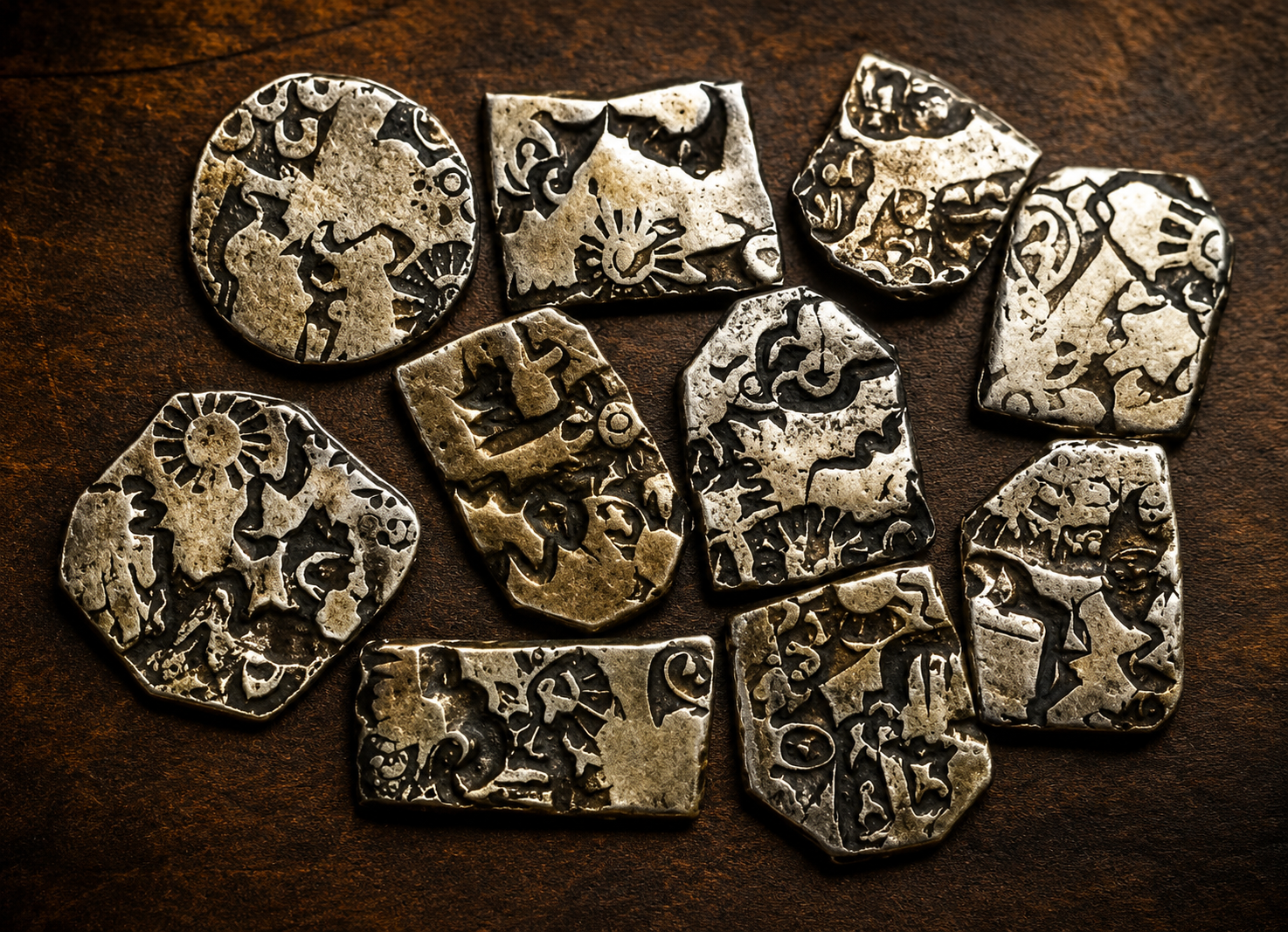
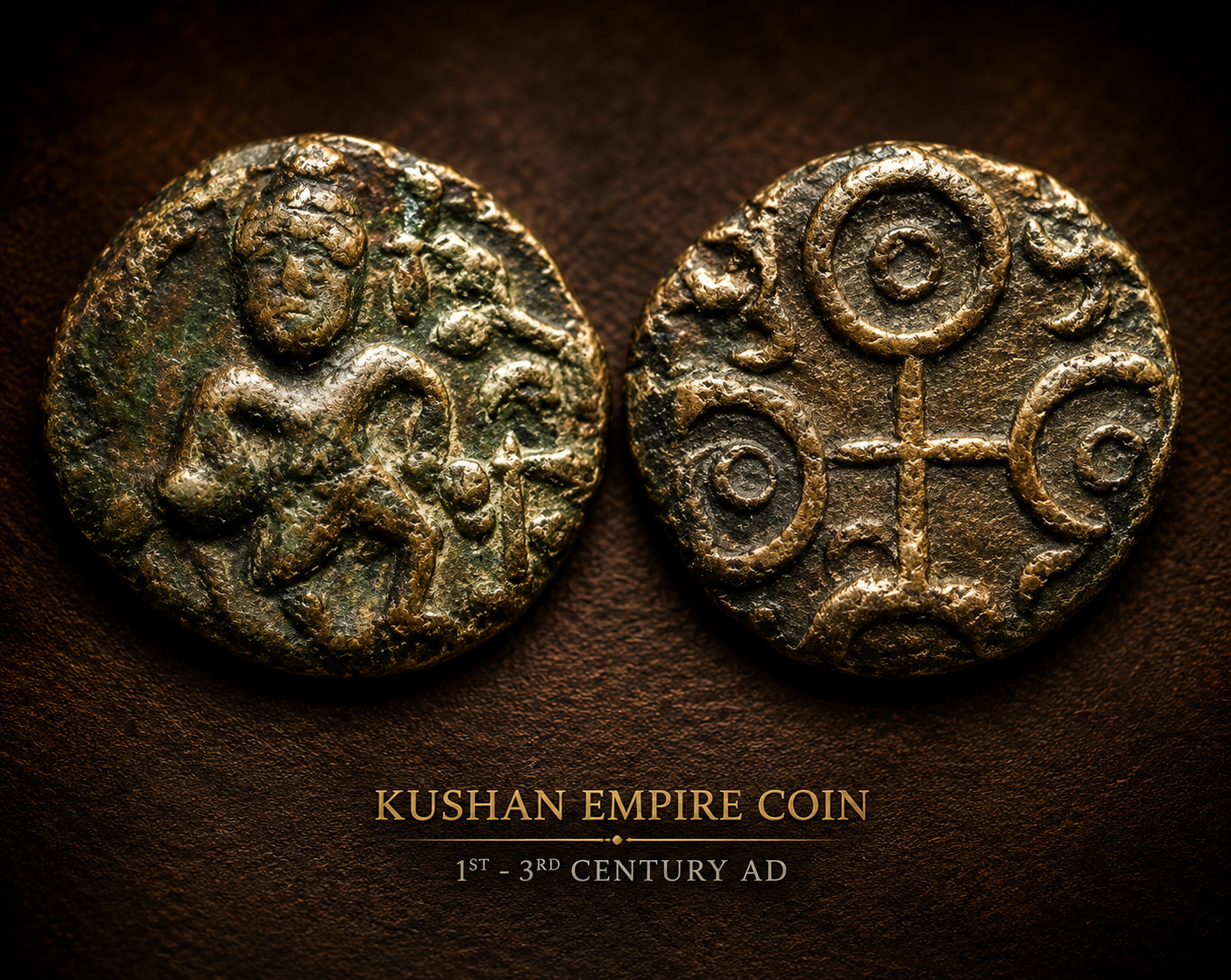
A surviving hoard of silver karshapanas and a copper uninscribed coin of Ujjayini, Avanti illustrate the range of punch-marked coinage recovered from this period.
Maurya Coins
- During the Mauryan period, punch-marked coins continued to be issued in large quantities; these represent a continuation of the Magadha kingdom’s coinage, since the ruling house of that kingdom went on to establish the Mauryan Empire. They contained, on average, 50–54 grains of silver in each coin.
- The basic coin is called the Karshapana (pana) in numismatic terms, but the Arthashastra states that there were at least four denominations of silver coins — pana, ardhapana (half-pana), pada (quarter-pana), and ashta-bhaga or arshapadika (one-eighth pana) — though only the Karshapana has actually been found.
- The style of these coins is not artistic, but they do show recognisable designs, such as Buddhist shrines and chaityas, or animals such as the elephant, horse, and lion.
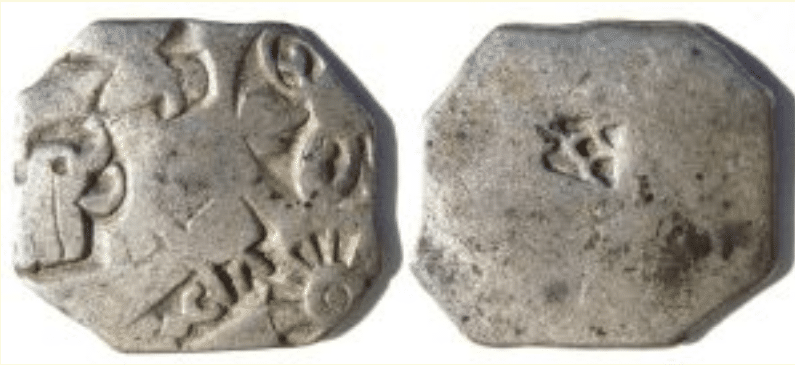
A punch-marked coin bearing an elephant and sun illustrates the recognisable Mauryan-era designs described above.
Practice Question: Punch-Marked Coins in Ancient India
Delineate various aspects of punch-marked coins in ancient India.
Answer: Punch-marked coins are a type of early Indian coinage, dating between about the sixth and second centuries BCE. The first coins in India may have been minted around the sixth century BCE by the Mahajanapadas of the Indo-Gangetic Plain. Punch-marked coins are known from both archaeological and literary sources.
Literary Sources
- Literary texts of the post-Vedic and Mauryan age — such as the Ashtadhyayi, the Arthashastra, and Buddhist texts — mention the names of these coins:
- Satamana (a larger silver coin);
- Karshapana (a smaller silver coin) — the most common;
- Pana (a silver coin) — the Ashtadhyayi mentions the salaries of officers being paid in Pana;
- Masaka (a large copper coin); and
- Kakini (a smaller silver coin).
Geographical Extent of the Coin
- Punch-marked coins circulated almost all over India — in the north-west, the Gangetic valley region, the Deccan, and even in the south.
- Important hoards of these coins have been found at Taxila, Amravati, Eran (Madhya Pradesh), Azamgarh (Uttar Pradesh), and Nandagaon (Uttar Pradesh), among other sites.
Metals of the Coin
- These coins were made mostly of silver, but also some copper; gold was notably absent.
Shape of the Coin
- The coins were of an irregular shape — some rectangular, some square, some round, and some with no specific shape at all.
Design of the Coin
- The obverse (front) bears a symbol — generally one, though some coins carry two to five symbols — while the reverse (back) is either blank or carries a minute symbol; there is no writing or legend on the coin.
- The various symbols found include human figures, weapons, animals (such as humped bulls in Saurashtra), tools, trees, geometric designs (such as the swastika in Dakshina Panchala), mountains, the sun, the wheel, birds (such as the peacock under the Mauryas), and trees within a railing (reflecting Buddhist influence).
Issued By
- Punch-marked coins were issued mostly by the state, though some references suggest the possibility of city or guild issues, indicating an element of private minting.
- City issues may be associated with Kausambi, Eran, Mahishmati, Vidisha, Taxila, and Varanasi, among other centres.
Other Aspects
- A unique discovery from the Kabul region is a bent-bar coin bearing no symbols at all.
- Evidence from Mauryan times sheds light on state regulation of coinage, with references to officers who served as controllers and regulators, such as the Lakshanadhyaksha (in charge of the mint), and the Roopdarshak and Roopdarka (both examiners of coins).
- It appears that the Mauryan state monopolised coin issue, and that the circulation of coins increased during Mauryan times compared with the earlier period.
Technology and Weight
- These coins were based on punching technology, with symbols hammered on using punches. They were made of silver of a standard weight but an irregular shape, achieved by cutting up silver bars and then trimming the edges to the correct weight.
- The basic unit of the coin standard was the Ratti, also known as the Raktika or Krishnala; 1 Ratti equalled 1.8 grains (a grain being a weight measure used for metals, with 1 grain equal to 64.79 mg).
- Two weight standards existed for silver coins: the Satamana, equal to 180 grains or 100 ratti, and the Karshapana, equal to 32 ratti.
Decline of Punch-Marked Coinage
- In the north, following the fall of the Maurya Empire and the growing influence of the Greco-Bactrians and Indo-Greeks, punch-marked coins were gradually replaced by cast, die-struck coins — a transition visible in the post-Mauryan coinage of Gandhara.
Conclusion
The evolution of punch-marked coinage — from the earliest Mahajanapada issues through the standardised Mauryan Karshapana to their eventual replacement by die-struck coins under Indo-Greek influence — traces the growing sophistication of the ancient Indian economy over nearly half a millennium. Their weight standards, regional symbols, and issuing authorities offer historians a rare window into the political geography and economic administration of the Mahajanapadas and the Mauryan Empire alike, making this an essential topic for UPSC History Optional aspirants studying the economic history of ancient India.




