

Harappan Religious and Funerary Beliefs

- One of the most complex issues concerning ancient history is determining past ways of thought and belief — especially in the case of the Indus civilisation, where these must be inferred entirely from material remains, since its writing has not been satisfactorily deciphered.
- The archaeological indicators here are mainly portable objects of various kinds, figural representations, and a few areas within settlements that seem to have been set apart for sacred purposes.
- One major problem is that, without written information, it is difficult to differentiate sacred from secular activities. Thus, it seems that almost any find from a Harappan site might potentially carry a sacred content.
- There are no structures at Indus sites that can be described as temples, nor are there any statues that can be considered images that were worshipped.
- In contrast to the contemporary Egyptian and Mesopotamian civilisations, the Indus valley lacks any monumental palaces, even though the society possessed the requisite engineering knowledge.
- This may suggest that religious ceremonies, if any, may have been largely confined to individual homes or to the open air.
Objects of Worship
- The evidence for the objects of worship comes primarily from the study of Harappan seals and terracotta figurines.
Female Goddesses and Fertility Worship
- The worship of female goddesses associated with fertility has long been held as one of the major features of Harappan religion.
- For instance, a seal showing a nude woman, head downwards, with her legs apart and a plant issuing from her vagina, is often interpreted as a prototype of Shakambari, the Earth Mother.
- The discovery of a large number of terracotta female figurines led to their being labelled “Mother Goddesses.”
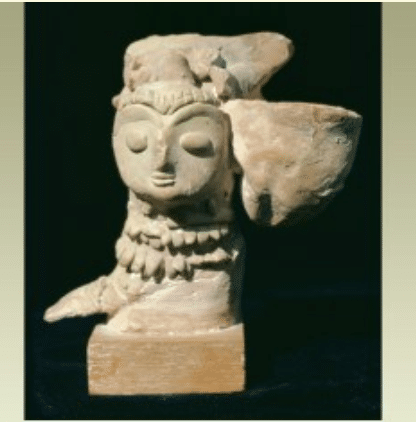
- This is also reflected in the importance of goddess worship in later Hinduism, and may be connected to the Harappans being an agricultural society, concerned with fertility.
Mother Goddess Terracotta Figurines
- The Harappan settlements have yielded a very large number of terracotta figurines.
- Not all female figurines necessarily represented goddesses, and not all goddesses necessarily had maternal associations.
- Some Harappan female figurines may have had a cultic significance, and may have been part of household rituals; others may simply have been toys or decorative items.
- The type most frequently interpreted as having religious significance is a slim female figure with a distinctive fan-shaped headdress, wearing a short skirt, and heavily ornamented with necklaces, armlets, bangles, anklets, and earrings.
- Sometimes they are shown with an infant. The general notion of fertility is also indicated by many representations of pregnancy — this evidence indicates the prevalence of fertility cults and mother goddess worship.
- Female figurines — including those with possible religious significance — are found in large numbers at sites such as Mohenjodaro, Harappa, and Banawali, but are notably absent at sites such as Kalibangan, Lothal, Surkotada, or Mitathal.
- The fact that so many of these figurines were found broken suggests that they may have been part of a ritual cycle, made for short-term use on certain specific occasions — they may thus have been votive offerings, rather than cult images.
Counter Views
- John Marshall hypothesised the existence of a cult of Mother Goddess worship, based on the excavation of several female figurines, and thought that this was a precursor of the Hindu sect of Shaktism.
- However, the function of the female figurines in the life of Indus Valley people remains unclear.
- Some stones interpreted by Marshall as sacred phallic representations are now thought to have been used as pestles or game counters instead, while ring stones, once thought to symbolise the yoni, were determined to be architectural features used to stand pillars — although the possibility of their religious symbolism cannot be entirely eliminated.
- At towns like Kalibangan and Surkotada, female figurines are practically absent.
- Even at Mohenjodaro, the fact that only 475 of the total number of terracotta figurines and fragments represented the female form suggests that fertility cult worship was not as common a practice as it has sometimes been made out to be.
- Several of the female figurines were also utilised as lamps, or for the burning of incense.
Male God: The Pashupati Seal
- The Harappans also worshipped a male god, represented on a steatite seal discovered at Mohenjodaro, usually referred to as the Pashupati seal.
- The description of the Pashupati seal:
- A male figure, wearing a buffalo-horned headdress, is shown sitting in a yogic posture.
- He is flanked by four animals — an elephant, rhinoceros, water buffalo, and tiger. Beneath the dais are two antelopes or ibexes.
- Marshall identified this figure with the god Pashupati.
- There exists a striking resemblance between this deity and Shiva (Rudra) of later Hindu mythology, who is associated with asceticism, yoga, and the linga — hence the figure is also called “proto-Shiva.”
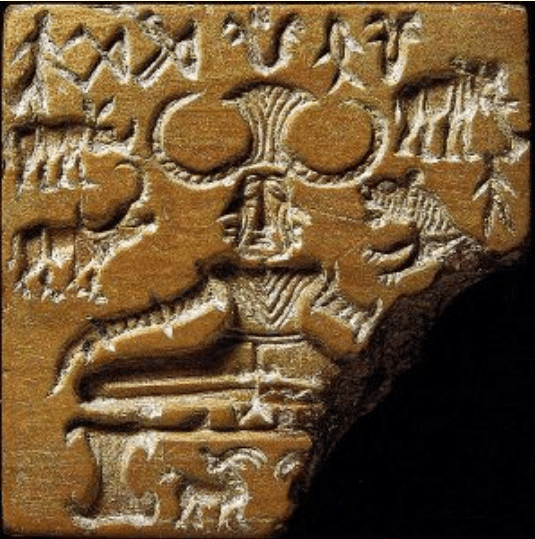
- Criticism of this identification: Many critics have argued that the figure does not have three faces or a genuinely yogic posture, and that in Vedic literature, Rudra was not a protector of wild animals.
- Some scholars suggest that while it would be appropriate to recognise the figure as a deity, its association with the water buffalo, and its posture of ritual discipline, regarding it as a “proto-Shiva” would be going too far.
- In another instance, a deity with horns and flowing hair is shown standing nude between the branches of a Pipal tree, with a worshipper kneeling in front of it.
- Behind the worshipper is a man-faced goat, and below are seven other human figures, with long pigtails and tall headdresses.
- In one seal, snakes are shown accompanying the yogic figure.
Lingas and Yonis
- Worship of male and female creative energy took the form of stone icons of lingas and yonis — reflecting fertility-related beliefs.
- Fertility has been evoked not merely in the context of the “Shiva-Pashupati” seal, but also with reference to phallic stones (found at Mohenjodaro, Harappa, and Dholavira), and to a miniature terracotta phallic emblem, set in an ovular shape, found at Kalibangan.
Trees, Plants, and Animals
- Harappan seals, sealings, amulets, and copper tablets depict a number of trees, plants, and animals, some of which may have had cultic significance.
- The presence of part-human, part-animal characters on Indus seals, and a human personage on a pipal tree, suggest a shamanistic component in Harappan religion.
- The Pipal tree appears often, and may have been venerated.
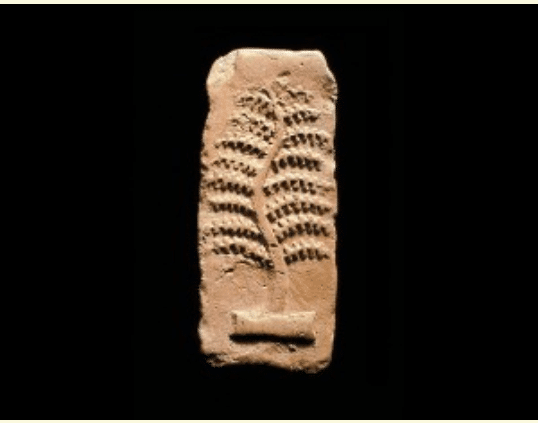
- In many cases, a figure is shown looking through the branches — scholars believe this represents the tree-spirit.
- In many cases, worshippers are shown standing in front of the tree; in other cases, a tiger or some other animal is shown in front of it.
- A seal found at Mohenjo-daro shows a row of seven figures with long braids, standing in front of a Pipal tree, which itself has a horned figure standing within it.
- This has been interpreted as the seven rishis, or the seven mothers, of later Indian mythology. The horned figure is probably Shiva.
- Some of the animals depicted on seals and sealings — the humped and humpless bull, snake, elephant, rhinoceros, antelope, gharial, and tiger — may have had cultic significance.
- The bull, a symbol of male virility, seems to have been particularly important — steatite bull statuettes have been discovered at certain sites, including a sophisticated terracotta bull found at Mohenjodaro.
- It is possible that some of the terracotta animals on wheels may have been cult images, rather than mere toys.
- Two Harappan sealings appear to represent animals being carried in processions — one of them resembling a bull or cow.
- The composite animals (tiger-human, bull-elephant, ram-bull-elephant, etc.) and the “unicorn” depicted on seals and sealings may also have had some sort of religious or mythological significance.
- The conception of composite creatures, like “Narasimha,” was very much a part of the mythology of the later Indian tradition.
- The “unicorn” was a mythical animal, since no such real beast exists — it is likely to have been a cult object.
- A seal reported from Chanhudaro depicts a bull-bison with an erect penis, fecundating a supine human figure.
- It is possible that present-day reverence for bulls and cows had its beginnings in the Harappan civilisation.
Water, Ritual, and the “Great Bath”
- A few structures reflect a connection between concepts of cleansing through water, and ritual function.
- The sunken, rectangular basin known as the “Great Bath” at Mohenjodaro is one such instance.
- The Great Bath was probably the scene of an elite ritual activity, involving ceremonial bathing. Such elaborate bathing arrangements were also made at very sacred ritual spots in subsequent historical phases in India.
- The cult connection of this water-using structure is evident from its method of construction, which had three concentric zones around it, including streets on all four sides — making it the only free-standing structure of the city — likely intended for a ritual procession leading into it.
- The bathing pavements and well found in the vicinity of the offering pits on Kalibangan’s citadel also underline this connection between water and ritual.
Amulets, Masks, and Signs of Sacrifice
- Some of the terracotta, shell, faience, and metal tablets may have been amulets.
- The svastika motif found on such terracotta, shell, faience, and metal tablets may have been associated with a protective function, or with auspiciousness.
- Terracotta masks and puppets, found at Mohenjodaro and Harappa, include those in the form of real and mythical animals, and may have been associated with religious rituals.
- A triangular cake found at Kalibangan points towards the practice of animal sacrifice.
- A cylindrical seal found at Kalibangan points towards the practice of human sacrifice.
- It shows a woman flanked by two men, who hold her with one hand and raise swords over her head with the other.
Fire Altars
- At Kalibangan, in the citadel, a series of raised brick platforms were found, crowned with “fire altars” — a series of brick-lined pits containing ash and animal bones.
- This area also had a well and bathing places. The complex seems to represent some kind of ritual centre, where animal sacrifice, ritual ablution, and some sort of fire ritual were performed.
- Many houses in the lower town also contained a room with a “fire altar.”
- At Lothal too, fire altars have been found.
- These findings are very important, since:
- They show that the Harappans in different geographical areas followed different religious practices.
- The fire ritual was central to the Vedic religion. The Vedic Aryans are believed to have been a distinct set of people — the evidence from Kalibangan might indicate that the Aryans, when they came and settled in these areas, adopted the religious practices of the Harappans.
Some Mythical Heroes
- Some other human figures with apparent religious significance are found on seals and amulets.
- Human figures with horns on the head and long tails are frequently shown on the seals; sometimes, they have the hooves and hind legs of cattle.
- Some other seals bring to mind Mesopotamian mythology.
- For example, a man grappling with a pair of tigers immediately calls to mind the brave warrior Gilgamesh, said to have killed two tigers.
The Places of Worship
- According to some historians, a number of large buildings in the citadel and the lower town at Mohenjodaro may have been temples of the gods.
- This view is supported by the fact that most of the large stone sculptures were found within these buildings.
- In the lower city at Mohenjodaro, a large building has been discovered, with a monumental entrance and a double stairway, leading to a raised platform on which was found a stone sculpture — a seated man with hands on knees, and a bearded face.
- Another stone statue was discovered in the same building — this is why scholars have identified this building with a temple.
- Near the Great Bath, another large structure was found, identified by some historians as the residence of a high priest, or a college of priests.
- Similarly, an oblong assembly hall has also been reported from the citadel area. To the west of this structure was found a complex of rooms, in one of which was discovered a seated male statue — this too has been identified as part of some religious structure.
- These ritual structures provide us with a glimpse of the religious practices of the people of Mohenjodaro; we can presume that some ritual performances took place in the large, temple-like structure described above.
- However, not a single structure found at any Harappan site can be conclusively identified as a temple.
Harappan Funerary Beliefs and Practices
- The disposal of the dead has been an important religious activity of human groups across history, since attitudes towards the dead are linked to human beliefs regarding this life, and life after death.
- The Harappan civilisation has not yielded any monuments for the dead that could equal, in grandeur, the pyramids of Egypt, or the Royal Cemetery of the Mesopotamian city of Ur. However, we do have certain evidence about the burial practices of the Harappans.
- The principal sites of burials are Harappa, Kalibangan, Rakhigarhi, Lothal, Rojdi, and Ropar.
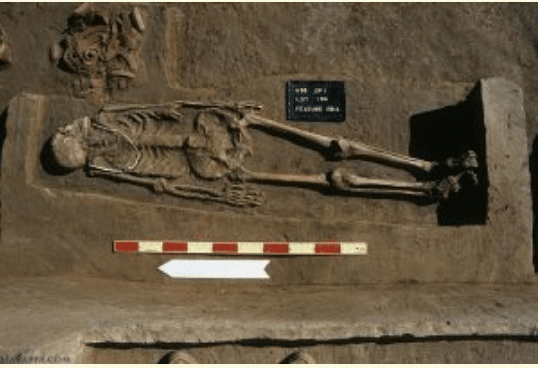
- At Harappa, the burial of an adult man shows the body — with a necklace around its neck — likely wrapped in a shroud, and then placed inside a wooden coffin, which was entombed in a rectangular pit surrounded by burial offerings in pottery vessels. Harappan cemeteries have also been located at sites such as Kalibangan, Lothal, Rakhigarhi, and Surkotada.
Extended Position
- The most common method of burial was to place the body of the deceased in an extended position, with the head towards the north, in a simple pit or brick chamber.
- Dead bodies were generally placed in a north-south orientation, laid on their backs.
Grave Goods
- Grave goods — including food, pottery, tools, and ornaments (such as shell bangles, necklaces, and earrings) — were placed along with the body, but they were never too many or too lavish.
- Clearly, the Harappans preferred to use their wealth in life, rather than bury it with their dead.
- A large number of earthen pots were placed in the grave; in some cases, copper mirrors, mother-of-pearl shells, and antimony sticks were also kept with the body.
Coffin Burial
- Normally, no coffin, structural or otherwise, was used — but at Harappa, archaeologists found a woman’s body in a wooden coffin, lined with reed mats.
Symbolic Burials
- Symbolic burials, with grave goods but no skeletons, were found at Kalibangan.
- Small circular pits containing large urns, accompanied by pottery, have been found — but these did not contain any skeletal remains.
Fractional Burials
- Fractional burials (where the body was exposed to the elements, and the bones then gathered and buried) were found at Mohenjodaro and Harappa.
Urn Burials
- Mohenjodaro and Harappa also gave evidence of urn burials, pointing towards the existence of the practice of cremation.
Multiple Burials
- Multiple burials of men and women were discovered at Lothal.
- A unique funerary rite, involving the simultaneous burial of two persons in the same grave pit, was observed at Lothal.
- The first anthropologically confirmed joint burial of a couple, buried simultaneously, has been found at Rakhigarhi. This could possibly represent the practice of sati, though this remains doubtful.
Regional and Site-Specific Variations
- At the Ropar cemetery, the body was normally laid in the grave with the head to the north-west, though in one case the orientation was north-south.
- At Ropar, a man was found buried with a dog.
- At Rojdi, two infants were found buried beneath the floor of a house.
- At Mohenjodaro, a few bodies were found scattered throughout the city in disarray.
- The skeletons seem to be in a state of trauma, as if the individuals had been caught in the act of some action, with weapons in their hands.
- The causes of these burials have been hypothesised to be either a loss of civic rule and order in the city, or an invasion of some kind.
- The burials at Kalibangan, the other large burial site, are of three types:
- Bodies buried in a supine position, with skeletal remains.
- Pot burials in circular pits — an interesting and rare type of burial, in which the bodies of individuals were crammed into pots and buried.
- Large pots interred in rectangular or circular pits, with no skeletal remains.
Social Hierarchy in Burials
- Interestingly, Harappan burials show little evidence of social hierarchies, unlike Mesopotamian or Egyptian burials, where some interments may indicate considerable wealth. But there was some degree of social hierarchy — for example:
- At Kalibangan, an older male was interred in an old brick chamber with 70 pottery vessels. The man was also decked in jewellery of an expensive nature — clearly, this individual was of high importance in the society.
- These practices show that the disposal of the dead among the Harappans was different from the practice that followed subsequently, in the historical phases of Indian history, where the predominant system seems to have been cremation.
- At the same time, the careful placement of bodies, provided with ornaments and toiletries, is indicative of some belief in life after death.
- Thus, it can be concluded that the religious and funerary beliefs and practices of the Harappans show great variety.
Diversity of Religious Practices
A study of the various kinds of objects found in excavations shows that different regions of the Harappan civilisation followed different kinds of religious practices.
- Fire worship was prevalent at Kalibangan and Lothal, but unknown at Harappa and Mohenjodaro.
- Ritual bathing, evidenced at Mohenjodaro, might have been absent at Harappa.
- Burial practices show wide variation, ranging from extended inhumation to double burials and pot burials — finds at Kalibangan also show that different kinds of burial practices were being followed within the same settlement.
- This kind of diversity in religious beliefs and practices, even within the same settlement, reflects the complex nature of the urban centres.
- Unlike tribal societies, where every member of the tribe tends to follow similar religious practices, urban centres are characterised by the presence of people following different kinds of religious practices.
- This apparently means that urban centres were formed through the political and economic integration of varied social groups.
- Also, an urban centre implies the presence of traders from different regions, each with their own religious practices — such groups retained their social mores and customs, even as they lost their political and economic independence.
Conclusion
The religious and funerary beliefs of the Harappans, reconstructed almost entirely from material remains in the absence of a deciphered script, reveal a civilisation of striking religious diversity rather than a single, uniform faith. From the contested “Mother Goddess” figurines and the much-debated Pashupati seal, to the fire altars of Kalibangan, the ritual bathing of the Great Bath at Mohenjodaro, and the wide variety of burial practices — extended, fractional, urn, symbolic, and multiple — found across sites like Harappa, Lothal, Rakhigarhi, and Ropar, the evidence consistently points not to a single Harappan religion, but to a mosaic of regionally and even locally distinct beliefs and rituals. This diversity, evident even within single settlements, is itself an important historical clue: it suggests that Harappan urban centres were not culturally homogeneous, but were formed through the integration of varied social and occupational groups, each retaining something of its own religious identity — a pattern that, together with the possible continuities linking Harappan fire rituals, phallic worship, and animal cults to later Vedic and Hindu practice, continues to make Harappan religion one of the most debated aspects of the civilisation.




