

The Ghurian Invasions – Factors behind Ghurian Success

The Ghurian invasions, culminating in the two decisive Battles of Tarain (1191 and 1192) and the Battle of Chandawar (1194), mark the true watershed in the establishment of Muslim political power in India, laying the foundations of the Delhi Sultanate. Yet this outcome was neither sudden nor inevitable — it was the product of nearly two centuries of political fragmentation in North India following the decline of the Gurjara-Pratihara and Rashtrakuta empires, compounded by the earlier destabilising raids of Mahmud of Ghazni, and finally sealed by the military and organisational superiority the Ghurids brought to the battlefield under Muizzuddin Muhammad. This article traces the political landscape of North India from the death of Harsha through the age of the Rajput kingdoms, examines the course of the Ghaznavid and Ghurian invasions in detail — including the careers of Mahmud of Ghazni and Prithviraj III Chauhan — and finally undertakes a comprehensive, historiographically informed analysis of the factors behind Ghurian success and Rajput defeat.
Geographical Context: The Mountain Passes
- West and Central Asia are connected to India geographically across mountain barriers that demarcate India from Central and West Asia but do not pose an insurmountable barrier, unlike the Himalayas to the north.
- Consequently, nomadic and semi-nomadic hordes have constantly tried to enter India through these mountain passes, attracted by:
- India’s well-watered plains with fertile soil.
- Its rich, flourishing cities and ports.
- Its fabulous wealth, generated by hardworking peasants, skilful artisans, and experienced traders and financiers.
Political Condition of North India
- After the death of Harsha and before the Muslim invasions, India was not politically united.
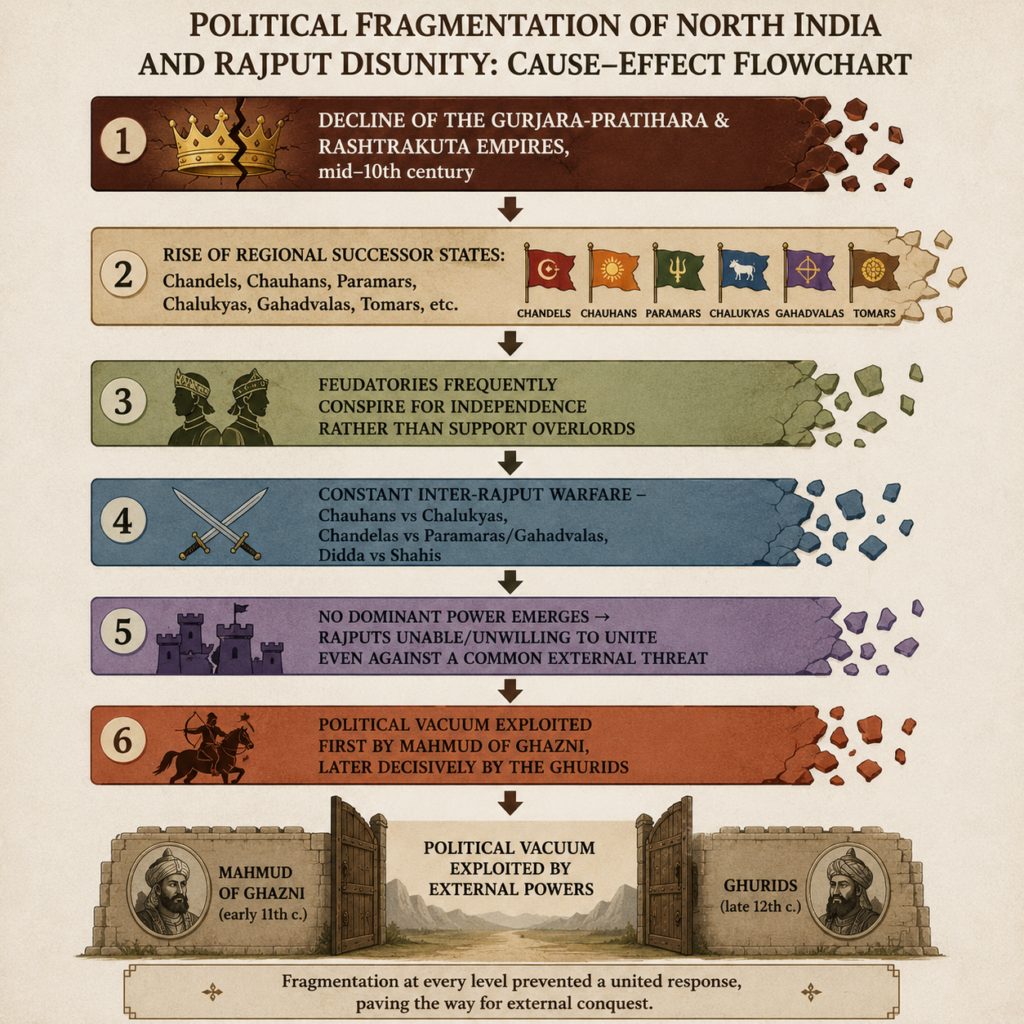
- The middle of the 10th century saw the decay of two of the most powerful states that had dominated North and Central India over the preceding two centuries — the Gurjara-Pratihara empire (capital at Kannauj) and the Rashtrakuta empire (capital at Manyakhet).
- In their place, a number of kingdoms rose up — the Chandels of Kalinjar and Mahoba, the Chauhans of Sakambhari in Rajasthan, the Paramars of Malwa, and the Chalukyas of Gujarat. These states had numerous feudatories, who sometimes assisted their overlords but more often conspired to become independent.
- Kashmir was under the powerful queen Didda, who ruled from 958 AD to 1003 AD — first as Regent for her son and various grandsons, and thereafter as sole ruler in her own right.
- Didda had a long-standing rivalry with the Shahis (Hindu-Shahis) and therefore refrained from assisting them in their struggle with Mahmud. Nor did any other Rajput ruler help the Shahis, despite Ferishta’s claims to the contrary.
- The Hindu-Shahis ruled from Peshawar to the river Beas, and were the first victims of Mahmud’s invasion of India.
Ghazni Invasion
- In political and military terms, the invasions of Mahmud of Ghazni were the actual precursors of the Delhi Sultanate.
- In 999, Mahmud ascended the throne at Ghazni. In 1001, he marched against the Hindu-Shahis, who ruled from Peshawar to the river Beas — the Shahis were defeated and made feudatory.
- In 1015, Mahmud advanced up to Lahore and plundered it, opening the way for further Turkish advance into the Gangetic plains.
- The 17th-century historian Ferishta claims the Shahis were assisted in this battle by the Rajput rulers of Delhi, Ajmer, Kalinjar, and Kannauj. However, modern historians doubt the veracity of this claim, since no contemporary historian mentions it — nor was Delhi an important state at the time, Ajmer had not even been founded, and the rulers of Kannauj were in decline. Ferishta’s account thus appears to have exaggerated the scale of the Ghaznavid victory.
- Mahmud undertook three expeditions into the Ganga Valley. The purpose of these raids was to:
- Acquire wealth for his Central Asian campaigns.
- Destabilise the states of the region, so that no coalition of powers against him could emerge.
- These expeditions did not lead to territorial expansion beyond the Punjab, but they did succeed in turning the upper Ganga doab into a kind of neutral territory, in which no powerful king could establish himself.
- In 1025, Mahmud plundered across Rajasthan to Somnath.
- Invasion was almost an annual feature of Mahmud’s reign, coming to an end only with his death in 1030 A.D.
- The ultimate result was the breakdown of Indian resistance, paving the way for future Turkish conquests, and exposing the inadequacy of Indian politics in offering a united defence against external threats.
Mahmud Ghazni: An Assessment
- Mahmud Ghazni was a bold warrior and leader, who almost single-handedly carved out one of the biggest empires in West and Central Asia.
- He also gave patronage to literary men and poets, such as Firdausi, the highly revered Persian poet and author of the epic Shahnamah (“Book of Kings”) — the world’s longest epic poem created by a single poet.
- However, he built no lasting institutions which could outlive him. Moreover, his rule outside Ghazni was tyrannical, and he levied heavy taxes in Khurasan.
- Mahmud is remembered in India primarily as a plunderer, and did not earn a good name for himself even outside India among his contemporaries.
After the Death of Ghazni
- In the 150 years between the death of Mahmud Ghazni in 1030 and the beginning of the Ghurid invasion, there was constant internecine warfare between the various Rajput principalities of the region, without any single power emerging as dominant.
- Following Mahmud’s raids on Kannauj, Pratihara power collapsed, giving rise to small feudatories.
- Towards the end of the 11th century, a new dynasty — the Gahadvalas (seat of power in the Varanasi area) — rose to power in the doab, constantly fighting the Palas of Bengal and the Tomars of Delhi.
- Another dynasty, the Chahamana (Chauhan), arose in Rajasthan, constantly fighting the Chalukyas of Gujarat and the Paramaras of Malwa.
- Another powerful dynasty was the Chandelas of Khajuraho, whose rivals were both the Paramaras of Malwa and the Gahadvalas of Kashi.
- These Rajput states, individually or as a group, were unable or unwilling to join hands to expel the Ghaznavids from the Punjab, despite the rapid decline of Ghaznavid power in West and Central Asia following Mahmud’s death.
- The successors of Mahmud, meanwhile, continued making debilitating raids into the doab as far as Varanasi, keeping the Ghaznavid economy buoyant through a continuing flow of bullion — though the Ghaznavids remained in no position to expand their territories in India.
- The South, meanwhile, was also divided into small kingdoms such as the Cholas, Cheras, Pallavas, Chalukyas, and Pandyas.
The Rise of the Ghurids
- The rise to power of the Ghurids at Ghur — a small, isolated area located in the mountains between the Ghaznavid empire and the Seljukids — was an unusual and unexpected development.
- The area was so remote that, until the 11th century, it had remained a pagan enclave (a variety of Mahayana Buddhism was prevalent there), surrounded by Muslim principalities.
- It was converted to Islam in the early part of the 12th century, after Mahmud raided it.
- After some regional conflicts, the Ghurs emerged as a prominent power.
- In 1163, Ghiyasuddin Muhammad assumed the throne of Ghur, appointing his younger brother, Muizzuddin Muhammad, as ruler at Ghazna — enabling Muizzuddin to engage all his energies for the conquest of India.
Sources for the Ghurian Invasions
- Contemporary and near-contemporary writers serve as the principal sources for the Ghurian invasions:
- Minhaj Siraj’s Tabaqat-i-Nasiri.
- Hasan Nizami’s Tajul-Ma’asir.
- Prithviraj Raso by Chand Bardai.
Prithviraj III and the Political Situation in North India
- The most famous Chauhan ruler was Prithviraj III, who ascended the throne at Ajmer at the age of eleven, in 1177, and took direct control of the administration at the age of sixteen, immediately commencing a vigorous policy of expansionism at the cost of smaller Rajasthani states.
- His most famous expedition was against the Chandelas of Khajuraho and Mahoba.
- The Chandelas constituted the most powerful state in the region and had a history of resistance against the Ghaznavids. The fight in which the famous warriors Alha and Udal died defending Mahoba has been immortalised in the Hindi epics Prithviraj-Raso and Alha Khanda.
- Prithviraj gained a significant victory against the Chandelas, acquiring considerable booty but no extra territory.
- Between 1182 and 1187, Prithviraj turned his attention to his ancient rivals, the Chalukyas of Gujarat.
- The Gujarat ruler, Bhima II — who had earlier beaten off the Ghurid ruler Muizzuddin — defeated Prithviraj as well.
- This forced Prithviraj to turn his attention towards the Ganga Valley and the Punjab, leading to a tussle with the Gahadvalas of Kannauj, who held the most extensive kingdom in the area.
- (This episode includes Prithviraj’s abduction of Sanyogita, daughter of the Gahadvala ruler Jai Chand, at her svayamvara, and Jai Chand’s subsequent defeat in battle.)
- By leading expeditions against all his neighbours, Prithviraj had isolated himself politically — a decision that cost him dearly when he later had to face the Turkish armies of Muizzuddin Muhammad.
- Prithviraj is remembered as a great fighter and a patron of poets and pandits; as a general, he had many victories to his credit. However, his conduct on the battlefield in the second Battle of Tarain stands as a blot on his generalship and statesmanship.
Chand Bardai and the Prithviraj Raso
- Chand Bardai was the court poet of King Prithviraj III Chauhan, with mastery of grammar, literature, astrology, and the Puranas. He accompanied the king during his wars, including the second Battle of Tarain.
- Chand Bardai composed the Prithviraj Raso, an epic poem in Hindi about the life of Prithviraj; over time, the text was embellished with interpolations and additions by many other authors.
- The Prithviraj Raso is a semi-historical, semi-legendary account depicting the bravery of Prithviraj Chauhan.
- The legend exaggerates historical events for dramatic effect, and its historicity is considered unreliable by historians — many events and battle details narrated in the Raso do not agree with other contemporary Hindu and Muslim sources.
- While not strictly history, the Prithviraj Raso remains a valuable source of information on the social and clan structure of the Kshatriya communities of northern India.
Early Invasions of Ghori (Muizzuddin Muhammad)
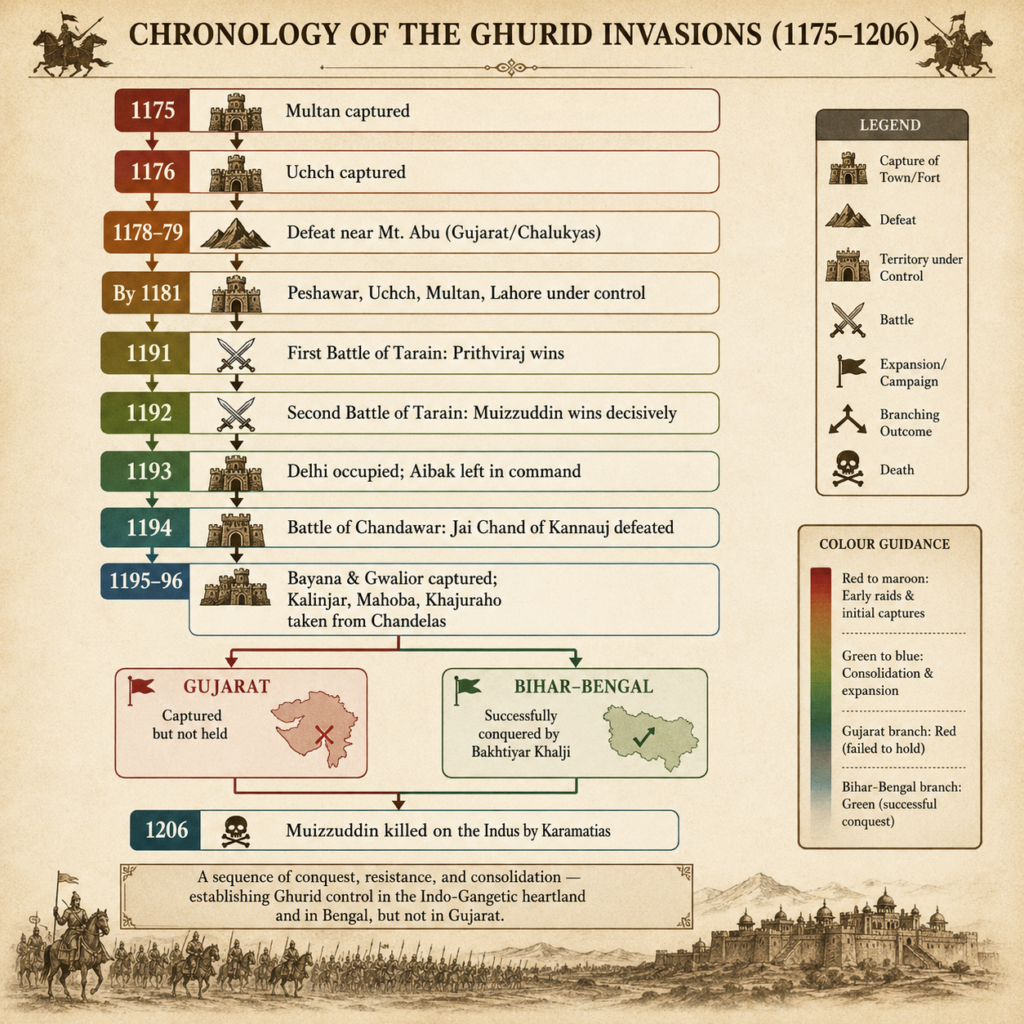
- Muizzuddin’s first expedition against India was launched in 1175, when he attacked and captured Multan. The following year, he captured Uchch.
- In 1178–79, he marched through Multan and Uchch to Neharwala in Gujarat; however, the Gujarat ruler inflicted a crushing defeat on Muizzuddin near Mt. Abu.
- The Chalukyas had requested Prithviraj for help; however, his ministers declined, considering both the Ghurids and the Chalukyas to be enemies of the Chauhans. Since Prithviraj was barely twelve at the time, he can hardly be blamed for this decision.
- Muizzuddin’s initial objective was to gain control over Punjab and Sind; by 1181, Peshawar, Uchh, Multan, and Lahore were under his control.
- Moving further into India, the Ghurids came into conflict with the Rajputs controlling the Gangetic plain.
The First Battle of Tarain, 1191
- In 1191, Muizzuddin attacked and captured the fortress of Tabarhinda, which was strategically important for the defence of Delhi.
- Realising its importance, and without giving the Turks time to consolidate, Prithviraj immediately marched towards Tabarhinda.
- In the battle, Prithviraj attained a complete victory, with Muizzuddin being saved by a Khalji horseman.
- After his victory, Prithviraj did not pursue the dispirited Ghurid army — either because he did not wish to venture into hostile territory far from his base, or because he believed, like the Ghaznavids before them, the Ghurids would be satisfied to rule over the Punjab.
- He thus treated the siege of Tabarhinda as merely a frontier fight, and made little preparation for a future contest with the Ghurid chief.
- The Prithviraj Raso accuses Prithviraj of neglecting the affairs of state after this victory.
The Second Battle of Tarain, 1192
- 1192 is rightly regarded as one of the turning points in Indian history.
- Muizzuddin made careful preparations for this contest, disgracing many amirs who had not stood firm in the earlier battle.
- The contemporary chronicler Minhaj Siraj records that Muizzuddin’s army had 120,000 men, fully equipped with steel coats and armour.
- The 17th-century historian Ferishta places Prithviraj’s forces at 3,000 elephants, 300,000 horsemen, and considerable infantry — figures that appear grossly exaggerated, though we may reasonably conclude that Prithviraj’s forces were indeed larger.
- Ferishta also claims that, on Prithviraj’s appeal, all the leading “Rais of Hind” joined his banners — but this is not correct, as Prithviraj had already alienated all his powerful neighbours through his militaristic policies; nor does Ferishta name any of the prominent Rais.
- The Battle of Tarain was more a war of movement than of position.
- The lightly armed mounted archers of Muizzuddin harassed the slow-moving forces of Prithviraj, attacking from all sides once confusion had set into his ranks.
- Prithviraj suffered a complete defeat and fled, but was pursued and caught near Sarsuti (modern Sirsa) in Hissar district.
- The historian Minhaj Siraj states he was executed immediately.
- According to another contemporary writer, Hasan Nizami, he was instead taken to Ajmer and allowed to rule — a claim supported by numismatic evidence, showing coins of Prithviraj bearing the words “Sri Muhammad Sam” on the reverse.
- Prithviraj rebelled after some time and was executed; his son succeeded him, continuing to rule Ajmer for a time as a feudatory.
- The Battle of Tarain was a watershed in Indian history — Rajput power entered a phase of irreversible decay.
Consolidation After Tarain
- The Ghorians did not immediately take over administration of all conquered territories. Wherever feasible, they allowed Rajputs to continue ruling, provided Turkish suzerainty was acknowledged — for example:
- Ajmer was allowed to be retained by Prithviraj’s son as a vassal ruler.
- The Tomar chief of Delhi, who had died at Tarain, had his son installed at Delhi as a vassal.
- However, this policy was disturbed by recurrent conflicts between the imperial designs of the Ghorians and local rulers.
- Ghori returned to Central Asia, leaving an occupation army at Indraprastha (near Delhi) under the command of Qutbuddin Aibak.
- In 1193, Delhi was occupied. Its location and historical tradition made it the most suitable capital for Turkish power in India — since expansion into the upper Ganga valley required Delhi not be left in alien hands, and rebellions both at Ajmer and Delhi decided the issue.
- Delhi now became the main base of Turkish operations in India.
- It was close to the Ghorid stronghold in Punjab.
- It was conveniently placed for launching expeditions towards the east.
Battle of Chandawar, 1194
- Having consolidated their position in the Delhi region, the Turks were now poised to attack the Gahadvalas of Kannauj, reputed to be the most powerful kingdom in the country.
- In 1194, Muizzuddin returned to India. The areas of Meerut, Baran (modern Bulandshahr), and Koil (modern Aligarh) in the upper doab — previously controlled by the Dor Rajputs — had already been occupied by the Turks shortly after the first Battle of Tarain.
- Although the Dors had offered stiff resistance, and the area held great strategic value, Jai Chand, the Gahadvala ruler, had not come to their help — earlier, in a false sense of security, he had even rejoiced at Prithviraj’s defeat at Muizzuddin’s hands.
- In 1194, Muizzuddin advanced towards Kannauj and Banaras; the battle was fought at Chandawar, and Jai Chand suffered a disastrous defeat.
- The battles of Tarain and Chandawar laid the foundations of Turkish rule in the Ganga valley. There was no large-scale resistance in the area to Turkish rule, though it took the Turks another fifty years to fully consolidate their hold.
Further Expansion and the Death of Muizzuddin
- To protect their southern and western flanks, and to provide future bases of operations, the Turks sought to conquer the strategic forts between Delhi and Malwa.
- In 1195–96, Muizzuddin occupied the Bayana fort (in Bharatpur district, Rajasthan). Gwalior, one of the most powerful forts, was captured after a long siege.
- A little later, Kalinjar, Mahoba, and Khajuraho were wrested from the Chandel rulers of Bundelkhand, the most powerful rulers of the area after the Gahadvalas.
- Efforts at expansion beyond the upper Ganga valley and eastern Rajasthan were made in two directions:
- Gujarat in the west: Muizzuddin’s slave invaded Anhilwara, defeating the Rai and occupying the city — but the Turks could not hold it for long, illustrating the limits of Turkish power in India at that stage, as they were not yet strong enough to retain places far from their base at Delhi.
- Bihar and Bengal in the east: this expansion, by contrast, was more successful, carried out by Muhammad-bin-Bakhtiyar Khalji.
- Muizzuddin suffered a sharp reversal in 1204, when he was defeated in West Asia and lost control of Merv and most of Khurasan.
- Rumours of his death led to a rebellion by the Khokhars in Punjab; Muizzuddin marched to India to suppress it.
- On his way back from the Punjab, Muizzuddin was killed on the banks of the river Indus in 1206, by a band of Karamatias — a fanatical sect that had absorbed many features of Hindu/Buddhist belief, and whom Muizzuddin had persecuted during his lifetime.
Factors Behind Ghurian Success and the Defeat of the Rajputs
Early Explanations
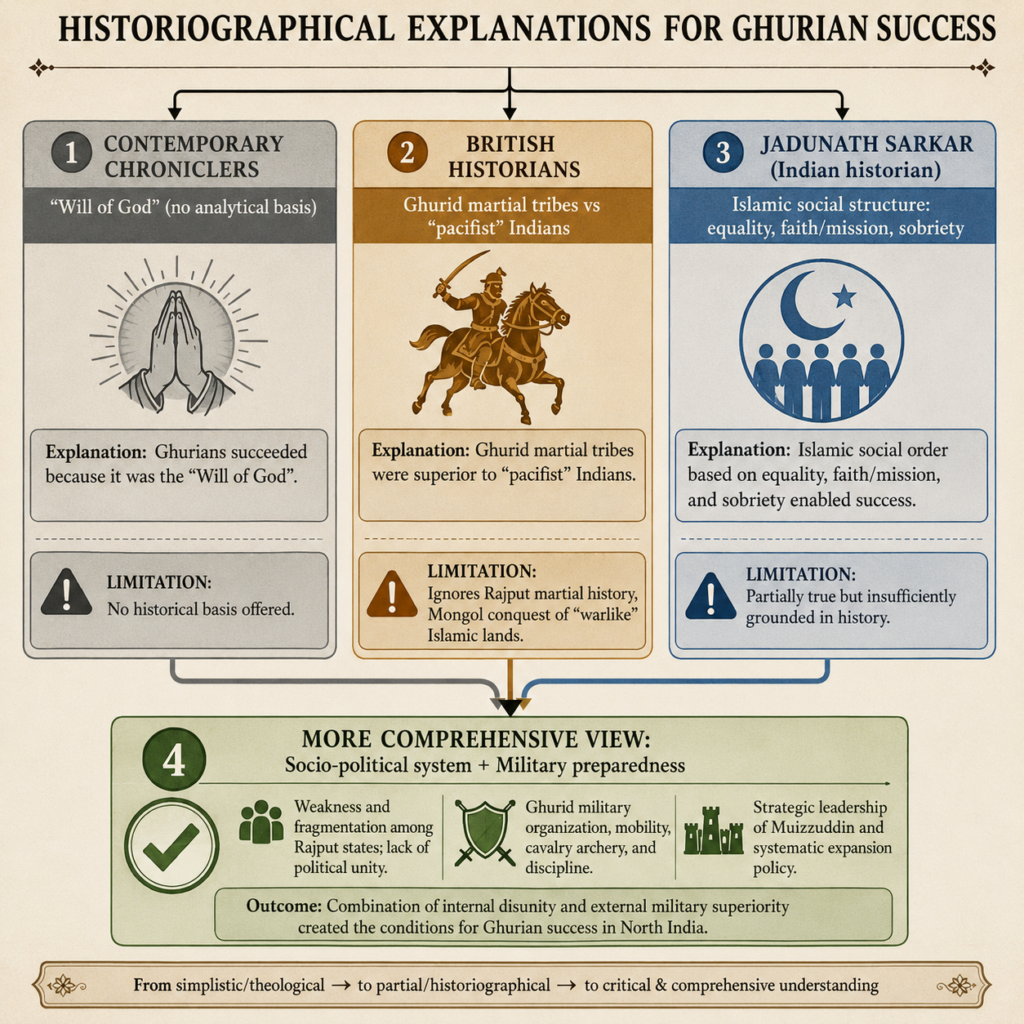
- Contemporary chroniclers attributed Ghurian success simply to the “Will of God.”
- British historians argued that:
- Ghurian armies were drawn from the warlike tribes inhabiting the difficult region between the Indus and the Oxus, who had gathered military expertise fighting the Seljuq armies and other fierce Central Asian tribes.
- By contrast, Indians were pacifist, not given to war, and divided into small states that hampered any expansionist ambition.
- Limitations of this view: It is inadequate and unbalanced, because:
- It leaves out well-known facts of both Indian history and the history of the invaders’ own homelands.
- The large-scale conquest and destruction of the supposedly “warlike” Islamic regions by the Mongols in 1218–19 was carried out without any real resistance.
- The Rajputs, whom the Turks conquered, were not lacking in bravery or martial spirit — the 8th to 12th centuries represent one long story of warfare and violent internal struggle.
- War was a sport for the Rajputs, and their prolonged resistance to Turkish inroads compares favourably against the easy defeat of other ancient civilisations.
- Some Indian historians, such as Jadunath Sarkar, traced Turkish success to the peculiar social structure created by Islam, emphasising three unique characteristics Islam imparted to the Arabs, Berbers, Pathans, and Turks:
- Complete equality and social solidarity with regard to legal and religious status.
- Absolute faith in God and His will, which gave them drive and a sense of mission.
- Islam’s role in securing Turkish conquerors from drunkenness — a vice that, Sarkar argued, ruined Rajput, Maratha, and other Indian rulers.
- Limitation of this view: It may be partially true, but appears insufficiently grounded in history.
A More Comprehensive View
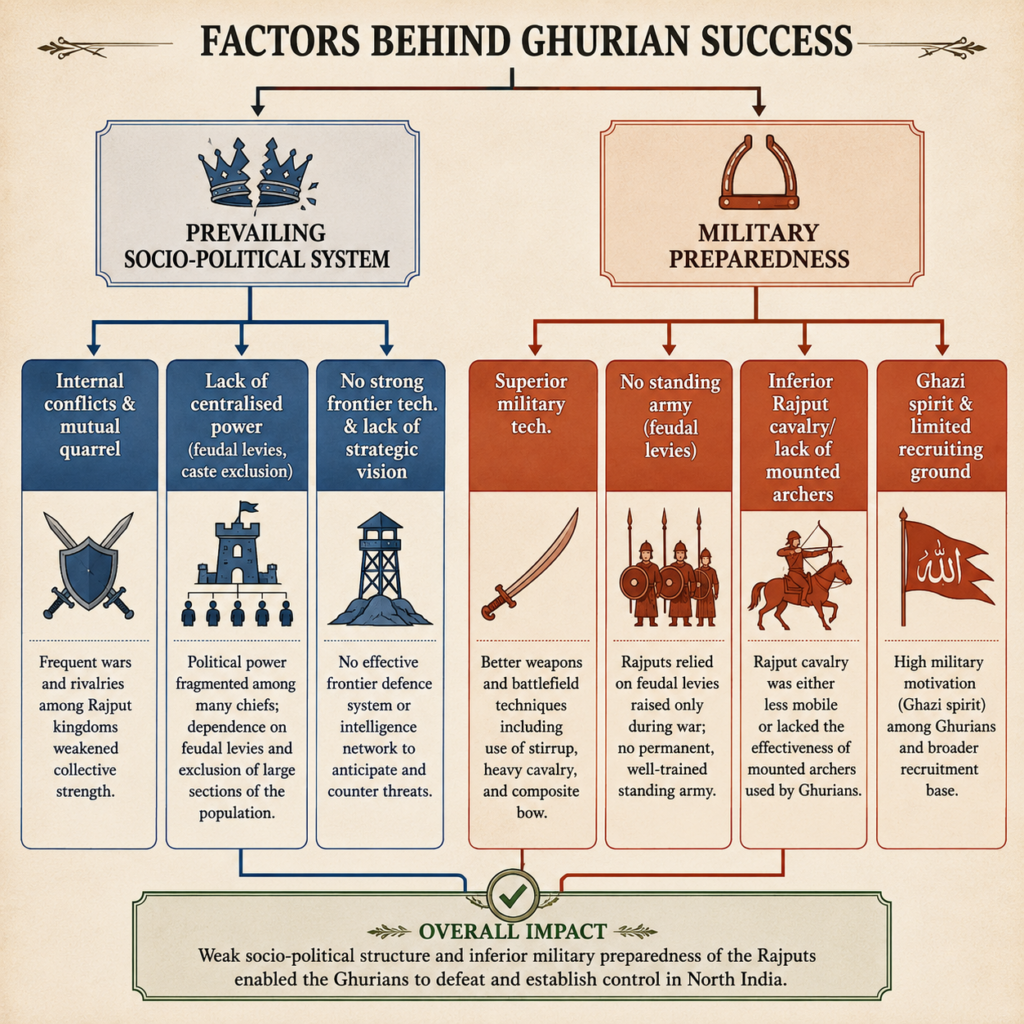
A more comprehensive explanation rests on two major factors: the prevailing socio-political system in India, and India’s military preparedness.
Prevailing Socio-Political System
- Internal conflicts: The small independent powers that arose after the fall of the Gurjara-Pratihara empire — the Gahadvalas in Kannauj, Paramaras in Malwa, Chalukyas in Gujarat, Chauhans in Ajmer, Tomars in Delhi, Chandellas in Bundelkhand, and others — were far from united.
- Mutual quarrel: The Rajputs consistently lacked unity and organisation; terrible battles were continually fought among the powerful Rajput dynasties, such as the Chauhans, the Rathors, and the Chandelas.
- This state of affairs weakened them in terms of military strength and monetary resources.
- As a result of these quarrels, the Rajputs lost the spirit of nationalism — for example, in 1192, Jayachand did not come to help Prithviraj, and when Jayachand himself fell prey to the same misfortune two years later, all other Rajput dynasties left him alone.
- Political disunion and absence of a dominant power: India was divided into small principalities at the time; there was no powerful empire that could lay the foundation of a Central Government by prevailing over the other Rajput rulers — and it is far harder to confront a powerful Central Government in battle than a collection of petty states.
- Lack of centralised power: Indian forces consisted of “feudal levies” — each military contingent was under the command of its immediate overlord or chief, not that of the king, so that the army lacked a “Unity of Command.”
- Feudal lords were difficult to control and were always eager to declare themselves independent rulers whenever a suitable opportunity arose.
- Since only a few castes and clans took up the military profession, the bulk of the population was excluded from military training — the general population remained totally detached from national defence.
- The concept of physical pollution (untouchability) also hampered military efficiency, since it made a proper division of labour impossible — soldiers had to perform all tasks themselves, from fighting to fetching water.
- Absence of a strong frontier: The Rajputs neglected the defence of their frontiers, especially the North-West frontier — there was neither a fort built nor any soldier posted to defend it, allowing foreign invaders to penetrate the country without obstruction.
- Lack of strategic consciousness among the Rajputs:
- They failed to perceive the force of invasion, showing a lack of political farsightedness; invasions were intermittent, and the Rajputs failed to exploit the breaks between them.
- They did not focus on securing north-west India — no effort was made to jointly oust the Ghaznavids from the Punjab, even after Mahmud’s death.
- The Rajput sense of insularity, rooted in the broader Indian cultural ethos, prevented the development of a strategic perspective.
- Al-Biruni noted this deep insularity of the Indians, observing: “The Hindus believe that there is no country but theirs, no nation but theirs, no kings like theirs, no science like theirs.”
- Certain institutional factors aided the growth of Turkish military power. The Turkish polity was more highly centralised than any of the Rajput states — under the iqta system, amirs were not hereditary, but dependent on the will of the sultan.
- Islam provided a strong bond of unity between different groups and sections, imbuing the Turks with a strong sense of mission and fighting spirit.
- The Islamic spirit of equality and brotherhood was certainly a positive factor, though it did not extend to the social sphere — both Turkish and Rajput societies remained hierarchical, one based on racial and family superiority, the other on clan.
- In both societies, power and office remained the monopoly of narrow sections; on balance, however, there was greater social mobility among the Turks than among the Rajputs.
Military Preparedness
- Superior military technology and art of war: The Turks used iron stirrups and horseshoes, which reinforced their striking power and cavalry stamina — horseshoes provided greater mobility to the horse, while the stirrup gave soldiers a distinct advantage.
- Absence of a standing army: Rajput rulers did not maintain regular standing armies, depending instead on their feudatories for troops at the time of war — a system with several defects:
- The number of soldiers in the army was never certain or definite.
- When rulers faced great difficulty, their feudatories often declared themselves independent.
- This system lacked team spirit, since the army was not under one command.
- Feudatories sometimes even fled the field with their own soldiers.
- The Turks relied largely on professional and slave soldiers on horseback, while the Indians normally employed an untrained peasant infantry.
- Slavery provided the Turkish sultans with a body of commanders totally loyal to them.
- The inferior cavalry of the Rajputs was no match for the superior cavalry of their opponents.
- The Rajputs depended too heavily on elephants, which were slow-moving; Indians were not accustomed to moving as an organised body of horsemen over long distances.
- The Rajputs also lacked mounted archers — the Turkish warriors, by contrast, were skilled in quick movements, rapid advance and retreat, and shooting arrows while mounted.
- The Rajput forces tended to be a heavy, slow-moving mass, centred on their elephants, while the Turks had better access to high-quality horses from the Oxus region.
- The iron stirrups and horseshoes used by the Turks reinforced their striking power and strengthened their cavalry, providing greater mobility and balance.
- The scholar Andre Wink holds the view that, even after the establishment of the Delhi Sultanate, it remained the policy of the Delhi Sultans to deprive Hindu rulers of access to war-horses.
- However, the popular notion that Indians were defeated on account of their use of elephants does not appear valid, as no evidence exists in the Tabaqat-i Nasiri or other sources to support this view.
- Jayapala’s case, where his elephants took to flight, is an exception rather than the rule.
- In fact, Mahmud of Ghazni himself is reported to have maintained a large number of elephants taken from India, employing them successfully in his own kingdom.
- While elephants themselves were not inherently a source of weakness, what truly mattered was how they were used.
- The “ghazi” spirit, first employed in fighting the non-Islamic Turks, was later turned against the “unbelievers” in India.
- The ghazis were volunteers fired by the spirit of defending and spreading Islam; they were not paid regularly, instead making up for their pay through plunder.
- Limitation of recruiting ground: The Rajputs possessed no good recruiting ground, since their states were small and people showed little interest in joining the army — the Muslims, by contrast, had many centres from which they could raise fresh armies easily and in large numbers.
- However, in terms of human resources or population, the Rajput-held areas were, in fact, advantageously placed — it would therefore be misleading to think that the workings of the caste system alone prevented the Rajput rajas from finding sufficient soldiers.
- Rajput armies did not consist solely of Rajputs — warrior groups such as the Jats, Meenas, or groups termed “kuvarna” (lower castes) in later sources were not excluded from the Rajput armed forces.
Lack of Organisation
- Though the Rajputs’ personal bravery and fighting spirit were in no way inferior to the Muslims, it is ultimately organisation and leadership that decide the outcome of battle.
- The Muslims were more offensive, driven by a sense of mission, while the Rajputs’ strategy was more defensive.
- The Rajputs followed a code of truth in the battlefield — finding a foe unarmed, they would refuse to fight him; nor would they attack an unprepared foe.
Conclusion
The success of the Ghurian invasions, culminating in the decisive Battles of Tarain and Chandawar, cannot be reduced to simplistic explanations of divine will or an inherent Rajput “lack of martial spirit” — the Rajputs’ near-continuous warfare across the 8th–12th centuries decisively refutes the latter. Instead, Ghurian success rested on the convergence of two deeper structural factors: a fragmented, feudal, and strategically short-sighted socio-political order in North India that had persisted since the fall of the Gurjara-Pratiharas, and a superior, more centralised, and technologically advanced military system under the Ghurids — from the iqta administration to the iron stirrup and disciplined mounted archery. Figures such as Prithviraj III exemplified both the genuine martial capability of the Rajputs and the fatal political isolation that came from years of internecine warfare — a pattern that, once exploited by Muizzuddin Muhammad at Tarain in 1192, proved irreversible. The consequences of this defeat — the establishment of Turkish rule at Delhi and the beginning of the Sultanate period — would go on to reshape the political history of India for the centuries that followed.





Consequences not mentioned.