The Khalji Revolution

The Khalji Revolution of 1290 marked far more than a simple change of ruling family in the Delhi Sultanate — it represented the overthrow of the Slave (Mamluk) Dynasty and the installation of the Khalji Dynasty (1290–1320), accompanied by a fundamental shift in the very nature of the state. Led by Jalaluddin Khalji, a seasoned frontier commander who had proven himself against the Mongols, this transition broke the long-standing Turkish monopoly over high office, widened the social base of the ruling class, and introduced significant new administrative measures — from market regulation to land revenue reform. This article examines the political background that precipitated the Khalji Revolution, the multiple senses in which it constituted a genuine “revolution,” and the distinctive — and historically significant — approach to statecraft pursued by its first ruler, Jalaluddin Khalji.
Background
- The Khalji Revolution marked the overthrow of the Slave Dynasty and the establishment of the rule of the Khalji Dynasty (1290–1320) within the reign of the Delhi Sultanate. It was not merely a change in dynasty — the very nature of the state was poised for a revolution under the Khaljis.
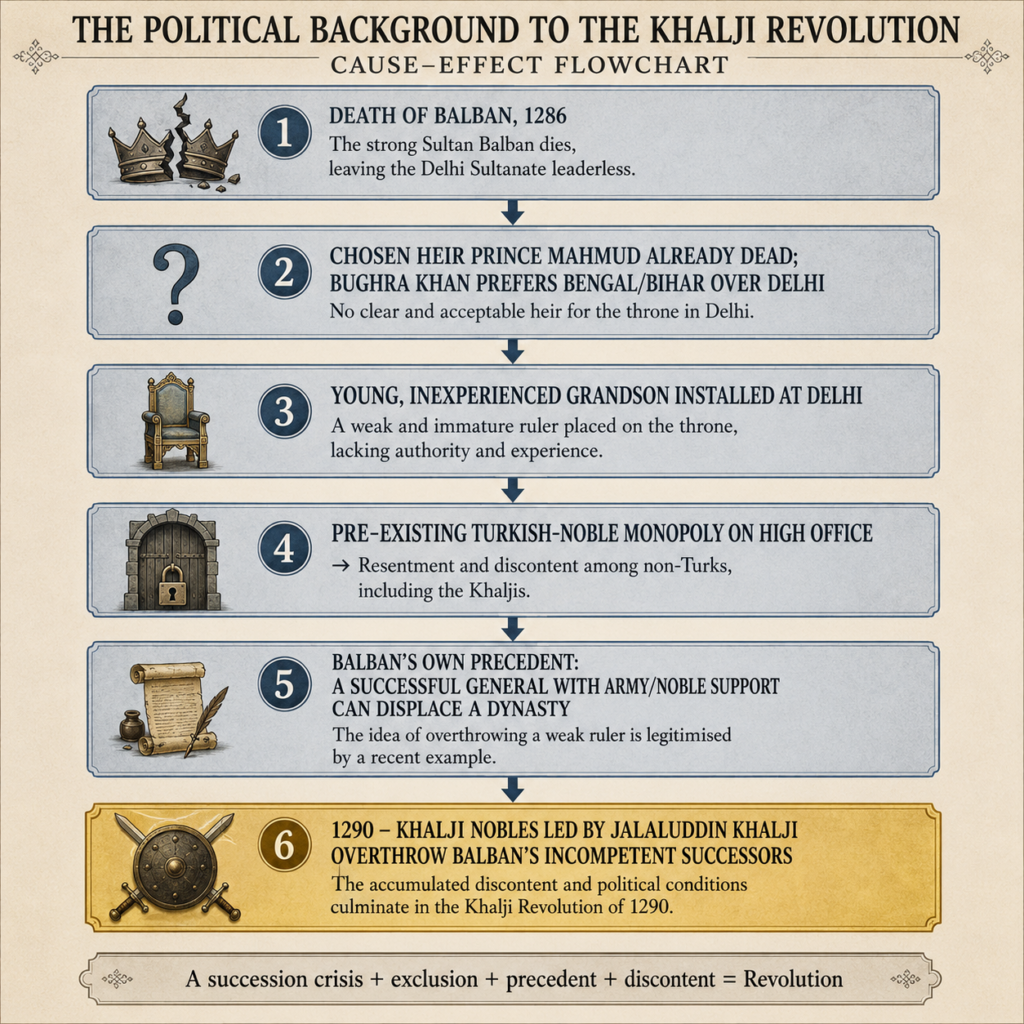
- After the death of Balban in 1286, confusion once again gripped Delhi for some time.
- Balban’s chosen successor, Prince Mahmud, had died earlier in battle against the Mongols.
- A second son, Bughra Khan, preferred to rule over Bengal and Bihar, despite being invited by the nobles at Delhi to assume the throne.
- Consequently, a grandson of Balban was installed in Delhi — but he was too young and inexperienced to cope with the situation.
- There had already been considerable resentment and opposition at the Turkish nobles’ attempt to monopolise high offices. Many non-Turks — such as the Khaljis — had come to India at the time of the Ghurid invasion, but had never received sufficient recognition in Delhi.
- Balban’s own precedent — of setting aside the sons of Nasiruddin Mahmud to ascend the throne himself — had demonstrated that a successful general could displace the scions of an established dynasty, provided he possessed sufficient support in the nobility and the army.
- For these reasons, a group of Khalji nobles, led by Jalaluddin Khalji — who had served as warden of the marches in the northwest and had fought many successful engagements against the Mongols — overthrew Balban’s incompetent successors in 1290.
- The Khalji rebellion was welcomed by the non-Turkish sections of the nobility.
- The Khaljis, being of mixed Turkish–Afghan origin, did not exclude Turks from high office — but their rise to power ended the Turkish monopoly over high offices in the Sultanate.
Why It Was a “Revolution”
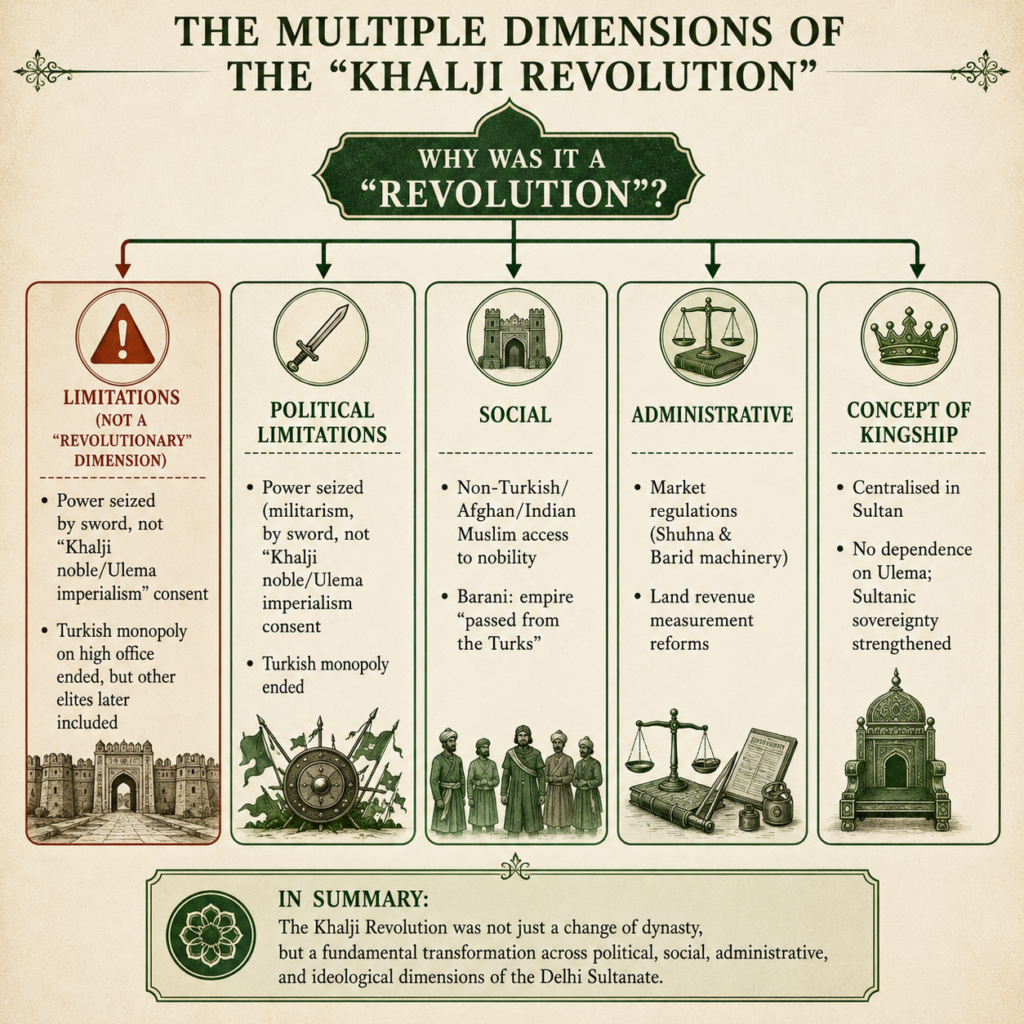
- The Khaljis came to power not on the support of either the nobility or the Ulema, but by the power of their sword.
- The Khalji revolution is considered a revolt of the lower segment of society against the established nobility.
- The Khaljis were not considered pure Turks. Though a Turkish tribe by origin, having lived long in Afghanistan, they had adopted Afghan habits and customs, and were treated as Afghans in the Delhi court. The success of the Khaljis in establishing a dynasty was thus a success for non-Turks.
- It represented the rejection of the racial policy of earlier rulers, as the Khaljis opened the gates of the nobility not simply to non-Turks but also to Indian Muslims — broadening the social basis of the ruling class.
- The historian Barani notes that with the accession of the Khaljis, the empire passed from the hands of the Turks.
- The Khalji revolution was a revolution also because several new administrative measures were introduced.
- For example, market regulations were introduced to fix the prices of different commodities.
- A new administrative machinery, comprising the Shuhna and the Barids, was set up to oversee these market regulations.
- Similarly, the land revenue administration was reorganised through the introduction of a measurement system.
- The Khaljis held a distinctive concept of kingship, in which power was centralised in the hands of the Sultan, with no other power centre in the administration — the Sultan was not required to act under the guidance of the Ulema.
- However, the Khalji revolution also had negative sides.
- It placed too much emphasis on the military aspect of government, giving impetus to militarism.
- There was vigorous expansion, often described as “Khalji imperialism.”
- In spite of these limitations, the Khalji revolution implied the beginning of a new era in the history of the Delhi Sultanate.
Jalaluddin Khalji (1290–1296)
- Jalaluddin Khalji ascended the throne after overthrowing the incompetent successors of Balban in 1290.
- During his six-year reign (1290–96), he faced numerous internal and external foes:
- Some of Balban’s officers revolted due to his assumption of power and the subsequent sidelining of nobility and commanders who had served the Mamluk dynasty. Jalaluddin suppressed the revolt and executed some commanders.
- He led an unsuccessful expedition against Ranthambhor, and repelled a Mongol force on the banks of the Sind River, with the help of his nephew Juna Khan (later Alauddin Khilji).
His Approach to the State
- Jalaluddin followed a liberal, humanitarian, benevolent, and beneficent approach to rule.
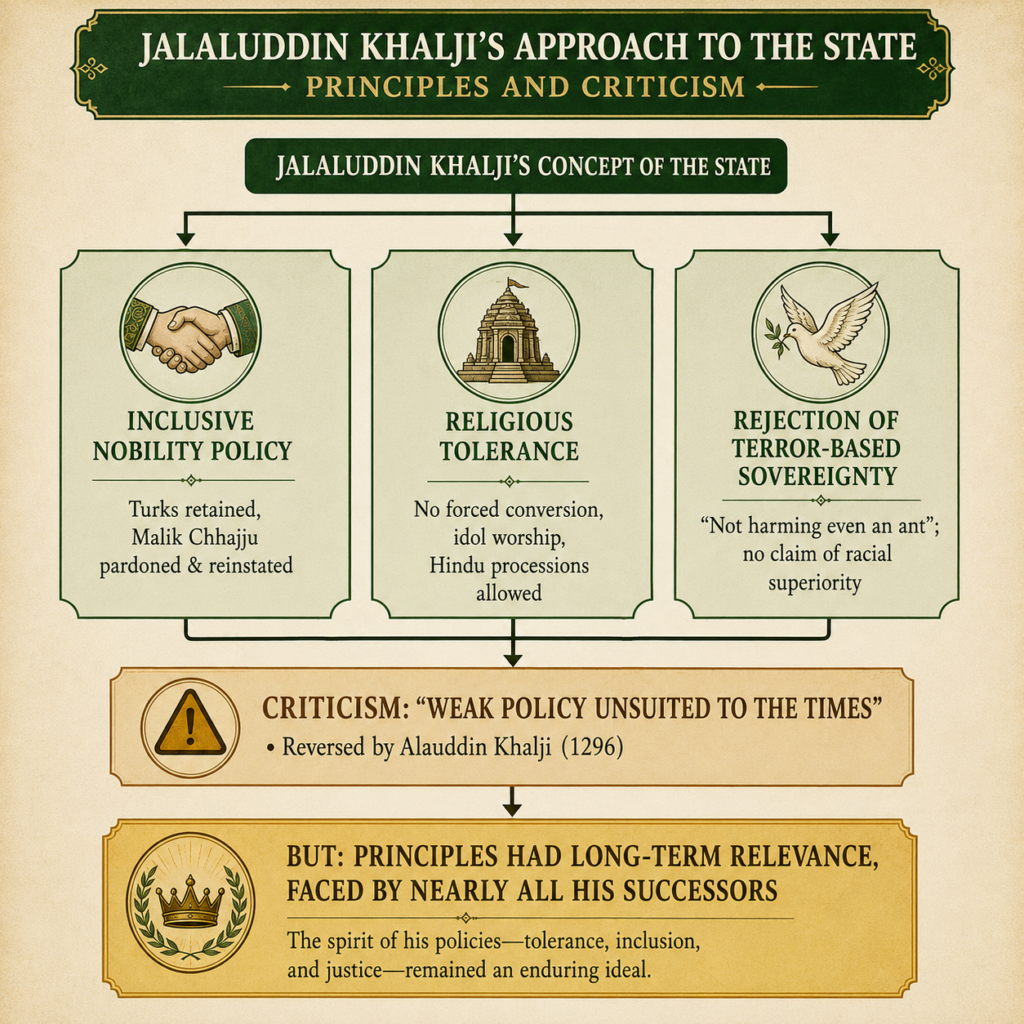
- He sought to mitigate the harsh aspects of Balban’s rule, and did not pursue a policy of narrow exclusivism. Many Turks and officers from Balban’s time who visited Jalaluddin were given important posts and iqtas.
- Even Malik Chhajju Kishli Khan, a nephew of Balban, was appointed governor of Kara — considered one of the most fertile and prosperous tracts. Nor were drastic punishments meted out when Malik Chhajju later rebelled, marched on Delhi, and was defeated.
- Through this, he sought to gain the goodwill of the nobility through a policy of tolerance, avoiding harsh punishments.
- Through his actions, Jalaluddin put forward the concept of a new type of state — one based fundamentally on the goodwill and support of the people of all communities, and one that was essentially beneficent, looking after the welfare of its subjects.
- He was the first ruler of the Delhi Sultanate to clearly articulate the view that the state should be based on the willing support of the governed, and that — since the large majority of the people in India were Hindus — the state in India could not be a truly Islamic state.
- Although Jalaluddin Khalji was himself a pious Muslim, he rejected demands from some Ulema — for example, the demand for the forced conversion of Hindus.
- In a discussion with his close associate Ahmad Chap, he defended the policy of allowing Hindus to worship idols, preach their beliefs, and observe practices that were regarded as the hallmark of infidelity by orthodox opinion. Likewise, Hindus were permitted to live a life of ease and splendour and honour, even at Delhi, the very centre of Islam.
- There is evidence that Hindus moved in procession, beating drums, near his palace for the immersion of images in the Yamuna — a practice he never stopped.
- Thus, unlike Balban, Jalaluddin refused to identify sovereignty with self-pride and tyranny. In the language of Barani, he believed in a policy of “not harming even an ant.”
- He did not claim sovereignty on the strength of racial superiority.
- According to Jalaluddin, while a policy of terror could establish fear of the government and its prestige in the hearts of the people for a short time, this approach would ultimately mean discarding (true) Islam.
- He possessed neither the will nor the resources to undertake any large-scale expansionist programme.
- However, many people — including his own supporters — considered this to be a weak policy, unsuited to the times.
- Alauddin Khalji (1296–1316), who ascended the throne after treacherously murdering Jalaluddin Khalji, reversed this policy, and did not accept the liberal, humanitarian precepts of Jalaluddin.
- Nevertheless, the principles enunciated by Jalaluddin carried long-term relevance — in one form or another, they had to be confronted by almost all his successors. Thus, Jalaluddin’s reign carries a long-term significance that is often overlooked.
Conclusion
The Khalji Revolution of 1290 was, in every meaningful sense, more than a change of dynasty — it broke the Turkish racial monopoly over the Delhi Sultanate’s ruling class, introduced significant administrative innovations in market regulation and land revenue, and articulated, through Jalaluddin Khalji, an entirely new conception of kingship centred on the willing consent of a Hindu-majority populace rather than religious coercion or racial pride. Though contemporaries and even Jalaluddin’s own supporters dismissed his liberal, non-punitive approach as a weak policy unsuited to the times — an assessment his successor Alauddin Khalji evidently shared, given his own far more coercive and expansionist rule — the underlying questions Jalaluddin raised about the basis of legitimate authority in a predominantly non-Muslim land would continue to confront nearly every Sultan who followed him. In this sense, the significance of the Khalji Revolution extends well beyond 1290, marking a genuine turning point in how the Delhi Sultanate understood the relationship between the state and its subjects.