Architecture, Culture, Literature and the Arts in Vijayanagara Empire

The establishment of the powerful Vijayanagara Empire in the 14th century filled the political vacuum in southern India and left a lasting imprint on the fields of administration, culture, religion, art, and architecture. These contributions were largely centred on the promotion of Hindu religion and culture, with rulers such as Harihara and Bukka, Deva Raya II, and Krishna Deva Raya particularly renowned for their patronage of cultural activity.
Religion
- The rulers of Vijayanagara were devout Hindus, most of them worshipping either Vishnu or Shiva.
- The early rulers of the Sangama dynasty were chiefly Saivites, with Virupaksha as their family deity. Later dynasties came increasingly under the influence of Vaishnava saints, and the Srivaishnavism of Ramanuja grew especially popular — the Vaishnava text Prapannamritam records the legendary conversion of the Vijayanagara king Virupaksha to Vaishnavism.
- Krishna Deva Raya was devoted to Vithoba (a manifestation of Vishnu) as well as to Shiva, while Sadasiva Raya followed a liberal policy, worshipping Shiva, Vishnu, and Ganesha alike.
- The Bhakti (devotional) movement made considerable progress under Vijayanagara rule, encouraged through several means:
- Compilation of major religious texts.
- Commissioning of commentaries (bhashyas) on religious texts.
- Construction of a large number of richly endowed temples.
- Celebration of numerous festivals.
- Grants of land and other privileges made generously to Brahmins.
- Despite this religious zeal, the rulers of Vijayanagara displayed considerable tolerance toward other sects and faiths:
- Beyond the Vedic religion, sects such as the Jains also enjoyed royal protection and patronage.
- Muslims were employed in the administration and were freely permitted to build mosques and worship.
- Barbosa, who visited Krishna Deva Raya’s court, observed: “The king allows such freedom that every man may come and go and live according to his own creed without suffering any annoyance and without enquiries whether he is a Christian, Jew, Moor or Hindu.”
Architecture
- Architecture attained a certain fullness and freedom of expression under Vijayanagara rule. Though often characterised as the Dravida style, it possessed distinct features of its own, and is more accurately termed the Vijayanagara (or “Provida”) style.
- This period also marked the beginning of a new tradition: the earlier soft-stone tradition gave way to the emergence of a hard-stone tradition.
- Architectural activity encompassed the construction of temples, monolithic sculptures, palaces, official buildings, entire cities, and irrigation works such as step-wells and tanks — reflecting a harmonious blend of Hindu and Islamic architectural features, and a convergence of the Nagara and Dravida temple forms.
(i) Temples
The religious zeal of the Vijayanagara kings found expression in the construction of new temples, the renovation of older ones, and additions made to numerous existing shrines.
Early Phase
- The first datable shrine, found at Hampi, was built during the first dynasty (Sangama) and was devoted to Jainism.
- The earlier temple style was influenced by the simpler Deccan idiom — to some extent, the style of the Chalukyas of Vatapi remained discernible, as seen in the Vidyashankar temple. Accordingly, 14th-century Vijayanagara temples primarily follow the Deccan idiom.
Second Phase
- By the early 15th century, the Tamil tradition had gained wide popularity, with the core design of temples now derived from the Tamil country and Chola shrines — as seen in the Ramachandra temple and a related Shiva temple.
- Granite became the principal building medium for temples constructed in this idiom.
Third and Mature Phase
- The 16th century witnessed the maximum development of Vijayanagara temple architecture. Unlike the 14th century, when temples were small or moderate in size, or the 15th century, which produced both small and medium-sized temples, the 16th century left behind a rich legacy of large, medium, and small temples alike.
- This century saw the introduction of several new elements, such as the composite pillar, along with entirely new types of structures, including the hundred-pillared hall and the chariot-street.
- The architectural development at Vijayanagara was, in essence, a fusion in which southern (Tamil/Chola) elements came to dominate over the earlier Deccan features.
- Under Krishna Deva Raya, the mature Vijayanagara style further developed: Chola forms continued in use, but were elevated to greater monumentality, with more elaborate sculpted animal-pillar motifs.
Last Phase
- The final phase of temple-building occurred during the 17th century, under the Nayaka period, when temples displayed even greater monumentality and increasingly elaborate sculpted animal-pillar motifs.
- Vijayanagara architecture did not merely borrow from existing traditions — in the course of its evolution, alongside amalgamation, genuine architectural innovation also took place.
Key Features of Vijayanagara Temples
- Larger temple complexes, with an ongoing process of horizontal elaboration and increasingly rich, heavy ornamentation.
- Huge compound walls enclosing the temple precinct, even as the core shrine structure itself often remained modest in size.
- The emergence of a new structure known as the Amman shrine, dedicated to the spouse of the chief deity.
Mandapas
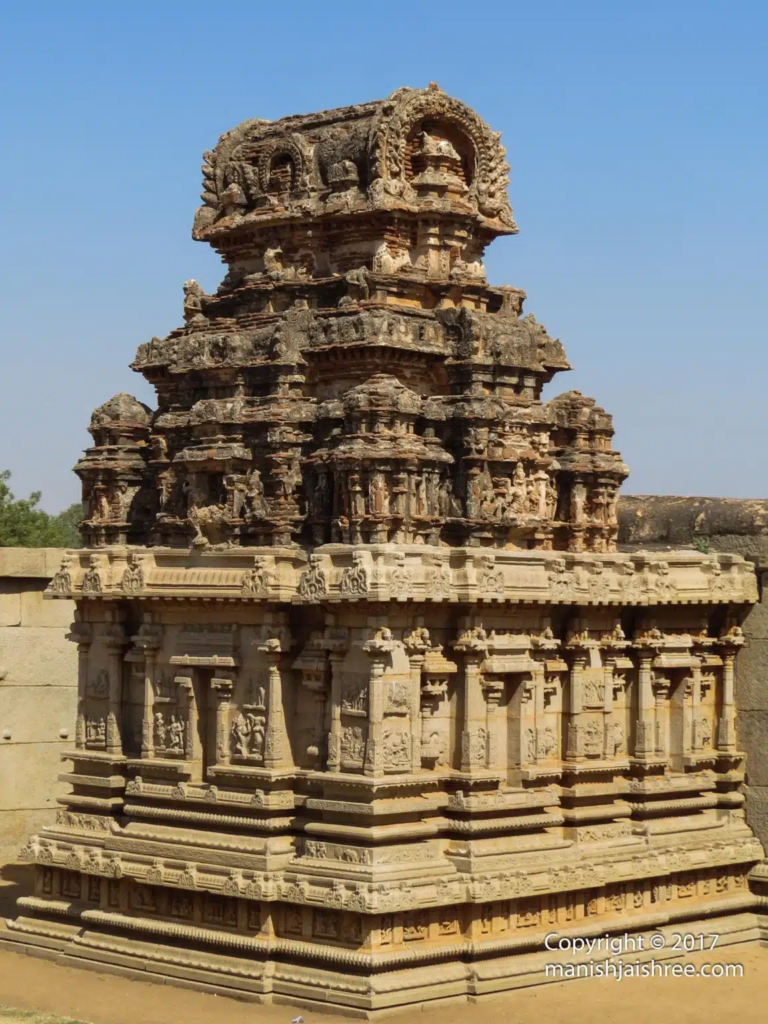
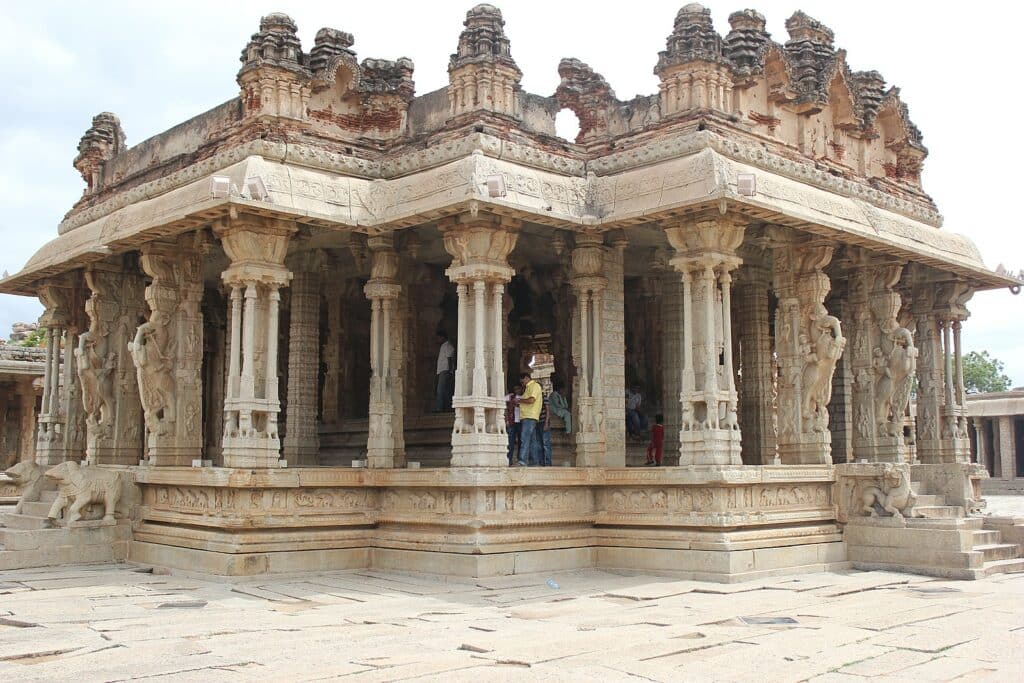
- A key architectural feature was the mandapa — an open pavilion with a raised platform meant for seating deities, exemplified by the open mandapa at the Vitthala temple.
- These mandapas featured columned interiors, with each pillar resting on its own separate base and topped with a double capital.
- A new structure, the Kalyana Mandapa, was introduced for conducting the ceremonial union of the deity and his consort on special occasions.
- The thousand-pillared mandapa — a huge hall containing numerous rows of pillars — also became a popular feature of this period, with such structures given various names, including Rangamandapa and Uttaramandapa.
Pillars
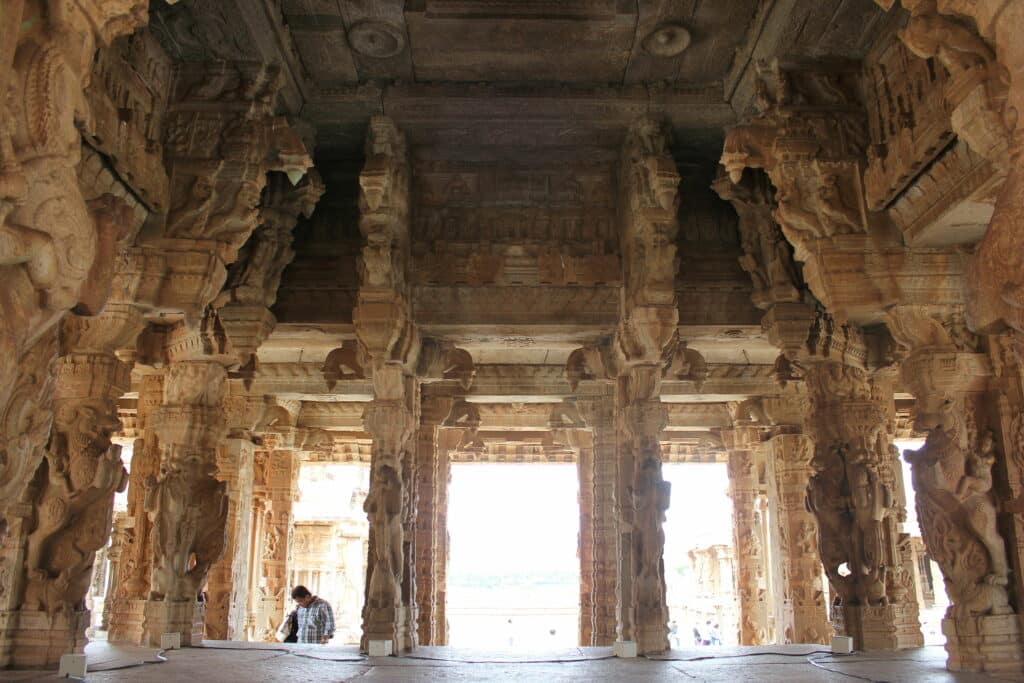
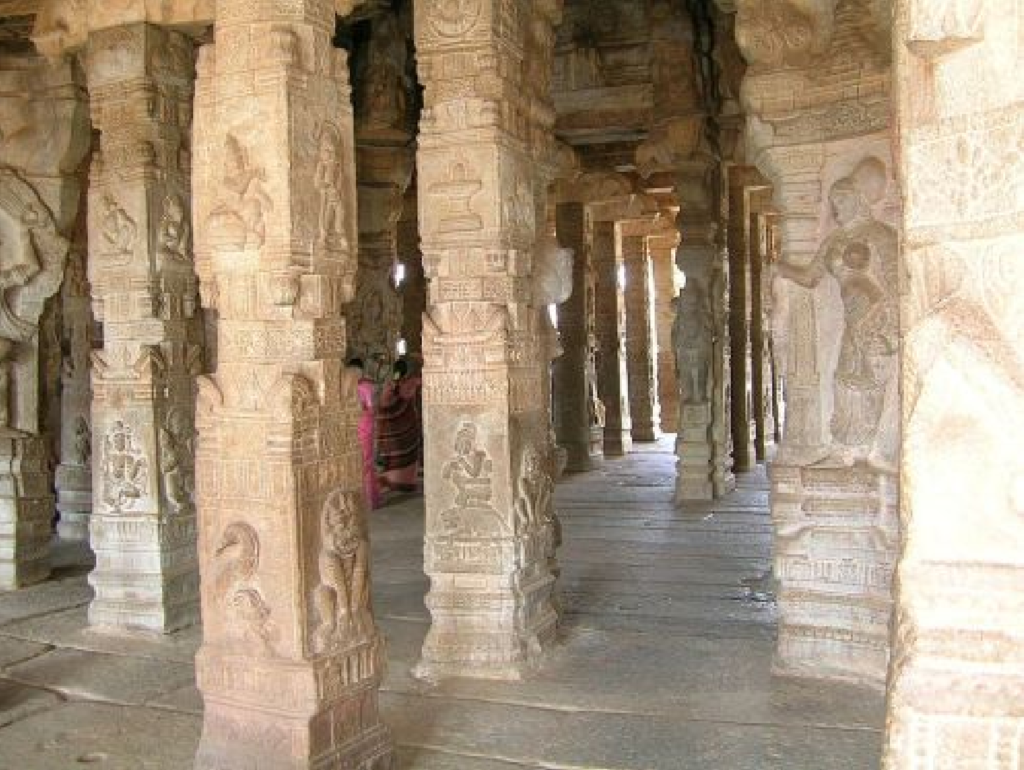
- Vijayanagara pillars are notable for their intricate carving and diverse decorative designs, exemplified by the pillared hall at the Lepakshi temple.
- Pillars grew increasingly large and elaborate, with the central portion of the shaft often cut away and carved with animal figures — the horse being the most common motif.
- Some pillars were so richly and precisely carved that striking them produced musical notes — these are known as musical pillars, as seen in the mandapa of the Vitthala Temple.
- Walls and pillars alike were adorned with profuse sculptural ornamentation depicting major episodes from the Ramayana, the Mahabharata, and other deities, humans, and animals.
- Some temples also featured wall and ceiling paintings, most notably the Virabhadra temple at Lepakshi.
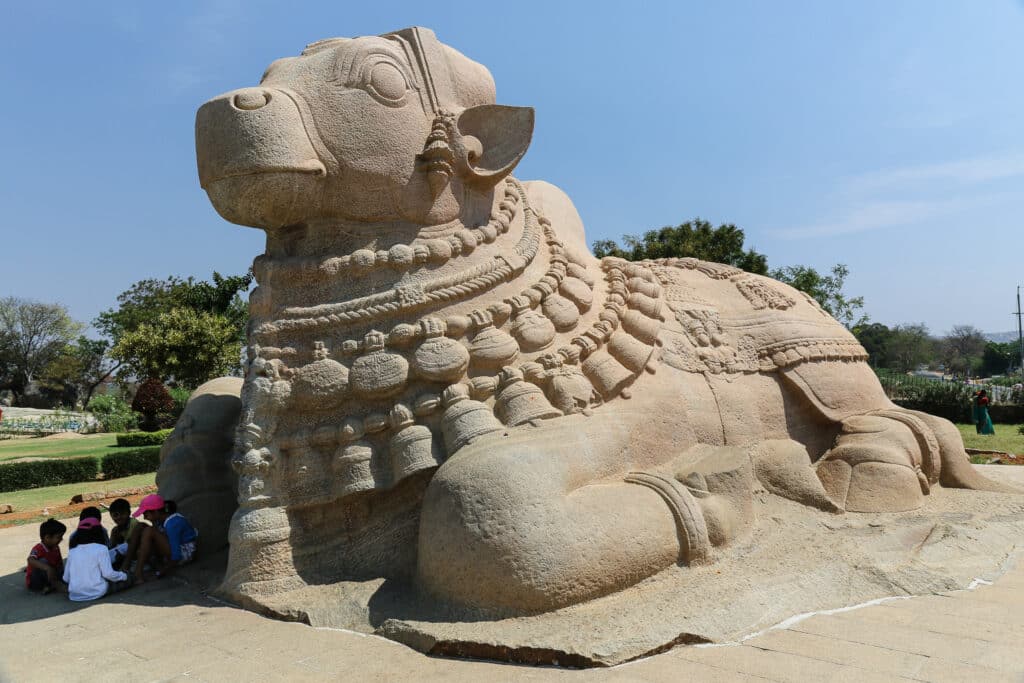
- Large monolithic sculptures, such as the celebrated Nandi near the Lepakshi temple — standing 4 metres high and 8 metres long, and considered the largest monolithic Nandi in India — were also a notable feature.
Additions to Existing Temples
- Beyond new construction, existing temples were also enriched with additions such as gopurams, pillared mandapas, kalyana mandapas, and temple chariots.
- Gopurams:
- Most gopurams were added under the patronage of Vijayanagara’s most famous ruler, Krishna Deva Raya.
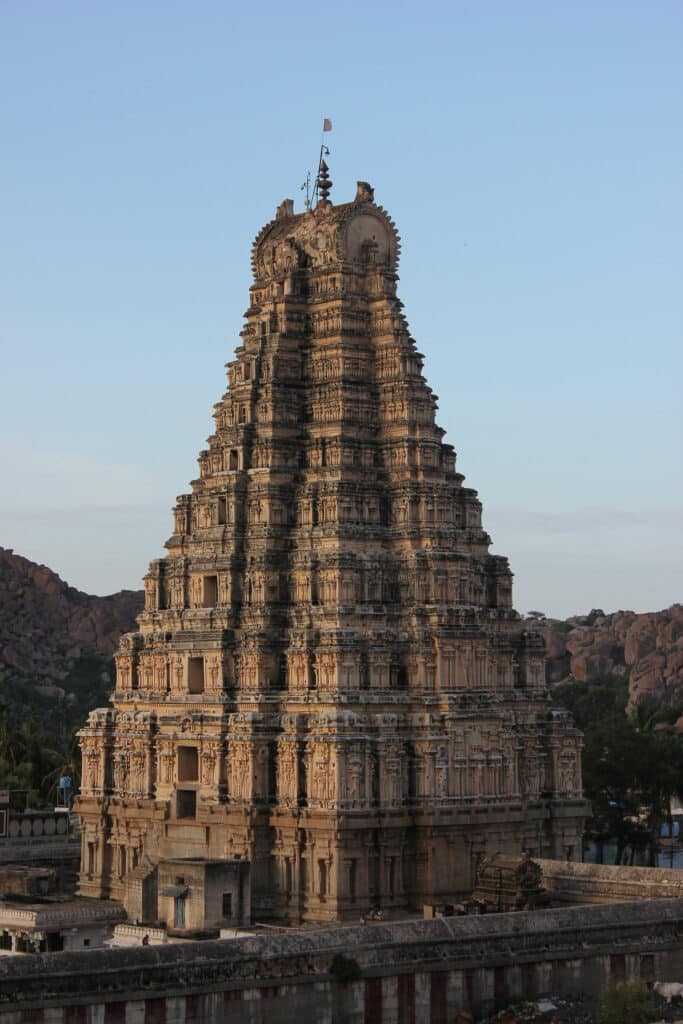
- These gopurams took the form of multi-storeyed pyramidal structures — the most magnificent being the southern gopuram of the Ekambaranatha temple, standing 188 feet high across ten storeys, built by Krishna Deva Raya.
- Larger and taller gopurams of this kind are known as Raya Gopurams — as exemplified by the Raya Gopuram of the Virupaksha temple.
- Most gopurams bear portrait statues of kings and other important patrons, reflecting a personal, iconographic connection established between the shrine and its royal or noble benefactors.
Important Temples of This Phase
- Vitthala Temple, Vijayanagara (Karnataka): regarded as the finest of the period, characterised by its temple chariot, Amman shrine, Kalyana Mandapa, three gopurams, and its celebrated musical pillars.
- Hazara Rama Temple, Vijayanagara (Karnataka).
- Virupaksha Temple, Vijayanagara (Karnataka).
- Virabhadra Temple, Lepakshi (Andhra Pradesh):
- Built in the mid-16th century during the reign of Achyuta Deva Raya, by Viranna and Virupanna, Vijayanagara governors of Penukonda.
- The temple comprises three sections — the Mukha Mandapa (used for dance and cultural performances), the Artha Mandapa (used for worship) together with the Garbhagriha housing the deity, and the Kalyana Mandapa (wedding hall), built of grey sandstone with 38 carved monolithic pillars.
- It contains the earliest preserved cycle of mural paintings in the Vijayanagara style.
- Venkateswara Temple, Tirupati (Andhra Pradesh).
(ii) Monoliths
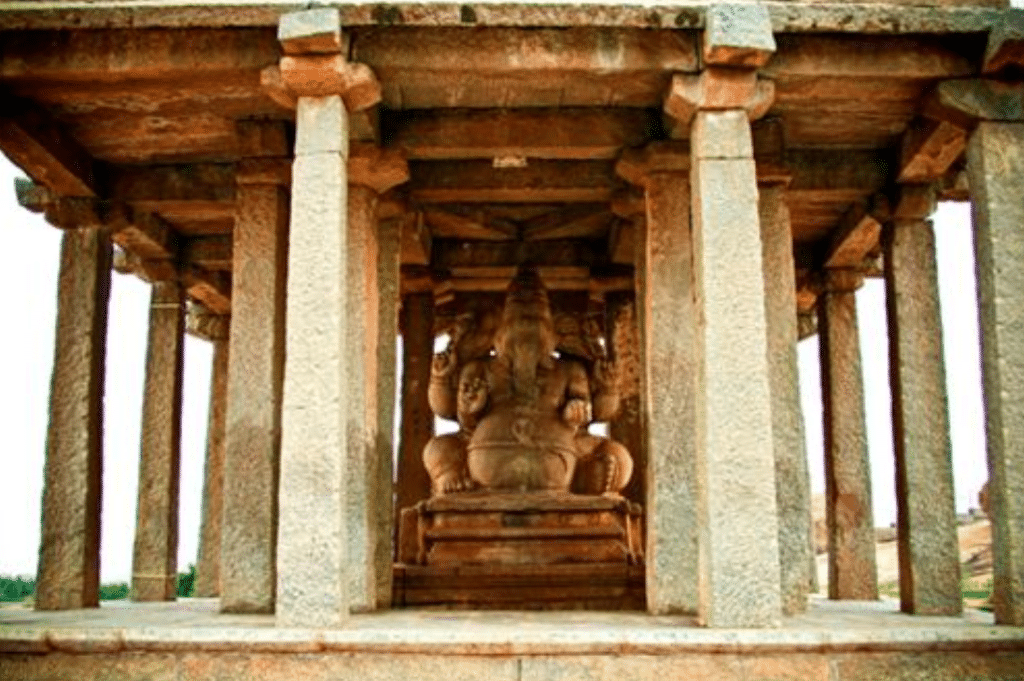
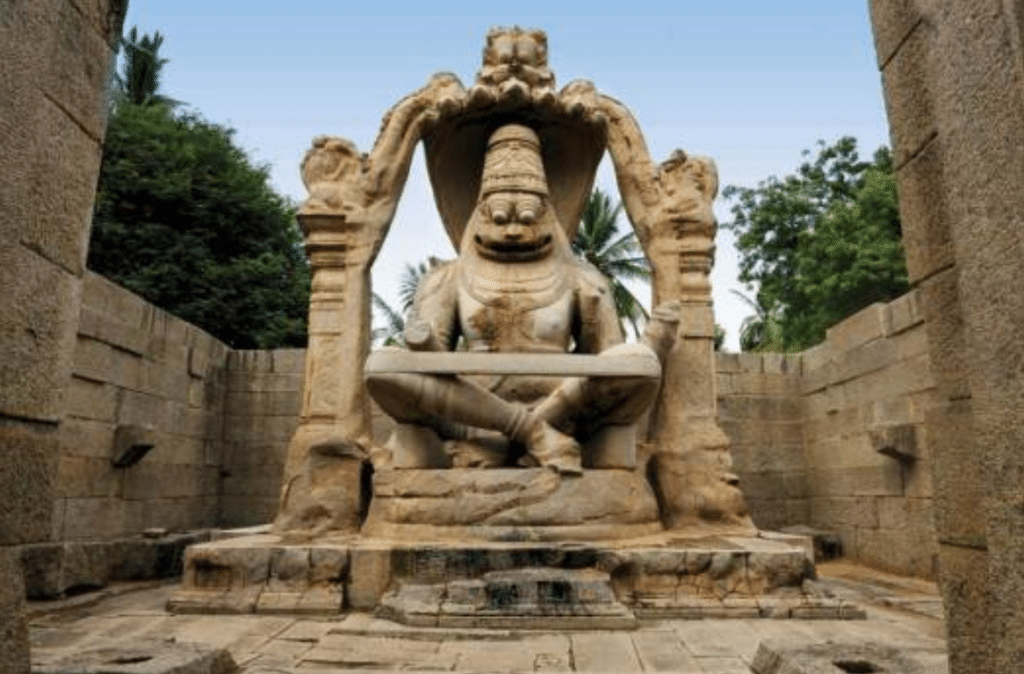
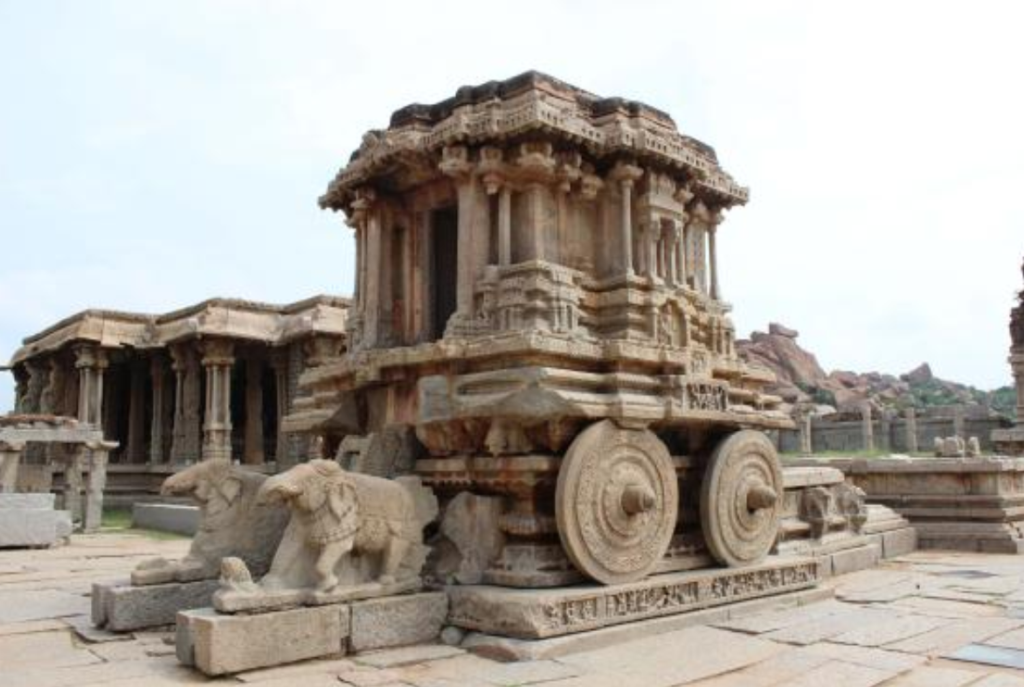
- The period produced several huge monolithic sculptures, including those of Ganesha and Narasimha (both at Hampi), a colossal Hanuman, and a stone chariot.
(iii) Tanks and Wells
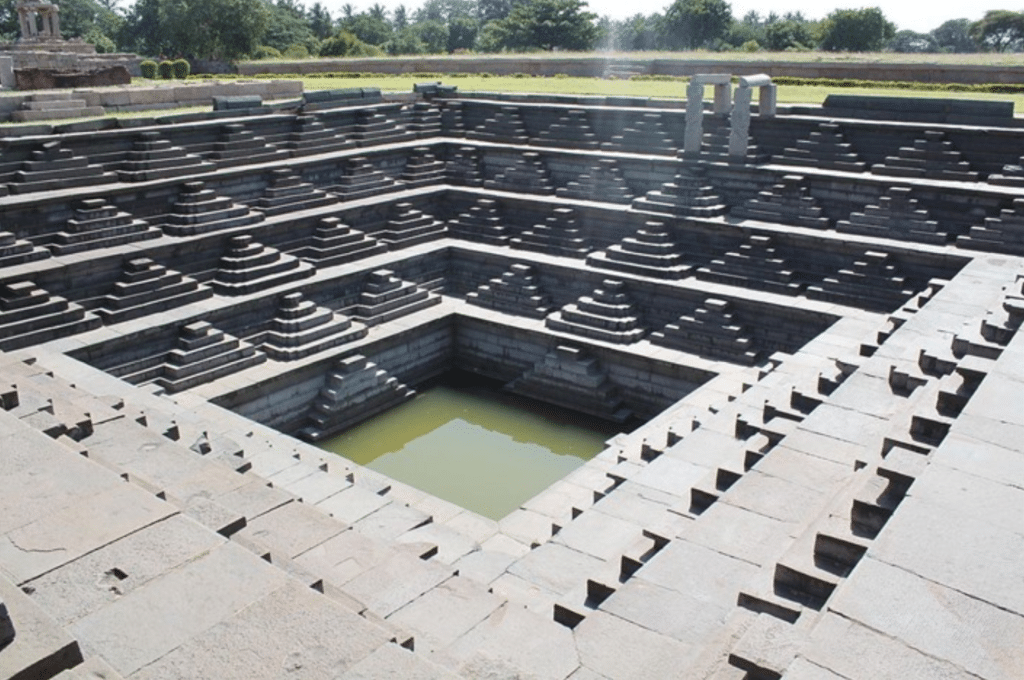
- Krishna Deva Raya constructed a large tank for the city’s water supply, along with a beautifully designed step-well at Hampi.
- Vijayanagara architecture — both religious and secular — thus forms an important and unavoidable chapter in the wider history of Indian architectural development.
(iv) Cities
- The cities of the Vijayanagara Empire were studded with grand palaces, public offices, and extensive irrigation works. The most splendid among the secular buildings were the royal palaces, described in detail by the Portuguese traveller Domingo Paes.
- Notable structures within the royal palace complex included:
- Royal Audience Hall: a high platform supported by wooden pillars.
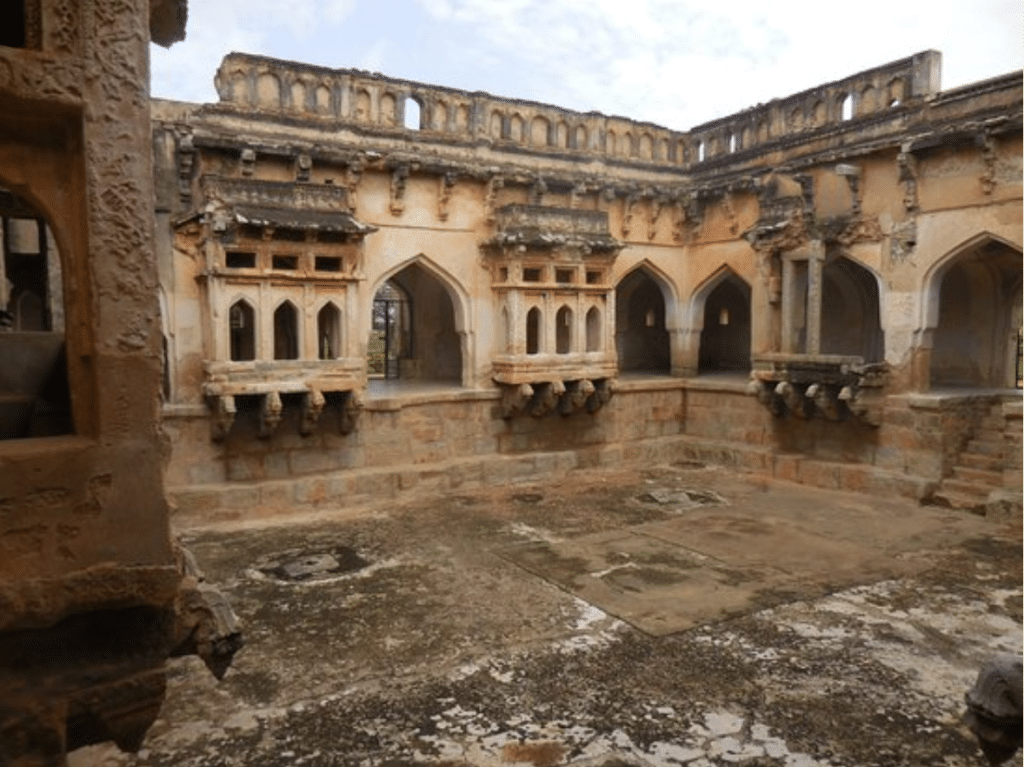
- Queen’s Bath: a water pavilion at Hampi, serving as a grand royal bathing space.
- Guards’ Quarters.
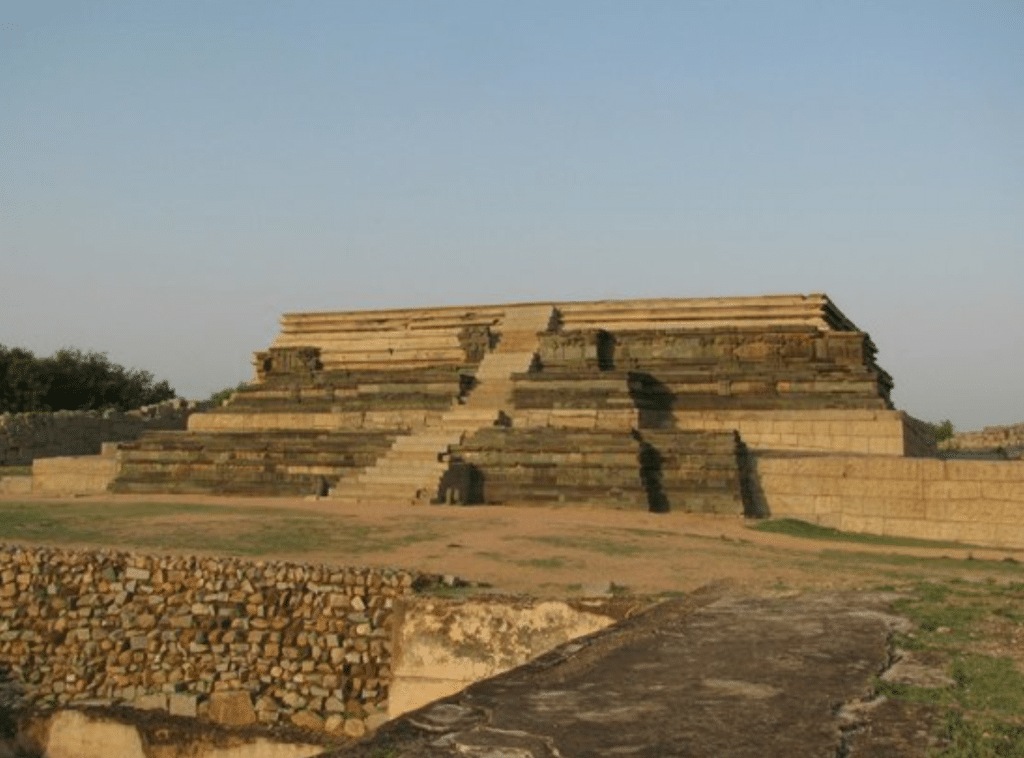
- Mahanavami Dibba: a massive and elevated platform, adjoined by a large tank, its sides engraved with figures of humans and animals.
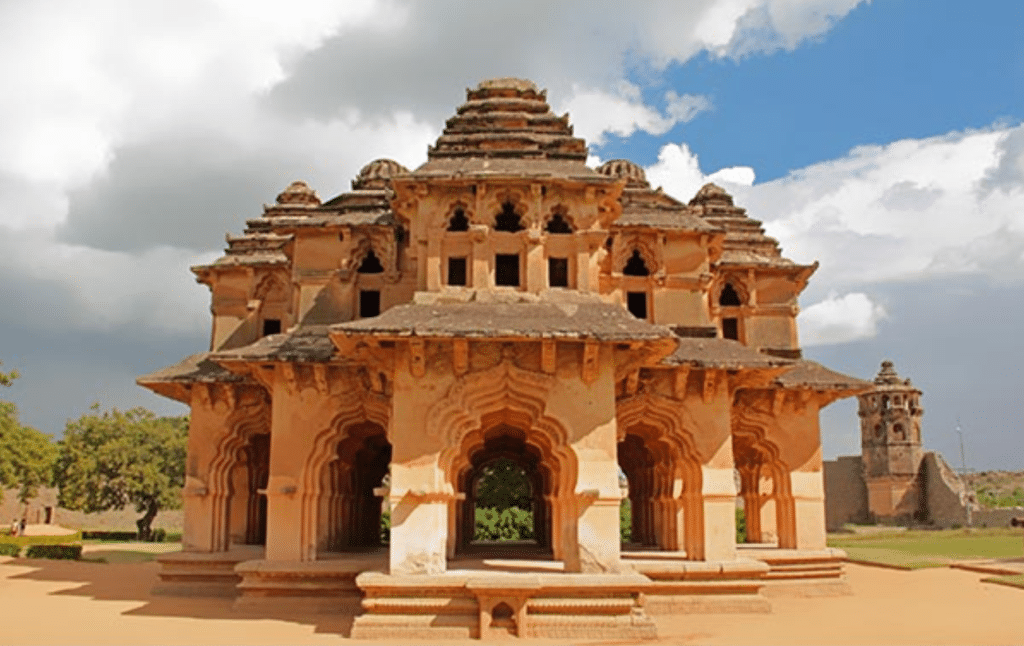
- Lotus Mahal: a two-storeyed structure, characterised by engrailed arches (an Islamic feature) combined with pyramidal towers (an Indian feature).
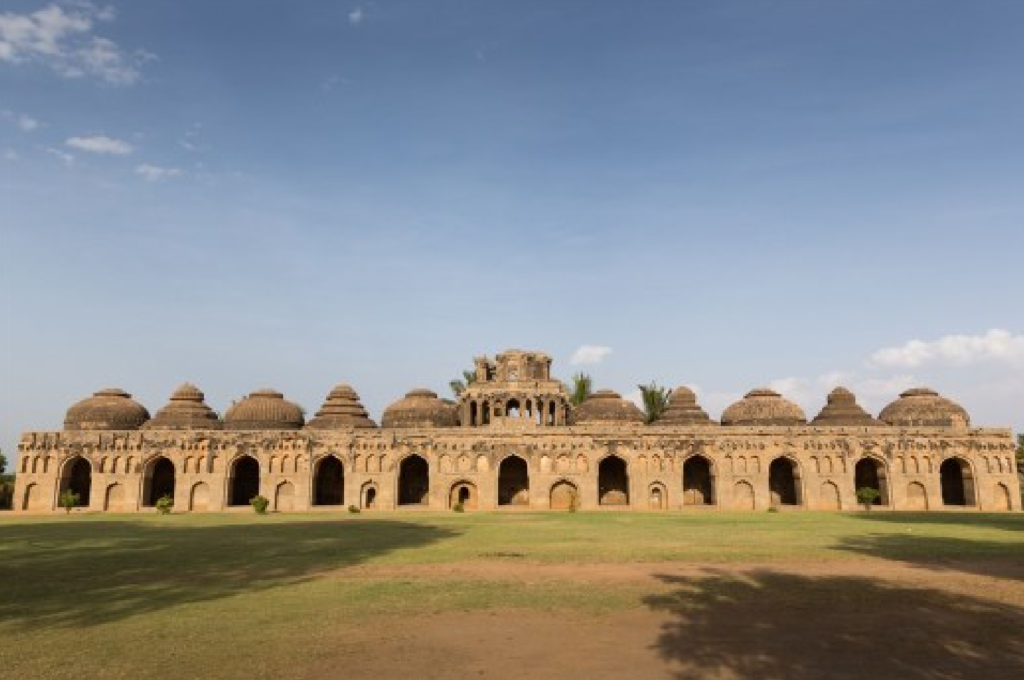
- Elephant Stables: also blending Islamic elements (domes and arches) with Indian pyramidal features.
- Even the mosques of Hampi featured pillars reminiscent of pillared mandapas, reflecting Indian architectural influence, while the gates of the city, with their domes and arches, displayed clear Islamic influence — together illustrating the composite architectural character of the empire.
- The Hampi bazaar stands as a fine example of street architecture, and the city’s amenities also included markets, palaces, and other public spaces.
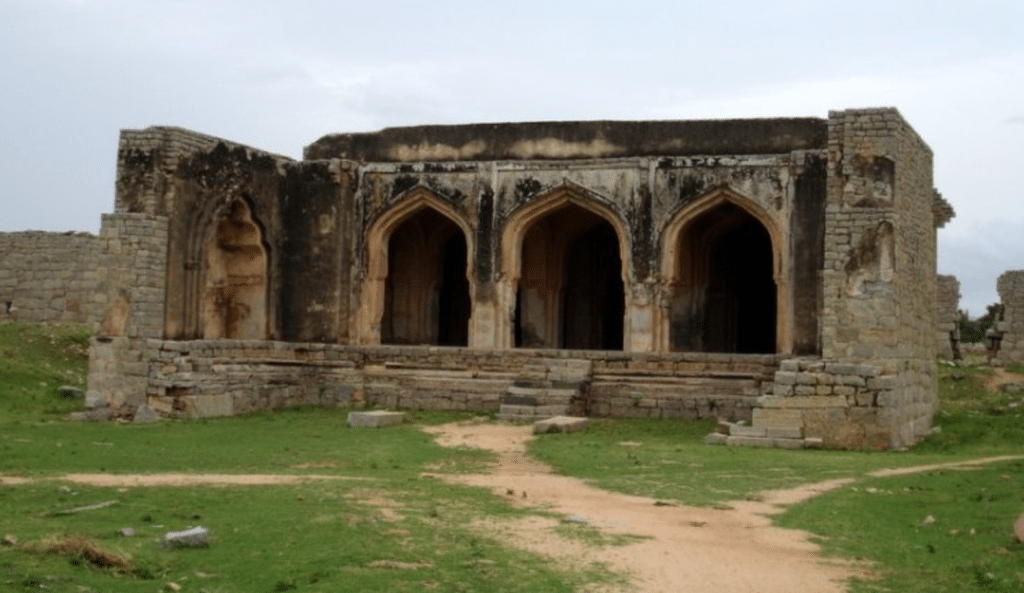
Foreign Travellers’ Accounts of Vijayanagara City
- Domingo Paes left invaluable descriptions of the city’s walls, gates, streets, markets, and royal palaces, noting that the city was as extensive as Rome, and describing the capital as “the best-provided city in the world.”
- Abdur Razzaq praised Vijayanagara as a city such that “the eye has not seen nor the ear heard of any place resembling it upon the whole earth,” and noted seven rings of ramparts protecting the city.
- The Russian traveller Nicolò Conti likewise recorded the extensive fortification of the city.
Nicolò Conti (Italian traveller, visited 1420)
- Visited Vijayanagara just after the accession of Deva Raya I, and is considered the first known foreign traveller to the city.
- Noted the fortification of the city and the presence of thousands of men employed in the army.
Abdur Razzaq (Persian traveller, first half of the 15th century, 1443)
- Was deeply impressed by Vijayanagara’s urban planning and threw light on its massive fortifications — recording seven rings of ramparts protecting the city, with walls that tapered slightly and were built without the use of mortar as a cementing material.
- Noted that the fortification incorporated forest and agricultural land intended for subsistence within its bounds.
- Described the city’s streets and houses, and the grand processions held during the Mahanavami festival.
Domingo Paes (Portuguese traveller, first half of the 16th century, during Krishna Deva Raya’s reign)
- Described Vijayanagara as a very large city, “as large as Rome,” and remarkably beautiful to behold.
- Left an account of the king’s palace, noting the many groves of trees, water conduits, and lakes found within the city.
- Described the Audience Hall and the Mahanavami Dibba together as the “House of Victory.”
- Recorded that the Mahanavami festival featured numerous processions of animals, warriors, and courtly women, along with wrestling matches, fireworks, and other entertainments.
- Described broad, beautiful streets lined with markets, where merchants lived and every conceivable good could be purchased — provisions such as rice, wheat, corn, and pulses, cheap and abundant, alongside precious goods like diamonds and pearls — confirming his verdict that this was “the best-provided city in the world.”
Fernão Nunes (Portuguese traveller, first half of the 16th century)
- Focused particularly on the markets of Vijayanagara, especially provisions and food materials.
- Recorded markets overflowing with fruits such as grapes, oranges, and mangoes, and stocked with goods ranging from mutton and pork to horses and sparrows — all available cheaply.
- Noted the elaborate jewels worn by women during the Mahanavami festivals.
Barbosa (Portuguese traveller, visited during Krishna Deva Raya’s reign, early 16th century)
- Described the cities of Vijayanagara as rich and well-provided, with large townships and a flourishing trade.
Cesare Federici (Italian traveller, visited 1567)
- Found the city only partly destroyed following the Battle of Talikota.
- Noted that the Aravidu dynasty intended to re-establish the Vijayanagara capital, though this effort ultimately proved unsuccessful.
Sculpture
- Sculptural expression found its fullest outlet in temples and in the great pillars adorning them, alongside numerous free-standing monolithic sculptures.
- The art of bronze casting continued from the Chola period, with both theme and technique remaining broadly consistent with earlier tradition.
- The Vijayanagara period is also notable for producing life-size portrait sculptures of kings and queens — a fine example being the portrait sculptures of Krishna Deva Raya and his queens preserved at Tirumala.
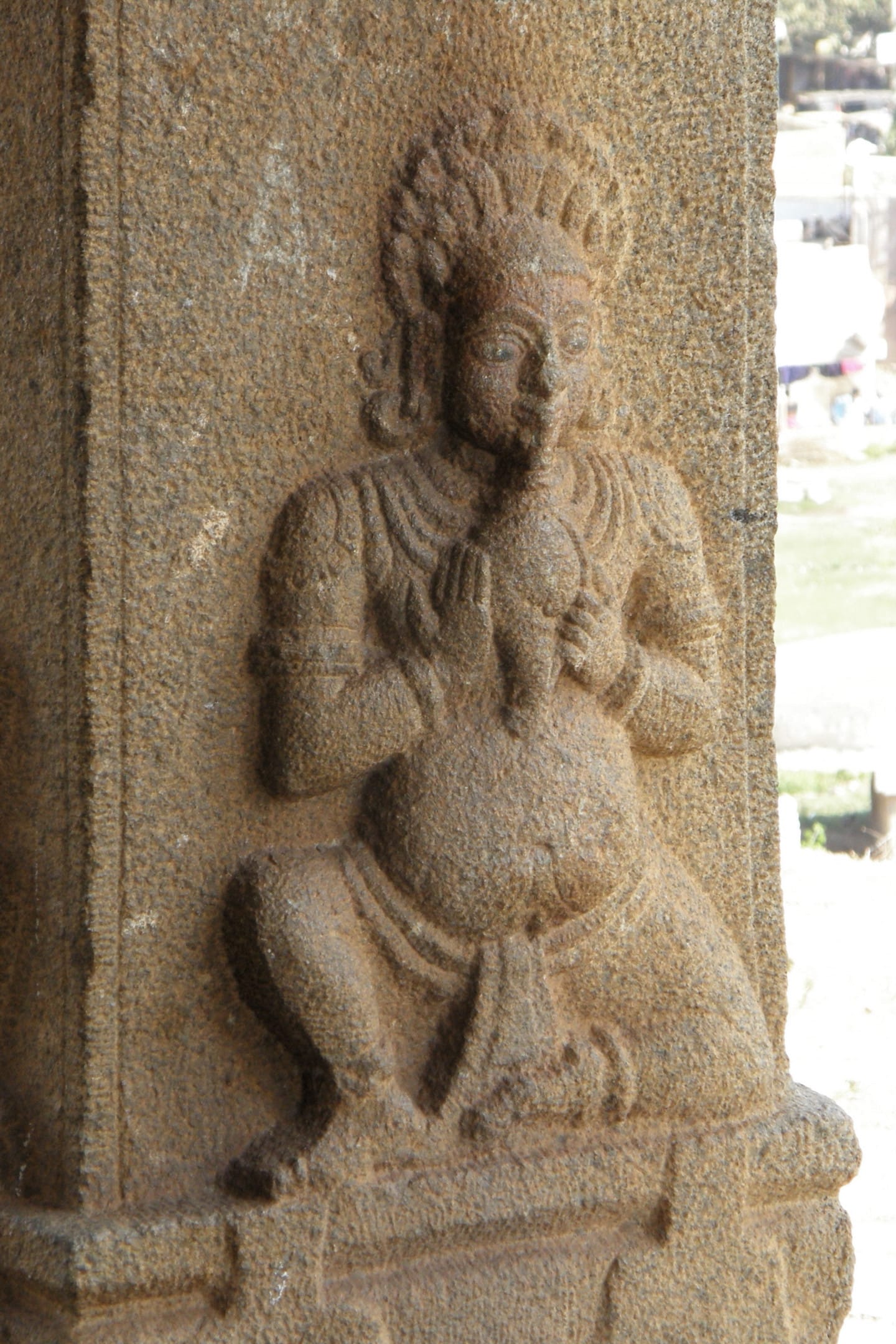
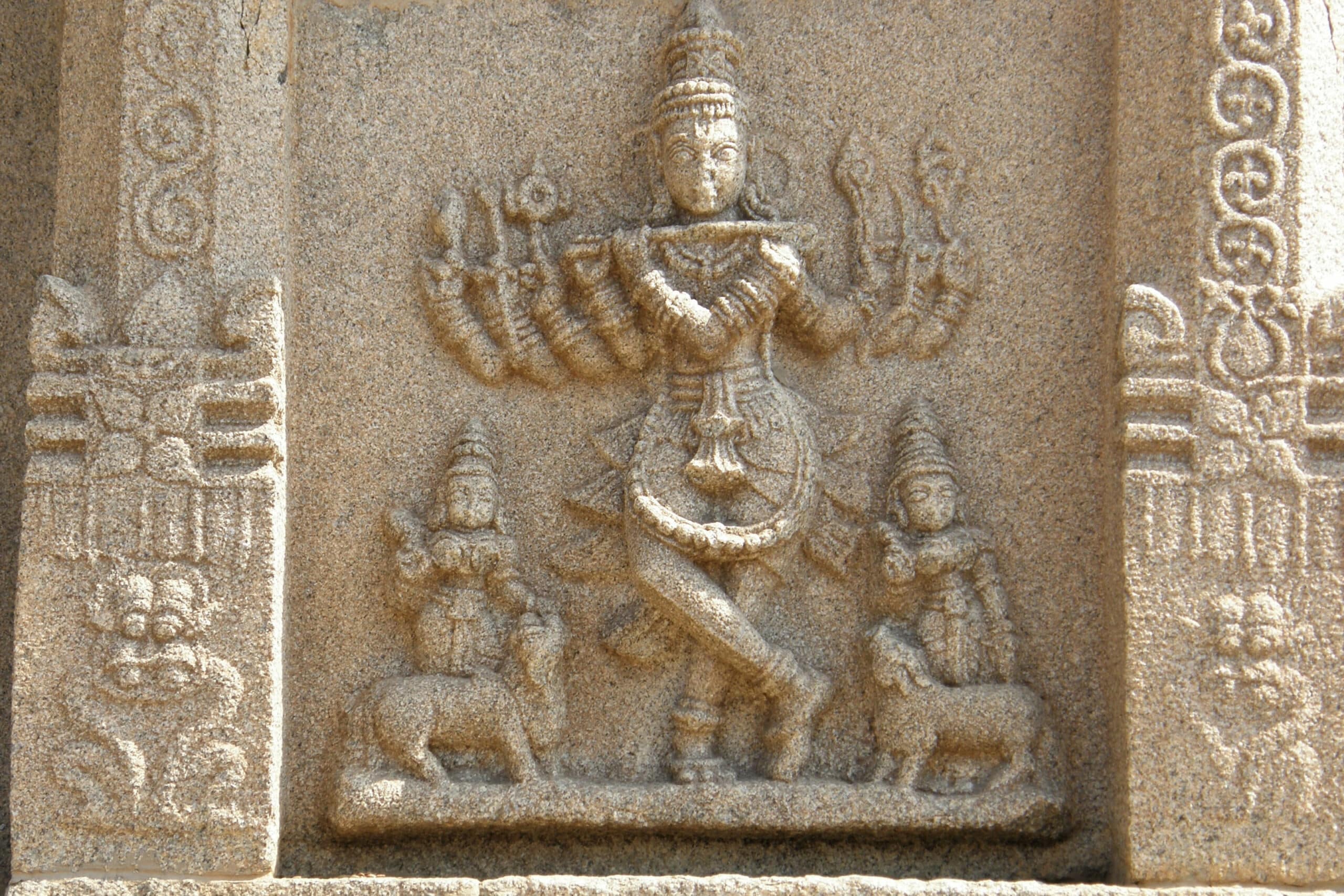
(Note: Certain aspects of sculpture have already been covered above under Architecture.)
Literature
- This period is widely regarded as the golden age of literature in South India, with the Vijayanagara rulers proving themselves great patrons of literary activity. Under their patronage, numerous religious and secular works were composed across Sanskrit, Telugu, Kannada, and Tamil, by scholars writing within the Jain, Virashaiva, and Vaishnava traditions.
- Literary development reached its peak under Krishna Deva Raya, rightly celebrated as the “Andhra Bhoja.” The period as a whole produced hundreds of works spanning nearly every facet of Indian culture — religion, philosophy, literature, history, biography, prabandhas (narrative poems), music, grammar, poetics, and medicine.
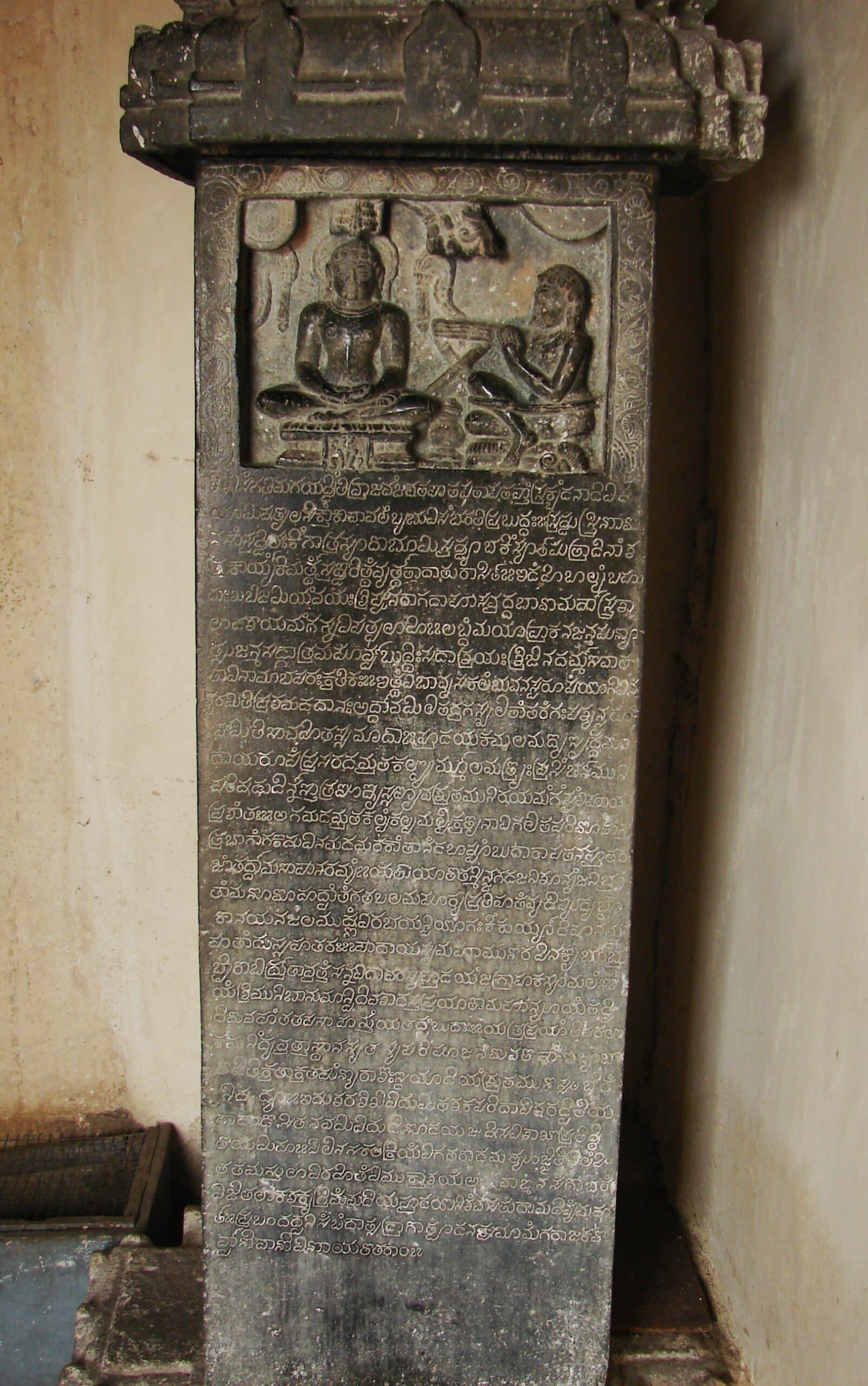
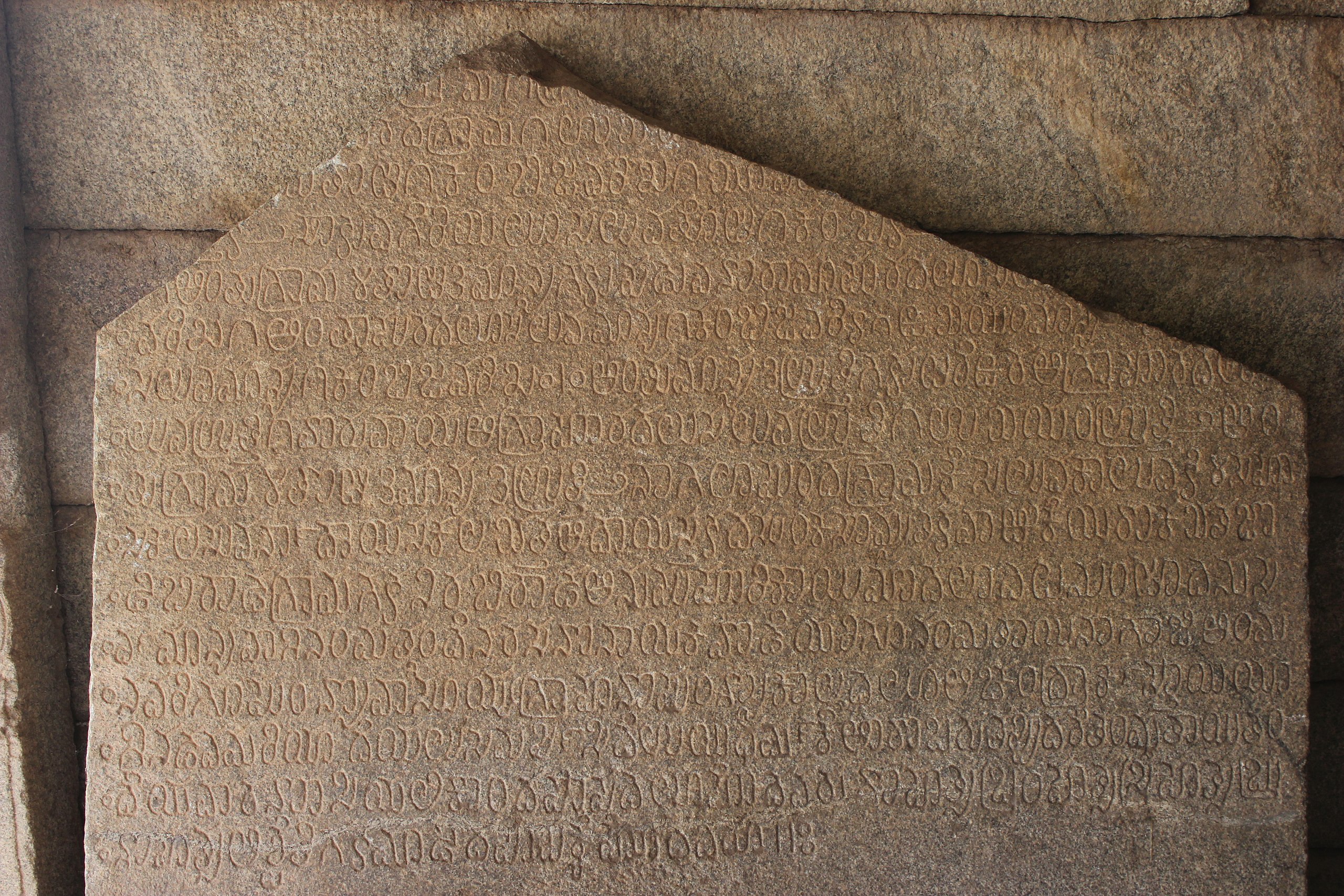
 Poetic_Kannada_inscription
 Kannada_inscription.
Bhashyas (Commentaries)
- Among religious works, numerous commentaries (bhashyas) were composed:
- Sayanacharya (patronised by Bukka Raya I) wrote commentaries on the Vedas, while Hemadri wrote commentaries on the Dharmashastras.
- Other important commentaries covered the Satapatha Brahmana and the Aitareya Aranyaka.
- Vyasatirtha, patron saint of the Vijayanagara Empire (patronised by Krishna Deva Raya), authored a detailed work on Dvaita philosophy.
- Vedanta Desika wrote an epic on Krishna titled Yadavabhyudayam, as well as the Hamsa Sandesa — a poem belonging to the sandesa-kavya (messenger poem) genre, closely modelled on Kalidasa’s Meghaduta.
- Krishna Deva Raya, himself an accomplished scholar, authored Madalasa Charita, Satyavadu Parinaya, Rasamanjari, and Jambavati Kalyana.
- Mohanangi, wife of Rama Raya (prime minister to Sadasiva Raya), wrote the celebrated five-part epic Marichiparinayam.
- The Ashtadiggajas, the eight court poets of Krishna Deva Raya, made significant literary contributions — including Manucharitam (by Allasani Peddana) and Panduranga Mahatyam. This era, defined by the richness of their prabandha literature, is accordingly known as the Prabandha Period.
- The Maduravijayam of Gangadevi, a Sanskrit poet, remains a significant historical work of the period.
Language
- The large-scale literary output of this period spurred substantial growth in language development.
- Telugu was a particularly popular literary medium, reaching its peak under the patronage of Krishna Deva Raya.
- Kannada, Telugu, and Sanskrit, along with regional languages such as Tamil, all received significant patronage, though Kannada and Telugu served as the empire’s principal administrative and court languages.
Kannada
- Kannada literature was chiefly promoted by Jain saints, though scholars of other traditions contributed as well:
- Bhima Kavi translated the Bhasyapurana.
- Over 7,000 inscriptions (shilashasanas), including some 300 copper-plate inscriptions (tamarashasanas), have been recovered from the period — nearly half in Kannada, the rest in Telugu, Tamil, and Sanskrit.
- Narahari composed a popular version of the Ramayana known as Torve Ramayana, while Kumaravyasa composed the Mahabharata in Kannada, and Vithalanatha translated the Bhagavata Purana into Kannada.
- The Vaishnava saints Purandaradasa, Kanakadasa, and Sripatiraja enriched Kannada literature through devotional songs and kirtanas.
- Bhimakavi wrote the Basava Purana, while Virupaksha Pandit authored the Chennabasava Purana.
Telugu
- Telugu, a court language, gained even greater cultural prominence under the later Vijayanagara kings.
- Up to 1500 AD, most Telugu literary works were translations. Prominent scholars of this early phase included Srinatha, Pothana, Jakkana, and Duggana, who translated Sanskrit and Prakrit works into Telugu.
- During Bukka I’s reign, Gangadevi wrote the Madura Vijayam.
- Deva Raya II himself authored two Sanskrit works — Mahanataka Sudhanidhi and a commentary on the Brahmasutras of Badarayana — and conferred the title Kanakabhisheka upon Srinatha, author of Sringara Naishada, Sivaratri Mahatyam, Kasikhanda, Bhimakhanda, Harivilasam, and Panditaradhya Charitra.
- Bommera Pothana translated the Bhagavata Purana into Telugu and also wrote Virabhadra Vijayam.
- Telugu literature reached its zenith during the era of the Ashtadiggajas under Krishna Deva Raya:
- Krishna Deva Raya himself wrote Amuktamalyada, a Telugu work on polity, and Jambavati Kalyanam, a Sanskrit drama.
- Nachana Somanatha wrote Uttara Harivamsam, while poets such as Allasani Peddana and Nandi Timmana flourished at court.
- Allasani Peddana wrote Manucharitam and Harikathasaramu, while Tenali Ramakrishna wrote Panduranga Mahatyam.
- Achyuta Raya patronised the scholar Rajanatha and the poetess Tirumalambadevi, who wrote Varadambika Parinayam.
- Rama Raya patronised Ramamatya, a leading authority on music, while Tirumala wrote a commentary on Jayadeva’s Gita Govinda, and Appayya Dikshitar wrote a commentary on the Vedas expounding Advaita philosophy.
- Vemana composed the Vemana Satakas, a body of moralist literature in Telugu, while Elugandi Peddana translated the mathematical text Lilavati into Telugu.
Tamil
- Krishna Deva Raya also patronised Tamil poets. Tirumalainatha and his son Paranjotiyar were well-known scholars of the period, while Sevaicch-buduyar translated the Bhagavata Purana into Tamil.
Sanskrit
- Numerous Sanskrit scholars were patronised, including Sayanacharya and Vyasatirtha, whose works were mostly devoted to Dvaita philosophy.
- Bhattakalankadeva, a Jain scholar, wrote a Kannada grammar in Sanskrit, complete with commentary, while the works of Vedanta Desika were similarly composed in Sanskrit.
Music and Dance
- The rulers of Vijayanagara encouraged court and temple singing as a specialised art form, carefully preserving the traditional music of the South without admitting Iranian influence.
- The Vijayanagara period is credited with the origin of Carnatic music, associated with Purandara Dasa, who is also credited with the origin of the Rudra Veena.
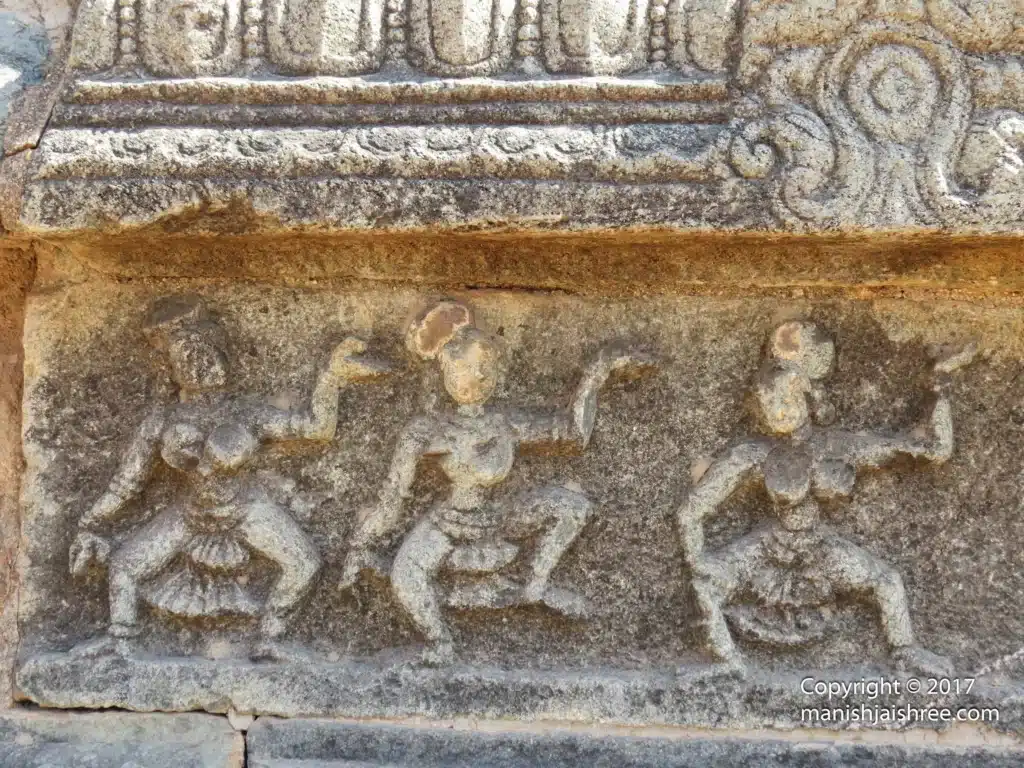
- Artists employed a wide variety of musical instruments, including the Veena, Venu, and Mridanga. Since vocal music could not itself be depicted visually in sculpture, contemporary music was instead represented through carvings of these musical instruments in sculpture and painting.
- Several important treatises on music were composed during this period, including:
- The Sangita Suryodaya of Lakshminarayana.
- The Sangitasara of Vidyaranya.
- A major Sanskrit commentary on the celebrated Sangeeta Ratnakara, written by Kallinatha.
- The Swaramela Kalanidhi, a major treatise on South Indian music, written by Ramamatya.
- Dance: Bharatanatyam received considerable royal patronage, while Yakshagana, a popular dance-drama, remained closely associated with temple walls and performances.
- Music and dance together played a vital role in Vijayanagara’s cultural life, with both folk and classical traditions enjoying equal popularity among the masses and the elite alike — a popularity vividly reflected in the paintings of the period.
Painting
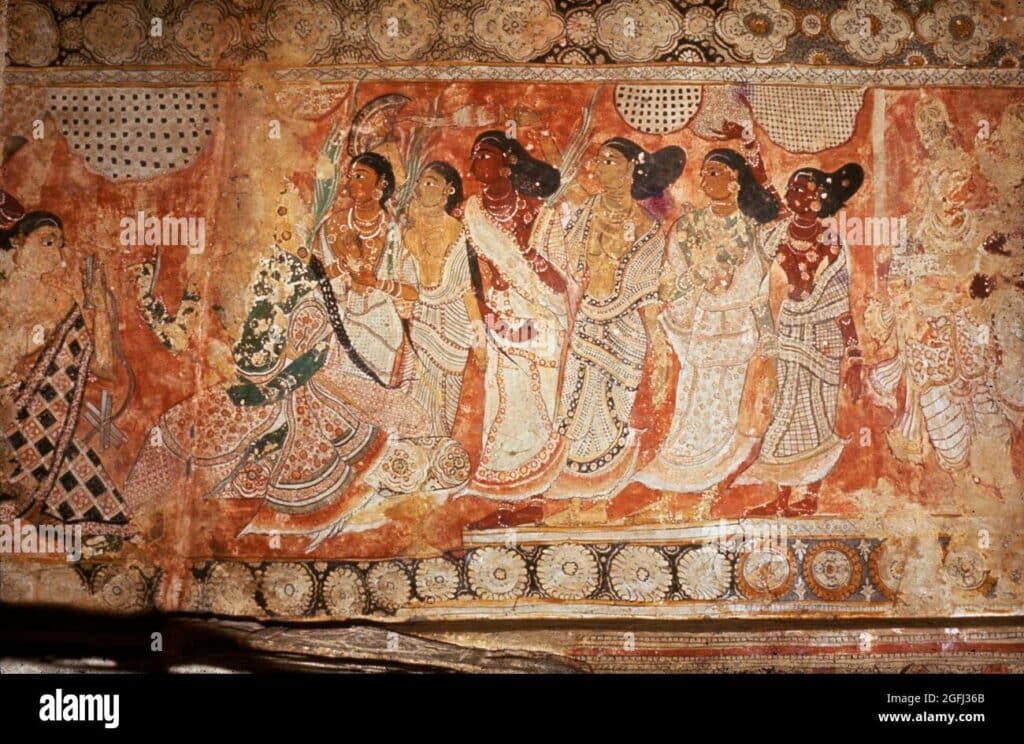
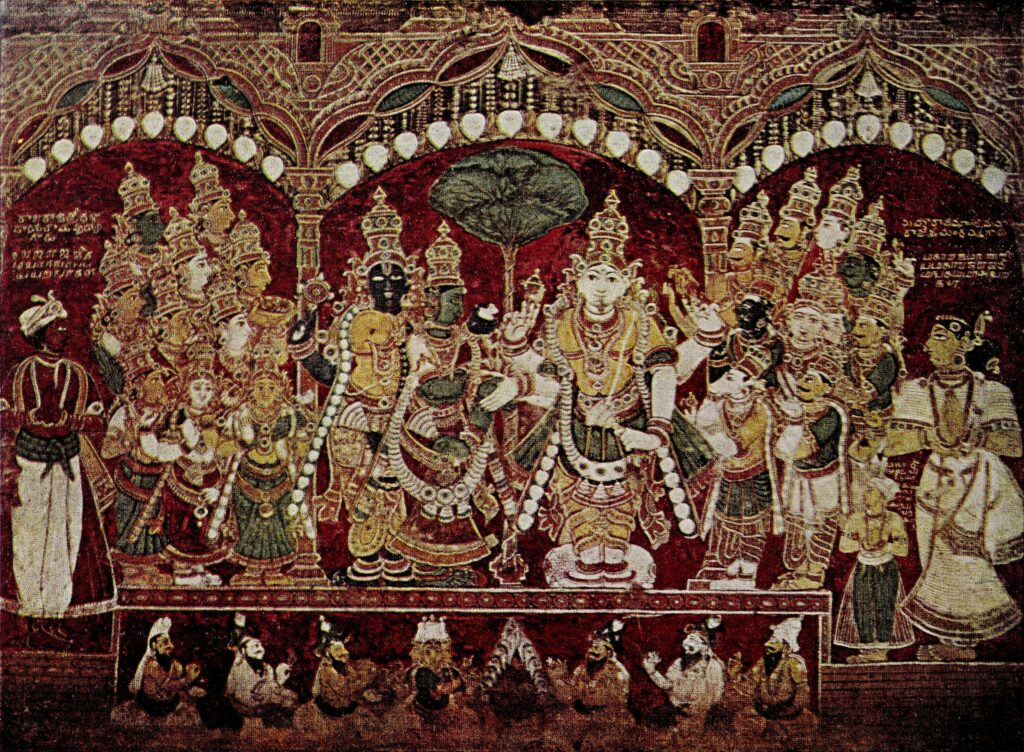
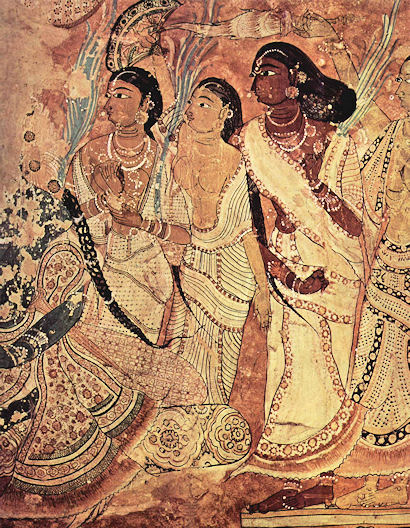
- Paintings from this period offer valuable insight into contemporary customs, amusements, religious beliefs, and various aspects of social life.
- Vijayanagara painting represents a great revival of Hindu religion and art in South India, developing chiefly as an adjunct to architecture, in the form of mural painting used to decorate the inner ceilings and walls of palaces and temples. Unfortunately, very few actual specimens have survived, and much of our knowledge of these paintings rests on descriptions left by foreign visitors.
- Notable surviving murals are found in temples such as the Virabhadra Temple at Lepakshi, the Virupaksha Temple, and the Kalyana Sundareswara Temple.
Themes and Features of Vijayanagara Painting
- Common themes included scenes from the epics — the Ramayana and various Puranas — including episodes such as Draupadi’s wedding and the Kiratarjuniya (Arjuna’s penance).
- Paintings also depicted animals and wildlife, including animated hunting scenes drawn from the Kirata story.
- Celestial figures and dancing girls were frequently depicted in fresco form, including scenes of a particularly dangerous dance performed while holding a double-edged sword.
- In some instances, foreign visitors to the Vijayanagara Empire were themselves depicted in these paintings.
- In most Vijayanagara paintings, human faces are shown in profile, with figures typically standing at a slight slant.
Paintings at the Virabhadra Temple, Lepakshi
- Found across the high ceilings of the temple’s huge gateways, mandapas, and corridors.
- The ceiling is divided into a series of strips, each further broken into square or rectangular panels — with each panel depicting a distinct scene or portion of one, in keeping with the overarching theme represented in the central panel.
- The ceiling features an extraordinarily large central painting of Virabhadra, flanked by his devotees, the temple’s patrons Virupanna and Viranna.
- Numerous panels depict scenes from the Mahabharata, Ramayana, and the Puranas, including gods such as Shiva and Vishnu, along with mythological figures such as Arjuna.
- Several murals are also dedicated to the kings and queens of the period.
- The paintings follow a distinctive style, marked by elegant line-work set against an orange-red background, with particular emphasis on rich textile patterns, detailed hairstyles, and exquisite jewellery — costumes are never left plain, always shown with intricate decorative patterns.
- The most spectacular of these paintings depicts the wedding of Lord Shiva and Goddess Parvati, notable especially for the elaborate costumes and jewellery worn by the wedding guests.
Paintings at the Virupaksha Temple, Hampi
- Feature paintings depicting dynastic history, episodes from the Ramayana and the Mahabharata, and the exploits of Shiva.
Debate on the Cultural Contribution of the Vijayanagara Empire
Scholars remain divided in their assessment of the Vijayanagara Empire’s cultural legacy.
- The favourable view holds that the rulers of Vijayanagara wrote a glorious chapter in the cultural history of South India, and that it was largely due to their efforts that traditional Hindu culture in the South was able to preserve its distinct identity, relatively free of Islamic influence. Through their extensive patronage of cultural activity, they are credited with substantially enriching the cultural life of the region.
- The critical view, by contrast, holds that the Vijayanagara period was, in fact, a phase of relative cultural stagnation in the South. On this reading:
- Its rulers clung to conservative patterns of cultural life, doing little to encourage genuinely new ideas or innovations.
- The literature of the period — particularly religious texts — often displays a tendency to repeat older ideas, lacking freshness of thought.
- In the arts too, earlier patterns were largely retained; while architecture did see some embellishment, sculpture and painting show unmistakable signs of decline over the period.