Muhammad Tughluq: Introduction

Muhammad bin Tughluq (1325–1351) remains one of the most fascinating — and most debated — rulers of the Delhi Sultanate: a scholar-king of formidable intellect and “highly innovative approach,” whose reign witnessed the Sultanate’s territorial peak, alongside a series of ambitious but ultimately failed experiments — the transfer of the capital to Daulatabad, the introduction of token currency, an abortive expedition against Khurasan, and a costly campaign into the Qarachil hills. Coming to power after the turbulent succession struggles that followed Alauddin Khalji’s death, and inheriting his father Ghiyasuddin Tughluq’s policy of direct annexation rather than mere tributary submission, Muhammad bin Tughluq pursued a vision of centralised, rationally administered empire that was, in the words of contemporary chronicler Ziauddin Barani, both remarkably progressive and fatally ill-suited to the realities of 14th-century India. This article traces the political background to the rise of the Tughluq dynasty, examines Muhammad bin Tughluq’s approach to kingship, his major administrative and economic experiments, the unique composition of his bureaucracy, the three phases of rebellion that punctuated his reign, and finally, a balanced historical assessment of his rule.
The Fall of the Khaljis and the Rise of the Tughluqs
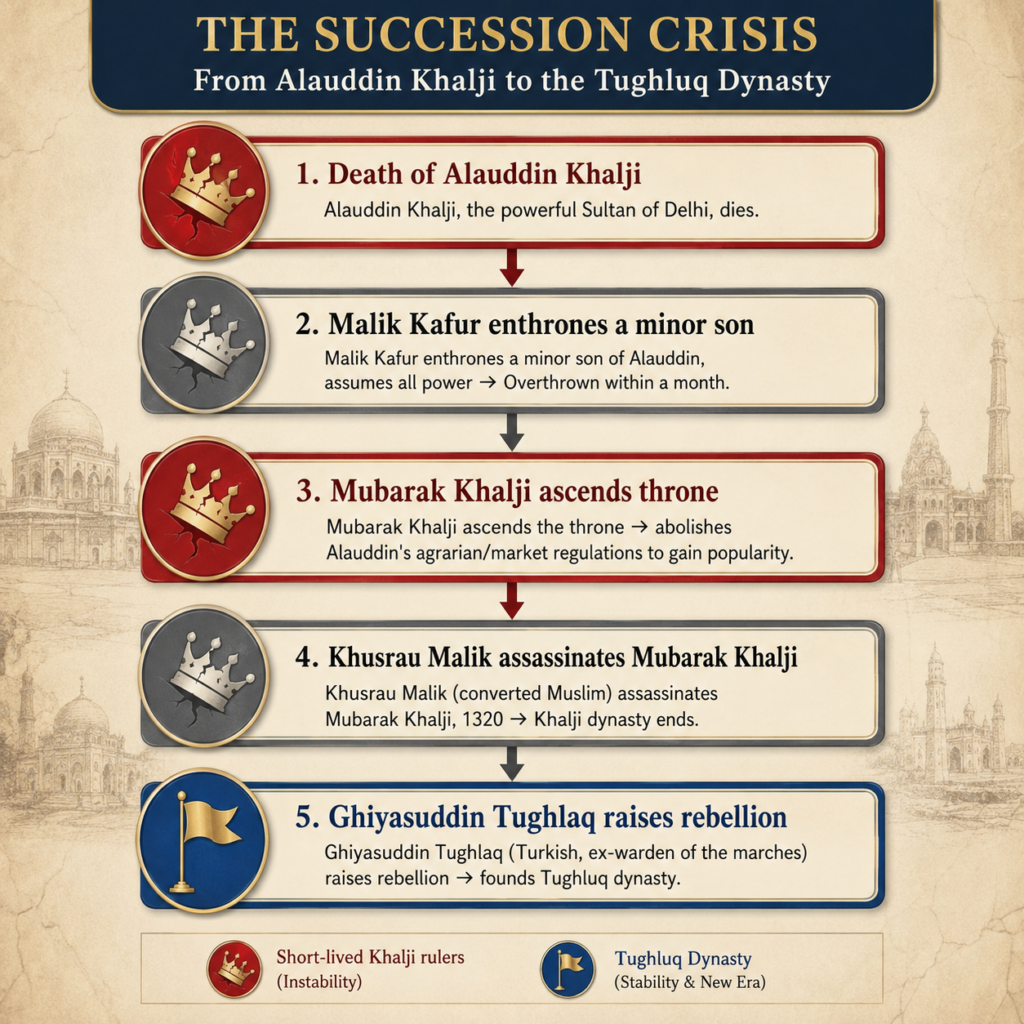
- After the death of Alauddin Khalji, the most influential noble, Malik Kafur, elevated a minor son of Alauddin to the throne and assumed all powers himself — but Kafur was overthrown within a month, and another son of Alauddin, Mubarak Khalji, ascended the throne.
- In order to gain popularity, Mubarak Khalji abolished all the agrarian and market-control regulations of Alauddin.
- Khusrau Malik, a converted Muslim, then assassinated Mubarak Khalji and assumed the throne himself in 1320, bringing the Khalji dynasty to an end.
- Ultimately, Ghiyasuddin Tughlaq — of Turkish origin, and formerly the warden of the marches against the Mongols — raised a rebellion and founded the Tughlaq dynasty.
Problems and Approaches
Policy of Annexation
- Ghiyasuddin Tughlaq, and his son and successor Muhammad bin Tughlaq, rejected Alauddin’s policy of non-annexation of distant states and of being content with their formal submission and regular tribute.
- Barani tells us that both Ghiyasuddin and Muhammad bin Tughlaq were highly ambitious. Muhammad bin Tughlaq was not prepared to leave a scrap of territory in India that was not subordinate to and under his direct control.
- Thus, during their rule, the direct control of Delhi was extended to Warangal (Telangana), Mabar (Coromandal), Madurai (Tamil Nadu), and Dvar Samudra (Karnataka), up to the southern tip of India.
- Whenever a territory was annexed, Muhammad Tughlaq would appoint a set of revenue officials to assess it — with their help, the accounts of distant provinces and tracts were audited in the office of the wazir, in the same detailed manner as villages and towns in the doab.
- Such a rapid expansion of directly ruled territories, and such a high degree of centralisation, carried their own pitfalls — ones which Muhammad Tughlaq was to realise only later.
Welfare of the People
- There are two other aspects bearing on the character of the state, with which Barani and other contemporary historians were concerned:
- The question of the welfare of the people, and
- The question of the relationship between state and religion.
- Barani praises Ghiyasuddin Tughlaq for his concern for the welfare of the people, and his policy of moderation, so that the country might not be ruined by the weight of taxation, and the path of improvement not barred.
- Almost for the first time, we see a recognition of the importance of agriculture and handicrafts on the part of the state, and the need to continuously expand cultivation.
- Thus, the policy of welfare and humanitarianism first put forward by Jalaluddin Khalji was reiterated and sought to be revived by Ghiyasuddin Tughlaq in a more positive manner. He extended this policy of mildness and generosity to the noble families of the era of Alauddin and his son, Kaiqubad.
- Many of these families had been leading lives of poverty and neglect; they were given posts and iqtas. Those who had received large sums of money as gifts from the previous regime were called to audit, and most were forced to return the sums.
Relationship Between State and Religion
- Regarding the relationship between state and religion, Ghiyasuddin Tughlaq, though a strict Muslim in his observance of religious practices, did not accept the narrow interpretation of the shara regarding the humiliation and impoverishment of the Hindus, as advocated by some theologians.
- Muhammad Bin Tughlaq, too, was strict in his personal observance of religious injunctions regarding prayers, fasting, etc.
- Barani’s criticism — which we may treat as a compliment — was that Muhammad was a “rationalist”, meaning he would not accept anything except by logical proof.
- He was a learned man, possessing a deep understanding of many branches of knowledge, including philosophy, mathematics, tibb (medicine), and religion.
- He was also interested in Persian and Hindi poetry, and had read widely.
- Barani accuses Muhammad bin Tughlaq of combining in his own person the traditions of prophethood (nubuwat) with sultanat — i.e., of trying to combine spiritual and political authority.
- This charge, however, has no real basis, except that Muhammad Tughlaq refused to accept the spiritual authority of many theologians and mystics.
- Though not a believer in mysticism himself, Muhammad Tughlaq respected the Sufi saints.
- He was the first Sultan to visit the tomb of Muinuddin Chishti at Ajmer.
- He also built mausoleums over the tombs of many Sufi saints, including Nizamuddin Auliya at Delhi.
- Muhammad Tughlaq was a man of an open mind.
- He associated with jogis and Jain saints, such as Raj Shekhar and Jinaprabha Suri.
- While in Gujarat, he visited some Jain temples and gave them grants.
- He is also known to have associated himself with Hindu festivals, such as Holi.
- Barani’s criticism of Muhammad Tughlaq’s faults of character cannot, however, be dismissed out of hand.
- He is accused of being hot and hasty in character, with an excessive reliance on his own judgement, without heeding the advice of others.
- Hence, many of his innovations were ill-considered, or launched without “adequate preparations.”
- Barani, and the Moroccan traveller Ibn Battutah, also accuse Muhammad Tughlaq of giving excessive rewards and punishments, and of appointing mean, low-born people to high offices.
Ghiyasuddin Tughlaq
- Ghiyasuddin Tughlaq ruled only for a short time, and died in 1325.
- After setting the administration in order, he sent his son, Ulugh Khan (later Muhammad Tughlaq), to restore the imperial position in Warangal, from which he returned with rich booty. He also sent a noble to deal with a rebellion in Gujarat.
- Ghiyasuddin marched on Bengal to reduce it to submission. On his return from this successful campaign, a pavilion erected by his son, Ulugh Khan, to welcome him, collapsed and crushed him to death (1325).
- It appeared to be an accident. However, historic documents state that Ulugh Khan (Muhammad Tughlaq) had plotted it to kill his own father.
- Thus, Ulugh Khan (Muhammad Tughlaq) ascended the throne in 1325.
Muhammad Bin Tughlaq: Nature of Kingship
- Highly autocratic and despotic in temperament.
- Pursued a separation of state and religion, focused on political consideration and state interest.
- Muhammad bin Tughlaq went so far as to substitute the name of the Abbasid caliph on his coins.
- Later, he also received a formal rescript (manshur) from the Caliph — but all this could hardly change the attitude of orthodox elements towards him.
- Muhammad bin Tughlaq went so far as to substitute the name of the Abbasid caliph on his coins.
- Practised a negation of the Ulema’s authority.
- Held higher imperial ambitions than Alauddin; it was under him that the territory of the Sultanate reached its peak.
- Followed a catholic (broad-minded) approach to religions.
- He was the first Sultan to participate in the festival of Holi.
- He was the first to employ Hindus in even high offices.
- He was also the first to include Sufis into the nobility, and to enter into matrimonial alliances with them.
- Created a composite nobility, including persons of very low status on the basis of talent — such as the cook or the gardener.
- Had a highly innovative approach, undertaking such steps as the second capital at Daulatabad, the token currency, an agricultural experiment, and a foreign campaign.
Major Projects and Agrarian Measures: His Experiments and Reforms
- Muhammad bin Tughlaq was keen to tone up the administration, and bring about uniformity in its functioning.
- Towards this end, according to Ibn Battutah, he issued large numbers of orders (manshurs).
- However, only a few of these appear to have been taken up seriously, or to have made a real impact. Those have been listed by Barani, and may be divided into two categories:
- Administrative and political measures.
- Economic and agrarian reforms.
Administrative and Political Measures
Exodus to Deogiri
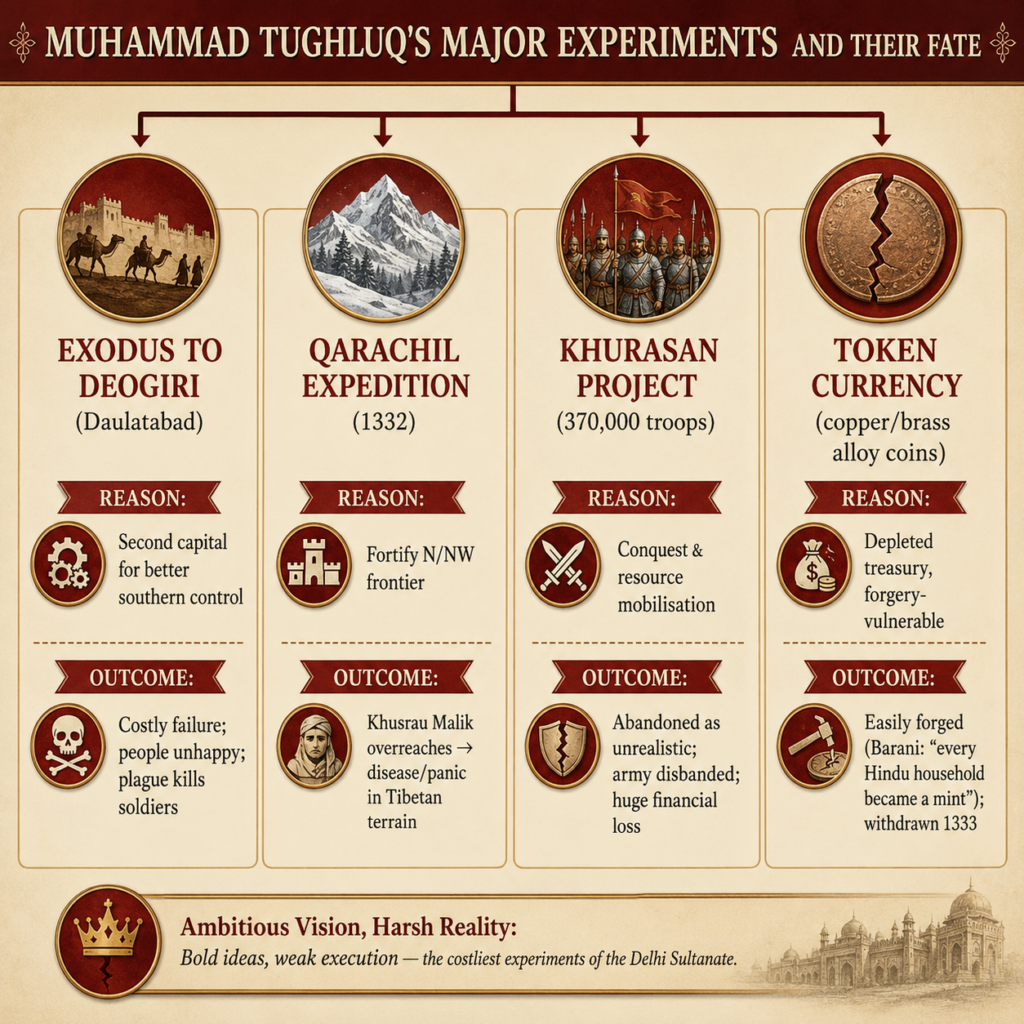
- One of the most controversial steps taken by Muhammad bin Tughluq early in his reign was his so-called transfer of the capital to Deogiri — renamed Daulatabad — and the alleged orders of the Sultan for a mass transfer of the people from Delhi to the new capital.
- He wanted a second capital in the south, so that he could control it more easily.
- The Sultan purchased the houses and dwellings of those at Delhi who had migrated and wanted the government to do so. Liberal grants were made to people, both at the time of their departure from Delhi and upon arrival at Daulatabad, where free boarding and lodging were provided.
- Nevertheless, most migrants were not happy — they had grown accustomed to Delhi, where many had lived for over a hundred years, and which they regarded as their true home.
- An outbreak of bubonic plague, coinciding with an ongoing serious rebellion, claimed the lives of many of his soldiers.
- Overall, the exodus to Daulatabad proved a costly failure, bringing misery to many people — though its effects were felt largely by the upper classes, and not by the ordinary people of Delhi.
Expeditions to the North-West and North
- Since Alauddin’s expedition to Multan, little attention had been given to Multan, with focus remaining mostly on the South and Gujarat. After Muhammad Tughluq (formerly Ulugh Khan) acceded to the throne, attention finally turned to the north-west frontier.
- Campaigns to Kalanaur and Peshawar:
- These were probably a sequel to the Mongol invasion under Tarmashirin Khan in 1326–27, aimed at securing the north-western frontier against future Mongol attacks.
- The Sultan stayed at Lahore, while the army conquered Kalanaur and Peshawar, with administrative arrangements settled there.
- The Qarachil Expedition (modern Kulu, Kangra district of Himachal Pradesh), 1332:
- This formed part of the plan to fortify the north and north-west frontier.
- A large army was enlisted under the command of Khusrau Malik.
- The army occupied Jidya, an important place in the Qarachil region, and was then instructed to return. However, in his enthusiasm, Khusrau Malik exceeded his instructions, marching ahead towards Tibet. Soon, the rains set in, and the army was overtaken by disease and panic — only a few soldiers returned to tell the tale of the catastrophe.
- The Qarachil expedition thus led to a tremendous waste of resources, and an erosion in the authority of Muhammad Tughluq.
- An Ambitious Project for Khurasan:
- A little before the Qarachil expedition, Muhammad Tughluq had launched an ambitious project of bringing Khurasan under submission.
- A large army of soldiers, numbering about 370,000, was recruited for this purpose, and the soldiers were paid a year’s salary in advance.
- A large sum was also invested in the purchase of costly equipment for the army.
- Ultimately, the project was abandoned as an unrealistic scheme, and the army disbanded — leading to a tremendous financial loss.
- The authority of the Sultan also suffered a serious setback, and a series of rebellions followed, hollowing out the most extensive empire the Delhi Sultanate had ever possessed.
Economic and Agrarian Reforms
Agrarian Measures of Muhammad Tughluq
- Muhammad Tughluq first extended Alauddin Khalji’s system of revenue collection, based on measurement, to Gujarat, Malwa, the Deccan, South India, and Bengal.
- At a later stage, the scale of agrarian taxation was enhanced considerably.
- Barani’s statement that the increase amounted to 20 or even 10 times is undoubtedly a rhetorical exaggeration, but it certainly gives an impression of an enormous increase. He also suggests additional new imposts (abwab) were levied; other taxes, such as kharaj, charai, and ghari, were also more rigorously collected.
- According to Yahya, cattle were branded and cottages counted to avoid any concealment.
- But more important than these measures was the fact that, for the assessment of kharaj:
- Wafa-i-farmani (officially decreed yields), and
- Nirkh-i-farmani (officially decreed prices) were used.
- These decreed yields and prices used for calculating revenue were not actual, and were generally inflated.
- The use of inflated yields, and prices much higher than what actually prevailed, had the obvious result of overstating the value of produce, and thus the share of the state.
- This tremendous increase in revenue demand resulted in the contraction of area under plough, and flight of the peasantry. There followed a peasant revolt in the Doab and around Delhi, which caused the failure of grain supplies to Delhi, and a famine that lasted for about seven years, from 1334–5 to 1342.
Agricultural Policy for Promoting Agriculture
- Faced with these problems, Muhammad Tughluq became the first Sultan to attempt to formulate an agricultural policy for promoting agriculture:
- Agricultural loans, named sondhar, were given for increasing the area under plough, and for digging wells for irrigation.
- Barani says that 70 lakh tankas (according to Afif, 2 crore tankas) were given as sondhar till 1346–7, though perhaps hardly any amount reached the peasantry.
- The Sultan was so determined to introduce his agricultural improvement project that, when a theologian declared that giving a loan in cash and receiving interest in grain was a sin, he had him executed.
- A new ministry, designated the Diwan-i-Amir-i-Kohi, was established to promote agriculture, with two main functions:
- To extend the area under cultivation, and to reclaim land that had gone out of cultivation, and
- To improve the production of land already under cultivation. For this, crop rotation was introduced, and the crop pattern was changed:
- (a) Wheat in place of Barley.
- (b) Sugarcane in place of Wheat.
- (c) Grapes and Dates in place of Sugarcane.
- He also established a model farm of 60 square miles under state management, over which the government invested 70 lakh tankas over a period of two years for improved cultivation.
- Though Muhammad bin Tughluq spent an exorbitant sum, the entire scheme was abandoned after three years.
- The corruption of officers, the inferior quality of land chosen for farming, and the lack of interest of cultivators assigned land under government administration were accountable for the scheme’s failure.
- Nevertheless, this scheme cannot be called a total failure. The idea of extending and improving cultivation with the help of agricultural loans became a standard practice with later Sultans, and became a part of the agricultural policy of the Mughals.
- Thus, Muhammad bin Tughlaq’s agrarian innovation helped in the evolution of an agrarian policy that matured fully only under the Mughals.
- Agricultural loans, named sondhar, were given for increasing the area under plough, and for digging wells for irrigation.
The Token Currency of Muhammad Tughluq
- The only major innovation in the currency system established since Iltutmish was made by Muhammad Tughluq.
- Token currency of copper and brass alloy (with the value of silver): the Sultan introduced a coin of copper-and-brass alloy, reckoned at the value of a silver tanka. This coin, for the first time, carried an inscription in Persian.
- The introduction of token currency had already been attempted in sister Asian empires.
- In China, Qublai Khan (1260–94) had introduced a token currency of paper, and the experiment was successful.
- In Persia, Kaikhatu Khan (1293) also tried to introduce a token currency, but the attempt failed.
- Muhammad Tughluq’s experiment met with total failure, perhaps owing to the fact that the new currency could be easily forged.
- Barani notes that “every Hindu household became a mint.”
- However, the Sultan accepted the failure with grace, and exchanged all the token currency.
- Motives behind the Token Currency:
- He wanted to increase his resources for his grand scheme of conquest and administrative reform, but revenue had fallen due to the famine. The Sultan’s treasury had also been exhausted by his reckless grant of gifts and awards.
- According to Barani, it was part of Muhammad’s ambition to conquer all the inhabited quarters of the world, for which a huge army was needed, along with a large treasury to pay them. Thus, it was intended to supplement the treasury.
- He introduced token currency and struck a vast quantity of copper coins, known as Dirham.
- However, a shortage of gold and silver could not have been the major reason for the step, because when the experiment failed, the Sultan called in the token coins, and paid gold and silver in exchange for them.
- Failure of the Token Currency System:
- The experiment failed largely because the Sultan was unable to prevent the forging of the new coins.
- Barani implies that Hindu goldsmiths, who knew how to make alloys of copper and brass coins, produced forged coins on a large scale.
- The state suffered a big loss, because the khuts and muqaddams in rural areas paid land revenue in the copper and brass coins, and purchased arms and horses with the same currency (per Barani’s Tarikh-i-Firuz Shahi).
- Soon, there was such an abundance of these new coins that their value depreciated rapidly, and trade and commerce began to be disrupted.
- Hence, Muhammad bin Tughlaq cancelled his orders, and redeemed the token coins with gold and silver coins.
- This could have been done only for coins issued from the royal mints.
- The token coins issued by Muhammad bin Tughlaq were both in copper and brass.
- None of the earlier Sultans had issued any coins in brass, which was an alloy of copper with tin and zinc, etc.
- Muhammad bin Tughlaq also issued bronze coins bearing distinct inscriptions in Persian and Arabic, to mark them as new.
- Confusion arose, because ordinary people could not easily distinguish between these and forged coins, as they could not read the language.
- The forged coins, brought by people for redemption but not accepted by the government, lay heaped in mounds outside the fort for a long time.
- The failure of the token currency must certainly have affected the treasury adversely — but it was not too serious a blow, nor did it upset public life significantly.
- It was given up by 1333, three years after its introduction.
- The token coins are not even mentioned by Ibn Battutah, who arrived at Delhi in 1334 — showing how speedily the entire episode had been forgotten.
- The experiment failed largely because the Sultan was unable to prevent the forging of the new coins.
Bureaucracy of Muhammad Tughluq
- To implement his progressive ideas, Muhammad Tughluq needed a progressive administrative machinery. His approach towards the nobility was not based on racial or narrow religious considerations.
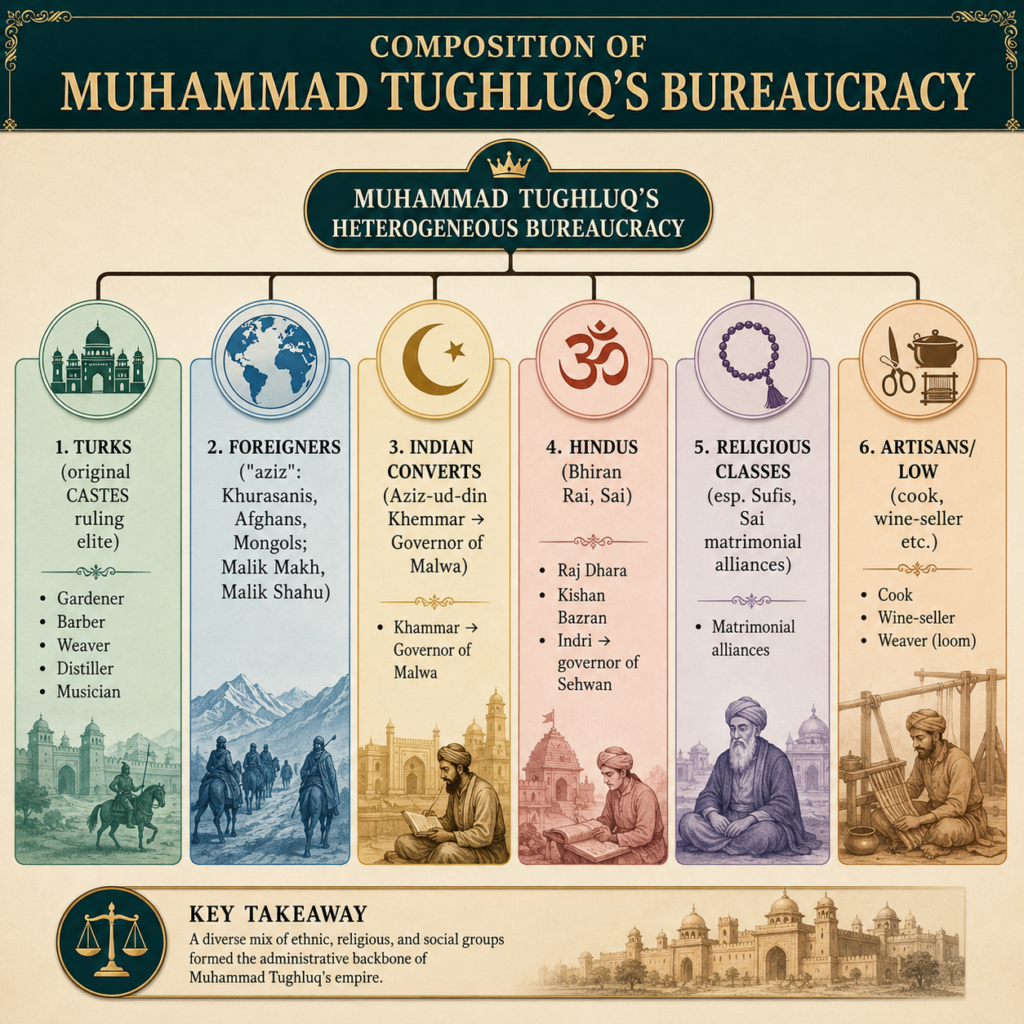
- He welcomed not only those families that had long been settled in India and had served previous rulers, but also admitted into service persons from artisan or other classes/castes despised by the Turks — such as gardeners, barbers, cooks, weavers, wine-distillers, and musicians.
Composition of Muhammad Bin Tughlaq’s Bureaucracy
- Turks were the ruling elite from the beginning of the Delhi Sultanate, and they continued to be part of Tughlaq’s bureaucracy.
- Foreign elements: Tughlaq gave great patronage to foreigners, calling them aziz (“friend”), and gave them lavish gifts. Foreigners included Khurasanis, Afghans, and Mongols, etc. — for example, Malik Makh and Malik Shahu were Afghan nobles.
- Indian converts: such as Aziz-ud-din Khammar, a distiller, who was made Governor of Malwa.
- Hindus: such as Bhiran Rai and Sai Raj Dhara; Barani also mentions Kishan Bazran Indri, who was made governor of Sehwan (Sindh).
- Religious classes: Muhammad bin Tughlaq also tried to induct into the administration members of the religious classes, especially the Sufis.
- Artisans or other classes despised by the Turks: such as gardeners, barbers, cooks, weavers, wine-distillers, and musicians — for example, Najba, a singer, was given charge of Badaun, then Gujarat and Multan; Aziz-ud-din Khammar, a wine-distiller, was made in-charge of Malwa; and Peera Mali, a gardener, rose to become Diwan-i-Wizarat.
- Barani severely criticises Muhammad bin Tughlaq for appointing these “low, ignoble” people, pouring scorn on “the clerks and grain-merchants (banias) who could not distinguish the front of a horse from its tail.”
- Muhammad Bin Tughlaq tried to take the first faltering steps towards a composite ruling class, consisting of both Hindus and Muslims.
- Even more importantly, he tried to rise above the narrow limitations of class and caste, inducting into service not only people of the land-owning classes, but men belonging to low or artisan classes.
- This heterogeneous bureaucracy might have proven more effective, but the lack of cohesion among its members, combined with the Sultan’s hasty and hot temperament, and the vast expanse of the empire, ensured that all his schemes met the same end — failure to produce the desired results.
- Even though the low-caste appointees, and many Turkish and Hindustani nobles, remained loyal, the Mongol and Afghan sadah amirs behaved differently.
Problems of Having a Heterogeneous Nobility
- The elevation of common people, such as artisans, to high posts was deeply resented by the old nobles.
- These newly elevated people were not incompetent — rather, they had risen on the basis of merit. But they were not soldiers; hence, they failed whenever they had to deal with rebellions.
- Muhammad bin Tughlaq’s nobility was thus very heterogeneous in character. As a result, there developed neither cohesion nor any sense of loyalty, and it could not serve as an instrument on which the Sultan could lean in times of difficulty.
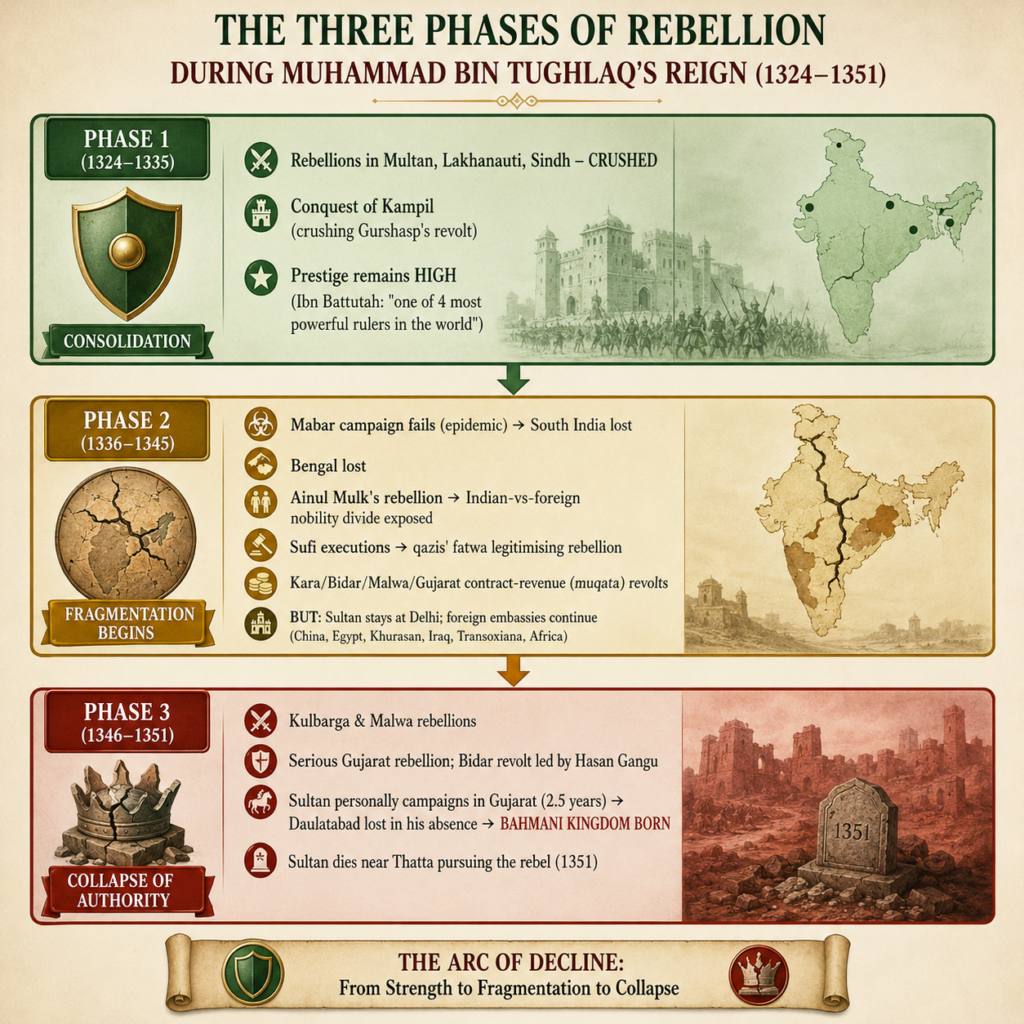
Rebellions During Muhammad Bin Tughlaq’s Reign
To assess the true extent of Muhammad bin Tughlaq’s successes and failures, his reign may be divided into three unequal phases.
First Phase (1324–1335)
- In this phase, Muhammad bin Tughlaq was engaged in consolidating the vast kingdom he had inherited.
- The only expansion was the conquest of Kampil in south Karnataka, following Muhammad bin Tughlaq’s march to crush the rebellion of his cousin, Gurshasp.
- There were rebellions in Multan, Lakhanauti, and Sindh, all of which were crushed.
- Despite the failure of his schemes — the exodus to Deogiri, the Khurasan and Qarachil expeditions, and the token currency experiment — the Sultan’s prestige remained high, as attested by Ibn Battutah.
- According to Ibn Battutah, the ruler of Delhi was one of the four most powerful rulers of the world at that time, the other three being China, Iraq, and the King of the Uzbeks.
Second Phase (1336–1345)
- The second phase began badly, with a rebellion in Mabar, and famine in the doab.
- The failure of the Mabar campaign — where an epidemic played a role — led to the loss of all the other southern states.
- Bengal was also lost during this period.
- The Sultan made little effort to recover these distant areas, either because he lacked resources in men and money, or because he felt that the control and direct administration of these areas from Delhi was an impossible task under the circumstances.
- The only area he still considered important — and to which he held on — was Daulatabad.
- During this period, a series of rebellions broke out across North India, and also in the Daulatabad region, which can be linked either to the discontent of the old nobles or to grasping revenue policies.
- Perhaps the most important rebellion of the old nobles was that of Ainul Mulk, who had been a close friend and associate of the Sultan, and had been made governor of Awadh.
- He had provided the Sultan with provisions while at Swarga-Dwar, and had suppressed a rebellion at Kara (near Allahabad). However, Muhammad Tughlaq became suspicious of Ainul Mulk’s growing popularity, and of the fact that he had given shelter to some revenue defaulters.
- Hence, he issued orders for Ainul Mulk’s transfer to Daulatabad, which became the occasion for the rebellion.
- Perhaps the most important rebellion of the old nobles was that of Ainul Mulk, who had been a close friend and associate of the Sultan, and had been made governor of Awadh.
- Although Muhammad bin Tughlaq ultimately pardoned Ainul Mulk, the conflict revealed the deep division between Indian and foreign elements.
- Ainul Mulk was an Indian, while the bulk of the forces of the wazir, his enemy, were foreigners — Persians, Turks, and Khurasanis.
- These divisions were aggravated further, since Muhammad bin Tughlaq gave great patronage to foreigners whom he called “aziz” (friend), showering them with lavish gifts.
- Muhammad bin Tughlaq also tried to induct religious classes, especially the Sufis, into the administration — even entering into matrimonial relations with some of them.
- However, most Sufis wanted to keep aloof from the state, and did not welcome this. In anger, Muhammad bin Tughlaq gave drastic punishments, executing some of them.
- Barani says he put many theologians (ulema), shaikhs, saiyyads, sufis, and qalandars (wandering saints) to death.
- In retaliation, and due to his association with yogis, etc., the qazis issued a fatwa, making it legal for anyone to rebel against the Sultan.
- In order to counter this propaganda, Muhammad bin Tughlaq decided to seek a formal rescript from the Caliph, to make his rule legal in the eyes of the orthodox.
- He went so far as to substitute the name of the Abbasid caliph on his coins.
- Later, he also received a formal rescript (manshur) from the Caliph — but all this could hardly change the attitude of the orthodox elements towards him.
- However, most Sufis wanted to keep aloof from the state, and did not welcome this. In anger, Muhammad bin Tughlaq gave drastic punishments, executing some of them.
- Some rebellions of this period — such as the one at Kara, and another at Bidar — arose because the Sultan had given the area on contract (muqata) to certain persons, on the basis of their promising large sums of money, which they subsequently failed to collect from the peasants. In the process, they tried to squeeze local officials or the sadah.
- Rebellions in Malwa and Gujarat later on were also connected to this phenomenon.
- Despite the Sultan’s concern with these repeated rebellions, they were contained. The Sultan remained at Delhi during this period, and his prestige remained high, as shown by the embassies he received from leading countries — including China, Egypt, Khurasan, Iraq, Transoxiana, and even some African countries.
Third Phase (1346–1351)
- In this phase, a series of rebellions broke out at Kulbarga and Malwa.
- A more serious rebellion broke out later at Gujarat, and at Bidar, by Hasan Gangu.
- Muhammad bin Tughlaq decided to personally lead the campaign against Gujarat, due to its economic and strategic importance — although the rebellion itself was led by low-grade sadah amirs. In his absence, Daulatabad was lost, and the Bahmani Kingdom was born.
- Muhammad bin Tughlaq remained in Gujarat for two-and-a-half years, spending his later years campaigning in Saurashtra, and then moving to Thatta (lower Sindh) in pursuit of the rebel.
- Muhammad bin Tughlaq died before reaching Thatta.
- Meanwhile, a council of regency, set up by him, functioned at Delhi. There were no rebellions in the north during the Sultan’s prolonged absence.
Assessment of Muhammad bin Tughlaq
- Despite his many limitations, Muhammad bin Tughlaq bequeathed a large empire with a functioning administration to his successor.
- While his rash and hasty temperament, his suspicious nature, and his tendency to give excessive punishments added to his difficulties, his main problems arose from an empire that had become too large, and in which he tried to impose a uniform and highly centralised system of administration.
- Some of his experiments and reforms also carried long-term significance.
- His experiment with token currency was a bold step, though one that was much beyond his time.
- He did, however, indicate a direction for agricultural expansion and growth.
- He also took the first faltering steps towards a composite ruling class, consisting of both Hindus and Muslims.
- Even more importantly, he tried to rise above the narrow limitations of caste, inducting into service not only people of the land-owning classes, but men belonging to low or artisan classes as well.
Conclusion
Muhammad bin Tughlaq’s reign stands as one of medieval India’s great paradoxes — a ruler of exceptional learning, religious tolerance, and administrative ambition, whose empire reached the greatest territorial extent of the Delhi Sultanate, yet whose signature projects — the transfer to Daulatabad, the Khurasan and Qarachil expeditions, and the token currency — all ended in costly failure, largely due to a combination of his own impulsive temperament and the sheer scale of an empire that resisted uniform, centralised control. His heterogeneous bureaucracy, remarkable for its inclusion of Hindus, converts, Sufis, and artisans alongside the traditional Turkish nobility, likewise reflected genuine social vision but lacked the cohesion and loyalty needed to sustain his rule through the escalating rebellions of his later years — rebellions that, by the time of his death near Thatta in 1351, had already given birth to breakaway successor states such as the Bahmani Kingdom. Yet, as later Sultans and the Mughals would demonstrate, several of his agrarian innovations — from crop diversification to state-sponsored agricultural loans — proved genuinely ahead of their time, ensuring that Muhammad bin Tughlaq’s legacy, whatever its immediate failures, left a lasting imprint on the administrative and economic history of medieval India.