Rise of Gandhi; Character of Gandhian nationalism; Gandhi’s popular appeal; Rowlatt Satyagraha; the Khilafat Movement; the Non-cooperation Movement; National politics from the end of the Non-cooperation movement to the beginning of the Civil Disobedience movement; the two phases of the Civil Disobedience Movement; Simon Commission; The Nehru Report; the Round Table Conferences; Nationalism and the Peasant Movements; Nationalism and Working class movements; Women and Indian youth and students in Indian politics (1885-1947); the election of 1937 and the formation of ministries; Cripps Mission; the Quit India Movement; the Wavell Plan; The Cabinet Mission.
Nationalism under Gandhi’s leadership is the third-largest unit in the History Optional. UPSC has set 49 questions on it between 1985 and 2026, and it has appeared in every one of the last ten papers. There has not been a Paper II in a decade without a Gandhi-era question.
Every question the Commission has asked on this topic is listed below, newest first, with a written model answer linked against each one.
| Questions asked (1985–2026) | 49 |
| Appeared in | 10 of the last 10 papers |
| Paper | Paper II, Section A (Modern India) |
| Usual mark value | 10, 15 or 20 marks |
| Model answers available | 48 of 49 |
PYQs: Nationalism under Gandhi’s leadership [1985-2026]

| Year | Question | Answer |
|---|---|---|
| 2026 | "The Quit India Movement of 1942 was a decisive phase in India's struggle for independence, rooted in the circumstances of the second world war, colonial policies and the growing strength of Indian Nationalism." Analyse. | |
| 2025 | "The emergence of Gandhi signified the Indianization of the national movement." Analyze with reference to his early movements between 1917-1922. | View answer |
| 2024 | Political extremism in colonial India often converged with cultural nationalism but not always. – Comment. | View answer |
| 2024 | The trade union movement joined forces with the mainstream of nationalist politics to strengthen each other in their struggle against colonial rule. – Comment. | View answer |
| 2023 | "Awakened political consciousness of Indian masses, bound with dishonourable and cowardly insults of the British led to the movement of Non-Cooperation." Critically examine. | View answer |
| 2023 | When Gandhiji launched the Civil Disobedience Movement he was "desperately in search of an effective formula." Critically examine. | View answer |
| 2022 | Do you think that the Indian National Movement was a 'multi class movement' which represented the anti-imperialist interests of all classes and strata ? Give reasons in support of your answer. | View answer |
| 2021 | The same Gandhiji who withdrew the Non-Cooperation Movement on the issue of violence at Chauri-Chaura, refused to condemn people’s violence during the Quit India Movement. Do you think that he was losing faith in the efficacy of non-violence and was willing to deviate from this path? Elucidate. | View answer |
| 2020 | Critically examine the following statement in about 150 words: “In the early twentieth century, there came into existence a number of women's organisations, which operated more actively in the public arena and focused more directly on women's political and legal rights." | View answer |
| 2020 | Do you agree with the fact that the virtual failure of the Non-Cooperation Movement and the gloom that descended on the nationalist scene, created conditions for revolutionary activities? Discuss. | View answer |
| 2020 | “In the divided and contestable space of Indian politics, Gandhiji could claim for himself a centrist position because he alienated neither and tactically combined the goal of the moderates with the means of the extremists." Discuss. | View answer |
| 2019 | Critically examine: “The Cripps Mission was plagued throughout and ultimately torpedoed." | View answer |
| 2019 | Why is the Quit India Movement characterised as a ‘Spontaneous Revolution'? Did it accelerate the process of Indian independence? | View answer |
| 2018 | Do you consider the suspension of Non-Cooperation Movement a “national calamity"? | View answer |
| 2017 | Explain why the efforts at finding solution to India’s constitutional impasse failed during 1942-1946. | View answer |
| 2017 | Discuss how the Satyagrahas of Gandhi removed the spell of fear among Indians and thus knocked off an important pillar of imperialism. | View answer |
| 2017 | Critically comment in 150 words: "Sri Narayana Guru's was a major intervention in the social reform movement from a subaltern perspective." | View answer |
| 2016 | What significant role did women play in the Indian National Movement? | View answer |
| 2016 | How did Dr. B. R. Ambedkar try to seek a political solution to the problem of caste in India? | View answer |
| 2015 | Critically examine: “This retention of Rowlatt legislation in the teeth of universal opposition is an affront to the nation. Its repeal is necessary to appease national honour.” | View answer |
| 2015 | The Royal Indian Navy Revolt was seen as an event which marked the end of the British rule almost as finally as Independence Day.” Explain. | View answer |
| 2015 | “To characterize the Quit India Movement as ‘Spontaneous Revolution’ would be partial interpretation, so also would be to look up at it as the culmination of Gandhian Satyagraha movements.” Elucidate. | View answer |
| 2014 | “M.K Gandhi made a gross mistake in cham-pioning the Khilafat cause, an extraterritorial issue which cut at the very roots of Indian nationality." Critically examine in 150 words. | View answer |
| 2014 | "… instead of rejecting the plan (Cabinet Mission Plan), they (the Congress Leadership) resorted to a half-baked legalistic stratagem to reserve their position on its long-term arrangements and accepted its short-term provisions.” Critically examine | View answer |
| 2014 | To what extent did the Freedom Movement in India influence the Liberation Movement in Africa? | View answer |
| 2013 | "Many of us who worked for the Congress programme lived in a kind of intoxication during the year 1921. We were full of excitement and optimisim… We had a sense of freedom and a pride in that freedom." Critically examine in 150 words. | View answer |
| 2013 | “Gandhi’s body is in jail but his soulis with you, India’s prestige is in your hands, you must not use any violence under any circumstances. You will be beaten but you must not resist; you must not raise a hand to ward off blows.” Critically examine in 150 words. | View answer |
| 2010 | Critically evaluate: “The active participation of Aruna Asaf Ali in 1942 movement symbolized the role of women in India’s freedom sttuggle.’ | View answer |
| 2009 | Do you think that the Quit India movement was a Spontaneous Revolution? | View answer |
| 2008 | "Is moral law,the law of conscience, higher than the law of the state, which is oppressive?” (Gandhi, 1922). Comment. | View answer |
| 2007 | “At Karachi in 1931, the Congress defined what Swaraj would mean for the masses.” Comment. | View answer |
| 2007 | Explain the circumstances leading to the alliance between the Khilafat and NonCooperation Movements. Was it a politically wise step on the part of the Congress? | View answer |
| 2005 | Analyse the factors responsiblefor the Civil Disobedience movement (1930-31). How far were its aims realised in the Government of India Act of 1935? | View answer |
| 2003 | ‘In the summer of 1942, Gandhi was in a strange and uniquely militant mood.’ Comment. | View answer |
| 2003 | Trace the factors which led to a split in the INC in 1907. What was its impact on the course of the nationalist movement? | View answer |
| 2002 | "Gandhi restrained mass movements, yet he retained his popularity among the masses." Comment. | View answer |
| 2001 | ‘The Quit India Movement was a spontaneous revolt of the people against British rule.’ Comment. | View answer |
| 1999 | “Gandhi's mystique consisted of a union of original ideas with a remarkable flair for tactics and an uncanny insight in the mass mind.” Elucidate. | View answer |
| 1996 | Trace the course of the people's movement in Indian States after 1937. How did the Congress leadership react to it? | View answer |
| 1995 | Trace the course and comment on the character of caste movements in south India in the 20th century. How far were their object achieved? | View answer |
| 1994 | Gandhi restrained mass – movements yet he retained his popularity among the masses. How do you explain this paradox? | View answer |
| 1993 | 'The nationalist political movements for liberation such as the non – cooperation and civil disobedience movements and their leadership depended heavily on the peasantry.’ Comment. | View answer |
| 1992 | Show how the Civil Disobedience was marked by much scattered potentially radical manifestations. Was the Karachi Congress an indication of certain basic weakness of the entire movement? | View answer |
| 1991 | Analyse the main contours of Non-Brahmin Movements in Western and South India in the nineteenth and first half of the twentieth centuries. | View answer |
| 1989 | What led to the Caste Movements in Western and Southern India? How did they affect the local socio-political life? | View answer |
| 1988 | "The Simla Conference (1945) afforded the last opportunity of the forces of nationalism to fight a reargued action to preserve the integrity of the country and when the battle was lost, the waves of communalism quickly engulfed it.” Comment in about 200 words. | View answer |
| 1988 | At different periods and at various levels, the National Movement assumed social, cultural and economic dimensions. Amplify. | View answer |
| 1987 | How would you explain Gandhiji’s ‘rise to power’ or ‘capture’ of national leadership in the course of 1919-20? Was it a very skillful top-level political game? | View answer |
| 1985 | Identify the main strands in the Civil Disobedience Movement with particular reference to the changing role of ‘business pressures’ in the country. | View answer |
What UPSC keeps asking about the Gandhian phase
Forty-nine questions fall into six threads. Three follow the mass movements in sequence; the other three are the interpretive questions that decide the high marks.
1. Gandhi’s rise and the character of his leadership (1987, 1994, 1999, 2002, 2008, 2013, 2017, 2020, 2023, 2025)
- Ten questions on Gandhi himself, apart from the movements.
- How he captured the Congress (1987), his mystique (1999), the Indianisation of nationalism (2025), and the recurring paradox: he restrained mass movements yet kept his popularity (1994, 2002).
- Judith Brown’s Gandhi’s Rise to Power and Shahid Amin’s “Gandhi as Mahatma” give the elite-managed and popular-reception readings; you need both.
2. Non-Cooperation and Khilafat (2014, 2015, 2018, 2020, 2021)
- The withdrawal after Chauri Chaura is the hinge question: a betrayal or a wise suspension (2018, 2021)?
- Khilafat as a mistake (2014), Rowlatt (2015), and the virtual failure of the movement (2020).
3. Civil Disobedience (1985, 1992, 2005, 2007, 2013, 2023)
- Its strands (1985), its scattered and uneven character (1992), the factors behind it (2005), and Karachi 1931 defining Swaraj (2007).
- 2023 asked what Gandhi had to accomplish when he launched it. Prepare regional variations — the NWFP, Bengal, the Salt march — not only the national narrative.
4. Quit India and the question of spontaneity (2001, 2003, 2009, 2010, 2015, 2019, 2026)
- Seven questions, and the same question in four of them: was Quit India a “spontaneous revolution” (2001, 2009, 2015, 2019)?
- The expected answer explains why it looked spontaneous — the arrest of the leadership on 9 August — and then shows the underground organisation, the Congress Socialists and figures such as Aruna Asaf Ali (2010).
- 2026 framed it as a decisive phase. Prepare the parallel governments at Satara, Tamluk and Ballia.
5. Constitutional negotiations and the road to 1947 (1988, 2014, 2015, 2017, 2019)
- Cripps (2019), the Simla Conference as the last chance for unity (1988), the Cabinet Mission (2014), and the failure to find a constitutional solution (2017).
- The Royal Indian Navy mutiny (2015) belongs here as the signal that British authority was ending.
6. Social groups and the breadth of the movement (1989, 1991, 1995, 1996, 2007, 2016, 2017, 2022, 2024)
- Caste and non-Brahmin movements (1989, 1991, 1995), Sri Narayana Guru (2017), Ambedkar’s political solution (2016), women (2016), trade unions (2024), states’ people’s movements (1996).
- 2022 asked whether the national movement was multi-class. This is where Bipan Chandra’s inclusive reading meets the Subaltern critique; set out both.
The model answers to this unit, in one place
Knowing the questions is half the work. The other half is seeing what a full-mark answer to each one looks like — not a hint or a bullet outline, but a complete answer at the mark and the word limit, with the historians named inside the argument.
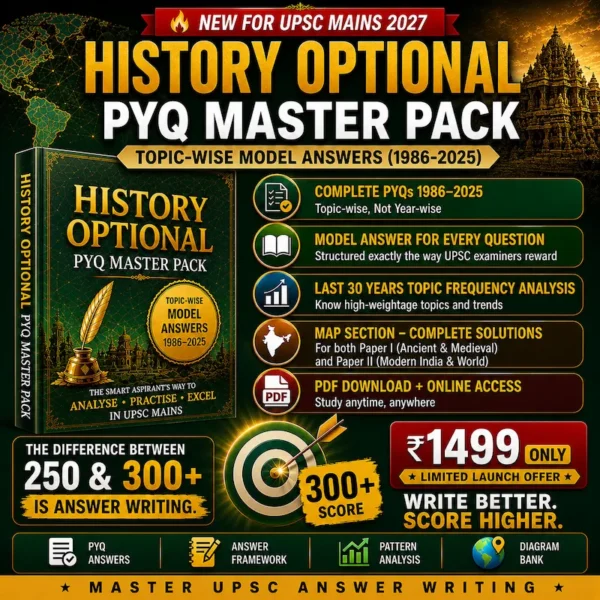
The History Optional PYQ Master Pack carries the same for every question the Commission has set since 1985, across the whole syllabus.
- PYQs 1985–2025, arranged topic-wise — revise a theme and see every way it has been asked
- Model answers with historiography — the debate cited where it belongs, not bolted on
- Map sections solved — the full 50-mark section, every year
- PDF plus online access — any device, permanently, no subscription
₹1,499 (regular ₹2,500). One-time payment, instant access.
How to use this topic list
Reading a question list feels like preparation and is not. Three sittings turn it into marks.
Sitting 1 — sort before you read (30 minutes)
- Copy the questions above into the threads identified in the previous section.
- Note which thread has gone longest without being asked — that is your priority, not the one you find most interesting.
Sitting 2 — write three answers cold (45 minutes)
- Pick the most recent question from three different threads.
- Seven minutes for a 10-marker, fifteen for a 20-marker. Stop when the time is up, even mid-sentence.
- Mark every place you wanted a historian’s name and could not produce one.
Sitting 3 — compare, then rewrite (45 minutes)
- Put your script beside the model answer for the same question.
- Compare structure first: opening claim, evidence, counter-view, judgement.
- Rewrite your weakest answer using that structure and no new content. Most candidates gain four to six marks from structure alone.
Two ways to prepare this optional
Two routes, depending on what is actually missing.
| PYQ Master Pack | Mains Master Kit 2027 | |
| Best when | Your notes are done; answer-writing is the gap | You are still building the subject |
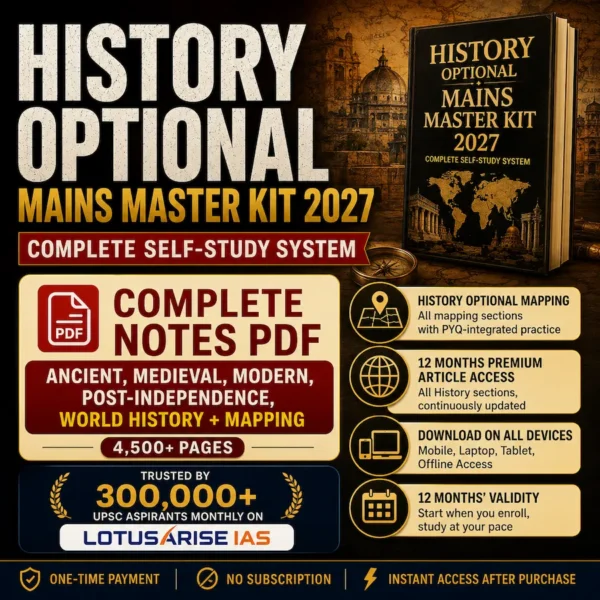
| What you get | Model answers to every question since 1985, topic-wise, map sections included | 4,500+ pages of notes, full mapping coverage, 12 months of article access |
| Price | ₹1,499 (reg. ₹2,500) | ₹1,770 (reg. ₹5,000) |
Frequently asked questions
Related topics
This unit sits at the centre of Modern India and draws on:
- Early Indian Nationalism
- Other Strands in the National Movement
- Politics of Separatism
- Indian Response to British Rule
- All topics — History Optional PYQs, topic-wise
Prefer to work year by year?
The complete papers, with both papers in full, unit-wise analysis and the official PDFs:
- History Optional Question Paper 2026
- History Optional Question Paper 2025
- History Optional Question Paper 2024
- History Optional Question Paper 2023
- History Optional Question Paper 2022
- History Optional Question Paper 2021
- History Optional Question Paper 2020
- UPSC History Optional Map Solutions (2013–2025)