Politics of Separatism; the Muslim League; the Hindu Mahasabha; Communalism and the politics of partition; Transfer of power; Independence.
Politics of Separatism covers the Muslim League, the Pakistan demand and the partition of 1947. UPSC has set 17 questions on it between 1989 and 2024, appearing in four of the last ten papers. It is the most contested subject in the Modern India syllabus, and the examiner rewards answers that present the scholarship evenly rather than assign blame.
Every question the Commission has asked on this topic is listed below, newest first, with a written model answer linked against each one.
| Questions asked (1989–2024) | 17 |
| Appeared in | 4 of the last 10 papers |
| Paper | Paper II, Section A (Modern India) |
| Usual mark value | 10, 15 or 20 marks |
| Model answers available | 17 of 17 |
PYQs: Politics of Separatism [1985-2026]

| Year | Question | Answer |
|---|---|---|
| 2024 | The strength of the Pakistan programme was its vagueness. It meant everything to everyone. | View answer |
| 2023 | "If abdication of British responsibility at the time of transfer of power was callous, the speed with which it was done made it worse." Critically examine. | View answer |
| 2020 | Critically examine the following statement in about 150 words: “Based on his discussion with Indian leaders, as well as his own perception, Lord Mountbatten soon came to the conclusion that partition was the only practicable and feasible solution." | View answer |
| 2018 | Critically examine the turns and twists in the politics of partition in 1930’s and 1940’s. | View answer |
| 2014 | “Why did the British finally quit India on 15th August 1947? The Imperialist answer is that independence was simply the fulfilment of Britain's self-appointed mission to assist the Indian people to self-government." Examine. | View answer |
| 2010 | "The developments during 1937 – 1939 greatly undermined the ability of the Indian National Congress to push through the agenda of national unity.” Comment. | View answer |
| 2009 | Discuss as to why the Congress accepted the partition of India in 1947. | View answer |
| 2007 | “There is no other instance in the history of mankind of a poet and philosopher working such a miracle in shaping the destiny of his people.” (A Tribute to M. Iqbal) Comment. | View answer |
| 2006 | “I felt that if we did not accept partition, India would be split into many bits and would be completely ruined." Comment. | View answer |
| 2004 | ‘We are therefore unable to advise the British Government that the power which at present resides in British hands should be handed over to two entirely separate sovereign States.’ Comment. | View answer |
| 1999 | Trace the origin and growth of the Indian Muslim League. | View answer |
| 1998 | “Both freedom and partition were the work of Indian middle classes.” Comment. | View answer |
| 1996 | The Pakistan movement converted a cultural and religious entity of a people into a separatist political force. Elucidate. | View answer |
| 1994 | “To glorify the strength of the Congress and deny that of the League is to be blind.” (P.C.Joshi, 1945). Comment. | View answer |
| 1993 | ‘Mountbatten's task was, therefore, merely to work out details and effect the partition, demanded by the League and accepted by both British Government and the Congress; and this the new Viceroy moved commandingly to perform.' Comment. | View answer |
| 1990 | ‘Lord Mountbatten came with an order to organise retreat, in military parlance-an operation.’ Comment in about 200 words. | View answer |
| 1989 | Examine the main aspects of Muslim League politics from 1937 to 1947. Was the partition of the country un-avoidable? | View answer |
What UPSC keeps asking about the Politics of Separatism
Seventeen questions fall into three threads. Almost all of them are quotations, and almost all of them are asking the same thing from a different angle: why did partition happen, and who bears responsibility?
1. The Muslim League and the Pakistan demand (1989, 1994, 1996, 1999, 2010, 2024)
- The League’s origin and growth (1999), its politics from 1937 to 1947 (1989), the effect of 1937–39 on its position (2010).
- 2024: “The strength of the Pakistan programme was its vagueness.” This is Ayesha Jalal’s argument in The Sole Spokesman — that Jinnah used the demand as a bargaining counter. Set it against the older view of a settled two-nation goal and against Venkat Dhulipala’s recent work on popular support for Pakistan.
2. Why the Congress accepted partition (1998, 2006, 2009, 2018)
- Nehru’s fear of fragmentation into many parts (2006), the Congress acceptance (2009), the turns and twists from 1937 (2018), and the middle classes as authors of both freedom and partition (1998).
- The strong answer covers the failure of the Cabinet Mission, the Interim Government deadlock, Direct Action and the violence of 1946–47.
3. British withdrawal and Mountbatten (1990, 1993, 2004, 2014, 2020, 2023)
- Why Britain left when it did (2014), Mountbatten’s mission as an organised retreat (1990, 1993), the Cabinet Mission statement (2004), and the abdication of responsibility at the transfer of power (2023).
- The imperialist, nationalist and Cambridge readings of the British exit each have a version here; know all three.
Every question above, already answered
Knowing the questions is half the work. The other half is seeing what a full-mark answer to each one looks like — not a hint or a bullet outline, but a complete answer at the mark and the word limit, with the historians named inside the argument.
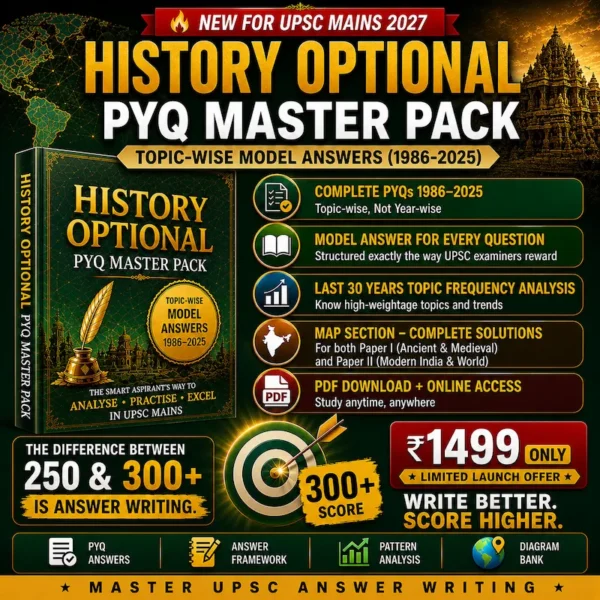
The History Optional PYQ Master Pack carries the same for every question the Commission has set since 1985, across the whole syllabus.
- PYQs 1985–2025, arranged topic-wise — revise a theme and see every way it has been asked
- Model answers with historiography — the debate cited where it belongs, not bolted on
- Map sections solved — the full 50-mark section, every year
- PDF plus online access — any device, permanently, no subscription
₹1,499 (regular ₹2,500). One-time payment, instant access.
How to use this topic list
Reading a question list feels like preparation and is not. Three sittings turn it into marks.
Sitting 1 — sort before you read (30 minutes)
- Copy the questions above into the threads identified in the previous section.
- Note which thread has gone longest without being asked — that is your priority, not the one you find most interesting.
Sitting 2 — write three answers cold (45 minutes)
- Pick the most recent question from three different threads.
- Seven minutes for a 10-marker, fifteen for a 20-marker. Stop when the time is up, even mid-sentence.
- Mark every place you wanted a historian’s name and could not produce one.
Sitting 3 — compare, then rewrite (45 minutes)
- Put your script beside the model answer for the same question.
- Compare structure first: opening claim, evidence, counter-view, judgement.
- Rewrite your weakest answer using that structure and no new content. Most candidates gain four to six marks from structure alone.
Two ways to prepare this optional
Two routes, depending on what is actually missing.
| PYQ Master Pack | Mains Master Kit 2027 | |
| Best when | Your notes are done; answer-writing is the gap | You are still building the subject |
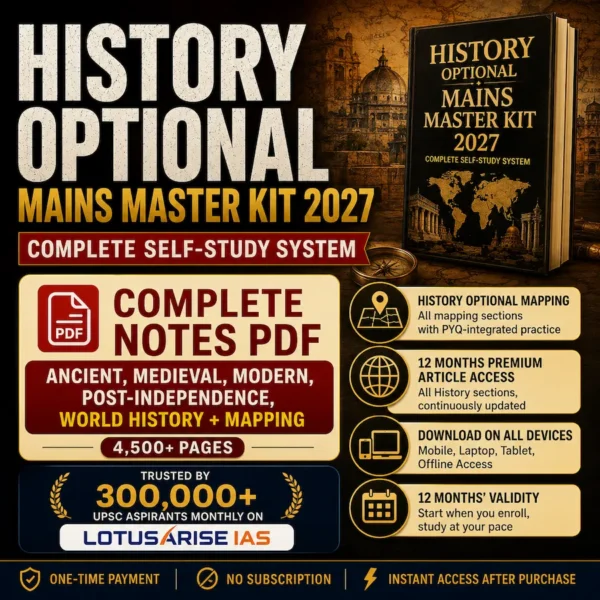
| What you get | Model answers to every question since 1985, topic-wise, map sections included | 4,500+ pages of notes, full mapping coverage, 12 months of article access |
| Price | ₹1,499 (reg. ₹2,500) | ₹1,770 (reg. ₹5,000) |
Frequently asked questions
Related topics
Separatism questions draw on:
- Nationalism under Gandhi’s Leadership
- Other Strands in the National Movement
- Consolidation as a Nation
- Early Indian Nationalism
- All topics — History Optional PYQs, topic-wise
Prefer to work year by year?
The complete papers, with both papers in full, unit-wise analysis and the official PDFs:
- History Optional Question Paper 2026
- History Optional Question Paper 2025
- History Optional Question Paper 2024
- History Optional Question Paper 2023
- History Optional Question Paper 2022
- History Optional Question Paper 2021
- History Optional Question Paper 2020
- UPSC History Optional Map Solutions (2013–2025)