Consolidation as a Nation; Nehru’s Foreign Policy; India and her neighbours (1947-1964); The linguistic reorganisation of States (1935-1947); Regionalism and regional Inequality; Integration of Princely States; Princes in electoral politics; the Question of National Language.
Consolidation as a Nation covers the first two decades after independence — integration of the princely states, linguistic reorganisation and Nehru’s foreign policy. UPSC has set 17 questions on it between 1990 and 2025, appearing in seven of the last ten papers. Post-1947 history was once an afterthought in this optional. It no longer is.
Every question the Commission has asked on this topic is listed below, newest first, with a written model answer linked against each one.
| Questions asked (1990–2025) | 17 |
| Appeared in | 7 of the last 10 papers |
| Paper | Paper II, Section A (India after Independence) |
| Usual mark value | 10, 15 or 20 marks |
| Model answers available | 17 of 17 |
PYQs: Consolidation as a Nation [1985-2026]

| Year | Question | Answer |
|---|---|---|
| 2025 | "The movement for linguistic States generated deep apprehensions among the nationalist elite. They feared it would lead to the Balkanization of India." Examine. | View answer |
| 2024 | Regionalism in India after 1947 was occasioned by developmental imperatives as much as linguistic particularism. – Elucidate. | View answer |
| 2022 | In the light of contentions over the McMohon Line, analyse the India-China relations in the 1950s and 1960s. | View answer |
| 2021 | How was the Princely States integrated in the Indian Union after the partition? What role did Sardar Patel play in it? | View answer |
| 2020 | “After Indian Independence India-China relations started on a high note, but during the course of the coming years India had to face a bitter experience due to the Chinese aggression." Elaborate. | View answer |
| 2020 | “The Reorganisation of the States on the basis of language was a major aspect of national consolidation and integration’’. Comment. | View answer |
| 2018 | Critically examine: “States’ reorganization did not, of course, resolve all the problems relating to linguistic conflicts.” | View answer |
| 2017 | Throw light on the nature of ‘Instrument of Accession’ and ‘Standstill Agreement’ signed by the Princely State with the Indian Union. | View answer |
| 2016 | “India’s need for a federal system was more an imperative than a political choice." Do you agree? | View answer |
| 2014 | “Sardar Patel accomplished a silent revolution by ensuring the absorption and assimilation of a multitude principalities without shedding even a drop of blood." Elucidate. | View answer |
| 2013 | “The reorganization resulted in rationalizing the political map of India without seriously weakening its unity. If anything, its result has been functional, in as much as it removed what had been a major source of discord, and created homogeneous political units which could be administered through a medium that the vast majority of the population understood. Indeed it can be said with the benefit of hindsight that language, rather than being a force for division, has proved a cementing and integrating influence." Examine. | View answer |
| 2012 | "Nehru’s policy of Non-Alignment came to symbolize the struggle of India and other newly independent nations to retain and strengthen their independence from colonialism." Critically examine in 150 words. | View answer |
| 2011 | Would you agree that India’s effort to pursue an independent foreign policy was a highlight of post – 1947 politics? | View answer |
| 2007 | “With great skill and masterful diplomacy and using both persuasion and pressure, Sardar Vallabhbhai Patel succeeded in integrating the hundreds of princely states with the Indian Union. Discuss. | View answer |
| 2004 | Analyse Indian foreign policy of Nonalignment between 1947 and 1964. | View answer |
| 2001 | Jawaharlal Nehru was the architect of India's policy of non-alignment. In the light of this statement discuss India’s relations with the two ‘Power Blocks’ between 1947-1964. | View answer |
| 1990 | 'The new India was not to be built up, as late nineteenth century patriots had thought, by copious draught from the past, but rather by frequent injections from the energetic contemporary west.' Comment in about 200 words. | View answer |
What UPSC keeps asking about Consolidation as a Nation
Seventeen questions fall into three threads of roughly equal size, and each has been asked within the last five years.
1. Integration of the princely states (2007, 2014, 2017, 2021)
- Patel’s “silent revolution” (2014), persuasion and pressure (2007), the Instrument of Accession and Standstill Agreement (2017), the process after partition (2021).
- Know the three hard cases — Junagadh, Hyderabad and Kashmir — and the role of V. P. Menon. The Instrument of Accession is a favourite short answer.
2. Linguistic reorganisation, federalism and regionalism (2013, 2016, 2018, 2020, 2024, 2025)
- Six questions, four since 2018.
- The States Reorganisation Commission and whether reorganisation rationalised the map (2013) or left problems unresolved (2018, 2020). The apprehensions it generated among national leaders (2025).
- 2016 on federalism as an imperative and 2024 on regionalism driven by development are the broader framings. Show why the fear that linguistic states would break India proved largely unfounded.
3. Non-alignment and foreign policy under Nehru (1990, 2001, 2004, 2011, 2012, 2020, 2022)
- Seven questions — the largest thread.
- Nehru as architect of non-alignment (2001), its record from 1947 to 1964 (2004), whether an independent foreign policy was achievable (2011), non-alignment as the struggle of the newly free (2012).
- The China relationship is the recent turn: from a high note to 1962 (2020) and the McMahon Line (2022). Prepare the boundary dispute in detail.
Every question above, already answered
Knowing the questions is half the work. The other half is seeing what a full-mark answer to each one looks like — not a hint or a bullet outline, but a complete answer at the mark and the word limit, with the historians named inside the argument.
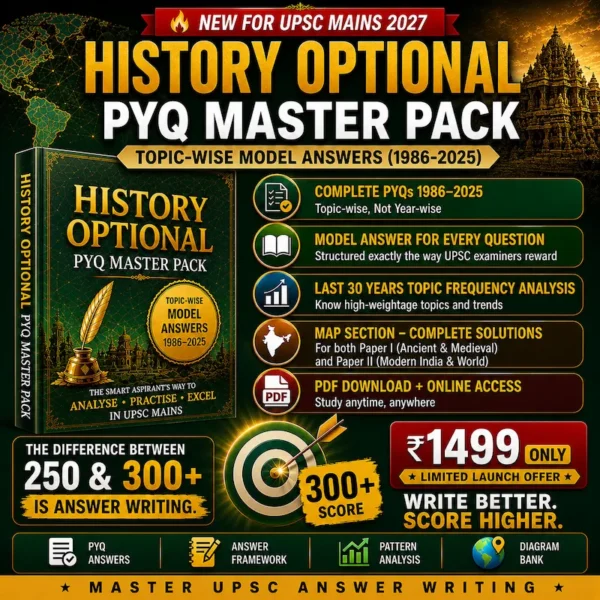
The History Optional PYQ Master Pack carries the same for every question the Commission has set since 1985, across the whole syllabus.
- PYQs 1985–2025, arranged topic-wise — revise a theme and see every way it has been asked
- Model answers with historiography — the debate cited where it belongs, not bolted on
- Map sections solved — the full 50-mark section, every year
- PDF plus online access — any device, permanently, no subscription
₹1,499 (regular ₹2,500). One-time payment, instant access.
How to use this topic list
Reading a question list feels like preparation and is not. Three sittings turn it into marks.
Sitting 1 — sort before you read (30 minutes)
- Copy the questions above into the threads identified in the previous section.
- Note which thread has gone longest without being asked — that is your priority, not the one you find most interesting.
Sitting 2 — write three answers cold (45 minutes)
- Pick the most recent question from three different threads.
- Seven minutes for a 10-marker, fifteen for a 20-marker. Stop when the time is up, even mid-sentence.
- Mark every place you wanted a historian’s name and could not produce one.
Sitting 3 — compare, then rewrite (45 minutes)
- Put your script beside the model answer for the same question.
- Compare structure first: opening claim, evidence, counter-view, judgement.
- Rewrite your weakest answer using that structure and no new content. Most candidates gain four to six marks from structure alone.
Two ways to prepare this optional
Two routes, depending on what is actually missing.
| PYQ Master Pack | Mains Master Kit 2027 | |
| Best when | Your notes are done; answer-writing is the gap | You are still building the subject |
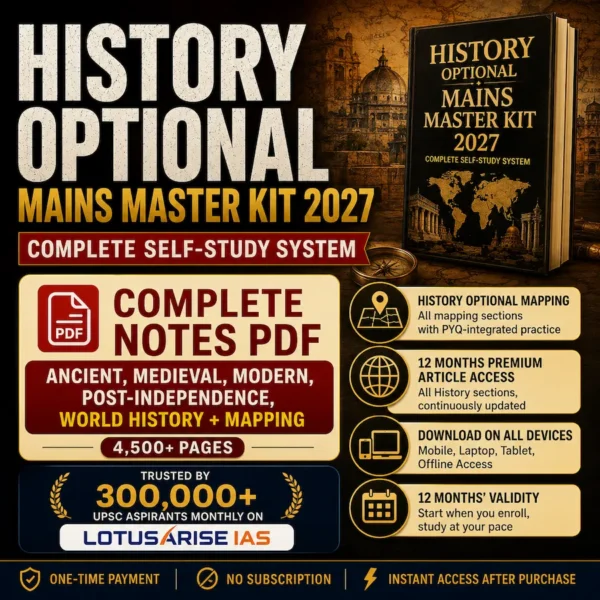
| What you get | Model answers to every question since 1985, topic-wise, map sections included | 4,500+ pages of notes, full mapping coverage, 12 months of article access |
| Price | ₹1,499 (reg. ₹2,500) | ₹1,770 (reg. ₹5,000) |
Frequently asked questions
Related topics
Post-1947 questions draw on:
- Politics of Separatism
- Caste and Ethnicity after 1947
- Economic Development and Political Change
- The World after World War II
- All topics — History Optional PYQs, topic-wise
Prefer to work year by year?
The complete papers, with both papers in full, unit-wise analysis and the official PDFs:
- History Optional Question Paper 2026
- History Optional Question Paper 2025
- History Optional Question Paper 2024
- History Optional Question Paper 2023
- History Optional Question Paper 2022
- History Optional Question Paper 2021
- History Optional Question Paper 2020
- UPSC History Optional Map Solutions (2013–2025)