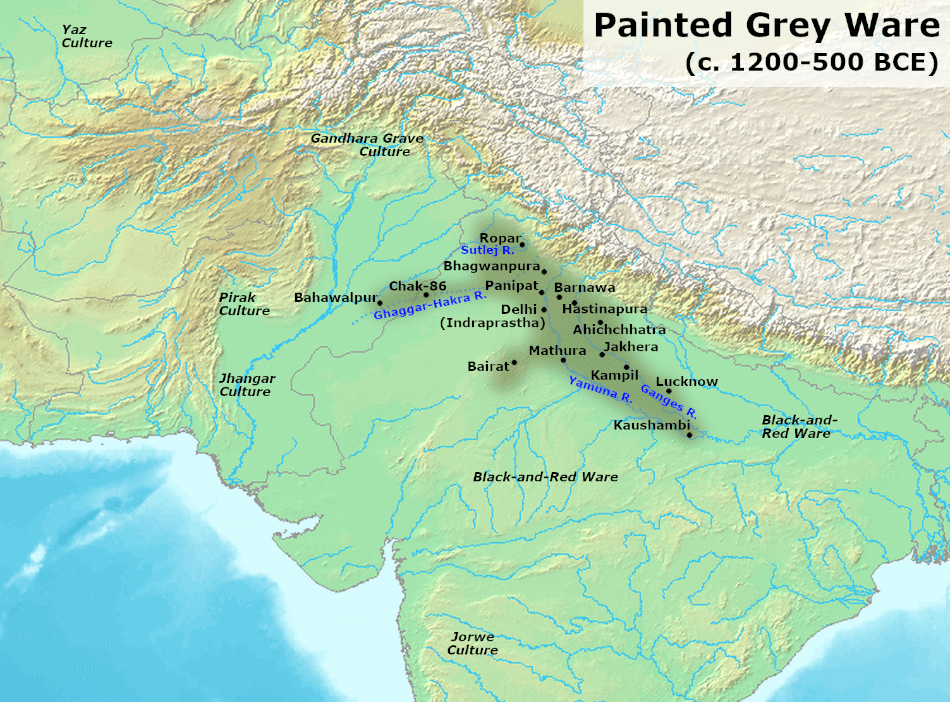
Kaushambi

- Location:
- Located in Kaushambi district, Uttar Pradesh
- Situated near the confluence of the Yamuna and Ganga rivers
- Historical Significance:
- Capital of Vatsa Mahajanapada, one of the 16 Mahajanapadas mentioned in 6th century BCE texts
- Ruled by the famous King Udayana, known from Buddhist and Sanskrit sources
- Visited by Chinese pilgrim Hiuen Tsang in the 7th century CE, who described it as a prosperous city
- Religious Importance:
- Jain tradition identifies Kaushambi as the birthplace of the 6th Tirthankara, Padmaprabha
- Important Buddhist centre during the time of Buddha
- Buddha is said to have visited the city several times
- Site of an early Buddhist monastery (vihara)
- Ashokan Connection:
- An Ashokan pillar with inscription in Brahmi script found at the site
- Indicative of Mauryan presence and imperial patronage
- Archaeological Discoveries:
- Excavations reveal settlements dating back to the 2nd millennium BCE
- Presence of Painted Grey Ware (PGW) pottery layer
- Suggests a Later Vedic settlement
- Associated with iron tools, showing the emergence of iron-age urbanisation
- Fortification walls built with mud and burnt bricks
- Houses, streets, and drains found in urban layout
- Coins, seals, and terracotta figurines discovered
- Economic Significance:
- Located on ancient trade routes
- Developed into a major commercial centre during the early historic period
- Presence of punch-marked coins, indicating early use of currency
- Cultural Continuity:
- Continuous occupation from Vedic period to the Gupta and post-Gupta period
- Significant for understanding the transition from rural PGW settlements to urban Mahajanapada cities
Shravasti
- Location:
- Located in Shravasti district, Uttar Pradesh
- Situated on the banks of the Rapti River
- Positioned strategically along northern trade routes
- Historical Significance:
- Capital of the Kosala Mahajanapada during the 6th century BCE
- Known in ancient texts like the Jatakas and the Brahmanical literature
- Associated with both Buddhist and Jain traditions
- Buddhist Importance:
- One of the six major cities in early Buddhism
- The Buddha spent 24 rainy seasons (vassas) here, mostly at Jetavana monastery
- Home to many important stupas, viharas, and Buddhist relics
- Numerous Buddhist sculptures and inscriptions found
- Became an active centre of Buddhist learning and pilgrimage
- Jain Importance:
- Birthplace of Sambhavanath, the 3rd Tirthankara of Jainism
- Jain texts refer to the city as a major centre of Jain religious activity
- Accounts of Xuanzang (7th century CE):
- Chinese pilgrim Xuanzang visited and found Shravasti in ruins
- Described decayed Buddhist monasteries and remains of stupas
- Archaeological Discoveries:
- Identified as a Painted Grey Ware (PGW) and Northern Black Polished Ware (NBPW) site
- Continuous occupation from Later Vedic period to early historic period
- Structural remains in PGW levels:
- Wattle-and-daub huts
- Mud houses
- Fortification remains indicate urban character in later phase
- Material Culture:
- Copper and iron tools such as arrowheads
- A unique iron image of the elephant god
- Ornaments of copper, indicating metallurgical development
- Terracotta figures, beads, bangles, and seals also unearthed
- Cultural and Economic Role:
- Served as a religious and trade hub in the Gangetic plains
- Played a pivotal role in religious syncretism—coexistence of Buddhism and Jainism
- Significance:
- Offers a well-rounded glimpse into the urbanisation, religious plurality, and material culture of the early historic period in India
- Important for understanding the evolution from Vedic settlements to Mahajanapada cities
Kampilya
- Location:
- Situated in Farukhabad district, Uttar Pradesh
- Identified with the ancient city of Kampilya, also spelled Kampil
- Historical Significance:
- Capital of South Panchala, one of the 16 Mahajanapadas
- Frequently mentioned in Ramayana, Mahabharata, and Panini’s Ashtadhyayi
- Considered the birthplace of Draupadi in the Mahabharata
- Mentioned as an important Vedic and epic centre
- Jain Significance:
- A sacred site for Jainism
- Associated with several Tirthankaras and ancient Jain traditions
- Archaeological Findings:
- Occupied from the PGW phase (c. 1100–600 BCE) onwards
- Stratified remains show:
- Wattle-and-daub houses
- Mud huts
- Gradual transition from rural to semi-urban settlement
- Material Culture:
- Painted Grey Ware (PGW) pottery associated with Vedic rituals
- Iron objects, terracotta figurines, and other small artefacts found
- Evidence of fire pits, suggesting domestic yajnas and Vedic sacrificial rituals
- Religious and Cultural Role:
- A centre of Vedic learning, religious practices, and Mahajanapada politics
- Its association with both Vedic and Jain traditions shows religious plurality
- Connected to the epic traditions of Panchala Kingdom, which was a significant power in Later Vedic India
- Significance:
- Kampilya represents a rich blend of archaeology, epic history, and religious sanctity
- Provides evidence of early Iron Age culture, Vedic settlement patterns, and Mahajanapada-level political organisation
Ahichchhatra
- Location:
- Situated in Bareilly district, Uttar Pradesh
- Identified as the ancient capital of Northern Panchala Mahajanapada
- Cultural Phase:
- Shows continuous cultural occupation from:
- Ochre Coloured Pottery (OCP)
- Painted Grey Ware (PGW) (c. 1200 BCE onward)
- Northern Black Polished Ware (NBPW)
- Early Historic Urban Development (up to 3rd century CE)
- Shows continuous cultural occupation from:
- PGW Settlement Features:
- Excavations revealed:
- Mud ramparts
- Wattle and daub houses
- Circular and rectangular huts
- Fireplaces and storage pits
- Indicates a semi-urban Vedic settlement with religious and economic complexity
- Excavations revealed:
- Material Culture:
- PGW pottery with black geometric designs
- Iron implements and copper tools
- Terracotta figurines
- Coins of Panchala and Kushanas
- Political and Cultural Importance:
- Identified in Later Vedic and Puranic texts as the capital of Panchala
- Continued significance during Mauryan and Kushana periods
- Served as a Mahajanapada centre
- Archaeological Significance:
- PGW was first identified here in 1946
- Offers evidence for:
- State formation in the Mahajanapada era
- The overlap between textual sources and material archaeology
- The growth of iron-based economies and early urbanism
Atranjikhera & Jakhera
- Location:
- Located in Etah district, Uttar Pradesh
- Situated on the banks of the Kali Nadi, a tributary of the Ganga River
- Atranjikhera is slightly South East of Jakhera
- Chronological Sequence:
- Shows a clear cultural sequence:
- Ochre Coloured Pottery (OCP)
- Black and Red Ware (BRW)
- Painted Grey Ware (PGW) – c. 1100–600 BCE
- Northern Black Polished Ware (NBPW)
- Reflects transition from village to town (proto-urban evolution)
- Shows a clear cultural sequence:
- Settlement and Architecture:
- Excavations reveal:
- Mud ramparts
- Wattle-and-daub houses
- Mud-brick structures in later phases
- Wooden post-supported houses
- Presence of fire altars and ritual hearths for Vedic yajnas
- Excavations reveal:
- Agriculture and Economy:
- Evidence of:
- Cultivation of wheat, barley, gram
- Practice of two crops per year
- Iron tools such as:
- Sickles, arrowheads, ploughshares (earlier in PGW, increased in NBPW)
- Copper tools and bone implements used
- Horse remains found
- Evidence of:
- Material Culture:
- PGW pottery with geometric patterns
- NBPW pottery in later phases
- Bone and ivory tools: arrowheads, beads, combs, bangles, etc.
- Vedic Associations:
- Presence of fire altars supports association with Vedic domestic rituals
- Aligns with descriptions in Shatapatha Brahmana and Samhitas
- Cultural Continuity and Significance:
- Indicates continuity into Mahajanapada period
- A key site showing transition from rural to urban society
- Supports understanding of early state formation and agro-metallurgical economy in the Later Vedic period
Hastinapur
- Location:
- In Meerut district, Uttar Pradesh
- Situated on the right bank of the old bed of the Ganga River
- Lies in the fertile upper Ganga–Yamuna doab region
- Cultural Sequence:
- Excavated by B.B. Lal in the 1950s
- Shows continuous occupation:
- Ochre Coloured Pottery (OCP)
- Painted Grey Ware (PGW)
- Northern Black Polished Ware (NBPW)
- Dates from the Vedic to early historic period
- Vedic and Epic Associations:
- Identified as the capital of the Kuru Kingdom mentioned in the Mahabharata
- Excavation revealed PGW pottery, fire altars, rice husks, indicating:
- Vedic domestic life
- Ritual practices aligned with Shatapatha Brahmana
- Supported by later texts and Puranic tradition
- Material Culture (PGW Phase):
- Pottery:
- PGW bowls and dishes
- Wheel-turned red ware with designs: fish, leaves, flowers, svastikas, triratnas, loops, circles, and other geometric patterns
- Houses:
- Made of wattle-and-daub and mud
- Use of unbaked bricks
- Tools & Implements:
- Iron tools, copper objects
- Weights made of chert and jasper
- Animal remains:
- Horse bones found, suggesting domestication and use
- Pottery:
- Post-PGW Continuity & Urbanization:
- Evidence of flood layer over PGW stratum
- Possibly explains the abandonment of Hastinapur and rise of Kaushambi
- Later (2nd century BCE–3rd century CE):
- Planned urban settlement
- Burnt brick structures
- Ring wells used for water management
- Evidence of flood layer over PGW stratum
- Artefacts (Early Historic Phase):
- Terracotta figurines: humped bull, torso of Bodhisattva Maitreya
- Iron, ivory, copper objects
- Rings, beads, potsherds, and seals
- Coins:
- Issued by Yaudheyas
- Kushana coins also found
- Religious Significance (Jain Tradition):
- Rishabha, the first Tirthankara, is believed to have lived here
- Mahavira is said to have visited the site
- Archaeological Importance:
- A rare site where archaeological findings correlate with Vedic literature
- Critical to the historicisation of the Mahabharata and epic traditions
Alamgirpur
- In Saharanpur district, UP.
- Easternmost Harappan site
- No early Harappan level.
- Burnt bricks, copper objects found in late Harappan period.
- PGW preceded by a late Harappan level.
- Break in occupation between Late Harappan and PGW.
Bhagwanpura
- In Kurukshetra district, Haryana.
- Late Harappan phase shows craft activity:- clay tablets and sherds with graffiti.
- Overlap between the late Harappan and PGW.
- Houses- Round and of three different kinds namely huts, houses made of mud bricks and kiln-bricks found.
- A house with 13 rooms with a corridor and courtyard have been excavated
- Artefacts– stone, bone, and terracotta.
- No evidence of iron artefacts.
- Evidence of horse found– Skeletal remains, terracotta horse.
- Ram- a terracotta figurine found.
Ropar
- In Rupnagar district, Punjab, on left bank of Sutlej river
- IVC, PGW and NBPW.
- No early Harappan level.
- Transition from village to town in period c. 600–200 BCE, and yielded NBPW and punch-marked and copper coins.
- A seal with an inscription in Brahmi.
- Houses made of stone, mud-brick and burnt brick.
- Iron workshop and agate beads in NBPW.
Jodhpura
- In the north-eastern part of Rajasthan.
- Jodhpura: PGW and Chalcolithic.
- Pottery:
- Handmade, Wheel-made, red in colour, with incised designs.
- Shapes:-dish-on-stand.
- Three cultural phases:
- Period I:
- Hunting-gathering
- microliths
- Period II:
- Beginning of metallurgy (copper).
- Circular huts
- Microliths
- animal bones.
- Period III:
- Many copper objects found:- evidence of copper working centre.
- Lesser number of microliths and animal bones.
- Period I:
- Contact with Harappan sites: – similar potteries, copper objects found.
Noh
- In Bharatpur district, Rajasthan.
- OCP, BRW and then PGW.
- Iron found at pre-PGW BRW levels.
- PGW with painted bird at the rim.
- Sunga and Kushana settlement found.
- Iron artefacts:– spearhead, arrowhead, axe.
- Remains of rice found.
- Gambling was favourite part time as suggested by discovery of gamesmen.
Chak-86
- On the banks of dried up Saraswati river, Ganganagar, Rajasthan.
- 5 circular huts of wattle and daub excavated.
- Beads of terracotta, carnelian, lapis- lazuli.
- Glass bangles, terracotta bangles and animal figurines, bone points , shell also found.
- Pottery – PGW (5%), BRW, Black ware, Red ware etc.
- Concentration of charred bones found.
Mathura
- On the bank of Yamuna, in Mathura district, UP.
- Centre of craft and trade.
- Textile
- Junction of trade route: Uttarpatha and dakshinapatha.
- Religious centre:
- Buddhism,
- Jainism, and
- early Hinduism.
- Capital city of Shurasenas in 6th century B.C
- Also second capital of the Kushana.
- Mathura School of Arts under the patronage of the Kushanas.
- BRW, PGW, NBPW
- At Sonkh, near Mathura, PGW, BRW and grey ware found.
- Post-holes and a double ditch.
- Beginnings of urbanization during Kushana period.
- NBPW: Coins came and specialized crafts such as the manufacture of terracotta figurines, copper and iron working, and bead making.
- In mythology, place is attached to Lord Krishna.
- Big city, part of Uttarapatha network.
Bhawalpur
- Located in Pakistan, on southern side of river Sutlej in Indus basin.
- It is the western-most site of PGW culture.
- Some potteries along with a few evidence of iron have been found.
- There is some evidence even of rice cultivation at this site.
Lal Qila
- Location:
- Located in Bulandshahr district, Uttar Pradesh
- Around 3 km west of Atranjikhera, on an upper stream of the Kali Nadi
- Cultural Sequence:
- Excavations revealed a long sequence of occupation, showing cultural continuity:
- Ochre Coloured Pottery (OCP): c. 2030–1730 BCE
- Painted Grey Ware (PGW): c. 1100–600 BCE
- Northern Black Polished Ware (NBPW) in the later phase
- Excavations revealed a long sequence of occupation, showing cultural continuity:
- Settlement Features:
- Eight habitation layers discovered
- Structural remains include:
- Rectangular and circular huts
- Post-holes
- Fire pits
- Charred bones
- Indicates domestic activities, ritual practices, and long-term settlement
- Material Culture:
- PGW pottery with painted geometric motifs
- Terracotta figurines (possibly religious or decorative)
- Copper-hoard tools and weapons
- Iron tools (such as sickles, arrowheads), showing metallurgical advancement
- Reflects an early craft-producing and metal-using society
- Economy and Subsistence:
- Evidence of a mixed economy:
- Agriculture: Tools and plant remains suggest crop cultivation
- Hunting-Gathering: Burnt animal bones indicate continued reliance on wild resources
- Evidence of a mixed economy:
- Ritual and Vedic Significance:
- Presence of fire pits suggests ritual practices linked to Vedic traditions
- Pottery designs and structural layout hint at domestic yajnas or ritual hearths
- Reflects Later Vedic cultural and religious transformation
- Archaeological Importance:
- Lal Qila serves as a valuable site for understanding:
- Vedic social evolution
- Technological advancements from copper to iron
- Continuity between OCP–PGW–NBPW phases
- Acts as a supporting site alongside Atranjikhera and Ahichhatra in tracing Vedic-era settlement expansion in the Ganga plains
- Lal Qila serves as a valuable site for understanding: