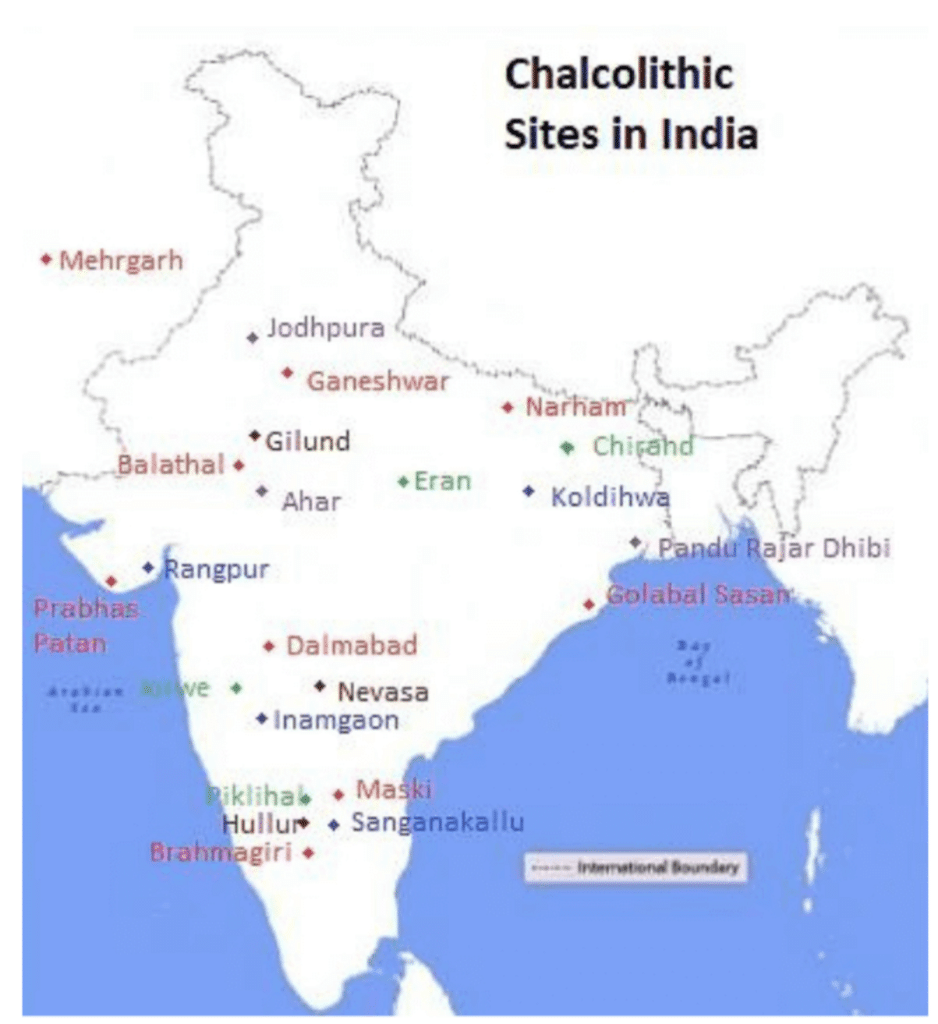
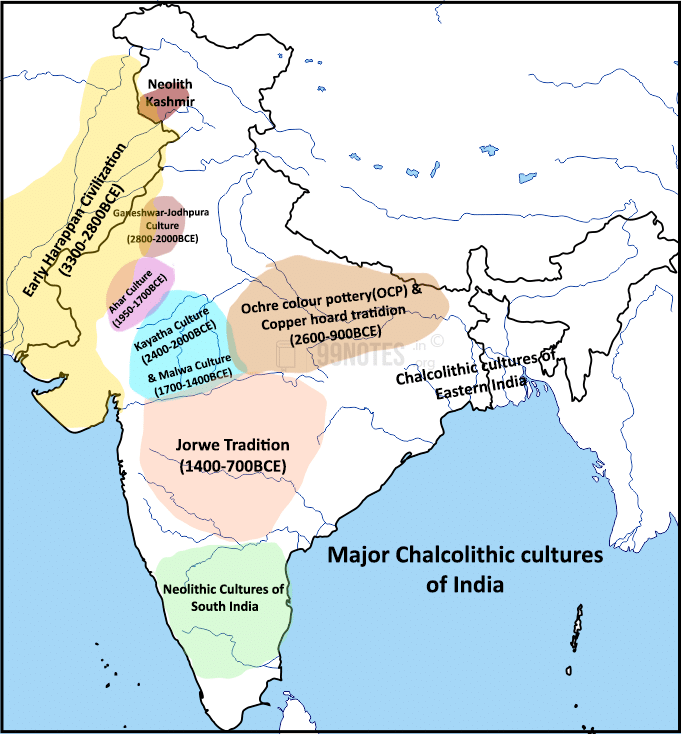
Bangarh

- Location
- Situated in South Dinajpur district, West Bengal.
- First site in North Bengal with evidence of Chalcolithic period.
- Chronology and Cultural Significance
- Associated with Chalcolithic habitation and craft activity.
- Marks the early metal-using phase in the region.
- Key Archaeological Findings
- Hearth with charcoal traces — indicating domestic or industrial activity.
- Artefacts include:
- Copper bowl, copper rod
- Black-and-Red Ware (BRW) dish
- Broken antimony rod
- Numerous pottery sherds
- Interpretation
- The presence of metal tools, hearth, and pottery suggests that Bangarh was a manufacturing centre during the Chalcolithic phase.
Mahisdal
- In Kopai valley, West Bengal.
- Period- 1619-1415 BCE.
- House floors rammed with terracotta nodules, lots of microliths and bone tools, beads of steatite
and semi precious stone, terracotta bangles and phallus ,one copper celt found. - Pottery– BRW was main form.
Pandu Rajar Dhibi
- In Burdman district of West Bengal.
- Situated on the banks of the Damodar River.
- Neolithic and Chalcolithic site.
- First chalcolithic culture discovered in the West Bengal.
- It reveals microliths, ground stone tools, bone tools, and pottery.
- In Chalcolithic Period, there were a few copper artefacts, beads of semi-precious stones, terracotta figurines, iron spearheads and points, slag, and oven.
- Iron artefacts found at chalcolithic levels.
- The pottery included mainly BRW.
- Black-and-red ware, plain red ware, and cord-impressed ware.
- Bones of domesticated cattle, buffalo, goat, and deer.
- Economy:
- Practiced mixed agriculture: rice, barley, legumes.
- Animal husbandry was also significant.
- Reflects an adaptable agro-pastoral economy in the alluvial valley.
- Burials and Settlement Features:
- Pit burials with grave goods like copper ornaments and pottery.
- Evidence of mud-walled houses and storage pits, indicating a settled village life.
Senuar/Senuwar(Neolithic and Chalcoiithic both)
- Rohtas, Bihar, on banks of Kudra river.
- Wattle and daub houses.
- Pottery – red ware, burnished red ware and burnished grey ware mostly wheel made.
- Stone tool along with microliths and some bone tools found.
- Beads of semi- precious stones discovered.
- Domesticated animals– cattle, buffalo, sheep, goat, cat, dog, pig, wild animals- nilgai, antelope, chital.
- Crop- Twice a year, rice, barley, dwarf wheat, millet, lentil.
- Shell food consumed as suggested by large remains of molluscs and shells.
Navdatoli
- In west Nimar district, MP, on banks of Narmada river.
- Chalcolithic and Late Harappan Site.
- Navdatoli is the largest settlement of Malwa culture.
- Habitation:
- Circular or rectangular shape.
- Circular wattle-and-daub houses, post holes
- Floors plastered with lime.
- Ancient village inhabited through four stages.
- Chulhas and storage jars found in houses.
- Pottery:
- BRW, grey ware with painted
- People sustained on both plant and animal food.
- Domesticated cattle, goat, sheep,pig, consumed as meat.
- Crop remains– rice, wheat, barley, black gram, lentil, ber and amla.
- Ritual – A sacrificial pit found, terracotta female figurine and bull associated with fertility ritual.
- A painted human figure is interpreted as proto-Shiva.
- A huge storage jar with figure of shrine in between the female figure, lizard.
Kayatha
- In Ujjain district, MP, on the banks of river Chotti Kali Sindh.
- Located on the Malwa plateau, near the Chambal River (tributary of Yamuna).
- Five fold cultural sequence identified starting with Kayatha culture followed by Ahar culture and then Malwa culture.
- Chalcolithic and late Harappan site.
- Houses:
- Rectangular / circular huts made of mud and reed with mud-plastered floors.
- Bones of domesticated cattle and horses found.
- Practiced agriculture with crops like barley, wheat, and lentils.
- Indicates a semi-sedentary agrarian lifestyle.
- Artefacts:
- Microliths made of locally available chalcedony.
- Copper axes, chisel, copper bangles etc.
- Ornaments made of agate, steatite and carnelian beads.
- Axes came from Ganeshwar.
- Pottery – brown slipped and well baked Kayatha ware mostly painted in violet or deep red.
- Well-burnished red and buff ware, decorated with geometric designs.
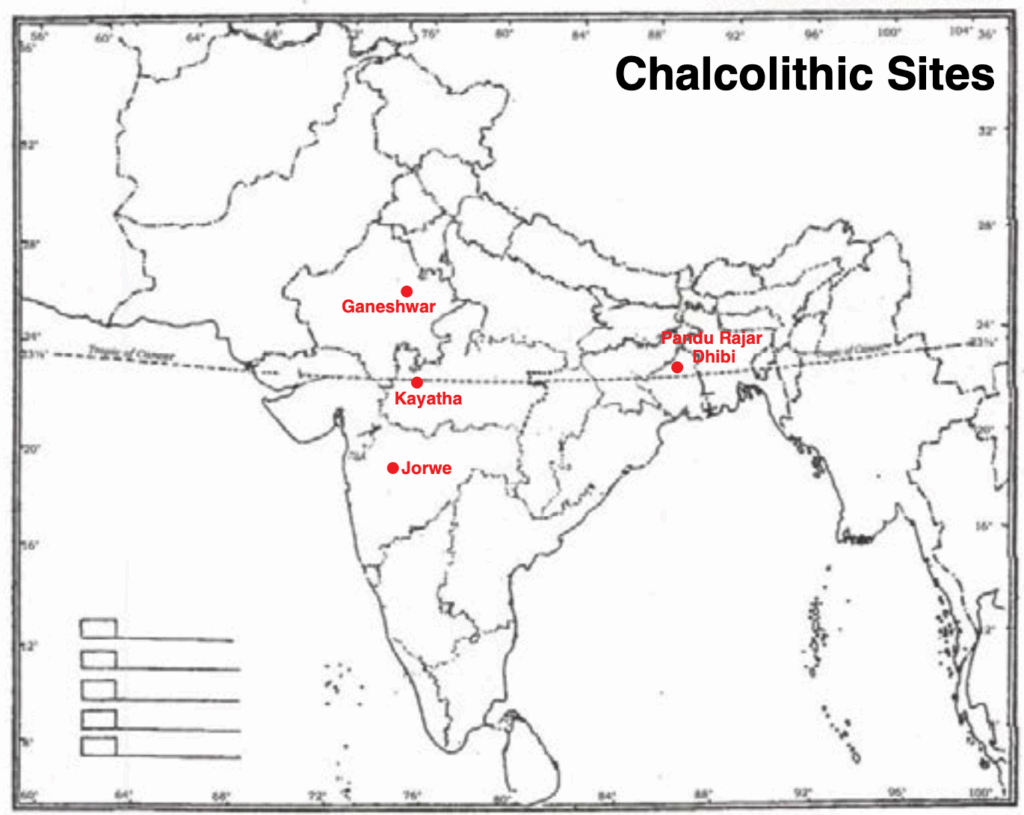
Eran
- In Sagar district, Madhya Pradesh.
- Gupta inscriptions:
- Epigraphic inscription of Samudra Gupta which mentions that a part of western Mawa was annexed by Chandra Gupta.
- Inscription at Eran dated 510 AD gives the first concrete evidence of Sati.
- Vishnu shrines of Gupta period found (famous varah temple).
- Early phase: Malwa culture, Later: BRW and iron.
- Mud fortification wall and a moat found.
Ahar (Ahar / Banas culture)
- On the banks of Ahar River of southeastern Rajasthan.
- Chalcolithic and Late Harappan site.
- Pottery:
- BRW with linear and dotted designs.
- Shapes:- bowls, bowls-on-stands, vases.
- Mainly copper tools like choppers, axes, knives, chisels etc. found.
- Habitation:
- People lived in single, double and multi-roomed rectangular and circular houses.
- Houses made of stones, mud bricks, the walls being plastered with mud.
- Each house had kitchen, storage bin, stone saddle querns.
- Subsistence pattern:
- Cultivation- wheat and,millets, rice, lentil etc.
- animal husbandry and hunting
- Trade links with the Harappans.
Balathal
- Very near to Ahar,Udaipur district, Rajasthan.
- Contemporary with Early Harappan phase and early Ganeshwar culture.
- Initially, wattle and daub houses, but later larger rectangular houses made of mud bricks and stone.
- Two potter’s kiln were found.
- Pottery includes thin red ware, tar ware, black 8s red ware, buff colored pots.
- Mainly copper tools like choppers, knives, etc.
- Also some bone tools, along with beads of semiprecious stones and terracotta figurines of bull found.
- Crops- wheat, barley, black and green gram, pea, linseed.
- Cattle, sheep, goat, pigs, were domesticated animals.
- Evidence of leprosy found by DNA testing of skeletons.
Gilund
- In Rajsamand district, Rajasthan.
- Chalcolithic and late Harappan site.
- Largest site of Ahar-Banas complex.
- Houses of mud bricks and burnt bricks with storage pits.
- Artefacts- Microliths, fragments of copper, beads of semi- precious stone.
- Terracotta figurines of animals including humped bull with long horns.
Gungeria
- Balaghat district, M.P
- A copper hoard site where 424 copper objects found in a single hoard.
Ganeshwar & Jodhpura
- In the Baleshwar Valley, Sikar district, Rajasthan.
- Located close to the Khetri copper belt.
- Jodhpura: PGW and Chalcolithic.
- Cultural Identity:
- Represents the Ganeshwar–Jodhpura Chalcolithic culture.
- Considered a Pre-Harappan Chalcolithic site.
- Three cultural phases:
- Period I:
- Hunting-gathering
- microliths
- Period II:
- Beginning of metallurgy (copper).
- Circular huts
- Microliths
- animal bones.
- Period III:
- Many copper objects found:- evidence of copper working centre.
- Lesser number of microliths and animal bones.
- Period I:
- Pottery:
- Handmade, Wheel-made, red in colour, with incised designs.
- Shapes: dish-on-stand.
- Pottery types include:
- Ochre-Coloured Ware (OCW)
- Red ware (plain, hand-made).
- No elaborate painted pottery, differentiating it from cultures like Malwa or Jorwe.
- Metallurgy and Tools:
- One of the earliest copper-producing centres in India.
- Over 1000 copper objects found, including:
- Arrowheads, fish hooks, spearheads, chisels, and bangles.
- Indicates specialized metallurgy, possibly supplying tools to Harappan settlements.
- On the basis of Harappan pottery and double spiral pins, contact between Ganeshwar and Harappan culture is postulated.
Atranjikhera
- Etah district, U.P.
- Is an Eastern Zone OCP culture site and also black and red ware site.
- Wattle and daub houses.
- Artefacts-Sandstone and quartzite pieces probably fragments of querns and pestles. Terracotta pieces,
worn out brick-bats. - OCP pottery of ochre coloured, dull red of both fine and coarse fabric. Pottery bearing incised design
and painting in black over a fine slipped base. - Crops– Rice, barley, gram, khesari, suggesting people grew two crops a year.
Lalqila
- Bulandshahr district, U.P.
- An Eastern Zone Ochre Coloured Pottery (OCP) site, one of the largest settlements among OCP culture.
- Rectangular and circular huts with postholes found.
- Fire pits with charred bones, rich animal and plant remains, terracotta figurines like two unique female
figurines. - Five copper objects – two pendants, one bead, an arrowhead and broken celt.
- Pottery included a vase painted with a seminaturalistic humped bull with long, curve bones.
- Crops were wheat, barley and rice-two crops a year.
Koldihwa
- In Allahabad district, UP.
- From the Neolithic, Chalcolithic to the iron age.
- Remains of rice and impression of rice husk embedded in pieces of burnt clay found.
- Other discoveries included stone blades, polished stone celts, microliths, querns and mullers (for grinding) and
- Bone tools also found.
- Pottery:
- Hand made,
- cord marked pottery,
- BRW.
- Chalcolithic period:
- Pottery:
- Introduction of wheel-made pottery,
- BRW.
- Pottery:
- Mud floors with burnt clay and post holes, remnants of wattle-and-daub houses.
- The tool kit includes copper, bone and stone tools.
- Microlithic tools used.
- Copper beads and bone tools.
- Beads of semi-precious stones, ring stones and terracotta found.
Saipai
- Etawah district, U.P.
- Eastern Zone, OCP Culture site.
- Sandstone pounders, querns and pestles found.
- Bones of domesticated cattle (Bos indicus ) found.
- A hooked spearhead and harpoon made of copper found which shows its Chalcolithic nature.
- Note-In Eastern zone, OCP sites pottery is marked by absence of basin with beaded rim, the dish- on stand and flask.
Chirand
- In Saran district of Bihar.
- Neolithic, Chalcolithic and Iron Age settlements.
- Neolithic period was earlier than 2500 B.C.
- Practiced agriculture with evidence of wheat, rice, mung, masur, peas found.
- The agricultural tools were made of stone and bone.
- Bone tools are special feature
- They practised hunting also.
- Bones of domesticated and wild animals are found.
- People lived in wattle and daub huts, circular in plan.
- Microliths are also found.
- Pottery:
- Hand-made, ‘red ware’ and BRW.
- Post firing painting on pottery.
- Chalcolithic culture: 1600 BCE
- BRW pottery found.
- Two phases:
- The first phase is without iron.
- Second has iron without NBPW.
- Later period shows the emergence of the N.B.P.W. culture.
Narhan
- In Gorakhpur district (UP), on northern bank of Sarayu river.
- Habitation:
- Wattle-and-daub houses with post-holes and hearths.
- Pottery:
- white painted black and red ware.
- Artefacts:
- Bone points;
- pottery discs;
- beads of glass, agate, and terracotta,
- bone and terracotta dice;
- glass bangles;
- terracotta female figurines; animal figurines
- polished stone axe.
- Copper objects included a ring and fishhook made of low tin bronze. This shows people knew alloying, annealing and casting.
- Agriculture:
- Rice, wheat, pea, gram, khesari, oilseeds, jackfruit, sal, teak, tulsi, mango, bamboo.
- Animal remains – humped cattle, sheep, goat, antelope, horse and fish.
- A fishhook made of iron with string of ramie fiber (a water resistant fiber) found.
Imlidih
- On the banks of Kuwana river, Gorakhpur, U.P.
- Two fold Cultural sequence, pre- Nahan culture and Nahan Culture is Chalcolithic dating 1300 B.C. – 800 B.C.
- Settlement-Two successive mud floors with several post- holes and oven.
- Pottery– White painted black and red ware (BRW).
- Copper object, included a ring and fishhook made of low tin bronze. This shows people knew alloying,
annealing and casting. - Crop remains – Wheat, barley, rice , green gram, chickpea and Kesari, mustard oilseeds found (Two crops/year). This show agriculture was main occupation.
- Animal remains – humped cattle, sheep, goat, antelope, horse and fish.
Pandu Rajar Dhibi
- In Burdman district of West Bengal.
- Neolithic and Chalcolithic site.
- First chalcolithic culture discovered in the West Bengal.
- It reveals microliths, ground stone tools, bone tools, and pottery.
- In Chalcolithic Period, there were a few copper artefacts, beads of semi-precious stones, terracotta figurines, iron spearheads and points, slag, and oven.
- Iron artefacts found at chalcolithic levels.
- The pottery included mainly BRW.
- Bones of domesticated cattle, buffalo, goat, and deer.
Golbai Sasan
- On left bank of river Mandakani in Puri district, Odisha.
- Neolithic and Chalcolithic site.
- Neolithic period:
- Post-holes found.
- Red and grey handmade pottery with cord impressions.
- Bone tools found including weapons and ornaments.
- Chalcolithic period:
- Circular huts with hearths and post holes.
- Both handmade and wheel-made pottery was found, including BRW.
- Copper artefacts and bone artefacts (including weapons and ornaments) found.
- Agriculture: rice, moong and kulthi.
- Animal Bones of cattle, goat, deer, and elephant.
- The polished stone tools included axes, adzes, and shouldered celts.
- A human figurine found.
Brahmagiri
- In Chitradurg district, Karnataka.
- Neolithic-Chalolithic and Megalithic site.
- Wattle-and daub huts with post holes.
- Polished stone tools,
- Microlithic blades, and
- Handmade grey pottery.
- Copper–bronze objects in later period.
- Burials:
- Extended burials of adults
- urn burials of children.
- Megalithic monuments have been found.
- Agriculture and domestication of animal.
- Draft animal used.
- Ashokan edicts denotes the southernmost extent of the Mauryan Empire.
Hallur
- In Haveri district, Karnataka.
- Neolithic-chalcolithic and Megalithic site
- Earliest use of iron in South India at Piklihal and Hallur.
- Tools:
- Polished tools
- Microlith blades.
- Ornaments made of carnelian, ceramic and gold found.
- Chalcolithic blade tools
- copper axes
- fish hooks
- Transition to the Iron Age period is marked by megaliths and iron implements.
- Ash-mounds
- Double urn burial
- Agriculture – millet and horsegram, Green Gram
- Pottery:
- Early phase: Handmade and grey ware.
- Later phase: wheel made, BRW
- Herding – Cattle, Sheep, Goat.
- Animal bones of cattle, sheep, goat and horse were found.
- Habitation:
- Circular floors made of stone chips and river sand.
- Wattle and doab huts, post hole,
- One house with circular fireplace and ash and charcoal.
Sanganakallu
- In Bellary district, Karnataka.
- Neolithic–Chalcolithic site.
- Pottery:
- Earlier neolithic phase- a-ceramic, handmade and no copper;
- Later phase: copper tools and wheel made pottery.
- BRW, grey, brown wares and black pottery.
- In both phases:
- Polished stone tools, celts, blades
- microliths
- bone points,
- chisels,
- copper and bronze artefacts.
- Terracotta figurines– bulls and birds.
- Bones of cattle, sheep, goat, and dog were identified.
- Habitation:
- Round wattle-and daub huts.
Maski
- In Raichur district, Karnataka.
- Neolithic-Chalcolithic and Megalithic cultures.
- Minor Rock Edict of the Mauryan Emperor Ashoka found.
- First edict of Emperor Ashoka that contained the name Ashoka.
- Artefacts:
- Polished stone tools, microlithic blades, and copper rod.
- Beads of carnelian, agate, chalcedony, shell, coral, glass, and paste.
- Pottery:
- Red ware
- BRW
- Incised designs on some pottery.
- Animal bones found.
- Rock paintings found.
- Subsistence base:
- agriculture,
- animal domestication,
- hunting.
Piklihal
- In Raichur district, Karnataka.
- Neolithic-chalcolithic site.
- Earliest use of iron in South India at Piklihal and Hallur.
- Habitation:
- Circular huts,
- wattle and- daub huts,
- Tools:
- neolithic tools,
- microlithic blades.
- Pottery:
- Handmade, wheel made,
- grey wares, black, red wares, BRW
- some pottery with paintings.
- Terracotta figurines of humans, animals, and birds were discovered.
- Bones of domesticated cattle, goat, and sheep found.
- Beads:
- Carnelian and shell beads.
- Fine disc beads obtained from the Harappans.
- Rock painting also found.
Inamgaon
- In Pune district, Maharashtra.
- Post-Harappan Chalcolithic site.
- Multiple cultural phases:- Jorwe culture and Malwa Culture found.
- Habitation:
- Early chalcolithic:
- Mud and circular houses.
- Storage pits.
- Biggest houses with five room was of the ruling chief.
- Granary.
- Later Chalcolithic:
- Fortified wall around the settled area.
- Early chalcolithic:
- Pottery:
- Red with black designs.
- Artefacts:
- Stone tools for cutting plants, meat etc.
- Few coppers tools and ornaments found.
- Ornaments:– beads, bangles, and anklets. Later gold also.
- Tools and weapons such as drills, fish hooks and arrowheads.
- Beads of terracotta, semi-precious stones ivory, sea shells.
- Terracotta figurines:- toys, bull, female goddess etc.
- Trade with other parts of the country.
- Agriculture:
- Wheat, barley, lentils, peas, gram and beans.
- Bones of wild and domesticates.
Jorwe
- Location and Chronology
- Located in Ahmednagar district, Maharashtra.
- Type site of Jorwe Culture, dated c. 1400–700 BCE.
- Cultural Identity
- Represents the final phase of Chalcolithic culture in the Deccan.
- Spread across Maharashtra and northern Karnataka.
- Material Culture
- Distinctive reddish pottery with black geometric patterns.
- Other finds include:
- Copper tools, stone blades, terracotta figurines, beads, and spindle whorls (indicating textile production).
- Agriculture and Economy
- Agro-pastoral economy: cultivation of millets, barley, wheat, lentils.
- Crop rotation.
- Evidence of animal husbandry.
- Use of lime-plastered grain storage pits, showing planned food management and surplus production.
- Burials and Settlement
- Urn burials and pit burials with grave goods.
- Houses were rectangular, made of wattle-and-daub.
- Settlements had a nucleated pattern, reflecting rural community organization.
Daimabad
- In Ahmednagar district, Maharashtra on the banks of river Pravara.
- Southernmost Harappan site.
- Chalcolithic and Late Harappan phase found.
- Multiple periods:
- Period I:- Savalda culture
- Period II: Late Harappan culture
- Period III:- Daimabad Culture
- Period IV: Malwa culture
- Period V: Jorwe culture
- Late Harappan:
- Pottery:
- Fine red ware with linear and geometric designs in black.
- Seals with Harappan writing and inscribed potsherds.
- Tools:
- Microlithic blades,
- stone and terracotta beads,
- shell bangles,
- gold beads,
- terracotta measuring scale.
- Copper smelted locally.
- Agriculture: Millets, gram, and moong, horse gram.
- Pottery:
- Daimabad culture:
- Pottery: Black-on-buff/cream ware.
- Copper-smelting furnace found.
- Three different types of burials—
- a pit burial,
- urn burial, and
- symbolic burial.
- Agriculture: Millets, gram, and moong, horse gram, Hyacinth.
- Except one burial belonging to the late Harappan phase, all of them were of infants and young people.
Nevasa
- In Ahmednagar district, Maharashtra.
- A paleolithic and chalcolithic site.
- There is evidence of factory site
- The middle palaeolithic industry of central and peninsular India is sometimes referred as the Nevasan industry after the site of Nevasa.
- The tools include a wide variety of scrapers such as agate, jasper, and chalcedony.
- Chalcolithic phase:
- Painted black and red pottery
- Copper tools
- Houses:
- walls of bamboo and mud, rammed floor, thatched roof, post holes
- Semi nomadic life style.
Rangpur
- In Surendranagar district of Saurashtra in Gujarat.
- Chalcolihthic and Harappan phase.’
- Mature, late and post Harappan phase found.
- Well built houses of mud bricks, lime used as bindingmedium.
- Pottery:
- Lustrous red ware with glossy surface.
- Artefacts:
- Dishes with beaded rim,
- painted black and redware and high-necked jars.
- Evidence of shell working.
- Agriculture:– Bajra, rice and Millet were found.
- Trade from western world.
Prabhas Patan
- In Junagadh district, Gujarat.
- Chalcolithic and Late Harappan.
- Pottery:
- Lustrous red ware with glossy surface.
- Rectangular houses built on soft stone.
- Warehouse:
- Made of stone blocks using mud mortar.
- Divided into smaller compartments.
- Artefacts:
- Steatite seal amulet and chert blades.
- Copper objects
- Beads of chalcedony, carnelian, and agate,
- a gold ear ornament.
- NBPW:- beginning of the early historical phase in Gujarat.
- Mediterranean amphorae and terra sigillata found:- trade with western world.
Mehrgarh
- In Baluchistan, Pakistan.
- A Neolithic and Calcolithic site.
- Neolithic:
- Small farming and pastoralist village:
- Planned ancient farm villages.
- mud brick house (later sun-dried brick)
- bone tools,
- a-ceramic.
- Precursor of IVC.
- It was later abandoned with Harappan urbanisation.
- One of the earliest sites with evidence of farming (wheat and barley), herding and metallurgy.
- One of the earliest cultivation of cotton.
- Evidence of fishing.
- Unique discovery:- Dental surgery and related medicinal activities.
- Figurines of terracotta found.