Industrialization in the USA

The economic transformation of the United States during the eighteenth, nineteenth, and early twentieth centuries stands as one of the most remarkable growth stories in world history — a trajectory that took a collection of resource-exporting colonies through repeated cycles of wartime opportunity, post-war collapse, protective recovery, and eventually into full-scale industrial supremacy. By 1850, the U.S. was firmly established on a path of sustained industrialisation; by 1900, it was not merely a fully industrialised economy, but one of the world’s three leading economic powers. While America’s industrial profile bears clear similarities to that of Western Europe, its specific causes were frequently quite different — driven less by any inherent flaw in the domestic economy, and more by externally generated shocks: European wars, British competition, protective tariffs, and the constant westward expansion of the American frontier. This article traces that journey in full — from the colonial “British Colonial System,” through the wartime industrial boom and post-war collapse of the early 1800s, to the protective revival of the 1820s–50s, the pioneering entrepreneurs of early American manufacturing, and finally the explosive “Second Industrial Revolution” of 1870–1916, which transformed America’s economy, society, and politics alike, and gave rise to the great reform movements of the Progressive Era.
Overview: An Unparalleled Economic Trajectory
- The economic progress of North America during the eighteenth and nineteenth centuries was absolutely unparalleled in history.
- There was hardly a point across these two hundred years when it did not enjoy the highest rate of growth in the world.
- For most of the first half of this period, growth was based on the exploitation of natural resources — both agricultural and mineral — but from the early nineteenth century onward, industrialisation also became increasingly important.
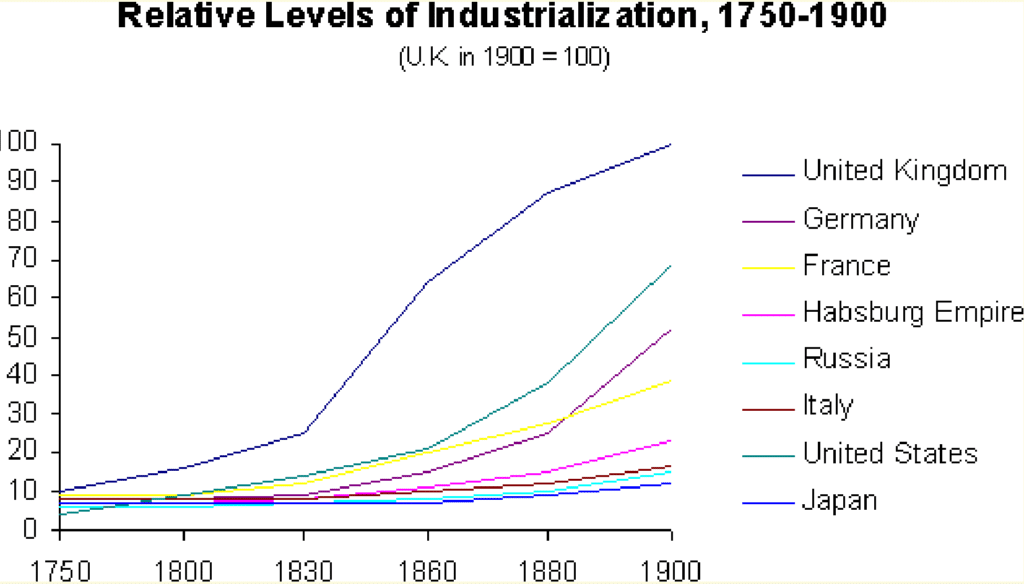
- By 1850, the U.S. was firmly established in a strong process of industrialisation, and by 1900, it was not only a fully industrialised economy, but also one of the world’s top three economic powers.
- In the twentieth century, its power continued to grow, eventually making it the world’s most advanced and largest economy.
- The overall profile of industrialisation in America is quite similar to that of Western Europe, though often for very different underlying reasons. There was, accordingly:
- Slow industrial development during the eighteenth century.
- A marked speeding up during the period of the French and Napoleonic Wars.
- Post-war dislocation and de-industrialisation, with the return of peace and renewed British competition.
- Recovery and sustained growth during the second quarter of the century.
- Crucially, however, the causes behind these shifts in pace were usually externally generated, rather than the result of any inherent problem with the domestic American economy or its socio-political-cultural context.
The Eighteenth Century
- From the 16th to the late 18th century, the North American continent was divided among a number of competing European empires — mainly the Spanish, French, and Dutch.
- During the colonial period, every aspect of American economic development was shaped by the “British Colonial System,” which gradually evolved out of mercantilist economic philosophy during the seventeenth century.
- In essence, this policy assumed that colonies existed for only one real reason — to serve the “mother country.”
- They were meant to do this by providing Britain with goods she could not otherwise obtain, both for domestic consumption and re-export, and by furnishing her with markets for her domestic industry.
- The American colonies were accordingly encouraged to develop as producers of food and raw materials — most notably tobacco, rice, sugar, and timber products — but were actively discouraged from developing anything beyond a narrow range of manufactures.
- In essence, this policy assumed that colonies existed for only one real reason — to serve the “mother country.”
- Although these constrictions generated rising frustration among the colonists — who, with increasing wealth and generational distance from England, increasingly wanted greater political freedom — they also brought considerable economic benefits, including:
- Privileged access to the rapidly expanding British market.
- Access to the trading opportunities of the growing British Empire.
- Perhaps most importantly of all, development within the context of a set of British cultural, social, and political institutions, which proved more conducive to private enterprise and capitalist expansion than any other comparable system in the world at that time. (This factor helps explain the wide long-term differences in economic performance between North and South America since the eighteenth century.)
- With the success of the American Revolution, the British were expelled, the constrictions of the old colonial system were removed, and American businessmen were unleashed for genuinely independent development.
- At first, however, things did not go well — the newly independent nation suddenly found itself deprived of advantages it had previously enjoyed under British protection, and its very continued independence was, for a time, cast into doubt.
- At that point, however, matters fortuitously took a sudden turn for the better, with the outbreak of general warfare in Europe.
The French and Napoleonic Wars (1794–1815)
- War in Europe meant, above all, sea warfare, as the British, and the French with their allies, fought for control of the sea lanes to their respective colonies and other long-distance markets.
- The British ultimately won this contest, cutting off the other European powers from their overseas empires.
- The only way trade and other essential links could still be maintained was through neutral shipping — and the Americans were more than pleased to accept this role.
- American ports, particularly in New England, experienced a return to genuinely unparalleled commercial prosperity.
- Markets for American primary products — particularly the large tobacco crop — likewise picked up substantially.
- Available capital was channelled primarily into planting, shipping, and commerce, while the supply of manufactured goods was conveniently left to old British manufacturers, who were themselves keen to re-establish good relations once earlier difficulties had been forgotten.
- All went reasonably well until economic warfare in Europe began to replace major military activities after 1806.
- Both Napoleon and Britain attempted to inflict economic injury upon each other, through Napoleon’s Continental System, and Britain’s own Orders in Council.
- While these measures arguably had beneficial effects on the process of “continental” industrialisation within Europe itself, they made life increasingly difficult for neutrals attempting to sustain Europe’s external trade.
- America retaliated in 1807 with her own Embargo Act.
- Relations with Britain gradually deteriorated, culminating in a second outbreak of war in 1812.
- While this combined economic and military warfare had genuinely disastrous consequences for American primary producers and mercantile and shipping interests, it simultaneously created the first real opportunity for the development of large-scale domestic industry.
- As in continental Europe, these protective wartime conditions fostered an explosion of industrial activity, led by textiles and metal manufacturing.
- To a large degree, this took the form of stimulating traditional, small-scale units of production — but Americans, unlike their continental European counterparts, found it considerably easier to learn directly from the British.
- Between 1805 and 1815, for example, 94 new cotton mills were built in New England, most of them — like Lowell’s famous mill at Waltham, near Boston — employing the latest British spinning and weaving machinery.
- However, even these new enterprises still carried relatively high costs, and they found it genuinely difficult to survive the eventual return of peace and normal trading relations.
The Post-War Period (1815 to the Early 1820s)
- In the immediate post-war period, a British import invasion — underpinned by superior British technology, and with prices deliberately cut to eliminate future American competitors — dealt a near-lethal blow to the momentum of American industrialisation.
- Many manufacturing companies were forced to close.
- Entrepreneurs turned away from industry, and back towards primary production and commercial activity.
- Meanwhile, the American population was increasing rapidly; the frontier had spilled across the Appalachian mountain range, and was racing across the Midwest.
- The nation was increasingly able to look inwards, towards the exploitation of its own domestic potential, rather than outwards towards the international economy that had dominated its earlier years.
- But there remained one last great international opportunity to be taken — namely, the supply of raw cotton to the seemingly insatiable appetite of the British and developing European textile industries.
- Throughout the 1810s, ’20s, ’30s, and ’40s, rapid economic growth across the nation as a whole was driven substantially by the expansion of the cotton crop and the southern “Cotton Kingdom.”
- However, the wider economy did not become totally unbalanced by cotton’s vast earnings potential.
- The southern plantations’ growing need for additional food supplies encouraged the expansion of commercial agriculture in the West, and the increasing wealth of both regions in turn created a demand for manufactured goods that the Northeast could begin to supply, alongside the British.
Revived Industrialisation (1820s–1850s)
- Just as war had once provided the protective market conditions needed to start a rush into manufacturing between 1812 and 1814, the introduction of a protective tariff in 1816 did much, first to arrest the decline, then to initiate recovery, and finally to sponsor sustained industrial progress.
- The “protective effect” of this tariff was progressively increased over the following decades, both through a gradual reduction in manufactured goods prices, and through a series of further increases in the size of the duty itself.
- This meant that British manufacturers gradually abandoned the market for basic, low-quality, utility goods — where profit margins were thin — to American manufacturers, concentrating instead on the higher end of the market.
- Together with various other stimuli, such as resource abundance and high labour costs, this particular market structure began to initiate experiments with entirely new forms of mass production technology, which would eventually lead to a new, characteristically American form of manufacture.
- Just as important to fostering this growth was the constant westward shift in the functional centre of the U.S. economy, alongside the progressive improvement of domestic transport facilities.
- This greatly expanded the market faced by American producers, while still providing a genuine protective effect — in the form of relatively high transport costs — against British competition.
- For example, to undercut manufacturing companies producing agricultural machinery and frontier implements for local markets in new western towns such as Pittsburgh, British manufacturers had to overcome not only high tariff barriers, but also expensive sea and land transport costs — particularly during the critical early years of the pre-railway era (the 1820s and ’30s).
- This greatly expanded the market faced by American producers, while still providing a genuine protective effect — in the form of relatively high transport costs — against British competition.
- Under these conditions — with cotton production and earnings driving the economy forward, the West continuously absorbing new resources, and the population booming through both high natural increase and immigration — it was, in truth, genuinely difficult for manufacturers to fail.
- By 1860, the cotton textile industry, based mainly in the Northeast, had been almost entirely mechanised, and was in no way inferior in its technology to that commonly used in England.
- In the iron industry, the latest British coal-fuelled techniques in smelting and refining were adopted, alongside the continued use of readily available traditional wood fuel.
- America also began producing its own new technologies, reflecting the different market forces at work there compared with Europe.
- The sewing machine, for example — developed by Howe, Singer, and Wilson from the late 1840s — greatly facilitated the work of women on remote western farmsteads, while also revolutionising the shoe and garment trades in the production of utility goods for working men.
- During this long period of growth and change, there were inevitably times of genuine doubt and crisis, alongside the distortions brought by civil war and internal conflict — but America remained, throughout, the “land of the free,” where entrepreneurial energy could flourish, and where the market was largely left free to promote a kind of unrestrained economic social Darwinism. It was, in every sense, a genuine roller-coaster of success.
Early Innovations in the USA
- Thomas Somers and the Cabot Brothers founded the Beverly Cotton Manufactory in 1787 — the first cotton mill in America, the largest cotton mill of its era, and a significant milestone in the future research and development of cotton mills more broadly.
- This mill was originally designed to use horse power, but the operators quickly discovered that a horse-drawn platform was economically unstable, and the mill suffered economic losses for years as a result.
- Despite these losses, the Manufactory served as a genuine playground of innovation — not only in processing large amounts of cotton, but also in developing the water-powered milling structure later used in Slater’s Mill.
- In 1793, Samuel Slater founded the Slater Mill in Rhode Island.
- He had learned of the new textile technologies as a boy apprentice in England, and defied laws prohibiting the emigration of skilled workers by leaving for New York in 1789, hoping to profit from his specialised knowledge.
- After founding Slater’s Mill, he went on to own 13 textile mills.
- Daniel Day established a wool-carding mill in Massachusetts in 1809 — the third woollen mill established in the US (the first having been established in Connecticut).
- The Blackstone River and its tributaries, spanning more than 45 miles from Massachusetts to Rhode Island, is widely considered the birthplace of America’s Industrial Revolution.
- At its peak, over 1,100 mills operated within this valley, including Slater’s Mill — marking the earliest beginnings of America’s industrial and technological development.
- Merchant Francis Cabot Lowell, from Massachusetts, memorised the design of British textile machines during his tour of British factories in 1810.
- Realising that the War of 1812 had ruined his existing import business, but that a growing demand for domestic finished cloth was emerging within America, he returned to the United States and set up the Boston Manufacturing Company.
- After his death in 1817, his associates went on to build America’s first planned factory town, which they named after him — Lowell, Massachusetts, considered by some historians a major contributor to the overall success of the American Industrial Revolution.
- The industrialisation of the watch industry began in 1854, at Waltham, Massachusetts, with the Waltham Watch Company, through the development of machine tools, gauges, and assembling methods specifically adapted to the micro-precision required for watchmaking.
Industrialisation and Reform in the USA: The Second Industrial Revolution Era (1870–1916)
- The industrial growth that began in the United States in the early 1800s continued steadily up to, and through, the American Civil War.
- Still, by the end of the war, the typical American industry remained relatively small.
- Hand labour remained widespread, limiting the overall production capacity of industry.
- Most businesses simply lacked the capital needed for significant expansion.
- Still, by the end of the war, the typical American industry remained relatively small.
- After the Civil War, however, American industry changed dramatically.
- Machines replaced hand labour as the primary means of manufacturing, tremendously increasing industry’s overall production capacity.
- A new nationwide network of railways distributed goods far and wide across the country.
- Inventors developed new products the public genuinely wanted, and businesses manufactured these products in large quantities.
- Investors and bankers supplied the huge amounts of capital that business leaders needed to expand their operations.
- Industrial growth centred chiefly on the North — the war-torn South, by contrast, lagged well behind the rest of the country economically.
- America’s role in foreign affairs also changed dramatically during the late 1800s and early 1900s, as the country built up its military strength and became a genuine world power.
The Rise of Big Business
- The value of goods produced by American industry increased almost tenfold between 1870 and 1916. Many interrelated developments contributed to this remarkable growth.
Improved Production Methods
- The use of machines in manufacturing spread throughout American industry after the Civil War.
- With machines, workers could produce goods many times faster than they could by hand alone.
- The new large manufacturing firms hired hundreds, or even thousands, of workers.
- Each worker was assigned a specific job within the production process — this system of organising labour, known as the “division of labour,” further sped up overall production.
Development of New Products
- Inventors created — and business leaders produced and sold — a wide variety of new products, including:
- The typewriter (1867).
- Barbed wire (1874).
- The telephone (1876).
- The phonograph, an early form of record player (1877).
- The electric light (1879).
- The petrol-engine car (1885).
Natural Resources
- America’s rich and varied natural resources played a key role in the rise of big business.
- The nation’s abundant water supply helped power industrial machines.
- Its forests provided timber for construction and wooden products.
- Miners extracted large quantities of coal and iron ore from the ground.
A Growing Population
- More than 25 million immigrants entered the United States between 1870 and 1916.
- Since American wages were considerably higher than those in Europe, particularly for skilled workers, this period saw a substantial influx of millions of European immigrants.
- The rapid expansion of industrialisation led to real wage growth of 60% between 1860 and 1890, spread across an ever-increasing labour force.
- Immigration, combined with natural population growth, caused the U.S. population to more than double during this same period, rising from roughly 40 million to about 100 million.
Distribution and Communication
- In the late 1800s, the American railway system became a genuinely nationwide transportation network.
- The total distance of all railway lines in operation in the United States soared from about 14,500 kilometres in 1850 to almost 320,000 kilometres by 1900.
- A high point in railway development came in 1869, when workers laid the tracks joining the Central Pacific and Union Pacific railways, near Ogden, Utah.
- This event marked the completion of the world’s first transcontinental railway system, linking the United States by rail from coast to coast.
- Mining companies used the railways to ship raw materials to factories quickly, over long distances.
- Manufacturers likewise distributed their finished products by rail to points throughout the country — the railways themselves became highly profitable businesses for their owners.
- In 1876, Alexander Graham Bell invented the telephone. These developments, together with the earlier telegraph, provided the rapid communication that proved vital to the smooth operation of big business.
Investment and Banking
- The overall business boom triggered a sharp increase in investments in the stocks and bonds of American corporations.
- As businesses prospered, people eager to share in the resulting profits invested heavily — their investments, in turn, provided the capital companies needed to expand their own operations.
- New banks sprang up throughout the country, helping finance the nation’s broader economic growth by making loans directly to businesses.
Life During the Industrial Era
- The industrial boom had major effects on the everyday lives of the American people.
- The availability of new industrial jobs drew people from farms into cities in genuinely record numbers.
- In 1870, only about 25 per cent of the American people lived in urban areas; by 1916, this figure had reached almost 50 per cent.
- The availability of new industrial jobs drew people from farms into cities in genuinely record numbers.
- The lives of people within these growing cities, however, contrasted sharply.
- A small percentage of them possessed enormous wealth, enjoying lives of considerable luxury.
- Below them economically, a larger middle class lived reasonably comfortably.
- But at the very bottom of the economic ladder, a huge mass of city people lived in conditions of extreme poverty.
The Wealthy
- The business boom opened up many genuine opportunities for financial gain.
- The economic activity it generated enabled many people to establish successful businesses, expand existing ones, and profit substantially from investments.
The Middle Class
- Other city residents prospered enough to live lives of genuine comfort, if not outright wealth.
- These included owners of small businesses, as well as workers such as factory and office managers — together, they formed the core of America’s growing middle class.
The Underprivileged
- The labourers who toiled in factories, mills, and mines did not meaningfully share in the benefits of this economic growth.
- They usually worked at least 60 hours a week, and enjoyed no fringe benefits whatsoever.
- As the nation’s population grew, so too did the competition for jobs — the overall supply of workers outstripped demand, and this oversupply of labour led directly to persistently high unemployment.
- Adding further hardship, economic depressions slowed the American economy to a near standstill in 1873, 1884, 1893, and 1907.
- The everyday life of the urban poor was genuinely dismal and drab.
- The poor lived crowded together in slums, with much of their housing consisting of cheap apartment buildings known as “tenements.”
- These crowded slum neighbourhoods bred crime.
- Overwork, poor sanitation, and inadequate diet left slum dwellers highly vulnerable to disease.
- Many poor children received little or no education, since they were compelled to work in order to contribute to their families’ welfare.
The Farmers
- American farmers also suffered considerable hardship after the Civil War.
- Advances in agricultural equipment and technique had enabled most farmers to substantially increase their production. However, middlemen standing between farmers and consumers took a large share of the money earned from farm products — these middlemen included the owners of railways, mills, and gins.
Government
- Political leaders of the era strongly favoured business interests.
- The government of this period was also marked by widespread corruption, which flourished similarly at both the state and local levels.
The Gilded Age
- The American author Mark Twain famously called this era of industrialisation “The Gilded Age.”
- Twain used this term to describe the culture of the newly rich of the period — lacking established tradition, the wealthy developed instead a distinctly showy, ostentatious culture.
- He characterised it as an era of serious social problems, masked by only a thin layer of gold gilding — a period, for example, of rapid industrialisation and rising wages, but also of abject poverty and deep inequality.
- Most ordinary Americans, however, held a rather different idea of “culture.”
- They enjoyed fairs exhibiting industrial machines, the latest inventions, and other items reflecting America’s material progress.
- The American public were eager spectators at circuses, vaudeville shows, and sporting events.
- Baseball became so popular after 1900 that it was widely called the national pastime.
- Also after 1900, a new form of entertainment — the cinema — began attracting significant public interest.
Reform
- A strong spirit of reform swept through the United States during the late 1800s and early 1900s.
- Many Americans called for changes to the country’s economic, political, and social systems.
- They wanted to reduce poverty, improve the living conditions of the poor, and regulate big business.
- They worked to end corruption in government, make government more genuinely responsive to the people, and accomplish other related goals.
- Many Americans called for changes to the country’s economic, political, and social systems.
- By 1917, reformers had brought about many significant changes.
- Some reformers called themselves “progressives,” and as a result, the period of American history from roughly 1890 to 1917 is often referred to as the Progressive Era.
Early Reform Efforts
- Early reform efforts included movements to organise both labourers and farmers.
- In 1886, skilled labourers formed the American Federation of Labor (AFL). This union bargained directly with employers, winning better wages and working conditions for its members.
- Farmers founded the National Grange in 1867, and various Farmers’ Alliances during the 1870s and 1880s — these groups helped force railways to lower their charges for hauling farm produce, and assisted farmers in various other ways as well.
- The drive for women’s suffrage grew notably strong after the Civil War.
- In 1869, the National Woman Suffrage Association was formed. The Territory of Wyoming granted women the right to vote that same year.
- Soon, a small number of other states allowed women to vote, though initially only in local elections.
The Progressive Era
- The broader outcry for reform increased sharply after 1890.
- Members of the clergy, social workers, and others studied life in the urban slums, reporting publicly on the awful living conditions there. Educators, meanwhile, sharply criticised the nation’s school system.
- Increasingly, unskilled workers resorted to strikes in attempts to win concessions from their employers — often, violence broke out between strikers and the strikebreakers hired by employers to oppose them.
- Socialists, and others opposed to America’s underlying economic system of capitalism, actively supported these strikers, gaining a considerable following of their own.
- As public support for reform grew, so too did the political influence of the reformers.
- In 1891, farmers and some labourers formed the Populist Party, calling for direct government action to help farmers and labourers.
- The Populists gained a substantial following, convincing many Democrats and Republicans alike to support significant reforms.
- Reformers won control of many city governments, and some state governments as well, also electing many sympathetic figures to Congress.
- In addition, the first three presidents elected after 1900 — Theodore Roosevelt, William Howard Taft, and Woodrow Wilson — each supported certain reform laws.
- In 1891, farmers and some labourers formed the Populist Party, calling for direct government action to help farmers and labourers.
Theodore Roosevelt’s “Square Deal”
- Theodore Roosevelt, who became president in 1901, was a liberal Republican who called for a genuine “square deal” for all Americans.
- Roosevelt became the first president to actively assist labourers in a strike against their employers.
- In 1902, the United Mine Workers struck for better wages and working conditions.
- Roosevelt asked both the miners and the mine owners to settle their differences through arbitration, but the mine owners initially refused.
- Angered by this refusal, the president threatened to have the army take over the mines directly.
- The owners ultimately gave in, reaching a compromise settlement with the miners.
- Roosevelt became the first president to actively assist labourers in a strike against their employers.
Woodrow Wilson and the Reform Movement
- In 1912, Democrat Woodrow Wilson won the presidency.
- The broader reform movement genuinely flourished under Wilson.
- The many reform measures passed during Wilson’s presidency included the lowering of a high tariff in 1913, which had previously protected American business from foreign competition.
Conclusion
The industrialisation of the United States offers a striking case study in how external circumstance, protective policy, and geographic advantage can combine to produce sustained economic transformation. From the constraints of the colonial “British Colonial System,” through the wartime opportunities and post-war collapses of the early nineteenth century, to the protective tariff-driven recovery of the 1820s onward, American industry gradually built the foundations for the explosive growth of the Second Industrial Revolution after the Civil War. Yet this remarkable material progress — captured in the value of American industrial output rising nearly tenfold between 1870 and 1916 — came at a steep social cost, producing the stark inequalities of Mark Twain’s “Gilded Age”: a small class of enormous wealth, a growing but comfortable middle class, and a vast underprivileged population enduring slum conditions, unsafe workplaces, and chronic job insecurity. It was precisely this tension between industrial triumph and social hardship that gave rise to America’s own great age of reform — from the AFL and the Populist Party, through the women’s suffrage movement, to the presidencies of Theodore Roosevelt and Woodrow Wilson — culminating in the Progressive Era‘s attempt to reconcile the extraordinary productive power of American industry with the basic welfare and dignity of the American people.