

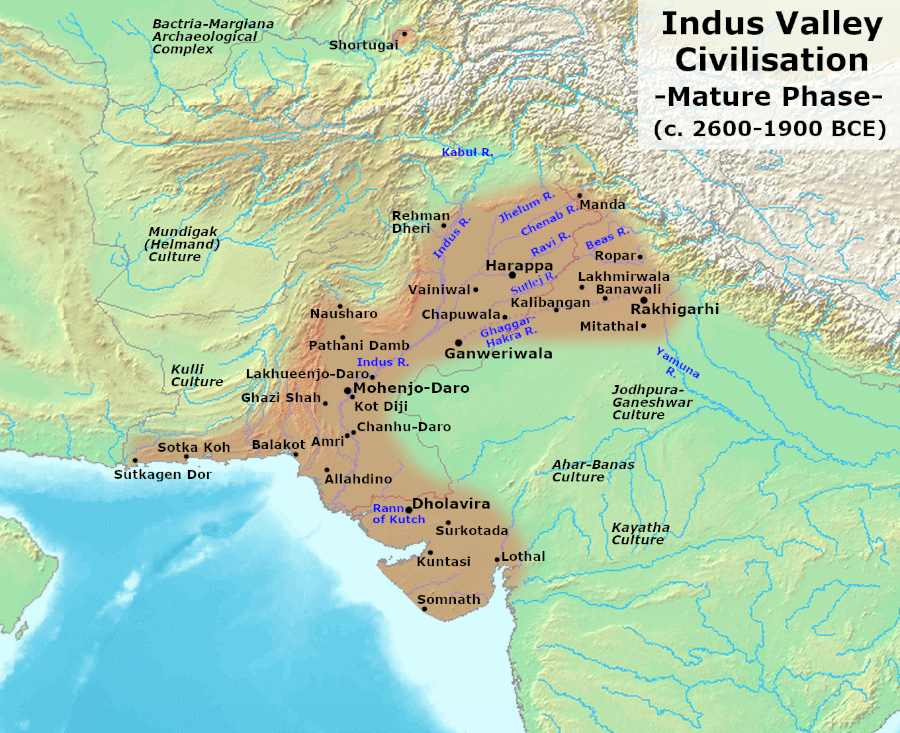
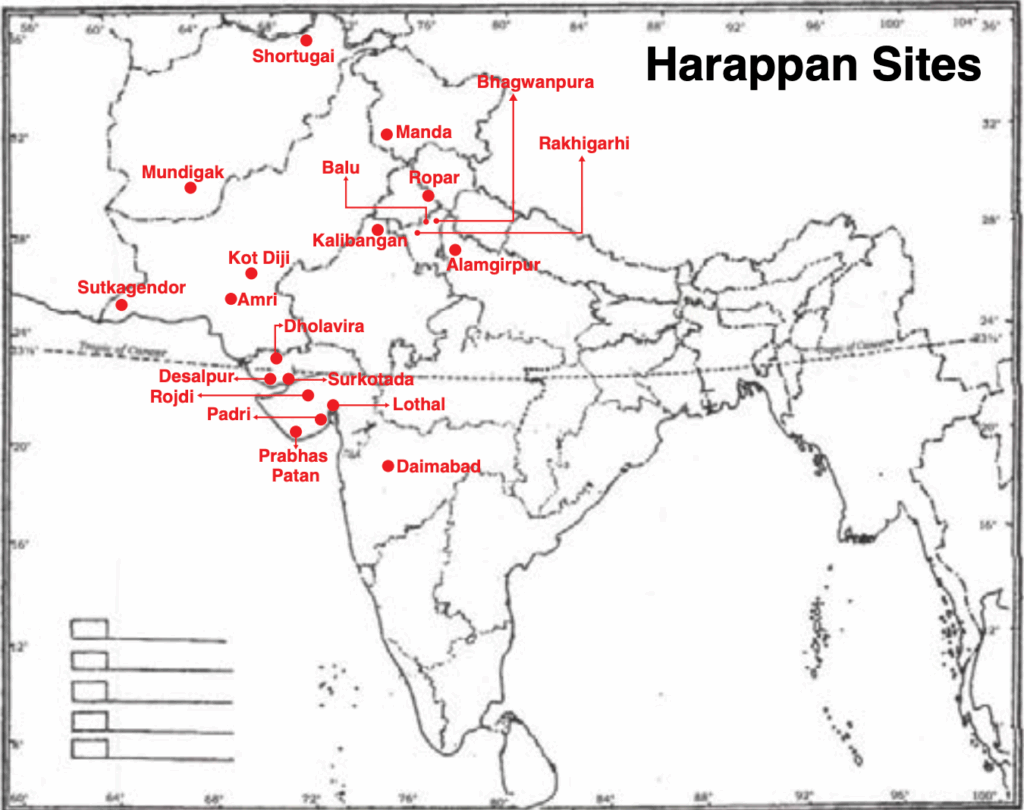
Indus Valley Civilization (IVC): Mature Harappan Phase (c. 2600 – 1900 BCE)


Manda / Akhnoor
- Location: Akhnoor, Jammu district, Jammu & Kashmir, on the right bank of the Chenab River, at the foothills of the Pir Panjal range.
- Cultural Sequence
- Northernmost Harappan site in India.
- Occupation phases:
- Pre-Harappan
- Mature Harappan
- Late Harappan
- Megalithic / Iron Age
- Historic Period (e.g., Kushana)
- Material Culture
- Pottery:
- Black-and-Red Ware (BRW), Red Ware, Grey Ware.
- Artefacts:
- Bangles, terracotta beads.
- Potshards with Harappan script.
- Bone arrowheads.
- Copper rods, iron daggers.
- Circular brick platforms.
- Pottery:
- Megalithic Features
- Pit burials and cairn circles.
- Stone-lined burial pits, some marked with small stone circles.
- Artefacts: Iron tools, BRW pottery, terracotta beads, burnt bone remains.
- Significance
- Timber resource centre for Harappans—likely floated downstream to urban sites.
- Reflects Harappan adaptation to Himalayan foothill ecology.
- Indicates interaction with upland and megalithic cultures.
- Historical Period
- Kushana artefacts: pottery, terracotta figurines, bone tools, and iron weapons.
- Nearby Akhnoor Fort built by Raja Alam Singh in 1802 (not Harappan, but regionally significant).
Harappa
- Location
- Punjab, Pakistan
- Situated on the bank of the Ravi River
- Cultural Phases
- Evidence of Early, Mature, and Late Harappan phases
- Historical Importance
- First Indus Valley Civilization (IVC) site to be discovered (1921)
- Major urban centre of the Harappan Civilization
- Urban Features
- Grid-pattern town planning
- Fortified citadel and lower town
- Flat-roofed brick houses with differentiated living quarters
- Proper drainage system
- Granaries and Economy
- Row of six granaries found near the citadel
- Economy sustained by agriculture and commerce
- Trade with Sumer (southern Mesopotamia)
- Burial Practices
- Only site with evidence of coffin burial
- Fractional burial also practiced
- Presence of grave goods
- Cemetery-H: linked with foreign/alien people
- Artefacts and Craft
- Seals with Indus script
- Stone figurines: torso of a nude male, female figure in dancing pose
- Evidence of bronze smelting and metal tools
Ropar/ Rupar
- Location
- Rupnagar district, Punjab
- On the left bank of the Sutlej River, near the Shivalik foothills
- Cultural Phases
- Mature Harappan, Painted Grey Ware (PGW), Northern Black Polished Ware (NBPW)
- No Early Harappan level
- Transition from village to town during c. 600–200 BCE
- Harappan Features
- Typical artefacts:
- Terracotta bangles, steatite seals, chert blades, storage jars
- Rectangular pit burials with:
- Pottery, copper implements, animal bones
- Reflects regional burial variation from sites like Kalibangan and Mohenjodaro
- Typical artefacts:
- Architectural Features
- Houses made of stone, mud-brick, and burnt brick
- Post-Harappan Features (PGW and NBPW)
- NBPW phase yielded:
- Punch-marked coins, copper coins, agate beads, iron workshop
- A seal with inscription in Brahmi script
- NBPW phase yielded:
- Geographical and Cultural Significance
- Served as a Harappan frontier settlement for Himalayan resources
- Enabled trade via Sutlej River
- Crucial for tracing post-Harappan to early Vedic cultural continuity
Kalibangan
- Location
- Hanumangarh district, Rajasthan
- Situated on the southern bank of the Ghaggar River
- Semi-arid zone of the Thar Desert
- Cultural Phases
- Pre-Harappan Phase
- Use of copper and pottery production
- No writing system
- Unplanned settlement layout
- Sun-dried brick structures
- Harappan Phase
- Fortified citadel and fortified lower town
- Use of mud and burnt bricks
- Grid-pattern town planning
- Burnt bricks used in drains, wells, bathing platforms, fire-altars
- Pre-Harappan Phase
- Key Archaeological Features
- Earliest ploughed field in the world
- Criss-cross furrows indicate multi-cropping system
- Intercropping of oilseeds and pulses
- Evidence of seasonal flood irrigation
- Earliest ploughed field in the world
- Pottery and Artefacts
- Wheel-made red pottery
- Used for household, religious, and burial purposes
- Rectangular and cylindrical seals
- Terracotta objects: bangles, bull figurines
- Unique fire altars indicating fire worship
- Wheel-made red pottery
- Burial Practices
- Pit burial and urn burial types discovered
- Cultural Significance
- Demonstrates agrarian innovation in arid zones
- Reflects urban and ritual planning in Harappan civilization
Banawali
- Location
- Hisar district, Haryana
- Situated near the Rangoi River
- Cultural Phases
- Early Harappan
- Mature Harappan
- Late Harappan
- Settlement Features
- Fortified settlement with a dividing wall
- Citadel area (higher)
- Lower town (residential)
- Houses made of mud-brick and burnt brick
- Equipped with hearths
- Storage pits located in courtyards
- Burnt bricks used in wells, bathing pavements, and drainage systems
- Presence of a multi-roomed house possibly belonging to a wealthy merchant
- Fortified settlement with a dividing wall
- Religious and Ritual Features
- Fire altars found—indicative of fire worship
- Artefacts and Material Culture
- Stone weights
- Terracotta ploughs
- Female figurines (possibly religious icons)
- Beads of gold, lapis lazuli, and carnelian
- Tiny weights suggesting trade or economic activity
- Decline and Late Phase
- Sudden end of urban life during Late Harappan phase
- Evidence of mud houses and a diverse range of artefacts during this period
Bhirrana
- Location
- Fatehabad district, Haryana
- Situated on the banks of the Ghaggar River
- Very close to Banawali
- Cultural Significance
- Recognized by the Archaeological Survey of India (ASI) as the oldest Harappan site
- Shows continuous cultural sequence from Pre-Harappan (Hakra) to Mature Harappan phase
- Settlement Features
- Fortified settlement with mud-brick houses
- Early use of drainage systems and planned structures
- Material Culture
- Pottery: Handmade and wheel-made red ware, black-on-red ware with painted designs
- Tools: Microliths, copper objects, terracotta bangles and beads
- Figurines: Terracotta human and animal figurines
- Agriculture and Subsistence
- Evidence of domesticated cattle and grains
- Use of storage pits, indicating surplus agricultural production
- Chronological Importance
- Radiocarbon dating suggests occupation from around 7500 BCE
- Pushes the timeline of Harappan culture to earlier than previously thought
- Unique Features
- One of the longest stratified Harappan sequences
- Significant for understanding the origins and development of Indus urbanism
Rakhigarhi
- Location
- Hisar District, Haryana
- Situated on the banks of the now-dry Sarasvati–Drishadvati river system
- Cultural Chronology
- Largest Indus Valley Civilization (IVC) site, spanning around 550 hectares
- Occupied from 5000 BCE to 1900 BCE
- Contains cultural layers from Early to Mature Harappan phases
- 9th phase of excavation currently ongoing
- Urban Planning and Architecture
- Well-planned township following grid layout
- Mud-brick and burnt-brick houses
- Proper drainage system and sanitation
- Houses with courtyards, bathing areas, and wells
- Material Culture and Artifacts
- Pottery: Red ware including dish-on-stand, vase, jar, bowl, beaker, perforated jars
- Seals: Inscribed steatite seals, including a cylindrical seal with five Harappan characters
- Ritual Objects: Animal sacrificial pits, circular fire altars suggesting ritualistic practices
- Other artifacts:
- Terracotta and shell bangles
- Beads of semiprecious stones (carnelian, lapis lazuli)
- Copper tools and objects
- Blades, bone points
- Terracotta toy carts, wheels, and animal figurines
- Craft and Industry
- Specialized craft areas including a jewelry-making unit
- Evidence of production of bronze, copper, and gold jewelry
- Semi-finished beads and figurines, indicating local manufacture and trade
- Agriculture and Economy
- Cultivation of wheat, barley, peas
- Domestication of cattle and buffalo
- Indications of surplus agricultural production
- Burial and Ritual Practices
- Animal sacrifices and structured fire altars
- Burials under residential floors and in open spaces
- Genetic and Anthropological Evidence
- DNA recovered from Harappan skeletal remains
- Suggests genetic continuity from 10,000 BCE, indicating no major external migration
- Challenges the Aryan migration theory
- Significance
- One of the most crucial sites for understanding Harappan urbanism, ritual life, and genetics
- Offers insights into continuity of South Asian populations and early urbanization
Alamgirpur
- Location
- Saharanpur district / Meerut district, Uttar Pradesh
- Located on the left bank of the Hindon River
- Cultural Phases
- Easternmost known Harappan site
- Belongs to the Mature and Late Harappan phases
- No Early Harappan level found
- Followed by Painted Grey Ware (PGW) and Northern Black Polished Ware (NBPW) layers
- Break in occupation between Late Harappan and PGW phases
- Settlement and Urban Features
- Limited urban traits compared to western Harappan cities
- No fortifications or large public structures
- Functioned as a rural or craft-specialized outpost, likely part of a satellite network
- Material Culture
- Typical Harappan pottery
- Terracotta bangles, beads, faience objects
- Spindle whorls and yarn impressions on pottery
- Indicates early cotton spinning and weaving, suggesting textile production
- Burnt bricks and copper objects from the Late Harappan phase
- Cultural Significance
- Important for studying eastward expansion of Harappan culture
- Crucial for tracing the transition from Harappan to early historic cultures in the upper Ganga plain
- Shows cultural continuity across multiple ceramic traditions: Harappan → PGW → NBPW
Bhagatrav
- Location
- Situated in Bharuch district, Gujarat
- Located near the estuary of the Kim River, close to the Arabian Sea
- Cultural Phase
- Belongs to the Indus Valley Civilization
- Part of the Mature Harappan phase
- Urban and Strategic Features
- Functioned as an important port or coastal trade center during the Harappan period
- Its strategic location allowed access to maritime trade routes linking it to sites like Lothal and Dholavira
- Material Culture and Finds
- Typical Harappan pottery and ceramics
- Artifacts show links with other Harappan sites, indicating inter-site trade and interaction
- Environmental Evidence
- Archaeological layers and geomorphological studies suggest the site declined due to recurrent flooding
- Possible shift in river courses or sedimentation led to abandonment
- Cultural Significance
- Provides insight into coastal adaptations and trade infrastructure of the Harappan Civilization
- Serves as evidence of Harappan expansion into Gujarat’s estuarine and maritime zones
Lothal
- Location
- Situated in Ahmedabad district, Gujarat
- Located near the Bhogava River, around 85 km southwest of Ahmedabad
- Chronology and Settlement
- Pre-Harappan phase: Began as a small village
- Mature Harappan phase: Developed into a major trade and craft centre
- Late Harappan phase: Continued occupation with reduced urban features
- Urban Layout and Architecture
- City divided into a citadel and a lower town
- Constructions made using fire-dried bricks, lime, and sand mortar
- Featured a sophisticated drainage system, indicating advanced civil planning
- Evidence of twelve bathrooms in the citadel area
- Warehouse and merchant houses found
- Key Findings
- Dockyard:
- One of the earliest known dockyards in the world (approx. 214 × 36 meters)
- Used an innovative water-locking system
- Indicates advanced maritime engineering
- Industrial Units:
- Bead-maker’s shop
- Shell ornaments maker’s shop
- Metal worker’s shop
- Fire altars
- Terracotta figurine of house
- Tools and Technology:
- Ivory scale with the smallest-known decimal divisions from the Indus Civilization
- Impression of cloth on sealings
- Artifacts:
- Persian Gulf seals
- Carnelian beads
- Bronze tools
- Dockyard:
- Economic and Cultural Aspects
- Served as a harbour and bead-making industry hub
- Centre for cotton and rice-growing
- Connected to other IVC cities via riverine routes
- Part of a coastal trade network linking Lothal, Dholavira, and Sutkagan Dor
- Later Harappan Culture
- Site remained inhabited with a smaller population
- Urban character declined, but people retained Harappan traditions in:
- Writing
- Pottery
- Utensils
- Trade declined, and industrial resources were largely exhausted
- Significance
- Lothal stands as a symbol of Harappan maritime trade, craft specialization, and town planning
- Demonstrates the technological and commercial sophistication of the Indus Valley Civilization
Rangpur
- Location
- Situated on the Saurashtra Peninsula, Gujarat
- Cultural Phases
- Belongs to the Mature and Late Harappan phases
- Also shows evidence of Post-Harappan occupation
- Architecture and Construction
- Use of Acacia wood in construction activities
- Material Culture
- Pottery:
- Black-and-Red Ware (BRW)
- High-necked jars
- Dishes
- Shell-working evidence, indicating craft activity
- Pottery:
- Agriculture and Subsistence
- Plant remains recovered include:
- Bajra (Pearl millet)
- Rice
- Millet
- Plant remains recovered include:
- Significance
- Demonstrates rural continuity and craft production in the Late and Post-Harappan periods
- Indicates adaptation to semi-arid Saurashtra region through diverse agriculture and local materials
Rojdi
- Location
- Located in Rajkot district, Gujarat, near the Bhadar River
- Approximately 70 km from the Arabian Sea coast
- Cultural Phases
- Palaeolithic, Mature Harappan, and Late Harappan phases
- Settlement Type
- A rural Harappan settlement, especially active during the Late Harappan phase (1900–1300 BCE)
- Indicates non-urban, village-based life after urban Harappan decline
- Architecture
- Houses built on stone foundations
- No use of bricks found
- Structures arranged in clusters without large public buildings
- Pottery and Inscriptions
- Hard, red-ware pottery (both handmade and wheel-made)
- Graffiti and Indus script signs (e.g., jar sign)
- Short Harappan inscription found on pottery
- Material Culture
- Copper or bronze flat axes
- Terracotta toy carts, sling balls, querns
- Indicates household-level craft production
- Agriculture and Economy
- Based on dry farming and animal husbandry
- Palaeobotanical evidence of cultivation:
- Millets
- Pulses
- Cereals
- Significance
- Provides insight into rural continuity and agrarian adaptation in the semi-arid Saurashtra region after urban Harappan collapse
- Highlights the local variation in material culture and settlement planning within the broader Indus Valley Civilization
Surkotada
- Location
- Situated in Kutch district, Gujarat
- Located on the land route to Lothal
- Cultural Phase
- A Harappan site—includes phases of Early, Mature, and Late Harappan occupation
- Architecture
- Construction using mud bricks and stone rubble
- Fortified citadel and residential complex, suggesting urban planning
- Material Culture and Antiquities
- Terracotta seal with Harappan script, but notably without animal motifs
- Beads made of steatite and carnelian
- Evidence of coastal trade, connecting Surkotada to other Indus cities
- Unique Findings
- Horse-like skeleton discovered—important in the debate on horse presence in IVC
- Elephant bones also found, indicating familiarity with large domesticated or wild animals
- Significance
- Marks the easternmost extent of horse remains in a Harappan context
- Shows continuity of trade, craft, and animal domestication in a smaller fortified settlement of the Indus Valley Civilization
Dholavira
- Location
- Located in Kutch district, Gujarat, on Khadir Island in the Rann of Kutch
- Strategically situated between inland Harappan cities and the Gulf of Kutch
- Linked via a coastal route to Lothal and Sutkagan Dor on the Makran coast
- Chronology
- Occupied from Early Harappan to Late Harappan phases
- City Layout and Urban Planning
- Unique three-part division:
- Citadel (upper fortified area)
- Middle town
- Lower town
- Each section enclosed by individual fortification walls
- Reflects a hierarchical spatial organization, unlike any other Harappan city
- Unique three-part division:
- Water Management System
- Sophisticated water conservation and storage system
- Large stone-lined reservoirs, channels, stepwells, and drains
- Designed to cope with the semi-arid environment of the Rann of Kutch
- Sophisticated water conservation and storage system
- Architectural Features
- Seven hemispherical constructions found—purpose debated (possibly ritual or observatory structures)
- Material Culture and Artefacts
- Painted Black-and-Red Ware (BRW) pottery
- Square stamp seals, including some without Indus script
- Terracotta figurines, stone tools, shell ornaments, beads
- Script and Significance
- Discovery of the Dholavira signboard:
- Made of sandstone
- Contains ten Indus script characters
- Considered the longest known inscription in Indus script
- Suggests administrative, civic, or ritual communication
- Discovery of the Dholavira signboard:
- Economic and Strategic Role
- Acted as a regional administrative and trade center
- Controlled trade between Harappan core zones and Arabian Sea routes
- Cultural Importance
- Provides insight into Harappan urbanism, water engineering, and administrative systems
- One of the most comprehensively planned and preserved Harappan sites in India
Desalpur
- Location
- Located in Kutch district, Gujarat
- Near the Banni plains, around 25 km north of Bhuj
- Close to the Rann of Kutch
- Chronology
- Belongs to the Mature Harappan and Late Harappan phases
- No evidence of Early Harappan occupation
- Continued into the Post-Harappan period
- Settlement and Fortification
- A small but compact Harappan town
- Featured a very large fortification wall:
- Constructed using stone with mud filling inside
- Rare example of stone fortification among Harappan sites
- Evidence of internal planning and housing structures
- Material Culture
- Black-and-Red Ware (BRW) pottery
- Blade tools, cubical weights, terracotta beads, bangles
- Harappan cultural traits clearly evident in artifacts
- Craft and Economic Activity
- Evidence of shell working industry
- Unfinished shell bangles found
- Suggests a craft specialization and possible link to coastal trade
- Evidence of shell working industry
- Cultural Significance
- Demonstrates Harappan expansion into arid and marginal zones
- Highlights use of local resources and adaptation in fortification materials
- Serves as a minor but strategic site in the broader Harappan trade and cultural network
Chanhudaro
- Location
- Situated in Sindh, Pakistan
- Located along the Indus River basin
- Chronology
- Belongs to the Mature Harappan and Late Harappan phases
- No Early Harappan level found
- Settlement Features
- A small Harappan site
- Unfortified settlement
- Structures built on mud-brick platforms
- Streets equipped with covered drains made of burnt bricks
- Presence of pottery kilns suggests large-scale ceramic production
- Craft and Industrial Activity
- A major craft production center of the Harappan Civilization
- Notable findings include:
- Bead factory (mostly made of steatite)
- Working of semi-precious stones such as carnelian, agate, amethyst, and crystal
- Evidence of both finished and unfinished beads
- Seal-making industry
- Shell working and stone weight production
- Cultural Significance
- Demonstrates Harappan urban specialization with focus on industrial production
- Played a key role in internal trade and possibly in export via overland or riverine routes
- Absence of fortification suggests a peaceful craft-based town under the protection of larger Harappan urban centers
Mohenjodaro
- Location
- Situated in Sindh, Pakistan, on the bank of the Indus River
- Chronology
- Belongs to the Early Harappan and Mature Harappan phases
- Declined by the Late Harappan phase
- Recognized as a UNESCO World Heritage Site
- Urban Layout
- City was divided into two parts:
- Citadel (western mound):
- Great Bath (used for ritual bathing)
- Large residential building
- Great Granary (storage facility)
- Two assembly halls (possibly for public gatherings)
- Lower City (eastern mound):
- Courtyard-style residential houses
- Followed a grid pattern of planning
- Citadel (western mound):
- City was divided into two parts:
- Domestic Architecture
- Houses equipped with:
- Small wells, private bathrooms
- Drains connected to a sophisticated sanitation system
- Brick stairs indicating multi-storied structures
- Large central well possibly served communal purposes
- Houses equipped with:
- Environmental Challenges
- Suffered multiple floods due to proximity to the Indus River
- Possible tectonic uplift may have altered river course and drainage
- Important Artefacts
- Bronze Dancing Girl (a masterpiece of Harappan metallurgy)
- Stone sculptures:
- Seated male figure often called Priest King
- Pashupati Seal:
- Depicts a horned deity in yogic posture, interpreted by some as a proto-Shiva
- Seven-stranded necklace (evidence of fine ornamentation)
- Beads and ornaments made of ivory, lapis lazuli, carnelian, and gold
- Significance
- One of the most advanced urban centers of the Indus Valley Civilization
- Represents Harappan expertise in urban planning, engineering, and craftsmanship
Shortugai
- Location
- Located in northeastern Afghanistan, near the lapis lazuli mines of Badakhshan
- Northernmost Harappan site
- Function and Significance
- A strategic Harappan trading outpost
- Set up to access and control trade in lapis lazuli, tin, and other highland resources
- Reflects a well-established long-distance trade network with Central Asia
- Findings
- Seals:
- One seal with short inscription
- Square seals with animal motifs
- Pottery:
- Painted pottery with typical Harappan designs
- Jars, beakers, and Harappan Red Ware
- Objects and Ornaments:
- Clay models of cattle with carts
- Lapis lazuli beads, gold pieces, bronze objects, and shell bangles
- Steatite beads, cubical weights, terracotta figurines
- Seals:
- Architecture
- Mud-brick structures, reflecting Harappan construction patterns
- Cultural Importance
- Demonstrates Harappan adaptability to distant and difficult terrains
- Evidence of cultural integration of far-flung outposts with the core Harappan region
- Highlights Harappan economic ambition and ability to establish remote colonies
Sutkagen Dor
- Location
- Located on the Makran coast, Baluchistan, Pakistan, near the Iranian border
- Westernmost site of the Indus Valley Civilization
- Historical Discovery
- First discovered by Edward Mockler in 1875
- Excavated further by Aurel Stein (1928) and George F. Dales (1960)
- Urban Features
- Covered about 4.5 hectares
- Presence of a citadel and lower town—following typical Harappan urban layout
- Fortification wall made of stone, up to 7.5 meters thick
- Gateways and stone architecture show defensive planning
- Trade and Connectivity
- Acted as a coastal trading post between Harappan India and Mesopotamia
- Part of a coastal trade route linking Lothal, Dholavira, and Sutkagen Dor
- Access to Persian Gulf and Arabian Sea trade networks
- Material Culture and Artifacts
- Stone vessels and flint blades
- Stone and copper arrowheads
- Shell beads, indicating shell-working craft
- Pottery: Typical Harappan wares
- A copper-bronze disc—evidence of metallurgical activity
- Cultural and Economic Significance
- Likely served as a logistics hub for maritime trade
- Shows Harappan expansion westward for economic and strategic reasons
- Reflects both craft specialization and resource exploitation in a coastal setting





Awesome content, I understood easily Thanks for providing such content