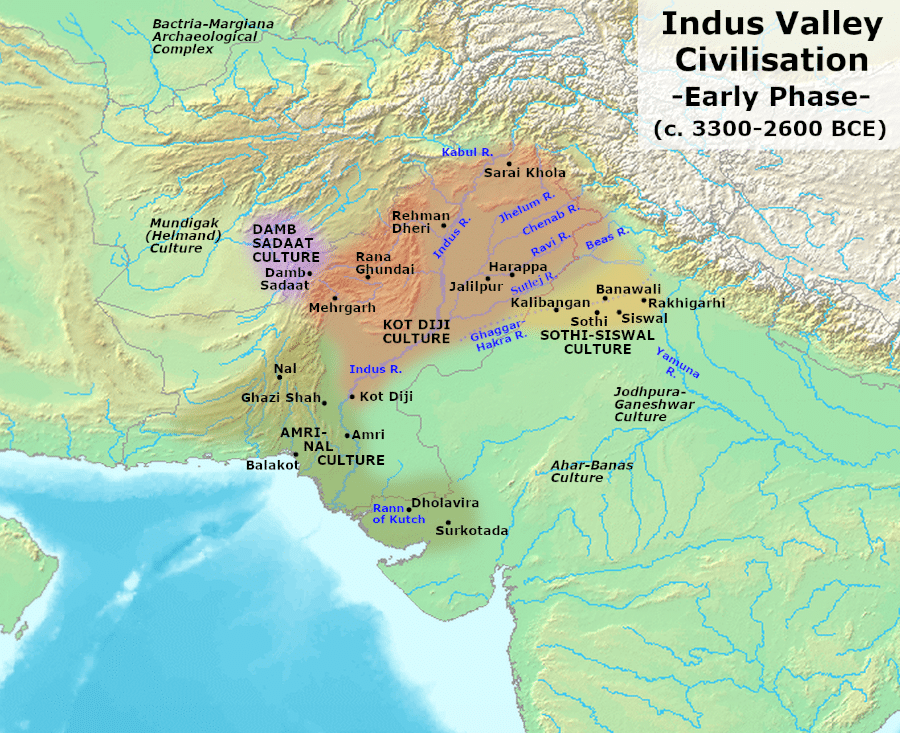
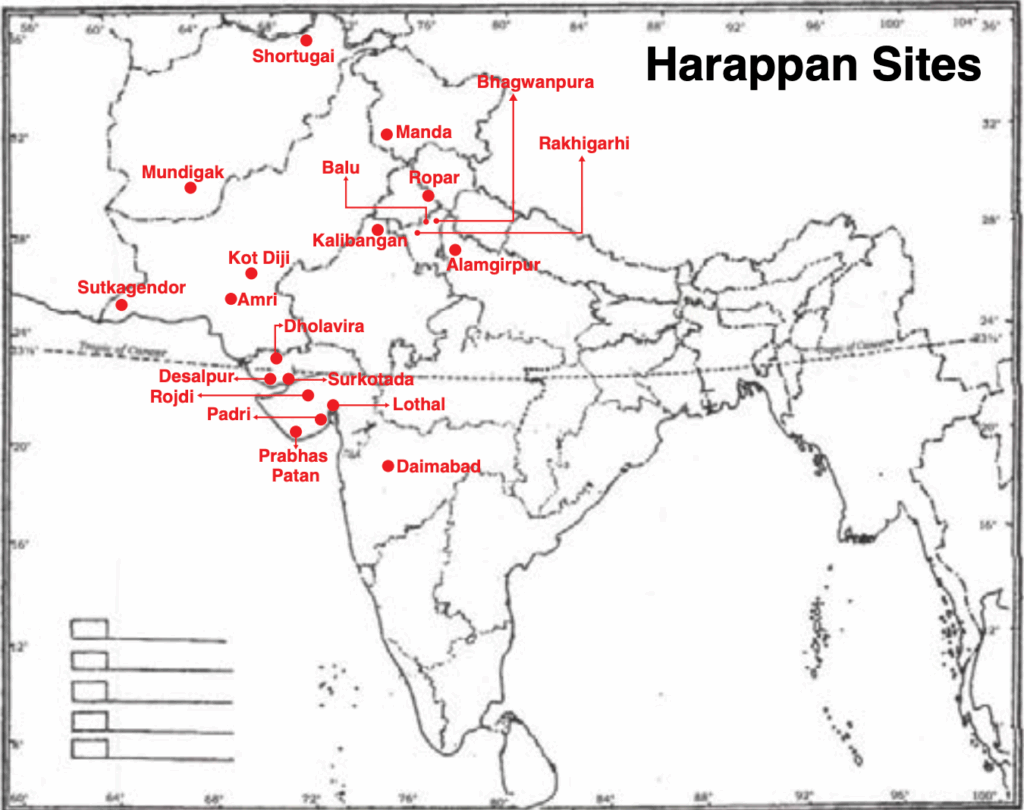
The Indus Valley Civilization: Early Harappan Phase (c. 3300 – 2600 BCE)


Surkotda (Gujarat)
- Location
- Located in Kutch district, Gujarat.
- Lies on the land route to Lothal (important for trade).
- Cultural Context
- Early Harappan Sites, with evidence of mature and late Harappan phases.
- Shows regional variation in Harappan architecture and materials.
- Architecture and Settlement Pattern
- Use of mud bricks and stone rubble in construction.
- Fortified settlement structure indicating urban planning.
- Important Artefacts
- Terracotta seal with Harappan script, notably without animal motif.
- Beads made of steatite and carnelian, indicating craft activity.
- Faunal Remains
- Horse-like skeleton found — rare and debated evidence for horse in Harappan context.
- Elephant bone also discovered.
- Trade Indications
- Evidence of coastal and inland trade during Harappan period.
Harappa
- Location
- Located in Punjab, Pakistan, on the left bank of the Ravi River.
- The first discovered site of the Indus Valley Civilization (IVC) (by Daya Ram Sahni in 1921).
- Chronology
- Evidence of Early, Mature, and Late Harappan phases.
- Urban Features
- Grid-pattern town planning with differentiated living quarters.
- Flat-roofed brick houses, often with private wells and toilets.
- Citadel and lower town division with fortification.
- Row of six granaries discovered — possibly used for surplus grain storage.
- Bronze smelting activity confirmed.
- Burial Practices
- Only IVC site with coffin burial evidence.
- Fractional burial also noted.
- Grave goods found along with burials (ceramics, ornaments).
- Cemetery-H indicates presence of foreign or intrusive people, possibly later migrants.
- Crafts and Artifacts
- Seals, including those with pictographic script and unicorn motifs.
- Stone figurines:
- Male torso (nude, red sandstone)
- Female figure in dancing pose (possibly a prototype of the bronze “Dancing Girl” of Mohenjo-daro)
- Economic and Trade Activity
- Agricultural surplus sustained urban life.
- Trade contacts with Mesopotamia, especially Sumer (Southern Mesopotamia) — Mesopotamian records mention trade with “Meluhha” (believed to be the Indus region).
Allhadino
- Location
- Situated near Karachi, in present-day Sindh, Pakistan.
- A coastal site of the Indus Valley Civilization.
- Site Type
- A small, unfortified village settlement.
- Likely served as a satellite or rural outpost supporting larger urban centers.
- Structural Features
- Mud-brick houses found.
- Wells with narrow diameters discovered:
- Possibly designed to increase groundwater pressure.
- May have supported local irrigation, suggesting small-scale agriculture.
- Significance
- Reflects hydraulic knowledge and adaptation to coastal ecological conditions.
- Demonstrates rural-urban linkage within the IVC economic system.
Amri
- Location
- Situated in Sindh, Pakistan, near the western bank of the Indus River.
- Close to the Kirthar Hills, marking its importance as a gateway between Baluchistan and the Indus Valley.
- Cultural Phases
- Exhibits both Pre-Harappan (Amri Culture) and Mature Harappan levels.
- Important for showing a clear transition from regional Neolithic-Chalcolithic culture to urban Harappan phase.
- Settlement Features
- Mud-brick and stone structures.
- Cellular compartments used for grain storage, indicating organized agrarian economy.
- Artefacts and Tools
- Chert blades, microliths, bone tools, stone balls.
- Fragments of copper and bronze, marking early metallurgy.
- Triangular terracotta cakes and terracotta figurines.
- Pottery
- Handmade and wheel-made wares.
- Decorated with geometric painted designs.
- Includes monochrome and polychrome pottery types.
- Significance
- Type site of the Amri Culture, one of the early regional cultures predating the Harappan urbanism.
- Played a strategic role in trade and cultural transmission between Baluchistan and Harappan cities.
Kot Diji
- Location
- Located in Khairpur district, Sindh, Pakistan, on the east bank of the Indus River.
- Opposite Mohenjodaro; near Amri.
- Cultural Phases
- Early Harappan (Kot Diji Phase): c. 2800–2600 BCE.
- Followed by Mature Harappan phase, making it a type site for early Harappan urban evolution.
- A burnt deposit found between early and mature phases (also at Gumla) suggests a major destructive fire.
- Settlement Features
- Fortified site: stone and mud-brick wall with bastions, enclosing a citadel and lower residential area.
- House walls built with stone and mud-brick, showing early urban planning concepts.
- Material Culture and Artefacts
- Tools and objects made of stone, shell, bone, and copper.
- Terracotta figurines, including a bull.
- Bangles, toy carts, beads, and evidence of metal casting and bead-making workshops.
- Pottery
- Wheel-made pottery, typically red ware with black-painted geometric designs.
- Specific pottery types include short-necked ovoid pots, painted with motifs like:
- Horned deity
- Pipal leaves
- Fish scales
- Significance
- Demonstrates transition from rural Neolithic-Chalcolithic culture to urban Harappan life.
- Shows early use of fortifications, organized craft production, and symbolic art.
Mehrgarh
- Location
- Located in Baluchistan, Pakistan, near the Bolan Pass.
- Strategically situated between the Iranian plateau and the Indus Valley.
- Cultural Phase
- A Neolithic and Chalcolithic site, dating from 7000 BCE onwards.
- Precursor to the Indus Valley Civilization; abandoned with rise of Harappan urban centers.
- Neolithic Phase (Aceramic)
- Planned farming village with mud-brick houses (later sun-dried bricks).
- Bone tools used; no pottery in early phase (aceramic).
- Small-scale agriculture (wheat, barley) and animal domestication (cattle, sheep, goats).
- One of the earliest sites for cultivation of cotton in the world.
- Evidence of fishing in nearby water sources.
- Practiced pastoralism along with agriculture.
- Chalcolithic Phase
- Introduction of pottery and copper tools.
- Continued craft production and development of trade networks.
- Unique Discoveries
- Earliest evidence of dental surgery in South Asia (drilled molar teeth).
- Terracotta figurines of humans and animals indicate symbolic or ritual activity.
- Presence of turquoise beads, shell bangles, lapis lazuli indicates long-distance trade and craft specialization.
Kalibangan
- Location
- Located in Hanumangarh district, Rajasthan, on the southern bank of the Ghaggar River.
- Lies in the semi-arid zone of the Thar Desert.
- Cultural Phases
- Contains both Pre-Harappan and Harappan layers.
- Pre-Harappan Phase
- Use of copper and handmade pottery.
- No writing system.
- Settlement lacked grid-planning; less organized layout.
- Sun-dried bricks used in construction.
- Harappan Phase
- Fortified citadel and lower town (both separately fortified).
- Use of mud and burnt bricks for structures.
- Grid-pattern town planning.
- Burnt bricks used in drains, wells, bathing platforms, and fire altars.
- Presence of cemetery and residential structures.
- Important Archaeological Features
- Fire altars:
- Rectangular and lined with bricks.
- Suggest practice of fire worship.
- Ploughed field:
- World’s earliest known ploughed field with criss-cross furrow pattern.
- Indicates multi-cropping and intercropping (possibly oilseeds and pulses).
- Seals:
- Rectangular and cylindrical types.
- Pottery:
- Wheel-made red ware used for domestic, ritualistic, and burial purposes.
- Burials:
- Both pit burial and urn burial types found.
- Other artefacts:
- Terracotta bangles, bull figurines, and household items.
- Fire altars:
Rakhigarhi
- Location
- In Hisar district, Haryana.
- Largest Indus Valley Civilization site (approx. 550 hectares) — bigger than Mohenjo-Daro.
- Cultural Phases
- Evidence of Early and Mature Harappan phases.
- Continuous habitation from 5000 BCE to 1900 BCE.
- Urban Features
- Grid-pattern township with planned layout.
- Mud-brick and burnt-brick houses.
- Advanced drainage system.
- Pottery
- Red ware pottery.
- Includes dish-on-stand, vase, jar, bowl, beaker, and perforated jars.
- Craft Production
- Presence of a jewelry-making unit (copper, bronze, gold ornaments).
- Terracotta figurines, seals, semi-finished beads, and toy carts.
- Inscribed steatite seals and sealings.
- Artefacts
- Cylindrical seal with five Harappan characters.
- Blades, bone points, terracotta and shell bangles.
- Animal figurines, terracotta wheel, copper objects.
- Religious/Ritual Evidence
- Animal sacrificial pit and circular fire altars — ritual significance.
- Subsistence
- Cultivation of wheat, barley, peas.
- Domesticated cattle and buffalo.
- Genetic Significance
- DNA from human remains suggests genetic continuity since 10,000 BCE.
- Challenges older theories of massive migrations into the subcontinent.
Banawali
- Location
- In Hisar district, Haryana, near the Rangoi River.
- Cultural Phases
- Evidence of Early, Mature, and Late Harappan phases.
- Urban Features
- Fortified settlement with a citadel and lower town, separated by a wall.
- Mud-brick and burnt-brick houses with hearths.
- Storage pits found in house courtyards.
- Burnt bricks used in wells, bathing pavements, and drains.
- A multi-roomed house indicates presence of urban elite or merchant class.
- Religious Features
- Presence of fire altars, indicating possible ritual practices.
- Artefacts
- Stone weights, terracotta ploughs, female figurines (possibly religious).
- Beads of gold, lapis lazuli, carnelian.
- Tiny weights suggesting trade and commerce.
- Decline
- In the Late Harappan phase, sudden decline is evident.
- Settlement continued with mud houses and diverse artefacts but without planned urbanism.
Mundigak
- Location
- Located in Kandahar province, Afghanistan.
- Cultural Phases
- Evidence of Neolithic, Chalcolithic, and Harappan contact phases.
- Material Culture
- Painted pottery depicting sacred fig leaves, tiger-like animal motifs.
- Artefacts include humped bull figurines, human figurines, shaft-hole axes, and terracotta drains.
- Harappan Phase (Mature)
- Excavations revealed a palace, a temple, and a city wall, indicating urban planning and Harappan influence.
Kulli
- Location: Southern Balochistan, Pakistan.
- Cultural Link: Belongs to the Kulli Culture (c. 2500–2000 BCE), which overlaps with Mature Harappan culture.
- Pottery: Fine black-on-red ware with painted motifs—especially of zebu bulls, peacocks, and pipal leaves.
- Artefacts: Terracotta figurines, including mother goddess and bulls, similar to Harappan styles.
- Agriculture: Use of dams and irrigation tanks, indicating developed water management.
- Significance: Reflects a regional variant of the Indus Valley Civilization with distinct ceramic and cultural traits.
Balakot
- Location: Near Sonmiani Bay, Makran coast, Balochistan, Pakistan.
- Early Harappan Site: Dates to c. 3500–2500 BCE.
- Architecture: Use of stone and mud-brick structures.
- Pottery: Handmade and wheel-made, including Balakot Ware—black-on-red slip with geometric patterns.
- Craft: Evidence of bead-making, shell working, and lapis lazuli trade.
- Significance: Important coastal site showing early trade and Harappan contact.
Sarai Khola
- Location: Near Taxila, Punjab province, Pakistan.
- Chalcolithic and Early Harappan site.
- Tools: Microliths and copper artefacts.
- Pottery: Red ware, painted and incised.
- Agriculture: Evidence of wheat and barley cultivation.
- Importance: Among the few excavated pre-Harappan and early agricultural sites in the Potwar plateau.
Gumla
- Location: Rajasthan, near the Aravallis; linked to Ganeshwar–Jodhpura culture.
- Phase: Early Harappan.
- Artefacts: Large number of copper tools, red ware pottery.
- Metalworking: Smelting of copper likely done at site; linked to Khetri copper belt.
- Significance: Served as a metal supplier to Harappan sites.
Rana Ghundai
- Location: Northern Balochistan, Pakistan.
- Multi-phase site: From Neolithic to Early Harappan.
- Early Settlement: Mud-brick houses, simple pottery.
- Later Phase: Black-on-red painted pottery, terracotta figurines.
- Significance: Represents early transition from rural Neolithic to Chalcolithic societies, possibly contributing to Harappan cultural zone.
Dholavira
- Location: In Kutch district, Gujarat; located on Khadir Island in the Rann of Kutch.
- Urban Layout:
- City divided into three parts: Citadel, Middle Town, and Lower Town — a unique tripartite layout in Harappan civilization.
- Fortified city with elaborate gateways and bastions.
- Water Management:
- Sophisticated water conservation system with stepwells, stone reservoirs, and channels — adapted to arid environment.
- Use of stone masonry in constructing water structures (unlike mud bricks elsewhere).
- Significant Discoveries:
- Dholavira Signboard: 10 large Indus script characters on a wooden board inlaid with gypsum — longest Indus script inscription found so far.
- Seals: Square stamp seals found; some without Indus script.
- Painted Black-and-Red Ware (BRW).
- Seven hemispherical structures — interpreted as possible memorial or mortuary structures.
- Trade & Connectivity:
- Located on an ancient trade route connecting Lothal and Dholavira to Sutkagan Dor (on the Makran coast), indicating coastal trade.
Mohenjo-daro
- Location: In Sindh, Pakistan, on the right bank of the Indus River.
- Cultural Phases: Both Early Harappan and Mature Harappan phases.
- Recognition: Declared a UNESCO World Heritage Site.
Town Planning & Architecture
- Divided into two parts:
- Citadel (western mound):
- Great Bath — most iconic public water tank structure.
- Great Granary with brick platforms.
- Large pillared halls (possibly assembly halls).
- Lower City:
- Grid pattern layout.
- Courtyard-style houses, brick-paved streets.
- Citadel (western mound):
- Houses:
- Made of baked bricks, some with multiple storeys (brick staircases).
- Private wells, bathrooms, covered drainage systems — advanced sanitation.
- Large public well in central part of the city.
Environment & Decline
- Suffered multiple floods — due to Indus river migration and tectonic uplift.
- Evidence of gradual decline in planning and structure in later phases.
Important Artefacts
- Bronze Dancing Girl — iconic example of lost-wax casting.
- Priest King Statue — steatite sculpture, bearded male figure.
- Pashupati Seal — depicts a horned deity in yogic posture (proto-Shiva interpretation).
- Jewelry: Seven-stranded necklace, gold, lapis lazuli, carnelian, ivory beads.
- Tools and other finds: Terracotta figurines, chert blades, weights, seals with Indus script.
Bhirrana
- Location: Fatehabad district, Haryana, on the banks of the Saraswati (Ghaggar) River.
- Cultural Sequence
- Exhibits all four cultural phases of the Indus Valley Civilization:
- Pre-Harappan (Hakra phase)
- Early Harappan
- Mature Harappan
- Late Harappan
- Exhibits all four cultural phases of the Indus Valley Civilization:
- Chronological Significance
- Considered the oldest Harappan site excavated till date by Archaeological Survey of India (ASI).
- Radiocarbon dating (C-14) suggests earliest layers date to circa 7570 BCE, pushing back IVC origins.
- Key Findings
- Pottery: Hakra ware and mature Harappan red ware.
- Structures: Mud-brick houses, streets, drains—urban planning evident even in early phases.
- Artefacts: Terracotta figurines, stone tools, beads, bangles, toy carts.
- Agriculture: Evidence of wheat, barley, and millets, indicating early agricultural practices.
- Importance
- Crucial for understanding the pre-Harappan cultural development.
- Supports indigenous origin theory of the Harappan Civilization in the Saraswati-Ghaggar basin.
Nal
- Location: Near Naal village in Baluchistan, Pakistan, southwest of Quetta.
- Cultural Phase:
- Belongs to Chalcolithic period, around 3100–2700 BCE.
- Associated with the Nal culture, which is distinct yet shows some links with Mehrgarh and Amri traditions.
- Key Features:
- Pottery:
- Highly polished and painted ware.
- Noted for fine polychrome pottery with complex geometric and naturalistic motifs (e.g., birds, animals, flowers).
- Rich use of black, red, and white colors.
- Artefacts:
- Terracotta figurines, bangles, beads of steatite and semi-precious stones.
- Copper objects found in limited quantity.
- Architecture:
- Mud-brick structures and storage facilities.
- Evidence of planned settlements.
- Pottery:
- Significance
- Indicates craft specialization and regional trade networks.
- Represents an advanced Chalcolithic culture of Balochistan.
- Important for studying early cultural diversity in the Indus periphery zone before the rise of mature Harappan urbanism.