Introduction

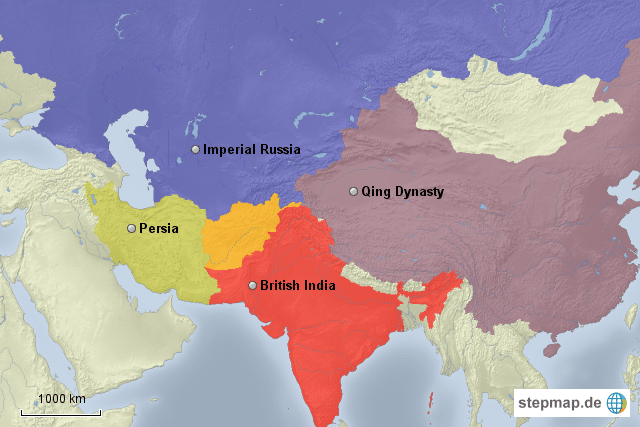
“The Great Game” was the term used for the strategic rivalry and conflict between the British Empire and the Russian Empire for supremacy in Central Asia — one of the defining geopolitical contests of 19th-century imperial history, and a recurring theme in the UPSC History Optional syllabus on colonialism and Great Power rivalry.
- The classic Great Game period is generally regarded as running from the Russo-Persian Treaty of 1813 to the Anglo-Russian Convention of 1907.
- The term itself is usually attributed to Arthur Conolly (1807–1842), an intelligence officer of the British East India Company.
This article traces the arc of the Great Game — from the British anxieties over Russian expansion into Afghanistan and Central Asia, through the shift of rivalry eastward to China, Mongolia, and Tibet, to the eventual Anglo-Russian Convention of 1907, and finally its lesser-known second phase during the Bolshevik Revolution and the Cold War. Understanding this century-long contest is essential for grasping the roots of modern geopolitics in South and Central Asia.
British–Russian Rivalry in Afghanistan
- From the British perspective, the Russian Empire’s expansion into Central Asia threatened to destroy the “jewel in the crown” of the British Empire — India.
- The British feared that the Tsar’s troops would subdue the Central Asian khanates (Khiva, Bokhara, Khokand) one after another, potentially turning Afghanistan into a staging post for a Russian invasion of India — a fear often termed “Russophobia.”
- With these anxieties in mind, the British launched the First Anglo-Afghan War in 1838, attempting to impose a puppet regime on Afghanistan under Shuja Shah.
- The regime proved short-lived and unsustainable without direct British military support. By 1842, mobs were attacking the British in the streets of Kabul, and the British garrison was forced to abandon the city amid constant civilian attacks.
- The retreating British army numbered approximately 4,500 troops (of which only 690 were European) along with 12,000 camp followers.
- During a series of attacks by Afghan warriors, all Europeans but one — William Brydon — were killed on the retreat to India; a few Indian soldiers also survived and later crossed into India.
- The British sharply curbed their ambitions in Afghanistan following this humiliating retreat from Kabul.
- After the Indian Rebellion of 1857, successive British governments came to view Afghanistan as a buffer state.
- The Russians continued to advance steadily southward through Central Asia toward Afghanistan, and by 1865, Tashkent had been formally annexed.
- Samarkand became part of the Russian Empire in 1868, and the independence of Bukhara was virtually stripped away by a peace treaty the same year — extending Russian control as far as the northern bank of the Amu Darya river.
- In a letter to Queen Victoria, Prime Minister Benjamin Disraeli proposed “to clear Central Asia of Russia and drive them into the Caspian.”
- He introduced the Royal Titles Act 1876, which added “Empress of India” to Victoria’s list of titles, symbolically placing her at the same level as the Russian Emperor.
- After the Great Eastern Crisis (which began in the Ottoman territories of the Balkans in 1875, with a series of uprisings and wars that drew in international powers before ending with the Treaty of Berlin in July 1878) broke out, and the Russians sent an uninvited diplomatic mission to Kabul in 1878, Britain demanded that the Afghan ruler, Sher Ali, accept a British diplomatic mission in return.
- The British mission was turned back, and in retaliation, a force of 40,000 men was sent across the border, launching the Second Anglo-Afghan War.
- The war’s conclusion left Abdur Rahman Khan on the throne; he agreed to let the British control Afghanistan’s foreign affairs, while he consolidated his own position on the throne.
- He went on to suppress internal rebellions with ruthless efficiency, bringing much of the country under central control.
- In 1884, renewed Russian expansionism triggered another crisis — the Panjdeh Incident (a battle in 1885, when Russian forces seized Afghan territory south of the Oxus River, or modern Amu Darya, at Panjdeh, in present-day Turkmenistan) — when Russia seized the oasis of Merv.
- On the brink of war between the two great powers, the British ultimately decided to accept the Russian possession of territory north of the Amu Darya as a fait accompli (an accomplished fact).
- Without any Afghan say in the matter, between 1885 and 1888, the Joint Anglo-Russian Boundary Commission agreed that the Russians would relinquish the farthest territory captured in their advance, but would retain Panjdeh.
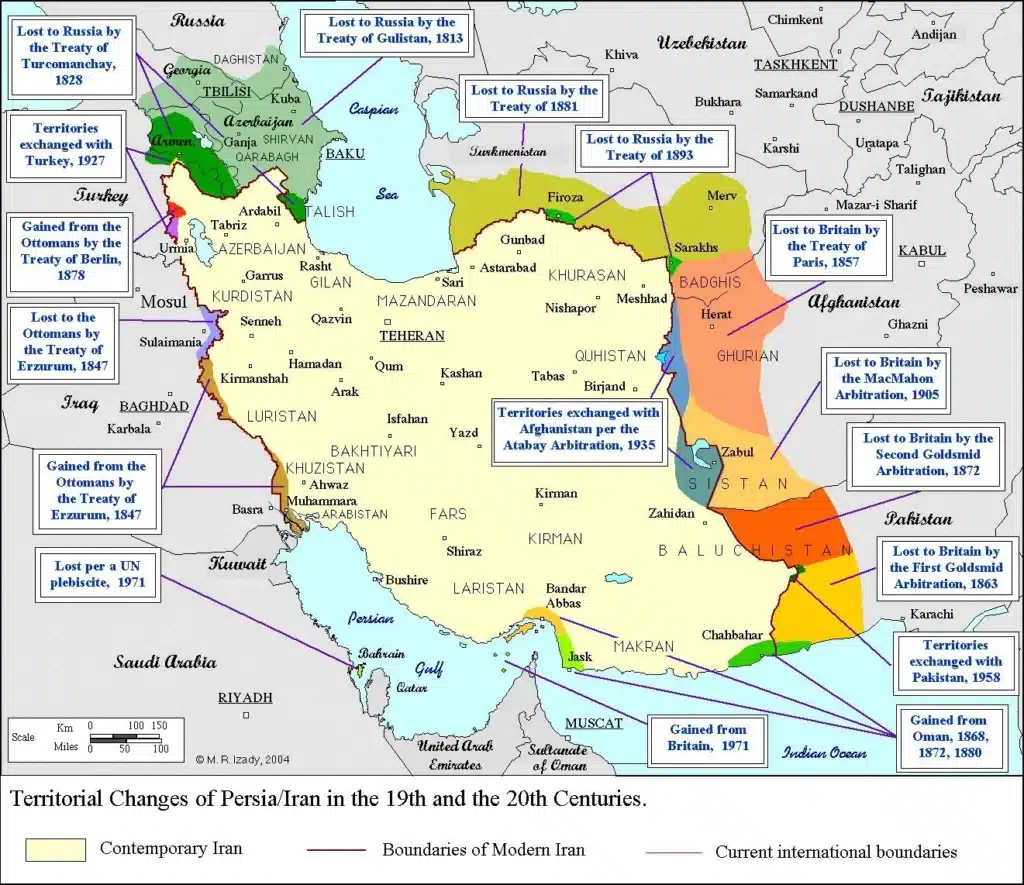
- The resulting agreement delineated a permanent northern Afghan frontier along the Amu Darya, at the cost of a large amount of territory, particularly around Panjdeh.
- This left the border east of Zorkul lake in the Wakhan unresolved; territory in this area was claimed by Russia, Afghanistan, and China. In the 1880s, the Afghans advanced north of the lake to the Alichur Pamir.
- In 1891, Russia sent a military force into the Wakhan and provoked a diplomatic incident by ordering the British captain present to leave.
- This incident, together with reports of a Russian incursion south of the Hindu Kush, led the British to suspect Russian involvement “with the Rulers of the petty States on the northern boundary of Kashmir and Jammu.”
- This suspicion prompted the Hunza-Nagar Campaign of 1891, after which the British established control over Hunza and Nagar in the Gilgit region of Kashmir.
- In 1892, the British sent Charles Murray to the Pamirs to investigate, concerned that Russia might exploit Chinese weakness in policing the area to gain further territory.
- In 1893, Britain reached an agreement with Russia to demarcate the remainder of the border, a process completed in 1895.
The Great Game Moves Eastward
- By the 1890s, the Central Asian khanates of Khiva, Bukhara, and Kokand had all fallen, becoming Russian vassals. With Central Asia firmly in the Tsar’s grip, the Great Game now shifted eastward toward China, Mongolia, and Tibet.
- In 1904, the British invaded Lhasa, a pre-emptive strike against suspected Russian intrigues and secret meetings between the 13th Dalai Lama’s envoy and Tsar Nicholas II.
- The Dalai Lama fled into exile, first to China and then to Mongolia.
- The British remained deeply concerned about the prospect of a Russian invasion of the Crown colony of India, although Russia — badly defeated by Japan in the Russo-Japanese War and weakened by internal rebellion — could not realistically afford a further military conflict against Britain.
- China, under the Qing Dynasty, presented an altogether different challenge.
- The Middle Kingdom had badly atrophied under the Manchus, the ruling ethnic caste of the Qing Dynasty; two and a half centuries of decadent rule, internecine feuds, and imperviousness to a changing world had progressively weakened the Empire.
- Natural disasters, famine, and internal rebellions further enfeebled China, and by the late 19th century, Japan and the Great Powers easily carved out trade and territorial concessions from her — humiliating submissions for the once all-powerful Manchus.
- Still, the central lesson of the Russo-Japanese War was not lost on the Russian General Staff: an Asian country employing Western technology and industrial production methods could defeat a great European power.
- In 1906, Tsar Nicholas II sent a secret agent to China to gather intelligence on the reform and modernisation of the Qing Dynasty.
- However, in 1907, Russia and Britain brokered the Anglo-Russian Agreement, formally ending the classical period of the Great Game.
The Anglo-Russian Convention of 1907
- In the run-up to World War I, both empires grew alarmed by the increasing activity of the unified German Empire in the Middle East, notably the German project of the Baghdad Railway, which would open up Mesopotamia and Persia to German trade and technology.
- Britain and Russia agreed to resolve their long-standing conflicts in Asia in order to present an effective, unified stand against German advances into the region.
- The Anglo-Russian Convention of 1907 formally brought the classic period of the Great Game to a close.
- Under its terms:
- Russia accepted that the politics of Afghanistan would remain solely under British control, so long as Britain guaranteed not to change the ruling regime.
- Russia agreed to conduct all political relations with Afghanistan through the British, while Britain agreed to maintain the existing borders and actively discourage any Afghan attempt to encroach on Russian territory.
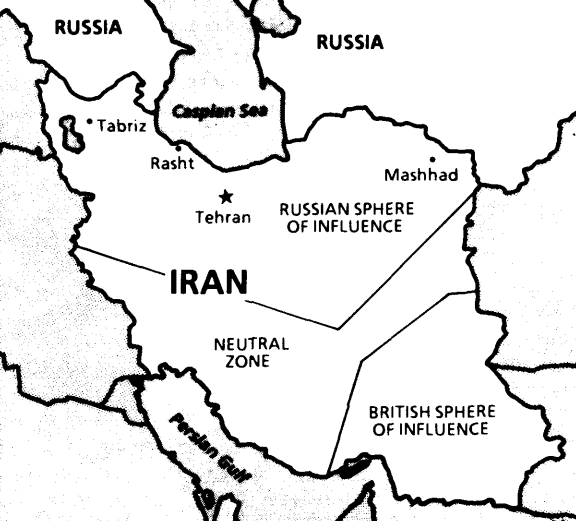
- Persia was divided into three zones: a British zone in the south, a Russian zone in the north, and a narrow neutral zone serving as a buffer between them.
- Regarding Tibet, both powers agreed to maintain the territorial integrity of this buffer state, and “to deal with Lhasa only through China, the suzerain power.”
A Less Intensive British–Soviet Rivalry
- The Bolshevik Revolution of 1917 nullified existing treaties, marking the beginning of a second phase of the Great Game.
- The Third Anglo-Afghan War of 1919 was precipitated by the assassination of the then-ruler Habibullah Khan. His son and successor, Amanullah, declared full independence and attacked the northern frontier of British India.
- Although little was gained militarily, the resulting stalemate was resolved through the Rawalpindi Agreement of 1919, under which Afghanistan re-established her self-determination in foreign affairs.
- In May 1921, Afghanistan and the Russian Soviet Republic signed a Treaty of Friendship.
- The Soviets provided Amanullah with aid in the form of cash, technology, and military equipment. British influence in Afghanistan waned accordingly, though relations between Afghanistan and the Russians remained equivocal, with many Afghans still hoping to regain control of Merv and Panjdeh.
- The Soviets, for their part, sought to extract more from the friendship treaty than Amanullah was ultimately willing to give.
- The United Kingdom responded to the treaty with minor sanctions and diplomatic slights, fearing that Amanullah was slipping out of the British sphere of influence, and increasingly concerned that the Afghan government sought control over all Pashtun-speaking groups on both sides of the Durand Line (the boundary between Pakistan and Afghanistan).
- In 1923, Amanullah responded by adopting the title padshah (“emperor”), and by offering refuge to Muslims fleeing the Soviet Union, as well as to Indian nationalists in exile from the Raj.
- Amanullah’s programme of reform, however, proved insufficient to strengthen his army quickly enough, and in 1928, he was forced to abdicate under pressure.
- The individual who most benefited from this crisis was Mohammed Nadir Shah, who reigned from 1929 to 1933.
- Both the Soviets and the British played the subsequent situation to their advantage: the Soviets gaining aid in suppressing an Uzbek rebellion in 1930 and 1931, while the British assisted Afghanistan in creating a 40,000-man professional army.
- With the German invasion of the Soviet Union on 22 June 1941, during World War II, came a temporary alignment of British and Soviet interests.
- Both governments pressured Afghanistan to expel a large German non-diplomatic contingent, believed to be engaged in espionage; Afghanistan immediately complied.
- A period of win-win cooperation between the USSR and the UK against Nazi Germany continued until the end of the war in 1945.
- This less intensive second phase of the Great Game would go on to enter an entirely new era, shaped by the sweeping geopolitical changes of the post-World War II period.
The Great Game During the Cold War
- After the Second World War, a new era of geopolitical realignment began, leaving the United States and the USSR as two superpowers separated by profound economic and political differences.
- During this post-Second World War, post-colonial period, the legacy of the Great Game would sow the seeds of a new, sustained state of political and military tension — an era that came to be known as the “Cold War,” or “Great Game II.”
- The decolonisation of the British Empire began during this period, and has been described as one of the focal points of Cold War evolution.
- Britain’s withdrawal reshaped the dynamics of inter-Asian geopolitics, especially across Central Asia and the Middle East, contributing to several major conflicts, including the Arab–Israeli conflict, the 1953 Iranian coup d’état, and the 1958 Iraqi Revolution.
- The USSR would go on to discover the same bitter truth within its own 1979 misadventure in Afghanistan that the British had learned in the 19th century, ultimately withdrawing its last troops from the so-called “graveyard of empires” — Afghanistan — in 1988.
Conclusion
The Great Game stands as one of the longest-running and most consequential geopolitical rivalries in modern history, stretching from the early 19th-century contest over Afghanistan and Central Asia through its later, less intense phases during the Bolshevik era and the Cold War. What began as a battle between the British and Russian Empires to secure India’s northern approaches evolved, over more than a century, into a template for great-power rivalry over Afghanistan and Central Asia that would recur with striking similarity — from the British retreat of 1842 to the Soviet withdrawal of 1988. For UPSC aspirants, the Great Game offers a crucial lens for understanding not only 19th-century imperial rivalry, but also the deep historical roots of contemporary geopolitics across South and Central Asia.