Cholas: Administration, Village economy and Society

Cholas: Administration, Village Economy and Society

  • The Cholas rose from feudatory status to become one of the most powerful and enduring dynasties of early medieval South India, best remembered for their maritime power, their temple architecture, and above all, their sophisticated administration, village economy, and society.
  • Vijayalaya, the founder of the Chola line, began as a feudatory of the Pallavas and captured Tanjore in AD 850, laying the foundation of an independent Chola kingdom.
    • By the end of the ninth century, the Cholas had defeated the Pallavas of Kanchi (Tondaimandalam) and weakened the Pandyas, bringing the entire southern Tamil country under their control.
  • This article examines three interlinked themes that form the backbone of the Chola polity: the structure of central, provincial, and local administration; the organisation of village economy through Vellanvagai, Brahmadeya, and Devadana villages; and the nature of Chola society, including caste, gender, and institutions like the Devadasi system.
  • Together, these themes explain why the Chola period (9th–13th century CE) is regarded as a high point of administrative and institutional development in South Indian history — a period in which the Cholas emerged as a maritime power and temple architecture reached its zenith.

Military Conquests and the Rise of Chola Maritime Power

  • Beyond their conquest of South Indian kingdoms, the Cholas’ most distinctive achievement was their emergence as a maritime power. They built a strong navy and used it both to expand their territory and to safeguard their commercial interests.
  • The climax of Chola power was achieved under Rajaraja I and Rajendra I, whose reigns together constitute the formative period of Chola imperialism.

Rajaraja I

  • He opened his military campaigns by attacking the confederation of the Pandya and Chera rulers along with Ceylon (Sri Lanka).
    • After defeating the Ceylonese king Mahinda V, Polonnaruva became the capital of the Chola province in North Ceylon, extending Chola territory further south.
  • He annexed the Maldives to strengthen the commercial interests of the Chola kingdom.
  • Several parts of modern Mysore were conquered and annexed, which intensified Chola rivalry with the Chalukyas.

Rajendra I

  • Rajendra I succeeded Rajaraja I in 1014 CE, having ruled jointly with his father for several years, and continued the policy of conquest and annexation that had raised Chola power and prestige.
  • He extended Chola control further into Ceylon, and after conquering the Pandya and Kerala country, constituted it as a viceroyalty under the Chola king.
  • Marching through Kalinga, Rajendra I attacked Bengal and defeated the Pala ruler Mahipala in 1022 CE, though he annexed no territory in North India.
    • To commemorate this achievement, he assumed the title Gangaikondachola (“the Chola conqueror of the Ganga”) and built a new capital near the mouth of the Kaveri, naming it Gangaikondacholapuram.
  • Using his naval forces, Rajendra I invaded the Malaya Peninsula and the Srivijaya Empire (extending over Sumatra, Java, and neighbouring islands) in order to safeguard the sea trade routes to China.
    • He also sent two diplomatic missions to China for political and commercial purposes.
  • This conquest of Southeast Asia carried Indian culture — language, sculpture, and temple architecture — into the region, an enduring legacy of Chola expansion.
  • The unique achievement of the Cholas in their maritime conquests lies in the fact that they were the first Indian dynasty to recognise the strategic importance of naval power, using it effectively to pursue both territorial and economic interests. In effect, the Bay of Bengal became a “Chola lake.”
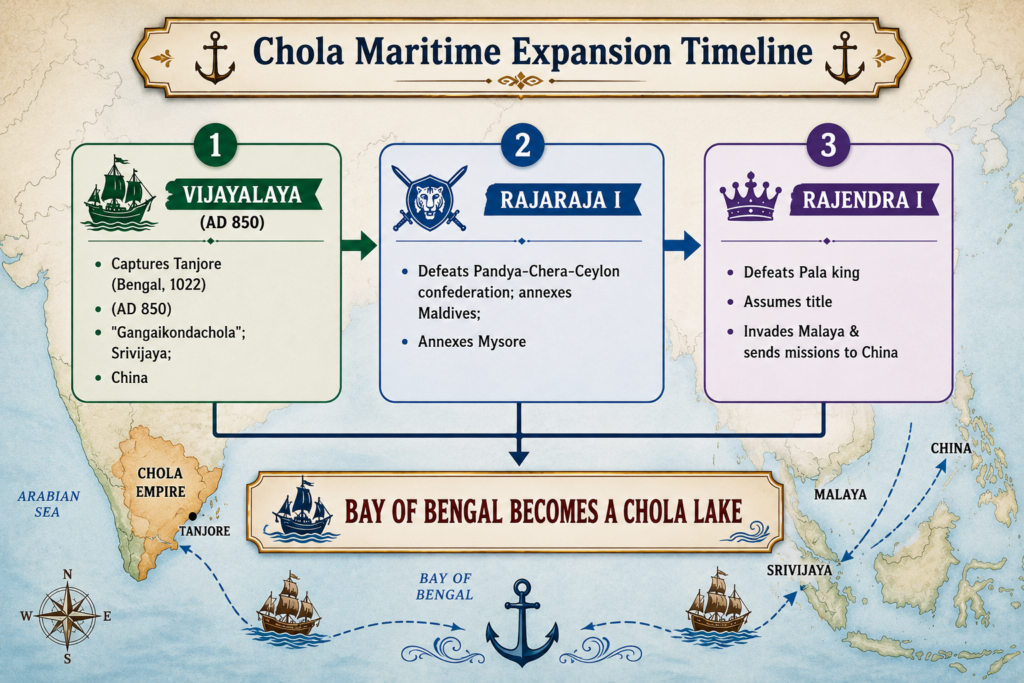
Chola maritime expansion timeline

Chola Administration

  • The Chola period witnessed the evolution of a strong and well-organised administrative system, operating at the central, provincial, and local levels.

Central Administration

  • The King was the pivotal figure in Chola administration, in whom all authority rested, though he was assisted by a council of ministers (Udankuttam).
  • The vast extent and resources of the empire enhanced royal power and prestige — reflected in grand capitals like Tanjore and Gangaikondacholapuram, elaborate royal courts, and generous grants to temples.
  • The Chola government was a hereditary monarchy generally following the rule of primogeniture; the king usually appointed his Yuvaraja (heir-apparent) during his own reign.
  • Kings undertook royal tours to improve administrative efficiency, supported by an elaborate bureaucracy of officials classed as perundanam (higher officials) and sirudanam (lower officials).

Revenue Administration

  • The land revenue department was well organised: all land was carefully surveyed and classified for the assessment of revenue, which was collected in cash or kind. Land was held by both individuals and communities, and under Rajaraja I, the state demanded one-third of the gross produce.
  • Besides land revenue, the state collected tolls and customs on goods in transit, various professional taxes, dues on ceremonial occasions such as marriages, and judicial fines; tax remissions were granted during periods of hardship.
  • The principal items of government expenditure were the king and his court, the army and navy, and public works such as roads, irrigation tanks, and canals.

Military Administration

  • The Cholas maintained a regular standing army comprising elephants, cavalry, infantry, and navy, with dedicated military cantonments (kadagams) for training troops.
  • The royal troops were known as the Kaikkolaperumpadai, within which a personal bodyguard corps called the Velaikkarar defended the king.
    • The Velaikkarars were the most trusted royal troops — they defended the monarch with their lives and were even prepared to immolate themselves on the king’s funeral pyre.
  • The naval achievements of the Tamils reached their climax under Chola rule, forming the backbone of their maritime expansion described above.

Provincial Administration

  • The empire was territorially divided into mandalams, each further divided into valanadus and nadus; each nadu contained a number of autonomous villages.
  • Mandalams were governed by royal princes or high officers, while perundaram (higher officials) and sirutaram (lower officials) administered subordinate levels, and were compensated through land assignments called jivitas, graded according to rank.
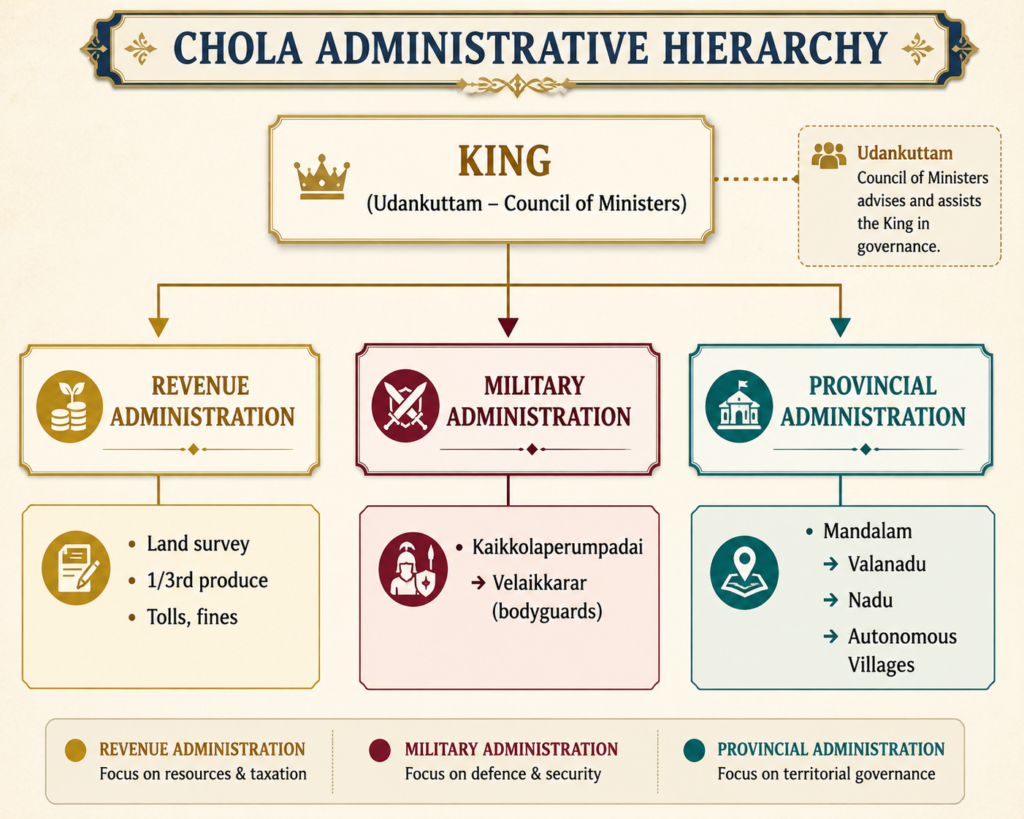
Chola administrative hierarchy

Local Self-Government under the Cholas

  • The system of village autonomy, expressed through assemblies (Sabhas, Urs, and Nagaram) and their functional committees (Variyams), developed over centuries and reached its fullest expression under Chola rule.
  • Two inscriptions from the reign of Parantaka I, found at Uttaramerur, provide the most detailed account of the formation and functioning of these village councils.
    • Dated around 920 CE, during the reign of Parantaka Chola (907–955 CE), this inscription is regarded as an outstanding document in Indian history — effectively a written constitution of a village assembly functioning 1,000 years ago.

Historical Background of Uttaramerur

  • Uttaramerur, located in the Kancheepuram district, was established around 750 CE by the Pallava king Nandivarman II, and was subsequently ruled in succession by the Pallavas, Cholas, Pandyas, Sambuvarayars, Vijayanagara Rayas, and Nayaks.
  • The village houses three important temples — the Sundara Varadaraja Perumal temple, the Subramanya temple, and the Kailasanatha temple — which together carry a large number of inscriptions, notably from the reigns of Raja Raja Chola (985–1014 CE), his son Rajendra Chola, and the Vijayanagar emperor Krishnadeva Raya, both of whom are known to have visited Uttaramerur.
  • Built on the canons of the agama texts, Uttaramerur’s layout places the village assembly mandapa at its centre, with all temples oriented in reference to it — a spatial arrangement reflecting the centrality of self-governance in village life.
  • While scholars believe village assemblies existed even before Parantaka Chola’s reign, it was during his reign that village administration was honed into a perfected system through elections — and Uttaramerur remains the only site where inscriptions on the assembly mandapa itself give complete details of how an elected village assembly actually functioned.

Functioning of the Village Assembly

  • The Uttaramerur inscriptions give astonishingly detailed information on: the constitution of wards, qualifications and disqualifications of candidates, the mode of election, the constitution and functions of committees, and the power to remove a wrongdoer.
  • The mandapa walls also record a wide range of secular transactions — administrative, judicial, commercial, agricultural, transportation, and irrigation matters — offering a vivid picture of efficient village governance in that era.
  • Villagers held the right to recall elected representatives who failed in their duties, and the entire village population, including infants, was required to be present at the mandapa during elections — only the sick and those on pilgrimage were exempted.
  • Standing committees managed specific functions — for the maintenance of irrigation tanks and roads, drought relief, and testing gold — with members chosen annually for bodies such as the Annual Committee, Garden Committee, Tank Committee, and Gold Committee.
    • These committees also supervised temple maintenance, agriculture, irrigation, tax collection, and road construction, and the Chola emperors generally respected the assemblies’ decisions.

Constitution of the Uttaramerur Assembly — Salient Features

  • The village was divided into 30 wards, with one representative elected per ward.

Qualifications for Candidature

  • A candidate had to own more than a quarter veli of tax-paying land and live in a house on his own site.
  • His age had to be between 35 and 70 years, and he was required to know the Mantrabrahmana — i.e., be capable of teaching it to others.
    • Even a person owning only one-eighth veli of land could qualify if he had learnt one Veda and one of the four bhashyas well enough to teach it.
  • Among those otherwise qualified, only individuals who were well-versed in business, virtuous, of honest earnings, and pure of mind, and who had not served on any committee in the preceding three years, could be chosen — making the essential criteria age, property ownership, and educational qualification.

Disqualifications

  • A person who had served on a committee but had not submitted his accounts, along with his close relatives (son, father, brother, son-in-law, father-in-law, uncle, sister-in-law, etc.), was barred from candidature.
  • Individuals guilty of incest or any of the first four of the five great sins, those who were foolhardy, had stolen another’s property, or had eaten forbidden food — even if later “purified” through expiatory ceremonies — were permanently disqualified for life.
  • A member who had already served on a committee could not contest again for the next three terms (each of one year), and those found guilty of bribery, misappropriation, or incest, or of acting against the public interest, were liable to disqualification.

Mode of Election (“Kudavolai” or Pot-Ticket System)

  • Names of eligible candidates from each of the 12 streets were written on separate tickets, packed ward-wise, and placed inside a common pot.
  • At a full meeting of the Great Assembly (attended by young and old members alike), all temple priests (Numbimar) present in the village were seated in the inner hall.
  • The eldest priest lifted the pot for all to see; a young boy, chosen at random and unaware of its contents, drew out one ward’s packet, which was then transferred to an empty pot and shaken before one ticket was drawn from it.
  • This ticket was handed to the arbitrator (madhyastha), who received it with open palm, read the name aloud, and had it re-confirmed by all priests present — the name thus announced stood elected. This process was repeated for each of the thirty wards.

Constitution, Duration, and Removal of Committees

  • Of the thirty elected members, those with prior experience on the Garden or Tank Committee, or those advanced in learning and age, were chosen for the Annual Committee; of the remainder, twelve formed the Garden Committee and six the Tank Committee.
  • All committee members held office for 360 days, after which they retired; if a member was found guilty of misconduct, he was removed immediately, and a fresh member was appointed through the pot-ticket process.
  • For the Pancavara and Gold Committees, thirty fresh tickets were drawn similarly, with twenty-four members allotted to the Gold Committee and six to the Pancavara Committee; wards already represented in a given year were excluded the following year, and individuals guilty of riding a donkey (a form of public humiliation-punishment) or forgery were rendered ineligible.
  • The accountant, chosen from arbitrators of honest earnings, could not be reappointed until he had submitted his accounts for the previous term and been certified honest by the “big committee.”
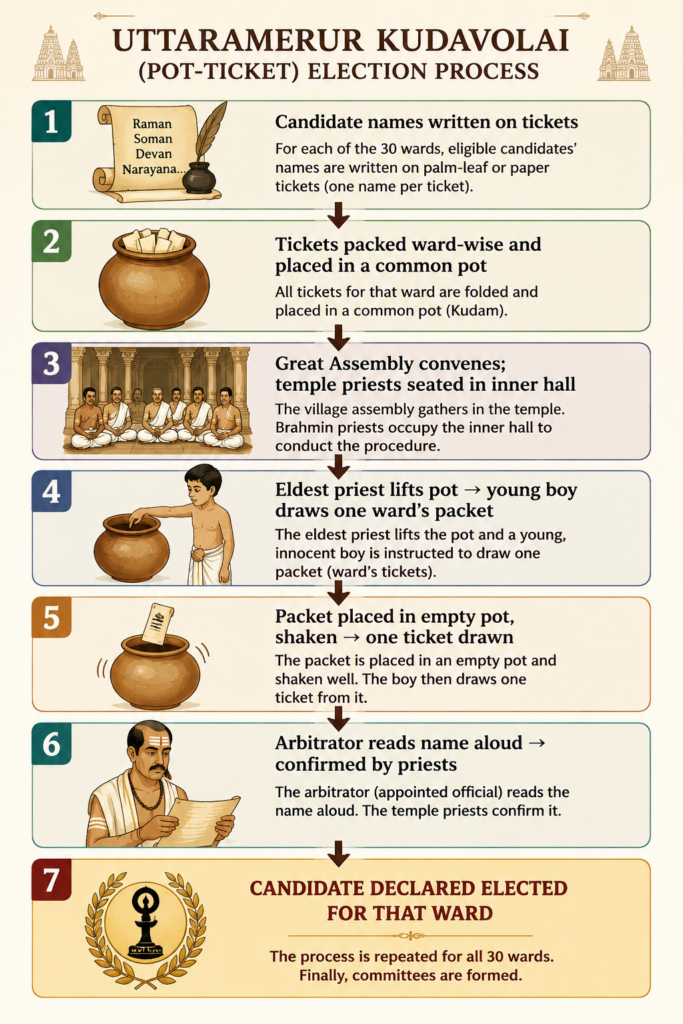
Assessing the “Democratic” Character of Chola Village Assemblies

  • Local self-government gave the population a genuine channel to air grievances and resolve local problems, strengthening the democratic character of village assemblies in certain respects.
  • However, the Chola polity remained an absolute monarchy, and several factors indicate that these assemblies fell short of democracy in the modern sense:
    • The central government, through its officers, exercised general supervision and could intervene in village affairs during emergencies; village assemblies had to function within the framework of central policy.
      • Uttaramerur inscriptions record that resolutions of the Sabha were passed in the presence of an official specially deputed by the king, while Tanjavur inscriptions show that Rajaraja I ordered the Sabha of Cholamandalam to perform services for the Brihadeshwara temple — evidence of close links between Brahmana Sabhas and the Chola court.
    • Candidates were selected through a lot system (Kudavolai) rather than direct voting, and no reference exists in actual practice to any quorum requirement or decision-making by vote.
    • Membership criteria differed by assembly type: the Ur (non-Brahmin village assembly) comprised tax-paying landowners, while membership of the Sabha (Brahmin assembly) was governed by property, family lineage, learning, and conduct. The Nagaram, a body of local traders, controlled market centres, levied cesses on shops, and organised commerce.
    • A significant section of the population — relatives of criminals, and those who had served on a committee within the past three years — stood debarred from contesting elections.
    • The availability of water largely determined which villages developed self-governing assemblies: villages in the central Kaveri river basin were kept under direct royal control, while those in drier, more distant regions enjoyed greater autonomy.
  • Taken together, these features suggest that while Chola village assemblies displayed genuine participatory practices, they cannot be equated with grassroots democracy in the modern sense, since royal oversight remained the final authority.

Adjustment between Central Authority and Local Self-Government

  • Each village assembly functioned autonomously under its own customary constitution, resolving local matters independently; disputes affecting more than one assembly were settled through mutual deliberation.
  • Important Brahmadeya villages were granted taniyur (“separate village”) status, giving them considerable functional autonomy as independent entities.
  • Local assemblies performed crucial administrative functions that eased the burden on the centre: the Nagaram regulated trade and markets on behalf of the monarchy, while the Ur, Sabha, and Nagaram collectively assessed and collected revenue before passing it on to the state.
  • By allowing the population to air grievances locally, this arrangement minimised popular opposition to the central government and strengthened the overall stability of the Chola state, even as the crown retained ultimate authority through supervisory intervention.

Village Economy under the Cholas

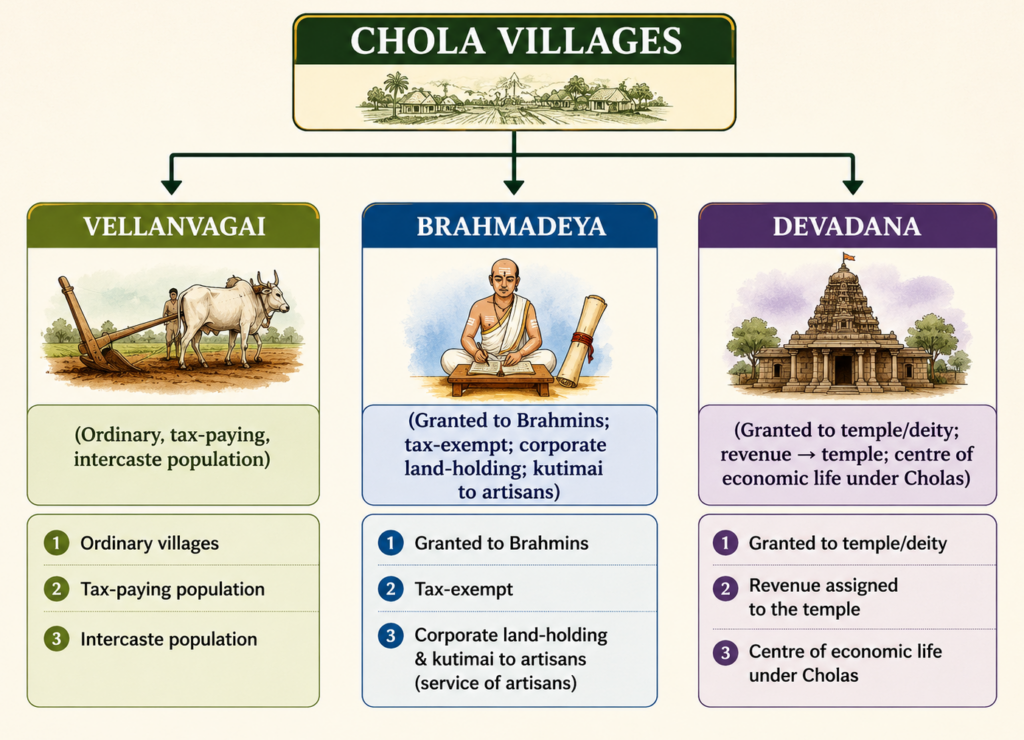
  • Chola villages were broadly of three types, each with a distinct social and economic character.

Vellanvagai (Ordinary Tax-Paying) Villages

  • This was the most common type of village, home to an intercaste population where land was held by people of all classes, who paid land revenue to the king.

Brahmadeya (Agrahara) Villages

  • These were villages granted to Brahmins, who were exempted from taxation and consequently prosperous; where land was held by a group of Brahmins, rights were enjoyed in common, with the Brahmins constituting a corporate body of landholders.
  • Since Brahmins themselves did not cultivate the land, they had it worked either by the existing agricultural communities of the region or by settling new cultivators — making Brahmins agents of deforestation and the extension of cultivation into previously uncultivated tracts.
  • They granted kutimai (subordinate land rights) to artisans and service-providers such as washermen, in exchange for guaranteed services.
  • In this way, the Brahmadeya became a settlement zone for both Brahmins and non-Brahmin cultivators/service-providers, functioning as a force of social and economic integration.

Devadana Villages

  • These were villages granted to a deity, with their revenues donated to a temple; under the Cholas, Devadana villages grew increasingly popular as temples became central to social and economic life.
  • A large number of temples, built with the patronage of Chola kings and queens, functioned as vibrant centres of economic activity throughout this period.
Economic Prosperity: Agriculture, Industry, and Trade

  • Agricultural prosperity was driven by the reclamation of forest lands and the construction and maintenance of irrigation tanks.
  • The weaving industry, especially silk-weaving at Kanchi, flourished, alongside metalwork, spurred by strong demand for temple images and utensils.
  • Commerce and trade were brisk, supported by trunk roads and merchant guilds, with gold, silver, and copper coins issued in various denominations.
  • Extensive commercial contacts existed between the Chola Empire and China, Sumatra, Java, and Arabia, with Arabian horses imported in large numbers to strengthen the Chola cavalry.

Chola Society

  • The caste system was firmly entrenched during the Chola period, with Brahmins and Kshatriyas enjoying special privileges; society was organised into hereditary, occupation-based social groups.
  • Brahmanas held a privileged position, combining religious authority with economic power: they were exempt from taxes, enjoyed royal patronage in landholding, and were entrusted with the learning and teaching of the Vedas and the performance of rituals — some serving as chief temple priests, while others engaged in trade. They also received lighter punishments for offences.
  • The near-total absence of Kshatriya institutions necessitated an alliance between sections of the Brahmanas and the dominant peasantry, the Nattar — with ordinary cultivators forming a subordinate client group under the nattars.
  • Rising general prosperity improved the economic standing of certain castes, leading to a broader social division into right-hand (Valangai) and left-hand (Idangai) groupings, into which newly assimilated castes from marginal tracts were often absorbed.
    • This division led to social conflict — most notably during the reign of Kulottunga I — which the Cholas were able to contain but never fully resolve; their strategy focused on suppressing conflict rather than improving social status.
  • The position of women did not improve during this period: the practice of sati persisted among royal families, and the Cholas institutionalised the Devadasi system in temples, ostensibly to nurture art, culture, and temple service.
    • This institution gradually lost its original purpose and was exploited in later ages, and is best understood as a failed social experiment of the Cholas.

Conclusion

  • The Cholas made significant and lasting contributions to administration, society, polity, art, and architecture, building one of the most elaborately organised states of early medieval India — from a professionalised central and provincial bureaucracy to a uniquely participatory system of local self-government exemplified by Uttaramerur.
  • Yet their record was mixed: social conflict intensified through the Valangai–Idangai divide, the condition of women did not improve, and institutional experiments such as the Devadasi system ultimately failed in their stated purpose.
  • For UPSC aspirants, the Chola model of administration, village economy, and society remains one of the richest case studies of statecraft, decentralisation, and social organisation in ancient and medieval Indian history.
Development of Chola power under Rajaraja I (985 -1014 CE)

  • Period of Rajaraja-1 constitutes the formative period of Chola imperialism. 
  • At the time of his accession, the Chola kingdom was a relatively small state, hardly recovering from the effects of the Rashtrakuta invasion. 
  • Under him it grew into a large empire and spread from Sri Lanka in the south to Kalinga in the north.
  • He efficiently organised and administered the empire and possessed a powerful standing army and navy. His major military conquests: 
    • Invasion of Kerala: 
      • His first great conquest was his invasion of Kerala, marching through the Pandya country. 
      • He destroyed the Chera navy. 
      • The cause of this invasion was the ill-treatment and imprisonment of Rajaraja’s envoy by the Chera ruler.
      • While marching towards Chera country the Pandya ruler (ally of Chera) opposed the army of Rajaraja. Rajaraja defeated the Pandya king and captured the port of Virinam. 
      • To commemorate these conquests, Rajaraja assumed the title Mummudi Chola, a title used by Tamil kings who ruled the three kingdoms of Cholas, Pandyas and Cheras. 
    • Coorg: 
      • After conquering the Chera country, Rajaraja invaded Coorg, defeated its ruler and converted it into a feudatory state. 
    • Gangavadi (Mysore): 
      • The next territory that was brought under Chola imperialism was Gangavadi then ruled by the Western Gangas which was annexed. 
    • Bellary (ruled by Nolamba Pallava): 
      • An army headed by Rajendra (son of Rajaraja) defeated the Nolamba Pallavas and deprive of their independence. 
    • Invasion of Ceylon: 
      • Rajaraja’s invasion and conquest of Ceylon was Rajaraia’s great venture. 
      • The Invasion of Ceylon was probably undertaken to re-establish Chola naval and military supremacy in Ceylon
      • Mahindra V was the ruler of ceylon at that time. 
      • Thiruvalangadu copper-plate inscriptions mention that Rajaraja’s army crossed the ocean by ships and destroyed Anuradhapura (capital of Sinhalas). 
      • Cholas made the city of Polonnaruwa as the capital and renamed it Jananathamangalam.
    • Influence over Vengi (Eastern Chalukya): 
      • Vengi kingdom was ruled by Bhima of the Eastern Chalukyas dynasty. 
      • Bhima was defeated by Raja Raja. 
      • Marriage relation brought about the union of the Chola Dynasty and the Eastern Chalukya Kingdom.
    • Conflict with Western Chalukyas: 
      • Rajaraja had captured provinces around Karnataka which were earlier feudatories of Rashtrakutas.
      • But the Rashtrakutas were defeated by the Western Chalukyas leading to direct conflict with Cholas.
      • Rajaraja subdued the Western Chalukyas. 
    • Maldives: 
      • Towards the close of his reign, the Maldives were also conquered. 
  • He continued the work of his father and further expanded his empire upto the banks of the river Ganga in North India and across the Indian ocean. 
  • His major conquests: 
    • Ceylon: 
      • Completed the conquest of the island begun by his father. 
      • Mahinda-V was taken prisoner and transported to the Chola country. 
    • Pandya and Kerala: 
      • Rajendra made a triumphal march through the Pandya and Kerala countries and appointed one of his sons as viceroy over both with the title Chola-Pandya. 
    • Western Chalukya and Kalinga: 
      • Jayasimha of Chalukya was defeated at Maski. The Tungabhadra was recognised as the boundary between the Chola and Chalukya kingdoms. 
      • The Chola army defeated Vijayaditya of Vengi, the rival of Rajaraja of Vengi and took possession of Vengi.
      • It then proceeded into Kalinga, as the ruler of Kalinga had sided with Jayasimha. After defeating him, It went still farther north for a grand military display in the form of an expedition to the Gangetic valley. 
    • Expedition to Ganges in North: 
      • The Chola army reached the Pala kingdom of Bengal where they defeated them. 
      • The Chola army also defeated other local rulers there. 
      • This expedition also resulted in the foundation of the Sena principality of Bengal (because South Indians settled in Bengal and Mithila) and the Karnataka dynasty of Mithila.
      • The expedition also led to the settlement of North Indian Saivas in Tamil country. 
    • Naval expedition to Kadaram and Sri Vijaya: 
    • The most famous venture of Rajendra was the naval expedition to Kadaram and Sri Vijaya (ruled by the Sailendra dynasty). 
    • Reason of these expeditions may be: 
      • an attempt on Sri Vijaya’s part to obstruct the Chola intercourse with China or 
      • it may be the result of Rajendra’s desire to win glory by extending his digvijaya to the countries across the sea. 
    • The expedition was a complete success. Kadaram and the capital Sri Vijaya were sacked and King was taken captive. 
    • The campaign apparently ended with the restoration of the kingdom to its ruler subject to his acknowledging Chola suzerainty. 
  • In this way, Rajaraja I and Rajendra I was able to establish and expand the Chola Empire not only in India but also beyond it. It also led to the spread of Indian culture in South-East Asia which is still present. 

Development of Chola power under Rajendra I 

  • He continued the work of his father and further expanded his empire upto the banks of the river Ganga in North India and across the Indian ocean. 
  • His major conquests: 
    • Ceylon: 
      • Completed the conquest of the island begun by his father. 
      • Mahinda-V was taken prisoner and transported to the Chola country. 
    • Pandya and Kerala: 
      • Rajendra made a triumphal march through the Pandya and Kerala countries and appointed one of his sons as viceroy over both with the title Chola-Pandya. 
    • Western Chalukya and Kalinga: 
      • Jayasimha of Chalukya was defeated at Maski. The Tungabhadra was recognised as the boundary between the Chola and Chalukya kingdoms. 
      • The Chola army defeated Vijayaditya of Vengi, the rival of Rajaraja of Vengi and took possession of Vengi.
      • It then proceeded into Kalinga, as the ruler of Kalinga had sided with Jayasimha. After defeating him, It went still farther north for a grand military display in the form of an expedition to the Gangetic valley.
    • Expedition to Ganges in North: 
      • The Chola army reached the Pala kingdom of Bengal where they defeated them. 
      • The Chola army also defeated other local rulers there. 
      • This expedition also resulted in the foundation of the Sena principality of Bengal (because South Indians settled in Bengal and Mithila) and the Karnataka dynasty of Mithila. 
      • The expedition also led to the settlement of North Indian Saivas in Tamil country. 
    • Naval expedition to Kadaram and Sri Vijaya: 
      • The most famous venture of Rajendra was the naval expedition to Kadaram and Sri Vijaya (ruled by the Sailendra dynasty). 
      • Reason of these expeditions may be: 
        • an attempt on Sri Vijaya’s part to obstruct the Chola intercourse with China or 
        • it may be the result of Rajendra’s desire to win glory by extending his digvijaya to the countries across the sea. 
      • The expedition was a complete success. Kadaram and the capital Sri Vijaya were sacked and King was taken captive. 
      • The campaign apparently ended with the restoration of the kingdom to its ruler subject to his acknowledging Chola suzerainty. 
  • In this way, Rajaraja I and Rajendra I was able to establish and expand the Chola Empire not only in India but alsobeyond it. It also led to the spread of Indian culture in South-East Asia which is still present.

Nadu: Represented a group of villages/clan settlements, which had evolved spontaneously in the rich alluvial river valleys, with no artificial boundaries. It was based on kinship ties, kin labour and communal control over land. It became a potential unit of agrarian and revenue organisation. 

Nararam: It was the market center for each Nadu. It is the place where exchange of the goods happened. It acted as meeting point for the people who were interested in exchange of goods. A nadu could have one or more nagarams. Urban growth of Chola period was related to the expansion of rural settlements, new agrarian order and their integration. There was gradual transformation towards urban forms and activities. In this the Brahmadeya, temples and royal center became focus and arose as nodal points. 

Role of nadu and nagaram in the growth of urbanisation under the Cholas 

  • The Nattar (administrative body of Nadu) accepted the royal order creating the Brahmadeya and Devadana and provided the necessary facilities to the new land controlled by Brahmanas and temples. These Brahmanas and temples were main points which contributed in urban development. Brahmadeya and the temple led to the extension of agricultural activities, and a more intensive organization of production supported the large populations in the brahmadeyas and temple centres. These clusters of settlements emerged as the foci of urban grown at the end of 9th century CE. The temple cities continued to dominate the urban landscape of south India. Urbanism was not merely in terms of economy and demography but also as a function of Chola imperialism and Bhakti ideology. 
  • Expanstion of agriculture and surplus production in Nadu facilitated commercialization. 
  • The Nagarams helped in breaking prevalent closed village economy and not only assisted in the exchange systemof the Nadu but also acted as a meeting point for inter Nadu exchange and inter regional exchange. It also enabled the movement of the goods in long distance trade carried on by itinerant trading organisations. There were gradual increase in such market centers and there merged a large trading network. 
  • Nagarams had a corporate body consisting of merchants and whose members were called nagarattar. Nagaram organization assumed the character of a local body maintaining local markets, supervising the flow of goods, and providing a regular link between nadus and itinerant traders, thus breaking the isolation of the nadu and its ties of kinship. The proliferation of nagarams kept pace with the expansion of the Chola power. During the middle Chola period, a change took place within the nagaram organization in the form of further diversification in trading activities because of specialization in marketing and trade. Thus emerged specialists like the Saliyanagaram and SattumParishattanagaram for trading in textiles; Sankarappadinagaram as suppliers of oil and ghee; Paraganagaram group representing seafaring merchants; and Vaniyanagaram as a large organization of oil- mongers. 
  • Many of Nagarams were located on the trade routes and distribution points intersecting with the itinerant trade of TisaiAyirattuAinnurruvar (Nanadesi, Valanjiyar and Ayyavole), Manigramam and Anjuvannam evolved into big urban centers. 

Though nadu and nagaram played a significant role in the growth of urbanisation, there were other factors whichcreated a suitable environment: 

  • During the reigns of Rajaraja 1 (985-1014) and Kulot-tunga 1 (1070-1118), Chola royal authority increased relatively to that of the local governing institutions of the nadu, and there were attempts to circumvent the political authority of the nadu and its agrarian elite. From Rajaraja’s reign revenue terms proliferate in the Chola inscriptions, suggesting an increased measure of intervention in nadu government. This helped in creating more favorable environment for urban growth. 
  • Trade was promoted by royal policy and conquest, the development of ports (e.g. Mamallapuram, Nagappattinam) and the stimulation of production centres and guild activity. The expedition to Srivijaya and Sri Lanka is also considered as part of this. There are evidence of long distance trade is marked by the presence of foreign agent (e.g. China at Nagappattinam) and royal functionaries interacting with each other. The exchange of embassies with china by the Chola rulers and the abolition of the tolls, building religious institutions like the Buddhist vihara at Nagapattinam were act of deliberate royal policy for promoting trade. 
  • The Chola period should not be seen as an undifferentiated unit. Itinerant merchant guilds trading with Southeast Asia and Sri Lanka are visible as early as the ninth century but only from the eleventh century are they drawn into a clearly articulated marketing system. 
  • Erivirapattanas or ‘chartered mercantile towns’ was a unique feature in the trade network. These towns were protected by armed mercenaries. Thus, encouraging trade and so urbanization. 
  • There is also Numismatic evidence which shows monetisation especially from 11th century. The chola issued coins of gold, silver and copper. 
  • There were many trading guilds which were main agent of urbanisation. e.g. TisaiAyirattuAinnurruvar (Nanadesi, Valanjiyar and Ayyavole), Manigramam and Anjuvannam
  • It was mostly temples, Brahmadeyas and royal center where urban centers evolved. Although earlier kings of south India had also built and patronized temples, the Cholas constructed a large number of new temples with elaborate architecture and also rebuilt some old temples in stone. Close connections developed between the political and religious domains exemplified by direct royal patronage to the construction of two distinctive Dravida-style temples in Thanjavur and Gangaikondacholapuram, as an act of royal policy in creating royal centre. 
    • Thus, under the Cholas, some of the bhakti centres became leading political, sacred or pilgrimage centres and further evolved into huge urban complexes, centered around a single large temple or with multiple temples together forming a part of such complexes. 
  • There were several royal centres which emerged during this time, the first being the city of Thanjavur, located on the southern bank of Vadarau on the south-western extremity of the Kaveri delta; the second, Gangaikondacolapuram which was situated at the northern edge of the Kaveri delta; and the third, Tanjai settlement which also developed into major royal and religious centre. 
    • Also, intentional attempts to establish new political and administrative centres, such as Thanjavur and Gangaikondacholapuram, due to their strategic location helped them to develop into urban centres. 
  • Another example urban development in the Chola period was evident in the twin cities of Kudamukku and Palaiyarai, located in the Chola heartland near the Kaveri delta. 
    • In this urban complex, trade and commercial activities played a major role, and the presence of religious institutions supported the urban process. 
    • There were several causes for the urbanization of Kudamukka. Its geographical location was such that it was located in the fertile delta region of the Kaveri where numerous peasant settlements rose and became the main source of income for the Cholas. This further helped in enhancing the links that Kudamukku established between the interior and coastal regions. It became an important point of convergence of all major routes which passed through the core region of the Chola kingdom. The Kaveri and its distributaries facilitated the safe transport of goods and people over shorter distances. 
    • Other dominant factor for the urban development of this region was the choice of Kudandai by the Sangam Cholas as their stronghold for guarding their treasure and of Palaiyarai as the residential capital by the imperial Cholas. A large number of articles, such as cloth (silk and cotton), gems and other luxury items, coconuts, fruits, flowers, betel, incense, oil and ghee, were traded in these centres. 
    • Further, Kudamukku was a major centre of betel and areca cultivation. Temples were the biggest consumers of such goods.

The nature of Chola state has been explained through several models like centralised state model, segmentary state model, feudal state model. 

The concept of ‘Segmentary State’ model was first developed by an anthropologist Aidan W. Southall to describe thepolitical organization of certain section of African society. The concept of segmentary state was first applied to politiesin South India of Chola and Vijayanagara by historian Burton Stein. 

Segmentary state model 

  • ‘Segmentary State’ is a form of political structure of a state, which is opposed to idea of centralised state with fixed territories, centralised administration and coercive power. 
  • Segmentary State lacks well defined territory and are characterised by numerous centres and domains. Each of these many centres has autonomous administrative authority, and some degree of political power. Each is also largely autonomous economically and though resources do flow between hierarchical levels of segmentary structure in the form of tax and tribute, such flows are often limited. 
  • The main difference between conventional and segmentary perspectives is based on the nature of local organisations, the degree of their autonomy and the extent of central control. 
  • Rather than political or economic, what moulds these segments together into a single state is an acknowledgement of a sovereign authority, particularly a sacred authority, of a single ritual centre and legitimate king. 

Applicability of segmentary state model for Chola state 

  • B. Stein pointed out that there was an inconsistency between the glorification (by nationalist historians) of Chola state as a strong, centralized, bureaucratised monarchy, and the simultaneous eulogy of strong local self governing institution. 
  • For Chola state, he emphasized on the concept of sacral kingship, segmentary state, peasant society and peasant state. And that it was not a bureaucratic state. 
  • Land revenue was extracted only from a limited area and states were dependent on looting expeditions for their sustenance. 
  • He also denied the existence of Chola standing army, arguing that military power was distributed among various groups including peasants, merchants and artisans. 
  • Under this system for Cholas, 
    • Nadus constitutes as segment of the kingdom, which had separate chief and had autonomous units. So, the entire state system characterised by many state segments. 
    • Nadus as homogeneous and cohesive units/ regions marked by lineage and kinship ties. 
    • Nadus as autonomous units characterised by chiefs and administrative apparatus. 
    • Three categories of Nadus: 
      • Central, 
      • Intermediary, 
      • Peripheral. 
    • Two kinds of sovereignty:
      • Political sovereignty (actual control) 
      • Ritual sovereignty (ideological influence) 
    • The central Nadus located in Kaveri delta region. It is known as prime centre. 
    • Chola political sovereignty in central Nadu and beyond it, ritual sovereignty became important.
    • Ritual sovereignty strengthened by: 
      • inscriptions, 
      • land grants, 
      • royal Saivite cult and 
      • constructing various images of the king/temple. 
  • Under this system is a negation of centralised state model characteristics by centralised mechanism like politico administrative units, centralised bureaucracy, revenue, military etc. 
  • Problems with segmentary model of B. Stein
    • This model constructed to explain tribal society in Africa. So it does not suit a highly stratified society, with trends of civilisation. This means it cannot be applicable to a civilised society. 
    • This model does not explain the political economy of Chola state, which created support base for large scale military campaign by rulers like Raja Raja Chola, Rajendra Chola. 
    • It creates a contradiction with the economic system of the time – like operation of regional, international guilds. 
      • Merchant guilds like Nanadesi, Anjuvanam, Manigranam etc. existed. These guilds are possible only if some sort of centralised system existed rather than small, autonomous units/segments as these guilds cannot operate freely in such small pockets. 
    • There was a gradual transformation of chiefs into high official from the period of Raja Raja Chola.
    • It is difficult to accept Chola kingship as purely sacral. 
    • The political sovereignty and ritual sovereignty are linked and Cholas enjoyed both i.e. actual and ideological influence also. 
    • Though war and loot was a part and parcel of politics of ancient and early medieval kingdom, but formation and persistence of empire such as Maurya, Gupta, Satavahana and Chola indicate that they were based on something more than sporadic looting expeditions. Some sort of administrative structure and revenue infrastructure did exist in that period. 
    • B. Stein confuses effective political or coercive power with centralized control. 
      • His views seem to represent as extreme reaction to the idea of centralized monarchy. 

Chola as a centralised State 

  • First presented by historian nationalist historian K.A. Neelkanth Shastri.
  • Under this model: 
    • Centralised state marked by autonomous assemblies at local level (unique mix). 
    • King as a supreme authority. 
    • Council of ministers (Udankuttam). 
    • Bureaucracy- represented by 2 cadres: 
      • Perundaram (high cadre) 
      • Sirundram (low cadre). 
    • Centralised military. 
    • Centralised revenue system. 
    • Jivitas- refer to land given to officials as salary. 
    • Landed magnets incorporated as state agents. 
    • Local chiefs- big/small- appear as state functionaries during the reign of Raja Raja Chola and onwards for a long time. 
    • Division of kingdom into politico-administrative unitsand in descending order, they were 
      • Mandalam 
      • Wala Nadu 
      • Nadu/ Kurram 
      • villages 
    • Reference of Taniyur- which was a big/ large village area created as separate revenue unit.
    • Within these centralised system, there existed autonomous assemblies at local level (Ur, Sabha, Nagaram). 
  • Criticism: 
    • Nationalist historians treated polity in isolation from society and economy. 
    • They were also influenced by imperialistic notions of the state and empire, centralised monarchies and powerful bureaucracies. 
    • Their assumptions were that all the known features of a modern state were prevalent in the earlier periods.
    • This narrative of centralised monarchy was tinged with nationalist fervour, and there was tendency to glorify the Chola state. 

Chola state as a feudal state 

  • Historian like Kesavan Veluthat, MGH Narayan and R.N Nandi described Chola state as a feudal state. (briefly mention nature of feudal state) 

Chola State as archaic state 

  • This model resembles the features of Asiatic mode of production, the marxist variant of oriental despotism.
  • A despotic state, absence of private property or little private property. 
  • Large scale slavery
  • Large scale irrigation network managed by state to appropriate large part of revenue. 
  • Rigid and oppressive collection of revenue. 

Balanced views 

  • As against these extreme views, the studies of the Chola state, based on analyses of the rich inscriptional data, provide other perspective: 
    • Research of Karashima indicates: 
      • several titles in Chola inscriptions refer to administrative offices and that Chola king made attempt to centralize their administration. 
    • Heitzman’s analysis of tax system and functional title of Chola inscription shows: 
      • Hierarchy of royal land revenue official. 
      • Chola kings issuing order aimed directing and reorganizing land taxation. 
      • Existence of corporate village organizations doesn’t indicate that peasants exercised political power at higher level. 
    • They show the development of a centralised polity from anearlier stage of independent peasant regions controlled by peasant assemblies. 
    • These peasant regions were integrated through various institutions and through the introduction of innovative administrative measures by a political authority. e.g.: The zenith of the Chola power was reached in the eleventh century, which also marked the crystallization of a centralised polity. 
  • As a whole Chola state should not be considered as homogeneous unit for the purpose of analysis. There were differences in the historical processes in the core area of Cholamandalam in Kaveri valley and those of other area such as Kerala, Karnataka and Andhra. 
  • In extensive imperial states, a highly centralised organisation is always non-existent and political structures entails diffused authority. This is norm in every case and not the exception for Chola. Hence, it cannot be fixed into any particular models of segmentary, feudal, archaic or centralised state.

History Optional Courses

guest
0 Comments
Oldest
Newest Most Voted