The downfall of the Gupta Empire in the mid-6th century CE fragmented North India into a number of small independent kingdoms, while the Huns established their supremacy over the Punjab and parts of central India. Out of this fragmented political landscape emerged the Vardhana dynasty of Thanesar, whose most celebrated ruler, Harshavardhana, briefly reunited large parts of Northern India and left behind one of the best-documented reigns in ancient Indian history. This article examines the rise of the Pushyabhuti/Vardhana dynasty, the reign and military campaigns of Harshavardhana, his administration and economy, his religious patronage, and the historiographical debates surrounding his legacy — a key topic for UPSC History Optional aspirants.
Background and Founding of the Vardhana Dynasty

- With the northern and western regions of India divided among a dozen or more feudatories, one of them — Prabhakaravardhana, ruler of Thanesar and a member of the Pushyabhuti family — gradually extended his control over the other feudatories, founding the Vardhana dynasty.
- The Pushyabhutis, who had their capital at Thanesar (Thanesvara in Kurukshetra, Haryana), became an important ruling family after the fall of the Guptas.
- The dynasty rose to prominence with the accession of Prabhakaravardhana, who defeated the Hunas and strengthened his position across Punjab and Haryana.
- Some scholars suggest that in their early days, the Pushyabhutis were probably feudatories of the Maukhari king of Kannauj.
- Prabhakara’s daughter Rajyashri married the Maukhari ruler Grahavarman, a marriage that significantly enhanced Prabhakara’s political status.
- He assumed the imperial title Parama-bhattaraka Maharajadhiraja — “the one to whom other kings bow because of his valour and affection.”
- Prabhakaravardhana had two sons, Rajyavardhana and Harshavardhana, and one daughter, Rajyashri.
- After his death, his elder son Rajyavardhana succeeded him.
Rajyavardhana and the Path to Harsha’s Accession
- According to the Harshacharita, after Prabhakaravardhana’s death, Devagupta, king of Malava, attacked Kannauj with the support of Shashanka, ruler of Gauda; Devagupta killed Grahavarman and captured Rajyashri.
- Bana does not name this king of Malava, but historians speculate that he belonged to the Later Gupta dynasty.
- Rajyavardhana, then king at Thanesar, could not accept this affront to his family and marched against Devagupta, defeating him — but he was treacherously killed by Shashanka, who had joined the battle as Devagupta’s ally.
- Harshavardhana then ascended the throne of both Thanesar and Kannauj in 606 CE, at just sixteen years of age.
- He rescued his sister Rajyashri just as she was about to commit sati, united the kingdoms of Kannauj and Thanesar, and shifted the capital to Kannauj.
- Shashanka continued to rule Gauda, facing frequent — and bravely resisted — attacks from Harsha.
- Shashanka was notorious for destroying the Buddhist stupas of Bengal and persecuting Buddhists.
- Major contemporary sources on his life include the copper plates of his rivals Harsha and Bhaskaravarman, the accounts of Banabhatta (Harshacharita) — a bard at Harsha’s court — and of the Chinese monk Xuanzang, along with coins minted during his reign.
Harshavardhana (606–647 CE): Overview
- Harsha ruled over the northern parts of India for 41 years, uniting the kingdoms of Thanesar (Kurukshetra) and Kannauj and transferring his capital to the latter.
- His reign is comparatively well documented, thanks to his court poet Bana, who wrote the Harshacharita — the first historical poetic work in Sanskrit — and the Chinese traveller Xuanzang (Hiuen Tsang), who described his travels in India in the Si-Yu-Ki.
Military Campaigns and Expansion
- Harsha waged many wars and brought the “Five Indies” — eastern Punjab (present-day Haryana), Kannauj, Bengal, Bihar, and Orissa — under his control.
- He conquered the Vallabhi king Dhruvasena of Gujarat and also conquered Ganjam, part of modern Orissa, while attempting, without success, to extend his rule into South India.
- Hiuen Tsang’s record, Banabhatta’s narrative, and Chalukya records all describe Harsha as “Lord of Northern India” or Sakalottarapatha-natha — sovereign of the entire uttarapatha.
- Hiuen Tsang’s account also calls Harsha the “Lord of Five Indias” — equivalent to Punjab, Kannauj (in Uttar Pradesh), Bihar, Bengal, and Orissa.
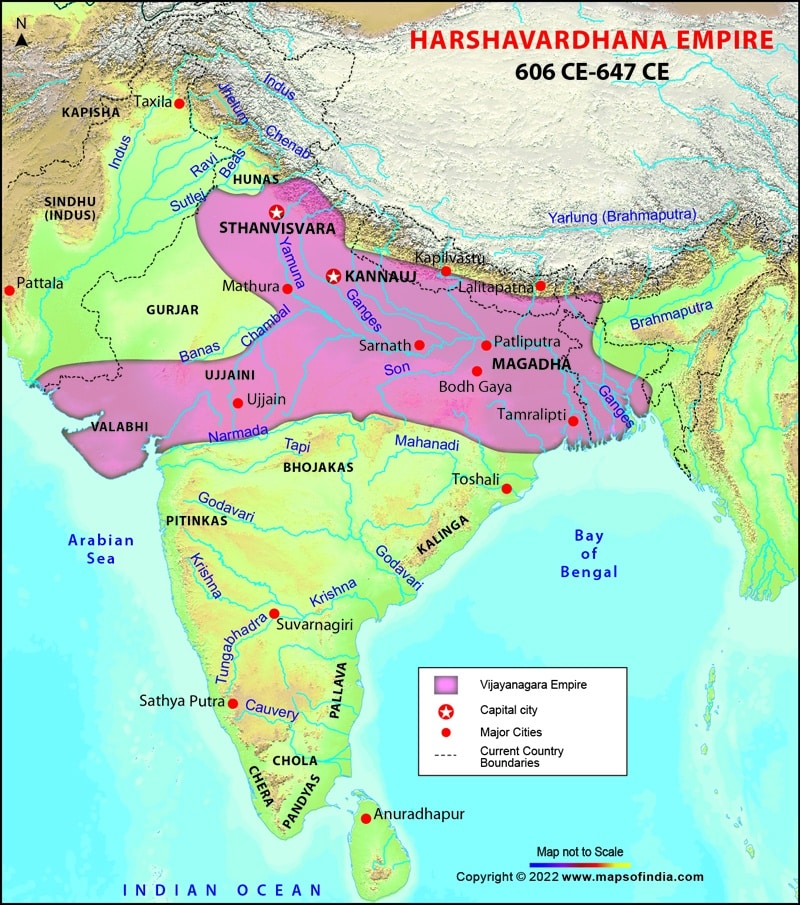
- Harsha was thus not the lord of the whole of North India: Kashmir, Western Punjab, Sindh, Gujarat, Rajputana, Nepal, Eastern and Northern Bengal, and Kamrupa (Assam) remained outside his sway — yet his empire stretching from Punjab to Orissa remains evidence of his military capability.
- Hiuen Tsang notes that India of that period had about seventy kingdoms.
- Harsha’s long run of victories was broken only when he was defeated by the South Indian emperor Pulakesin II of the Chalukya dynasty.
Extent of the Empire
- Between 606 and 612 CE, Harsha brought most of northern India (Punjab, Uttar Pradesh, Bengal, Bihar, and Orissa) under his control and assumed the title Siladitya.
- Hiuen Tsang claims Harsha conquered the entire country within the first six years of his reign, but this statement should not be taken at face value — Harsha neither occupied the whole of North India, nor were his wars limited to those first six years.
- Harsha’s Bengal campaign was initially unsuccessful, as evidence shows Shashanka continued to rule the greater part of Bengal and Orissa until 637 CE; it was only after Shashanka’s death that Harsha succeeded in this mission.
- Harsha also exercised influence over the kings of Jalandhar and, perhaps, Kashmir.
- In western India, his initially cordial relations with the rulers of Valabhi soured over the contested territory of Malwa, leading to conflict.
- This resulted in the defeat of the Valabhi ruler Dhruvasena II, who accepted the position of a feudatory vassal; hostilities eventually ended through a matrimonial alliance.
- Opinions differ on Harsha’s conquest of Nepal, though an era mentioned in a Nepalese inscription is taken by some to be the era of Harsha, suggesting he probably subdued it.
- Harsha was also successful in his eastern campaign — a Chinese account calls him “king of Magadha” in 641 CE.
- Bhaskaravarman, king of Kamarupa, was his subordinate ally who helped him gain control over Bengal and Orissa.
- He was also victorious against the ruler of Sindh in the northwest, while in the south, the Narmada formed the boundary beyond which Pulakesin II ruled.
- Dr K.M. Panikkar described Harsha’s empire as extending from Kamrupa in the east to Kashmir in the west, and from the Himalayas in the north to the Vindhyas in the south — a view strongly refuted by Dr R.C. Majumdar.
- Majumdar maintained that Harsha’s empire comprised only Eastern Punjab, Uttar Pradesh, Bihar, West Bengal, and Orissa, though his power was recognised by neighbouring states such as Vallabhi, Kutch, and Kamrupa.
- Kashmir, Western Punjab, Sindh, Rajputana, Nepal, and Kamrupa remained genuinely independent in his time; yet Harsha is still regarded as a powerful emperor who succeeded in providing unity to a large part of Northern India after the fall of the Guptas.
- In sum, Harsha’s empire covered most of Northern and Central India, with actual control exercised mainly in the Gangetic plain, while rulers in peripheral areas functioned as feudal vassals whose relations with Harsha depended on his empire’s political needs.
Was Harsha a Great Conqueror? A Historiographical Debate
- Banabhatta and Hiuen Tsang describe Harsha as one of the greatest rulers of Northern India, a view many modern historians have accepted, concluding that “Harsha was the last great empire-builder of the Hindu period, and his death marked the end of all successful attempts to restore the political unity of India.”
- Dr R.C. Majumdar, however, while recognising Harsha as a powerful ruler, disputes this framing:
- In the north, the empires of Lalitaditya in Kashmir, Yashovarman at Kannauj, and of Ganga and Karna of the Kalachuri dynasty were not smaller in territorial extent than Harsha’s empire, while those of the Pala and Pratihara dynasties were considerably more extensive and durable.
- In the south, the Rashtrakuta kings Dhruva and Govinda III, the Chalukya ruler Vikramaditya VI, and the Chola ruler Rajendra each established far more extensive empires than Harsha’s.
- Majumdar therefore argues it would be unjust to Indian history to accept Harsha as the last empire-builder of Hindu India.
- Majumdar nonetheless credits Harsha with many virtues, writing that although his reign does not “constitute a distinctive age or mark an epoch in Indian history,” he deserves praise and admiration “as a great ruler, a brave military leader, a patron of arts and letters, and a man of noble impulses and distinguished personality” — a view now widely accepted.
- Harsha as a statesman: Harsha possessed the qualities of a practical statesman, succeeding his brother at a moment when Thaneswar’s position was quite critical, hemmed in by hostile states in the northwest and west, while Devagupta of Malwa and Shashanka of Bengal had killed his brother-in-law and brother and occupied Kannauj.
- He pursued a bold and aggressive policy — entering a diplomatic alliance with Bhaskaravarman of Kamrupa, occupying Kannauj, and eventually securing Bihar, Orissa, and West Bengal.
- His conflict with the ruler of Vallabhi ultimately ended in a matrimonial alliance that strengthened his position in the north, though his effort to penetrate the Deccan was checked by Pulakesin II.
- Harsha thus succeeded in creating the most powerful and extensive empire of his age in Northern India, earning his place among its empire-builders.
- Harsha as a military commander: Despite this, Harsha was a capable commander rather than a military genius or great conqueror — he achieved little against Shashanka, was probably defeated by Pulakesin II, and secured the friendship of the Vallabhi ruler through a matrimonial bargain rather than outright victory.
- Nonetheless, he was respected by neighbouring rulers, friend and foe alike, none of whom dared attack his kingdom, preferring instead to befriend him.
- Harsha failed to provide the lasting unity and emotional integration needed to sustain a great and enduring empire, and his empire broke up soon after his death — his success was personal and short-lived, meaning he cannot be ranked among ancient India’s great emperors, even as he is rightly regarded as one of the great rulers of his own age.
Harsha’s Relations with Contemporary Rulers
Shashanka
- The Gauda king Shashanka and the Malava king Devagupta killed Grahavarman, the Maukhari king and Harsha’s brother-in-law, and captured Kannauj; Harsha’s elder brother Rajyavardhana died in the enemy camp.
- After rescuing his sister and Grahavarman’s widowed queen Rajyashri, Harsha was offered the throne by the Maukhari ministers, who had no successor of their own, and thus began ruling both the Pushyabhuti and Maukhari territories.
- He vowed revenge on Shashanka and invaded the eastern kingdoms that had refused him allegiance, though neither Banabhatta nor Xuanzang offer information on any actual conflict between the two.
- Xuanzang mentions that some years before 637–638 CE, Shashanka had cut down the Bodhi tree at Gaya — a sacred Buddhist symbol — an act only possible if he controlled the Gaya region at the time.
- Xuanzang also indicates that Harsha conquered northern, eastern, and southern Odisha by 643 CE, suggesting Harsha achieved no success in eastern India before Shashanka’s death around 637 CE.
Bhaskaravarman
- Bhaskaravarman, ruler of Kamarupa, maintained a friendly relationship with Harsha.
- The Harshacharita of Bana gives a detailed account of Bhaskaravarman’s envoy, Hangsavega, meeting Harsha; plying him with gifts and praise, the envoy secured an offensive and defensive alliance between the two kings, which helped Harsha against the combined forces of Gauda and East Malwa.
- The armies of Harsha and Bhaskaravarman attacked Bengal after Shashanka’s death and succeeded — East Bengal was occupied by Bhaskaravarman, and West Bengal by Harsha.
Valabhi and the Gurjaras
- The kingdom of Valabhi in Saurashtra was ruled by the Maitrakas, vassals of the Guptas; Harsha’s relationship with this dynasty was somewhat complicated.
- Inscriptions of the Gurjara kings of Broach claim to have protected the Valabhi ruler who was overpowered by Harsha, indicating a real conflict between Harshavardhana and Valabhi.
- The Latas (southern Gujarat), Malavas, and Gurjaras originally occupied a strategic position between the kingdoms of Harsha and Chalukya Pulakesin II, north and south of the Narmada respectively, and both rulers sought to bring these three under their control.
- Pulakesin II claims all three as his vassals in his Aihole inscription.
- Peace between Harsha and Valabhi was eventually settled via a matrimonial alliance: Dhruvasena II Baladitya of the Maitraka dynasty married Harsha’s daughter and became his ally.
- Scholars disagree on the terms of this settlement: Dr R.C. Majumdar holds that Harsha’s daughter went to the king of Valabhi and the hostilities ended amicably without Valabhi accepting Harsha’s suzerainty, while Dr D.C. Sarkar maintains that the king of Valabhi did have to recognise Harsha as his suzerain.
- Other scholars suggest Harsha did not fare well against Valabhi and therefore resorted to a matrimonial alliance — one that weaned Dhruvasena II away from Pulakesin’s influence, possibly contributing to the celebrated conflict between Harsha and Pulakesin II.
Pulakesin II
- The kingdoms of Harsha and Pulakesin II touched at the border of the Narmada river.
- In his Aihole inscription, Pulakesin claims that Harsha’s joy (harsha) “melted away through fear” when his elephants fell in battle.
- From Xuanzang’s account, it appears Harsha took the initiative but could not achieve success against Pulakesin.
- The successors of Pulakesin II claim he acquired the title Parameshvara by defeating sakalottarapathesvara (Harsha).
Sind, Kashmir, and Nepal
- Sind was hostile even to Prabhakaravardhana, and conflict continued into Harsha’s reign; Harsha is said to have been victorious against the ruler of Sindh, though this claim is doubtful.
- Dr Raychaudhuri suggests Harsha may have led a campaign against Sind, but Hiuen Tsang leaves no doubt that Sind remained a strong, independent kingdom even during his own visit there.
- Bana is also vague about the outcome, remarking only rhetorically that Harsha “pounded the King of Sindhu and appropriated his fortune.”
- Harsha impressed his might upon Kashmir owing to border disputes, establishing control such that its ruler sent him tributes.
- Opinions differ about Harsha’s conquest of Nepal, though an era mentioned in a Nepalese inscription is sometimes taken to correspond to Harsha’s era, suggesting he probably subdued it.
- However, the kingdoms of Sind, Kashmir, and Nepal remained ultimately independent of Harsha’s influence.
Diplomatic Relations with China
- Harsha maintained diplomatic relations with the Chinese Empire.
- A Brahmin envoy sent by Harsha to the Tang emperor Tai Tsung in 641 CE returned in 643 CE accompanied by a Chinese mission bearing a reply.
- These first diplomatic contacts were established through Xuanzang, who spent eight years in Harsha’s dominions.
- Harsha’s diplomatic outreach to China was probably meant as a counterweight to the friendship his southern rival Pulakesin II cultivated with the king of Persia, about which we are informed by the Arab historian Tabari.
Administrative Structure of Harsha’s Empire
- The administration of Harsha closely resembled that of the Gupta Empire.
Administrative Units
- Bhukti: The kingdom was divided into provinces or divisions called bhukti.
- Vishaya: Bhuktis were further divided into vishayas, corresponding to modern districts.
- Pathaka: A smaller territorial unit, roughly the size of a present-day taluk.
- Grama: The lowest unit of administration was the grama (village).
Nature of Harsha’s Rule
- Harsha’s administration was despotic in the sense typical of oriental despotism, where the sovereign is the centre of the state and the success of administration depends on his ability and benevolence.
- Theoretically, Harsha ruled as an autocrat, but in practice his rule was one of “enlightened despotism” — the ministers and village community held considerable power, serving as a check on royal autocracy.
- “People lived in peace and happiness. The king made charities to the poor.” Yet other evidence suggests Harsha’s administration, though efficient, was not as pervasive as that of the Mauryas or the Guptas.
Civil Administration
- According to Hiuen Tsang, Harsha divided his day into three periods — one for state affairs and two for religious work.
- His civil administration is highly praised: he personally supervised affairs rather than relying entirely on bureaucrats, constantly toured the provinces, and administered justice, giving equal attention to rural and urban areas.
- During these tours — conducted like a state procession with music and drums — he punished the guilty and made direct contact with the people, though he suspended his inspection work during the rainy season due to weather and communication difficulties, staying instead in temporary buildings.
- The people could interview the king and present grievances whenever he halted at any place.
- Hiuen Tsang notes that during Harsha’s reign there were very few criminals or rebels, and whoever broke the law was strictly punished.
- Principal modes of punishment included the mutilation of limbs, banishment into the jungles, and imprisonment; trial by ordeal was also practised.
Military Administration
- Harsha maintained a well-organised standing army, comprising elephants, camels, cavalry, and infantry, with cavalry and elephants having separate commanders.
- The head of the cavalry was called Brihadasvavaru.
- Hiuen Tsang states that Harsha had 60,000 elephants and a cavalry of one lakh, while Bana notes horses were purchased from places like Kamboja, Sindh, and Persia.
Ministers and Advisors
- Harsha was assisted by a council of ministers known as the Mantri-Parisad, who advised him on important affairs of state and foreign policy.
- The superior civil service was manned by Kumaramatyas, or “Cadet Ministers”; other officials mentioned in Banabhatta’s Harshacharita include the Mahasandhivigrahika (supreme minister for peace and war), Mahapratihara (head of the palace guards), Simhanda (commander-in-chief), Mahabaladhikrita (commander of the forces), Mahakshapatalike (chief accounts officer), Nyayakarnika (judicial officer), Bhandagaradhikrita (superintendent of stores), and Kayastha (scribe).
- According to Hiuen Tsang, Harsha was just in his administration and punctilious in the discharge of his duties.
- Society was not choked by grinding bureaucracy or heavy taxation; families were not registered, and individuals were not subject to forced labour.
- Most senior officers were remunerated with the income of particular areas of land rather than in cash, though lower-grade officers were paid in cash or land — reflecting an early trace of a jagirdari-like system of feudalism in Harsha’s administration.
Economy under Harsha
- The economy under Harsha’s reign became increasingly self-sufficient and feudal in nature as trade and commerce receded.
- This is reflected in the decline of trade centres, the paucity of coins, and the near-complete disappearance of trader and merchant guilds, though the economy of northern India initially prospered, with his capital at Kanauj becoming a great centre of trade.
- Diminishing trade affected handicrafts and other industries through want of demand, and indirectly affected agriculture, as the need to produce agricultural goods for external sale vanished — marking the rise of self-sufficient village economies increasingly dependent on agriculture.
Feudal Tendencies
- Scholars often take Harsha’s kingdom as a typical example when discussing Indian feudalism.
- A key insight comes from a set of copper plates dated to 632 CE, recording a land grant by a military officer in Harsha’s service to two Brahmins.
- Donations before Harsha’s reign had typically come from a royal prince or provincial governor; in these plates, the first dignitary named was a Mahasamanta, who ruled territory adjoining Kanauj, while the actual donor was a military servant of Kanauj, with the grant’s execution falling under Harsha’s accounts.
- This suggests that Mahasamantas were, in effect, semi-independent rulers with kingdoms near the core area of an overlord — here, Harsha — who paid tribute and provided military assistance to him.
- Though they may have obtained territories through inheritance or conquest, some served the king and received land grants to support their official duties, a process resembling the distribution of feudal grants in Europe.
Finance
- The main source of state income was land revenue, set at one-sixth of agricultural produce; other taxes existed but were light, and the state’s demands were generally modest.
- The state’s income was spent under four broad categories: the expenses of the state and ceremonial worship; the advancement of ministers; rewarding the clever, the learned, and the talented; and acquiring religious merit through spending on heretics.
Harsha’s Coins
- A gold coin attributed to Harsha bears the legend “Harshadeva” along with the figure of a horseman.
- Harsha is called Harshadeva not only in inscriptions but also in Bana’s Harshacharita.
- About 284 silver coins bearing the name “Sri Siladitya” have been discovered.
Harsha as a Patron of Scholars
- Harsha is credited with composing three Sanskrit dramas — Ratnavali, Priyadarsika, and Nagananda.
- He is also credited with two poems on Buddhist themes — the Ashtamahasricaityastotra (“Praise to Eight Grand Chaityas”) and the Suprabhatastotra (“Laud to Morning”) — as well as a tract on grammatical gender, the Linganusasanam.
- Harsha’s authorship of these works has been disputed at times, though no decisive contrary arguments have been established.
- His court hosted the celebrated literary figure Bana, who wrote the Kadambari and Harshacharita.
- Bana’s brother-in-law, Mayura, was a celebrated poet whose works included the Surya Sataka, Arya Muktamala, and Mayurastaka; other scholars such as Haridatta and Jayasena also enjoyed his patronage.
- Bana mentions more than once that a group of skilled painters painted auspicious scenes, though the iconoclastic zeal of the early Muslim invaders left no trace of these paintings, nor of the monuments Harsha erected.
Religion under Harsha
- Prabhakaravardhana was a devotee of the Sun and reportedly offered daily a bunch of red lotuses in a ruby bowl, while Rajyavardhana was a Buddhist.
- Harsha himself was a devotee of Shiva, Surya, and Buddha, and is said to have erected costly temples in service of all three.
- Harsha’s conversion to Buddhism is attributed by Bana to the influence of the Buddhist ascetic Divakaramitra, who lived in a hermitage in the Vindhya forests.
- It was, however, the Chinese pilgrim Xuanzang who definitively established Harsha’s and his sister’s faith in Mahayana Buddhism, through his discourse on its doctrines and exposure of the perceived deficiencies of Hinayana, at their very first meeting.
- According to Xuanzang, who visited his kingdom in 636 CE, Harsha built numerous stupas in the Buddha’s name.
- His religious approach is evident in his play Nagananda, whose theme is based on the Jataka tale of the Bodhisattva Jimutavahana, but into which Harsha introduces the goddess Gauri as Jimutavahana’s saviour — a feature absent from the original Jataka.
- Harsha’s enthusiasm for his new faith led him to organise a grand assembly at Kanauj to publicise Xuanzang’s masterly treatise on Mahayana Buddhism and establish its supremacy over rival creeds.
- Harsha is said to have prohibited animal slaughter and meat-eating even more rigorously than Ashoka.
- At Nalanda, he erected a bronze temple 100 feet high, and built rest houses and hospitals along the highways.
The Kanauj Assembly
- In 643 CE, Harsha summoned a great assembly at Kanauj to take advantage of Xuanzang’s presence and spread Buddha’s teachings across the country.
- A large number of kings attended, along with 3,000 Mahayana and Hinayana Buddhist monks, 3,000 Brahmanas and Nigrodhas, and about 1,000 Buddhist scholars from Nalanda University.
- The meeting was presided over by Xuanzang, focused on Mahayana Buddhism, and lasted 23 days.
- A monastery and shrine were erected on the banks of the Ganga, and a golden image of the Buddha was placed in a 100-foot tower; a smaller image, three feet high, was carried daily in a procession joined by 20 Rajas and 300 elephants, with Harsha personally washing and carrying the image.
- At the assembly’s conclusion, Harsha offered Xuanzang gold, silver, jewels, and other valuables in recognition of his scholarship, which Xuanzang refused to accept.
- Harsha then placed Xuanzang on an elephant and led him through a procession proclaiming that he had established the standard of Mahayana doctrine over all opposing ones.
The Prayag Assembly
- After the Kanauj assembly, Harsha, accompanied by Xuanzang, proceeded to Prayag (Allahabad), at the confluence of the Ganga, Yamuna, and Saraswati, where he customarily celebrated a solemn religious festival every five years (Kumbha Mela) — this being the sixth such occasion of his reign.
- Harsha summoned his tributary kings, including the king of Vallabhi and Bhaskaravarman of Assam, along with followers of different sects — Shramanas, Nirgranthas, the poor, orphans, and the needy.
- On the first day, the image of the Buddha was installed in a thatched building, followed by the distribution of precious articles and fine clothing.
- On the second day, the image of Aditya (the Sun god) was installed, with charity distributed at half the previous day’s amount.
- On the third day, the image of Shiva was installed, followed by similar distributions of charity and gifts.
- This assembly lasted for three months.
Society during the Time of Harsha
- The Chinese traveller Hiuen Tsang, who visited India during Harsha’s rule, left valuable accounts of contemporary society.
- According to him, the people were known for their honesty, courage, and love of learning, and were neither deceitful nor treacherous, remaining faithful to their oaths and promises.
- They maintained careful personal hygiene — cleaning their floors with cow-dung and strewing them with seasonal flowers, bathing daily, and applying scented unguents such as sandal and saffron.
- They washed their hands before meals, and leftover food was not served again.
The Nalanda University
- Students came to India to study at institutions such as Nalanda not only from China but also from Mongolia, Korea, Japan, Java, Tibet, and Ceylon, among other countries.
- Nalanda was an institute of higher, post-graduate-level learning, where education was not confined to religious subjects or tied to a single sect — Hindu and Buddhist literature in all its branches, along with logic, grammar, medicine, Samkhya philosophy, and occult science, were studied.
- The university campus contained many multi-storeyed halls and buildings, housing about 8,500 students and 1,500 teachers, all provided with free education, food, and lodging.
- The working day was eight hours, with nearly a hundred lectures delivered daily by numerous teachers, the most renowned including Dharmapala (Kulapati of Nalanda when Xuanzang was a student there), Arya Deva, Chandrakirti, Chandragomin, Gunamati, Prabhamitra, Buddhakirti, Jinamitra, and Sumatisena.
- Admission required passing a tough entrance examination, cleared by only about 20 percent of applicants.
- The university housed a large library comprising three buildings — Ratna-Sagar, Ratnadadhi, and Ratna Ranjaka.
- The Chinese traveller Yijing notes revenues drawn from 200 villages, compared with 100 in Xuanzang’s time.
- Towards the end of the 12th century, Muslim invaders set fire to the university’s buildings, burnt its valuable library, and killed its monks, teachers, and students, bringing the glorious career of this world-famous university to an end.
- The Afghan military chief Bakhtiyar Khilji was responsible for destroying the great universities at Nalanda, Vikramsila, and Odantapuri.
Harsha’s Personality: Comparisons with Ashoka and Samudragupta
- Harsha took up the reins of his kingdom at a very young age and built a fairly large empire, displaying a multi-dimensional personality — a good administrator known equally for his political shrewdness, as seen in his securing the ruler of Vallabhi as a permanent ally through his daughter’s marriage.
- Similarly, although Shashanka of Gauda was responsible for his brother Rajyavardhana’s death, Harsha did not rush into conflict with him, given the precarious circumstances of his own accession following the deaths of his father, mother, brother, and brother-in-law.
- Because of his administrative ideas and military achievements, historians such as Dr R.K. Mookerjee have argued that, as a conqueror and administrator solicitous of his subjects’ welfare, Harsha combined the piety of Ashoka and the valour of Samudragupta — both rulers having brought most of North India under their control and reduced distant rulers to the status of feudal vassals.
The Piety of Ashoka
- Hiuen Tsang describes Harsha as having conquered the entire country within the first six years of his reign, ruling peacefully for the next thirty years without raising arms — paralleling Ashoka, who engaged in military activity chiefly in the early part of his reign and renounced war after the Kalinga War.
- Like Ashoka, Harsha patronised Buddhism, and both rulers are said to have converted to it and adopted its ideals.
- Xuanzang states Harsha banned animal slaughter for food, just as Ashoka’s Major Rock Edict I prohibited animal slaughter and banned festive gatherings involving the killing of animals.
- Xuanzang further states that Harsha erected several thousand stupas along the banks of the Ganga and built well-maintained hospices for travellers and the poor on highways across India, paralleling Ashoka’s construction of 84,000 stupas and several viharas for travelling monks.
- Both rulers organised major religious assemblies: the Third Buddhist Council was held around 250 BCE at Pataliputra under Ashoka’s patronage and the presidency of Moggaliputta Tissa, while Harsha organised two major assemblies at Kanauj and Prayag under the presidency of Xuanzang.
- Both kings were known for their generosity, donating to different religious orders, and although converted to Buddhism, both remained tolerant of other religions.
- Both regarded the welfare of their subjects as their foremost duty, constantly touring their empires (barring the rainy season) to observe conditions firsthand, and were known for their benevolent nature — as Kautilya put it, “In the happiness of his subjects lies the king’s happiness, in their welfare lies his welfare,” while Xuanzang observed that “Harsha even forgets to take meals or sleep for doing public welfare activities.”
- Like Ashoka, Harsha maintained friendly relations with some neighbours — Bhaskaravarman of Kamrupa and the ruler of Jalandhar — much as Ashoka maintained friendly relations with the Cholas, Pandyas, Satyaputras, and Keralaputras of the south.
- Both rulers also maintained diplomatic relations with foreign powers — Ashoka sending envoys to Greek rulers and Ceylon, and Harsha sending an envoy to the Chinese ruler.
- However, some historians, such as K.M. Panikkar, argue there is no similarity between the two rulers beyond the most superficial kind, noting that Harsha was a military monarch for much of his reign.
- There is evidence that Harsha remained involved in war even in the later part of his reign — for instance, control over Bengal was gained only after Shashanka’s death in 637 CE.
- Xuanzang’s claims about Harsha’s monasteries and stupas are not archaeologically proven, and Ashoka’s concept of righteous conquest (dhammavijaya) finds no parallel under Harsha.
The Valour of Samudragupta
- Like Samudragupta, Harsha is known for his military conquests, having waged many wars and pursued a policy of expansion and aggression to establish a vast empire.
- Harsha attempted to revive Samudragupta’s imperial legacy and sought to unite Northern and Southern India under one rule — in vain, as events proved.
- The Allahabad Pillar inscription documents Samudragupta’s conquests and qualities, much as Banabhatta and Xuanzang document Harsha’s.
- This comparison, however, has been questioned by many scholars:
- Harsha’s ascension to the thrones of both Thanesar and Kannauj placed him in a privileged position for empire-building from the outset, yet he remained a capable commander rather than a military genius, achieving little against Shashanka, likely losing to Pulakesin II, and securing Vallabhi’s friendship through marriage rather than conquest — whereas Samudragupta achieved military success even in southern India.
- Harsha’s success was personal and short-lived, while Samudragupta created an enduring empire that lasted more than 150 years.
- Historians such as Dr R.C. Majumdar have therefore questioned this comparison; though viewing Harsha as a combination of Ashoka’s piety and Samudragupta’s valour is debatable, he was undoubtedly an enlightened monarch deserving to be counted among India’s great rulers of his time.
Was Harsha the Last Hindu Emperor?
- Harsha is often considered the last Hindu emperor of Northern India, though it can be argued that he was neither a follower of Hinduism alone, nor truly an “emperor,” since he ruled only part of North India and gave patronage to other religions as well.
- Harsha was the last in a long line of Hindu rulers who worked to build and organise a powerful state for the progress of humanity, though it would be incorrect to think he made the last attempt at India’s political unity — several empires rose and fell after his death.
- His contribution cannot be underestimated, as it was he who turned the small kingdom of Thaneswar into a major power in Indian history; he was equally a great scholar and a great administrator.
- His two admirers, Banabhatta and Hiuen Tsang, spoke very highly of him, and it is only natural that they may have painted him with some exaggeration.
- Ancient Indian education and literature flourished during Harsha’s rule, and Harsha distinguished himself equally in the arts of peace and war.
- He was himself a good author, with his three Sanskrit plays — Nagananda, Ratnavali, and Priyadarshika — exhibiting his literary skill; he put into verse the story of the Bodhisattva Jimutavahana, and the poet Jayadeva also praised him as a poet.
- From Hiuen Tsang, we learn that Harsha spent one-fourth of his revenue on patronising scholars, and he was patron of the University of Nalanda, the greatest centre of Buddhist learning of the time.
- His literary circle included Banabhatta (author of Kadambari and Harshacharita), along with Mayura, Divakara, Jayasena, and the Chinese scholar Hiuen Tsang himself.
- He was famous for his religious catholicity, benevolence, and charity: at the royal lodge, daily rations were provided for 1,000 Buddhist monks and 500 Brahmanas.
- Even allowing for some exaggeration in the accounts of Banabhatta and Hiuen Tsang, the impact and contribution of Harshavardhana to early Indian history cannot be underrated.
Aftermath
- Harsha died in 647 CE, having ruled for 41 years; his empire disintegrated rapidly into small states with his death.
- In 648 CE, the Chinese emperor Taizong of the Tang dynasty sent Wang Xuance to India in response to Harsha’s earlier embassy to China.
- Upon arrival, Wang discovered Harsha had died and that the new king — Arunashwa, Harsha’s minister, who had usurped the throne — attacked him and his 30 mounted subordinates.
- This led Wang Xuance to flee to Tibet, raise an army of Nepalese mounted infantry and Tibetan infantry, and launch an attack on the Indian state.
- The success of this attack won Wang the prestigious title of “Grand Master for the Closing Court,” and he also secured a reported Buddhist relic for China.
- Chinese historical texts tend to overstate Wang’s influence in ending the Harsha empire — neither Bana’s nor Xuanzang’s accounts give any details of this later period.
Conclusion
Harshavardhana’s reign marks a significant, if transitional, chapter in ancient Indian history — one in which a young ruler from the small kingdom of Thanesar built one of the most extensively documented empires of his time, patronised Buddhist learning and Sanskrit literature, and briefly restored a measure of political unity to Northern India after the fall of the Guptas. Yet, as historians such as Dr R.C. Majumdar remind us, his achievements must be weighed carefully against those of later dynasties, and his empire’s rapid disintegration after his death underscores the personal, rather than institutional, nature of his success — making the Vardhana dynasty and Harsha’s reign an essential and richly debated topic for UPSC History Optional preparation.