Colonisation and Decolonisation of Vietnam: Introduction

Vietnam’s path from French colony to unified, independent, communist state was one of the longest and bloodiest decolonisation struggles of the twentieth century, spanning nearly three decades of near-continuous conflict from the end of the Second World War to 1975.
Part of French Indochina — alongside Laos and Cambodia — Vietnam’s freedom struggle unfolded in two distinct phases: first, the Franco-Vietminh War (1946–54), in which the Vietnamese fought for and won independence from France, and second, the far bloodier Vietnam War (1954–75), in which the United States intervened to check the spread of communism, only to withdraw in eventual defeat.
At the centre of this story stands Ho Chi Minh, whose life’s mission — from a young petitioner at Versailles in 1919 to the founder of the Democratic Republic of Vietnam — came to embody the nation’s struggle for unification and independence.
Part I: The Background to Vietnam’s Struggle for Independence
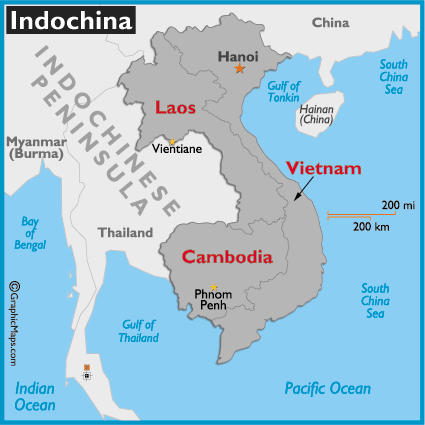
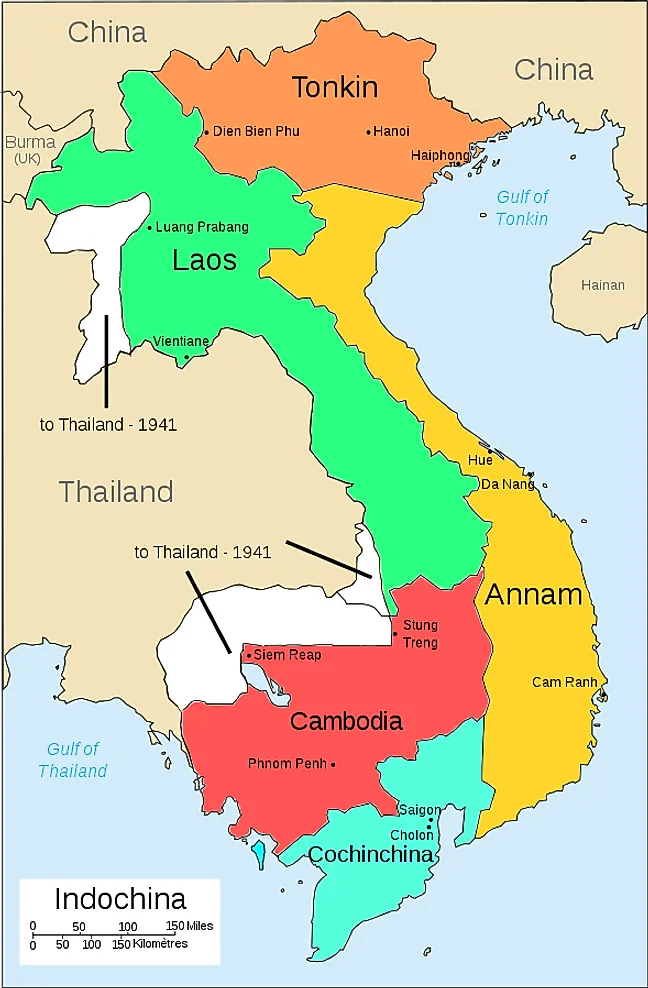
French Indochina and the Colonial Legacy
- Indochina, comprising three areas — Vietnam, Laos and Cambodia — was part of the French Empire in South East Asia, and became the scene of almost non-stop conflict from the end of the Second World War.
- The French colonial system severely limited political freedom, since colonialism’s initial aim was to assimilate the colonies’ cultural, political and social spheres with the “motherland” — effectively terminating Indochina’s right to self-determination.
- Together with Laos and Cambodia, Vietnam formed part of the French Empire’s Indochinese Union, established in 1887.
- In many respects, the French were competent colonial administrators — they built roads, railways, schools, hospitals, and even a university in Hanoi. Yet there was very little industrialisation, and most of the population remained poor peasants.
- During the 1930s, protest movements began to emerge but were consistently suppressed by the French authorities — repression that, rather than extinguishing nationalist sentiment, only fuelled a rush of support for the newly formed Vietnamese Communist Party, established by Ho Chi Minh in 1929.
The Rise of Ho Chi Minh and Vietnamese Communism
- Ho Chi Minh had spent time in France, China and the USSR. Always a committed nationalist, he became a committed communist as well after his travels abroad — his dream was a united Vietnam under Communist rule. Through the 1930s, however, there seemed little hope of breaking free from French control.
World War II: Japanese Occupation and the Rise of the Vietminh
- The French defeat in Europe in June 1940 raised hopes of Vietnamese independence, but these were soon dashed as Japanese forces moved into Indochina.
- When nationalists and communists launched a full-scale uprising in southern Vietnam, the French — now under orders from the Vichy government, and therefore technically on the same side as Germany and Japan — worked together with the Japanese to brutally crush the rising.
- With the communist movement nearly wiped out in the South, Ho Chi Minh moved north and organised the communist-nationalist resistance movement, the League for the Independence of Vietnam, known as the “Vietminh.”
- The Vietminh were forced to bide their time until the tide turned against Japan. In the summer of 1945, with Japanese defeat imminent, Ho Chi Minh prepared to seize the initiative before the French could return.
- Vietminh forces and supporters took over Hanoi, Saigon (later renamed Ho Chi Minh City) and most of the country’s large towns, and in September 1945, the Democratic Republic of Vietnam was proclaimed, with Ho Chi Minh as president.
A Premature Declaration and the Restoration of French Control
- Unfortunately, this declaration proved premature.
- The Allies had already agreed that, once the war ended, the southern half of Vietnam would come under British and French administration. Once British forces moved in, it was decided that French control should be restored as quickly as possible.
- In an extraordinary turn, the British used Japanese troops — still present in Vietnam after their government’s surrender, and not yet disarmed — to suppress the Vietminh in the south, anxious not to see their ally deprived of its colonies for fear this might encourage a broader trend towards decolonisation, one that could ultimately cost Britain its own empire.
- By the end of the year, order had been restored, and some 50,000 French troops had arrived to take control.
- At this point, before the Cold War had fully developed, the Americans were appalled by what had happened, having promised to liberate the peoples of Indochina.
- As historian J. A. S. Grenville observed: “This was one of the most extraordinary episodes of the post-war period. If the south had been permitted to follow the north and the independence of the whole of Indo-China had been accepted by the British, the trauma of the longest war in Asia, which led to at least 2.5 million deaths and untold misery, might have been avoided.”
The Breakdown of Compromise
- At first, the French appeared willing to compromise, controlling the south while recognising the independence of the Vietnamese Republic in the north — provided it remained within the French Union.
- By the summer of 1946, however, it became increasingly clear that France had no intention of granting the north genuine independence.
- Ho Chi Minh therefore demanded complete independence for the whole of Vietnam. The French rejected this, and hostilities began when they shelled the northern port of Haiphong, killing thousands of Vietnamese civilians.
Part II: Three Decades of War (1946–1975)
- Vietnam endured three decades of war between 1946 and 1975, unfolding in two broad phases.
- In the first phase, the peoples of Indochina fought for, and won, their independence from France.
- The second phase (1961–75) began with civil war in South Vietnam; the USA intervened to check the further spread of communism, but eventually had to admit failure.
First Phase: The Struggle Against France (1946–54)
- From 1946 until 1954, the Vietnamese fought for independence from France.
- Indochina had been occupied by Japan during the Second World War, but French colonial administration persisted throughout, since Japan was content with indirect rule, maintaining a military presence while leaving French administrators in place — though Governor-General Admiral Decoux was compelled to hire more Vietnamese officials as anti-French sentiment grew.
- Resistance to both the Japanese and the French was organised by the League for Vietnamese Independence (Vietminh), led by the communist Ho Chi Minh, who had spent years in Russia learning the organisation of revolutions.
- Though led by communists, the Vietminh was, in practice, an alliance of all shades of political opinion united in wanting an end to foreign control.
- At the end of the war in 1945, Ho Chi Minh declared the whole of Vietnam independent — but since the French had no intention of leaving, the first phase of open conflict began in 1946, launching an eight-year struggle that ended with the French defeat at Dien Bien Phu (May 1954).
- The USA, worried about the prospect of communists coming to power in Vietnam, treated the struggle as part of the wider Cold War against communism and extended aid to the French — who were nonetheless badly defeated, for several reasons.
- The guerrilla tactics employed by the Vietnamese.
- Huge public support for the Vietminh.
- French forces, weakened by the effects of the World War, were unable to send adequate reinforcements.
- The communist governments of China and Russia provided support to the Vietnamese.
- Following the French defeat, the Americans were nonetheless determined to take France’s place in order to prevent the spread of communism across South East Asia.
The Geneva Agreement (1954)
- Under the Geneva Agreement of 1954:
- Laos and Cambodia were to become independent.
- Vietnam was temporarily divided into two states at the 17th parallel.
- The Ho Chi Minh government was recognised in North Vietnam.
- South Vietnam was to have a separate government for the time being, but nationwide elections were to be held by 1956, after which the country would be reunified.
- In the interim, the area south of the 17th parallel would be overseen by an international commission of Canadians, Poles and Indians, tasked with organising the promised July 1956 elections, after which Vietnam would be reunited.
- Ho Chi Minh was disappointed by the partition but confident that the communists would win the promised election. The election, however, was never held, and a civil war developed in South Vietnam that would eventually draw in the North and the United States.
Part III: The Second Phase of the War (1954–1975)
Why Civil War Broke Out in South Vietnam and Why the USA Became Involved
- Violation of the Geneva Agreement and fear of communism. All indications pointed to a Vietminh victory in national elections, but once again, Vietnamese hopes were dashed — the elections never took place.
- The USA, backing the southern regime, did not press for elections for fear of a communist victory. With the Cold War in full swing, the Americans were determined to prevent a united Vietnam under a government with strong communist ties.
- Washington backed Ngo Dinh Diem, a nationalist and staunch anti-communist, for the leadership of the south.
- The South Vietnamese government under President Ngo Dinh Diem — chosen through a national referendum in 1955 — refused to prepare for the promised nationwide elections.
- In 1955, Diem proclaimed the Vietnam Republic, with himself as president of a strongly anti-communist regime; elections had, by then, disappeared from the agenda altogether.
- US President Eisenhower (1953–61) worried about the spread of communism and feared the “domino theory” — the notion that if one country in a region fell to communism, its neighbours would quickly follow.
- This American stance, however, was itself a clear violation of the Geneva Agreement.
- Ngo Dinh Diem’s declining popularity. Though he began energetically, Diem’s government soon lost popularity — he came from a wealthy Roman Catholic family, while three-quarters of the population were Buddhist peasants who felt discriminated against.
- They demanded land reform of the kind carried out in China and North Vietnam, where land had been taken from wealthy landowners and redistributed among the poor — a reform that never materialised in South Vietnam.
- Diem was also widely considered corrupt, and unpopular among nationalists for his perceived dependence on American influence. His growing unpopularity pushed more people towards the communists, or Vietcong, who were enthusiastically backed by the North.
- Formation of the National Liberation Front (1960). Various opposition groups — including many former communist members of the Vietminh — formed the National Liberation Front (NLF) in 1960.
- They demanded a democratic national coalition government that would introduce reforms and negotiate peacefully for a united Vietnam.
- A guerrilla campaign began, targeting government officials and buildings, while Buddhist monks staged public self-immolation in protest.
- Diem’s credibility declined further as he dismissed all criticism — however reasonable — and all opposition as communist-inspired, even though the communists were only one section of the NLF. He also introduced harsh security measures.
- He was overthrown and murdered in an army coup in November 1963, after which the country was ruled by a succession of generals, with President Nguyen Van Thieu lasting the longest (1967–75). His removal, however, left the underlying situation unchanged, and the guerrilla war continued unabated.
- The growing US military presence. As it became clear that Diem could not cope with the deteriorating situation, the USA decided to increase its military presence in South Vietnam.
- Under Eisenhower, Washington had supported the regime since 1954 with economic aid and military advisers, accepting Diem’s claim that communists lay behind all the unrest. Having failed to defeat communism outright in North Korea and Cuba, American policymakers felt a firm stand had to be made — both Kennedy and his successor Lyndon Johnson proved willing to go well beyond economic aid and advisers.
- Publicly, the Americans framed their intervention as protecting Vietnamese independence, but the real motive was to keep the country securely within the non-communist bloc.
- Help from North Vietnam, China and the USSR. American resolve was strengthened by the knowledge that the Vietcong guerrillas were receiving supplies, equipment and troops from North Vietnam.
- Ho Chi Minh considered such aid entirely justified — it was the USA and the South, in his view, who were refusing to honour the Geneva agreements; given the South’s refusal to hold national elections, only force could unite the two halves of the country.
- Vietnam differed sharply from Korea. Unlike Korea, where the US had fought as part of a UN coalition, its Vietnam intervention proceeded largely alone.
- In the intervening years, many new UN members — mostly former colonies of European powers — had joined the organisation. Sceptical of what they saw as unjustified US interference, these newer states could not be relied on to back American action through the UN, forcing Washington to act unilaterally, without UN participation.
The War Through Successive US Presidencies
- John F. Kennedy (1961–63) tried to keep American involvement limited to an anti-guerrilla campaign.
- He sent roughly 16,000 “advisers,” along with helicopters and other equipment, and introduced the “safe village” policy, moving local peasants en masse into fortified villages to isolate the Vietcong outside. This failed, since most of the Vietcong were themselves peasants who simply continued operating inside the villages.
- Lyndon Johnson (1963–69) inherited a situation in which the Vietcong and NLF controlled roughly 40 per cent of South Vietnamese villages, with the peasant population appearing to support them.
- Assuming the Vietcong were directly controlled by Ho Chi Minh, Johnson decided to bomb North Vietnam starting in 1965, hoping Ho would call off the campaign. Many historians have blamed Johnson for committing the USA so deeply to Vietnam, calling it “Johnson’s War” — though he had, in truth, inherited the situation from decisions taken by the two presidents before him, and felt he had no alternative but to honour their existing commitments.
- Over the following seven years, a greater tonnage of bombs fell on North Vietnamese cities than had fallen on Germany during the entire Second World War, while more than half a million American troops arrived in the South.
- Despite this massive effort, the Vietcong still managed to launch the Tet Offensive of February 1968, capturing roughly 80 per cent of all towns and villages — an offensive that convinced many Americans of the war’s hopelessness.
- Public opinion put enormous pressure on the government to withdraw, and some of Johnson’s own military advisers told him the war could not be won at any reasonable cost. On 31 March 1968, Johnson announced he would suspend the bombing of North Vietnam, freeze troop levels, and seek a negotiated peace. In May, peace talks opened in Paris — though no quick compromise emerged, and the talks dragged on for another five years.
- Johnson had also hoped to build a “Great Society” in America, ending poverty and racial injustice — but faced the dilemma of funding both the war in Vietnam and the war on poverty simultaneously. It has been suggested that the entire Great Society programme was chronically under-financed because of the enormous cost of the Vietnam War.
- Richard Nixon (1969–74) recognised that a new approach was needed, since public opinion would scarcely tolerate sending more American troops.
- Early in 1969, some 500,000 Americans, 50,000 South Koreans and 750,000 South Vietnamese troops faced 450,000 Vietcong plus 70,000 North Vietnamese regulars.
- Nixon’s new strategy, known as “Vietnamization,” involved rearming and training the South Vietnamese army to take over the country’s own defence, allowing a gradual withdrawal of American troops.
- At the same time, Nixon resumed the heavy bombing of North Vietnam, and extended it to the Ho Chi Minh Trail running through Laos and Cambodia, along which supplies and troops moved from the North. It proved to no avail — by the end of 1972, the Vietcong controlled the entire western half of the country.
- Nixon now faced mounting pressure, both at home and from world opinion, to withdraw entirely. Several factors drove this revulsion of feeling against the war.
- The devastating bombing of North Vietnam, Laos and Cambodia.
- The use of chemical defoliants to destroy jungle foliage, and of flammable napalm jelly, which burned people alive — chemical after-effects that caused many babies to be born deformed and handicapped.
- The deaths of thousands of innocent civilians — the most notorious incident occurring in March 1968, when American soldiers rounded up and shot the inhabitants of My Lai, including elderly people carrying young children, burying them in mass graves.
- Improving US-China relations also reshaped Nixon’s calculations — he eventually acknowledged there was no single, monolithic communist plan to dominate the world.
- Relations between China and the USSR were, in fact, severely strained, with numerous border clashes in Mongolia. Nixon seized the opening to improve ties with China, lifting trade and travel restrictions and ending US Navy patrols in the Taiwan Straits, while some of Mao’s generals urged him to unfreeze relations with Washington. In February 1972, Nixon paid a successful visit to Beijing.
- A ceasefire was eventually arranged for January 1973, under which all American troops would withdraw from Vietnam, with both North and South agreeing to respect the frontier along the 17th parallel.
- The Vietcong, however, continued their campaign, and without American support, President Thieu’s government in Saigon soon collapsed as his poorly led armies crumbled.
- In April 1975, Saigon was occupied by North Vietnamese and Vietcong forces — Vietnam was at last united and free of foreign intervention, under a communist government. That same year, communist governments were also established in Laos and Cambodia. The American policy of preventing the spread of communism in South East Asia had ended in complete failure.
Why Did the USA Fail?
- Popular support for the Vietcong and NLF. The chief reason lay in the widespread support the Vietcong and NLF enjoyed among ordinary people, who held genuine grievances against an inefficient government that failed to introduce necessary reform.
- When the NLF was formed in 1960, the communists were only one of several opposition groups — but by ignoring the legitimacy of the NLF’s grievances and choosing, in their obsession with anti-communism, to prop up an obviously deficient regime, the Americans actually encouraged the spread of communism across the South. Meanwhile, Ho Chi Minh’s government in Hanoi began introducing socialist policies of industrialisation and agricultural collectivisation.
- Mastery of guerrilla warfare. The Vietcong, like the Vietminh before them, were experts in guerrilla warfare, fighting on familiar terrain — far more difficult for the Americans to counter than the conventional armies faced in Korea.
- With no distinguishing uniform, guerrillas could easily blend into the local peasant population, and it proved impossible to stop the flow of supplies and reinforcements down the Ho Chi Minh Trail.
- Help from outside. The Vietcong received troops from North Vietnam and arms from China and Russia.
- After 1970, the Russian contribution became especially critical, including rifles, machine guns, long-range artillery, anti-aircraft missiles and tanks.
- Dedication to unification. The North Vietnamese remained dedicated to eventual victory and national unification, showing remarkable resilience — despite appalling casualties and destruction from American bombing, they responded by evacuating city populations and rebuilding factories outside the cities.
The Effects of the War
- The government of the new Socialist Republic of Vietnam was officially proclaimed in July 1976, with its capital at Hanoi.
- Vietnam was united, but at an appalling cost.
- Between one and two million Vietnamese civilians lost their lives, and around 18 million were left homeless.
- The North Vietnamese army likely lost as many as 900,000 men, while the South lost 18,000.
- About 50,000 American servicemen lost their lives, with a further 300,000 wounded.
- Roughly a third of South Vietnam was severely damaged by explosives and defoliants.
- The challenges of reconstruction were enormous, and the new government’s policies carried unpleasant aspects, including concentration camps for opponents and the absence of freedom of speech.
- Beyond the blow to American prestige, the war’s failure had a profound effect on American society.
- Involvement in the war came to be seen, in many circles, as a terrible mistake — a perception that, alongside the Watergate scandal that forced Nixon’s resignation, shook public confidence in the American political system itself.
- War veterans, rather than being treated as heroes, often found themselves shunned by their own society.
- Future American governments would have to think far more carefully before committing the country so deeply to any similar conflict.
- The war marked a victory for the communist world, though both the Russians and Chinese reacted with notable restraint, not boasting of it to any great extent — perhaps signalling a wish to relax international tensions, even as they gained a powerful new ally in the Vietnamese army.
Part IV: The Role of Ho Chi Minh in Vietnam’s Struggle for Freedom
Phase 1 — The Inter-War Period
- Ho Chi Minh first emerged as an outspoken voice for Vietnamese independence while living in France as a young man during the First World War.
- In 1919, he organised a group of Vietnamese immigrants and petitioned delegates at the Versailles Peace Conference, demanding that the French colonial government in Indochina grant its subjects the same rights it granted its own rulers.
- Inspired by the success of Lenin’s Bolshevik Revolution, he joined the newly formed French Communist Party in 1920.
- He soon began recruiting members of the Vietnamese nationalist movement that would form the basis of the Indochinese Communist Party, founded in Hong Kong in 1930.
Phase 2 — During World War II (1939–1945)
- When Germany defeated France in 1940, Ho saw it as an opportunity for the Vietnamese nationalist cause.
- Ho returned to Vietnam in January 1941 and organised the Viet Minh, or League for the Independence of Vietnam.
- Forced to seek China’s aid for his new organisation, Ho was imprisoned for eighteen months in China by Chiang Kai-shek’s anti-communist government.
Phase 3 — 1945–1954
- With the Allied victory in 1945, Japanese forces withdrew from Vietnam.
- Led by Vo Nguyen Giap, Viet Minh forces seized the northern city of Hanoi and declared Ho Chi Minh president of North Vietnam.
- French military forces gained control of southern Vietnam, including Saigon, while Chiang Kai-shek’s Chinese forces moved into the north under the terms of an Allied agreement.
- Ho began negotiations with the French, seeking a Chinese withdrawal as well as eventual French recognition of Vietnam’s independence and the reunification of North and South Vietnam.
- Despite Ho’s best efforts to preserve peace, his more militant followers called for war, which broke out that December.
- During the First Indochina War, the French established the State of Vietnam (South Vietnam) in July 1949, with Saigon as its capital.
- Armed conflict continued until the decisive battle at Dien Bien Phu ended in French defeat at the hands of Viet Minh forces. The subsequent treaty negotiations at Geneva partitioned Indochina and called for reunification elections in 1956.
Phase 4 — 1956–1975
- Backed by the United States, the strongly anti-communist South Vietnamese government of Ngo Dinh Diem refused to honour the Geneva accords, indefinitely postponing the promised elections.
- In 1959, armed conflict broke out again, as communist guerrillas began attacking targets — including US military installations — in South Vietnam. In July, the central committee of Ho’s Workers’ Party voted to link the establishment of socialism in the North to the cause of unification with the South.
- At this same meeting, Ho ceded his position as party secretary-general to Le Duan, remaining nominally North Vietnam’s head of state through the war while taking a more behind-the-scenes role. To his people, “Uncle Ho” nonetheless remained an enduring symbol of Vietnam’s unification.
- The US continued increasing its support for South Vietnam, sending economic aid and, from December 1961, military troops. American air strikes against North Vietnam began in 1965.
- In July 1966, Ho sent a message to the Vietnamese people declaring that “nothing is as dear to the heart of the Vietnamese as independence and liberation” — a line that became the motto of the North Vietnamese cause.
- The Tet Offensive of 1968 proved a strategic success for the North Vietnamese, marking a crucial turning point in American participation in the war and the beginning of a slow, painful American withdrawal.
- US President Lyndon Johnson decided to halt further escalation and called for peace talks to begin.
- The conflict was still ongoing on 2 September 1969, when Ho Chi Minh died in Hanoi at the age of 79.
- Peace talks dragged on for another five years, during which more American soldiers were killed than in all the previous years of the conflict combined. The last US troops left Vietnam in March 1973, and in April 1975, communist forces seized control of Saigon, renaming it Ho Chi Minh City.