

Al-Biruni’s India

Al-Biruni (c. 972–1048), a Persian polymath from the Khwarezm region, stands as one of the greatest intellectuals of the 11th century and is widely regarded as the first prominent Muslim Indologist.
Arriving in the Indo-Gangetic valley in the wake of Mahmud of Ghazni’s invasions, Al-Biruni transformed what could have remained a purely military encounter into one of the most remarkable works of cross-cultural scholarship in medieval history — the Kitab-ul-Hind (or Tarikh-ul-Hind).
Combining scientific rigour with genuine intellectual curiosity, Al-Biruni studied Sanskrit, engaged with Hindu scholars, and produced a systematic account of Indian religion, philosophy, society, science, polity, and geography that remains an indispensable primary source for historians of early medieval India.
Al-Biruni: Life and Background
- Al-Biruni (c. 972–1048) was a Persian scholar from the Khwarezm region who spent a large part of his life in Ghazni, in modern-day Afghanistan, the capital of the Ghaznavid dynasty.
- He was the first prominent Muslim Indologist and one of the greatest intellectuals of the 11th century.
- Al-Biruni accompanied the invading hordes of Mahmud to the Indo-Gangetic valley as a freelance observer in the 11th century.
- He was a polymath, a man of “encyclopaedic learning.”
- His knowledge and interests spanned astronomy, geography, physics, logic, medicine, mathematics, philosophy, religion, and theology.
- He also distinguished himself as a historian and chronologist.
- In religion, he was a Shi’ite Muslim; his works sought to combine Greek wisdom with Islamic thought.
- For his keen observations on Indian society and cultural ethos, some scholars have described him as the “first anthropologist.”
- In 1017, he travelled to the Indian subcontinent, journeying extensively across the country, studying the language, religion, and philosophy of the Hindus, and writing the classic account of the country and its people in Arabic, entitled the Tarikh-ul-Hind.
- He is considered the “founder of Indology.” He was an impartial writer on the customs and creeds of various nations. Most of Al-Biruni’s works are in Arabic.
Mahmud Ghazni’s Policy Helped Al-Biruni
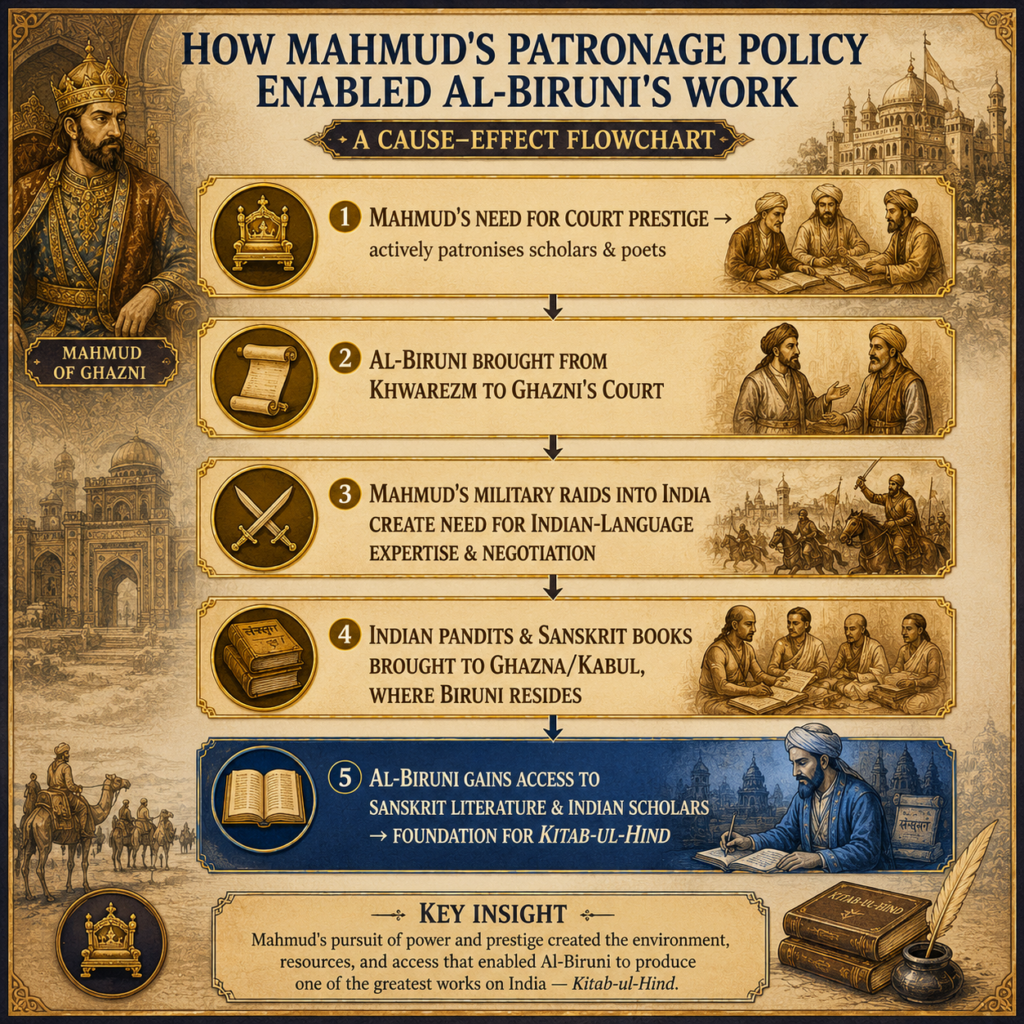
- Mahmud’s policy with regard to science played a significant role in Al-Biruni’s discovery and knowledge of Indian society.
- The promotion of scholarship was considered essential for rulers of that era.
- The presence of poets or scholars at a sultan’s court added to his prestige and reputation.
- In a sense, such writers helped create the sultan’s best image at the time.
- Possessing numerous scholars and artists at court constituted a sign of prosperity and power, ultimately helping a ruler assert authority over dependent dynasties and in relation to the Caliphate.
- Moreover, Mahmud actively encouraged scholarship.
- He brought Biruni from Khwarezm to his court, at the same time attracting the poet Firdawsi and the physician-philosopher Ibn Sina, though the latter refused to join his court.
- Furthermore, Mahmud needed people fluent in Indian languages to assist him in his military raids and negotiations in al-Hind.
- It seems more than probable that Indian pandits and books were brought to Ghazna or Kabul, where Biruni spent some years — corroborating the origin of much of his source material.
- It also emerges from the Kitab al-Hind that Biruni had familiarised himself with various fields of Sanskrit literature.
Kitab-ul-Hind or Tarikh-ul-Hind
- Al-Biruni’s Kitab-ul-Hind (or Tarikh-ul-Hind) is a survey of Indian life based on his study and observations in India between 1017 and 1030.
- The Kitab-ul-Hind is simple and lucid, divided into 80 chapters on subjects such as religion and philosophy, festivals, astronomy, alchemy, manners and customs, social life, weights and measures, iconography, laws, and metrology.
- Al-Biruni extensively quotes from the vast corpus of Sanskrit literature, including Patanjali, the Gita, the Puranas, and Samkhya philosophy.
- Distinctive structure:
- Al-Biruni adopted a distinctive structure in each chapter — beginning with a question, following it up with a description based on Sanskrit traditions, and concluding the chapter with a comparison with other cultures.
- It is an authentic primary source of information about the socio-religious condition of India during Mahmud of Ghazni’s time.
- It is one of the most important discussions of Indian sciences, religion, and society by an outsider, offering a scholarly analysis of the social and religious institutions of the Hindus and shedding light on their rich cultural heritage, including science and literature.
- The book presents a “deep sociological study”, characterised by a rare spirit of enquiry, modern scientific attitude, and sympathetic insight; his approach was scientific, and religious prejudices did not mar the quality of his observations.
- Unlike the prevalent Puranic tradition of recording genealogies, or the West Asian tarikh tradition of narrating political history chronologically, Al-Biruni’s work is of a critical nature, covering diverse aspects such as religion, society, and science.
- Al-Biruni gives a dispassionate account of the weaknesses of the Indian character and the shortcomings of their socio-political order, which led to their defeat and humiliation at the hands of the invaders.
- His critical assessment of Indian customs, ways of life, festivals, ceremonies, and rites is particularly interesting.
- He observed that Indians’ heavy dependence on tradition was a hindrance to genuine intellectual quest.
- He felt that learning and scientific spirit suffered because they had been subordinated to religion.
- Al-Biruni ascribed the decline of Indian science to the arrogance and growing insularity of the Brahmans.
- Al-Biruni learned Sanskrit so that he could study the sources of Hindu thought and religion at first hand — he read the religious texts and met learned Indians.
- He made extensive use of Sanskrit literature, quoting chapter and verse in support of his arguments, drawing from the Bhagavad Gita, the Vishnu Purana, Kapila’s Samkhya, and the works of Patanjali.
- He also translated, or began translating, several Sanskrit texts into Arabic — such as the Kitab Sank, the Kitab Patanjal, the Brahmasiddhanta, the Pulisasiddhanta, the Brihatsamhita, and the Laghujataka.
- His research methodology was innovative, and the data he provided is generally accurate.
- He analysed not only written sources but also oral sources.
- His work displays elements of scientific historiography, advising historians to be more careful with their sources and to critically examine them.
- Al-Biruni was careful in mentioning the written sources of India’s social and cultural history, specifically regarding Indian scientific works and their authors.
- The concern to record facts as they are, without prejudgment, is one of the most significant aspects of Al-Biruni’s methodology.
- Al-Biruni did not play a partisan role and even condemned Mahmud Ghazni’s destructive activities.
- Where he was not certain of his own knowledge, he frankly admitted it.
Motives of Writing the Kitab Tarikh Al-Hind
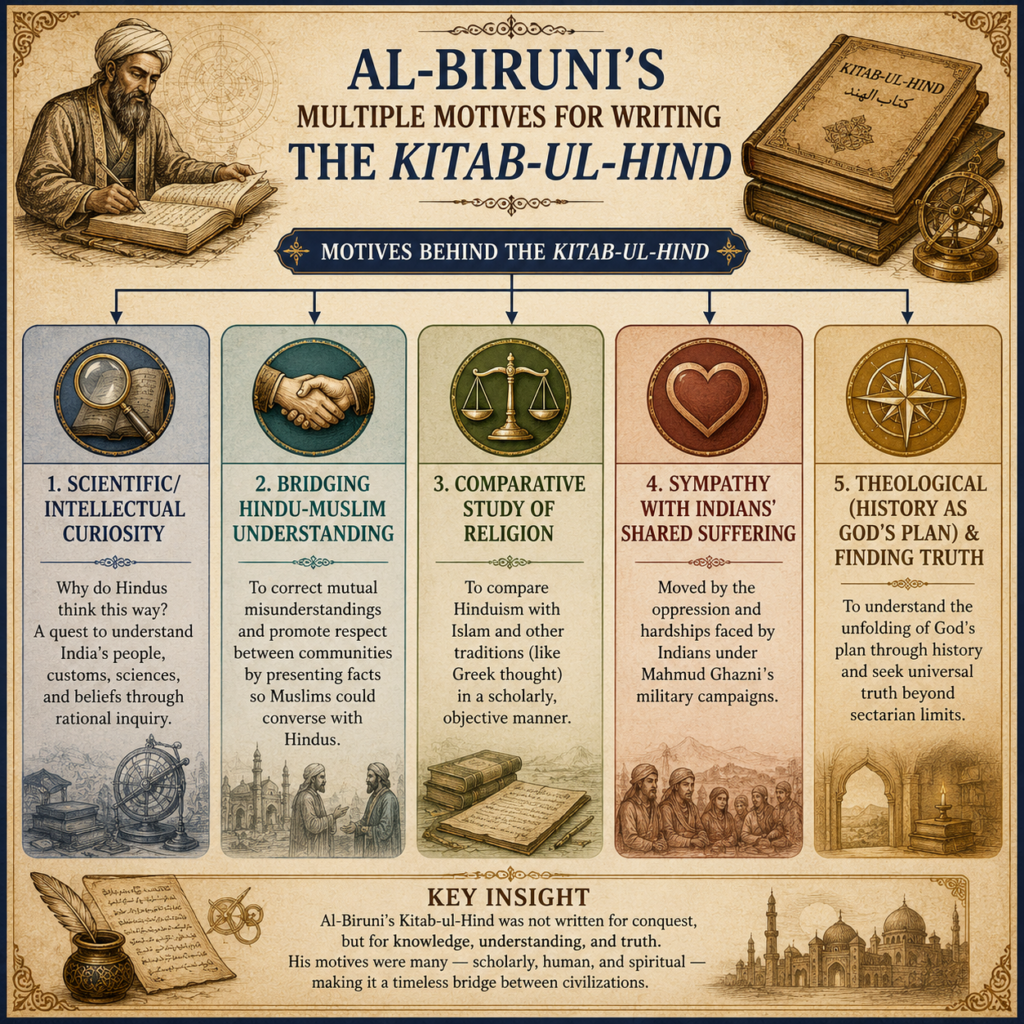
- Al-Biruni expressed his objective with simple eloquence: he stated that his book was nothing but a simple historic record of facts, presenting Hindu theories as they are and drawing comparisons with similar Greek theories to show the relationship between them.
- He read the major Indian religious and astronomical texts; in his account, he highlights portions of the Gita, the Upanishads, Patanjali, the Puranas, the four Vedas, and scientific texts (by Nagarjuna, Aryabhata, and others), relating stories from Indian mythology to illustrate his points.
- Scientific and intellectual curiosity:
- Al-Biruni was motivated by scientific and intellectual curiosity, wishing to understand what factors determined the thought process of Indians.
- As an example of his analytical approach, Al-Biruni summarised why many Hindus hated Muslims: he explained that Hinduism and Islam were fundamentally different, and that Hindus in 11th-century India had suffered destructive attacks and enslavement at the hands of Islamic armies — which, he claimed, contributed to Hindus becoming suspicious of all foreigners, not just Muslims, whom they considered violent and impure.
- Al-Biruni was motivated by scientific and intellectual curiosity, wishing to understand what factors determined the thought process of Indians.
- Understanding Hindu culture and establishing connection between Hindus and Muslims:
- India at the time was not an ideal place for a foreigner like Al-Biruni, whose intention was to study this new culture with a view to establishing friendly relations between Hinduism and Islam.
- Al-Biruni wrote his work to provide, in his own words, “the essential facts for any Muslim who wanted to converse with Hindus and to discuss with them questions of religion, science, or literature.”
- According to Al-Biruni, dialogue with Hindus was necessary since many subjects remained intricate and obscure, which would become clear with greater connection between the two communities.
- Al-Biruni was the first scholar, at least in the Muslim world, whose interest in other religious traditions went beyond the common tendency of treating Hindus as mere heretics or polytheists, despite their apparently idolatrous practices.
- Over time, Al-Biruni won the welcome of Hindu scholars, collecting books and studying with them to become fluent in Sanskrit, and to discover and translate into Arabic the mathematics, science, medicine, astronomy, and other fields of art as practised in 11th-century India.
- Comparative studies of religion:
- Al-Biruni’s motive also included making a comparative study of religions — Islam and Hinduism — and he compared Indian thought to the Greek thought of Socrates, Pythagoras, Plato, and Aristotle, and at times to Sufi teaching.
- Sympathy with Indians:
- Some scholars suggest he wrote out of sympathy for Indians, who, like his own countrymen, had suffered at the hands of Mahmud Ghazni.
- Unfolding God’s divine plan:
- He considered history to be the unfolding of God’s divine plan, working through prophets.
- Finding truth:
- He considered both the sciences and the recording of history to be aimed at discovering truth.
Indian Society
Al-Biruni’s observations of Indian society can be examined under the following heads:
Caste-Ridden Society
- The complete caste structure of Indian society did not go unnoticed by Al-Biruni, who, in the Kitab-al-Hind, beautifully summarised the theories and practices of the Indian caste system.
- Chatuh-varna system:
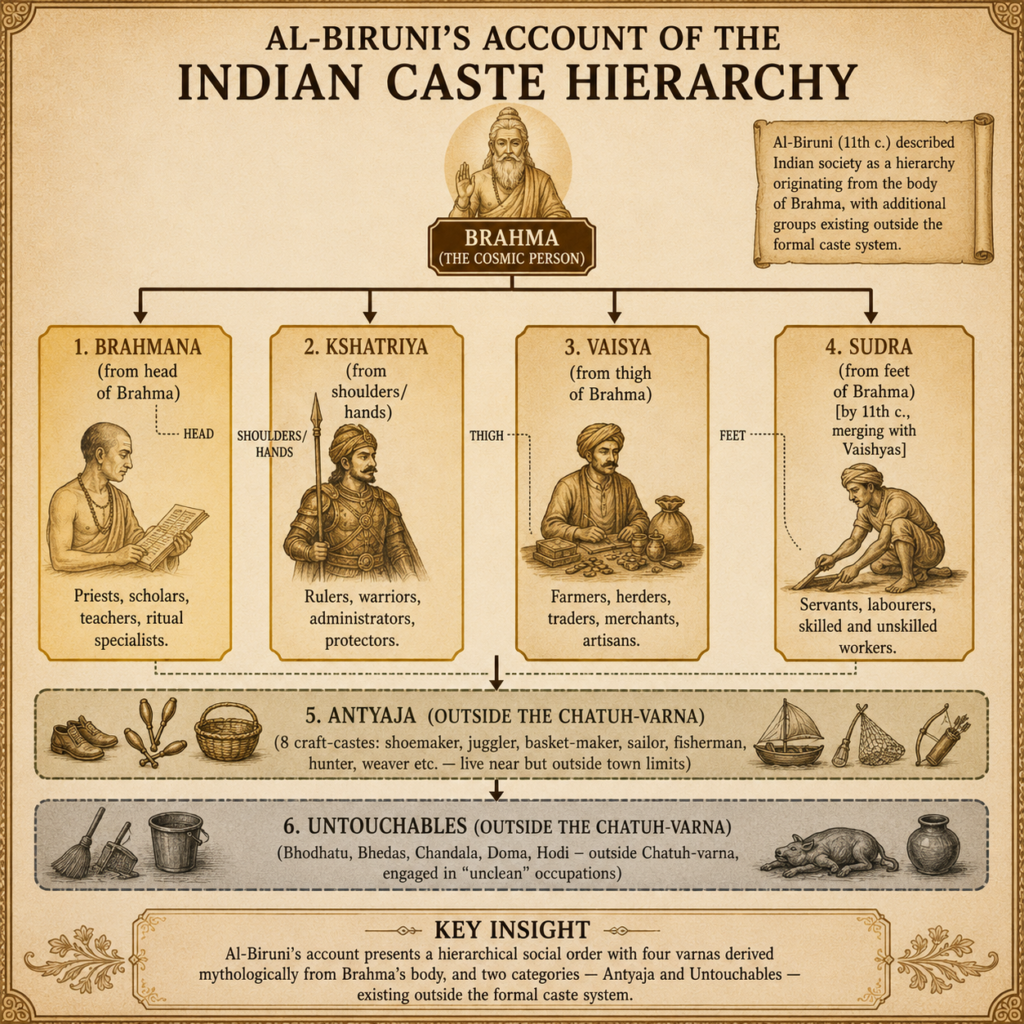
- He discussed the origin of the four-varna (Chatuh-varna) system on the basis of the Purusha-Sukta hymns.
- The highest caste is the Brahmana, created from the head of Brahma.
- The next caste is the Kshatriya, created from the shoulders and hands of Brahma.
- After them follow the Vaisya, created from the thigh of Brahma.
- The Sudra, created from the feet of Brahma.
- The four castes do not live together at the same place.
- Each of the four castes, when eating together, must form a group for themselves — one group not being allowed to comprise men of two different castes.
- Since it is forbidden to eat the remains of a meal, every man must have his own food for himself.
- He discussed the origin of the four-varna (Chatuh-varna) system on the basis of the Purusha-Sukta hymns.
- Antyaja:
- Al-Biruni lists eight antyaja castes, below the status of the Sudras.
- The Antyaja rendered various kinds of services and were not part of the Chatuh-varna, but were considered members of a certain craft or profession — their crafts included shoemaker, juggler, basket-maker, sailor, fisherman, hunter, and weaver, among others.
- They lived near the villages and towns of the four castes, but outside them.
- Untouchables:
- Some untouchable castes mentioned by Al-Biruni include Bhodhatu, Bhedas, Chandala, Doma, and Hodi.
- They too were not part of the Chatuh-varna, and were engaged in “dirty” work, such as the cleansing of villages and other services.
- They were considered akin to illegitimate children, since, according to general opinion, they descended from a Sudra father and a Brahman mother, and were therefore degraded as outcasts.
- Attaining moksha:
- Hindus were said to differ among themselves as to which castes were capable of attaining moksha.
- According to some, only Brahmanas and Kshatriyas were capable of attaining moksha, as others could not learn the Vedas.
- Al-Biruni reports that, according to Hindu philosophers, moksha was in fact attainable by all castes and by humankind as a whole.
- Hindus were said to differ among themselves as to which castes were capable of attaining moksha.
- Comparison with other societies:
- Al-Biruni sought to explain the caste system by looking for parallels in other societies.
- He noted that ancient Persia recognised four social categories — (a) knights and princes, (b) monks and fire-priests, (c) lawyers, physicians, astronomers, and other scientists, and (d) peasants and artisans — suggesting that social divisions were not unique to India.
- At the same time, he pointed out that within Islam, all men were considered equal, differing only in their observance of piety; Al-Biruni disapproved of the notion of untouchability.
- Al-Biruni sought to explain the caste system by looking for parallels in other societies.
- Absence of significant differences between Vaishyas and Sudras:
- Al-Biruni observed that the Vaishyas were fast degenerating to the rank of Sudras, noting the absence of any significant difference between the two, who lived together in the same town and village and mixed together in the same household.
- By the 11th century, it appears that the Vaishyas had come to be treated as Sudras, virtually and legally.
- Al-Biruni observed that the Vaishyas were fast degenerating to the rank of Sudras, noting the absence of any significant difference between the two, who lived together in the same town and village and mixed together in the same household.
- Alliance between Brahmanas and Kshatriyas:
- The alliance of convenience between the Brahmanas and the ruling Kshatriyas was a fact to which Al-Biruni refers indirectly.
Closed Society
- The closed attitude of Indian society, lacking dynamism, did not go unnoticed by Al-Biruni.
- He noted that travelling to far-off places was considered undesirable by the Brahmins.
- The area within which a Brahmana could live was fixed, and a Hindu was not generally permitted to enter the land of the Turks.
- This makes sense in the context of “feudal localism,” which ruled out other types of connection between different regions of the country.
- Al-Biruni further noted that the isolationist attitude of Indians was buttressed by a false sense of superiority.
- In his opening chapter, he wrote that “the Indians believed that there is no country like theirs, no nation like theirs, no king like theirs, no religion like theirs, no science like theirs.”
- He observed that Indians were, by nature, niggardly in communicating what they knew and did not believe in the exchange of ideas — withholding knowledge from men of another caste, from among their own people, and even more so from any outsider.
- He argued that insularity at every level was the characteristic feature of India in the 11th century, and that the price of this insularity was the disruption of the country by the coming of the Turks.
Stagnant Knowledge
- It is indeed unfortunate that Al-Biruni visited India at a time when knowledge was at a low ebb.
- While he highlighted the rich heritage of past knowledge — referring to various siddhantas and the progress made in astronomy and mathematics — he painted a very pathetic picture of the 11th century.
- He observed: “The Indians are in a state of utter confusion, devoid of any logical order, and they always mix up with silly notions of the crowd. I can only compare their mathematical and astronomical knowledge to a mixture of pearls and sour dates. Both kind of things are equal in their eyes since they cannot raise themselves to the method of a strictly scientific deduction.”
Social Evils
- Al-Biruni mentions evil social practices within Indian society, such as child marriage, sati, and the low position of women in general and of widows in particular.
- He noted that Hindus married at a very young age.
- If a wife lost her husband to death, she could not remarry.
- A widow had only two options — to remain a widow for the rest of her life, or to burn herself (sati); the latter option was generally preferred, since a widow was ill-treated.
Indian Customs and Manners
- Indian customs, manners, and festivals are also vividly portrayed by Al-Biruni.
- He observed that many customs differed so greatly from those of his own country that they simply appeared monstrous to him.
- Some customs he described include:
- People plaited their moustaches into a single braid to preserve them, and allowed their nails to grow long, glorifying idleness since they did not use them for work.
- Hindus discarded eaten plates if they were earthen.
- They had red teeth from chewing areca nuts with betel leaves and chalk.
- They sipped cow’s milk but did not eat its meat.
- Men used turbans and trousers.
- Men wore articles of female dress, used cosmetics, and wore ear-rings, arm-rings, and golden seal-rings on the right finger as well as on the toes.
- Men took the advice of women in all consultations and emergencies; they did not ask permission to enter a house but asked permission to leave it.
- They wrote the titles of books at the end, rather than the beginning.
- These customs amused and sometimes horrified Al-Biruni.
Indian Festivals
- Al-Biruni enlists all the important festivals without much comment on them, mentioning 2nd Chaitra (a Kashmiri festival), Guru Tritiya, Vasanta, and others.
- He took important note of the fact that most festivals were celebrated by women and children only.
Religion and Religious Beliefs and Practices
- Al-Biruni extensively quotes Patanjali, the Gita, the Puranas, and the Samkhya school of philosophy to discuss the Hindu belief in God — noting that Hindus believe God to be one, eternal, and without beginning or end.
- He observed that the belief of the educated class differed from that of the uneducated class.
- The former strived to conceive abstract ideas and define general principles, while the latter was content with derived rules without going into detail.
- For the uneducated class, Al-Biruni found most views on the concept of God simply abominable, though he noted that similar errors occur in other religious traditions.
- He observed that belief in a multitude of gods is typical of the uneducated, while educated Hindus believe God to be one and eternal, and consider His existence real, since everything that exists, exists through God.
- He summarised the Hindu definition of God: “They call him Isvara i.e. self-sufficing, beneficient, who gives without receiving. They consider the unity is really a plurality of things. The existence of God they consider as a real existence, because everything that exist exists through him.”
- He further enumerated differing Hindu opinions on philosophical concepts such as action and agent — according to Hindu belief, spirits or souls do not differ from each other in substance, having an identical nature, though their individual characters and manners differ according to the bodies with which they are united.
Concept of Paradise and Hell
- Al-Biruni discussed at length the Hindu concepts of paradise and hell.
- The Hindus use the word “loka” for paradise, and “nagarloka” (the world of serpents) as well as “narakloka” and sometimes “patala” (the world of men) for hell.
- He quotes the Vishnu Purana to elucidate the Hindu tradition of numerous hells, their qualities, names, and the specific hell reserved for each type of sin.
- Hindus consider swarloka (paradise) a higher state, where a man lives in bliss due to previous good deeds, while migration through plants and animals is considered a lower, punitive stage for a certain duration.
Concept of Moksha
- Al-Biruni drew an interesting parallel between Patanjali’s definition of “moksha” and the Sufi term for “knowing” — the attainment of the “state of knowledge.”
- For Sufis, too, there is a belief that a human being possesses two souls — an eternal one, not exposed to change, and a human soul, which is liable to change.
Transmigration of the Soul
- Al-Biruni had also learned about the Hindu concept of the transmigration of the soul.
- He explained that Indians believed every act in this life would be rewarded or punished in the life to come, and that final emancipation was possible only through true knowledge.
- He termed all these beliefs of the Indians “narrow-mindedness.”
- Al-Biruni, who had carefully studied the philosophy and institutions of Hindu religion, had no difficulty in identifying the trinity gods (three deities of the Hindu religion) and the philosophy of the Upanishads.
- Indian philosophy: In his account of Indian views on the origins of the world, he appears well aware of Samkhya philosophy and its exposition of the relationship between spirit and matter.
Indian Polity
- Al-Biruni’s work was not focused on political events in India, but it nonetheless provides valuable information on the subject.
- The animosity between the Muslim Turkish invaders and the Indians is, for the first time, attested in Al-Biruni’s record — he lamented the widespread destruction caused by invasions and the migration of learned men further east.
- He accurately dates the conquest of Somnath by Sultan Mahmud, and also notes its exact location and the legend surrounding the building of the temple.
- Al-Biruni also records the history of the Hindushahis, who bore the brunt of Mahmud’s invasion.
- He mentions the dynasties of Kashmir and the Kalachuris, and even makes reference to Rajendra Chola.
Science in India
- Al-Biruni was among the first scholars to make a deep study of Hindu sciences, and was the first to systematically study India’s scientific literature.
- He was most impressed by the Indian knowledge of astronomy, metrology, arithmetic, alchemy, and geography, which he documented in the Kitab-al-Hind.
- Although often critical of Indian scientific knowledge, Al-Biruni also praised it on occasion.
- When Al-Biruni arrived in India, he already possessed some knowledge of Indian astronomy, acquired through Arabic translations of Sanskrit texts. He considered the Indians well-versed in astronomy and mathematics, but noted that they tended to mix science with popular religious belief.
Astronomy
- Al-Biruni observed that astronomy was the most popular science among Indians, given its close connection to their religion — hence the expectation that an Indian astronomer should also be a good astrologer.
- He mentions Varaha Mihira’s Panchasiddhantika (6th century), Brahmagupta’s Brahma Siddhanta and Khandakhadyaka (7th century), and the works of Aryabhata I’s Dasagitika as well as those of Aryabhata II.
- He described the composition of the Earth and the Heavens as given in Hindu texts, along with the planets and their motions, the twelve signs of the Zodiac, and the different lunar stages.
- He noted that Indian astronomers divided the zodiac into 27 or 28 lunar stations (nakshatras), giving the number of stars in each and their distance from the sun.
- He recorded that Indian astronomers understood the real cause behind solar and lunar eclipses, and described two methods given in the Khandakhadyaka for ascertaining the time of an eclipse.
- He also discussed the calculation of equinoxes, referring to the Brahmasphutasiddhanta on the revolution of the sun, moon, and planets, and analysed various astronomical terms such as kalpa and adhimasa.
- He was inspired by Indian scholars’ arguments that the Earth must be ellipsoid in shape, with an as-yet-undiscovered continent at the South Pole, and that Earth’s rotation around the sun was the only way to fully explain variations in daylight by latitude, seasons, and the Earth’s relative position to the moon and stars.
- He drew comparisons between Greek and Indian astronomical science, and discussed the five Siddhantas (standard books) of Indian astronomy:
- Surya Siddhanta
- Vasishtha Siddhanta
- Pulisa Siddhanta
- Romaka Siddhanta
- Brahma Siddhanta
Metrology
- In metrology, Al-Biruni enlisted contemporary weights and measures, such as Suvarna, tola, Masha, Yava, Kala, Pada, Kudava, Prastha, Adhaka, Dropa, and Surpa, praising the Indian system of weights, measures, and distance measurement.
- He drew an interesting comparison between the tola and the Arabic Mithkal, and worked out the equivalent weight of the two.
Arithmetic
- In arithmetic, Al-Biruni’s interest lay in the Indian order of numbers, mentioning the eighteen orders of numbers listed in Sanskrit literature.
- He quoted the famous Indian astronomer Brahmagupta on the science of numerical writing: “If you want to write one, express it by everything, which is unique, as the earth; two by everything which is double, as, e.g. black and white; three by everything which is three-fold.”
Chemistry
- Al-Biruni referred to chemistry mainly in the context of alchemy (rasavidya), condemning such ideas overall while conceding the efficacy of some metals and chemicals for medicinal purposes.
- He gave an account of three alchemists — Bhanuvasa, Nagarjuna, and Vvadi.
- He was aware of Ayurveda and the Charaka Samhita, though not of the Sushruta Samhita — and consequently had nothing to say on the art of surgery.
Mathematics
- On the Indian numeral system, Al-Biruni noted that numerical signs had different shapes and styles in different regions of India.
- He recorded that the decimal system, the symbol for zero, and higher-order numbers were all known to Indians, and mentioned the value of pi (π) as calculated by Brahmagupta and Aryabhata.
Indian Alphabets
- Al-Biruni also noted the many variations of Indian alphabets.
Criticism of Science in India
- Although Al-Biruni regarded the Hindus as excellent philosophers, good mathematicians, and astrologers, he considered his own knowledge superior and disdained being placed on a level with them.
- To assert this superiority, he compared Greek theories — being “near akin” and strictly scientific — with those of the Hindus.
- He identified Indian knowledge of alchemy (Rasayana) almost with witchcraft, and Hindus with sorcerers.
- He wrote: “The Hindus believe that there is no country but theirs, no nation like theirs, no kings like theirs, no religion like theirs, no science like theirs. They are haughty, foolishly vain, self-conceited, and stolid. Their haughtiness is such that, if you tell them of any science or scholar in Khorasan and Persian, they will think you to be both an ignoramus and a liar.”
- Al-Biruni ascribed the decline of Indian science to the arrogance and growing insularity of the Brahmans, condemning the hypocrisy of Brahmin scholars, who, despite knowing the scientific explanation of various natural phenomena, preferred to mislead the masses and keep them steeped in ignorance and superstition.
- At the same time, Al-Biruni did not conceal what he considered wrong or impractical with the Hindus, while duly appreciating their genuine mental achievements — whenever he encountered something noble and grand in science or practical life, he did not fail to praise it with warm-hearted approbation.
- Speaking of the construction of ponds at holy bathing-places, he remarked: “In this they have attained a very high degree of art, so that our people (the Muslims), when they see them, wonder at them, and are unable to describe them, much less to construct anything like them.”
Criticism of Indian Literature
- According to Al-Biruni, the available literature on Hinduism was not only insufficient but also misleading — a more serious violation of being truthful to truth (al-haqq).
- He complained: “Everything which exists on this subject in our literature is second hand information which one copied from the other, a farrago of materials never sifted by the sieve of critical examination.” This, he argued, was inconsistent with the ethical framework provided by the scriptures of both Christianity and Islam.
- He illustrated his argument by referring to the Qur’an and the Bible — the Qur’an, he noted, reads: “Speak the truth, even if it were against yourselves.”
- Al-Biruni was critical of Indian scribes, whom he believed carelessly corrupted Indian documents while copying older manuscripts.
- He admired Hindu civilisation but was critical of the attitude of scholars and the dichotomy between scientific awareness and ignorance that existed side by side among the Hindus.
- He noted several lies and concoctions mixed up with almost all historical traditions and records, especially regarding the reading of Indian texts, criticising the Hindus for their lack of interest in history.
Indian Legal System
- Al-Biruni made a great effort to understand the Indian legal system.
- He noted every practical aspect of the legal system, pointing out the difference between actual practice and the legal theories expounded in law books such as the Manusmriti.
Geography
- Al-Biruni made extensive use of the Puranic tradition to discuss Indian knowledge of geography.
- Because of his travels, he was able to observe different geographic features first-hand, and formulated theories about how they were connected.
- Madhyadesa:
- He began with the Indian concept of Madhyadesa (the area around Kannauj), the “middle of the realm.”
- He noted that Madhyadesa had remained an important political centre, since in former times it was the residence of India’s most famous heroes and kings.
- He recorded the distances between Kannauj and various parts of the country, such as Mathura, Prayaga (Allahabad), Banaras, Pataliputra, Kashmir, and Ghazni.
- He also gave a detailed account of the routes to Nepal, Tibet, Malwa, Gujarat, North-Western India, and parts of Southern India, with references made to the islands of South-East Asia and those of the Chinese Sea.
- He gave an account of the Varshakala (monsoon season) in India.
- He listed the various rivers of India, as given in the Vayu Purana and Matsya Purana, along with the great knots of the mythical Mount Meru, from which these rivers were believed to flow.
- For example, rivers such as the Godavari, Krishna, Tungabhadra, and Kaveri flow from “Sahya”, while the Mahanadi, Narmada, and Chitrakuta flow from “Riksha.”
- By analysing the different types of soil particles in the Ganges River, from its source to the Bay of Bengal, Al-Biruni formulated theories about erosion and how landforms are shaped, particularly noting the role of water in this process.
- He also discovered fossils of ancient sea animals in the mountains that cut India off from the rest of the world — the Himalayas.
- Since it seemed unlikely that lowly sea snails and shellfish would travel thousands of miles inland and up a mountainside, Al-Biruni concluded that the Himalayan Mountains must have been under the ocean at one point, moving to their present location over millions of years.
Limitations
Barriers That Obstructed Al-Biruni’s Understanding of India
- Al-Biruni himself identified several “barriers” that obstructed his understanding of India:
- The first barrier was language — according to him, Sanskrit was so different from Arabic and Persian that ideas and concepts could not be easily translated from one language to another.
- The second barrier was the difference in religious beliefs and practices.
- The third barrier was the self-absorption and consequent insularity of the local population.
- Aware of these problems, Al-Biruni relied almost exclusively on the works of Brahmanas, often citing passages from the Vedas, the Puranas, the Bhagavad Gita, the works of Patanjali, and the Manusmriti, to construct an understanding of Indian society.
Faulty Reading of Sources
- At times, Al-Biruni could not correctly understand original concepts due to misunderstanding and faulty reading of Indian texts.
Ignoring Non-Sanskrit Texts
- He relied mainly on Sanskrit texts for information on Indian society, religion, and science, largely ignoring other Indian texts — such as Buddhist and Jaina texts, and other works written in Prakrit, Pali, and other languages.
Limited Audience
- His audience was limited to the upper castes of Indian society, and hence his work fails to provide information on aspects such as the real understanding of the varna order from the point of view of the lower classes.
Information Not Always Based on Direct Observation
- While the compilation date of his work — around 1030 A.D. — is known, the exact territory covered by his research, as well as his sources, remains subject to doubt, for three reasons:
- First, he rarely mentions where his visits took place, or when.
- Second, the Kitab-al-Hind itself is lacking in positive evidence on this point.
- Third, it is sometimes difficult to distinguish historical events from legendary ones in his account.
- Defining Al-Biruni’s actual field of investigation is crucial for using the Kitab-al-Hind as a historical source appropriately.
- Biruni’s mobility depended largely on the conquered boundaries of Mahmud’s empire — a distinction between the conquered and unconquered world is therefore needed to assess the depth of his information and his methodology.
- Most scholars consider that Biruni’s travels were confined to the boundaries of the Ghaznavid dominion.
- The Kashmir Valley was not included in the Ghaznavid empire, as Al-Biruni explicitly indicates two unreachable locales — Kashmir and Varanasi.
- Yet he provides generous information on the Kashmir Valley — describing at length its geographical, ethnic, and social features; naming its cities and mountains; listing itineraries leading to the valley; mentioning the customs of its inhabitants; describing the alphabets and scripts in use; and presenting detailed accounts of its religious practices and astronomy.
- Compared to any other region of India, the Kashmir Valley is described in the most minute detail in the Kitab-al-Hind.
- The amount and accuracy of this information suggests, first, that Kashmir’s isolation must be reconsidered, and second, that Al-Biruni’s information here did not rest on direct observation.
- It is possible to draw out from the Kitab-al-Hind how Al-Biruni obtained such information.
- He describes certain mobility between people of Kashmir Valley and other parts of India, in a strictly religious sense, connected with visits by outsiders to places of pilgrimage in Kashmir.
- He also describes how he interacted with Kashmir through the circulation of written documents between the conquered and unconquered (Kashmir) world.
- His expression, “the people of Kashmir whom I have seen,” indicates that he met informants from Kashmir directly.
- There is also evidence of a scholarly exchange of books between Biruni and a Kashmiri scholar, which aided him in gathering information.
- We may conclude, then, that Biruni acquired information through a certain interaction and mobility between different regions of India, which generated the circulation of written and oral data — intellectual interactions that were also encouraged by different dynasties of India.
- Although one might expect direct observation to have been Al-Biruni’s main method with regard to conquered territory, this expectation is not confirmed by a closer look at the Kitab-al-Hind.
- On the contrary, direct observation is rare in the Kitab-al-Hind; as in the case of the Kashmir Valley, oral informants and written sources provided most of the data for his field of investigation.
- In other portions of the text, Biruni names two of his sources — Jivasarman and Sripala — who informed him about Kashmir and Multan respectively.
- A large amount of written material was equally available to Biruni, who was acquainted with these works either through the accounts of Brahmins or quotations found in books he read, such as the Vedas, the Smriti of Manu, or various Puranas.
- Biruni remained largely silent regarding the origin of his written sources’ authors, except for three — Durlabha from Multan, Utpala from Kashmir, and Vijayanandin from Varanasi.
- Since Kashmir and Varanasi were out of reach, Biruni had probably obtained the books originating there through intermediaries; similarly, he could have collected books from Multan without having visited the city himself.
- To summarise, the majority of the information found in the Kitab-al-Hind appears to be based on first-hand and second-hand literature — mainly the Puranas, the Gita, the Kitab Sank, and Patanjali for information on physical or mythical geography, religion, culture, history, and philosophy, and the Siddhantas, Tantras, and Karanas for information related to astronomy and astrology.
- Biruni’s work is thus based on a vast body of literature compared to that of his predecessors, whose accounts were generally based on observation and hearsay alone.
Conclusion
Al-Biruni’s Kitab-ul-Hind remains, despite its acknowledged limitations, one of the most valuable windows into 11th-century Indian civilisation available to historians. Enabled paradoxically by Mahmud of Ghazni’s conquests, Al-Biruni transcended the role of a mere court chronicler to produce a work marked by critical method, comparative analysis, and a genuine — if not always unbiased — spirit of enquiry into Indian religion, society, science, polity, and geography. His candid criticism of both Indian insularity and Brahmanical exclusivism, alongside his admiration for Indian achievements in astronomy, mathematics, and engineering, reflects a historian who, in his own words, sought above all to place before readers “a simple historic record of facts.” Yet his heavy reliance on Sanskrit, Brahmanical sources, his limited direct observation beyond the Ghaznavid dominion, and his neglect of Buddhist, Jaina, and vernacular traditions remind us that the Kitab-ul-Hind, for all its brilliance, offers a view of India filtered through a particular — largely elite, Sanskritic — lens. Read with this caveat in mind, Al-Biruni’s account remains an indispensable primary source for reconstructing the social, religious, scientific, and intellectual history of early medieval India.




