The state of indigenous education, its dislocation; Orientalist – Anglicist controversy. The introduction of western education in India; The rise of press, literature and public opinion; The rise of modern vernacular literature; Progress of science; Christian missionary activities in India.
Social and Cultural Developments covers education, the press and the intellectual encounter with the West. UPSC has set 22 questions on it between 1988 and 2026, and it has appeared in eight of the last ten papers. It is a compact, predictable unit: three subjects account for almost every question.
Every question the Commission has asked on this topic is listed below, newest first, with a written model answer linked against each one.
| Questions asked (1988–2026) | 22 |
| Appeared in | 8 of the last 10 papers |
| Paper | Paper II, Section A (Modern India) |
| Usual mark value | 10, 15 or 20 marks |
| Model answers available | 21 of 22 |
PYQs: Social and Cultural Developments [1985-2026]

| Year | Question | Answer |
|---|---|---|
| 2026 | "The Orientalist-Anglicist controversy of the 19th century constituted a turning point in shaping colonial educational policy in India." Examine. | |
| 2025 | "The tug of war between the two principles of freedom and control of the press made its influence felt on the colonial rulers' attitude to the press." Discuss. | View answer |
| 2023 | To accomplish the aims of education, 'political propaganda and formation as well as propagation of nationalist ideology', the press became the chief instrument. Comment. | View answer |
| 2022 | Was the Western education a harbinger of cultural awakening or an instrument of colonial hegemony? Discuss. | View answer |
| 2022 | 'Within a limited scope the Indian Scientists could pursue original scientific research in colonial India'. Critically examine. | View answer |
| 2021 | Critically examine the following statement in about 150 words: The introduction of Western education transformed India in unforeseen ways. | View answer |
| 2021 | Critically examine the following statement in about 150 words: The Vernacular Press Act of 1878 was designed for better control of the vernacular press and to empower the government with more effective means of punishing and repressing seditious writings. | View answer |
| 2019 | Examine the forces at work for the introduction of western education in India. Analyse the thrust given to it by the Christian Missionaries. | View answer |
| 2018 | What was the significance of Orientalist Anglicist controversy in nineteenth century India? Analyse. | View answer |
| 2017 | Assess the role of press in arousing awareness on important social issues in the second half of the nineteenth century. | View answer |
| 2016 | Do you agree with the view that the growth of vernacular literature in the 19th and the 20th centuries paved the way for social reform and cultural revival in India? | View answer |
| 2012 | '“The current practice of categorization of 'Early Modem India’ is based on a shift from the old imperialist periodization of 'Muslim India’- ‘British India’ to the more secularist one of 'Medieval India’ – ‘Modern India’, which puts Indian history in a universalist chronological structure.” Critically examine. | View answer |
| 2011 | “Orientalism produced a knowledge the past to service the needs of the Colonial State.” Elucidate. | View answer |
| 2011 | “The vernacular press in nineteenth century India served not just as newspapers but more importantly as views – papers." Comment. | View answer |
| 2008 | “The vernacular press in the nineteenth century was both newspaper as well as ‘viewspaper* that enlightened the dormant masses”. Comment. | View answer |
| 2004 | Examine the impact of British rule on Indian Society in the 19th Century. | View answer |
| 2002 | “India broke her British fetters with Western hammers." Comment. | View answer |
| 1999 | The Christian Missionary propaganda from 1813 onwards was “often insensitive and wounding.” Comment. | View answer |
| 1997 | “India broke her British fetters with western hammers." Comment. | View answer |
| 1990 | What was the Anglicisit – Orientalist controversy about? How was it resolved and with what results? | View answer |
| 1989 | 'Nowhere was the influence of the missionaries felt more than in relation to the women’s movement.’ Comment in about 200 words. | View answer |
| 1988 | Review the educational policy of the English East India Company. To what extent did it serve the imperial interests of Great Britain? | View answer |
What UPSC keeps asking about Social and Cultural Developments
Twenty-two questions fall into three threads, and each has a stock formulation the examiner keeps returning to.
1. Western education and the Orientalist-Anglicist controversy (1988, 1990, 2011, 2018, 2019, 2021, 2022, 2023, 2026)
- The largest and most active thread — nine questions, six since 2018.
- The controversy itself (1990, 2018, 2026), Orientalism as colonial knowledge (2011), the forces behind Western education (2019), and whether it was cultural awakening or an instrument of empire (2022).
- Macaulay’s Minute and Wood’s Despatch are the documents. Said’s Orientalism and Bernard Cohn’s colonial knowledge are the historiography the 2011 question was built on.
2. The press (2008, 2011, 2017, 2021, 2025)
- The vernacular press as both newspaper and “views-paper” (2008, 2011) — set twice in near-identical words.
- The Vernacular Press Act (2021), the press and social issues (2017), and the tug of war between freedom and control (2025).
- Prepare the sequence of press laws from 1823 to 1910 with one line on each.
3. The Western encounter and its effects (1989, 1997, 1999, 2002, 2004, 2012, 2016, 2022)
- “India broke her British fetters with Western hammers” — set twice (1997, 2002).
- Missionaries (1989, 1999), vernacular literature (2016), Indian scientists within colonial limits (2022), and the periodisation of early modern India (2012).
- The strong answer shows how Western ideas were selectively absorbed and turned against colonial rule, not simply received.
The model answers to this unit, in one place
Knowing the questions is half the work. The other half is seeing what a full-mark answer to each one looks like — not a hint or a bullet outline, but a complete answer at the mark and the word limit, with the historians named inside the argument.
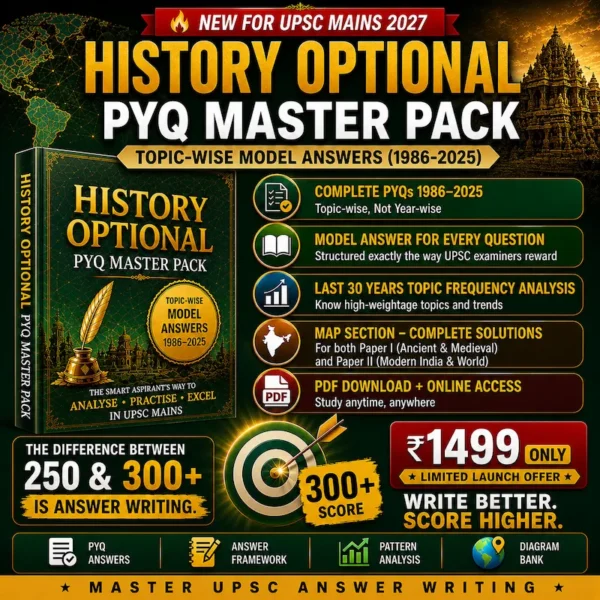
The History Optional PYQ Master Pack carries the same for every question the Commission has set since 1985, across the whole syllabus.
- PYQs 1985–2025, arranged topic-wise — revise a theme and see every way it has been asked
- Model answers with historiography — the debate cited where it belongs, not bolted on
- Map sections solved — the full 50-mark section, every year
- PDF plus online access — any device, permanently, no subscription
₹1,499 (regular ₹2,500). One-time payment, instant access.
How to use this topic list
Reading a question list feels like preparation and is not. Three sittings turn it into marks.
Sitting 1 — sort before you read (30 minutes)
- Copy the questions above into the threads identified in the previous section.
- Note which thread has gone longest without being asked — that is your priority, not the one you find most interesting.
Sitting 2 — write three answers cold (45 minutes)
- Pick the most recent question from three different threads.
- Seven minutes for a 10-marker, fifteen for a 20-marker. Stop when the time is up, even mid-sentence.
- Mark every place you wanted a historian’s name and could not produce one.
Sitting 3 — compare, then rewrite (45 minutes)
- Put your script beside the model answer for the same question.
- Compare structure first: opening claim, evidence, counter-view, judgement.
- Rewrite your weakest answer using that structure and no new content. Most candidates gain four to six marks from structure alone.
Two ways to prepare this optional
Two routes, depending on what is actually missing.
| PYQ Master Pack | Mains Master Kit 2027 | |
| Best when | Your notes are done; answer-writing is the gap | You are still building the subject |
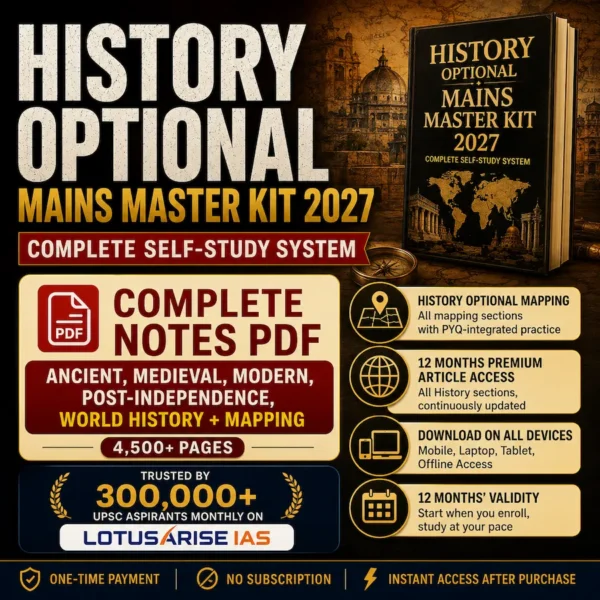
| What you get | Model answers to every question since 1985, topic-wise, map sections included | 4,500+ pages of notes, full mapping coverage, 12 months of article access |
| Price | ₹1,499 (reg. ₹2,500) | ₹1,770 (reg. ₹5,000) |
Frequently asked questions
Related topics
This unit leads directly into:
- Indian Response to British Rule
- Early Indian Nationalism
- Early Structure of the British Raj
- Economic Impact of British Colonial Rule
- All topics — History Optional PYQs, topic-wise
Prefer to work year by year?
The complete papers, with both papers in full, unit-wise analysis and the official PDFs:
- History Optional Question Paper 2026
- History Optional Question Paper 2025
- History Optional Question Paper 2024
- History Optional Question Paper 2023
- History Optional Question Paper 2022
- History Optional Question Paper 2021
- History Optional Question Paper 2020
- UPSC History Optional Map Solutions (2013–2025)