Pandyas: Art and Architecture

Pandya art and architecture, spanning early rock-cut cave shrines to the towering gopurams of temples such as the Meenakshi Temple at Madurai, illustrates the evolution of Dravidian temple building in the far south of the peninsula. For UPSC History Optional aspirants, this topic is valuable both for its distinctive architectural features — from monolithic rock-cut vimanas to the later ascendancy of the gopuram over the sikhara — and for its rich sculptural and painting traditions, including the celebrated frescoes of Sittanavasal, which link the earlier Ajanta tradition to the later Chola school of painting. This article examines Pandya rock-cut and structural temples, the general features of Pandya temple architecture, Pandya sculpture, and the paintings of the Pandya period.
Pandya architecture includes both rock-cut and structural temples.
Rock-Cut Temples
- The early rock-cut temples have monolithic vimanas.
- Rock-cut temples are found at Thirupparankundram, Anaimalai, Karaikudi, Kalugumalai, Malaiyadikurichi, and Trichy; these temples were constructed for Lord Shiva and Vishnu.
- Cave temples are also found at Kalugumalai and Trichy.
Structural Temples
- The structural temples are small stone temples that have all the features of larger temples — vimana, mandapa, and sikhara — but were simpler in style.
- Temples consist of the garbhagriha, ardhamandapa, and mahamandapa; the Shiva temples have a Nandi in front of the mahamandapa.
- The period of the later Pandya rulers saw the development of elegant vimanas with finely sculptured idols, along with the gopurams of the temples.
- The rectangular entrance, or portal, of the temple is called the gopuram; the portion above the entrance is pyramidal in shape.
- Gradually, the gopurams were given more importance than the sikharas: while the former grew higher and more imposing, the latter declined in height.
- Lofty gopurams of great proportions, with lavish decoration, were constructed by succeeding dynasties.
- Groups of small temples are to be seen in Tiruchirapalli district, Tamil Nadu.
- The zenith of Pandya architecture is represented by the Meenakshi Temple at Madurai and the Aranganathar temple at Srirangam.
- Structural stone temples are also found at Kumbakonam, Thiruvannamalai, Kovilpatty, Thiruppathur, Alagarkoil, Ambasamudram, and Madurai.
- The Shiva temple at Ambasamudram, the Vijayanarayana temple at Nanguneri, and the Lakshmi Narayana temple at Athur are structural temples.
- The Pandyas also built temples, mandapas, and gopurams at Chidambaram and Srirangam.

General Features
- The plan was usually rectangular, though the emphasis was on the gateways — the gopuram — whose own plan was also rectangular in shape.
- The ground floor and first floor were vertically built in stone, while the floors above were pyramidal and built in brick, with an inclination of 25 degrees.
- Pinnacles, called sikharas, were used in odd numbers.
- Niches were carved with heavily detailed sculptures of Hindu mythological figures, and images of horses and other animals were carved on pillars.
Srivilliputtur Andal Temple
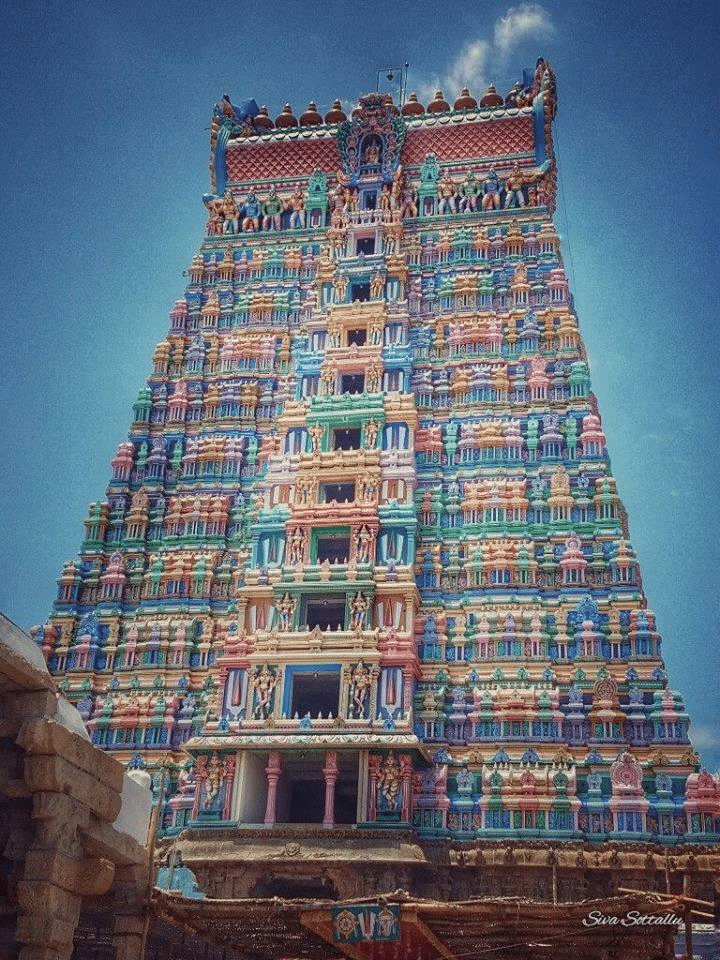
- The Srivilliputtur Andal Temple has a 12-tiered tower structure (59 m high), dedicated to the presiding Lord of Srivilliputtur, and is the official symbol of the Government of Tamil Nadu.
- Images of the Panchamurtis, Thumburu, Narada, Sanatkumara, Kinnara Mithuna, the Sun, and the Moon are represented at the deity’s feet.
- The sanctum sanctorum has three doorways, and a flight of stairs leads up to it.
- A large, impressive hall features detailed wooden carvings depicting incidents from the Puranas.
Sculpture
- Pandya sculptures are beautiful and ornamental; some are engraved on a single block of stone.
- Sculptures at Kalugumalai, Thirupparankundram, Thirumalapuram, and Narthamalai are very famous.
- Famous sculptures include Somaskandar, Durgai, Ganapathy, Narasimha, and Nataraja.
- The Vishnu sculpture at Kunnakudi and the Nataraja sculpture at Thirukolakkudi are of a standard comparable to the finest sculptures of the Pallava and Chola periods.
Painting during the Pandyas
- Several mural paintings of the mid-9th century existed in the temples excavated in the rock at Thirumalapuram and Sittanavasal.
Thirumalapuram Painting
- Traces of early Pandya painting can be seen in the Thirumalapuram rock-cut caves.
- There are representations of small secondary deities (gana) on the roof — one rides a mythical lion, while others appear among lotus foliage, amid which a duck is depicted in a very naturalistic way.
- These works unfold with confidence in a sober range of colours: white, indigo, black, and light blue.
- Also on a column’s capital is a group of bearded characters (perhaps hunters) in the company of girls, a drum player, and several dynamic gana dancers.
Sittanavasal Painting
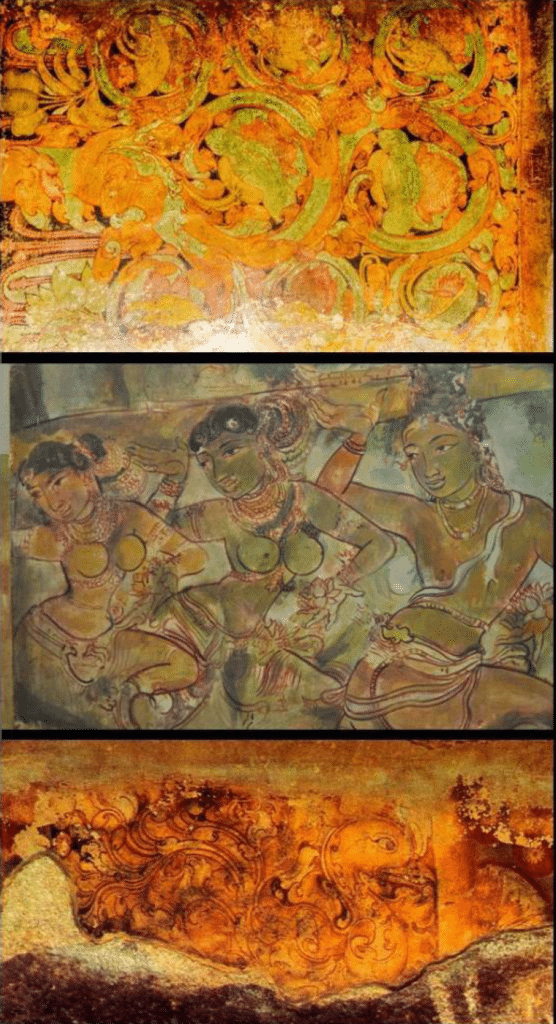
- Though severely damaged, the remaining frescoes have been preserved on the upper parts of the columns and ceilings inside the cave temple.
- Painting fragments survive in the Jain cavern at Sittanavasal, where two superimposed layers of frescoes were discovered, along with an inscription of about 850 CE.
- Pandyan-style frescoes from about 850 CE are located on the ceiling, walls, and columns of the veranda.
- One of these represents a couple whose busts appear abundantly jewelled; another represents two female dancers; and a third is a rather enigmatic composition featuring a stylised lotus tank, inside which are three men gathering flowers, along with fish, birds, and several quadrupeds, including elephants.
- This last fresco, of the lotus tank, was painted in a style related to the Ajanta frescoes, evident in several features: the attitudes and simplicity of the characters, the purity of line, and the use of more sustained colours to indicate modelling.
- As for the characters in the two other compositions — the female dancers and the couple — they are more closely related to the Chola paintings, and are therefore likely more recent than the lotus tank fresco.
- The most central and important fresco in this rock-cut cave — the Lotus Tank — represents a pond filled with lotuses, on the ceiling of the sanctum and the ardha-mandapam of the cave, depicting natural-looking images of monks, animals, flowers, swans, and fishes.
- This scene refers to the Samavasarana, an important motif in the Jain religion: the audience hall in which Tirthankaras deliver sermons after attaining realisation (kevala-gnana).
- Bulls, elephants, apsaras, and gods are shown gathered in this audience hall to witness the grand scene.
- The paintings were executed using the fresco-secco technique.
- The colours used were derived from minerals: white from lime, black from wood charcoal, yellow from yellow ochre, red from red ochre, blue from ultramarine/lapis lazuli, and green from terre verte.
- Compared to the classical cave-painting styles of the Ajanta Caves, these decorative paintings show only minor variations in materials, and are reported to provide a link between the Ajanta paintings (4th–6th century AD) and the Chola paintings of the 11th century at Thanjavur.
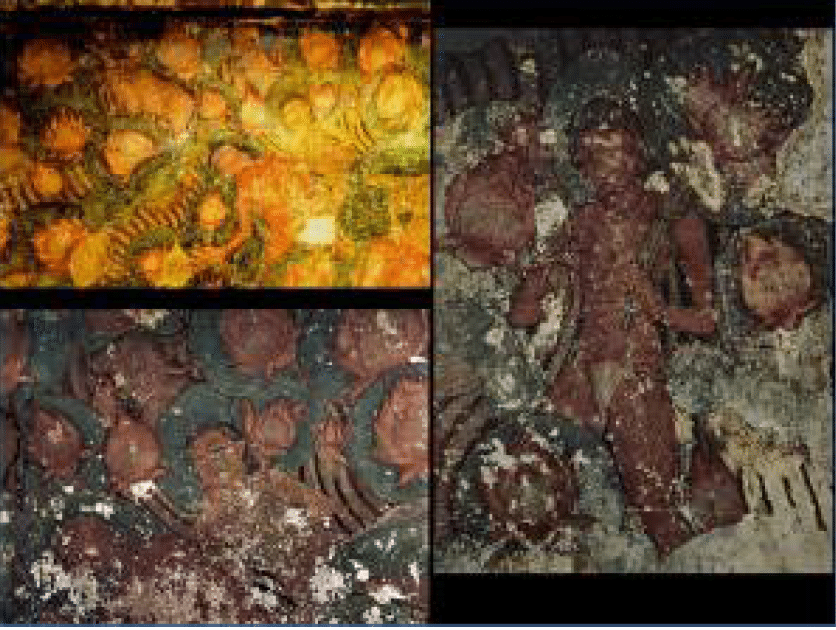
- Pillars at the site carry figurines of the Pandya king Srimara Srivallabha (9th century AD) and his queen, shown offering reverence to Ilam Gautaman, an acharya of Madurai credited with creating these paintings.