

Rise of the Magadha Empire and the Nanda Dynasty

Of the sixteen Mahajanapadas that emerged in the sixth century BCE, it was Magadha that ultimately triumphed over its rivals to become the first great imperial power of recorded Indian history. The rise of Magadhan imperialism — culminating in the vast, wealthy empire of the Nandas and setting the stage for the Mauryan Empire — was no historical accident, but the product of a unique convergence of geographical advantage, economic prosperity, cultural ferment, and a remarkable succession of ambitious and capable rulers. Understanding the factors behind Magadha’s rise, the succession of its ruling dynasties, and the process of imperial consolidation under Bimbisara, Ajatashatru, and their successors is a cornerstone topic for UPSC History Optional aspirants studying the political history of ancient India.
The Sixteen Mahajanapadas and the Rise of Four Great Powers
- There were initially sixteen Mahajanapadas, of which Magadha formed one. In the course of time, small or weak kingdoms either submitted to stronger rulers or were eliminated altogether, until, by the sixth century BCE, only four major kingdoms survived: Avanti, Vatsa, Kosala, and Magadha — of which Magadha finally emerged the most powerful.
Factors that Led to the Rise of Magadha
- This rise of Magadhan imperialism is unique in Indian history. The political history of India, from the earliest times to the present day, is an endless story of struggle between the forces of centralisation and decentralisation, and the sixth century BCE presented the chronic symptom of disintegration — Aryan India in the north was divided into sixteen great kingdoms and a number of republican, autonomous states.
- Of the four powerful kingdoms — Avanti, Vatsa, Kosala, and Magadha — the Magadha Empire rose to prominence by aggrandising upon the weaker states, entering into a four-power conflict for imperial supremacy that ended in the ultimate victory of the Magadha kingdom. This was the first successful attempt at imperial and dynastic unification of India within the period of recorded history.
- The factors that contributed to the rise of the Magadha Empire were both internal and external. As collectivist historians emphasise, situation and circumstance make a leader in history — it is not simply that leaders create history, but that actors and factors collaborate in bringing about historical change.
Geographical Factors
- Magadha lay on the main land route connecting eastern India with the west, allowing her to easily control trade between the two regions of the country.
- Her capitals occupied strategic positions: Rajgir was surrounded by five hills, while Pataliputra was surrounded by the Ganga, Gandak, Son, and Ghagra rivers — making it a true jaladurga (water-fort).
- The Magadha Empire was encircled by the Ganges, the Son, and the Champa rivers on three sides, rendering it impregnable to the enemy. Her old capital, Rajagriha, was strategically situated, surrounded on all sides by hills and cyclopean stone walls.
- Her new capital, Pataliputra, was even more strategically invincible than Rajagriha, situated near the confluence of the Ganges and the Son — a location from which it was easier to control the course of the Ganges itself.
- Rivers also facilitated military movement for Magadha. These geographical advantages helped Magadha remain aggressive towards her neighbours, even as her own impregnability baffled them; the availability of elephants further allowed Magadha to deploy them effectively in war against her enemies.
Agricultural Factors (Economic)
- One of the main factors behind the rise of Magadhan power was her economic solvency and growing prosperity. Magadha possessed a vast population that could be employed in agriculture, mining, and the manning of her army.
- The Shudras and non-Aryans could be employed in clearing forests and reclaiming surplus land for farming, and the surplus population could easily live off the yield of this surplus land.
- The Magadhan lands were exceptionally fertile owing to their location between the Ganges and the Son; by the fourth century BCE, Magadhan lands yielded multiple crops throughout the year, and the resulting prosperity of the people made the government itself automatically rich and powerful.
- Rivers also aided trade and commerce.
Mineral Resources
- The mineral resources of Magadha were another source of her power and prosperity. With the dawn of the Iron Age, iron became an essential metal for implements, ploughshares, and weapons of war.
- Magadha had an abundant supply of iron from the Rajgir mines, besides possessing copper mines; this allowed her to equip her vast army with iron weapons while also selling surplus iron to other states. The easy supply of iron also made deep ploughing with heavy iron ploughs possible.
- Iron mines were also available to Avanti, which is precisely why Avanti proved to be Magadha’s most serious competitor for supremacy over north India.
Role of Trade
- Magadha was situated on the land route connecting eastern India with the west, and the trade flowing along this route passed through her territory; the river Ganges, flowing through the heart of Magadha, served as the principal route of trade in northern India.
- Magadha was linked to parts of northern India as far as Kasi (Varanasi) via the Ganga route, and from Prayag (Allahabad) — the confluence of the Ganga and Yamuna — she could send her merchandise along the Yamuna route as far as the Delhi region.
- Downwards from Magadha, the open sea could be reached via the Ganga route; the Son and Champa rivers flowed along the Magadhan frontier. In ancient times, river routes served as highways of commerce, and Magadha could control North Indian trade through her mastery over the Ganges.
- When Bimbisara conquered the kingdom of Anga, its flourishing port of Champa was annexed to Magadha — a famous river port from which ocean-going vessels laden with merchandise sailed to South-East Asia, Ceylon, and South India.
Significance of the Ganges
- The rise of the Magadhan kingdom was closely linked to the establishment of her supremacy over the Ganges. After the annexation of Champa, the Magadha Empire turned to establishing its supremacy over the upper Gangetic region.
- Bimbisara and Ajatashatru defeated Kosala and annexed Kasi, a famous river port and emporium; mastery over Kasi gave Magadha the opportunity for economic penetration into the Kosala kingdom (modern Uttar Pradesh), and virtually the entire southern side of the Ganges came under Magadhan hegemony, where she pursued ceaseless economic penetration.
- Magadha then turned her gaze to the northern side of the Ganges — the Vaishali and Lichchhavi countries — whose fertile tracts became targets of Magadhan imperialism. The conquest of Vaishali and the Lichchhavi territories gave Magadha supreme mastery over the entire Gangetic valley, rendering her virtually invincible.
- Magadha launched her programme of a pan-Indian empire, resting on the strength of her secure heartland in the Gangetic valley.
Cultural Factors
- Culturally, the rise of Magadha can be explained by the fact that Magadha was the meeting ground of two opposite cultures.
- Aryan culture lost its original virility upon reaching Magadha, and the lingering traces of non-Aryan culture in eastern India mixed with it; this interaction between the two cultures gave new power and spirit to the Magadha Empire.
- In the sphere of thought and philosophy, eastern India made its mark through the teachings of Mahavira and the Buddha — a revolution in thought that was supplemented, in the political field, by the emergence of Magadhan imperialism and its bid to establish a pan-Indian empire.
The Unorthodox Character of Magadhan Society
- Finally, the unorthodox character of Magadhan society deserves mention. Having been only recently “Vedicised,” Magadhan society demonstrated a greater enthusiasm for expansion than kingdoms that had been brought under Vedic influence at an earlier stage.
Political Factors
- Politically, the fulfilment of the Magadhan dream of imperial unification under the Magadhan banner was made possible by the political atomisation of northern India in the sixth century BCE.
- Rivalry among the great monarchies prevented them from forming alliances against Magadha; none but the republican states under the Vriji confederacy made common cause against her. Geographical and natural barriers — rivers, mountains, and jungles — likewise prevented the fostering of a united resistance movement against Magadha.
- An unbroken chain of exceptionally able and extraordinary monarchs ascended the Magadhan throne. Dynastic monarchy is generally cursed with incompetent rulers, but Magadha proved an exception to this rule.
- The credit for the rise of the Magadha Empire goes to its competent rulers — Shishunaga, Bimbisara, Ajatashatru, Mahapadma, and Chandragupta were all exceptionally able kings, and they were fortunate in having great ministers and diplomats such as Vassakara, Kautilya, and Radhagupta, without whose efforts Magadhan ascendancy would have suffered.
Ambitious Rulers
- The formation of the largest state in India during this period was the work of several enterprising and ambitious rulers, such as Bimbisara, Ajatashatru, and Mahapadma Nanda, who employed every means in their power — fair and foul — to enlarge and strengthen their kingdoms.
Military Organisation
- Magadha enjoyed a special advantage in military organisation. Although Indian states were well acquainted with the use of horses and chariots, it was Magadha that first used elephants on a large scale in its wars against its neighbours; the eastern part of the country could supply elephants to the princes of Magadha, and Greek sources record that the Nandas maintained as many as 6,000 elephants.
- Elephants could be used to storm fortresses and to march across marshy terrain and other areas lacking roads or other means of transport.
- Ajatashatru is said to have used a war engine capable of throwing stones like a catapult, and also possessed a chariot fitted with a mace.
Danger of Foreign Invasions
- Externally, the threat of foreign invasions — such as that of the Achaemenians in the sixth century BCE, and of the Macedonians in the fourth century BCE, along with the subsequent infiltration of foreign races — raised the question of whether it was possible to defend the subcontinent from foreign invasion without a central, paramount government.
- Such a consciousness certainly worked behind the rise of Magadhan imperialism, preparing the country to submit to Magadhan hegemony.
Magadha Dynasties
The Haryanka Dynasty (c. 600–413 BCE)
- According to tradition, the Haryanka dynasty founded the Magadha Empire in 600 BCE, with its capital at Rajagriha, later moved to Pataliputra, near present-day Patna. This dynasty lasted until 424 BCE, when it was overthrown by the Shishunaga dynasty.
Bimbisara (543–491 BCE)
- Bimbisara was a king, and later emperor, of the Magadha Empire. His expansion of the kingdom — especially his annexation of Anga to the east — is considered to have laid the foundations for the later expansion of the Maurya Empire.
- Bimbisara built the city of Rajagriha, famous in Buddhist writings. According to Buddhist scriptures, King Bimbisara met the Buddha for the first time prior to the Buddha’s enlightenment, and later became an important disciple who features prominently in certain Buddhist suttas; he is recorded to have attained sotapannahood, a degree of enlightenment in Buddhist teaching.
- Jain scriptures, on the other hand, describe Bimbisara as a disciple of Mahavira who frequently sought his teachings; as per Jain texts, he is referred to as King Shrenika of Rajgriha (the possessor of a large army). Bimbisara sent Jivaka to Ujjain for the medical treatment of King Pradyota of Avanti.
Marriage Alliances
- Bimbisara used marriage alliances to strengthen his position. His first wife was Kosala Devi, sister of Prasenjit, king of Kosala — her dowry brought him the territory of Kashi, useful for trade; this marriage also ended the hostility between Magadha and Kosala, giving him a free hand to deal with other states.
- Bimbisara’s second wife, Chellana, was a Lichchhavi princess from Vaishali — Mahavira was related to Queen Chellana, who was the daughter of Mahavira’s uncle, King Chetaka. His third wife, Kshema, was the daughter of the chief of the Madra clan of Punjab.
- Bimbisara was ultimately imprisoned by his own son, Ajatashatru, so that the latter could ascend the throne of Magadha.
Ajatashatru (491–460 BCE)
- According to Jaina tradition (the Nirayavalika Sutta of the Jaina Agamas), Ajatashatru was born to king Bimbisara and Queen Chelna; Buddhist tradition (the Digha Nikaya Atthakatha), however, records him as born to King Bimbisara and Queen Kosala Devi. Both queens were called “Vaidehi” in their respective traditions, and Ajatashatru is accordingly referred to as Vaidehiputra in an inscription at the Mathura Museum.
- With the help of his two ministers, Sunidha and Vassakara, Ajatashatru built a fort near the banks of the river Ganges to strengthen Magadha’s defences — for the war with Vaishali, and to protect against an invasion led by Pradyota of Avanti — naming it Patali Grama (village); this later developed into a city that became popular as Pataliputra, now known as Patna.
- Ajatashatru reorganised and strengthened his army, equipping it with new weapons, including a war engine used to throw stones like a catapult, and a chariot fitted with a mace for mass killing. He followed a policy of conquest and expansion.
War with Vaishali and Kosala
- Ajatashatru fought a terrible war against the Vajjis/Lichchhavis and conquered the once seemingly invincible democratic Vaishali Republic; his opposition to the tribal confederacy of the Vajjis, headed by the Lichchhavis of Vaishali, formed part of a broader monarchical antagonism against tribal polities.
- The immediate pretext for war was that traders complained of double import duties collected by both the Magadhan king and the Lichchhavi king, each claiming full control over the Ganga; the first step taken was the fortification of Pataliputra.
- According to Buddhist tradition (and Jaina tradition also mentions the attack on Vaishali), it seemed almost impossible to fight against the whole confederacy of Vaishali. Ajatashatru sent his chief minister Vassakara to ask Lord Buddha the reason for Vaishali’s invincibility, to which the Buddha gave seven reasons: the Vajjis were punctual to their meetings; disciplined in behaviour; respectful towards elders; respectful towards women; did not marry their daughters forcefully; extended spiritual protection to the Arhats (those who had attained nirvana); and maintained the chaityas (altars) within the town.
- With the help of his minister Vassakara, Ajatashatru managed to sow division among the Vajjis and also destroyed the chaityas within the town; he then attacked and conquered it.
- There is also mention of Amrapali, a nagarvadhu (royal courtesan) of the Vaishali republic — after defeating the king, Ajatashatru entered into a relationship with Amrapali, who later, following the Buddha’s teachings, became an arahant.
- Ajatashatru also defeated his neighbours, including the king of Kosala: his brothers, at odds with him, fled to Kashi (of “Kasi-Kosala,” which had been given to Bimbisara as dowry), leading to war between Magadha and Kosala; Ajatashatru occupied Kashi and captured the smaller kingdoms.
- After conquering Vaishali, Kasi, and Kosala, Ajatashatru conquered 36 republican states surrounding his kingdom, firmly establishing the predominance of Magadha. King Pradyota of Avanti, however, remained too powerful for Ajatashatru to conquer at that time.
Religion
- Ajatashatru was a contemporary of both Mahavira (540–468 BCE) and the Buddha (563–483 BCE), and enjoys a respectable position in both Jaina and Buddhist traditions, each claiming him as a close follower.
- The Jaina claim appears better founded: whereas Ajatashatru met the Buddha only once, he had several meetings with Mahavira. The Buddha spent only five monsoon retreats in Rajgriha and none in Champa (Ajatashatru’s capital), while Mahavira spent fourteen monsoon retreats in Rajgriha and three in Champa — though it is possible he later embraced Buddhism.
- The First Buddhist Council was held soon after the Buddha’s Mahaparinirvana — dated by most recent scholars to around 400 BCE — under the patronage of king Ajatashatru, with the monk Mahakasyapa presiding, at the Sattapanni caves, Rajgriha.
- Its objective was to preserve the Buddha’s sayings (suttas) and the monastic discipline, or rules (Vinaya); the suttas were recited by Ananda, and the Vinaya by Upali.
- According to Buddhist texts, the four kings who ruled Magadha after Ajatashatru all killed their own fathers.
Udayabhadra / Udayin (460–444 BCE)
- The Mahavamsa records that Udayabhadra succeeded his father, Ajatashatru, and moved the capital of the Magadha kingdom from Rajgriha to Pataliputra.
Nagadasaka
- Nagadasaka was the last king of the Haryanka dynasty.
The Shishunaga Dynasty
- Shishunaga, the founder of this dynasty, was initially an amatya (minister) of the last Haryanka ruler, Nagadasaka, and ascended to the throne after a popular rebellion in 413 BCE. He temporarily shifted his capital to Vaishali, and defeated Avanti, bringing to an end a hundred-year-old rivalry.
- Avanti became part of the Magadha Empire during the rule of the Shaishunaga and Nanda dynasties; under Mauryan rule, it became the Avantirattha, or western province, of the empire, with its capital at Ujjayini.
- Kalashoka Kakavarna: according to the Puranas, Shishunaga was succeeded by his son Kakavarna, while the Sinhala chronicles name his son as Kalashoka (the two are possibly the same person).
- The two most significant events of this reign were the Second Buddhist Council at Vaishali in 383 BCE, and the final transfer of the capital to Pataliputra from Vaishali.
- Nandivardhana, or Mahanandin, was probably the last ruler of this dynasty, which was succeeded by the Nanda dynasty around 345 BCE.
The Nanda Dynasty (345–321 BCE)
- The Nandas, who usurped the throne of the Shishunaga dynasty, were thought to be of low origin — some sources state that the dynasty’s founder, Mahapadma, was the son of a Shudra mother.
Mahapadma Nanda
- The first Nanda king, Mahapadma Nanda, described in the Puranas as “the destroyer of all the Kshatriyas,” defeated numerous other kingdoms, including the Panchalas, Kasis, Haihayas, Kalingas, Asmakas, Kurus, Maithilas, and Surasenas — earning him the title Ekrat (“sole king,” having destroyed all others).
- He conquered Kalinga and brought back an image of Jina with him; the Hathigumpha inscription of Kharavela of Kalinga mentions this Nanda conquest of the region. He also expanded his territory south of the Vindhya range, into the Deccan plateau.
- The Nandas are sometimes described as the first empire-builders in the recorded history of India — inheriting the large kingdom of Magadha, they wished to extend it to yet more distant frontiers.
- To this end, they built up a vast army. As described by Diodorus (a Greek historian) and Quintus Curtius Rufus (a Roman historian), it consisted of 200,000 infantry, 20,000 cavalry, 2,000 war chariots, and 3,000 war elephants; according to Plutarch (a Greek historian), the Nanda army numbered 200,000 infantry, 80,000 cavalry, 8,000 war chariots, and 6,000 war elephants.
- The Nandas, however, never had the opportunity to test their army against Alexander, who invaded India during the reign of Dhana Nanda — Alexander was forced to confine his campaign to the plains of Punjab, since his own forces, frightened at the prospect of facing such a formidable foe, mutinied at the Hyphasis River (the modern Beas River), refusing to march any further.
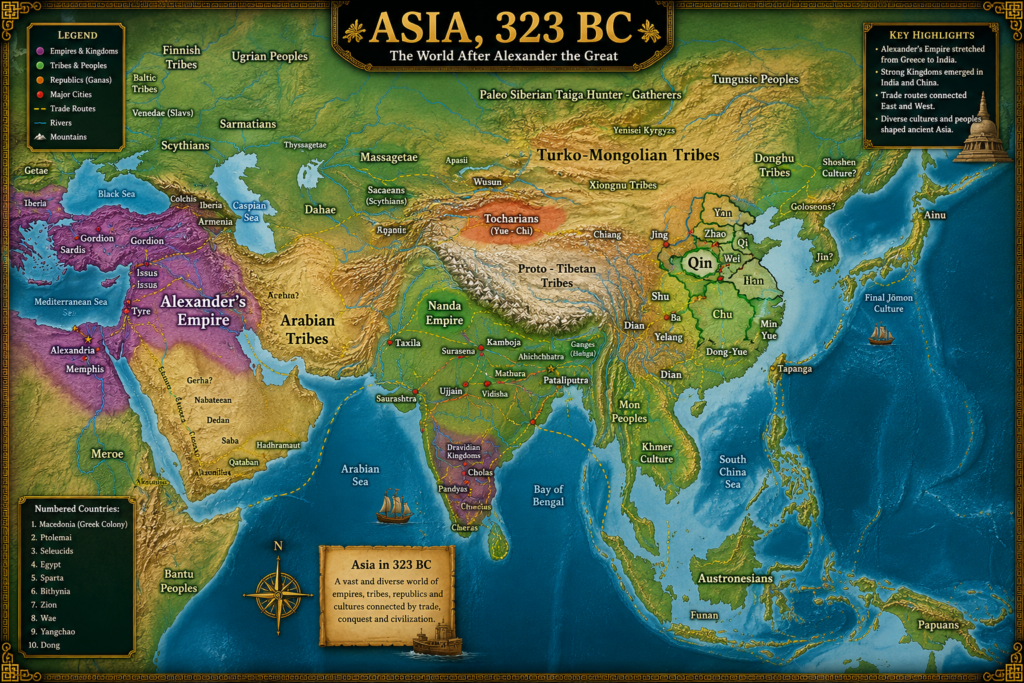

- The Nandas were also renowned for their immense wealth. They undertook irrigation projects, invented standardised measures for trade across their empire, and ruled with the assistance of many ministers.
- The Nanda dynasty is also mentioned in the ancient Sangam literature of the Tamil people — the famous Tamil poet Mamulanar described the capital city of Pataliputra under the Nandas, along with the wealth and treasure accumulated by its great rulers.
- The last king of the Nanda dynasty was Dhana Nanda (329–321 BCE). Their unpopularity — possibly owing to their “financial extortion” — facilitated a revolution that led to their overthrow by Chandragupta Maurya and Kautilya; nevertheless, “the greatness attained in the Maurya age would hardly have been possible but for the achievements of their predecessors,” the Nandas.
Model Answer: Magadhan Imperialism
Practice Question: Describe Magadhan Imperialism.
Answer: Magadha was one of the sixteen Mahajanapadas that flourished shortly before the time of Gautama Buddha. Of these sixteen, Magadha, Kosala, Vatsa, and Avanti rose to prominence and engaged in a struggle for supremacy; the republican confederacy of the Vrijis was also a strong contender. This struggle continued for about a century, and ultimately, Magadha emerged victorious, establishing itself as the supreme power. Magadhan imperialism was, in essence, the result of the efforts of enterprising and ambitious rulers such as Bimbisara, Ajatashatru, and Mahapadma Nanda.
Growth under Bimbisara
- Bimbisara, a contemporary of the Buddha, laid the foundation of Magadhan imperialism, initiating a policy of conquest and aggression that would ultimately culminate in Ashoka’s Kalinga war. He pursued a three-pronged policy:
- matrimonial alliances — for instance, with Kosala, Lichchhavi, and Madra;
- friendship with strong rulers — for instance, with Avanti; and
- conquest of weak neighbours to expand the empire — for instance, the conquest of Anga.
- Under his policy of matrimonial alliances, Bimbisara married the sister of Prasenjit, king of Kosala, who brought him the territory of Kashi in dowry — yielding a revenue of 1,00,000 coins; control over Kasi, together with friendship with Prasenjit, allowed Magadha to concentrate on other areas.
- His other wives were daughters of the chiefs of Lichchhavi and Madra (middle Punjab) respectively; these marriage relations with different princely families lent enormous diplomatic prestige and paved the way for Magadha’s expansion westward and northward.
- Bimbisara also conquered Anga, defeating its ruler Brahmadatta; the conquered territory was placed under the viceroyalty of his son Ajatashatru, based at Champa — a city of great importance for inland and maritime trade. Thus, Kashi and the conquest of Anga together became the launching pad for Magadha’s expansion.
- Magadha’s most serious rival was Avanti, with its capital at Ujjain. Its king, Chanda Pradyota Mahasena, fought Bimbisara, but the two eventually thought it wise to make peace; later, when Pradyota was afflicted with jaundice, Bimbisara sent his royal physician Jivaka to Ujjain at the Avanti king’s request.
- Bimbisara is also said to have received an embassy and a letter from the ruler of Gandhara, with whom Pradyota had fought unsuccessfully.
- Through his combination of conquest and diplomacy, Bimbisara made Magadha the dominant state in the sixth century BCE.
Growth under Ajatashatru
- Ajatashatru pursued an aggressive policy of expansion, showing no particular respect for family relations — he fought two wars and made preparations for a third.
- He first came into conflict with his maternal uncle Prasenajit, aggrieved by the treatment meted out to Bimbisara; Prasenajit asked Ajatashatru to return the territory of Kasi, given to his mother as dowry. Ajatashatru refused, and only after a fierce battle did Prasenajit agree to leave Kasi with Magadha.
- Similarly, Ajatashatru fought his maternal grandfather Chetak, chief of Vaishali, and after sixteen long years of war, succeeded in breaking the might of Vaishali — the pretext being that the Lichchhavis were allies of Koshala. He sowed dissension within the ranks of the Lichchhavis and eventually ended their independence, invading their territory and defeating them in battle.
- Ajatashatru thus not only retained Kasi, but also added Vaishali to Magadha.
- Ajatashatru faced a stronger rival in the ruler of Avanti: Avanti had defeated the Vatsas of Kaushambi and now threatened an invasion of Magadha. To meet this threat, Ajatashatru began the fortification of Rajgir, the remains of whose walls can still be seen — though the anticipated invasion never materialised during his lifetime.
- Ajatashatru was succeeded by Udayin (460–444 BCE), whose main contribution was building a fort at the confluence of the Ganga and Son rivers, at Pataliputra (Patna) — a strategically significant step, since the site was not only centrally located but also allowed easy movement of merchants and soldiers.
Growth under the Shishunaga Dynasty
- Udayin was succeeded by the Shishunaga dynasty; its most important achievement was the defeat of Avanti (Malwa), which it made a part of Magadha.
Growth under the Nanda Dynasty
- The Nandas proved to be the most powerful rulers of their time; Mahapadma Nanda, its most important ruler, possessed a large army and added Kalinga to his empire.
Growth under the Mauryan Dynasty
- The Mauryas built a vast empire on the foundations laid by the Nandas.
Chandragupta Maurya
- Many historians attribute great importance to the role Chandragupta Maurya played in ruthlessly stemming the tide of foreign interference in the north-west, and in suppressing indigenous rulers in western and southern India.
- Both Indian and classical sources agree that Chandragupta overthrew the last of the Nanda kings, occupied his capital Pataliputra, and ascended the throne around 321 BCE.
- Chandragupta’s political rise was also linked to the invasion of Alexander in the north-west. The years 325–323 BCE were crucial, since many of the governors stationed in the north-west after Alexander’s invasion were assassinated or forced to retreat, creating a vacuum that made it easier for Chandragupta to subdue the Greek garrisons left behind.
- What remains unclear is whether he achieved this before or after his accession to the Magadhan throne — Chandragupta may have first established himself in Punjab and then moved eastward until he gained control over the Magadha region. In any case, both tasks were complete by 321 BCE, setting the stage for further consolidation.
- One of Chandragupta’s first major military achievements was his contact with Seleucus Nikator, who ruled the area west of the Indus around 305 BCE. In the war that followed, Chandragupta emerged victorious, and peace was eventually established.
- In return for 500 elephants, Seleucus ceded him eastern Afghanistan, Baluchistan, and the area west of the Indus; a marriage alliance was also concluded. Seleucus further sent an ambassador, Megasthenes, who lived at Chandragupta’s court for many years.
- This achievement meant that the territorial foundation of the Mauryan Empire had been firmly laid, with the Indus and Gangetic plains well under Chandragupta’s control.
- A majority of scholars suggest that Chandragupta ultimately established control not only over the north-west and the Ganges plains, but also over western India and the Deccan — the only regions left outside his empire being present-day Kerala, Tamil Nadu, and parts of north-eastern India.
- The conquest and subjugation of Saurashtra (Kathiawar) in the extreme west is attested by the Junagadh Rock Inscription of Rudradaman, from the middle of the second century CE; this record refers to Chandragupta’s viceroy, Pushyagupta, who is said to have constructed the famous Sudarshana Lake — implying that Chandragupta also controlled the Malwa region.
- Details of his conquests in different parts of India are otherwise lacking; Greek writers simply mention that Chandragupta overran the whole country with an army of 600,000. Regarding his control over the Deccan, we rely on later sources — some medieval epigraphs indicate that Chandragupta protected parts of Karnataka, while Tamil writers of the early Sangam texts allude to the “Moriyar,” said to refer to the Mauryas’ contact with the south — though this likely refers to the reign of Chandragupta’s successor rather than his own.
Bindusara
- Bindusara is said to have succeeded Chandragupta Maurya in 297 BCE; comparatively little is known about him from either Indian or classical sources.
- A very late source — the sixteenth-century work of the Buddhist monk Taranatha of Tibet — tells of Bindusara’s warlike activities, claiming he destroyed the kings and nobles of about sixteen cities and reduced to submission all the territory between the eastern and western seas; the descriptions of early Tamil poets of Mauryan chariots thundering across the land probably refer to his reign.
- Many scholars believe that since Ashoka is credited with conquering only Kalinga, the extension of the Mauryan Empire beyond the Tungabhadra must have been the work of his predecessors — suggesting it was probably in Bindusara’s reign that Mauryan control of the Deccan, and the Mysore plateau in particular, was firmly entrenched.
- Though Bindusara is called the “slayer of foes,” his reign is not well documented, and the extent of his conquests can only be inferred by comparing them against a map of Ashoka’s empire, since Ashoka himself conquered only Kalinga (Orissa).
- After Bindusara’s death (around 273–272 BCE), there was a struggle for succession among his sons lasting about four years; ultimately, around 269–268 BCE, Ashoka was crowned as his successor.
Ashoka
- During his father’s reign, Ashoka served as viceroy at Ujjain and also at Taxila — it is suggested that he was sent to Taxila specifically to quell a revolt there.
- Ashoka fought a major war with Kalinga around 261 BCE, in which a large number of people were killed or imprisoned; Ashoka himself, in Rock Edict XIII, describes his conquest of Kalinga, said to have taken place eight years after his consecration.
- Though Ashoka was victorious on the battlefield, the inscription goes on to describe his remorse, which ultimately turned him towards Dhamma. A policy of conquest through war was given up and replaced by a policy of conquest through Dhammavijaya, and thereafter he favoured the dhammaghosha (drum of Dhamma) over the bherighosha (drum of war) — a shift meant to work at both the state and personal levels, and one that transformed the attitude of the king and his officials towards their subjects.
- The historian Romila Thapar presents the view that Dhamma was an ideological tool used by Ashoka to weld together and consolidate his far-flung empire, aimed at political integration through social harmony and cohesion among its different sects.
Conclusion
The rise of Magadha from one among sixteen Mahajanapadas to the seat of India’s first pan-Indian empire was the product of converging advantages — a defensible, resource-rich, and strategically located heartland; command over river-borne trade and the fertile Gangetic valley; a uniquely unbroken line of capable and ambitious rulers, from Bimbisara and Ajatashatru to Mahapadma Nanda; and a political landscape too fragmented to mount unified resistance. This trajectory, carried forward through the Haryanka, Shishunaga, and Nanda dynasties, culminated in the establishment of the Mauryan Empire under Chandragupta, Bindusara, and Ashoka — the first genuinely pan-Indian state in recorded history. For UPSC History Optional aspirants, tracing this continuous thread of imperial consolidation from Magadha’s regional rise to Mauryan paramountcy offers essential grounding in the political history of ancient India.




