

Unification of Italy (1850–1870)

The final unification of Italy (1850–1870) represents the culmination of decades of failed uprisings and fragmented nationalist sentiment discussed elsewhere in this series. Where Mazzini’s idealism and Garibaldi’s sword had repeatedly proven insufficient against Austrian military power, it was the calculated diplomacy of Camillo Benso di Cavour, Prime Minister of Piedmont-Sardinia, that transformed the “Italian Question” from a domestic Austrian affair into a matter of European concern. Through skilful use of Realpolitik — alliances with France and Britain, victories in the Crimean and Austro-Sardinian Wars, and calibrated cooperation with the revolutionary energy of Garibaldi — Cavour engineered the annexation of Lombardy, the Central Duchies, and the Kingdom of the Two Sicilies to Piedmont. The process concluded with the acquisition of Venetia (1866) and Rome (1870), completing the unification of Italy under King Victor Emmanuel II. This article examines the diplomatic and military milestones of 1850–1870, and closes with a comparative assessment of the contributions of Cavour, Mazzini, Garibaldi, and Victor Emmanuel II to the Italian Risorgimento.
Cavour Appointed as Prime Minister
- Camillo Benso di Cavour was born in 1810, the son of a Piedmontese noble of the Old Regime. He served as a military engineer and held liberal opinions, which attracted the hostile notice of the government.
- Finding himself cut off from professional advancement, he left service to develop his own estate and proved an excellent agriculturist. His study of English political ideas further confirmed his liberalism.
- In 1847, Cavour helped found and edit Il Risorgimento, a newspaper whose publication had been made possible by a recent relaxation of censorship, and which became the official voice of the Italian National Movement.
- He successfully pressed King Charles Albert of Sardinia to grant a constitution and form a constitutional monarchy, and in 1848 to go to war against Austria as the leading power in the Italian peninsula.
- The failure of this military action prompted the king to abdicate in favour of his son, Victor Emmanuel.
- Cavour served briefly as a member of parliament (1848–49), before becoming Minister of Agriculture, Industry, and Commerce (1850), Finance Minister (1851), and finally Prime Minister in 1852.
- He formed a coalition known as the connubio (“union”), uniting moderate men of the Right and the Left, which brought about the fall of the cabinet in November 1852.
- The King reluctantly accepted Cavour as the most conservative available choice for premier, though their relationship was never an easy one.
- Cavour’s premiership can be considered one of the most successful in history: when he took office, Piedmont had just suffered a crushing defeat at Austria’s hands; by the time he died, Victor Emmanuel II ruled a state five times larger, dominating Italy and ranking among Europe’s great powers.
Cavour’s Policy
- Cavour was broadly liberal, believing in free trade, freedom of opinion, and secular rule, but he was firmly opposed to republicans and revolutionaries, whom he regarded as disorganised radicals capable of upsetting the social order.
- He was the first statesman to recognise that only Piedmont-Sardinia could lead the war for Italian independence and unification, being himself a committed monarchist who sought unification under the crown.
- He placed great emphasis on social, economic, spiritual, and intellectual progress alongside purely political concerns.
- He believed that if Piedmont, under the House of Savoy, was to lead the national movement, she had to be made a model state — raised up politically, socially, economically, and spiritually — so that other Italian states would naturally recognise her leadership.
- In his own words: “It would gather to itself all living forces of Italy and will be in a position to lead her to the high destiny to which she is called… Piedmont must begin by raising herself, by re-establishing in Europe as well as in Italy a position and a credit equal to her ambition.”
Economic Reform
- Cavour believed that economic progress had to precede political change, and launched several initiatives to address Piedmont’s economic problems.
- He encouraged agriculture and industry, expanded trade and commerce through a policy of free trade, and stressed the advantages of railroad construction.
- A strong supporter of steam-powered transport, he sponsored numerous railroads and canals, reorganised the state budget, and increased taxation.
Internationalising the Problem of Italy, with Austria as the Main Enemy
- Drawing on the experience of Italian patriots over the preceding decades, Cavour desired the unity and independence of Italy, and openly detested Austria as “the oppressor of Italy.” He recognised her as the greatest obstacle to Italian liberty and unity, and understood that this goal could not be achieved without driving her out.
- However, he was equally realistic about the actual military weakness of the Italian states relative to Austria — a view that set him apart from Mazzini.
- Mazzini believed only Italians themselves could complete unification — “Italia farà da sé” (“Italy will fend for herself”) had been the motto of 1848 — but Cavour recognised that Italian unity could not be achieved so long as great powers like Austria and France retained both the capacity and the will to prevent it.
- His great achievement was to set aside the older methods of plots and insurrection in favour of new methods and tactics — chiefly, seeking the sympathy and active support of the Great Powers.
- A small state like Sardinia-Piedmont could not, alone or with help from the rest of Italy, match Austria’s superior numbers and strength; the support of a great military power was essential.
- The Italian Question also involved complex issues — the interests of the various princes and the position of the Pope — which could not be resolved without international cooperation, since any solution would require wholesale revision of the international settlement established at the Congress of Vienna.
- Cavour therefore sought to lift the Italian Question out of the realm of Austria’s domestic policy and make it a matter of European concern — making him the first statesman to internationalise the problem of Italy.
Reorganisation of the Army
- Cavour believed that the freedom and unity of Italy could be achieved only through war, and considered it essential to strengthen Piedmont’s military capacity against Austria.
- Accordingly, the military reorganisation of Piedmont formed a central element of his overall policy.
Reform of the Church
- As Prime Minister, Cavour sponsored policies promoting economic development, permitted some political liberalisation, and countenanced reforms that, in certain respects, compromised the Church’s position.
- Piedmont-Sardinia had already, in 1848, abolished ecclesiastical courts and introduced civil marriage — measures that drew strong protests from Pope Pius IX.
- Cavour’s new measures ordered the closure of roughly half the monastic houses within Sardinian territory and reduced the Church’s excessive privileges.
- He sought to divorce religion from politics, since the clergy strongly opposed Italian unity under Sardinian auspices, championing the principle of “a free church in a free state.”
- Throughout these measures, Cavour worked with and through Parliament, which thereby became the centre of the nation’s political life — and under his leadership, Piedmont came to occupy a commanding position within Italy.
Cavour and the Crimean War
- Realpolitik — the notion that politics must be conducted through a realistic assessment of power and national self-interest, pursued by whatever means necessary — was a doctrine Cavour employed with great skill.
- The domestic reforms Cavour initiated were merely a prelude to the second part of his programme: the union of Italy under the House of Savoy, achievable only with foreign assistance.
- The Crimean War (October 1853 – February 1856) saw Russia defeated by an alliance of France, the United Kingdom, the Ottoman Empire, and Sardinia, forming part of the wider Eastern Question.
- Its immediate cause concerned the rights of Christian minorities in the Holy Land, then under Ottoman control — France championing Catholic rights, and Russia those of the Orthodox Christians.
- The outbreak of the Crimean War presented Cavour with a “heaven-sent opportunity.” In 1855, as Prime Minister of Sardinia, he committed the kingdom to the British and French side, intending to use the eventual peace conference to give international publicity to the cause of Italian unification.
- Cavour had no genuine interest in the Eastern Question and no quarrel with Russia; his real aim was to secure allies for the unification of northern Italy.
- He seized the opportunity to join England and France, an alliance with great powers that would place them under a moral obligation to assist Italy at a later date.
- He committed Piedmont to the war in 1855, once Allied victory had become fairly certain.
- Peace negotiations at the Congress of Paris produced the Treaty of Paris, signed on 30 March 1856.
- A significant diplomatic victory was scored by tiny Piedmont, which — though not yet considered a “great” European power — was granted a seat at the Congress in recognition of the brilliant conduct of her troops.
- There, despite considerable Austrian opposition, Cavour raised the entire Italian Question before the assembled diplomats, delivering a damaging account of Austrian rule and denouncing Austrian political and military interference as a suppression of the Italian people’s right to self-government.
- The anomalous and unhappy condition of Italy was thus exposed to Europe, no longer discussed by revolutionaries alone but debated among representatives of the Great Powers — converting the Italian Question into a matter of genuine European concern, and raising Piedmont’s international prestige and sympathy.
Cavour Wins Over Napoleon III
- The next step in Cavour’s strategy was to win Napoleon III over to the Italian cause. The French Emperor was known to be sympathetic to Italy, having himself fought as a Carbonaro in 1831.
- At the Paris peace conference, Cavour found Britain and France sympathetic but entirely unwilling to defy Austrian wishes, since any move toward Italian independence would necessarily threaten Austria’s hold on Lombardy and Venetia. Private talks between Napoleon III and Cavour after the conference, however, identified Napoleon as the most likely — though still uncommitted — candidate for aiding Italy.
- Cavour skilfully cultivated Napoleon’s sympathy, and his efforts were unexpectedly reinforced by an assassination attempt on the French Emperor by an Italian, Felice Orsini.
- On 14 January 1858, Orsini led an attempt on Napoleon III’s life. The incident brought widespread sympathy for the Italian cause and had a profound effect on Napoleon himself.
- Though it initially seemed disastrous for Cavour’s hopes, he skilfully argued that such revolutionary crimes were the misguided acts of men driven to desperation by the oppressive rule of Austria and the Italian despots.
- His arguments were reinforced by Orsini’s own appeal to the Emperor: while awaiting trial, he wrote a public letter urging Napoleon to “set my country free,” promising that “the blessings of twenty-five million people will follow you everywhere and forever.”
- Moved and stimulated to action, Napoleon resolved to help Piedmont against Austria, partly to defuse the risk of future revolutionary upheaval inside Italy.
- After a covert meeting at Plombières in 1858 (the Compact of Plombières), Napoleon III and Cavour signed a secret treaty of alliance against Austria:
- France would help Sardinia-Piedmont fight Austria if attacked, driving Austria out of Lombardy and Venetia, which would then be added to Piedmont.
- Naples and Rome were to remain unmolested, while the rest of Italy was to be organised into a separate kingdom.
- As the price of his aid, Napoleon was to receive Nice and Savoy (the ancestral seat of the Piedmontese royal family), with the alliance further cemented by the marriage of Victor Emmanuel’s daughter to the Emperor’s cousin, Prince Jérôme Bonaparte.
- This secret alliance served both parties: it advanced the Sardinian (Piedmontese) plan of unification under the House of Savoy, while weakening Austria, a bitter rival of Napoleon III’s French Empire.
- That same year, Cavour dispatched his cousin, the celebrated beauty and secret agent Virginia Oldoini, to further the interests of Italian unification with the Emperor by whatever means possible — by most accounts, she succeeded, famously becoming Napoleon’s mistress.
The Austro-Sardinian War, 1859
(The Second Italian Independence War; the First was the Revolution of 1848.)
- The nine months between the Pact of Plombières and the outbreak of war were a period of mounting tension and difficulty for Cavour, who needed to find a suitable pretext for war.
- Unable to secure French assistance unless Austria attacked first, Cavour deliberately provoked Vienna through military manoeuvres near the border, hostile tariffs, press attacks, and the fomenting of disaffection in Lombardy and Venetia — eager to secure war before Napoleon III could change his mind.
- Britain, Prussia, and Russia proposed an international congress, one likely outcome of which would have been the disarmament of Piedmont.
- Napoleon III, facing domestic opposition to war, agreed to the English suggestion of a general disarmament for all parties involved.
- Cavour, in despair at the apparent wreck of his hopes — he even briefly contemplated suicide — was compelled to agree to Sardinia’s demobilisation.
- Austria, however, unwittingly rescued the situation by sending an ultimatum on 23 April, demanding Piedmont disarm instantly or face war — casting Austria as the aggressor and playing directly into Cavour’s hands.
- By rejecting the Austrian ultimatum, Cavour could appeal to France and present Piedmont to Europe as defending, not attacking. A relieved Napoleon III, who had hesitated to launch an aggressive war, was satisfied, and Cavour famously declared: “The die is cast, we have made history.” War broke out in 1859.
- The Austrian forces counted on a swift victory over the weaker Sardinian army before French reinforcements could arrive.
- The Austrian commander-in-chief, Field Marshal Gyulay, proved an unaggressive leader whose sluggish, indecisive advance soon petered out.
- Franco-Piedmontese forces advanced into Lombardy and defeated Austria at the Battles of Magenta and Solferino. Simultaneously, in northern Lombardy, Giuseppe Garibaldi’s volunteer “Hunters of the Alps” defeated the Austrians, clearing Lombardy of Austrian forces.
The Treaty of Villafranca (Armistice of Villafranca)
- The battles of Magenta and Solferino left Franco-Piedmontese forces in control of Lombardy; Venice was within reach and Austrian expulsion appeared certain.
- However, fearing possible Prussian entry into the war and the emergence of an over-strong Piedmontese state, Napoleon signed a separate peace with Austria — the Treaty of Villafranca, on 11 July 1859. Its terms provided that:
- Austria would cede Lombardy to Sardinia but retain Venetia.
- The rulers of Central Italy (Tuscany, Parma, and Modena), expelled by revolution shortly after the war began, would be restored, and an Italian federation formed under the presidency of the Pope.
- This deal, concluded by Napoleon behind the backs of his Sardinian allies, provoked great outrage in Sardinia-Piedmont — Cavour himself resigned in protest, though he later returned to office.
- The terms of Villafranca, however, were never actually implemented: although reaffirmed by the final Treaty of Zürich in November, the agreement had by then become a dead letter.
- The central Italian states remained occupied by Piedmontese forces, who showed no willingness to restore the deposed rulers, and the French showed no willingness to enforce the treaty’s terms.
- The Austrians could only watch in frustration at France’s failure to carry out the agreement.
- For the time being, Napoleon did not press his claim to Nice and Savoy (as agreed under the Compact of Plombières), since he had not pursued the war to the terms originally agreed.
Why Napoleon signed the Treaty of Villafranca:
- Prussia might have intervened on Austria’s behalf, since a decisive French victory would have threatened Prussian security.
- French losses had been heavy, and Austrian forces remained strongly entrenched in Venetia.
- The domestic situation in France was growing serious: the Catholic party opposed the war, fearing harm to the Pope in the event of a Piedmontese victory.
- Austria’s defeat had inspired such a surge of nationalism across north-central Italy that the population expelled their rulers and demanded union with Piedmont — a united Italy appeared genuinely dangerous to France, going well beyond what Napoleon had originally bargained for. Rather than a divided Italy under French hegemony, he now faced the prospect of a unified and potentially threatening neighbour.
Acquisition of Lombardy and the Sound Judgement of Victor Emmanuel
- Though Lombardy was secured, the truce of Villafranca was a bitter disappointment to Italians, dashing hopes of complete emancipation.
- Cavour, furious, urged the King to repudiate the treacherous treaty; when his advice went unheeded, he resigned.
- King Victor Emmanuel’s judgement, however, proved sounder than Cavour’s at this critical moment.
- He recognised the wisdom of accepting what could be gained and awaiting future opportunities, rather than risking everything at once.
- He understood that the determination of Italy’s future had passed out of the hands of diplomats and into those of the people — a judgement soon vindicated by subsequent events.
The Sympathetic Attitude of Britain and the Confusion of France
- English policy, now directed by Liberal ministers such as Palmerston and Russell, was openly sympathetic to Italian aspirations, championing non-intervention and the principle that Italians should be allowed to settle their own affairs.
- It was a fortunate circumstance for Italy that her cause found no better friend than the English Government during these critical years.
- Napoleon, meanwhile, remained confused: he could neither encourage the annexationist movement (in violation of the Treaty of Zürich) nor oppose it by force, given Britain’s stance.
- At this juncture, Cavour, having returned to office, found a way forward — reopening the offer of Savoy and Nice and thereby securing Napoleon’s consent to the changing situation.
Annexation of the Central Duchies and the Papal States
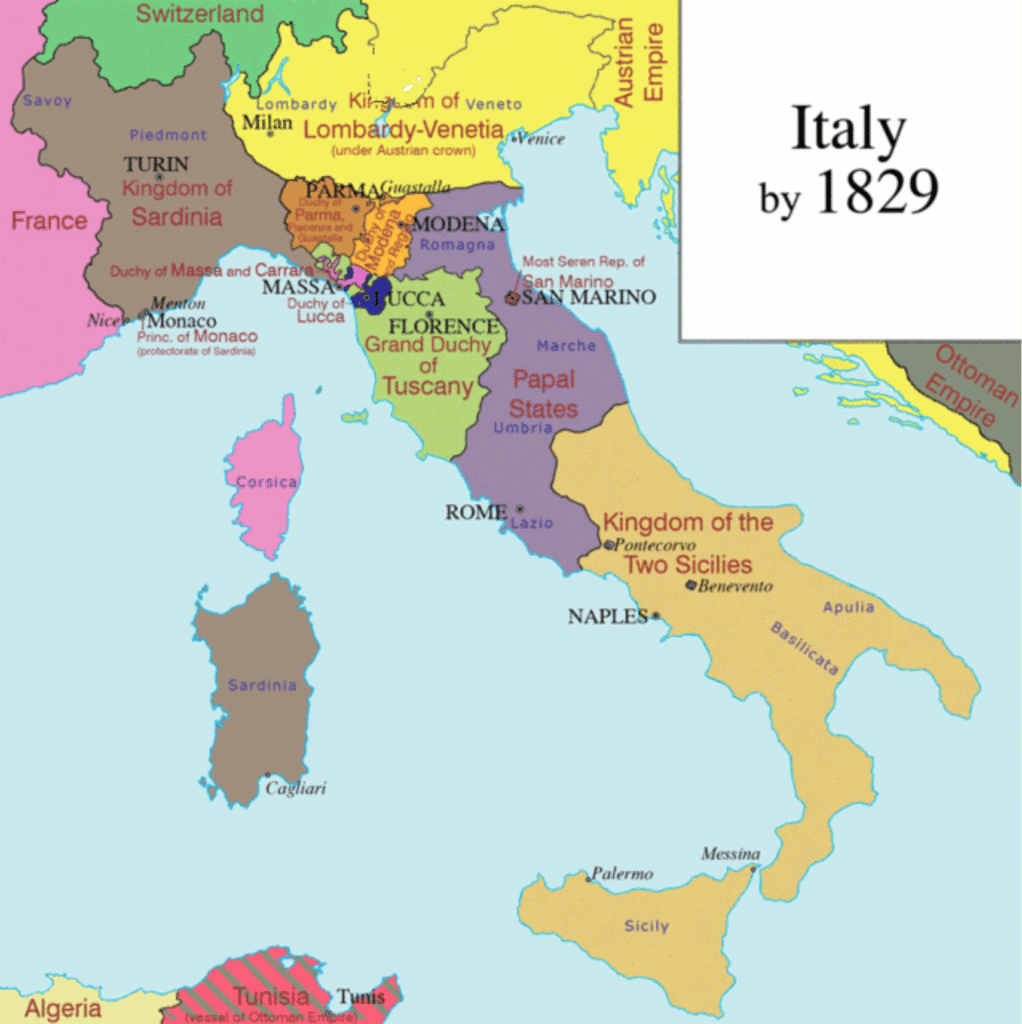
- News of the Austrian evacuation of Lombardy triggered popular revolts in the central duchies: Parma, Modena, and Tuscany rose up and expelled their rulers.
- In Romagna, the northernmost of the Papal States, the population repudiated the Pope’s temporal sovereignty.
- All these states established provisional governments and unanimously voted for fusion with Piedmont, leaving Napoleon unable to secure the restoration of the expelled rulers, as coercion became increasingly impossible.
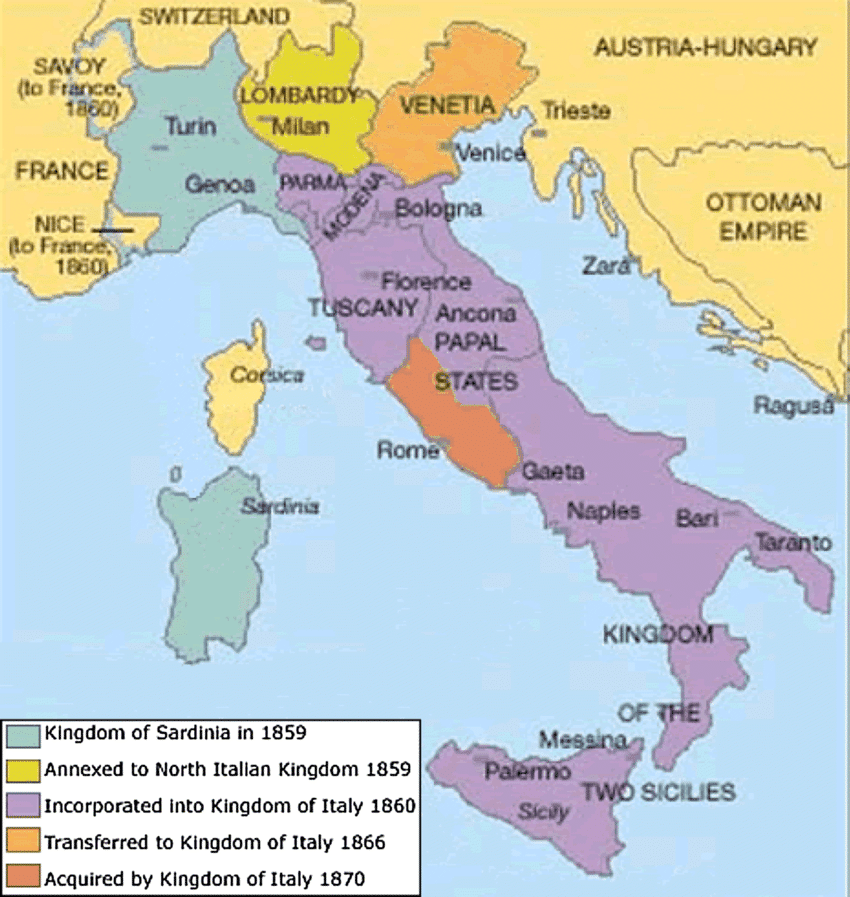
- The following year, in 1860, with French and British approval, the Duchy of Parma, Duchy of Modena, Grand Duchy of Tuscany, and the Papal States (Romagna) were annexed by the Kingdom of Sardinia following unanimous plebiscites in favour of union with Piedmont — the second step in Italian unification, after the annexation of Lombardy.
- Napoleon ultimately accepted this outcome once France received its deferred reward — Savoy and Nice — a move vehemently opposed by the Italian national hero Garibaldi, a native of Nice, and one that directly precipitated Garibaldi’s expedition to Sicily, which would complete the preliminary unification of Italy.
- With this, save for Venetia, the northern half of Italy was united and free of foreign rule.
Criticism of Cavour’s Assent to the Surrender of Nice and Savoy
- Cavour faced severe criticism for agreeing to the surrender of Nice and Savoy — in England, there was intense feeling against the enlargement of French territory.
- Nice was Garibaldi’s birthplace, and he felt bitterly that Cavour had made him a foreigner in his own land.
- Cavour, however, was guided by higher political considerations: refusal of the bargain might have provoked Franco-Austrian intervention, and it was highly unlikely that England would have backed its protest with armed intervention.
The Next Stage of Italian Unification
- Close on the heels of the unionist movement in the north, a similar movement gathered momentum in southern Italy.
- Following the annexation of Tuscany, Modena, Parma, and Romagna to Piedmont in March 1860, Italian nationalists turned their attention to the Kingdom of the Two Sicilies — comprising all of southern mainland Italy and Sicily — as the next step toward full unification.
- The Two Sicilies (Naples and Sicily), under Bourbon rule, seethed with discontent and was honeycombed with secret societies.
- Giuseppe Garibaldi, deeply resentful of the French annexation of his native Nice, initially hoped to use his supporters to reclaim the city. Cavour, terrified that this might provoke war with France, persuaded Garibaldi to direct his forces instead toward the Sicilian rebellions.
- The Sicilians appealed to Garibaldi, who promised assistance provided the revolt was undertaken in the name of Italy and Victor Emmanuel, and initiated by the Sicilians themselves.
- Thus assured of help — and further incited by Mazzini — the Sicilians rose in revolt, and Garibaldi assembled his volunteer army of a thousand men, the famous “Redshirts,” to support the rebellion.
The Expedition of the Thousand
- The Expedition of the Thousand, undertaken in 1860 by Giuseppe Garibaldi, overthrew the Bourbon Kingdom of the Two Sicilies (Naples), enabling the union of southern Italy and Sicily with the north.
- By 1860, Garibaldi had established a reputation as a successful military leader, wholly committed to Italian unification and, though sympathetic to democratic ideals, willing to work under Victor Emmanuel II for the sake of the national cause.
- Growing impatient with the cautious, diplomatic tactics of Cavour, Garibaldi grew ready to act on his own initiative.
- A revolt in Sicily beginning on 4 April 1860 prompted Garibaldi to launch an attack on the Bourbon kingdom in the south, with covert British support.
- Sicilian leaders were discontented with Neapolitan rule over the island.
- Britain, meanwhile, was concerned by Neapolitan overtures toward the Russian Empire, which was seeking Mediterranean access, and was further motivated by the desire to secure favourable economic terms for Sicilian sulfur, essential for the new generation of steamships, and by the growing strategic significance of Sicilian ports with the opening of the Suez Canal.
- By May 1860, Garibaldi had gathered over 1,000 volunteers, mostly idealistic young northerners — the Red Shirts.
- On the night of 5–6 May, he embarked from Genoa. The expedition landed at the western Sicilian port of Marsala on 11 May, aided by the presence of British ships in the harbour, which deterred Bourbon naval interference.
- This benevolent, semi-diplomatic British intervention helped save the expedition and formed part of Britain’s contribution to the cause of Italian unification.
Difficulty of Cavour’s Position:
- Cavour sympathised with the expedition’s objective but found himself in a difficult position: since the Piedmontese government was theoretically on amicable terms with Naples, it was his duty, as the responsible minister, to prevent Genoa’s port from being used as a base for attacking a neighbouring state — any encouragement of such an attack risking grave violation of European public law and possible intervention by other powers.
- Cavour’s policy was therefore to treat Garibaldi publicly as an unauthorised, independent adventurer, while outwardly maintaining strict neutrality.
- He nonetheless permitted the departure of Garibaldi’s expedition, provided such secret aid as he could, and used his diplomatic skill to deflect the protests raised by other powers upon learning of the expedition’s departure.
- Garibaldi faced the daunting task of defeating over 20,000 Neapolitan troops of the Bourbon King Francis II in Sicily with an untrained force armed only with rusty rifles.
- He defeated a Neapolitan force at Calatafimi (15 May), after which many Sicilians joined his cause to overthrow their despised Neapolitan rulers.
- Aided further by the incompetence of the Bourbon command, Garibaldi captured Palermo and, following the Battle of Milazzo (20 July), won control of nearly all of Sicily.
- Within three months, Garibaldi was master of the island and proclaimed himself dictator of Sicily in the name of Victor Emmanuel — a rapid conquest achieved by a handful of men, unmatched in the pages of history.
- Garibaldi, however, refused immediate annexation of Sicily to Piedmont, having his own plans for further operations, and remained impatient and distrustful of Cavour’s cautious diplomacy.
- Garibaldi now aimed to take Naples, and even to complete Italian unification through a march on papal Rome. His advance became a triumphal procession as King Francis II of Naples fled to Gaeta, precipitating the total collapse of Bourbon rule; Garibaldi entered Naples as a hero on 7 September.
Cavour Comes Into Action:
- Garibaldi’s brilliant success presented Cavour with an urgent and deeply complex problem.
- Flushed with victory and encouraged by republicans, Garibaldi contemplated pushing on to Rome — an advance that would certainly provoke war with France, since Rome was protected by a French garrison.
- There was also a real risk that Garibaldi, a republican at heart, might be persuaded by extremists to give the movement a republican character, as the Risorgimento was increasingly being co-opted by his radical followers — a development that risked civil war and the collapse of the national cause.
- To block Garibaldi’s march on Rome, Cavour engaged in careful political manoeuvring, famously declaring that Italy must be saved from “foreigners” (French intervention), an “evil principle” (Garibaldi’s republicanism), and a “madman” (Garibaldi himself).
- To ensure Piedmont retained leadership of the unification movement and to prevent any republican turn under Garibaldi, Cavour ordered Piedmontese troops under Victor Emmanuel to invade the papal territories of Umbria and Marche and join Garibaldi at Naples to keep him in check.
- Victor Emmanuel II invaded and defeated the Papal States, then advanced south to meet the Redshirts at Naples.
- Garibaldi, distrustful of the pragmatic Cavour — particularly over his role in the French annexation of Nice, Garibaldi’s own birthplace — nonetheless accepted Victor Emmanuel’s command, recognising that completion of unification was impossible under the existing circumstances.
- Garibaldi agreed to hold a plebiscite in the south, resulting in an overwhelming vote for annexation under Piedmont (21 October).
- On 26 October, Garibaldi met Victor Emmanuel and relinquished his dictatorship over the south into the king’s hands, allowing loyalty to the crown to triumph over personal ambition. With rare selflessness, he refused all honours and rewards, retiring into private life as a farmer.
- The Expedition of the Thousand remains one of the most celebrated episodes of the Risorgimento. With this, only Rome (held by the Pope with French assistance) and Venetia (held by Austria) remained to be added for complete Italian unification.
Victor Emmanuel Proclaimed King of Italy, and the Death of Cavour
- Victor Emmanuel completed the conquest that Garibaldi had, until then, carried out largely alone.
- The fall of the fortress of Gaeta led to the surrender of King Francis II of Naples in 1861, bringing military operations to a close.
- On 18 February 1861, Victor Emmanuel assembled the deputies of the first Italian Parliament at Turin.
- On 17 March 1861, the Parliament proclaimed Victor Emmanuel King of Italy, and on 27 March 1861, Rome was declared the capital of Italy — though the Italian government could not actually take its seat there, since a French garrison, maintained by Napoleon III, still held the city. Italy now possessed a liberal constitution.
- Three months later, with his life’s work nearly complete, Cavour died. On receiving the last rites, he is said to have declared: “Italy is made. All is safe.”
The Roman Question
- Mazzini remained discontented with the perpetuation of monarchical government and continued to agitate for a republic.
- With the motto “Free from the Alps to the Adriatic,” the unification movement now set its sights on Rome and Venice, though several obstacles remained:
- Any challenge to the Pope’s temporal dominion was viewed with great distrust by Catholics worldwide.
- French troops remained stationed in Rome.
- Victor Emmanuel, wary of the international repercussions of attacking the Papal States, discouraged his subjects from participating in revolutionary ventures aimed at Rome.
- Garibaldi, however, believed the government would ultimately support him if he attacked Rome.
- Frustrated by the king’s inaction and bristling at perceived snubs, he came out of retirement to organise a new campaign. In June 1862, he sailed from Genoa and landed again at Palermo, gathering volunteers under the slogan “Roma o Morte” (“Rome or Death”).
- Far from supporting this venture, the Italian government strongly disapproved and dispatched the regular army against Garibaldi’s volunteer bands.
- On 28 August, the two forces met at Aspromonte.
- Garibaldi forbade his men from returning fire against fellow subjects of the Kingdom of Italy; the volunteers suffered several casualties, and Garibaldi himself was honourably imprisoned for a time before being released.
- Meanwhile, Victor Emmanuel sought a safer path to acquiring the remaining papal territory, negotiating with Napoleon for the removal of French troops from Rome through a formal treaty — culminating in the September Convention.
The September Convention
- The September Convention was signed on 15 September 1864 between the Kingdom of Italy and the French Empire, under which:
- Napoleon III agreed to withdraw all French troops from Rome within two years.
- Victor Emmanuel II guaranteed the frontiers of the Papal States, then comprising Rome and Latium.
- The Italian government would relocate from Turin to Florence, signalling that it would not attempt to establish itself in Rome.
- This treaty was opposed by the Pope, French Catholics, and Italian patriots alike.
- The seat of government was moved in 1865 from Turin, the old Sardinian capital, to Florence, where the first Italian parliament convened.
- This transfer provoked such disturbances in Turin that the king was forced to leave the city hastily for his new capital; widespread anti-government riots broke out, killing hundreds of Italian civilians.
- The last French troops left Rome in December 1866, freeing Italy (excluding Venetia and Savoy) from the presence of foreign soldiers.
- Napoleon III hoped that the Italian government and Pope Pius IX would negotiate a compromise allowing the government to move from Florence to Rome, but the intransigent Pius IX rejected all such proposals.
- Italian patriots, led by Garibaldi, subsequently organised an invasion of Latium and Rome in October 1867, but were defeated at Mentana by 2,000 French troops dispatched by Napoleon III. A French garrison remained in Rome to prop up Pius IX’s rule.
The Third Independence War and the Acquisition of Venetia
(The Austro-Prussian War is termed Italy’s Third Independence War, following the First in 1848 and the Second in 1859.)
- Growing discord between Austria and Prussia over the German Question erupted into open war in 1866, offering Italy an opportunity to capture Venetia.
- On 8 April 1866, the Italian government signed a military alliance with Prussia (which supported Italy’s acquisition of Venetia), mediated by Emperor Napoleon III. On 20 June, Italy declared war on Austria.
- Despite Italian defeats at Custoza (on land) and Lissa (at sea) at Austria’s hands, the decisive Prussian victory at Sadowa forced Austria to surrender Venetia to the Italian king under the terms of the Peace of Prague.
- Venetia was formally annexed after a plebiscite, ensuring the transfer appeared as the will of the people rather than merely a French gift.
- The final unification of Italy would be completed three years later, with the Capture of Rome by the Kingdom of Italy and the subsequent plebiscite.
The Acquisition of Rome
- In July 1870, the Franco-Prussian War began.
- In early August, Napoleon III recalled his garrison from Rome — both because France urgently needed the troops for its own defence, and because Prussian diplomats were actively courting Italy to join the war, raising genuine concern that Italy might use the French presence in Rome as a pretext for hostilities with France.
- Italy, which had allied with Prussia during the earlier Austro-Prussian War and whose public opinion largely favoured the Prussian side, ultimately remained neutral in the Franco-Prussian War; the removal of the French garrison eased Franco-Italian tensions.
- With the French garrison gone, widespread public demonstrations demanded that the Italian government take Rome.
- Rome, however, technically remained under French protection on paper, so an outright attack could still have been regarded as an act of war against France. The Italians therefore remained unwilling to provoke Napoleon — until the surrender of Napoleon and his army at the Battle of Sedan transformed the situation entirely.
- The French Emperor was deposed, and the new French government was clearly in no position to retaliate against Italy, nor did it possess the political will to defend the Pope’s position.
The Capture of Rome
- King Victor Emmanuel II sent Pius IX a letter offering a face-saving proposal that would have allowed the peaceful entry of the Italian Army into Rome under the guise of protecting the Pope.
- Alongside the letter, the accompanying envoy carried a document (drafted by Lanza) setting out ten articles to serve as the basis for an agreement between Italy and the Holy See. Its main points were:
- The Pope would retain the inviolability and prerogatives attaching to him as a sovereign.
- The Italian state would guarantee the Pope’s freedom to communicate with the Catholic world, along with diplomatic immunity.
- Pius IX rejected the offer, since acceptance would have implicitly endorsed the legitimacy of the Italian kingdom’s rule over his former domains.
- Alongside the letter, the accompanying envoy carried a document (drafted by Lanza) setting out ten articles to serve as the basis for an agreement between Italy and the Holy See. Its main points were:
- The Italian Army crossed the papal frontier on 11 September and advanced toward Rome. Pius IX remained intransigent to the end, ordering his troops to offer only token resistance.
- On 20 September, Rome and Latium were annexed to the Kingdom of Italy, following a plebiscite held on 2 October.
- Pius IX declared himself a “prisoner in the Vatican,” although he was not actually restrained from coming and going.
- The Capture of Rome (20 September 1870) marked the final event of the long process of Italian unification, the Risorgimento — signalling both the final defeat of the Papal States under Pope Pius IX and the unification of the Italian peninsula under King Victor Emmanuel II of the House of Savoy, with Rome as its capital.
The Architects of Unification: Contrasting Contributions
- Italian unification is traditionally attributed to the combined efforts of four key figures:
- Mazzini’s moral enthusiasm — the Soul of Italian Unification.
- Garibaldi’s sword — the Sword of Italian Unification.
- Cavour’s diplomacy — the Mind of Italian Unification.
- Victor Emmanuel II’s tact and good sense.
- Three individuals in particular played a decisive role, each along a distinct path — Mazzini ideologically, Garibaldi militarily, and Cavour politically.
Mazzini
- Born in Genoa in 1805, then under French rule, Mazzini was drawn to revolutionary movements from an early age.
- He became a member of the Carbonari and, owing to his revolutionary activities, was arrested in 1831.
- Distrustful of any government’s willingness to introduce change, Mazzini believed the Italian people themselves could transform the nation’s fortunes, and concentrated on building a revolutionary movement more effective than the Carbonari.
- With the goal of transforming Italy into “one, independent, and free republic” through popular uprising, he created Young Italy — a movement that eventually spread to other countries as Young Europe.
- Although Mazzini believed his planned popular revolutions would achieve his vision, the uprisings that followed — including the 1834 Piedmont rising, organised with Garibaldi — all ended in failure. Once again arrested, Mazzini was forced into exile in London.
- He roused the enthusiasm of Italians, kept alight the sacred flame of nationalism, and gave the movement a moral ideal to strive for, infusing it with a strong moral fervour. It was he who prepared the ground for others — he was the prophet, thinker, and heart of Italian unity.
- Though his greatest contribution lay in the ideological realm, Mazzini also engaged with the political and military spheres.
- Revolutions he organised in towns such as Bologna (1843) and Milan (1853) all ended in failure, reflecting his strengths as an ideological rather than military leader.
- Politically, however, he achieved some success: during his exiles (1837–1840 and 1850), he gained British sympathy and support, lending the unification movement important international recognition.
- During the siege of Rome, he demonstrated genuine administrative capability as leader of the Roman government.
- When Mazzini realised his vision of a republican Italy was unlikely to materialise — as in Milan in 1848 — he stepped back. After 1849, he supported Garibaldi’s attempts to conquer Rome, though his own role in the unification movement was drawing to a close.
Garibaldi
- Garibaldi engaged with the unification movement in 1833, joining Young Italy, inspired by the vision of a united Italian state.
- Like Mazzini, following the failed Piedmont rising of 1834, he escaped to South America.
- His years in America were far from wasted: whereas his marine background had previously confined him to naval combat, he now learned how to fight on land.
- On hearing of the planned revolutions, Garibaldi returned to his homeland with his guerrilla force, the Red Shirts, and helped Mazzini defend Rome.
- He subsequently marched south, gradually winning over the southern Italian states, including Sicily and Naples.
- As a military leader, Garibaldi frequently had to make decisions with political and ideological implications.
- Unlike Mazzini, he never gave up and remained willing to compromise, fighting for a united Italy rather than for a fixed ideological vision.
- His handover of his southern conquests to Victor Emmanuel II in 1861 is a striking example of such political compromise, effectively uniting Italy through this single gesture — aware that continued expansionist action would risk war and potentially derail unification altogether.
- Garibaldi’s contribution was fundamentally military: he was a man of action who looked to the sword to free Italy, willing to strike and accept the outcome, hit or miss.
- It was he who forged a path with his sword when Cavour’s diplomacy stalled, and who, with rare self-effacement, handed the fruits of his victory to Victor Emmanuel II.
- Though a republican by conviction, he did not merely serve under the King of Sardinia but actively supported, against his own personal principles, the vision of a united Italy under the crown — loving his country more than his own ideals. He is often described as having “the heart of a lion but the mind of a fox.”
Cavour
- Cavour is often regarded as the real creator of Italy — the first statesman to study the Italian Question in all its aspects and complications.
- He demanded not merely the expulsion of Austria, but the extinction of the many princely houses and the destruction of the Pope’s temporal power.
- New methods and policy: The old approach of plots and spasmodic uprisings had been repeatedly discredited by failure. As a shrewd and observant politician, Cavour understood that achieving his aims demanded a delicate policy — strengthening Piedmont’s standing within both Italy and Europe, since no lasting change was possible without securing the goodwill and cooperation of the great powers.
- Tact and judgement: By joining the Crimean War against Russia, he won England’s sympathy and France’s active support; he later secured support for the coming war with Austria through the Pact of Plombières (1859).
- He guided and controlled the revolutionary movements in the central duchies, securing their annexation to Piedmont, and his sound judgement was again on display in 1861, when — to prevent conflict between France and Garibaldi — he sent Piedmontese troops to check Garibaldi’s zeal while ensuring the fruits of his victory were still reaped for the national cause.
- Skilful use of all available resources: Cavour channelled all the political forces of his time into a single current — Napoleon’s ambition, Mazzini’s inspiration, insurrectionary movements, and Garibaldi’s sword — earning his reputation as the master diplomat of his age.
- Cavour as an administrator: His brilliance as a diplomat has often overshadowed his equally significant achievements as an administrator; he was a pioneer of free trade in Europe, and his internal reforms materially aided Italian unification.
- Dealing with cultural differences: One important challenge of unification was managing Italy’s deep regional and cultural diversity.
- Despite his own leadership in introducing constitutional and liberal reforms in Sardinia, Cavour had little patience for regionalism once unification became his goal, crushing regional and cultural distinctions through moderately conservative social and political policies.
- In doing so, he began to alienate southern peasants and nobles, creating a regional divide that would later resurface as a challenge for a united Italy.
- The political path of unification belonged, to a great extent, to Cavour. Unlike Garibaldi and Mazzini, he never involved himself directly in revolutionary movements and had little sympathy for them.
- He was a moderate liberal for whom unification was not initially the primary aim — he began as a Piedmontese expansionist, seeking to strengthen his own country and force Austria’s withdrawal from Italy.
- After becoming Prime Minister in 1852, he steadily elevated Piedmont’s international standing — for instance, through participation in the Crimean War (1853–56).
- One of Cavour’s defining traits was his opportunism: recognising that the nationalist movements within Italy could endanger Piedmont’s position, he nonetheless managed to redirect them in service of his own broader aim — transforming, over time, from a Piedmontese expansionist into a politician whose actions became increasingly focused on unification itself.
- Unlike Garibaldi and Mazzini, Cavour’s direct involvement with the military was minor, and he held virtually no personal sympathy for nationalist ideology, which he found largely foreign and even faintly ridiculous — he was, in fact, openly at odds with Mazzini, the two men disliking each other intensely.
- When it came to military operations, Cavour never took part directly — he only planned them.
- Cavour and Garibaldi were, in many respects, complete opposites: Cavour was a politician of sophisticated intelligence who weighed every action with extreme caution, while Garibaldi was far more direct, willing to act decisively whenever he believed it would serve the cause.
- Garibaldi, a democrat, warrior, and anti-Catholic, was almost inevitably destined for conflict with Europe’s monarchies, whereas Cavour, representing a monarch, blended seamlessly with the political realities of the age.
- Cavour was, above all, a realist who practised genuine Realpolitik — allying with France when necessary, and later with France’s own rival, Prussia, when that too served Piedmont’s interests.
- By keeping his ultimate goal firmly in mind, Cavour used international power to achieve domestic ends, while Garibaldi was compelled to rely on his own grassroots strength, drawn from young Italian democrats inspired by an idealistic vision of the nation’s future.
Victor Emmanuel II
- Victor Emmanuel II’s common sense during moments of great crisis, his capacity for military organisation, his straightforwardness, and his steady support for his ministers proved invaluable to his country’s emancipation.
- As a long and complicated process, the unification of Italy required the devotion of many individuals, but equally demanded leaders capable of making the right decision at the right moment, fully conscious of the consequences.
- Although the contributions of Garibaldi, Mazzini, and Cavour were not equal in scale, together they built the essential foundation for a united Italy, each proving indispensable in his own distinct field:
- Mazzini — ideologically, spreading the spirit of nationalism across the country and striving, in his own way, to unite the state.
- Garibaldi — militarily, defending Rome, conquering the South, and demonstrating to the people what determined action could achieve.
- Cavour — politically, rationally planning every step of Piedmont’s strategy and, when necessary, subordinating his own ambitions to the greater national cause.
Conclusion
The unification of Italy between 1850 and 1870 demonstrates how idealism, military daring, and calculated diplomacy — often in tension with one another — can combine to achieve a historical outcome none of the individual actors could have secured alone. Cavour’s internationalisation of the Italian Question, his alliance with Napoleon III, and his careful management of Garibaldi’s revolutionary energy proved decisive in transforming a collection of fragmented states into a modern nation-state under Victor Emmanuel II. Yet the process also revealed enduring fault lines — between republicanism and monarchy, between northern and southern Italy, and between the Church and the new Italian state — that would continue to shape Italian politics long after 1870. For UPSC aspirants, this final phase of the Risorgimento offers a valuable comparative lens on how nationalism, diplomacy, and individual statesmanship interact in the process of nation-building.




