Colonisation and Decolonisation of Malaya

Malaya’s journey from a patchwork of Portuguese, Dutch and eventually British possessions to the independent, multiracial Federation of Malaysia offers one of the more intricate case studies in Asian decolonisation — shaped as much by internal ethnic complexity among Malays, Chinese and Indians as by the external pressures of the Second World War and the Cold War. Unlike many decolonisation stories that end cleanly at the moment of independence, Malaya’s continued to unfold well beyond 1957, through the formation of Malaysia in 1963, Singapore’s dramatic exit in 1965, and a prolonged communist insurgency that persisted into the late 1980s.
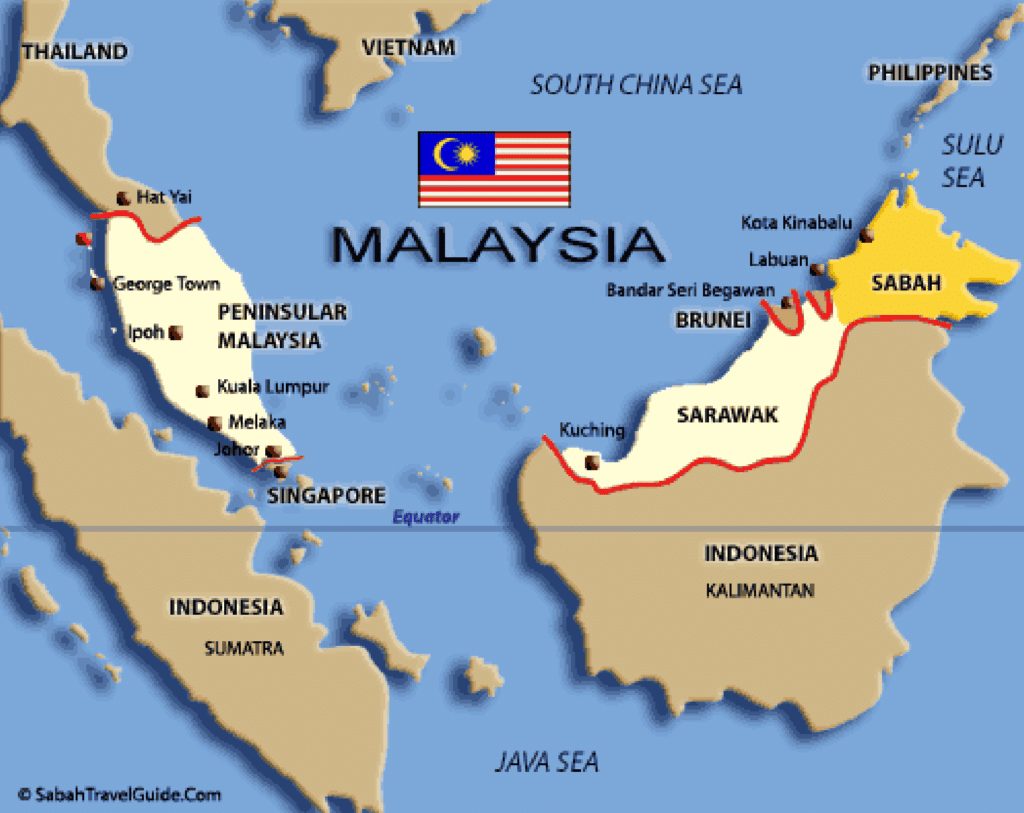
British Colonialism in Malaya: Origins
- Malacca was conquered by Portugal in 1511, before being taken by the Dutch in 1641 — setting the stage for European rivalry over the peninsula long before the British arrived.
When Did the British Come to Malaya?
- The British first arrived in the late 1700s.
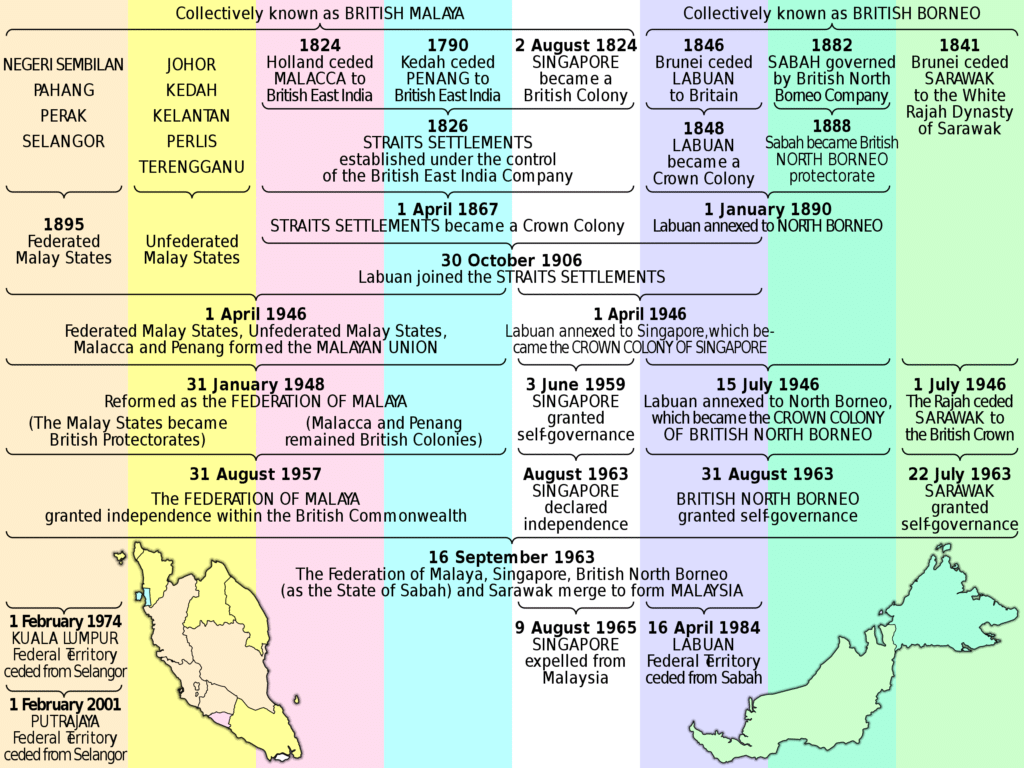
- In 1786, the British Empire established its first presence in Malaya, when the Sultan of Kedah leased Penang to the British East India Company. That same year, the British — under Sir Francis Light — occupied Penang and founded Georgetown.
- The British obtained the town of Singapore in 1819, and in 1824, took control of Malacca following the Anglo-Dutch Treaty.
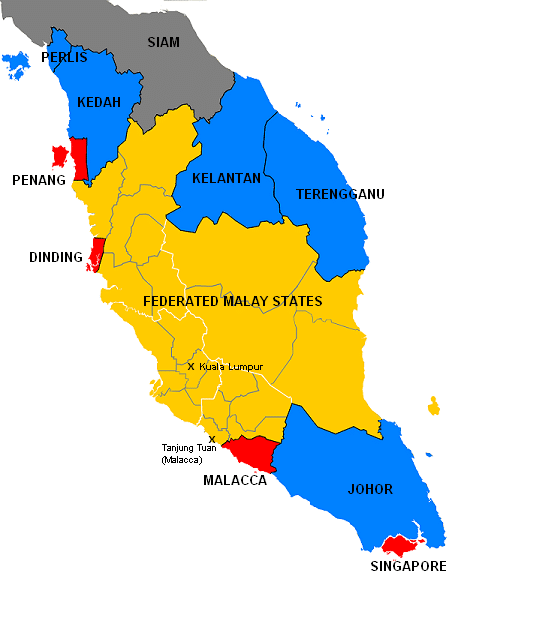
- By 1826, the British directly controlled Penang, Malacca, Singapore and the island of Labuan, consolidating them into the crown colony of the Straits Settlements.
- Development on the Malay Peninsula and in Borneo generally proceeded separately until the nineteenth century.
- The area now known as Sabah came under British control as North Borneo, after both the Sultan of Brunei and the Sultan of Sulu transferred their respective territorial rights between 1877 and 1878.
- In 1842, Sarawak was ceded by the Sultan of Brunei to James Brooke, whose successors ruled as the “White Rajahs” over an independent kingdom until 1946, when it became a Crown colony.
- By the late 1800s, the British East India Company traded extensively in the region and partly controlled its territories.
- By the twentieth century, the states of Pahang, Selangor, Perak and Negeri Sembilan — collectively known as the Federated Malay States — had British Residents appointed to advise the Malay rulers, to whom the rulers were bound by treaty to defer.
- The remaining five peninsular states, known as the Unfederated Malay States, while not under direct British rule, also accepted British advisers around the turn of the twentieth century.
Why Did the British Come to Malaya?
- The British were looking towards South East Asia for new resources.
- Key raw materials that drew the British to Malaya included pepper, resin, tobacco, oil palm and rubber.
- The growing China trade carried in British ships also increased the East India Company’s desire for regional bases nearby — a further reason for establishing a foothold in Malaya.
British Colonial Policies
- During British rule, Chinese and Indian labourers migrated to Malaya in large numbers, working as miners, merchants and planters.
- One policy the British in Malaya pursued with notable success was their conviction that Malaya “must be protected” from economic and cultural change, and that traditional class divisions should be preserved.
- Malay farmers were compelled to shift from subsistence farming to cash crops in order to pay colonial taxes.
- British policy actively promoted the production of crops such as tobacco, resin, oil palm, rubber and spices, with Malaya eventually becoming the world’s largest exporter of several of these commodities.
Malaya During the Second World War
- During the Second World War, the Japanese army invaded and occupied Malaya, North Borneo, Sarawak and Singapore for more than three years — a period that sharply raised ethnic tensions and fuelled the growth of nationalism.
- The Japanese were supported by young Malayan radicals belonging to the Kesatuan Melayu Muda (KMM) in British Malaya, and cooperated closely with Muslims, who were granted special protection.
- The fall of Singapore and Japan’s rapid advance across the Malay Peninsula forced the British to reconsider their earlier non-interventionist policies in favour of ethnic cooperation and multiracial government — though reconciling the diverse interests of different communities remained a genuinely difficult task.
- Popular support for independence grew markedly after Malaya was reconquered by Allied forces.
Decolonisation After the Second World War
- In the aftermath of the war, the imperial powers began transferring authority to indigenous populations across their colonies — a process termed decolonisation.
- Post-war economic problems complicated Malaya’s path forward.
- Malaya’s roads and infrastructure had been badly damaged during the war and required extensive rebuilding.
- International commodity prices and exchange rates remained highly volatile amid the broader post-war reorganisation of the global economy.
- A third of Malayan jobs, and the majority of its foreign exchange earnings, depended on rubber plantations — but the invention of synthetic rubber led owners to gradually cut wages and workforce numbers. The resulting unemployment became fertile ground for communist insurgency and political unrest.
The Complexity of Post-War Malaya
- Malaya was liberated from Japanese occupation in 1945, but several difficult problems had to be resolved before the British were prepared to withdraw.
- The territory itself was a complex patchwork, consisting of nine states, each ruled by a sultan, two British settlements — Malacca and Penang — and Singapore, a small island less than a mile from the mainland.
- The population was thoroughly multiracial — predominantly Malay and Chinese, with sizeable Indian and European minorities as well. In descending order of population share, Malaya’s racial composition ran: indigenous Malays, Chinese, then Indians.
- Post-war British plans to unite Malaya’s administration under a single crown colony, the Malayan Union, met with strong Malay opposition, centred on fears that it would weaken the Malay rulers and grant citizenship too readily to the ethnic Chinese population.
- The Malayan Union, established in 1946 and covering all British possessions on the Malay Peninsula except Singapore, was quickly dissolved and replaced by the Federation of Malaya, which restored a measure of autonomy to the rulers of the Malay states under continued British protection.
- In preparation for eventual independence, it was decided to group the states and settlements into the Federation of Malaya (1948), while Singapore remained a separate colony.
- Each state retained its own legislature for local affairs; the sultans kept some measure of power, but the central government held firm overall control.
- All adults were granted the vote — a franchise that, given their numbers, usually ensured the Malays, as the largest community, dominated political affairs.
The Malayan Emergency and the Communist Insurgency
- Chinese communist guerrillas, organised as the Malayan Communist Party and led by Chin Peng — who had played a leading role in resisting the Japanese — now began stirring up strikes and violence against the British in support of an independent communist state.
- The British declared a state of emergency in 1948, and ultimately dealt with the communist insurgency successfully, though it took considerable time — the state of emergency remained in force until 1960.
- A key British tactic was to resettle Chinese residents suspected of aiding the guerrillas into specially guarded villages.
- The British made clear that independence would follow as soon as the country was ready — a promise that helped keep the Malays firmly pro-British and left them offering very little support to the largely Chinese communist insurgency.
- The British declared a state of emergency in 1948, and ultimately dealt with the communist insurgency successfully, though it took considerable time — the state of emergency remained in force until 1960.
- Throughout this period, countering the threat of communism was a major theme shaping the wider process of decolonisation, set against the backdrop of the emerging Cold War.
The Road to Independence (1957)
- The move towards independence accelerated once the Malay Party, under its able leader Tunku Abdul Rahman, joined forces with the main Chinese and Indian political groups to form the Alliance Party, which won 51 of the 52 seats contested in the 1955 elections.
- This decisive result suggested political stability, persuading the British to grant full independence in 1957 through peaceful talks and negotiations — with Malaya subsequently admitted to the Commonwealth.
- The Federation of Malaysia was set up in 1963. Under Tunku’s leadership, Malaya prospered, its economy — built on exports of rubber and tin — becoming the most prosperous in South East Asia.
Formation of the Federation of Malaysia (1963)
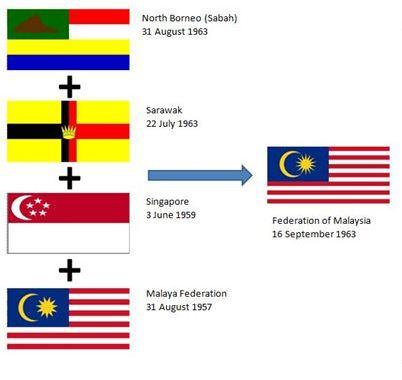
- In 1961, when Tunku proposed that Singapore and three other British colonies — North Borneo (Sabah), Brunei and Sarawak — should join Malaya to form the Federation of Malaysia, Britain readily agreed.
- This proposal, however, could not be realised until the mid-1960s, owing to opposition from Indonesia, the Philippines and, ultimately, Brunei (1963).
- After a United Nations investigation team reported that a large majority of the populations concerned favoured the union, the Federation of Malaysia was officially proclaimed in September 1963.
- Brunei ultimately chose not to join, and eventually became an independent state within the Commonwealth in 1984.
- Singapore became part of Malaysia on 16 September 1963, with Malaysia emerging as a new political entity formed from the merger of the Federation of Malaya with North Borneo, Sarawak and Singapore — marking the end of a 144-year period of British rule in Singapore, dating back to the founding of modern Singapore by Sir Stamford Raffles in 1819.
Singapore’s Merger and Exit (1963–65)
- The new union, however, proved unstable, undermined by distrust and ideological differences between the leaders of the State of Singapore and the Federal Government of Malaysia, producing frequent disagreements over economics, finance and politics.
- The federation also brought heightened regional tensions, including a conflict with Indonesia (the Konfrontasi), alongside Singapore’s eventual departure in 1965.
- Singapore left the federation within two years, owing to persistent political and economic disputes, and declared itself an independent republic in 1965.
- Although Singapore chose to leave, the rest of the Federation of Malaysia continued to function successfully.
- These events and the accompanying uncertainty left the economies and politics of the Malay Peninsula countries in a somewhat fragile state.
Post-Independence Malaysia: Ethnic Tensions and the Cold War
- Given the large indigenous Malay population, post-independence Malaysia adopted Islam as the national religion and Malay as the national language, with the government also introducing reservation quotas in favour of the indigenous Malay community.
- The Chinese community, however, remained ahead of the other two groups in education and economic opportunity. They formed an opposition party that went on to win a subsequent general election — a result that triggered racial riots and a fresh state of emergency.
- Disenchanted sections of the Chinese community were increasingly drawn into the ranks of communist insurgents. The ongoing Cold War and Vietnam War further complicated matters through the involvement of foreign players, and the resulting insurgency continued to disturb Malaysia’s peace efforts and nation-building well into the late 1980s.
- Cold War ideological rivalry was a persistent undercurrent across the Malayan Peninsula, where the rise of Comintern-aligned communist parties — such as the Malayan Communist Party and the Chinese Communist Organisation — raised real fears of the peninsula falling to communism.
- This prospect was viewed as a genuine nightmare by the liberal democracies and colonial powers, particularly Britain, which worked accordingly to ensure that power was transferred to ideologically friendly regimes.