

Rise of Provincial Dynasties: Bengal

Timur’s invasion of Delhi in 1398 hastened the final downfall of the Tughluq dynasty, and with it, the political unity of the Delhi Sultanate — a process of fragmentation that was already well underway, with Gujarat, Malwa, Jaunpur, Sindh, Multan, and the Deccan breaking away, and the Rajput states of Rajputana asserting independence following the expulsion of the Muslim governor from Ajmer. Yet, far from being a period of unrelieved decline, the 15th century in north India was marked by a genuine balance of power among these newly independent provincial kingdoms, and by vigorous cultural developments within each. Among these provincial powers, Bengal stands out as one of the most enduring and culturally significant — a region that had long exploited its distance, difficult communications, and unsuitable climate to repeatedly assert independence from Delhi, and which, under dynasties such as the Ilyas Shahis and the Husain Shahis, developed into a flourishing centre of trade, religious tolerance, and Bengali literary culture.
This article examines the broader political and cultural context of provincial fragmentation in 15th-century north India, before tracing in detail the rise, consolidation, and cultural achievements of the independent Sultanate of Bengal.
Political Situation and Balance of Power in North India
- Timur’s invasion of Delhi in 1398 hastened the downfall of the Tughluq dynasty, and the end of the Sultanate of Delhi.
- Even before Timur’s invasion, the weakness of the Delhi Sultanate had become manifest to all — with the emergence of two rival kings, one at Firuzabad and another at Delhi, and the breaking away of many provincial kingdoms.
- The Deccani states, Bengal in the east, and Sindh and Multan in the west had already broken away towards the end of Muhammad bin Tughlaq’s rule, and Firuz had reconciled himself to this loss.
- Following the Timurid invasion, the governors of Gujarat, Malwa, and Jaunpur declared themselves independent.
- With the expulsion of the Muslim governor from Ajmer, the various states of Rajputana also asserted their independence.
- Even within the Delhi region itself, the rulers were hard put to assert their control.
- While these various provincial kingdoms and Rajput states fought against each other, the 15th century was not a period of decadence and decline in north India.
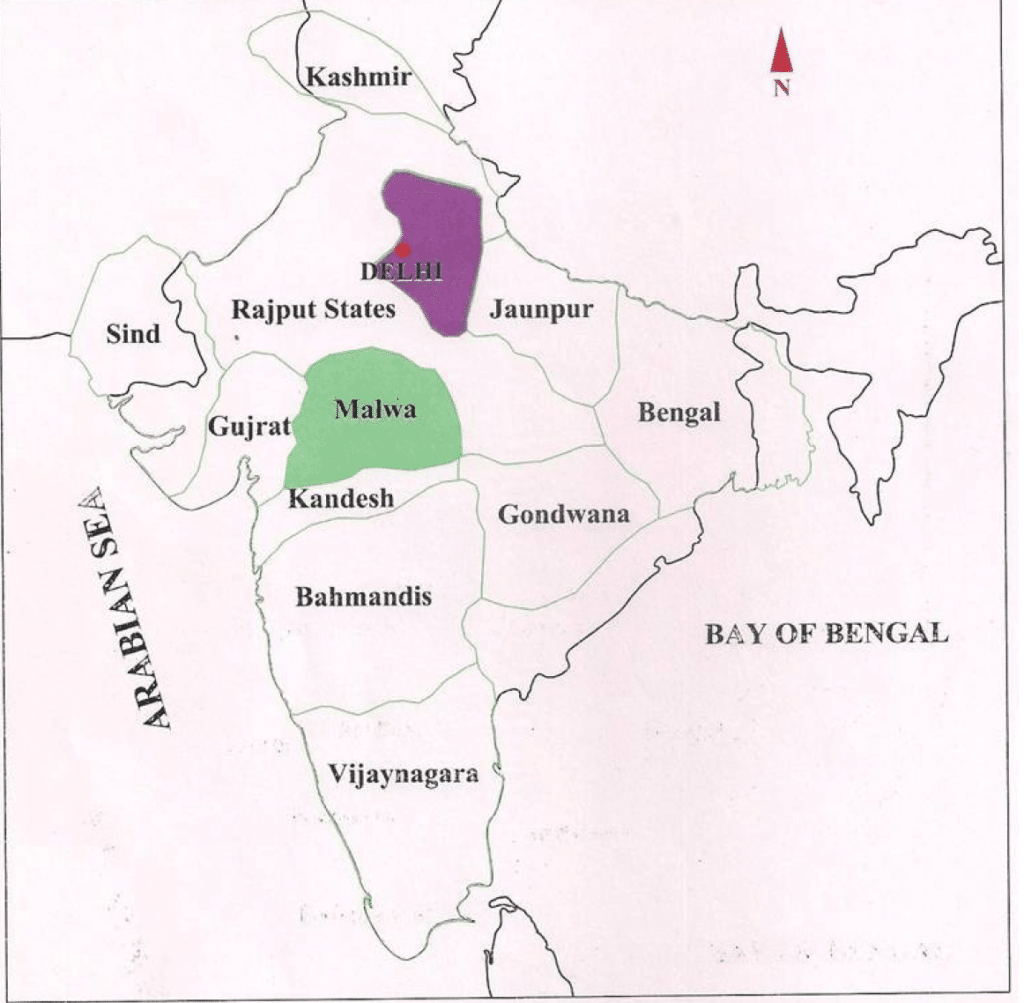
Political Dimension: The Balance of Power
- Warfare between the various states rarely extended beyond the border regions, with a definite pattern of balance of power emerging among the states located in different regions.
- In the west, Gujarat, Malwa, and Mewar balanced and checked the growth of each other’s power.
- In the east, Bengal was checked by the Gajapati rulers of Orissa, as well as by the Sharqi rulers of Jaunpur.
- In the north, while Kashmir remained aloof, the rise of the Lodis at Delhi towards the middle of the 15th century led to a long-drawn-out struggle between them and the rulers of Jaunpur, for mastery of the Ganga-Jamuna doab.
- This balance of power began to break down by the end of the 15th century.
- With the final defeat of Jaunpur by the Lodis, and the extension of their rule from Punjab up to the borders of Bengal, the Sultanate of Delhi had been virtually re-established, and the pressure now shifted onto eastern Rajasthan and Malwa.
- Meanwhile, Malwa itself began disintegrating due to internal factors, sharpening the rivalry between Gujarat and Mewar.
- The Lodis, too, were keen to extend their rule over the region.
- Thus, Malwa became the cockpit of the struggle for mastery of north India.
Cultural Dimension
- The new kingdoms tried to utilise local cultural forms and traditions for their own purposes.
- This was mostly manifested in the field of architecture, where efforts were made to adopt and adapt the new architectural forms developed by the Turks, by utilising local forms and traditions.
- In many cases, encouragement was given to local languages, while political necessity compelled many of these kingdoms to establish a closer association with Hindu ruling elites.
- This had an effect on the processes of cultural rapprochement between Hindus and Muslims, which had been working apace.
Eastern India: Bengal
- Bengal had frequently asserted its independence from Delhi, taking advantage of:
- Distance.
- Difficulty of communications, by land or water.
- A hot and humid climate, which did not suit soldiers and others accustomed to the drier climate of north-western India.
- Due to Muhammad Tughlaq’s preoccupation with rebellions in various quarters, Bengal again broke away from Delhi in 1338.
- In 1342, one of the nobles, Ilyas Khan, captured Lakhnauti and Sonargaon, and ascended the throne under the title Sultan Shamsuddin Ilyas Khan.
Sultan Shamsuddin Ilyas Khan (1342–1358)
- He became the Sultan of the kingdom of Lakhnauti in 1342, and after conquering the kingdom of Sonargaon in 1352, became the sole ruler of the whole of Bengal — thereby becoming the founder of a unified Bengal Sultanate.
- He founded the Ilyas Shahi dynasty, which ruled Bengal for 73 years (1342–1415), and — after a gap of 20 years (1415–1435) — the dynasty again ruled Bengal for 52 years (1435–1487).
- Ilyas Shah was succeeded by his son, Sikandar Shah.
- Ilyas extended his dominions in the west, from Tirhut to Champaran and Gorakhpur, and finally up to Banaras.
- This forced Firuz Tughlaq to undertake a campaign against him. Firuz Tughlaq occupied the Bengali capital, Pandua, forcing Ilyas to seek shelter in the strong fort of Ekdala.
- After a siege of two months, in a hard-fought battle, the Bengali forces were defeated, but Ilyas Khan once again retreated into Ekdala.
- Finally, a treaty of friendship was concluded, by which the river Kosi in Bihar was fixed as the boundary between the two kingdoms.
- Though Ilyas exchanged regular gifts with Firuz, he was in no way subordinate to him.
- Friendly relations with Delhi enabled Ilyas to extend his control over the kingdom of Kamrup (Assam). He also made plundering raids up to Kathmandu in Nepal, and into Orissa.
- Ilyas Shah was a popular ruler:
- When Firuz was at Pandua, he tried to win over the inhabitants of the city to his side, by giving liberal grants of land to nobles, the clergy, and other deserving people — his attempt failed.
- Firuz Tughlaq invaded Bengal a second time when Ilyas died, and his son Sikandar succeeded to the throne.
- Sikandar followed the tactics of his father, retreating to Ekdala.
- Firuz failed once again to capture it, and had to beat a retreat.
- After this, Bengal was left alone for about 200 years, and was not invaded again till 1538 — after the Mughals had established their power at Delhi.
- It was overrun by Sher Shah in 1538, but Akbar had to reconquer it after the end of the Sur dynasty.
Ghiyasuddin Azam Shah (1389–1409)
- Ghiyasuddin Azam Shah was the third Sultan of the first Ilyas Shahi dynasty of Bengal.
- His tomb is situated in Narayanganj, Bangladesh.
- He was known for his love of justice.
- Azam Shah had close relations with famous learned men, including the celebrated Persian poet Hafiz of Shiraz.
- Ghiyasuddin was a patron of scholars and poets; the Persian poet Hafiz was in correspondence with him.
- Shah Muhammad Sagir, a Bengali poet, wrote his famous work, Yusuf-Zulekha, during Ghiyasuddin’s reign.
- Also during his time, the Krittivasi Ramayan — a translation of the Ramayana into Bengali — was written by the Hindu poet Krittibas Ojha.
- He re-established friendly relations with the Chinese.
- The Chinese emperor received his envoy cordially, and in 1409, sent his own envoy with presents to the Sultan and his wife, along with a request to send Buddhist monks to China — this was done.
- Incidentally, this shows that Buddhism had not died out completely in Bengal by this time.
- Six years later, his successor, Sultan Saifuddin, again sent a letter written on a gold plate, along with a giraffe, to the Chinese emperor.
- The Chinese emperor received his envoy cordially, and in 1409, sent his own envoy with presents to the Sultan and his wife, along with a request to send Buddhist monks to China — this was done.
- The revival of contact with China helped in the growth of Bengal’s overseas trade.
- Chittagong became a flourishing port for trade with China.
- Ocean-going ships were built in Bengal, and its exports included fine-quality textiles.
- Bengal also became a centre for the re-export of Chinese goods.
- Ma Huan, the Chinese interpreter to the Chinese envoy, has left an account, mentioning mulberry trees, the production of silk in Bengal, and paper as glossy as deer’s skin.
Sufis in Bengal
- During this period, many Sufis came to Bengal. They were welcomed by the Sultan, and encouraged with grants of rent-free land.
- These saints impressed the people by their simple style of living, and their deep devotion and saintliness.
- These saints are credited with effecting conversions to Islam on a large scale, particularly in the eastern part of Bengal, where Buddhism was widely prevalent, and poverty was widespread.
- Perhaps, the conversions were also due, in large measure, to social, cultural, and other factors.
Other Rulers: Raja Ganesh and the Interregnum
- Powerful Hindu rajas continued to live under the Muslim rulers of Bengal, remaining associated with the affairs of the state.
- Raja Ganesh of Dinajpur, who had a large estate and his own army, first became a kingmaker to the successors of the Sultan, and later assumed the throne himself.
- Some of the Turkish nobles and theologians sent an invitation to the ruler of Jaunpur to reclaim the land of Islam from the Hindus.
- A Jaunpur army was sent to Gaur for this purpose, and won a victory — but it could not stay on, because of the active struggle between the rulers of Jaunpur and Delhi.
- Raja Ganesh, who was an old man, died soon after, and was succeeded by his son, who preferred to rule as a Muslim.
- However, the affairs of the kingdom remained unsettled until Alauddin Husain succeeded to the throne in 1493, setting up a new dynasty, which continued to rule until the rise of Sher Shah.
Alauddin Husain Shah (Reign 1494–1519)
- He founded the Hussain Shahi dynasty.
- He became ruler of Bengal after assassinating the Abyssinian Sultan, Muzaffar Shah, under whom he had served as wazir.
- After his death in 1519, his son Nusrat Shah succeeded him.
- Husain Shah’s long reign was a period of peace and prosperity.
Initial Administrative Actions
- Immediately after his accession, Husain Shah ordered his soldiers to desist from pillaging Gaur, his capital city.
- But when they continued to do so, he executed many soldiers, and recovered the pillaged articles, which included 13,000 gold plates.
- Next, he disbanded the paiks (the palace guards), who were the most significant agitators inside the palace.
- He removed all Habshis (Abyssinians) from administrative posts, replacing them with Turks, Arabs, Afghans, and local people.
Engagement with the Delhi Sultanate
- Hussain Shah Sharqi, after being defeated by Bahlol Lodi, retired to Bihar, where he was confined to a small territory.
- In 1494, he was again defeated by Sikandar Lodi, and fled to Bengal, where he was granted asylum by Sultan Alauddin Husain Shah.
- This resulted in an expedition against Bengal in 1495 by Sikandar Lodi.
- The armies of Delhi and Bengal met at Barh, near Patna.
- Sikandar Lodi halted the advance of his army, and concluded a treaty of friendship with Alauddin Husain Shah.
- According to this agreement, the area west of Barh went to Sikandar Lodi, while the area east of Barh remained under Husain Shah of Bengal.
- The final dissolution of the Jaunpur Sultanate resulted in an influx of Jaunpur soldiery into the Bengal army, which was further strengthened by it.
- Husain Shah tried to extend his territories — in the north into Assam, in the south-west towards Orissa, and in the south-east towards Chittagong and Arakan.
- He was most successful in extending his empire towards Chittagong and Arakan.
- Control over the port of Chittagong was an important link with overseas trade with South-East Asia, extending up to China on the one hand, and Africa on the other.
The Kamata-Kamrup Expedition
- Husain Shah’s general Shah Ismail Ghazi led an expedition to the Kamata kingdom, and annexed the territory up to Hajo.
- They took Nilambara, the king of Kamata, prisoner, and pillaged the capital city — publicly recorded in an inscription at Malda.
The Orissa Campaigns
- Shah Ismail Ghazi commenced his campaign from the Mandaran fort (in Hooghly district) in 1508–9, and reached Puri, raiding Jajpur and Katak along the way.
- The Gajapati ruler of Orissa, Prataparudra, was busy in a campaign in the south.
- On hearing this news, he returned, and defeated the invading Bengal army. He reached the Mandaran fort, and besieged it, but failed to take it.
- Intermittent hostilities between the Bengal and Orissa armies along the border continued throughout the reign of Husain Shah.
- The Portuguese explorer, Vasco da Gama, arrived in India by sea in 1498.
- Consequently, a Portuguese mission came to Bengal to establish diplomatic relations, towards the end of Husain Shah’s reign.
Cultural Contribution
- The reign of Husain Shah witnessed a remarkable development of Bengali literature.
- Under the patronage of Paragal Khan, Husain Shah’s governor of Chittagong:
- Kabindra Parameshvar wrote his Pandabbijay, a Bengali adaptation of the Mahabharata, eulogising Husain Shah as the incarnation of Krishna in the Kaliyuga.
- Under the patronage of Paragal’s son, Chhuti Khan, who succeeded his father as governor of Chittagong, Shrikar Nandi wrote another Bengali adaptation of the Mahabharata.
- Bijay Gupta wrote his Manasamangal Kavya also during his reign, eulogising Husain Shah by comparing him with Arjuna.
- An official of Husain Shah, Yashoraj Khan, wrote a number of Vaishnava padas, and also praised his ruler in one of his padas.
Religious Tolerance
- The reign of Husain Shah is also known for religious tolerance towards his Hindu subjects in Bengal.
- His wazir was a Hindu.
- The chief physician, the chief of the bodyguard, and the master of the mint were all Hindus.
- The two Vaishnava brothers, Rupa and Sanatan, held high posts, one of them serving as the Sultan’s private secretary.
- Krittibas, the translator of the Ramayana into Bengali, was closely associated with Sanatan.
- However, during his Orissa campaigns, he destroyed Hindu temples.
- The celebrated saint Chaitanya Mahaprabhu and his followers preached the Bhakti cult throughout Bengal during his reign.
- When Husain Shah learned of Chaitanya Mahaprabhu’s huge following among his subjects, he ordered his qazis not to injure him in any way, and to allow him to go wherever he liked.
- Later, two high-level Hindu officers in his administration — his Private Secretary (Dabir-i-Khas), Rupa Goswami, and his Intimate Minister (Saghir Malik), Sanatana Goswami — became devoted followers of Chaitanya Mahaprabhu.
Language
- The Sultans also patronised the Bengali language.
- The celebrated poet Maladhar Basu, compiler of Sri Krishna-Vijaya, was patronised by the Sultans, and was granted the title of Gunaraja Khan.
- His son was honoured with the title of Satyaraja Khan.
- The celebrated poet Maladhar Basu, compiler of Sri Krishna-Vijaya, was patronised by the Sultans, and was granted the title of Gunaraja Khan.
- The most significant period for the growth of the Bengali language was the rule of Alauddin Hussain (1493–1519).
- Some of the famous Bengali writers of the time flourished under his rule.
- A brilliant period began under the enlightened rule of Alauddin Hussain.
- Some of the nobles of Alauddin Hussain also gave patronage to Bengali poets.
Conclusion
The history of Bengal under the Ilyas Shahi and Husain Shahi dynasties offers one of the most compelling case studies of provincial state formation in the wake of the Delhi Sultanate’s 15th-century fragmentation. From Ilyas Shah’s successful defiance of two Tughluq invasions through the strategic use of the Ekdala fort, to Ghiyasuddin Azam Shah’s revival of maritime trade with China, to the composite, religiously plural, and literarily brilliant reign of Alauddin Husain Shah — during which Hindu officials rose to the highest posts, Chaitanya Mahaprabhu preached the Bhakti cult with royal protection, and the Bengali language flourished through Mahabharata adaptations and Vaishnava poetry — Bengal demonstrates how a regional kingdom could achieve genuine political independence, economic prosperity, and cultural distinctiveness, even as it remained entangled in the broader contest for power among Delhi, Jaunpur, and Orissa. This combination of political resilience, commercial dynamism, and cultural syncretism makes medieval Bengal an essential case study for understanding the broader phenomenon of provincial dynastic rise in 15th- and early 16th-century India.




