

Munich Agreement to the Outbreak of World War II (September 1938 – September 1939)

The period from the Munich Conference to the German invasion of Poland is one of the most important segments of World History in the UPSC History Optional syllabus, tracing how the policy of appeasement finally collapsed and Europe slid into the Second World War. This fateful year saw Hitler waging two successive pressure campaigns — the first against Czechoslovakia, the second against Poland — and it is essential for aspirants to understand both the sequence of events and the long-running historiographical debate over who bore responsibility for the outbreak of war.
Czechoslovakia
Why Hitler Wanted to Destroy Czechoslovakia
- Hitler had decided to destroy Czechoslovakia for several interlocking reasons:
- it fitted his broader Lebensraum (living space) policy;
- he detested the Czechs for being a democracy;
- he detested them for being Slavs; and
- their state had been created by the hated Versailles settlement.
- Czechoslovakia’s location was also strategically important — control of the area would bring Germany major military and economic advantages in dominating central Europe.

The Propaganda Campaign in the Sudetenland
- Hitler’s excuse for launching his opening propaganda campaign was that 3.5 million Sudeten Germans, led by Konrad Henlein, were being discriminated against by the Czech government.
- It was true that unemployment was more severe among the Germans, but this was largely because a large proportion of them worked in industry, the sector hit hardest by the depression.
- The Nazis organized huge protest demonstrations in the Sudetenland, leading to clashes between Czechs and Germans.
- Czech President Edvard Benes feared Hitler was stirring up the disturbances so that German troops could march in “to restore order.”
- Chamberlain (British PM) and Daladier (French PM), afraid that war would break out, were determined to avoid it at almost any cost and put tremendous pressure on the Czechs to make concessions to Hitler.
- Benes eventually agreed that the Sudeten Germans might be handed over to Germany.
- Chamberlain flew to Germany and held talks with Hitler at Berchtesgaden (15 September), explaining the offer; Hitler seemed to accept it.
- At a second meeting a week later, at Godesberg, Hitler stepped up his demands, now wanting more of Czechoslovakia along with the immediate entry of German troops into the Sudetenland.
- Benes refused this and immediately ordered the mobilization of the Czech army.
- The Czechs had put great effort into fortifying their frontiers with Germany, Austria, and Hungary, building bunkers and anti-tank defences, and had expanded their army; with hoped-for help from allies, particularly France and the USSR, they believed any German attack could be repulsed, and it would certainly not have been a walkover for the Germans.
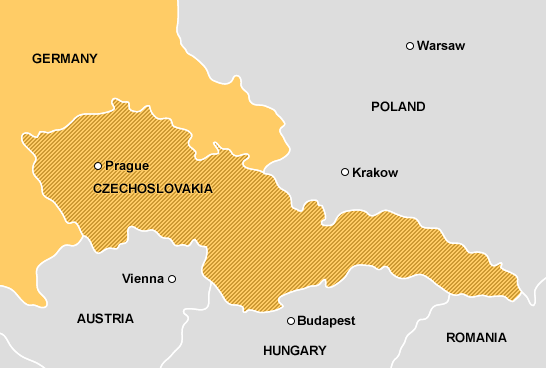
The Munich Conference, 29 September 1938
- When war seemed inevitable, Hitler invited Chamberlain and Daladier to a four-power conference in Munich, where a plan produced by Mussolini (though actually drafted by the German Foreign Office) was accepted.
- The Sudetenland was to be handed over to Germany immediately.
- Poland was given Teschen.
- Hungary received South Slovakia.
- Germany, along with the other three powers, guaranteed the rest of Czechoslovakia.
- Neither the Czechs nor the Russians were invited to the conference.
- The Czechs were warned that if they resisted the Munich decision, they would receive no help from Britain or France — even though France had guaranteed the Czech frontiers at Locarno.
- Given this betrayal by France and the unsympathetic attitude of Britain, Czech resistance seemed hopeless, and the Czechs had no choice but to accept the conference’s decision. A few days later, Benes resigned.
The ‘Scrap of Paper’
- The morning after the Munich Conference, Chamberlain held a private meeting with Hitler at which both signed a statement — the ‘scrap of paper’, drafted by Chamberlain — promising that Britain and Germany would renounce warlike intentions against each other and rely on consultation to resolve future problems.
- On returning to Britain, Chamberlain was given a rapturous public welcome as he waved the ‘scrap of paper’ for the newsreel cameras, famously remarking: “I believe it is peace for our time.”
- Not everyone shared this enthusiasm: Churchill called Munich “a total and unmitigated defeat,” and Duff Cooper resigned from the cabinet, arguing that Hitler could not be trusted to keep the agreement. Events would prove them right.
The Destruction of Czechoslovakia, March 1939
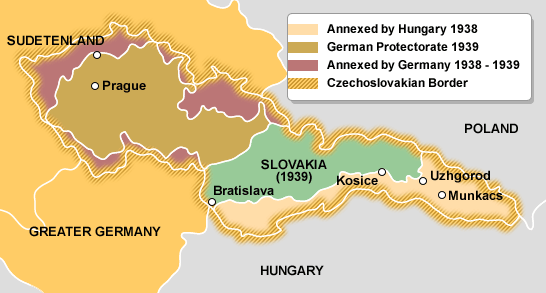
- As a result of the Munich Agreement, Czechoslovakia was crippled by the loss of 70 per cent of her heavy industry, a third of her population, roughly a third of her territory, and almost all her carefully prepared fortifications, mostly to Germany.
- Slovakia and Ruthenia were given self-government over internal affairs, though a central government remained in Prague.
- Early in 1939, Slovakia, encouraged by Germany, began demanding complete independence from Prague, and it looked as though the country was about to fall apart.
- Hitler pressed the Slovak prime minister, Father Jozef Tiso, to declare independence and request German help, but Tiso remained ultra-cautious.
- On 9 March 1939, the Prague government moved against the Slovaks to forestall the expected declaration of independence: the Slovak cabinet was deposed, Tiso was placed under house arrest, and the Slovak government buildings in Bratislava were occupied by police.
- This gave Hitler his opening: Tiso was brought to Berlin, where Hitler convinced him the time was ripe. Back in Bratislava, Tiso and the Slovaks proclaimed independence (14 March), and the next day asked for German protection.
- Czech President Hacha was next invited to Berlin, where Hitler told him that a protectorate must be imposed over what remained of Czechoslovakia in order to “protect” the German Reich.
- With German troops poised to enter, Hacha was told to order the Czech army not to resist, and, faced with such browbeating, felt he had no alternative but to agree.
- Consequently, on 15 March 1939, German troops occupied the rest of Czechoslovakia while the Czech army remained in barracks.
- Slovakia became a nominally independent state under the protection of the Reich, while Ruthenia was occupied by Hungarian troops.
- Britain and France protested but, as usual, took no action; Chamberlain argued that the guarantee of Czech frontiers given at Munich did not apply, since technically the country had not been invaded — German troops had entered “by invitation.”
- Hitler was greeted with enthusiasm when he visited the Sudetenland.
- However, the German action provoked a great outburst of criticism: for the first time, even the appeasers could not justify what Hitler had done, since he had broken his promise and seized non-German territory. Even Chamberlain felt this went too far, and his attitude hardened.
Other Results
- Britain and France had lost the help of a strong potential ally in Czechoslovakia.
- Russia was offended at being left out of the Munich settlement and grew more suspicious of Britain and France.
- The British public celebrated their relief that war had, for the present, been avoided. However, growing numbers came to believe that Hitler was not, as Chamberlain had believed, just another politician open to negotiation, but would continue to behave aggressively — and that war would come sooner or later. Even Chamberlain began building up British forces against that possibility.
Poland
- After taking over the Lithuanian port of Memel (which was admittedly peopled largely by Germans), Hitler turned his attention to Poland.
Hitler Demands the Return of Danzig
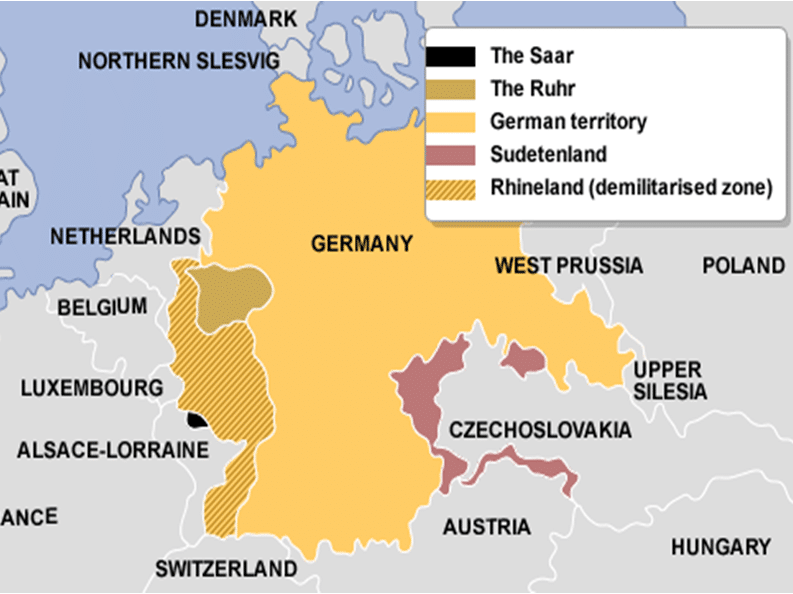
- The Germans resented the loss of Danzig and the Polish Corridor at Versailles, and now that Czechoslovakia was safely out of the way, Polish neutrality was no longer necessary to Hitler.
- In April 1939, Hitler demanded the return of Danzig along with a road and railway across the corridor linking East Prussia with the rest of Germany.
- This demand was not, in itself, unreasonable, since Danzig was mainly German-speaking; but coming so soon after the seizure of Czechoslovakia, the Poles were convinced it was merely a preliminary to invasion.
- Fortified by a British promise of help “in the event of any action which clearly threatened Polish independence,” Foreign Minister Colonel Beck rejected the German demands and refused to attend a conference, likely wary of “another Munich.”
- British pressure on the Poles to surrender Danzig came to nothing.
- Hitler was probably surprised by Beck’s stubbornness, and was still hoping to remain on good terms with the Poles, at least for the time being.
The German Invasion of Poland
- The only way Britain’s promise of help to Poland could be made effective was through an alliance with Russia, but Britain moved so slowly and hesitantly in negotiating this alliance that Hitler got there first.
- Hitler signed a non-aggression pact with the USSR, along with a secret agreement to divide Poland between Germany and the USSR (24 August).
- Convinced now that Russia was neutral, Hitler believed Britain and France would not risk intervention, and treated the British ratification of their guarantee to Poland as a bluff.
- When the Poles still refused to negotiate, a full-scale German invasion began early on 1 September 1939.
- Chamberlain, not yet fully free of appeasement, suggested that a conference could be held if German troops were withdrawn, but received no response from Germany.
- Only when pressure mounted in Parliament and across the country did Chamberlain send Germany an ultimatum: withdraw troops from Poland or Britain would declare war.
- Hitler did not even bother to reply; when the ultimatum expired at 11 a.m. on 3 September, Britain was at war with Germany. France declared war soon after.
The Road to the Second World War
- 15 March 1939 — the German army invaded the rest of Czechoslovakia.
- 31 March 1939 — Britain promised to defend Poland.
- 22 May 1939 — Italy and Germany signed the Pact of Steel, pledging mutual help in the event of war.
- 23 August 1939 — to the dismay of France and Britain, the Nazi-Soviet Non-Aggression Pact was signed by Germany and Russia, with both nations promising not to fight each other.
- 1 September 1939 — German forces invaded Poland.
- 3 September 1939 — Britain declared war on Germany.
Why Did War Break Out? Were Hitler or the Appeasers to Blame?
- The historiographical debate over responsibility for the Second World War continues among historians.
- The Versailles Treaties have been blamed for filling the Germans with bitterness and a desire for revenge.
- The League of Nations and the idea of collective security have been criticized for failing to secure general disarmament or control potential aggressors.
- The world economic crisis has also been cited, since without it Hitler would probably never have come to power.
- While these factors no doubt created the sort of atmosphere and tensions likely to lead to war, something more was needed to explain it.
- It is worth remembering that by the end of 1938, most of Germany’s grievances had already been removed: reparations were largely cancelled, the disarmament clauses had been ignored, the Rhineland was remilitarized, Austria and Germany were united, and 3.5 million Germans had been brought into the Reich from Czechoslovakia. Germany was a great power again — so what went wrong?
Were the Appeasers to Blame?
- Some historians argue that appeasement was largely responsible for the situation deteriorating into war.
- They contend that Britain and France should have taken a firm line with Hitler before Germany grew too strong: an Anglo-French attack on western Germany in 1936, at the time of the Rhineland occupation, might have taught Hitler a lesson and even toppled him from power.
- By repeatedly giving way to him, the appeasers only increased Hitler’s prestige at home.
- As Alan Bullock wrote, “success and the absence of resistance tempted Hitler to reach out further, to take bigger risks.” He may not have had definite plans for war, but after the surrender at Munich, he became convinced Britain and France would remain passive again, and decided to gamble on war with Poland.
- Chamberlain has also been criticized for choosing the wrong issue over which to make a stand against Hitler.
- It is argued that German claims to Danzig and routes across the corridor were more reasonable than the demands over the Sudetenland, which had contained almost a million non-Germans.
- Poland was also militarily much weaker than Czechoslovakia and far more difficult for Britain and France to defend.
- Chamberlain, in this view, should have made his stand at Munich and backed the Czechs, who were militarily and industrially strong and possessed excellent fortifications.
- Chamberlain’s defenders, on the other hand, argue that his main motive at Munich was to buy Britain time to rearm for an eventual fight against Hitler.
- Arguably, Munich did gain a crucial year during which Britain was able to press ahead with its rearmament programme.
- John Charmley argues that Chamberlain had very little option but to act as he did, and that his policies were far more realistic than any of the alternatives — such as building a Grand Alliance including Britain, France, Poland, Czechoslovakia, Romania, and the USSR.
- This idea, suggested at the time by Churchill, is dismissed by Andrew Roberts as never having been a serious possibility, given the many points of disagreement between the potential allies.
- Robert Self believes Chamberlain had very few viable alternatives and deserves great credit for trying to prevent war, arguing that any “normal” leader — like Stresemann, for example — would have responded positively to Chamberlain’s reasonable policies; sadly, Hitler was not a typical German statesman.
- Even so, Britain and France arguably must share at least some responsibility for the outbreak of war in 1939.
- As Richard Overy pointed out, it must not be forgotten that war in 1939 was declared by Britain and France on Germany, and not the other way round.
Why Did Britain and France Go to War with Germany?
- Britain and France had complex interests and motives for going to war, weighing decisions on international questions against both public opinion and potential enemies elsewhere.
- British and French policy before 1939 was governed primarily by national self-interest and only secondarily by moral considerations.
- In other words, the British and French, just like the Germans, were anxious to preserve or extend their power and safeguard their economic interests — and, in the end, this meant going to war in 1939 to preserve Franco-British power and prestige.
Did the USSR Make War Inevitable?
- The USSR has been accused of making war inevitable by signing the non-aggression pact with Germany on 23 August 1939, which also included a secret agreement to partition Poland between Germany and the USSR.
- It is argued that Stalin ought instead to have allied with the West and with Poland, thereby frightening Hitler into keeping the peace.
- On the other hand, the British were themselves most reluctant to ally with the Russians; Chamberlain distrusted them for being communists, as did the Poles, and he also considered them militarily weak.
- Russian historians justify the pact on the grounds that it bought the USSR time to prepare its defences against a possible German attack.
Was Hitler to Blame?
Hitler Had a Long-Term Plan for a Major War
- Many historians believe Hitler intended a major war right from the beginning.
- They argue he hated communism and wanted to destroy Russia and control it permanently, thereby acquiring Lebensraum (Living Space) for Germany — an aim achievable only through a major war.
- The destruction of Poland, in this view, was an essential preliminary to the invasion of Russia, and the non-aggression pact with Russia merely a way of lulling Russian suspicions and keeping her neutral until Poland had been dealt with.
- Evidence for this theory is drawn from Hitler’s book Mein Kampf (My Struggle) and from the Hossbach Memorandum — a summary by Hitler’s adjutant, Colonel Hossbach, of a meeting held in November 1937 at which Hitler explained his expansionist plans to his generals — as well as from Hitler’s Secret Book, finished around 1928 but never published.
- By attacking Poland on all fronts rather than merely occupying Danzig and the Corridor, Hitler showed he intended not just to recover the Germans lost at Versailles, but to destroy Poland altogether.
- Martin Gilbert argues that Hitler’s motive was to remove the stigma of defeat in the First World War: “for the only antidote to defeat in one war is victory in the next.”
- The Hossbach memorandum shows Hitler preparing to go much further, embarking on an ambitious expansionist policy.
- As Neil Gregor points out, what Hitler had in mind was “a racial war of destruction,” beginning with the dismemberment of Poland, continuing with the attack on the USSR, and culminating in a horrific genocidal war — the destruction of the Jews and other groups the Nazis considered inferior to the German master race, alongside the destruction of communism.
- If this theory is correct, appeasement cannot be blamed as a cause of the war, except insofar as it made things easier for Hitler; he had his ‘blueprint’ for action, meaning war was inevitable sooner or later.
Adam Tooze’s Interpretation
- Adam Tooze theorised that Hitler feared the longer he delayed the inevitable war, the greater the danger that Britain and France would overtake German rearmament.
- According to Tooze, “Hitler knew that he would eventually have to confront the Western powers. And in the autumn of 1939 he attacked Poland because he had decided that he was willing to risk that wider war sooner rather than later…. The military advantage that Germany currently enjoyed over its enemies was fleeting.”
- Germany had indeed been steadily rearming: from 1936, when the Four Year Plan was introduced, until 1939, no less than two-thirds of all industrial investment went toward producing war materials, and by 1939 about a quarter of the industrial workforce was employed on military orders — “a figure unmatched by any other state in Europe.”
- However, the German armaments industry was running short of raw materials, largely because Germany’s shortage of foreign exchange made it impossible to import sufficient iron and copper ore.
- Throughout the interwar period, the German currency, the Reichsmark, was chronically overvalued, making exports uncompetitive.
- Hitler complained that Germany’s enemies, egged on by their “Jewish backers,” had closed their borders to German exports.
- Matters worsened further when, in response to the German occupation of Prague, President Roosevelt of the USA placed punitive tariffs on German imports in March 1939.
- As Tooze explains, Hitler might have wished to fight the larger war against Britain and France at a moment of his own choosing sometime in the early 1940s, but by early 1939 the pace of events had rendered such long-term plans impractical: with America, France, and Britain appearing to grow ever closer together, there was no time to lose — it was time to wager everything.
Hitler Had No Long-Term Plan for a Major War: A.J.P. Taylor’s Interpretation
- A.J.P. Taylor, in The Origins of the Second World War, believed Hitler did not intend to cause a major war and expected, at most, a short war with Poland.
- Taylor thought the German occupation of the rest of Czechoslovakia in March 1939 was not the result of a sinister long-term plan, but rather “the unforeseen by-product of events in Slovakia” — that is, the Slovak demand for greater independence from Prague.
- Just as Chamberlain miscalculated in believing he could make Hitler “respectable and civilized,” Hitler in turn misread the minds of Chamberlain and the British: how could he have foreseen that the British and French would be inconsistent enough to support Poland — where his claim to land was comparatively more reasonable — after giving way to him over Czechoslovakia, where his case was far weaker?
- Thus, for Taylor, Hitler was lured into war almost by accident, after the Poles had called his bluff; the war of 1939, far from being premeditated, was a mistake resulting from diplomatic blunders on both sides.
- The German historian Eberhard Jackel claimed that Hitler set himself two goals — a war of conquest and the elimination of the Jews — with his ultimate aim being the establishment of a greater Germany than had ever existed before in history.
- The path to this greater Germany was a war of conquest fought mainly at the expense of Soviet Russia, where the German nation was to gain living space for generations to come.
- Militarily, the war was expected to be easy, since Germany would be opposed only by what Hitler considered a disorganized country of “Jewish Bolsheviks and incompetent Slavs” — suggesting it was probably not a world war that Hitler had in mind.
- Alan Bullock similarly believed Hitler did not want a war with Britain; all he asked was that the British not interfere with his expansion in Europe, and allow him to defeat Poland and the USSR in separate, localised campaigns.
Conclusion
- Today, very few historians accept Taylor’s theory that Hitler had no long-term plans for war.
- It is true that some of Hitler’s successes came through clever opportunism, but there was much more behind his foreign policy than that.
- Although Hitler probably did not have a detailed, step-by-step plan worked out in advance, he clearly had a basic vision that he was working towards at every opportunity — a Europe dominated by Germany, achievable only through war. This explains the heavy emphasis on rearmament from 1936 onwards; Hitler clearly intended much more than self-defence.
- According to Hitler’s biographer Ian Kershaw, Hitler had never doubted, and said so on innumerable occasions, that Germany’s future could only be determined through war — war being, for Hitler, “the essence of the Nazi system” and therefore inevitable; only its timing and direction remained at issue.
World War II as a Total War
- The Second World War differed from all previous wars in ways that led to its characterization as a total war, a revolutionary departure from traditional theories of conflict, for the following reasons:
- It was a war in which all the resources of the state and the entire activity of the nation were mobilised for war purposes; states mobilized the material, intellectual, and moral energies of their people, so that by extension the enemy community as a whole — its scientists, workers, and farmers — became legitimate objects of war.
- Strategic bombing became the chief instrument of total war, directed at enemy populations through attacks on economic targets or domestic morale; it was indiscriminate in its effects, deliberately aimed not at forces in the field but at the war-willingness and material capacity of the society behind them.
- The omnipotence of the state was exercised as never before, taking control of every sphere of life and subordinating it to the demands of war — food and other goods were rationed, private houses requisitioned, factories controlled, and universal blackouts declared, bringing the war home to every family, so that in a sense everybody was made to contribute to the war effort.
- The scope of the war, and its strategy, was worldwide: battles were fought across the ice floes of the Arctic, the deserts of North Africa, the jungles of Burma and New Guinea, the Atlantic Ocean, and the islands of the Pacific in the Far East.
- The war was also characterized by unparalleled mobility — Hitler’s Blitzkrieg (lightning war) struck down six nations within a period of three months.
The Spanish Civil War (1936–39) as a Prelude to World War II
Background to the War
- In the 1930s, Spain was a deeply divided country, politically torn between the right-wing Nationalists and the left-wing Republicans.
- The Nationalists were made up of monarchists, landowners, employers, the Roman Catholic Church, and the army.
- The Republicans consisted of workers, trade unions, socialists, and peasants.
- Economically, the country had been hit hard by the Great Depression following the Wall Street Crash.
- Partly as a result of this turmoil, in 1929 the military dictatorship that had ruled Spain since 1923 collapsed, and in 1931 the King abdicated after the Republicans came to power.
- A period followed in which the two political rivals alternated in elected power, but the country remained so divided and unstable that in 1936 the army rebelled and forcibly removed the Republicans from power, plunging Spain into civil war.
The Importance of Spain in Europe
- If Spain fell to the Nationalists, supported by the Fascist powers, France would find itself surrounded by Fascist powers on multiple sides — Germany and Italy.
- If France were then invaded by Fascist nations, alliances between other anti-Fascist nations would be weakened, leaving one less army to resist Fascist expansion.
- Spain also possessed strategic naval bases on the Mediterranean Sea and Atlantic Ocean, which the Fascists could use to control shipping and establish submarine bases, applying military and economic pressure on other European nations.
International Intervention
The Fascist Powers
- Hitler and Mussolini both sent thousands of troops and weapons to Spain to aid the Nationalist forces, sharing a common desire to see Spain fall to the right-wing side.
- As Fascist allies, it was in the interest of both Germany and Italy to fight the spread of communism, and neither wanted a near neighbour to become a Soviet-backed stronghold.
- Conversely, a right-wing Spain could become an important ally to both countries in any future conflict, and the spread of the Fascist creed to yet another major European nation would signal to the world that Fascism was a power to be reckoned with.
The Democracies
- France and Britain found themselves in an awkward position over Spain.
- They did not want Spain to fall to the Nationalists, since this would strengthen the Fascist alliance of Germany and Italy, but they would be no better off if Spain fell to the Soviet-backed Republicans, given that communism was also seen as a major threat to world peace.
- The French and British therefore agreed a mutual policy and set up a Non-Intervention Committee, which effectively blocked international aid from reaching Spain — though it could not stop Germany and Italy from sending forces and supplies to the Nationalists, leaving the Republicans reliant solely on the limited support of Stalin’s Russia.
The Soviet Union
- The USSR sent weapons and supplies to aid the Republicans in their struggle against Fascism, but was never as committed to the conflict as either Germany or Italy.
- Stalin sold the Republicans only enough supplies to keep them fighting, content that Germany was being kept busy with Spain rather than concentrating its efforts in eastern Europe.
The International Brigades
- The fight against Fascism drew young men and women from across Europe and the USA to Spain, where idealists, socialists, and communists fighting for the Republicans formed the International Brigades, a determined if rag-tag army upholding democracy against the right-wing threat.
- At any one time, up to 15,000 people were fighting in the International Brigades.
The Results
- The better organised and equipped Nationalist forces won the war after Madrid was captured in March 1939.
- Hitler’s position in Europe was strengthened, as he now had another potential ally in Spain’s right-wing dictator, General Franco.
- Participation and co-operation in the Spanish war strengthened the bond between Italy and Germany, resulting in the formation of the Rome-Berlin Axis, with the two nations now firm allies.
- By openly ignoring the Non-Intervention Committee and its chief architects, France and Britain, Hitler had demonstrated his growing strength in European affairs.
Why the Spanish Civil War Is Described as a Prelude to World War II
Use of Modern Technology and Tactics
- The Spanish Civil War saw the use of new weapons and new tactics, including the first examples of Blitzkrieg (swift military offensive), carpet bombing, and new tank warfare tactics.
- It was the first war in which air power played a significant part, including the bombing of towns and other civilian targets — features that would play a significant role in the Second World War as well.
Ideological Warfare
- The Spanish Civil War was also an ideological war, with both sides motivated by passionate attachment to their ideologies, foreshadowing the multi-racial armies used in the Second World War.
- The war was fought between the fascist Franco and his supporters and the already-established Republic, a left-leaning government; the fascists and conservatives were funded with cash and supplies by Nazi Germany and Fascist Italy, while the Republic was supported by the USSR and also, to some extent, by France and the USA.
- This reflected the ideological warfare later fought in the Second World War, which similarly involved competing ideologies such as Fascism, Communism, and Capitalism.
Involvement of Multiple Countries
- The Spanish Civil War is also unique in that very large contingents of foreign forces intervened on both sides.
- Franco was helped with men and arms sent by the two Fascist powers of the time, Germany and Italy, along with smaller contingents of volunteers of other nationalities such as Irish, Portuguese, and White Russian.
- The Republicans, on the other side, were mainly helped by the USSR, but were also joined by volunteers from every continent who opposed fascism and dictatorship in any form.
- This foreshadowed the World War, which similarly involved multiple countries and a multinational, multiracial military.
Other Factors
- Britain and France led a political alliance of 27 nations that promised an embargo on all arms to Spain; Germany, Italy, and the Soviet Union also signed on officially but blatantly ignored the embargo, and these clandestine actions by various European powers were, at the time, considered to risk sparking another World War.
- Thanks in part to the spirit of appeasement shown by democracies like Britain, Fascist forces succeeded in Spain — a success that gave a further boost to Fascist ambitions leading toward the Second World War.
- The Spanish Civil War thus served as a message to the world, a warning of the perils and events to come, and it increased international tensions in Europe in the lead-up to World War II.




