

Mahajanapadas: Formation of States (Monarchies and Republics) in Ancient India

The sixth century BCE marks a watershed in ancient Indian history, when the loose tribal polities (Janapadas) of the later Vedic age gave way to large, well-organised territorial states known as the Mahajanapadas. This transition from tribe (Jana) to territory (Janapada) reflects a fundamental shift in political organisation — from kinship-based loyalty to allegiance rooted in land and administration. The Sixteen Mahajanapadas, as recorded in Buddhist, Jaina, and Brahmanical literature, formed the political backdrop against which the lives of the Buddha and Mahavira unfolded, and out of their prolonged rivalry eventually emerged the Magadhan Empire. For any UPSC History Optional aspirant, understanding the formation of the Mahajanapadas — their monarchical and republican (gana-sangha) forms of government, their administrative structures, and the factors behind the rise and fall of each — is essential, since this theme recurs frequently in the Ancient India section of the Mains examination.
Background: The Rise of Territorial States
Kautilya’s Saptanga Theory of the State
- Kautilya, in his Arthashastra, describes the Saptanga theory — a framework of seven constituent elements (Saptanga) that, together, define a fully formed state:
- the king (svamin),
- the minister (amatya),
- the country (janapada),
- the fortified city (durga),
- the treasury (kosha),
- the army (danda), and
- the ally (mitra).
- No state formation satisfied all seven of these elements until the close of the sixth century BCE.
Factors Behind the Formation of Large Territorial States
- From the sixth century BCE onwards, the widespread use of iron in eastern Uttar Pradesh and western Bihar — evidenced by excavations at Raj Ghat and Chirand — enabled the formation of large territorial states that were militarily better equipped and in which the warrior class played the leading role.
- The idea of territorial sovereignty was gradually strengthened through the sixth century BCE with the rise of large states, or Mahajanapadas, with towns as their seats of power.
- New agricultural tools and implements allowed peasants to generate a substantial surplus, which not only met the needs of the ruling class but also sustained numerous towns.
- Towns emerged as centres of industry and trade:
- Towns such as Shravasti, Champa, Rajagriha, Ayodhya, Kausambi, Kashi, and Pataliputra were of major economic importance to the Ganges plains.
- Others, such as Vaishali, Ujjain, Taxila, and the port of Bharukachchha (Broach), had a wider economic reach beyond the Gangetic heartland.
- A passage from Panini makes clear that people owed allegiance to the Janapada (territory) to which they belonged, rather than to the Jana (tribe) — marking the shift from tribal to territorial identity.
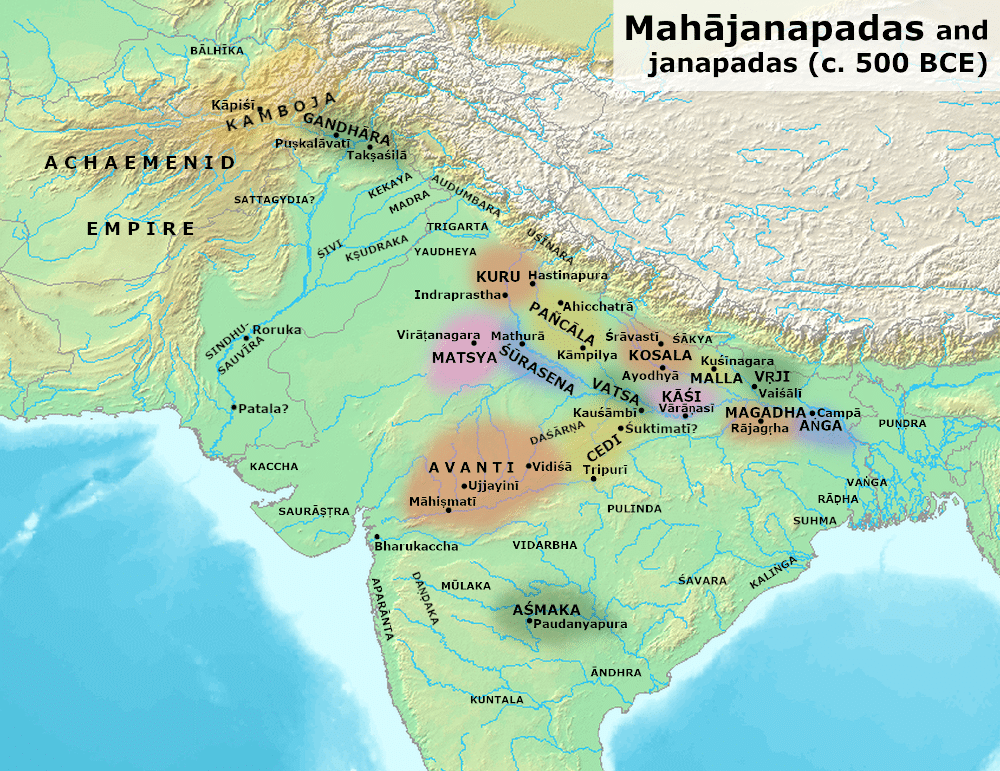
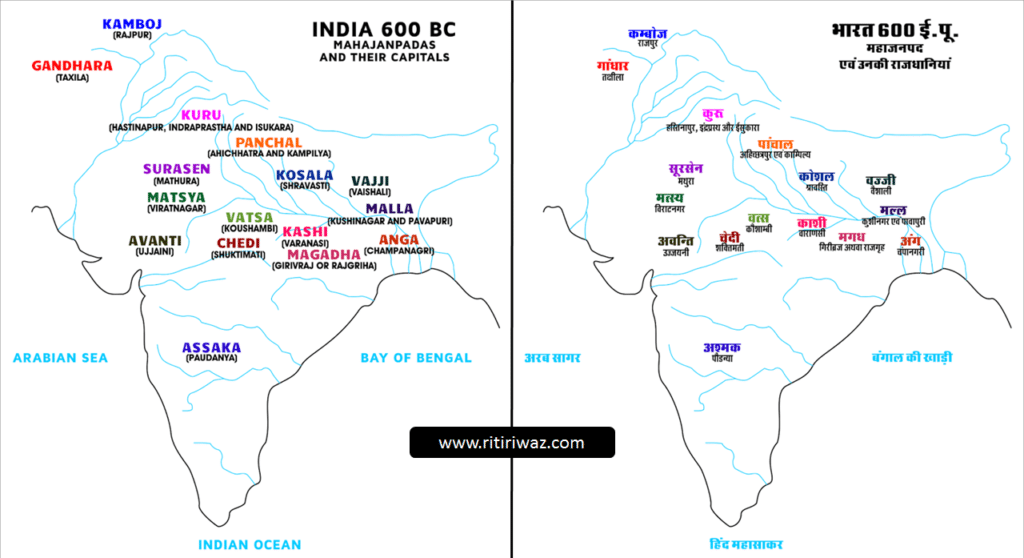
The Sixteen Mahajanapadas (Solasa Mahajanapadas)
- In the post-Vedic period, the entire northern territory — situated mostly north of the Vindhyas and extending from the North-West Frontier to Bihar — was divided into sixteen states called the Sodasha Mahajanapadas.
- These Mahajanapadas were either monarchical or republican in character.
- Buddhist and other texts refer only incidentally to the sixteen great nations (Solasa Mahajanapadas) that existed before the time of the Buddha, and they provide no connected history of these states except in the case of Magadha.
- According to Buddhist texts, fourteen of the Mahajanapadas belonged to Majjhimadesa (Mid India), while two — Gandhara and Kamboja — belonged to Uttarapatha, the north-western division of Jambudvipa.
Textual Lists of the Sixteen Mahajanapadas
- The Anguttara Nikaya’s list of the Mahajanapadas is as follows: Kashi, Koshala, Anga, Magadha, Vajji (Vrijji), Malla, Chetiya (Chedi), Vamsa (Vatsa), Kuru, Panchala, Machchha (Matsya), Shurasena, Assaka (Ashmaka), Avanti, Gandhara, and Kamboja.
- The Mahavastu gives a similar list but substitutes Shibi (in Punjab) and Dasharna (in central India) for the north-western states of Gandhara and Kamboja.
- Another Buddhist text, the Digha Nikaya, mentions only the first twelve Mahajanapadas in the above list and omits the last four.
- The Jaina Bhagavati Sutra gives a slightly different list of sixteen Mahajanapadas:
- Its author focuses only on the countries of Madhyadesa and the far east and south, omitting the Uttarapatha nations of Kamboja and Gandhara.
- This omission of all Uttarapatha countries suggests that the Bhagavati list is of later origin and is therefore considered less reliable.

Monarchies and Ganas: An Overview
- The list of Mahajanapadas includes two kinds of states:
- monarchies (rajyas), and
- non-monarchical states known as ganas or sanghas.
- The terms gana and sangha are used synonymously in the political sense in the Ashtadhyayi (Panini) and the Majjhima Nikaya.
- Translating gana and sangha as “republic” can be misleading, since these were in fact oligarchies, where power was exercised by a select group of people rather than by the population at large.
- The most powerful states of the sixth century BCE were Magadha, Kosala, Vatsa, and Avanti.
- Relations among the Mahajanapadas fluctuated over time and included warfare, truce, and military alliances.
- Marriage alliances were also an important aspect of inter-state relations, though they often became irrelevant once political ambitions came into play.
The Sixteen Mahajanapadas: A Profile
(1) Anga
- The capital of the Anga Mahajanapada — corresponding to the modern Bhagalpur and Munger districts of Bihar — was Champa.
- Magadha lay to its west and the Raja Mahal hills to its east, while the Ganga bordered it on the north; the Champa river formed its boundary with Magadha.
- It was a great centre of trade and commerce, and its merchants regularly sailed to distant Suvarnabhumi.
- Anga was annexed by Magadha in the time of Bimbisara — this was, in fact, the one and only conquest of Bimbisara.
(2) Assaka (Ashmaka)
- The capital of the Assakas was Potana (also called Potali or Podana), located in modern Maharashtra.
- Assaka (or Ashmaka) was located in Dakshinapatha, or southern India, and was the only Mahajanapada situated south of the Vindhya mountains.
- In the Buddha’s time, the Assakas were located on the banks of the river Godavari; the Ashmakas are also mentioned by Panini.
- Jataka stories suggest that Assaka may at some point have come under the influence of Kashi, and that it achieved a military victory over Kalinga in eastern India.
(3) Avanti
- The country of the Avantis was an important kingdom of western India and one of the four great monarchies of the post-Mahavira and post-Buddha era, the other three being Kosala, Vatsa, and Magadha.
- Avanti was divided into a northern and a southern half by the river Vetravati.
- Initially, Mahissati (Sanskrit: Mahishmati) was the capital of southern Avanti, while Ujjaini (Sanskrit: Ujjayini) was the capital of northern Avanti; by the time of Mahavira and the Buddha, Ujjaini had become the capital of a unified Avanti.
- Both Mahishmati and Ujjaini stood on the southern highway called Dakshinapatha, which extended from Rajagriha to Pratishthana (modern Paithan).
- Avanti roughly corresponded to modern Malwa, Nimar, and adjoining parts of Madhya Pradesh, and was an important centre of Buddhism, home to several leading theras and theris.
- The Pradyota dynasty ruled over Avanti; Pradyota was a contemporary of Gautama Buddha.
- Ajatashatru, king of Magadha, fortified Rajagriha to protect it from an invasion led by Pradyota.
- Pradyota also waged war on Pushkarasarin, king of Takshashila.
- Pradyota’s chief queen was a disciple of the Buddhist monk Mahakatyayana and constructed a stupa at Ujjayini.
- The last king of Avanti, Nandivardhana, was defeated by king Shishunaga of Magadha, after which Avanti became part of the Magadhan empire.
(4) Chedi
- The Chedis (or Chetis) were located in eastern Bundelkhand, near the Yamuna, midway between the kingdoms of the Kurus and the Vatsas.
- Its capital was Sotthivatinagara.
- According to the Hathigumpha inscription of Kharvela, a branch of the Chedis founded a royal dynasty in the kingdom of Kalinga.
(5) Gandhara
- The kingdom of Gandhara comprised the modern Peshawar and Rawalpindi districts of Pakistan and the Kashmir valley; its capital, Takshashila (Taxila), was a major centre of trade and learning.
- The Taxila University was a renowned centre of learning in ancient times, drawing scholars from across the known world — Panini, the celebrated Indian grammarian, and Kautilya were among its world-renowned products.
- Gandhara was located on the Uttarapatha and served as a centre of international commercial activity, forming an important channel of communication with ancient Iran and Central Asia.
- King Pukkusati (or Pushkarasarin) ruled over Gandhara in the mid-sixth century BCE; he was a contemporary of king Bimbisara of Magadha, maintained cordial relations with Magadha, and waged a successful war against Avanti.
- Gandhara was often linked politically with the neighbouring regions of Kashmir and Kamboja.
- The Behistun inscription of the Achaemenid emperor Darius indicates that Gandhara was conquered by the Persians in the later part of the sixth century BCE.
(6) Kamboja
- Kamboja included the area around Rajaori, along with the Hazara district of the North-West Frontier Province of Pakistan; its capital, Rajpur (modern Rajori), lay around the Punchh area of Kashmir.
- The Kambojas are also included among the Uttarapatha states; ancient Kamboja is known to have comprised regions on either side of the Hindukush.
- The Mahabharata refers to several ganas (or republics) of the Kambojas, and Kautilya’s Arthashastra together with Ashoka’s Edict No. XIII attest that the Kambojas followed a republican constitution.
- Panini’s Sutras tend to convey that Kamboja was a Kshatriya monarchy, but the “special rule and exceptional form of derivative” he assigns to denote the ruler of the Kambojas implies that the king was merely a titular head.
- In the struggle for supremacy that followed in the sixth/fifth century BCE, the growing state of Magadha emerged as the most predominant power in ancient India, annexing several Janapadas of Majjhimadesa.
- The Puranas lament that the Magadhan emperor Mahapadma Nanda exterminated all Kshatriyas — an evident reference to the Kasis, Kosalas, Kurus, Panchalas, Vatsyas, and other tribes of the eastern Punjab.
- The Kambojans and Gandharans, however, never came into direct contact with the Magadhan state until Chandragupta and Kautilya arose on the scene.
- These north-western nations instead fell to the Achaemenids of Persia during the reign of Cyrus (558–530 BCE) or in the first year of Darius; Kamboja and Gandhara together formed the twentieth and richest satrapy of the Achaemenid Empire, and Cyrus I is said to have destroyed the famous Kamboja city of Kapisi (modern Begram).
(7) Kashi
- The kingdom of Kashi was bounded by the Varuna and Asi rivers to the north and south respectively, and it is from these two river names that its capital city, Varanasi, derives its name.
- Before the Buddha, Kashi was the most powerful of the sixteen Mahajanapadas; several Jataka tales attest to the superiority of its capital over other Indian cities and speak highly of its prosperity and opulence.
- These stories describe a long struggle for supremacy between Kashi and the three kingdoms of Kosala, Anga, and Magadha.
- The Jatakas specifically refer to a longstanding rivalry between Kashi and Kosala, and Kashi was also involved in occasional conflicts with Anga and Magadha.
- Once among the most powerful states of north India, Kashi was eventually absorbed into the Kosalan kingdom during the Buddha’s time.
- Kashi emerged as a leading textile manufacturing centre in the time of the Buddha — the kashaya, the orange-brown robes worn by Buddhist monks, are said to have been manufactured here.
(8) Kosala
- The kingdom of Kosala was bounded by the Sadanira (Gandak) on the east, the Gomati on the west, the Sarpika (or Syandika/Sai) on the south, and the Nepal hills to the north; its territory corresponded to modern Awadh in central and eastern Uttar Pradesh.
- The Sarayu river divided Kosala into a northern and a southern part: Shravasti was the capital of north Kosala, and Kushavati the capital of south Kosala, while Saketa and Ayodhya were two other important towns that may once have served as political centres.
- The kingdom was ruled by the famous king Prasenajit (Pasenadi) during the era of Mahavira and the Buddha; Prasenajit was a contemporary of the Buddha, is frequently mentioned in Pali texts, and was himself highly educated.
- His position was further strengthened by a matrimonial alliance with Magadha: his sister was married to Bimbisara, with part of Kashi given as dowry.
- Kosala succeeded in conquering Kashi and extended its power over the Sakyas of Kapilavastu.
- Kosala and Magadha were linked through matrimonial ties during the time of Prasenajit and the Magadhan king Bimbisara, but a bitter struggle between the two kingdoms broke out after Bimbisara’s death; this was finally settled once the confederation of the Lichchhavis aligned itself with Magadha.
- Kosala was ultimately merged into Magadha when Vidudabha was its ruler.
(9) Kuru
- The Kurus roughly corresponded to modern Thanesar, the state of Delhi, and the Meerut district of Uttar Pradesh.
- According to Buddhist tradition, the Kuru kingdom was ruled by kings of the Yuddhitthila gotta (the family of Yudhishthira), from their capital at Indapatta (Indraprastha), near modern Delhi.
- The Kurus established matrimonial relations with the Yadavas, Bhojas, and Panchalas.
- In the Buddha’s time, the Kuru country was ruled by a titular chieftain (king-consul) named Korayvya — the Kurus of the Buddhist period no longer held the same position they had enjoyed in the Vedic period.
- Though a well-known monarchical people in the earlier period, the Kurus are known to have adopted a republican form of government during the sixth to fifth centuries BCE; in the fourth century BCE, Kautilya’s Arthashastra attests that the Kurus followed the Rajashabdopajivin (king-consul) constitution.
(10) Magadha
- Magadha was one of the most prominent and prosperous of the Mahajanapadas; its capital city, Pataliputra (modern Patna, Bihar), was situated at the confluence of major rivers such as the Ganga, Son, Punpun, and Gandak.
- The alluvial plains of the region, together with its proximity to the iron-rich areas of Bihar and Jharkhand, helped the kingdom develop good-quality weapons and support an agrarian economy — factors that helped Magadha emerge as the most prosperous state of the period.
- The kingdom of the Magadhas roughly corresponded to the modern districts of Patna and Gaya in southern Bihar and parts of Bengal in the east; during the Buddha’s time, its boundaries also included Anga.
- Its earliest capital was Girivraja or Rajagaha (modern Rajgir, Bihar), which was also an active centre of Jainism in ancient times — the First Buddhist Council was held at Rajagaha, in the Vaibhara Hills. Pataliputra later became the capital of Magadha.
(11) Malla
- The Mallas are frequently mentioned in Buddhist and Jain works. The Malla principality was located west of the Vajjis and consisted of a confederacy of nine clans, with two political centres — at Kusinara and Pava.
- The Vajjis and Mallas appear to have been allies.
- During the Buddhist period, the Malla Kshatriyas were a republican people (known as a Gana), their dominion comprising nine territories corresponding to the nine confederated clans.
- Two of these confederations — one centred at Kusinara (modern Kasia, near Gorakhpur) and the other at Pava (modern Padrauna, twelve miles from Kasia) — had become very important by the time of the Buddha.
- Kusinara and Pava hold great importance in the history of Buddhism and Jainism, since the Buddha and Mahavira (the 24th Tirthankara) took their last breaths at Kusinara and Pava/Pavapuri respectively.
- The Mallas originally had a monarchical form of government but later switched to one of Samgha (republic), whose members called themselves rajas.
- The Mallas appear to have formed an alliance with the Lichchhavis for self-defence, but lost their independence not long after the Buddha’s death, and their dominions were annexed to the Magadhan empire.
- The Mallas, along with other Sanghiya Kshatriyas such as the Lichchhavis, Koliyas, and Shakyas, governed from their Santhagara — an assembly hall; these Santhagara Kshatriyas were placed below the Vedic Kshatriyas in the social hierarchy.
(12) Matsya
- The Matsya (or Machcha) tribe lay south of the Kurus and west of the Yamuna, which separated them from the Panchalas; the region roughly corresponded to the former state of Jaipur-Alwar-Bharatpur in Rajasthan and was suitable for cattle rearing.
- The capital of Matsya was Viratanagara (modern Bairat), said to have been named after its founder king Virata.
- In Pali literature, the Matsyas are usually associated with the Surasenas, whose capital lay at Mathura; Buddhist tradition describes Avantiputra, king of the Surasenas, as a disciple of the Buddha — his name (literally, “son of Avanti”) suggests a possible matrimonial alliance between Surasena and Avanti.
- The Matsyas held little independent political importance by the time of the Buddha; king Sujata ruled over both the Chedis and the Matsyas, indicating that Matsya once formed part of the Chedi kingdom.
(13) Panchala
- The Panchalas occupied the country east of the Kurus, between the mountains and the river Ganges, roughly corresponding to modern Budaun, Farrukhabad, and adjoining districts of Uttar Pradesh.
- Panchala was divided into two parts by the Ganga: the capital of Uttara (north) Panchala was Ahichchhatra, and that of Dakshina (south) Panchala was Kampilya. The famous city of Kanyakubja (Kanauj) was situated within the Panchala kingdom.
- Originally a monarchical clan, the Panchalas appear to have switched to a republican corporation during the sixth and fifth centuries BCE; in the fourth century BCE, Kautilya’s Arthashastra likewise attests that the Panchalas followed the Rajashabdopajivin (king-consul) constitution.
(14) Surasena
- The Surasenas lay east of Matsya and west of the Yamuna, corresponding roughly to the Brij region of Uttar Pradesh, Haryana, and Rajasthan, and the Gwalior region of Madhya Pradesh; their capital was at Madhura (Mathura).
- Avantiputra, king of Surasena, was the first among the chief disciples of the Buddha, and it was through his help that Buddhism gained ground in the Mathura country.
- In Kautilya’s Arthashastra, the Vrishnis are described as a samgha (republic); the Vrishnis, Andhakas, and other allied tribes of the Yadavas formed a samgha, with Vasudeva (Krishna) described as its samgha-mukhya.
- Mathura, the capital of Surasena, was also known in the time of Megasthenes as a centre of Krishna worship. The Surasena kingdom eventually lost its independence upon annexation by the Magadhan empire.
(15) Vajji (Vrijji)
- The principality of the Vajji (Vrijji) lay in eastern India, north of the Ganga, extending up to the Nepal hills, and was considered a confederacy of eight clans, with 7707 Rajas.
- This figure is based on a reference in Buddhaghosha’s Sumangala Vilasini to the atthakulikas of the Vajjis as one of the legal tribunals of Vaishali.
- The most important members of the confederacy were the Vajjis, Lichchhavis, Videhas, and Nayas (Jnatrikas).
- Vaishali was both the capital of the Lichchhavis and of the Vajji confederacy.
- Mithila (modern Janakpur, Nepal) was the capital of Videha and became the predominant centre of political and cultural activity in northern India.
- The Lichchhavis were a very independent people, frequently mentioned in Buddhist texts.
- They were on good terms with Kosala and the Mallas, but were embroiled in conflict with Magadha; Jaina tradition holds that the nine Lichchhavis formed a league with the nine Mallas and eighteen clan lords of Kashi and Koshala.
- The mother of Mahavira was a Lichchhavi princess. Vaishali (modern Basarh, north Bihar) was the capital of the Lichchhavis and the political headquarters of the Varijian confederacy — located 25 miles north of the Ganges, it was a very prosperous town, and the Second Buddhist Council was held there.
- The Lichchhavis were followers of the Buddha, who is said to have visited them on many occasions; they were closely related by marriage to the Magadhas, and one branch of the Lichchhavi dynasty ruled Nepal until the start of the Middle Ages.
- Vaishali was ultimately defeated by king Ajatashatru of Magadha.
- Around 600 BCE, the Lichchhavis were disciples of both Mahavira and Gautama Buddha, who each visited Vaishali several times during their lifetimes.
- The Jnatrikas were based at Kundapura (or Kundagrama); Mahavira belonged to this clan.
- The Vajji confederacy is said to have been led by Chetaka, brother of Trishala (mother of Mahavira) and father of Chellana, wife of the Magadhan king Bimbisara.
Vajji Administration
- Known as the Vajji Sangha, the confederacy consisted of several janapadas, gramas (villages), and gosthas (groups); the main gosthas were the Lichchhavis, Mallas, and Shakyas.
- Eminent individuals were chosen from each khanda (district) as representatives, called gana mukhyas, to the Vajji gana parishad (people’s council of Vajji).
- The chairman of the council was titled gana pramukha, though he was often addressed as a king, even though his post was neither dynastic nor hereditary.
- Other executives included the mahabaladhrikrita (a minister of internal security), the binishchayamatya (chief justice), and dandadhikrita (other justices).
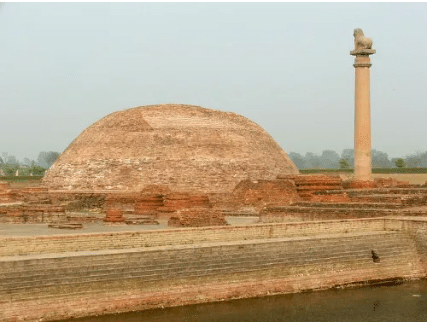
The Ananda Stupa, with an Ashokan pillar, stands at Vaishali, the capital city of the Lichchhavis and the Vajji confederacy.
(16) Vamsa (Vatsa)
- Vatsa (or Vamsa), situated south of the Ganga, was noted for its fine cotton textiles; its capital was Kaushambi (near Allahabad).
- It had a monarchical form of government. Kaushambi was a very prosperous city, home to a large number of millionaire merchants, and served as the most important entrepôt for goods and passengers travelling from the north-west and the south; Ujjain and Kaushambi were connected by a major trade route.
- Udayana was the ruler of Vatsa in the sixth century BCE, during the time of the Buddha — he was powerful, warlike, and fond of hunting.
- Initially opposed to Buddhism, Udayana later became a follower of the Buddha and made Buddhism the state religion.
- Legends recount the rivalry between king Udayana of Vatsa and Pradyota of Avanti, and refer to a love affair and marriage between Udayana and Vasavadatta, Pradyota’s daughter.
- Udayana also appears to have entered into matrimonial alliances with the ruling families of Anga and Magadha; he went on to become the romantic hero of three later Sanskrit dramas — the Svapnavasavadatta of Bhasa, and the Ratnavali and Priyadarshika of Harsha.
Republics and Monarchies: The Gana-Sanghas
The Existence of the Republics (Ganas/Sanghas)
- The tribal political organisation of the Rig Vedic phase gave way to the rise of the territorial state towards the end of the Vedic period; this territorial idea was gradually strengthened in the sixth century BCE with the emergence of large states with towns as their seats of power.
- Buddhist literature, particularly the Anguttara Nikaya, lists the sixteen Mahajanapadas, which can be divided into monarchies and republics (ganas or sanghas). Of these sixteen, two — the Vajji and the Malla — were sanghas.
- Buddhist texts mention several other republics beyond the sixteen Mahajanapadas: the Sakyas of Kapilavastu, the Koliyas of Devadaha and Ramagrama, the Bulis of Alakappa, the Kalamas of Kesaputta, the Moriyas of Pipphalivana, and the Bhaggas (Bhargas), whose capital lay on the Sumsumara hill.
- Geographically, while the monarchies were concentrated in the Gangetic plains, the republics existed either in the Indus basin or near the Himalayan foothills of eastern Uttar Pradesh and Bihar.
- In a society of gana-sanghas, people were treated on an equal basis, at least among the ruling clans; they rejected the Vedic philosophy for dividing society into four distinct varnas, and the new Buddhist and Jaina ideas found popularity among such people.
- It is possible that some independent-minded settlers of the plains, disliking Vedic orthodoxy and social division, moved towards the hills and established settlements founded on greater equality.
- The Mahajanapadas of Vajji, Malla, Kuru, Panchala, and Kamboja were republican states, as were other smaller states like the Lichchhavi, Shakya, Koliya, Bhagga, and Moriya.
Sources for the Study of the Republics
- Indian literature — comprising Brahmanical, Buddhist, and Jain texts — mentions different types of non-monarchical states called ganas or sanghas, and this account is corroborated by the statements of the Greek historians of Alexander’s campaigns in India.
- Buddhist texts clearly indicate that the Sakya assembly gathered to discuss important business such as forging alliances, embarking on war, and concluding peace.
- More details on ganas are provided by Buddhist and Jaina texts than by Brahmanical ones, since kingship was central to Brahmanical social and political ideology, and kinglessness was equated with anarchy.
- There are hardly any references to purohitas or land grants to Brahmanas in the ganas, and Brahmanas may not have enjoyed the same prestige in the republics as they did in the monarchies (rajyas).
- In the Ambattha Sutta of the Digha Nikaya, when the Brahmana Ambattha visited Kapilavastu, members of the Sakya assembly are said to have laughed at him, treating him with scant respect.
- The terms gana and sangha are used as synonymous political terms in literary sources such as Panini’s Ashtadhyayi and the Majjhima Nikaya.
- The Arthashastra mentions several corporations, such as the Lichchavikas, Vrijjikas, and Madras, which had assemblies whose members were called rajas.
- Coins also offer information on the republics — the term gana on coins of the Yaudheyas and Malavas points to their non-monarchical polity.
- The existence of republics is further attested by Greek writers: Megasthenes notes that most Indian cities of his time had a democratic form of government, and mentions several tribes that were free and had no kings.
- His statement is corroborated by Arrian, who states that superintendents reported everything to the king where people had a king, and to the magistrates where people were self-governed; Arrian also refers to the small state of Nysa as having an oligarchical form of government.
- Two types of republics/ganas existed:
- those comprising all or a section of one clan (for instance, the Sakyas, Koliyas, Mallas); and
- those comprising a confederation of several clans (for instance, the Vajjis, Yadavas, Vrishnis).
Factors Responsible for the Rise of the Republics
- The origin of the republics has been traced to a reaction against the pattern of life that evolved in the later Vedic period.
- This movement aimed at abolishing the growing class and sex distinctions and rejected superstitious religious practices that took a heavy toll of cattle-stock, as well as hereditary kingship bolstered by Brahmanas who arrogated all rights and privileges to themselves.
- The republics in the Indus basin may have been remnants of the Vedic tribes; in parts of Uttar Pradesh and Bihar, people were possibly inspired by the old ideals of tribal equality, which did not give much prominence to the raja.
- The new movement against Vedic orthodoxy derived inspiration from traditions about a remote past when there were no varna distinctions, no domination by upper classes over lower ones, and no coercive oppression by hereditary kings — a legend that perhaps explains why republics are said to have replaced monarchies in certain traditions.
- The traditional story of the origin of the Shakyas, the tribe to which the Buddha himself belonged, holds that they descended from the royal house of Kosala: four brothers and their four sisters were expelled by their royal father, and preserved the purity of their race by marrying among themselves.
- This account indicates that the founders of republics broke away from the parent stock and moved to new areas — a pattern that may also explain Videha and Vaishali, both referred to as monarchies transformed into republics.
- Socio-political conditions also played a role: in the early period, members of the ruling class received a portion of the booty of war and tributes collected from the vanquished non-Aryans, but in later times, as victorious tribal chiefs came to occupy prominent, hereditary royal positions in territorial states, they began claiming all revenues for themselves.
- The leading members of the tribe resented this situation and demanded the right to collect taxes from the peasants and to bear arms and maintain their own army — a reaction that gave birth to the republican political framework.
- The ganas retained greater vestiges of tribal organisation than the monarchies did:
- some may simply have been more complex political forms of older tribal formations; while
- others may have been created through the subversion of monarchical rule — the Videhas, for instance, were apparently originally a monarchy but had become a gana by the sixth century BCE, and the Kurus were a monarchy at this time but became a gana a few centuries later.
Functioning of the Republics (Gana-Sanghas)
- In a gana-sangha, the heads of families belonging to a clan (or the chiefs, where more than one clan was involved) governed through assemblies; the right to govern was reserved for only a few ruling families, who alone were members of these assemblies, while other members of the community had no right of governance.
- The central feature of “republican” government was its seemingly corporate character — representatives of the tribes and heads of families are believed to have sat together in the public assembly (santhagara) of the capital, presided over by one of the representatives, called the raja or senapati.
- The office of the chief executive of the tribal state was not hereditary, and he was more a chief than a king.
- This is indicated in a later Buddhist story: Simha, despite being the youngest son of senapati Khanda, was allowed to succeed his father to office; when Simha wanted to step aside in favour of his eldest brother, the members of the assembly told him plainly that the office did not belong to his family but to the assembly of the tribe.
- All important issues were placed before the assembly, and no decision was taken in the absence of unanimity among members — a practice that has given rise to the much-repeated notion among some historians that the non-monarchical states of the post-Vedic period were truly democratic in character.
Were the Ganas or Sanghas Truly Democratic?
- Early studies on the ganas by nationalist historians tended to glorify them by exaggerating their democratic features, mainly to counter the assertions of Western scholars that Indians had never known anything other than despotic rule.
- The ancient Indian ganas were not, however, democracies — the translation of gana and sangha as “republic” is itself misleading, since power was vested in the hands of an aristocracy comprising the heads of leading Kshatriya families.
- There was no single hereditary monarch; instead, there was a chief — known variously as ganapati, ganajyestha, ganaraja, or sanghamukhya — and an aristocratic council that met in a hall called the santhagara.
Meetings at the Santhagara
- Meetings at the santhagara of the ganas were probably announced by the beating of a drum, and there may have been a regulator of seats.
- Voting was conducted using pieces of wood known as salakas; the collector of votes was the salaka-gahapaka, chosen for the role on account of his reputation for honesty and impartiality.
- The gana-puraka was responsible for ensuring the presence of a quorum, required for major deliberations.
- These assemblies were nonetheless dominated by oligarchs — real power lay in the hands of tribal oligarchies, and the absence of monarchy did not truly mean the prevalence of democracy in any real sense of the term.
Social Exclusivity of the Ganas
- In the republics of the Sakyas and Lichchhavis, the ruling class belonged to the same clan and the same varna (mostly Kshatriya); the ganas were closely associated with the Kshatriyas and were named after the ruling Kshatriya clan, with members linked to each other through real or claimed kinship ties.
- However, apart from this hereditary elite, various other groups — Brahmanas, farmers, artisans, wage labourers, slaves, and others — lived in these principalities with a subordinate status, politically and probably also economically and socially; they were not entitled to use the clan name and had no rights of political participation.
- For instance, Upali, the barber who lived in Sakya territory, and Chunda, the metal-smith who lived in Malla territory, were not part of the ruling elite and did not attend the assembly.
- Although 7707 rajas are said to have sat in the assembly of the Lichchhavis of Vaishali, held in the moot-hall, the Brahmanas were not included among them.
- In post-Maurya times, in the republics of the Malavas and the Kshudrakas, the Kshatriyas and Brahmanas were granted citizenship, but slaves and hired labourers were excluded from it.
- In a state situated on the Beas river in Punjab, membership was restricted to those who could supply at least one elephant to the state — a typical example of oligarchy in the Indus basin.
- This confirms that the republican system was, in essence, oligarchical: the assembly of rajas usually met once a year to transact public business and elect their leader, who held a fixed tenure.
- The Lichchhavi assembly possessed sovereign power and could pronounce punishments of death or exile, though effective executive power and day-to-day political management must have rested with a smaller group; significantly, women were not included in the assembly.
Authoritarian Character Despite the “Republican” Form
- The strict control that non-monarchical governments exercised over their domains through executive edicts and legislation exposes their undemocratic character.
- A Buddhist narrative records that on the occasion of the Buddha’s visit to the city of Pava, the Mallas issued a decree that a general welcome should be given to him, enforced by the penalty of a heavy fine for default — revealing an authoritarian streak.
- According to a Jataka story, there was a ban among the Shakyas on the marriage of a girl even to a king of supposedly low status, and it was likewise not permitted for people of unequal birth to dine together.
- Such laws, enacted by the “republican” states to control the private and family life of individual members of society, were no better than those framed by the Brahmana authors of the Dharmasutras.
- The republics could not do away with the essential organisational and ideological features of monarchies — the governments of the Lichchhavis, Shakyas, and Mallas possessed all the paraphernalia of a monarchical state apparatus, and could not rise above the level of “distorted republics.”
- The political system of the ganas, in the end, seems to have been a compromise between government by assembly and government by an oligarchy within that assembly.
The Administrative Machinery of the Ganas
- The administrative machinery of the Sakyas and Lichchhavis was simple, consisting of the raja, uparaja (vice-king), senapati (commander), and bhandagarika (treasurer).
- We hear of as many as seven courts for trying the same case, one after another, in the Lichchhavi republic — though this seems too elaborate to be entirely true.
- The elder members of the aristocratic families (rajakulas) formed the core of the assembly; in one instance, the rajakulas are credited with the right of declaring war.
Example of the Lichchhavis
- The Lichchhavis of Vaishali had, according to the Ekapanna Jataka, 7707 rajas to govern the realm, along with a similar number of uparajas (subordinate kings), senapatis (military commanders), and bhandagarikas (treasurers), all given to argument and disputation; the Mahavastu, however, puts the number at 168,000 rajas in Vaishali.
- These figures should not be taken literally, but they do suggest that the Lichchhavis had a large assembly comprising the heads of Kshatriya families who called themselves rajas, meeting once a year to transact public business and elect their leader, who held a fixed tenure. The uparajas may have been the eldest sons of the rajas.
- The Lichchhavi assembly had sovereign power and could pronounce death or exile punishments; daily administrative matters, however, were handled by a smaller council of nine men acting in the name of the larger assembly, and women were, significantly, not included in the assembly.
- It is possible, even likely, that the procedures of the Buddhist monastic order (sangha) were patterned on the sangha polities, especially that of the Lichchhavis.
Influence of the Monarchies on the Republics
- Members of the republican assembly bore the title raja (king), and the head of the state carried the title senapati — the very term used to denote the commander of the army in the monarchical system.
- Even the officers of the republics bore the same titles as their counterparts in the contemporary monarchies; common terms such as mahamatta (mahamatya) and amachchha (amatya) were used to describe officers in both the republics and the kingdoms.
- This suggests that the post-Vedic republics were greatly influenced by the monarchies of their time; in any case, certain states in the age of the Buddha were not ruled by hereditary kings but by persons who were responsible to their assemblies.
Other Characteristics of the Gana-Sanghas
- The gana-sanghas had two divisions within society — the Kshatriya rajakula (ruling families) and the dasa karmakara (slaves and labourers) — and did not observe a varna-based society in the Brahmanical sense.
- These republican states had a Gana-parishad (assembly of senior and responsible citizens), which held supreme authority in the state; all administrative decisions were taken by this Parishad, in which the rajas sat as representatives, enjoying social and political power.
Land Ownership in the Ganas
- In a gana-sangha, land was owned by the clan, though hired labourers and slaves worked upon it; the Kshatriya political elite were probably also the largest landowners in the ganas.
- The historian Walter Ruben suggests that the clan exercised rights over land, and that private property may have been absent altogether.
- The gana-sanghas tolerated individual and independent opinions and unorthodox views, and generally ruled over a small geographical area.
- A gana-sangha can be seen as a kind of proto-state: unlike a kingdom, power within it was diffused, stratification of society was limited, and the ramification of administration and coercive authority was not extensive.
- Despite being conquered periodically, the resilience of the gana-sangha system was demonstrated by its reappearance and continued presence until the mid-first millennium CE, even as the republican tradition became progressively weaker from the Maurya period onwards.
Differences Between Monarchies and Republics
- In the monarchies, the king alone claimed to be the recipient of revenue from the peasants, but in the republics this claim was advanced by every tribal oligarch known as a raja; each of the 7707 Lichchhavi rajas, for instance, maintained his own store-house and apparatus of administration.
- Every monarchy maintained a regular standing army and did not permit any group of people to keep arms within its boundaries, but in a tribal oligarchy, each raja was free to maintain his own small army under his senapati, allowing each to compete with the others.
- The Brahmanas exercised great influence in the monarchies but had no place in the early republics, nor did they recognise these states in their law-books, since they did not enjoy the same privileges in republics that they did in monarchies.
- The chief difference between a monarchy and a republic lay in the fact that the latter functioned under the leadership of oligarchic assemblies rather than an individual, as was the case with the former; unlike the monarchies, kingship in the republics was not hereditary — the chief was usually elected and known as mahasammata, “the great elect.”
- Geographically, the monarchies were concentrated in the Gangetic plains, while the republics were ranged around the northern periphery of these kingdoms — in the foothills of the Himalayas and just south of them, and in north-western India, in modern Punjab.
- States near the foothills were smaller in size compared to those of the Gangetic plain, making it easier to maintain a republican form of government, since kings could be represented more readily in the assembly of smaller states; as states grew larger, factors such as distance made a representative form of government increasingly difficult to sustain.
Factors Responsible for the Decline of the Republics
- The republican tradition became progressively feebler from the Maurya period onwards, though even in pre-Maurya times, monarchies were already far stronger and more common.
- The history of the ganas of ancient India spanned roughly a thousand years, but they were eventually defeated by the monarchical states — their military defeats can be seen as a result of the inability of their system of governance and military organisation to meet the challenges of empire-building.
- The chief cause of the decline of the republics was internal quarrels between clans and groups within the state; it was through internal conflict alone that the great republics of the Andhaka-Vrishnis, the Vajjis, and the Videhas were destroyed.
- Their greatest asset — governance through discussion — proved to be their greatest weakness as well, since it paved the way for internal dissension, particularly when threatened by aggressive monarchies.
- The ambitions of monarchical states were reflected in the political vocabulary of the time, in terms such as chakravartin, samrat, and sarvabhauma, signifying a “universal ruler” who aimed to establish rule over all of Jambudvipa (the subcontinent) — an ambition that the rulers of Magadha would, several centuries later, succeed in translating into reality.
- Power in the republics remained concentrated in the hands of a few clans unwilling to extend it to other sections of society; since the Kshatriyas did not consider other classes equal to themselves, they were unable to widen the circle of their influence, and their power consequently remained modest compared to that of their monarchical counterparts.
- The republics did not adhere to the principle of electing the most meritorious person, as leadership came to be assigned on the basis of birth, and the principle of hereditary succession was gradually introduced — sacrificing the founding principle of the gana-sanghas.
- Caste arrogance and the caste system were also among the reasons for the decline of the republics, since they could not accept people born into other castes on the basis of equality; as a result, despite their democratic ideology, the republics could not achieve unity within their own states.
- Kautilya’s Arthashastra, a treatise on statecraft, outlines strategies that a would-be conqueror could use to vanquish the ganas, directed towards creating dissension within their ranks; the ambitions of empire-building and universal rule spurred the monarchies’ military victories over the ganas, whose system of governance and military organisation proved unable to meet these challenges.
- Unlike the monarchies, standing armies may not have existed in the ganas — the Lichchhavis had a strong army, but when not engaged in battle, the soldiers probably retired to their own lands.
- Most of the ganas, especially the politically important ones, were located in or near the Himalayan foothills in eastern India, while the major kingdoms occupied the fertile alluvial tracts of the Ganga valley; owing to this, the ganas lacked resources compared to the monarchies, and their small size and limited resources meant they could not match the strength of the monarchies.
- After the decline of the Mauryas, the republics briefly revived and flourished for a couple of centuries, but were ultimately destroyed by the imperial Guptas, who pursued a policy of extending the empire and annexing neighbouring states — a few of them by Chandragupta I, most of them by Samudragupta, and the rest by Chandragupta II.
The Kingdom (Monarchy) in the Mahajanapada Age
- A kingdom means a territory ruled by a king or queen. In the sixth century BCE, alongside the gana-sanghas, several kingdoms also emerged, particularly in the Ganges plains, where the land was more fertile and settlement occurred somewhat later than in gana-sangha territories.
- In a kingdom, the king enjoyed sovereign power, and all functions of government centred around him; he could compel obedience to laws and use force where necessary. Customary laws of the jatis and of the region continued to be followed alongside royal law throughout the ages, and a family ruling over a long period came to constitute a dynasty.
- The king was assisted by advisory councils such as the sabha and the parishad. Whereas people had earlier been more loyal to their clans, this loyalty weakened within a kingdom and shifted instead to an individual’s caste and to the king; as kingdoms expanded over larger areas, the popular assemblies were correspondingly weakened.
- Three important kingdoms of this period — Kashi, Kosala, and Magadha — often fought for control of the Ganges plains in order to strengthen their defence and economy.
Important Characteristics of a Kingdom
- Kingship came to be attributed to the wishes of God, and the importance of priests and Vedic rituals correspondingly increased.
- Whereas there had earlier been rivalry between the Brahmanas (priests) and the Kshatriyas (rulers), in a kingdom the two classes came to support one another.
- Instead of the voluntary tributes of earlier times, kings began collecting compulsory taxes, such as bali, bhaga, kara, and sulka (toll duties).
- A clear division emerged between the ruler and the ruled, and between the rich and the poor; some individuals or families came to possess more land than others, while the state claimed all rights over unused land.
- After clearing wastelands, the king received a tax from the cultivators, usually amounting to one-sixth of the produce.
- In a kingdom, the state generally controlled the means of production and distribution.
Administration in the Monarchies
- The most important feature of the administrative machinery was the rise of a class of officials known as mahamatras, with specific functions assigned to each:
- sarvarthaka — general affairs;
- vyavaharika — justice;
- senanayaka — the army;
- rajjugahakas — cadastral survey, or the measurement of the king’s share in the produce; and
- ganaka — chief accountant.
- Royal chariots were drawn by horses or wild asses and carried six men — two bowmen, two shield-bearers, and two charioteers.
- Bhaga was the most important source of state revenue, which earned the king the epithet shadabhagin; the grama-bhojaka was the most important revenue-collecting authority.
- Toll officers were known as the shaulikika in the Dharmasutras and as the shulkadhyaksha in the Pali texts.
Republic versus Democracy: Clearing the Conceptual Confusion
- Many confuse a republic with a democracy. To understand the difference, it helps to first distinguish a monarchy — a form of government in which governance is carried out by a private individual (the king or emperor) who is not accountable to anyone else — from a democracy, in which governance is carried out by representatives elected by the people.
- However, in a pure democracy alone, elected representatives who govern the country would still not be answerable to anyone, since they would not be bound to follow any fixed rules while governing.
- This is where the concept of a republic comes in: a republic is a government in which governance must abide by a predefined set of rules, generally called a “Constitution.” In a republic, therefore, those who govern the country must always act within the rules defined by the Constitution and must never violate them.
- In the republican Mahajanapadas, there was no real democracy in this sense, as not everyone had the right to choose their representatives — only the upper layers of society, such as the Brahmanas and Kshatriyas, had a say in representation.
Conclusion
The Mahajanapadas represent the crucial transitional stage between the tribal polities of the Vedic age and the emergence of large, centralised empires in ancient India. Whether organised as monarchies, with hereditary kings supported by priestly and administrative institutions, or as gana-sanghas, governed by oligarchic assemblies of Kshatriya clan-heads, none of the sixteen Mahajanapadas developed a genuinely democratic system of governance in the modern sense. Yet the sustained rivalry among these states — fought over fertile land, trade routes, and matrimonial alliances — set the stage for Magadha’s eventual rise to supremacy, culminating in the foundation of the first pan-Indian empire. For UPSC History Optional aspirants, this period offers rich material not only on early state formation and comparative polity, but also on the socio-economic and religious currents — particularly the rise of Buddhism and Jainism — that shaped ancient India’s political landscape.




