

Society in the Thirteenth and Fourteenth Centuries: Composition of Rural Society and Ruling Classes

- Society in the thirteenth and fourteenth centuries was marked by a genuinely complex, layered structure — both in the countryside, where a heterogeneous rural population ranged from powerful intermediaries to the most dependent labourers, and at the apex of the state, where an evolving Turkish nobility gradually broadened to include Khaljis, Afghans, and Indians.
- This article examines both halves of this social order: first, the composition of rural society — its intermediaries, its stratified peasantry, and the deepening inequality driven by a growing cash nexus — and second, the composition of the ruling classes — the nobility’s evolving racial and social character, the institution of the iqta, the emergence of the zamindar, and the judicial and administrative functionaries who supported the state.
Composition of Rural Society
- Rural society during this period was genuinely heterogeneous, comprising numerous distinct social classes.
Rural Intermediaries and the Village Elite
- Contemporary sources make frequent reference to three types of rural elite: Chaudhuris, Khuts, and Muqaddams.
- Chaudhuris: Irfan Habib suggests the chaudhuri was, in effect, a successor — albeit with much-reduced authority — to the head of the chaurasi (a group of eighty-four villages) under the earlier Gujara-Pratihara and Chalukya administrations.
- Khuts: smaller landlords.
- Muqaddams: village headmen.
- The historian Barani records the genuinely high status enjoyed by these groups, describing them as privileged figures within rural society, functioning as middlemen between the peasantry and the state.
- Alauddin Khalji’s land revenue policy formally abolished the privileges of these groups — even so, they continued to enjoy a standard of living higher than that of ordinary peasants, and appear to have resumed their earlier ways after Alauddin’s death.
- Since rural intermediaries remained genuinely necessary to the machinery of land revenue collection, the stern measures taken against them were never likely to endure for long.
- Ghiyasuddin Tughluq subsequently introduced a degree of moderation — restoring exemption from grazing taxes and taxation on their own cultivation, though without permitting them to impose any cess of their own upon the peasantry.
- They received further concessions under Feroz Tughluq, whose reign — and the resulting affluence of these intermediaries — is described quite approvingly by Barani.
- From the time of Feroz Tughluq onward, all such intermediaries came to be grouped under a single blanket designation: Zamindar — a term that would come into much wider use during the later Mughal period.
- Alauddin Khalji’s land revenue policy formally abolished the privileges of these groups — even so, they continued to enjoy a standard of living higher than that of ordinary peasants, and appear to have resumed their earlier ways after Alauddin’s death.
Hemachandra’s Four Categories of Village Folk
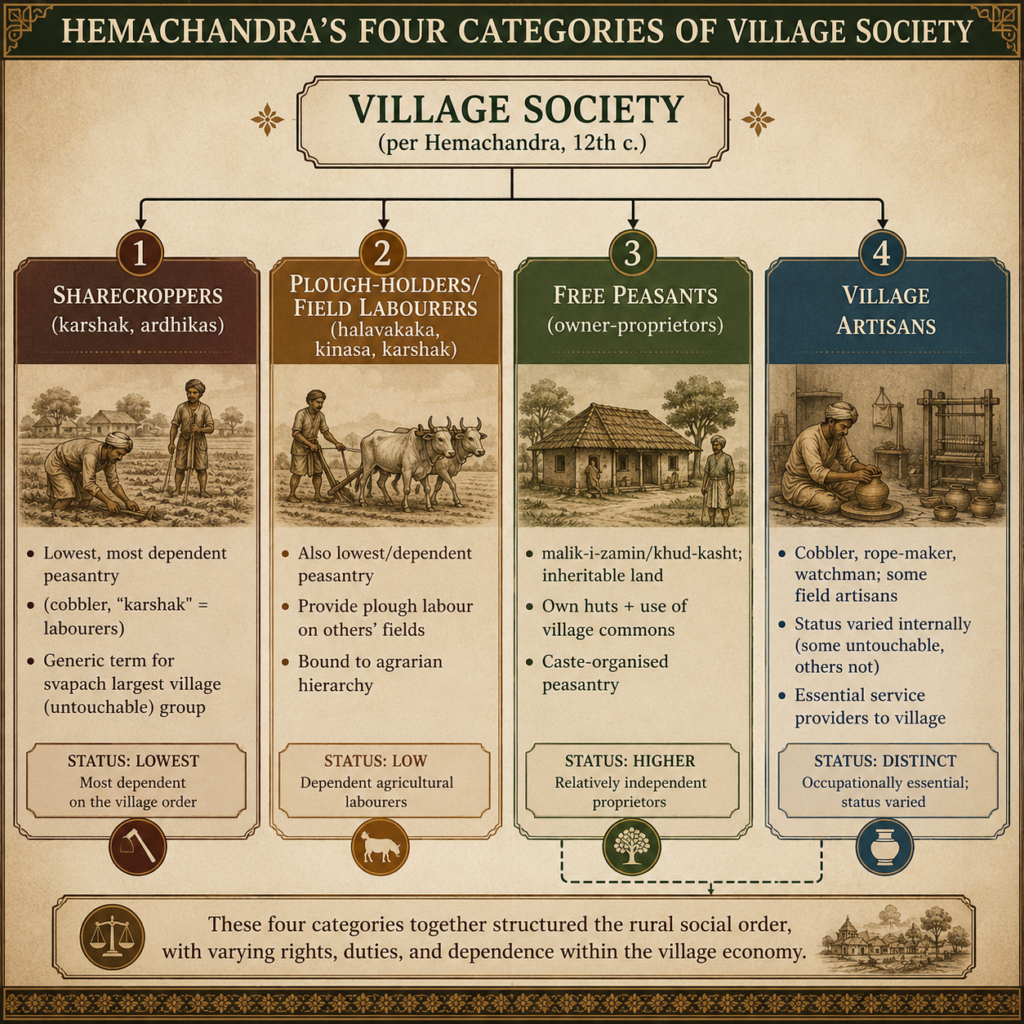
- The writings of the twelfth-century Jain author Hemachandra allow village society to be divided into four broad categories:
- Produce-sharing peasants or sharecroppers, described using terms such as karshak or ardhikas (“receivers of a half share”).
- Plough-holders and field labourers, described using terms such as halavakaka, kinasa, and, again, karshak.
- These first two groups together constituted the lowest, most dependent peasantry. The word karshak — literally, “tiller of the soil” — appears to have functioned as a generic term for the broader lower peasantry, which formed the largest single group within the villages.
- Free peasants, for whom the term “owner-proprietor” may be a more accurate description.
- In later usage, they were termed malik-i-zamin (“owners of the land”) or khud-kasht (“owner cultivators”).
- They held the right to inherit the land they claimed by descent, owned their own huts or houses, and enjoyed the use of the village commons — this group was often organised along caste lines.
- Village artisans — the cobbler, the rope-maker, the watchman, and others.
- Certain village artisans, such as the cobbler and field labourers, belonged to the svapach (untouchable) category, generally referred to using the terms low or adhama.
The Peasantry, Moneylenders, and Labourers
- Peasants formed the overwhelming majority of the rural population, continuing to work hard while eking out little more than bare subsistence.
- Rural moneylenders and rural labourers completed this social picture, with the genuine poverty of ordinary peasants and field labourers standing in sharp contrast to the luxurious life of the landed aristocracy — the samantas.
- Village society was highly unequal, and the growth of a cash nexus, which accelerated rapidly under the Sultanate, only widened these disparities further.
- While the agrarian policies of the Sultans were primarily designed to secure a steady income for the ruler and his administering officials, these same policies inevitably had a real impact on rural society and economy — an aspect historians must largely infer, since medieval chroniclers themselves showed little direct concern for it.
- In sum, rural society was a genuinely stratified society, with a clear hierarchy separating the superior right-holders (khots, muqaddams, and chaudhuris) from ordinary peasants (raiyat) — and the caste system remained an important institution structuring rural life throughout.
Composition of the Ruling Classes
- The ruling class served as a crucial pivot for consolidating conquered territory and sharing in the country’s resources. The Turks brought with them the institution of the iqta, which significantly aided the centralisation of authority — and as this drive toward centralisation intensified, corresponding changes appeared both in the iqta system itself and in the broader composition of the ruling class.
The Ruling Class at the Time of the Ghurian Invasion
- North India, at this point, was divided into numerous principalities ruled by rais and ranas (local chiefs).
- At the village level, khots and muqaddams (village headmen) stood at the border of the rural aristocracy proper.
- In between, the chaudhuri headed a group of roughly a hundred villages (eighty-four, according to Irfan Habib).
Nobility under the Delhi Sultanate
- The early Turkish ruling class functioned very much as a co-sharer of political and financial power alongside the Sultans themselves.
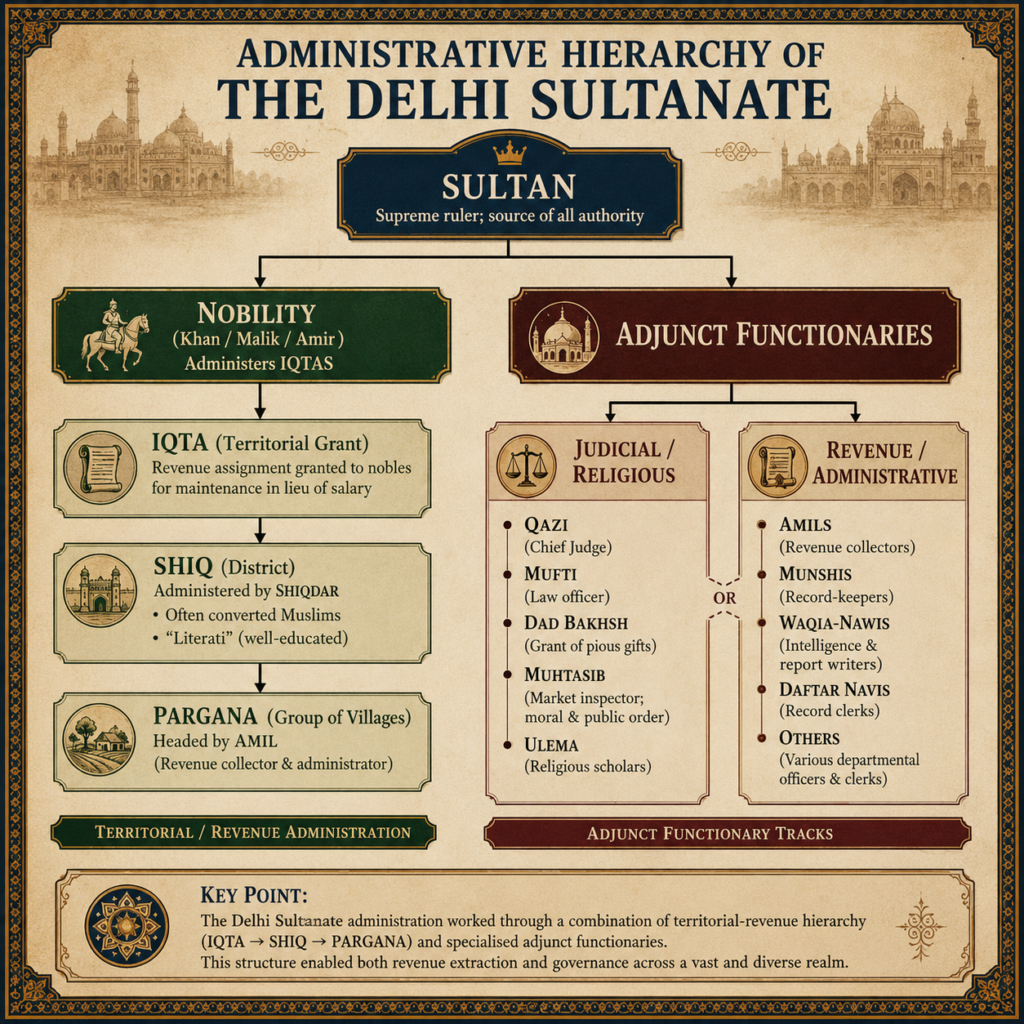
- In the earliest stages, the nobles (amirah) were practically independent within the distant areas of conquered territory to which they were sent as governors — designated muqti or wali, with their territories known as iqtas. Over time, the practice developed of periodically transferring muqtis between different iqtas.
- The pre-Ghurian political structure appears to have largely continued, with tribute realised from the rais and ranas, who were expected to continue collecting taxes as before.
- Contemporary historians such as Minhaj Siraj and Barani reveal that the most important nobles — and even several early Sultans themselves — hailed from families of Turkish slave-officers.
- Many early Turkish nobles and Sultans (such as Aibak and Iltutmish) began their careers as slaves, receiving formal letters of manumission (khat-i-azadi) before rising to the throne.
- Iltutmish created his own corps of Turkish slaves — the Shamsi maliks, termed turkan-i-chihilgani (“The Forty”) by Barani. His nobility also included a number of Tajik, or free-born, officers. The succession crisis following Iltutmish’s death exposed real divisions within this nobility.
- Despite frequent internal quarrels, the ruling class displayed a basic underlying solidarity, manifested clearly in its shared hostility toward outsiders — for instance, Raziya’s (1236–1240) elevation of the Abyssinian noble Jamaluddin Yaqut to the post of amir-i-akhur (“master of the royal horses”) provoked considerable resentment.
- Race, and to some extent religion, thus played a genuinely important role in shaping ruling groups. The ruling class was never a monolithic organisation — numerous factions and cliques existed, each jealously guarding its own exclusive position.
- The Turkish military leaders who had accompanied and participated in the original Ghurian invasion formed the genuine core of this early ruling class, acquiring most key posts both at the centre and across the provinces.
The Ilbarites
- The Sultans depended fundamentally on the support of the nobility to establish and sustain their rule — Iltutmish, for instance, ascended the throne with the direct backing of Delhi’s nobles.
- According to Barani, the older Turkish nobility would remind one another: “What art thou, that I am not, and what wilt thou be, that I shall not be.”
- The early Turkish nobility actively sought to emphasise their own exclusiveness and their claimed monopoly to rule — efforts by other social groups to challenge this monopoly were met with real resentment and resistance.
- When Nasiruddin Mahmud (1246–1266) attempted to break the entrenched power of the Turkish nobles by dismissing Balban (himself one of “The Forty”) and replacing him with Imaduddin Raihan, an Indian convert, the effort met with little success.
- Minhaj voiced the anger of the “Turks of pure lineage,” who “could not tolerate Imaduddin Raihan of the tribes of Hind to rule over them” — Turkish opposition ultimately forced the Sultan to remove Raihan and reinstate Balban.
- On his own accession, Balban (1266–1286) took decisive measures to break the entrenched power of the turkan-i-chihilgani — Barani records that Balban had several of the older Turkish nobles killed.
- When Nasiruddin Mahmud (1246–1266) attempted to break the entrenched power of the Turkish nobles by dismissing Balban (himself one of “The Forty”) and replacing him with Imaduddin Raihan, an Indian convert, the effort met with little success.
The Khaljis
- Barani identifies the Khaljis as a distinctly different “race” from the Turks proper.
- While modern scholars such as C.E. Bosworth classify the Khaljis as Turks, no one in the thirteenth century regarded them as such — their rise to power was accordingly viewed as something genuinely novel, since they had not previously formed a significant part of the ruling class.
- Alauddin Khalji further eroded the power of the older Turkish nobility, deliberately introducing new groups such as the Mongols (the “New Muslims”), Indians, and Abyssinians — the latter exemplified by the well-known case of Malik Kafur.
- This broadening of the ruling class’s composition continued under the subsequent Tughluq dynasty.
- A small, distinct group known as the kotwalian (plural of kotwal) existed at Delhi during the reigns of Balban and Alauddin Khalji — a family grouping headed by Fakhruddin, kotwal of Delhi, which appears to have played some political role both during and after Balban’s death.
The Tughluqs
- Under Muhammad Tughluq: the ruling class became unprecedentedly heterogeneous, incorporating Indians, Afghans, and growing numbers of foreign elements — particularly Khurasanis, whom the Sultan himself termed aizza (“dear ones”).
- Many Khurasanis were appointed as amir-sadah (“commander of a hundred”).
- Regarding non-Muslims and converted Indians, Barani laments that the Sultan elevated the “low-born” (jawahir-i-lutrah) to high status — musicians, barbers, and cooks among them. Examples include Peera Mali, a gardener given charge of the diwan-i-wizarat; converts such as Aziz-ud-Din Khammar (a distiller) and Qawamul Mulk Maqbul; Afghans such as Malik Makh and Malik Shahu Lodi; and Hindus such as Sai Raj Dhara and Bhiran Rai, all granted iqtas and high positions.
- Under Feroz Tughluq: his reign offers no clear pattern regarding the social origins of his nobility, characterised instead by a relatively smooth, if somewhat superficial, peace between Sultan and amirs.
- Certain formal designations came into use to describe the nobility: khan, malik, and amir.
- Khan was typically used for Afghan nobles.
- Amir came to denote a military commander.
- Malik denoted a chief, ruler, or king.
- Alongside such titles, nobles were also granted symbolic marks of dignity (maratib): the khilat (robe of honour), a sword and dagger presented by the Sultan, permission to use horses and elephants in processions, a canopy of state, the grant of a parasol (chhatri), and various insignia and kettledrums.
- Certain formal designations came into use to describe the nobility: khan, malik, and amir.
- It is worth noting that every Sultan sought to build and organise his own group of personally loyal nobles — hence the emergence of terms like Qutbi (after Qutbuddin Aibak), Shamsi (after Shamsuddin Iltutmish), and similarly Balbani and Alai amirs.
- One thing, however, remained constant: every faction sought to capture the Sultan’s personal attention, since all privilege and power ultimately flowed from the sovereign — in turn, this dynamic gradually strengthened the Sultan’s own position, provided he possessed sufficient force of will.
- Afghans were frequently recruited into the feudal bureaucracy of the Delhi Sultanate, and with the arrival of the Lodis, Afghan predominance expanded even further.
Social Origin of the Nobility
- During the early phase, considerable social mobility characterised the nobility — individuals from a wide range of social backgrounds, provided they possessed the capacity to raise and maintain a military following (jamiat), or simply caught the Sultan’s eye, could rise, with luck, to the rank of Malik. Many nobles, in fact, had begun their careers as slaves, gradually climbing the social ladder.
- This genuinely open character of the nobility persisted largely through the 13th century, owing to the rapid rise and fall of successive dynasties, which repeatedly displaced nobles from earlier regimes — as a result, the 13th century saw few families whose members held high grandee status for more than a single generation.
- During the 14th century, with the rise of the Khaljis, followed by the Tughluqs (who ruled for nearly a century), the social character of the nobility gradually broadened and stabilised.
- With the breaking of the earlier Turkish monopoly over high office, the zone of recruitment expanded considerably — many Khaljis, Afghans, and Hindustanis entered the nobility, without any deliberate effort to exclude the Turks themselves.
- Even when a noble lost his power and position, the tradition of former dignity passed to his descendants, who typically believed their eventual restoration to power was merely a matter of time and opportunity.
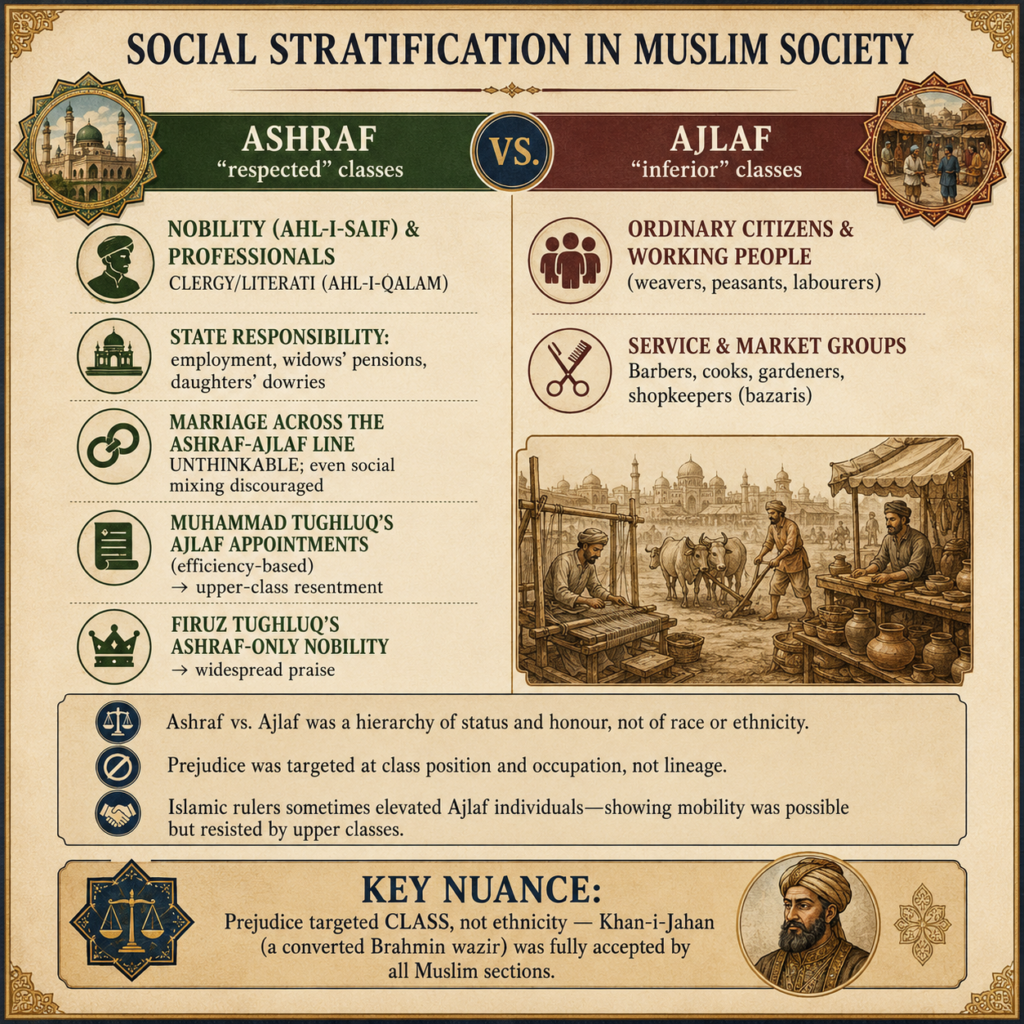
- Together with the clergy, these privileged sections constituted what were called the ashraf (“respected” classes).
- According to contemporary thinking, the state bore a special responsibility toward these sections — not only in matters of employment, but in providing pensions for widows, and even funding the marriage of unmarried daughters.
- A broad division existed between the ahl-i-saif (“men of the sword”) and the ahl-i-qalam (the literati).
- The latter — including the ulema — were chosen for judicial and clerical posts. So long as administration remained essentially a military exercise for extracting land revenue from recalcitrant chiefs, muqaddams, and peasants, the literati were largely kept away from actual administration, even though it was sometimes urged that the wazir himself should be drawn from their ranks.
- In general, the nobles held the literati in low regard, considering them unfit for genuine administrative or political matters.
- Alauddin Khalji, for instance, not only rejected the advice of Qazi Mughis on negotiating with the Mongols, but openly ridiculed him for offering military and political counsel, given that he was merely a nawisanda (clerk).
Categories of Nobles
- Nobles are generally divided into three categories: Khans (the highest), followed by Maliks and Amirs — though this categorisation was never entirely rigid or clear.
- Those holding junior posts in and around the court — sarjandar (commander of the king’s personal forces), saqi-i-khas (in charge of drinks), sipahsalar, and sar-i-khail (junior military commanders) — were generally termed amirs. Over time, the term “amir” came to be used more loosely, denoting simply a person of wealth and influence in government.
- The two most significant categories remained Maliks and Khans — all top government posts were held by individuals from these two ranks. Notably, the lists of nobles compiled by Minhaj Siraj and Barani mention only Maliks.
- The category of Khan itself resulted from Mongol influence, among whom the Qa’an (Khan) commanded some 10,000 troops; in the Delhi Sultanate, the term “Khan” was used purely to confer special status — Balban, for instance, held the title Ulugh Khan.
- Nobles were further honoured with distinctive titles such as Khwaja Jahan, Imad-ul-Mulk, and Nizam-ul-Mulk, alongside the various privileges (maratib) already described — robes, swords, daggers, flags, and drums — greatly valued precisely because they signified both status and personal closeness to the Sultan. Horses and elephants with costly trappings were similarly awarded on special occasions.
Number of Nobles
- Minhaj Siraj provides a list of 32 Maliks under Iltutmish, including 8 princes who were themselves displaced Central Asian rulers — the term Turkan-i-Chahalgani (“corps of forty Turks”), used by Barani, likely reflects the approximate number of top nobles at any given time.
- For Balban’s reign, Barani lists 36 Maliks, excluding qazis; this number rose to 48 under Alauddin Khalji, of whom 7 were relatives, including his own sons.
- From this, we may conclude that until the sudden expansion of the Sultanate following Alauddin Khalji’s death, the number of top nobles or Maliks in the country remained genuinely small.
Factional Fighting
- Even within this small group of nobles, genuinely bitter factional fighting was common, shaped by considerations of mutual relationship and ethnicity.
- The Turks considered themselves superior to all other groups — Tajiks, Khaljis, Afghans, and Hindustanis alike.
- The Turks ousted the Tajiks following Iltutmish’s death, establishing a near-total Turkish monopoly over high office — a monopoly subsequently broken by the rise of the Khaljis.
- Under the Khaljis and Tughluqs, Indian Muslims advanced significantly, largely on the strength of personal efficiency. Even so, foreign blood, or descent from a well-known foreign family, continued to carry considerable social value and esteem — as testified by the Moorish traveller Ibn Battuta.
The Dispersal of Resources among the Ruling Class
- Land revenue, termed iqta, was assigned by the state to individual nobles. Muqtis (iqta-holders) were required to:
- Furnish military assistance to the Sultan whenever needed.
- Maintain law and order within their assigned territory.
- Collect the revenue due from their iqta.
- Through the iqta institution, the Sultan retained real control over his nobility:
- Revenue assignments were generally non-hereditary and transferable.
- The demand that muqtis remit surplus revenue (fawazil) to the diwan-i-wizarat symbolised the broader trend toward centralisation.
- Muqtis were required to submit detailed accounts of their revenue collection and expenditure to the treasury, with auditing kept genuinely severe to prevent fraud.
- Alauddin Khalji took further steps to control his nobility:
- Barids (intelligence officers) kept the Sultan closely informed of noble activity.
- Close checks were kept on noble socialising, and marriages between noble families required the Sultan’s explicit permission.
- The primary motivation behind these controls was the recurrent pattern of rebellion, in which muqtis used and appropriated the resources of their iqtas either to rebel outright, or to make a bid for the throne itself.
- Under Muhammad Tughluq: nobles received iqtas in lieu of a cash salary, but — in a departure from earlier practice — their troops were now paid directly in cash by the treasury.
- These new fiscal arrangements, and the correspondingly greater central control over assignments, contributed directly to growing conflict between the Sultan and his nobles, who found themselves deprived of the earlier gains of iqta management.
- Under Feroz Tughluq: a genuine retreat from increased central authority over the iqta system occurred.
- In practice, Feroz began granting iqtas to the sons and heirs of existing iqta-holders — a reign that saw comparatively few rebellions, but which also marked the beginning of gradual disintegration and decentralisation.
- By the time of the Lodis (1451–1526), iqtadars (by then termed wajhdars) no longer appear to have been subject to constant transfer.
Social Stratification within Muslim Society: Ashraf and Ajlaf
- Social stratification was similarly visible within Muslim society itself, broadly divided into two sections: ashraf (the respected classes) and ajlaf (the lower, “inferior” classes).
- The ashraf comprised the nobility and clergy — contemporary thinking held that the state bore special responsibility toward this section, including employment support, widows’ pensions, and funding for daughters’ marriages.
- The ajlaf, by contrast, comprised ordinary citizens and professionals such as weavers, peasants, and labourers.
- Marriage between these two sections was considered genuinely unthinkable, and even ordinary social interaction between them was discouraged.
- While such social gradations had already existed among Muslims in West and Central Asia, they became considerably more rigid and pronounced after arrival in India — a country with its own deep-rooted tradition of hereditary stratification, namely, caste.
- Arising directly from this social division was the widespread belief that only members of the “respectable” ashraf classes possessed a legitimate right to hold high state office.
- There was accordingly considerable resentment among the upper classes when Muhammad Tughluq appointed Hindus and Muslims from “inferior” ajlaf classes or castes — barbers, cooks, gardeners, shopkeepers (bazaris) — to high office, apparently on the basis of individual efficiency.
- Firuz Tughluq, by contrast, earned considerable praise and approval for selecting nobles only from families whose ancestors had already served the king, or who otherwise belonged to the “respected” classes.
- It is worth stressing that this prejudice was directed not against “Hindustanis” as such, but specifically against the so-called inferior classes, whether Hindustani or Muslim — a point confirmed by the fact that Firuz’s own wazir, Khan-i-Jahan, a converted Brahmin, remained fully acceptable to all sections of Muslim society.
Salary and Wealth of the Nobles
- Barani records that during Balban’s reign, nobles apparently held little ready cash on hand — whenever they wished to host a majlis or convivial gathering, their agents would rush to borrow from the houses of the Sahs and Multanis, meaning that virtually all the income from their iqtas ultimately flowed back to these merchant-lenders as repayment. Gold and silver, as a result, were to be found chiefly in the houses of merchants rather than nobles.
- This situation appears to have changed with the arrival of Alauddin Khalji and the growth of a new, centralised system of land revenue administration, which continued under the Tughluqs.
- The new revenue system placed particular emphasis on cash payment of land revenue — applying not only to khalisa territory (income destined for the central treasury) but also to territory assigned as iqta.
- When Ibn Battuta was appointed a judge with a salary of 5,000 dinars, this was funded through the assignment of 2½ villages, whose annual income matched that figure — we similarly hear of nobles being granted correspondingly large salaries, rising even higher under Firuz Tughluq.
- This system implied an unprecedented centralisation of rural surplus in the hands of the central elite.
- These high emoluments implied not only great affluence, but the very real possibility of hoarding wealth.
- When Malik Shahin, naib amir-i-majlis of Sultan Firuz, died, he left behind 50 lakh tankas, besides jewels, ornaments, and costly robes.
- Imad-ul-Mulk Bashir-i-Sultani, who had begun his career as the Sultan’s own slave, left behind 13 crore tankas, of which the Sultan confiscated 9 crore.
- Such cases, however, appear to be genuine exceptions rather than the rule. Beyond serving as a form of insurance against uncertainty, the growth of such hoards also serves as an index of the slow, gradual growth of a genuine money economy in the country.
Attitude towards Trade
- The growth of a money economy brought with it a real shift in attitudes toward trade and traders.
- Ibn Battuta describes ships owned directly by the Sultan of Delhi. On one occasion, Muhammad bin Tughluq placed three ships at the disposal of Shihabuddin Kazruni, a friend engaged in flourishing overseas trade, whom he styled a “king of merchants.”
- Almost for the first time, traders became directly involved in matters of administration: Muhammad Tughluq gave Shihabuddin charge of the city of Khambayat, even promising him the post of Wazir — though he was ultimately murdered on the orders of the actual wazir, Khan-i-Jahan, while en route to Delhi.
- Abul Hasan Ibadi, an Iraqi resident of Delhi, similarly traded using Sultan Muhammad bin Tughluq’s own funds, purchasing weapons and goods on his behalf in Iraq and Khurasan.
- On balance, it appears that the major investments of the nobility lay not in trade, but in orchards — whose numbers grew sharply under Firuz alongside general noble prosperity. Genuine, productive investment by the nobility in trade would have to await the re-centralisation of the empire under Akbar.
Literacy and Cultural Patronage among the Nobility
- Nobles were, on the whole, far from illiterate: even slaves purchased in the slave markets of Samarqand and Bokhara were educated before resale — though newly converted, they had generally absorbed the prevailing Islamic religious and cultural norms of Central Asia and Khurasan.
- Even so, such individuals could hardly have absorbed the finer cultural graces of an old, well-established nobility, nor could they be expected to function as genuinely knowledgeable patrons of culture — even though patronising poets and writers, sometimes with extravagant rewards, was considered a mark of real prestige.
- This began to change with the rise of Amir Khusrau and his companion Amir Hasan Sijzi toward the end of the 13th century. Gradually, a genuinely new Indo-Muslim culture developed, actively shaped by many nobles and Sufis alike.
- Zia Nakkshabi (d. 1350), for instance, wrote extensively on numerous subjects including poetry, and had a number of Sanskrit works translated into Persian.
- In this way, the nobility gradually evolved from being merely “rude warriors” into genuine patrons of culture as well.
The Chiefs — Emergence of “Zamindars”
- Although the Rajputs had lost formal state power across most of North India — with the exception of Rajasthan and adjacent areas, as well as the remoter Himalayan and Bundelkhand hill regions — Rajput rajas continued to dominate large tracts of countryside even within centrally administered regions such as Punjab, the doab, Bihar, and Gujarat. They were generally styled rai, rana, or rawat.
- The term “chief” has generally been applied to them in scholarship. They maintained their own armed forces, typically resided in fortresses across the countryside, and remained genuinely important figures in the political, social, and economic life of rural India.
- Although contemporary sources invariably portray these chiefs as enemies against whom continuous jihad was both legitimate and necessary, a relationship of permanent hostility proved impractical for both the Turkish rulers and the chiefs themselves.
- For the Turkish rulers, it was simply more convenient to allow chiefs to continue ruling their territories, provided they paid a fixed sum of tribute regularly and behaved with general loyalty.
- There is clear evidence of a growing political relationship between Turkish rulers and Hindu chiefs:
- When Firuz Tughluq invaded Bengal, he was joined by several rais of eastern UP, the most prominent among them being Udai Singh, the Rai of Gorakhpur and Champaran.
- When Malik Chhajju, a nephew of Balban and governor of Kara, rebelled against Jalaluddin Khalji, he was joined by local rais, rawats, and payaks. Though Chhajju was ultimately defeated, from this point onward, Hindu chiefs appear to have become regular fixtures in attendance at the Sultan’s court.
- Despite these deepening political linkages, the overall position of the chiefs remained one of considerable uncertainty.
- It formed a consistent part of Delhi Sultanate policy to overthrow Hindu chiefs whenever feasible, or at minimum, to steadily reduce their power and privilege by extending the imperial revenue administration into territories under their control.
- By the early 14th century, references to “zamindars” grow increasingly common. This term — which exists nowhere outside India — was used with growing frequency to designate hereditary intermediaries.
- Amir Khusrau was among the first writers to use the term, which in time came to be applied equally to the khuts, muqaddams, and chaudhris.
- Under the later Mughals, “zamindar” broadened further to describe all hereditary landowners, or those holding a hereditary share in land revenue — even the chiefs themselves came to be included within this category. Broadly, the growing affluence of these privileged rural sections stands in sharp contrast to the poverty of the rest of rural society.
Adjuncts to the Ruling Class: Judicial, Administrative Officers, and the Ulema
- The ruling classes — the nobility above all — could hardly have functioned without a broad supporting layer of lower functionaries, in addition to the large retinue of servants, slaves, and other retainers they employed.
- These functionaries can be broadly divided into two groups: judicial and religious functionaries, and revenue and administrative functionaries.
Judicial and Religious Functionaries
- This group consisted of qazis and muftis, appointed in every city with a sizeable Muslim population.
- They dispensed civil justice for Muslims, leaving Hindus to resolve their own disputes according to customary law and the Dharmashastras; they also handled criminal justice, headed at the top by the Chief Qazi.
- In the capital, and likely in other major cities, a Dad Bak was responsible for checking the arbitrary imposition of taxes, and for supervising the amirs responsible for surveying and recording Muslim property for taxation purposes.
- The muhtasib, working under the kotwal, was responsible for ensuring Muslims did not openly violate the sharia or neglect compulsory religious obligations such as roza (fasting) and namaz (prayer); he was also responsible for checking market weights and measures.
- All these posts were salaried, and their numbers grew steadily alongside the country’s growing Muslim population.
- Also included in this broader category were imams, muazzins, reciters of the Holy Quran (appointed to mausoleums or called upon for religious functions), and religious teachers appointed to schools (maqtab) and colleges (madrasa) — together, these sections constituted the broader theological class, or ulema.
The Ulema
- The ulema held a genuinely important position within the Sultanate, commanding considerable respect.
- As a general rule, they had undergone formal training in Muslim law, logic, and theology, including some knowledge of Arabic; important legal and judicial appointments were drawn from their ranks — including the sadr-us-sudur, shaikh-ul-Islam, qazi, mufti, muhtasib, imam, and khatib.
- The ulema can reasonably be understood as an adjunct of the ruling class, sustained through revenue grants from the Sultan and members of the ruling elite. Their ideological significance was substantial, since they provided crucial legitimacy to the ruling class, exercising an influence that was often political, not merely religious.
- Even so, the nobility generally considered the ulema unfit for genuine administrative or political matters — as illustrated by Alauddin Khalji’s dismissive treatment of Qazi Mughis’s advice regarding the Mongols. Amir Khusrau, similarly, regarded qazis who accepted judicial office as corrupt and ignorant, unfit for responsible positions in the kingdom.
- As a general rule, the Sultans confined the ulema’s role to judicial cases, religious matters, and education, allowing them little real say in political affairs.
- Even so, the ulema did play a genuinely positive role, acting as a bridge between the ruling classes and ordinary Muslims, and helping to instil a broader sense of religious unity among Muslims.
- It should equally be noted that many ulema were themselves foreigners, who had taken refuge in India either fleeing the Mongols, or drawn by India’s prosperity.
- Possessing limited real understanding of India, these individuals — and a section of India’s own theologians — sometimes heightened social tensions between ordinary Hindus and Muslims, constantly emphasising elements of religious conflict while overlooking the genuine sense of social amity that generally prevailed among the people.
Revenue and Administrative Functionaries
- A large body of clerks and officials was required to staff the growing machinery of administration — both at the centre and across provincial and district towns — following the new revenue system introduced by Alauddin Khalji.
- The considerable power wielded by these officials, the real possibilities of corruption and oppression, and the harsh corrective measures taken by Alauddin against them, are all described in detail by Barani.
- A significant number of these lower officials were likely converted Indian Muslims, or members of the ulema class.
- Setting aside the muqaddams and patwaris (village accountants), who were generally Hindu and resided within villages, most of these lower administrative officials were probably Muslim.
- Hindus, however, appear to have entered this administrative class more substantially under Muhammad bin Tughluq — which would help explain his selection of a small number of Hindus for high positions, and the emergence, by this time, of a distinct class of Persian-knowing Hindus.
- Very often, poets, scholars, historians, physicians, and lower government functionaries — amils (revenue collectors), muharrirs (accountants), and others — were drawn from this same broad social class, collectively describable as the literati, or educated, literate class.
- In a country that remained predominantly illiterate, individuals who were both educated and capable of speaking with religious authority naturally commanded enormous prestige.
Conclusion
- Society in the thirteenth and fourteenth centuries reveals two closely interlinked hierarchies — a rural society stratified between powerful intermediaries (khuts, muqaddams, chaudhuris — later unified as “zamindars”), a large dependent peasantry, and village artisans; and a ruling class that evolved from a narrow, race-conscious Turkish nobility into a genuinely broader, if still deeply stratified, elite incorporating Khaljis, Afghans, Indians, and even former slaves.
- Running through both halves of this social order was a common thread: growing centralisation — visible in the state’s tightening grip on rural intermediaries, in the Sultan’s increasing control over the iqta system, and in the steady expansion of a cash-based, literate administrative apparatus staffed by qazis, ulema, and a broadening class of revenue officials.
- Even so, deep structural inequalities — between rural elite and peasant, between ashraf and ajlaf, between Turk and non-Turk — persisted throughout this period, shaping medieval Indian society well beyond the Sultanate’s own political lifespan.




