Paleolithic Period: Hunting and Gathering

- The Indian Stone Age is divided into the Palaeolithic, Mesolithic, and Neolithic, on the basis of geological age, the type and technology of stone tools, and the subsistence base.
- The Palaeolithic is further divided into the Lower, Middle, and Upper Palaeolithic. A general time range for each is:
- the Lower Palaeolithic, from about 2 mya to 100,000 years ago;
- the Middle Palaeolithic, from about 100,000 to 40,000 years ago; and
- the Upper Palaeolithic, from about 40,000 to 10,000 years ago.
- However, there is a great deal of variation in the dates for different sites.
- The Palaeolithic cultures belong to the Pleistocene geological era, while the Mesolithic and Neolithic cultures belong to the Holocene era.
- Stone Age cultures did not evolve uniformly, in a neat unilinear fashion, all over the subcontinent. There are regional variations in some of their features, and their dates also vary considerably.
- There are tools considered characteristic of each particular phase. However, this does not mean that there is complete uniformity in the tools found at different sites, or that tools typical of one phase were entirely absent in another.
- For example, celts are associated with the Neolithic, but are known to occur as late as the historical period in certain parts of eastern India.
- Similarly, with regard to the subsistence base, it should be noted that hunting and gathering did not come to an end with the beginnings of animal and plant domestication.
- Many agricultural communities continued to hunt and forage for food. In fact, these subsistence activities continue to be prevalent in certain niches of the subcontinent even today.
Palaeolithic Age (Old Stone Age)
- Palaeolithic culture developed in the Pleistocene period.
- The Pleistocene period (about 2 million years ago) is the geological period referring to the last, or the Great Ice Age — the period when ice covered the earth’s surface.
- It was basically a hunting and food-gathering culture.
- The term Palaeolithic was coined by archaeologist John Lubbock in 1865. It literally means “Old Stone Age” (palaeo meaning “old” and lithic meaning “stone”).
- Robert Bruce Foote was the first to discover a Palaeolithic stone tool in India, in 1863.
Tools
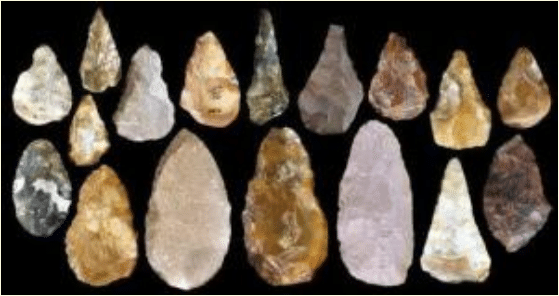
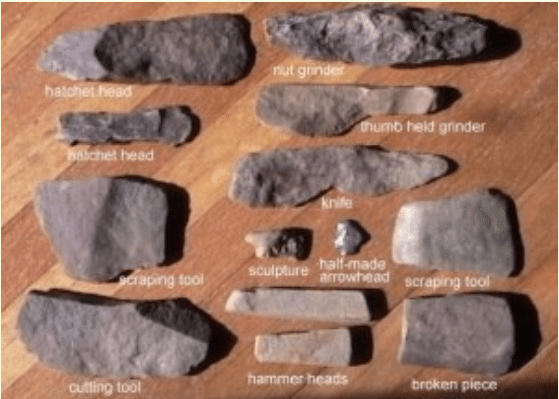
- Palaeolithic tools included the club, sharpened stone, chopper, hand axe, scraper, spear, bow and arrow, harpoon, needle, and scratch awl, among others.
- The tools were generally made of hard quartzite rock, and so Palaeolithic man is sometimes called “Quartzite Man.”
- Handaxe:
- A handaxe is generally a core tool, also known as a biface, because it is usually worked on both sides.
- Generally made on a core, it is roughly triangular in shape, broad at one end and pointed at the other — its butt end is broader, and the working end is narrower.
- It might have been used for cutting and digging purposes.
- Cleaver:
- A cleaver is a flattish tool made on a broad rectangular or triangular flake, with a broad and straight cutting edge at one end; it has a biface edge.
- It was used for clearing and splitting objects such as the trunks of trees.
- Chopper:
- A chopper is a large, unifacial tool — that is, worked on one side only — used for chopping purposes.
- Chopping tool:
- It is again a massive core tool, like the chopper. A chopping tool is made on a core or a pebble and is flaked alternately on both sides to produce a wavy cutting edge.
- Used for a similar purpose as the chopper, it was more effective, owing to its sharper edge.
- Flake:
- A crude, desired shape of tool produced by applying force on the stone.
- Side scraper:
- A side scraper is made of a flake or blade with continuous retouch along a border.
- It might have been used for scraping the bark of trees and animal skins.
- Burin:
- A burin is a small tool made on a blade (a blade being itself a flake tool). It has a sharp but thickset working border, similar to that of a modern screwdriver.
- It was used for engraving on soft stones, bones, or the walls of rock shelters and caves.
- The term Acheulian is often used to refer to an assemblage of stone tools marked by advanced and increasingly symmetrical handaxes and cleavers. These are associated with the Lower Palaeolithic, but continue well afterwards as well.
- The artefacts were found in three river terraces, which were correlated with the phases of the four-fold Pleistocene glaciation.
- Factory sites are generally located close to the sources of raw materials, and are marked by a profusion of stone tools in various stages of preparation. In many instances, they were visited and used during several phases of the Stone Age.
Palaeolithic Age in India: The Three Phases
- Palaeolithic tools/culture has been divided into three phases, on the basis of the nature of the stone tools made by human beings, as well as due to changes in climate and environment.
- The tools of each phase are broadly distinguished as follows:
- The Lower Palaeolithic phase includes mainly handaxes, cleavers, choppers, and chopping tools.
- Middle Palaeolithic industries are based upon flakes.
- The Upper Palaeolithic is characterised by burins and scrapers.
(1) Early or Lower Palaeolithic (c. 500,000 – 100,000 BC)
- It covers the greater part of the Ice Age.
- Tools:
- Mainly handaxes, cleavers, choppers, and chopping tools.
- The tools were made by removing flakes from a block or core of stone until it reached the required size and shape.
- Apart from directly breaking off pieces of stone from large boulders — which would have required considerable strength — it is possible that people lit fires against rocks and threw water over them, so that large fragments broke off more easily.
- They served a variety of functions, including hunting, butchering and skinning animals, breaking bones to extract marrow, digging roots and tubers, processing plant foods, and making wooden tools and weapons.
- Raw materials used:
- Early Palaeolithic tools were fairly large core tools, made of quartzite or other hard rocks — hard and durable quartzite, though quartz was occasionally used as well.
- In some parts of India, such as Hunsgi in Karnataka, limestone was the main material; at Lalitpur in central India, pink granite was chosen; while in parts of Maharashtra and central India, basalt was preferred.
- The earliest reliable stone tool assemblages belong to two distinct cultural and technological traditions: the Sohanian culture and the Acheulian culture, both under the Lower Palaeolithic.
Sohanian culture:
- The name is derived from the Sohan river, a tributary of the Indus.
- The sites of the Sohanian culture were found in the Siwalik Hills in north-west India and Pakistan.
- Lower Palaeolithic stone tools have also been found in the Soan valley (now in Pakistan), and at several sites in Kashmir and the Thar Desert.
- These were known as the Soanian industries (while the artefacts found over much of the rest of India were known as Acheulian or “Madrasian“), and were dominated by pebble, blade, and chopper/chopping tools.
- The animal remains from this deposit included horse, buffalo, straight-tusked elephant, and hippopotamus, suggesting an environment characterised by perennial water sources, tree vegetation, and grass steppes.
Acheulian culture / Madrasi culture:
- Acheulian culture, named after the French site of St. Acheul, was the first effective colonisation of the Indian subcontinent, and is almost synonymous with the Lower Palaeolithic settlements in India.
- Sites:
- The Acheulian culture was a hunter-gatherer culture that adapted to a variety of climates, including western Rajasthan, the Mewar plain, Saurashtra, Gujarat, central India, the Deccan plateau, the Chota Nagpur plateau, and the Eastern Ghats, north of the Cauvery river.
- The sites are densely concentrated in central India and the southern part of the Eastern Ghats, as this area received adequate rainfall, has perennial rivers and a thick vegetation cover, and is rich in wild plant and animal food resources.
- Bori in Maharashtra is considered to be the earliest Lower Palaeolithic site.
- The most well-known sediments are found in the rock shelter at Bhimbetka in Madhya Pradesh.
- Acheulian people occupied a variety of microhabitats in different regions of India. The hunter-gatherers of the Acheulian culture were more concentrated in:
- Nagaur and Didwana of Rajasthan.
- The Vindhya Hills of central India (Bhimbetka).
- Barkhera, near Bhimbetka.
- Putlikarar in Raisen district of Madhya Pradesh.
- The rock shelter and open-air sites represent seasonal camping places of the same populations.
(2) Middle Palaeolithic (c. 100,000 – 40,000 BC)
- The Acheulian culture was slowly transformed into the Middle Palaeolithic, by shedding some tool types and incorporating new forms and new techniques of manufacture.
- Tools:
- Middle Palaeolithic tools were primarily made on smaller, lighter flake tools and blades, finely trimmed along the edges.
- Some were used for manufacturing wooden tools and weapons, and also for processing animal hide. There are only slight hints of the use of wooden shafts.
- In comparison to the Lower Palaeolithic era, the tools of the Middle Palaeolithic became smaller, thinner, and lighter.
- There was also a significant change in the choice of raw material for making tools: while quartzite, quartz, and basalt continued to be used, in many areas they were replaced or supplemented by fine-grained siliceous rocks such as chert and jasper.
- Tool factory sites at chert outcrops occur at many places in central India and Rajasthan.
- Sites:
- The first general observation about the Middle Palaeolithic era is that, in comparison with the Lower Palaeolithic era, the distribution of sites is sparser.
- This is because the Middle Palaeolithic culture developed during the Upper Pleistocene, a period of intense cold and glaciation in the northern latitudes; in those times, the areas bordering glaciated regions experienced strong aridity.
- Generally, Middle Palaeolithic hominids continued largely to occupy areas already inhabited during the Lower Palaeolithic; but in some parts of India, such as Tamil Nadu, rock shelters began to be occupied for the first time.
- In the north-west, large numbers of stone tools, mostly of the Middle Palaeolithic, have been found in the Potwar plateau, between the Indus and Jhelum rivers.
- The Sanghao cave, in the North-West Frontier Province of Pakistan, has revealed a Middle Palaeolithic occupation: thousands of stone tools were found, along with bones (of animals, and possibly some humans) and hearths. All the tools are made of quartz, which is easily available around the site.
- The earliest trace of human occupation in the Ganga plain is found at Kalpi (in Jalaun district, UP), on the southern bank of the Yamuna.
- A number of vertebrate fossils — an elephant tusk, the shoulder blade of an elephant, and molars of Equus and bovids — were found here.
- Middle Palaeolithic stone tools (including pebble tools, points, and side scrapers), as well as bone tools, were found alongside them. There are several Middle and Upper Palaeolithic sites further east, especially in the western part of West Bengal.
- The Belan valley (UP), which lies at the foothills of the Vindhyas, is rich in stone tools and animal fossils, including cattle and deer; these remains relate to both the Lower and Middle Stone Age.
- Sites are also found in the Rohri hills of upper Sind, the Luni valley, and around Didwana and Budha Pushkar in Rajasthan.
- Thar region:
- In the Thar region, Middle Palaeolithic artefacts occur in reddish-brown soil, which indicates more abundant vegetation, more surface water, and a cooler, wetter, and more humid climate compared to Lower Palaeolithic contexts.
- Small factory sites and camp sites have been found in various parts of the Thar, especially near rivers and lakes.
- A large number of Stone Age sites, belonging to the Middle Palaeolithic phase onwards, are located around Budha Pushkar lake, which offered easy availability of water and stone.
- Middle and Upper Palaeolithic tools are also found around Ajmer.
- Middle Palaeolithic working floors have been found at Hokra and Baridhani, close to now dried-up lakes.
- In the Jaisalmer area, Upper Palaeolithic material is not as abundant as Middle Palaeolithic artefacts.
- Middle Palaeolithic sites have also been located along the Luni river system. The term Luni industry is used for Middle Palaeolithic assemblages west of the Aravallis, and can be contrasted with the industry of the regions lying east of the Aravallis.
- Although certain forms are common to both areas, sites west of the Aravallis display more variety in stone tool types and a larger number of reworked flakes.
- The Wagaon and Kadamali rivers in Mewar are rich in Middle Palaeolithic sites.
- Sites are also found along the Son and Narmada rivers and their tributaries in central India, and at several sites south of the Tungabhadra river.
- Middle and Upper Palaeolithic tools have also been found along the eastern margin of the Gujarat plain.
- The Middle Palaeolithic industry of central and peninsular India is sometimes referred to as the Nevasan industry, after the site of Nevasa. The tools, which include a wide variety of scrapers, are made of smooth, fine-grained stone such as agate, jasper, and chalcedony.
- Patne in the Tapi valley revealed a sequence of Middle and Upper Palaeolithic and Mesolithic tools, and there is evidence of a Middle Palaeolithic living and factory site at Chirki, near Nevasa.
- At Bhimbetka, the tools representing the Acheulian tradition were replaced at a later stage by the Middle Palaeolithic culture.
- Some sparse sites also occur in the Chota Nagpur plateau, the Deccan plateau, and the Eastern Ghats.
- In South India, the Middle Palaeolithic culture is marked by a flake tool industry. On the Visakhapatnam coast, quartzite, chert, and quartz were frequently used to make stone tools.
- By and large, open-air sites along streams, on hill slopes, on stable dune surfaces, and in rock shelters continued to be used, as is evident from finds at:
- the Sanghao cave in Pakistan;
- the Luni river basin in Rajasthan;
- the sand dunes of Didwana;
- the Chambal, Narmada, Son, and Kortallayar river valleys; and
- the plateaus of eastern India and the Hunsgi valley in the south.
- The first general observation about the Middle Palaeolithic era is that, in comparison with the Lower Palaeolithic era, the distribution of sites is sparser.
(3) Upper Palaeolithic (c. 40,000 – 10,000 BC)
- The Upper Palaeolithic is characterised by burins and scrapers.
- The important technical advance of the Upper Palaeolithic was the making of parallel-sided blades and an increase in the number of burins.
- The tools of the Upper Palaeolithic era show marked regional diversity with respect to the refinement of techniques and the standardisation of finished tool forms.
- Bored stones and grinding slabs have also been found, hinting at advancements in the technology of tool production.
- The trend was towards smaller tools, which must have been due to adaptations to environmental changes — it is known, for instance, that the climate of northern and western India seems to have become increasingly arid during the Upper Palaeolithic.
- Older tool types continued to be made for activities that required heavier tools.
- The Upper Palaeolithic marks:
- The appearance of Homo sapiens and new flint industries.
- The widespread appearance of figurines and other artefacts reflecting art and rituals.
- The appearance of a wide range of bone tools, including needles, fishing tools, harpoons, blades, and burin tools.
- One important discovery is that of ostrich egg shells at over 40 sites in Rajasthan, Madhya Pradesh, and Maharashtra, showing that the ostrich — a bird adapted to arid climates — was widely distributed in western India during the later part of the Upper Pleistocene.
- There were very important changes in the Upper Palaeolithic environment, which had their own impact on the distribution and living ways of humans. Some of these were as follows:
- There was an extremely cold and arid climate in the high altitudes and northern latitudes.
- There was extensive formation of deserts in north-west India.
- The drainage pattern of western India became almost defunct, and river courses shifted “westwards.”
- Vegetation cover over most of the country thinned out during this period.
- Coastal areas of south-eastern Tamil Nadu, Saurashtra, and Kutch developed quartz and carbonate dunes, as a result of the lowering of the sea level.
- During the terminal Pleistocene, south-westerly monsoons became weak, and the sea level decreased by several tens of metres.
- Due to the harsh and arid climate, vegetation was sparse, though faunal fossils show the presence of grasslands.
- The human population faced restricted food resources, which is the reason why the number of Upper Palaeolithic sites is very limited in the arid and semi-arid regions.
- Sites:
- The Belan and Son valleys, in the northern Vindhyas.
- Chopani Mando, in the Belan valley, seems to be a habitation site with a cultural sequence running from the Upper Palaeolithic to the Neolithic.
- The Upper Palaeolithic assemblage consisted of tools made from chert, a stone available in the nearby Vindhyas.
- The animal bones discovered in the Belan valley included those of wild cattle, sheep, and goats. Since sheep and goats do not seem to be indigenous to this area, they may have been brought here from the north-west — this could represent an early stage of animal domestication.
- Chopani Mando, in the Belan valley, seems to be a habitation site with a cultural sequence running from the Upper Palaeolithic to the Neolithic.
- In Siddhi district of Madhya Pradesh, in the valley of the Son river, the Upper Palaeolithic site of Baghor.
- The Chota Nagpur plateau in Bihar, upland Maharashtra, Orissa, and the Eastern Ghats in Andhra Pradesh.
- In the north-west, the Sanghao cave has given evidence of Middle and Upper Palaeolithic tools, hearths, animal bones, and what appear to be burials.
- The Rohri hills in Sindh.
- In north India, the Kashmir Upper Palaeolithic coincides with the onset of a milder climate.
- In the Thar, the number of Upper Palaeolithic sites is fewer than those of the preceding phase, due to increasing aridity — however, there was continuing human occupation around the Budha Pushkar lake.
- In central India, Upper Palaeolithic habitation sites have been found in caves and rock shelters of the Vindhyas.
- There are many Upper Palaeolithic sites in the Chotanagpur region and the Damin area of the Rajmahal hills — these include Paisra, in Munger district.
- Upper Palaeolithic tools have been found in various districts of West Bengal.
- The Upper Palaeolithic cave sites of Kurnool and Muchchatla Chintamanu Gavi in Andhra Pradesh are the only places in the subcontinent where tools made of animal bones have been found in an Upper Palaeolithic context.
- Upper Palaeolithic artefacts were also found in a cave at Renigunta, in Chittor district of southern Andhra Pradesh.
- The Belan and Son valleys, in the northern Vindhyas.
Palaeolithic Art (Upper Palaeolithic Era)
- Prehistoric art marks the beginning of the history of art, and is also an important window into the world of prehistoric people.
- Apart from paintings on rocks, rock art includes petroglyphs — a term used when some substance of a rock surface is removed through engraving, bruising, hammering, chiselling, or scooping.
- Prehistoric art can occur in permanent places (e.g., cave paintings) or can be portable (e.g., figurines). Such remains were clearly an integral and important part of community life, and some of them seem to have held some sort of cultic or religious significance.
- An Upper Palaeolithic carved bone object found at Lohanda Nala, in the Belan valley (UP), has been identified as a mother goddess figurine by some, and as a harpoon by others.
- Animal teeth found in a cave at Kurnool have grooves suggesting that they may have been attached to a string and worn as ornaments.
- A circular disc made of chalcedony at Bhimbetka, and a soft sandstone disc at Maihar (south-west of Allahabad), were found in Acheulian contexts — neither seems to have been a tool.
- The earliest form of art is found in the form of ostrich egg shell pieces engraved with cross-hatched designs, from the Upper Palaeolithic period.
- A piece of ostrich eggshell, engraved with two panels of criss-cross designs, was discovered at Patne.
- Four perforated beads and one incomplete bead made of ostrich eggshell came from Patne, and one from the Bhimbetka rock shelters, all from Upper Palaeolithic contexts.
- The site of Baghor I in Madhya Pradesh has given fascinating evidence of an Upper Palaeolithic shrine.
- Here, there was a roughly circular platform made of sandstone rubble.
- In the centre was a piece of natural stone with a striking pattern of concentric triangular laminations in colour.
- Kol and Baiga tribal people, who live in this part of the Kaimur hills today, make circular rubble platforms and worship similar triangular stones as a symbol of the female principle, or as an icon of a goddess.
- The earliest paintings at Bhimbetka belong to the Upper Palaeolithic, when people lived in small groups.
Distribution of Palaeolithic Sites
- The distribution of stone tools tells us not only about the areas in which the hunter-gatherers lived and moved, but also about their environment.
North and West India
Kashmir:
- The Kashmir Valley is surrounded by the Pir Panjal Hills to the south-west and the Himalayas to the north-east.
- A handaxe was discovered near Pahalgam in Kashmir, on the river Lidder.
- However, Palaeolithic tools are not found in large numbers in Kashmir, because Kashmir was intensely cold during glacial times.
Potwar region:
- The Potwar region (present-day West Punjab and Pakistan) lies between the Pir Panjal and the Salt Range. This area experienced tectonic movement, and the rivers Indus and Sohan originated in this process.
- The Sohan Valley yielded handaxes and choppers; the sites that have yielded such tools are Adial, Balwal, and Chauntra.
- The banks of the rivers Beas, Rangange, and Sirsa have also yielded Palaeolithic tools.
Delhi and the Belan valley:
- In Delhi, many sites, ranging from the Lower Palaeolithic to the Microlithic, have been identified.
- Excavations at Anangpur, in the Badarpur hills to the south of the city, revealed thousands of early and late Acheulian tools, along with traces of several palaeochannels of the Yamuna river.
- The evidence indicates that this was a large Lower Palaeolithic habitation and factory site.
- In the Belan valley in Uttar Pradesh, detailed studies have revealed a sequence of Stone Age industries from the Lower Palaeolithic to the Neolithic to the protohistoric.
Rajasthan:
- In Rajasthan, Lower, Middle, and Upper Palaeolithic tools have been found around Ajmer, and stray finds of Lower Palaeolithic tools occur in the Luni valley.
- The Didwana area of Nagaur district, in western Rajasthan, has yielded tools from the early to the Middle Palaeolithic.
- The Luni river complex has many Palaeolithic sites. The river Luni has its source in the Aravallis; Chittorgarh (Gambhir basin), Kota (Chambal basin), and Negarai (Berach basin) have all yielded Palaeolithic tools.
- The Wagaon and Kadamali rivers in Mewar are rich in Middle Palaeolithic sites — a variety of scrapers, borers, and points have been discovered in this area.
- The Mogara hill near Jodhpur seems to have been a factory site where Lower, Middle, and Upper Palaeolithic, as well as Mesolithic, tools were made.
Gujarat:
- The rivers Sabarmati, Mahi, and their tributaries in Gujarat have yielded many Palaeolithic artefacts.
- Lower Palaeolithic tools have been found in the valleys of the Sabarmati and its Orsang and Karjan tributaries, and in the Bhadar valley in Saurashtra.
- Middle Palaeolithic artefacts have been reported from Bhandarpur, near the Orsang Valley.
- The river Bhadar in Saurashtra is rich in Palaeolithic assemblages — handaxes, cleavers, chopping tools, points, borers, and scrapers have all been reported from its banks.
- The Kutch area has produced many Palaeolithic tools, such as cleavers, handaxes, and choppers.
- The Narmada river flows into the Gulf of Cambay, and its banks are rich in Palaeolithic sites; many handaxes and cleavers have been reported here.
- Lower Palaeolithic and later artefacts have been found all along the Konkan coast, up to Goa.
Maharashtra:
- In Maharashtra, Palaeolithic tools have been found in many places along the coast and in the Wardha–Wainganga valleys. Stratigraphic profiles of sections of the Mula-Mutha, Godavari, Pravara, and Tapi rivers are available.
- Lower and Middle Palaeolithic tools have been found in the Dattawadi area of the Mutha river, in Pune.
- Lower Palaeolithic tools have been found in the Gangawadi area on the Godavari, at Nasik.
- From Chirki, near Nevasa in Maharashtra, Palaeolithic tools such as handaxes, choppers, cleavers, scrapers, and borers have been reported.
- Other important Palaeolithic sites in Maharashtra include Koregaon, Chandoli, and Shikarpur.
Central India
- Prehistoric remains occur in various parts of central India, in Damoh, Raisen, and the Narmada, upper Son, and Mahanadi valleys.
- The Narmada valley is an especially rich and well-researched area. Excavations at Adamgarh hill revealed a sequence of Lower and Middle Palaeolithic tools.
- However, the most spectacular finds come from the hundreds of rock shelters at Bhimbetka (in Raisen district, MP), which have given evidence of an enormously long sequence of occupation, stretching from the Lower Palaeolithic to the historic period.
- The Bhimbetka hillside is composed of sandstone and quartzite, and this site must have been attractive to Stone Age people from the point of view of shelter, food, and raw material for tools.
- Most of the stone tools at Bhimbetka were made of a yellowish quartzite, available in plenty in the area, though a grey quartzite was also obtained from further away.
- Five floors paved with flat stone slabs, belonging to the Lower Palaeolithic, were identified.
- No bones have been found so far, perhaps because of the acidic soil.
South India
- The rivers Tapti, Godavari, Bhima, and Krishna have yielded a large number of Palaeolithic sites.
- The distribution of Palaeolithic sites is linked to ecological variation, such as erosional features and the nature of soils.
- The Tapti trough has deep regur (black soil), while the rest of the area is covered mostly by medium regur.
- There is a scarcity of Palaeolithic sites in the upper reaches of the Bhima and Krishna.
- From the Malprabha, Ghatprabha, and other affluents of the Krishna, a number of Palaeolithic sites have been reported.
- Lower and Upper Palaeolithic tools have been identified in the Malaprabha–Ghataprabha valleys in Karnataka.
- In the Ghatprabha basin in Karnataka, Acheulian handaxes have been found in large numbers. Anagawadi and Bagalkot are two of the most important sites on the Ghatprabha, where both Early and Middle Palaeolithic tools have been found.
- Lower Palaeolithic tools have been found in the Hunsgi–Baichbal and Krishna valleys.
- Lower Palaeolithic tools occur at many places at Hunsgi, in the Gulbarga district of Karnataka, on the banks of the Hunsgi, a tributary of the Krishna river.
- Here, sites with very few types of artefacts may represent places where certain specific activities, such as tool-making or killing game, were carried out.
- Sites where tools occur in larger number and variety may have been temporary camp sites.
- Still larger sites, where stone tools have been found in great profusion and variety, may have been places where groups of people lived for longer periods of time.
- The Hunsgi tools were mostly made of various kinds of stone, including limestone, sandstone, quartzite, dolerite, and chert, some of which were not locally available.
Tamil Nadu:
- The rivers Palar, Penniyar, and Kaveri in Tamil Nadu are rich in Palaeolithic tools.
- In Tamil Nadu, sites near Chennai range from the early Palaeolithic to the Mesolithic.
- The Gudiyam cave, near Chennai, has yielded a sequence of Lower, Middle, and Upper Palaeolithic tools. The fewness of the tools and the absence of other remains suggest that the site was occupied only for short periods of time.
- Attirampakkam, in the Kortallayar river basin, is one of the richest Palaeolithic sites in Tamil Nadu.
- Excavations revealed a sequence of Lower, Middle, and Upper Palaeolithic cultures, with a break in occupation after the Middle Palaeolithic.
- The artefacts, mostly handaxes, were made of quartzite stones that were not available locally; very little debitage was discovered at the site, suggesting the tools were made elsewhere and then brought here.
- One of the most interesting discoveries was a set of animal foot-prints found alongside Acheulian tools.
- Another interesting discovery was of three animal fossil teeth, possibly those of a horse, water buffalo, and nilgai, suggesting an open and wet landscape in early Palaeolithic times.
Andhra Pradesh:
- Lower Palaeolithic tools have been found in inland areas, as well as in the coastal Visakhapatnam area.
- Nagarjunakonda has given palaeo-climatic evidence of three alternating wet and dry cycles.
Kerala:
- Choppers and scrapers made of quartz have been found in the Palghat district of Kerala.
Eastern India
- In eastern India, the river Raro (Singhbhum, Jharkhand) is rich in Palaeolithic tools, such as handaxes, bifacial chopping tools, and flakes. From Singhbhum, many Palaeolithic sites have been reported, with the main artefacts being handaxes and choppers.
- The river valleys and foothills of the Chota Nagpur plateau in Jharkhand, and adjoining areas of West Bengal, have yielded Lower Palaeolithic tools.
- In Bihar, a Lower Palaeolithic living and working floor was excavated at Paisra, in the Kharagpur forests near Munger.
- The whole area was rich in finished and unfinished artefacts, broken pieces of stone, and anvils.
- Eight post-holes were found, marking places where wooden posts had been dug into the ground to support thatched huts.
- Palaeolithic tools have also been reported from the valleys of the Damodar and the Suvarnarekha, and the distribution pattern of Palaeolithic culture here is, again, conditioned by topographical features.
- In Orissa, tools of all three phases of the Palaeolithic have been found in many places.
- A large number of Lower and Middle Palaeolithic tools were found in explorations at Dari-dungri, in Sambalpur district, and Lower Palaeolithic tools have also been found along the valleys of the Budhabalan and Brahmani rivers.
- The Baitarani, Brahmani, and Mahanadi rivers form the deltaic region of Orissa, and some Palaeolithic tools have been found in this area.
- The Buharbalang valley in Mayurbhanj, Orissa, has many Early and Middle Palaeolithic tools, such as handaxes, scrapers, points, and flakes.
Society during the Palaeolithic Age
- Palaeolithic people lived in shelters made of rock, branches, grass, leaves, or reeds. More and less permanent settlements can be identified, and some sites represent specific kinds of activities.
- Habitation sites, such as Bhimbetka and Hunsgi, give evidence of continuous occupation over centuries.
- Other sites indicate temporary camp sites, where people came, lived for part of the year, and then moved on.
- Still others were connected with specific activities — for example, kill or butchery sites and factory sites.
- The basic social structure of Palaeolithic hunter-gatherers may have corresponded, in some ways, to a “band society”:
- Bands are small communities, usually consisting of fewer than 100 people.
- They are nomadic to some extent, moving from one place to another depending on the seasonal availability of the animals they hunt and the plant food they gather.
- Members of a band are usually related to each other through kinship, and their division of labour is based on age and sex.
- The exchange of goods is based on reciprocity, not commercial exchange; no single person owns the natural resources on which they all depend.
- There are no institutions of formal government, and no formal or permanent leaders. The behaviour of members of the group is not regulated by force, but through customs, norms, and social etiquette.
Subsistence Pattern
- The material desires and wants of Palaeolithic humans must have been relatively limited, and their technology did not permit them to hoard food beyond a point.
- These two factors meant that their subsistence-related activities ceased once they had obtained enough food — likely giving them time for other kinds of activities.
- Ethnographic evidence, in fact, shows that not all modern hunter-gatherers live a hand-to-mouth existence, and many of them have plenty of leisure time to sleep, chat, play games, and relax.
- A commonly held view is that hunting-gathering is an inefficient mode of subsistence. This can be questioned on the basis of the long history of this mode of subsistence, and its continuation even into our own time.
- Ethnographic studies have shown that many hunting-gathering groups do not fully exploit the natural resource potential of their area, and that they consciously practise sensible restraint in exploiting the environment, in order to conserve its resources.
- There is a rich assemblage of animals, both of indigenous and foreign origin.
- Primates, many giraffe-like forms, muskdeer, goats, buffaloes, bovids, and pigs seem to be of indigenous origin.
- The camel and the horse had a North American connection. Hippopotamus and elephants migrated to India from Central Africa; the migratory routes lay east and west of the Himalayas.
- However, the wave of migration of most of these immigrant animals was along the north-western borders, indicating a great deal of interaction between India and Africa.
- As regards the relationship between Palaeolithic human beings and their resources, the faunal remains give us some idea about their subsistence pattern.
- These remains suggest that people were primarily in a hunting and gathering stage.
- It is likely that a balance was maintained between the size of the human population and the animal population of the area in which they lived and moved, in order to ensure food supply.
- People would have made extensive use of the faunal and floral resources in their immediate vicinity.
- Hunting practices were concentrated on large and middle-sized mammals, especially ungulates; deer, rhino, and elephant also seem to have been hunted.
- There is no evidence of selective hunting in this period. In some assemblages, a few species dominate — likely because of their abundance in the area, and also because they were easier to hunt.
- It seems that the subsistence patterns of hunter-gatherers were geared to a dry-season/wet-season cycle of exploitation of plant and animal foods.
- It is likely that Palaeolithic people subsisted on animals such as ox, bison, nilgai, chinkara, gazelle, black buck antelope, sambar, spotted deer, and wild boar, along with a variety of birds, tortoises, and fishes, and on honey and plant foods such as fruits, roots, seeds, and leaves.
- Modern hunter-gatherers tend to obtain a significant amount of their food through gathering rather than hunting.
- This suggests that the “hunting” part of the term “hunter-gatherer” has perhaps been overemphasised by scholars, and the “gatherer” part neglected — a conclusion with important implications for understanding subsistence patterns, as well as gender roles and relations, in Palaeolithic societies.
- In most modern hunter-gatherer communities, men hunt and women gather food, and a similar division of labour probably existed in Palaeolithic times.
- But if plant food had greater dietary importance, it can be inferred that women must have contributed in a major way to the subsistence base of Palaeolithic communities.
- It is likely that Palaeolithic people took an animal diet along with the products of wild plants.
- Rock paintings and carvings also give us insight into the subsistence pattern and social life of Palaeolithic people.
- The earliest paintings belong to the Upper Palaeolithic age. Bhimbetka, located on the Vindhyan range, is well known for its continuous succession of paintings across different periods.
- Period I belongs to the Upper Palaeolithic stage, and its paintings are done in green and dark red colours, predominantly of bisons, elephants, tigers, rhinos, and boars. They are usually large, some measuring two to three metres in length.
- There is a need to work out the frequency of different types of animals depicted, in order to gain a more precise idea of the hunting life of Palaeolithic people — though hunting is clearly reflected as the main subsistence pursuit in the carvings and paintings.
- It is sometimes possible to distinguish between men and women on the basis of anatomical features in these depictions.
- These paintings also reflect that Palaeolithic people lived in small band (small group) societies, whose subsistence economy was based on the exploitation of resources in the form of both animal and plant products.
- People were also scared of thunder and lightning, and worshipped them; they wore leaves, animal skins, and the bark of trees.
- The earliest paintings belong to the Upper Palaeolithic age. Bhimbetka, located on the Vindhyan range, is well known for its continuous succession of paintings across different periods.
- The Upper Palaeolithic settlements also show a distinct trend of being associated with permanent sources of water. The use of grinding stones may have been for processing plant foods, such as wild rice.
Conclusion
The Palaeolithic period — spanning nearly two million years, from the Lower Palaeolithic through the Middle and Upper phases — reveals a long, regionally varied story of human hunting-gathering adaptation across the Indian subcontinent, shaped at every stage by climate, raw material availability, and shifting environmental conditions. From the massive core tools of the Sohanian and Acheulian traditions to the finer flake and blade industries of the Middle and Upper Palaeolithic, and finally to the earliest evidence of art, ritual, and possibly nascent animal domestication at sites like Baghor I and the Belan valley, the Palaeolithic record — however unevenly preserved and unevenly distributed across India’s regions — offers a rich foundation for understanding the subsistence patterns, social organisation, and material life of India’s earliest human communities.